Showing posts with label Marguerite Duras. Show all posts

Tuesday, 17 May 2022

Recents (Vivier/McPhee/Nodosus/Duras)


For Artforum, I wrote up the three-day Claude Vivier festival that took place the Southbank Centre in early May. Great in particular to hear pieces like 'Lonely Child' and 'Zipangu' live--all too rare an occurrence, though there seems to be a bit of momentum around Vivier's work of late. Vivier's was a career cut short just as it seemed to be entering a new phase--but such riches there, particularly in the last two or three years of his life. Despite the traces of Stockhausen in the earlier works--their theatricality, their derivation of works from melodic cells or formulae--and the affinities with Spectralism in those towards the end, there really is little else like this in music, in its singularity of focus, the strange ambiguity of its soundworld: waves of un-identifiable feeling, swathes of colour, beams of light. For context, Bob Gilmore's biography is very highly recommended. Hoping to write in more depth on Vivier for another project, in any case...
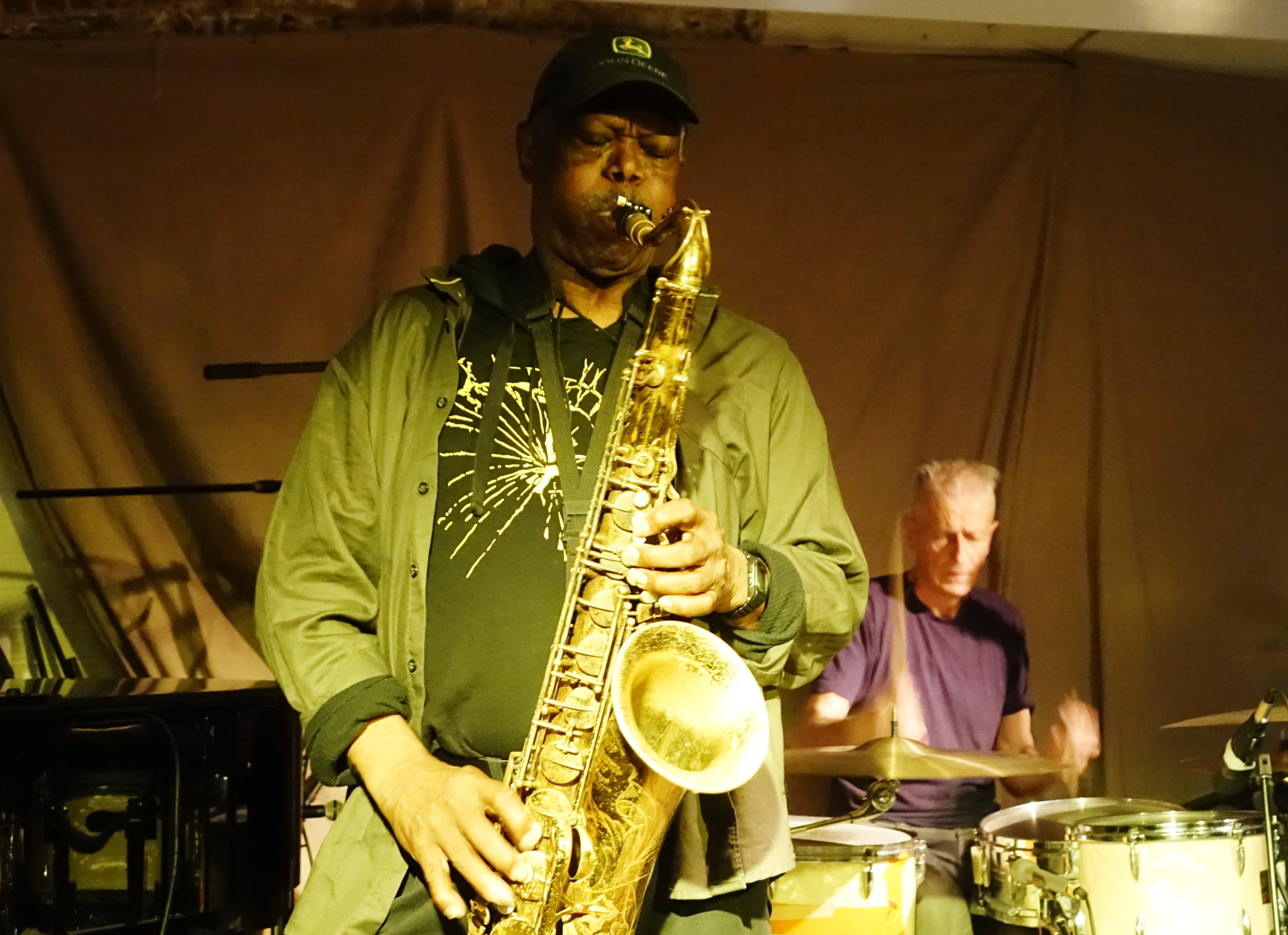


Photo by John Sharpe.

A few days before that, Decoy with Joe McPhee at Cafe Oto were sublime, continuing their periodic reinvention of the organ trio as if they'd never left off. Alex Hawkins on a vintage Hammond B-3 hired for the occasion, John Edwards on deep-diving bass, Steve Noble on absolutely thunderous drums, McPhee--who I last saw at the venue pre-pandemic, in a series of varied duets including a mesmerisingly surprising one with Áine O'Dwyer on harp and vocals--this time on tenor only, no trumpet (with occasional recitations of poems), taking his time, playing in bursts or sections rather than blasting in one uninterrupted flow, an immensely subtle player, though the energy he conjures up might make that easy to overlooks. This is a real live band, thriving off the crowd's energy and creating energy all of their own, they played for two nights, four sprawling sets, from floor-rumbling quakes to glassy high pitches and McPhee's too-little remarked lyricism (there's little else as gorgeous as that short early seventies piece 'Cosmic Love', recovered for posterity several decades after it was made). Somehow, despite the broader revival of interest in those of his generation--preferably dead and thus saintly--McPhee has to an extent escaped this sort of mainstream attention. Perhaps his career outside the circuits of academia has something to do with it; or the fact that McPhee isn't writing works for classical forces and the concert hall, those worlds that still, despite gradual signs of change, are arbiters and gatekeepers of musical value and prestige within the world of the avant-garde. Perhaps, too, class could be invoked, McPhee working in a factory for years alongside his musical career. Either way, it's almost impossible to believe that he's in his early eighties, and Decoy is surely one of the most sympathetic contexts he's had over the past ten years. Above all else, there was a real sense of joy and fun to the music: life affirmed, over and over. A capsule review of that will be out in the next Wire.


And within the same week, Dom Lash and N.O. Moore at the indefatigable Hundred Years Gallery. Scheduled as a trio, they ended up performing a duo in the absence of the scheduled John Butcher, the unforeseen combination of double bass and guitar a fairly unusual combination (though Joe Morris and Damon Smith provided an interesting contrast over the speakers in the break). In fact, that accident served as a kind of focussing device, in two sets fascinating for their textural detail and the concentration the detail afforded: Moore's playing admirably finding ways out of the inevitable Bailey-Rowe alternatives facing the non-idiomatic guitar player, a modest array of pedals swallowing up the sound like hiccups or stuttering gulps, scratching and plucking, cut-off gasps, or else exploding and expanding the sound with the occasional flying-fingered virtuoso run; Lash's scrapes and thwacks activating the bass's woody surface, all the nervy robustness of the instrument at play, tensile and tense. Gnarly is the word I'd use, in the all the best senses of that word. (Some representative video clips provided by a fellow audience member here.)


Mention should also be made of the album launch the previous month by another Lash-featuring group, Nodosus,  this one taking in South London at Iklectik, round the corner from Waterloo station, a warmish evening, farm animals poking their heads behind the fence next-door. I've brought along a gigantic volume of the collected poems of Larry Eigner that I brought back from New York, the conglomeration of minute fragments in unwieldy, oversized form. Maybe that combination of the small and the large says something about the music that takes place, maybe that's just coincidence. "All matter / standing / build up / wave to wave" reads an Eigner poem dated May 10, 1970. And the pairing that takes place here--whether opposition, interrelation, transformation--of solidity and flux, materialism and what troubles its edges, is as good a way into this music as any.

Nodosus is a brass and strings kind of ensemble: John Butcher's on tenor, Angharad Davies on violin, Matt Davis on trumpet and electronics, Dimitra Lazaridou-Chatzigoga on zither.  The sound they make together is, as might be expected, quiet(ish) and droning in its tendencies, but it's often fuller or more jagged of texture than might at first meet the ear. This is, above all, real ensemble music by a group of players really excellent at listening in groups, overlapping and building a collective texture that's not homogenous but finely abraded, interlinked, solid yet with a tendency to dissolve at any point. Lash, focused more on the bow than in the duo with Moore, was perhaps more assertive than might have been expected from his playing in Wandelweiser contexts or the quieter idioms of "non-idiomatic" playing: moving forward or holding back, leaning into the music's deep end or playing high harmonics as a kind of ethereal commonplace, commonplace ether, everyday magic. Activating the resonating surface of a zither with e-bows and objects, Lazaridou-Chatzigoga's sense of touch never ceases to amaze, succession of vibrating or smoothly oscillating held pitches ensuring the music has a drone-like energy to it all the way through, but capable of switching texture at any moment. What's fascinating about watching Lazaridou-Chatzigoga perform is the way you can see the sound shaped before your eyes: the pressure of object on string, of finger on object, the way that placement alters sound, live-sculpting, structures built and dismantled, textures thickened and lightened, tightened and loosened, a playing unassumingly yet at times overwhelmingly focused in its presence. Angahard Davies, too, is the most subtle of players, her approach to the violin so often a radical reinvention of all the cliches associated with the instrument--quiet, brittle, circling, not smooth and flowing and dripping with molasses-like pathos; and so good as a group or solo player alike--again, that interrogation of the surface of the instrument, of touch, a perpetual reinvention of what it means to play ensemble; while Butcher and Davis  bring in a sense of breath, of extension and pausing, holding notes in upper registers and multiphonics, latching onto phrases that cycled, held, subsided. I remember Davis' playing, in the deconstructionist vein of Dixon--Doerner--Uhler--Kerbaj, from one of the first free improvisation gigs I went to, at the old Red Rose in Finsbury Park; possibly the Freedom of the City festival; Bechir Saade might also have been playing. It's not a playing self-consciously minimal in its approach, nor does Davis appear to have any interest in asserting himself as a single voice or element outside the ensemble texture; and while the tone of the instrument might lend itself to a certain melodic heft, leaning more towards the melancholic lineage of Dixon and its jazz trumpet associations than the noise elements of the trumpet-with-electronics approach, its place in the group is one of texture as much of melody (or conversely, of melody, as much of texture). Finally, it's perhaps easy to take John Butcher for granted, but every time he plays there's a new surprise to go alongside the vocabulary he's long made his own. A particular phrase he played at one point was one of those moments in an improvised performance perfect in their transitoriness, jewel-like, gleaming--and unassumingly as much a part of the music as any other. 

"All matter / standing / build up / wave to wave". Yes, the Eigner poem fits perfectly, arbitrarily precise: the sound of these five musicians together combining over two sets in solid rippling waves.  A few years ago there might have been some debate about whether this was 'eai', which school of Berlin or London silences it might have bene placed in. In 2022, it was free to be what it was, in all of that inscrutable and beautiful mystery. The CD can be found on Daniel Thompson's Empty Birdcage records here.

Finally...somehow I've only just discovered the existence of Marguerite Duras' children's story Ah, Ernesto!, via Duras' last film, Les Enfants, an expanded feature which later spawned her novel Summer Rain--one of the first of her books I read in a copy discarded by the local library or charity shop. (The original was adapted into a short by Straub-Huillet.) There's a reprint from 2014, apparently illustrated as if it were a cookbook, which I suppose fits Duras's austerity but not the wildness that austerity enshrines. From  the looks of it, the original printing has some more (in)appropriately wild psychedelic images, including a giant Einstein. If anyone knows of somewhere I can get hold of a more affordable (French-language) copy than the £87 currently listed on AbeBooks, do leave a comment here.




(To be read, perhaps, alongside Lorna Finlayson's piece "I was a Child Liberationist" at the LRB...)

Sunday, 17 January 2021

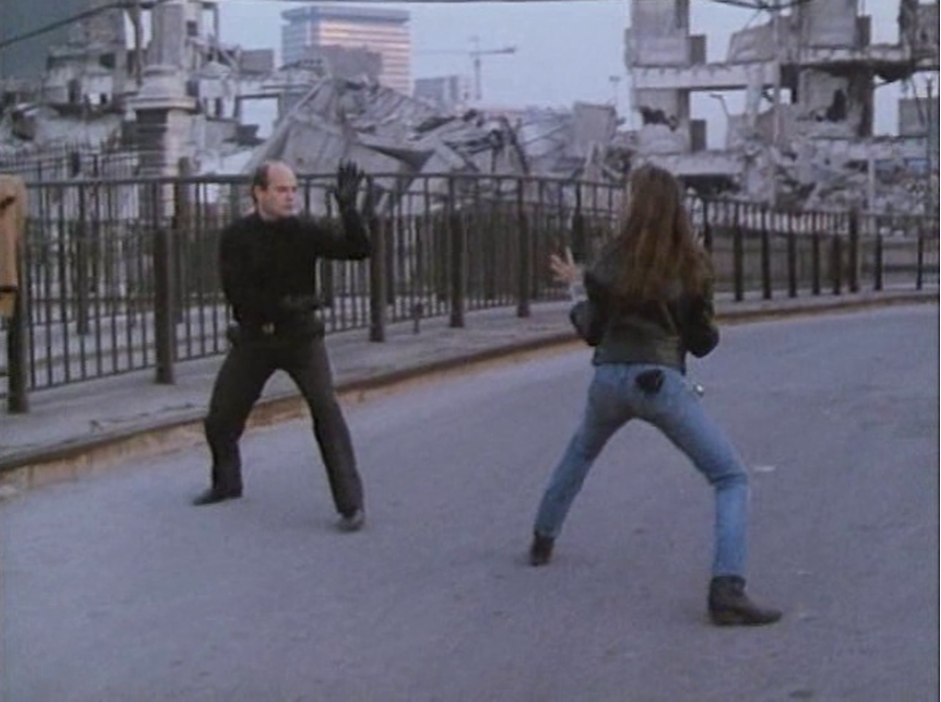
"Real life is a reign of terror": Le Pont du Nord (1980, dir. Jacques Rivette)

In his best-known film, Celine and Julie Vont a Bateau/Celine and Julie Go Boating (1974), Jacques Rivette had suggested that one can transform the ways in which life is narrated. Jumping in at the deep end of a mystery involving déjà vu, magic spells and secret houses, Celine and Julie gradually discover that they can change the content of what’s initially experienced as unalterable hallucination or dream, and thus in turn redeem time, history and a narrative that orients towards female victimhood (the murder of a young girl). The film ends with a gentle trip down the river, the protagonists, accompanied by the girl they’ve rescued from the clutches of time and death, forming a kind of substitute family of women. Celine was made the year of President Valéry Giscard D’Estaing’s first election, the year after the 1973 energy crisis, the end of the ‘Trentes Glorieuses’, the beginning of a regime of austerity and unemployment. Wearied by the succeeding half-decade, Le Pont presents no child to rescue, no boating trip or shaggy-dog story, but a bridge which, as in the children’s song from which the film drew its inspiration, selfish children will fall, in a kind of divine punishment dished out by a moralistic universe. (“The bridge collapsed and they drowned / See the fate of obstinate children”).

Protagonists Marie (Bulle Ogier) and Baptiste (her daughter, Pascale) first meet when Marie, absent-mindedly absorbed in her little red notebook—a joking nod to the radicalism of the ’68 generation (“see you at Mao”), rendered now pure introspection—steps out into the road in front of Baptiste, causing the latter to crash her moped and furiously slash a wire to quieten the out-of-control vehicle, still spinning wildly on the road. Running into each other twice more, Baptiste insists that she and Marie team up—for while meeting once or even twice might be chance or accident, three times is fate. Seeking to reuinite with her lover Julien (Pierre Clémenti) after spending a year in prison, Marie reluctantly and then more willingly teams up with Baptiste after Julien mysteriously disappears to undertake a task that will take him three days—after which, he promises, they can continue their love relationship. Ground down by prison, Marie tells Baptiste that she’s now committed to love as the guarantor of future happiness and security, but, as the film unfolds, this love affair is revealed to be caught up in more sinister machinations. Before their meeting, Baptiste has repeatedly revved up the moped as if threatening to confront a man who, apparently quite innocently prepares to set off on a motorbike being fixed at the side of the road. This man will reveal himself to be—perhaps—the principal antagonist in a vaguely-defined conspiracy operating through figures Baptise calls ‘Maxes’: spies or ‘guards’ who follow their victims, always in disguise, so many of them overrunning the city that “sometimes they kill each other”. After Baptiste exchanges Julien’s valise with a substitute, ruining an exchange involving large amounts of money: guns begin to be drawn, bodies to be found, threats to be made. The conspiracy centres principally on information—the valise contains maps, newspaper cuttings, obscure symbols—in the manner of the MacGuffin. We never really decipher what this information might mean, though we do discover that its consequences can be deadly. The protagonists’ quest to follow the mysterious diagrams they find drawn over maps of Paris, and approximating to the centuries-old children’s ‘Game of the Goose’, ends with Julien shooting Marie on the titular bridge, and Baptiste preparing to do battle with the chief ‘Max’ (Jean-François Stévenin)—a battle that then breaks through the fourth wall into a moment of levity that at once belies the drama of what we’ve just seen and heightens its lack of real resolution.

The information that Marie and Baptiste find in the valise reads as a kind of anatomy of the preceding decade: newspaper clippings, underlined in mysterious red and with arcane annotations covering everything from murder cases to bank robberies, political assassinations to corruption scandals, with Jacques Mesrine, whose name appears several times, as index of this ambiguity—a would-be Robin Hood who had been a member of the far-right OAS, in the ’70s declared Public Enemy no.1, whose death—denounced by some as extra-judicial execution on the part of the police force—had been celebrated by President D’Estaing. Marie hints that, Patty-Hearst like, she was manipulated into taking part in a series of bank robberies by those who argued that the real thieves were the banks themselves, but ideology, as with Mesrine, seems fluid here—whether the various deadly games in the film are taken on the part of the State, criminal organisations, or in the mercenary shadow world between the two. (Indeed, at one point, Stévenin suddenly speaks to Marie in German, raising the possibility of a clandestine network of former Nazis, material for a 1970s paranoiac-thriller of the ‘Marathon Man’ variety).
  
Gangsters, property developers, politicians: against this murky political world—involvement in which seems to have led to her time in prison—Marie clings to the promises of heterosexual romance, reuniting with Julien and telling Baptiste that she’s now resolved to devote herself to love—despite the fact that, as she admits, they’d been together only a week before she was arrested, and despite the hint that it was a romantic relationship which led to her crimes in the first place. Ultimately, it’s through Julien that Marie meets her fate, slain on the titular bridge. The lovers here take the titles of Rivette’s at the time-abandoned Marie and Julien project. A story of love and death inspired by the story of a woman who’d committee suicide, the film had led Rivette to a nervous breakdown (it would later be revived in the 1990s as a kind of ghost story). Yet this is hardly genuine amour fou (and all the gendered violence that the associated legal definition of the crime passionnel has historically covered), even if, early in the film, Rivette deploys the iconic romantic fatalism of Piazzola’s ‘Libertango’, which he described as “somewhere between a brothel and the church”.

Rather, it’s the relationship between Marie and Baptiste that takes centre stage: two women who traverse the city without the ‘guidance’ of a man, their relationship serving challenge to existing orders—whether it’s in the patriarchal expectations of a city of (male) gazes, or the double-bind between the routinised enclosure of the workplace or the prison (the workhouse itself, that fusion of the two characteristic of an earlier era, having given way to a more ‘civilised’ separation) and the ‘rootless’ wandering of the unemployed taken as such a threat by the State. Baptiste, in her leather jacket, anticipates a kind of wider-eyed, more lively version of Agnes Varda’s ‘vagabond’ a few years later, and she and Marie stand in for those who, ‘sans toit ni loi’ (without roof or law, the French title to Varda’s film) occupy space as transitory and transient inhabitants—not as romanticised images of movement, nor as pitiable images of suffering, nor as moralistic images of condemnation, nor as peripheral concern, but as central social fact. (After all, as Foucault suggested, it’s in the control of surplus populations, and in the increased surveillance function of the disciplinary apparatus, that the modern European state began to develop its characteristic forms.)
Interviewing Rivette about the film, Marguerite Duras was wholly admiring of the gendered mobility of the film’s protagonists, of its refiguring of the city through perpetual movement, at once liberation and prison: “We have never seen women like this out in the open air, without any attachment, without identity, a film that runs along like a river...”) In some ways, the opening sequences recall the endless motion of Marguerite Duras’ late ’70s short films (Aurelia Steiner, Les Mains Negatives, Le Navire Night, Cesaree), shot in and around Paris at its edges, at dusk or dawn, with their overlaid narrations of desire, of missed connections, and of concealed historical trauma. This movement is also a kind of literal going round in circles. Riding endlessly round the square, shaking her fist at the stone lions, Baptiste invokes the Rastafarian/Hebrew condemnation of ‘Babylon’ in a kind of Quixotic windmill-tilting, right before her first encounter with Marie knocks her off her moped and renders her warrior’s horse useless.
Thereafter, Baptiste is on foot. For her part, Marie, rendered claustrophobic by her time in prison, refuses to go indoors; we first see her taking a lift in the back of an open-topped truck, then ordering a croissant from the door of a cafe and asking it to be brought outside; she runs across the crowded roundabout of the Arc de Triomphe, risking death from waves of cars, rather than take the pedestrian subway. As a result, she and Baptiste wander on the peripheries, tracing a route round the city that’s not so much circuitous as an unpredictable zig-zag, crossing, re-crossing, doubling back along railroad tracks, reservoirs, building sites, footbridges, endless steps in Escher-like matching shot patterns (see the extremely detailed shot analysis here). But rather than a liberated movement in the mode of the flânuer or the dérive, such movement feels expressive of a relation to space characterised by loneliness and a lack of security. “You’re the first person I’ve met [in this city]”, Baptiste tells Marie. Much of the latter portion of the film takes place in the largely deserted wastelands that develop as a consequence of the deals between property developers, city officials; half-ruined buildings, a graveyard so overgrown that the graves only become visible after a protagonist literally stumbles across them (along with a dead body), a church apparently in the middle of nowhere, missing buildings knocked down to make way for the new that’s permanently promised and never quite arrives.
 
Against this—the city as wasteland or trap—Rivette (and DP William Lubtchansky) juxtaposes Marie and Baptiste’s game-playing with the imaginative transformations rendered by cinema itself. After Marie rescues Baptiste from the giant spider’s web in which she’s been trapped by a ‘Max’, the camera moves across a set of new, multi-coloured but already-dilapidated apartment blocks rising like distorted fairytale castles from the surrounding ruins of one of the city’s many new ‘(re)development’ sites: two forms of the sublime, the ridiculous, and the pragmatic indexing the realities of urban property rights and the exclusions their surfaces and edifices both exacerbate and deny. This shot encapsulates the film’s methodology—to relentlessly draw attention to its own limited technical means (at various points we see the actors buy or steal props used in subsequent scenes) whilst also combining them with a kind of whimsical enchantment. Based on improvisation and delivered with a technical minimum of means, film is refigured as play, or play-acting: a child-like assembly and re-assembly of stock figures, poses and props, harking back to the simplified repetition of generic conventions in early film (as when an actor puts their head on a railroad line to listen for approaching trains), or to the replaying of film clichés in children’s games. And while Baptise and Marie make little direct reference to cinema, film posters appear throughout—whether as illusion of space and freedom (our protagonists spend the night in the cinema watching 1956 western The Big Country (Les Grandes Espaces)—or as indication of gendered oppression—when Marie suffers an anxiety attack aboard a train, Baptiste sits her down beneath a poster for the slasher movie ‘The Silent Scream’ (rendered in French as ‘The Silence that Kills’), and at another point we glimpse the poster for Clouzot’s strange piece of misplaced psychedelia about voyeurism, domination and attraction to imprisonment, La Prisonniere. Baptiste associates the visual forms of mass media—whether cinema or advertisements—as menacing forces. Obsessed with surveillance, slashing at the eyes on billboards (whether a Kurosawa film or an advert for glasses)— she tells Marie that “eyes are everywhere”. Indeed, what’s striking about the film in contrast to Celine and Julie is that, for all the games and play-acting seen here, the mood of the film is suffused by a fatalism and low-level paranoia with no real outlet or end in sight. Whereas Celine and Julie negotiate their way into an apparent magical transformation of reality, the protagonists’ role-playing remains trapped within the terms of shadowy male domination it attempts to resist. As Serge Daney put it: “Facing a scenario whose terms are set, more or less hypocritically, by men (stories of secret societies, scavenger hunts, traps), the women respond by inventing an even more aleatory way of acting! A game unto themselves, then a game between themselves – beyond all hope, parodic, and excessive.”

Breaking the fourth wall in the final scene opens the film up to a playfulness it’s hitherto—despite being largely about game-playing—managed to largely avoid. But it also suggests a further falling into the abyss of indecipherable meaning, doubling, switching and artifice that is as much index of powerlessness as tool of protection. Baptiste has rehearsed for this fight every morning—removing her jacket (“my armour”, as she tells Marie) in an activity between self-defense, aesthetic form and obsessive-compulsive ritual, in which respect for opponents (the closing bow which Marie returns with a sardonic affection) suggests a formalised naivety out of place in the present moment. The inadequacy of the form is suggested in the final ‘battle’, in which the ‘Max’ instructs her: “Don’t forget your enemy is imaginary”. Baptiste’s karate fight is, in fact, a game played for the cameras operated by men.
Asked about the film’s perspective, Rivette told Daney and Jean Narboni in 1981: “It’s never the point of view of power, that’s for sure!” Rivette continues that he can’t show those in power because he can’t take them seriously. Yet this refusal to dignify those in power with representation also means that power’s operations themselves become numinous, in true Foucauldian fashion—the ‘Maxes’ are only the (possible) agents of power, its representatives or conduits, never those in charge. When Marie questions some of her stranger speculations on fate as modes of fantasy, Baptiste responds: “Real life is a reign of terror”. Referencing the formative campaign of state violence that both lies behind and is denied within the French republic, Baptiste extends such histories to the present, whilst alluding to the shadowy campaigns of extra-legal killings involving Mesrine, the Far Right, and the State itself. Ultimately, Marie and Baptiste are up against capitalism itself: the combination of chance and intent that drives a system based on a combination of apparent pragmatic naturalisation (capitalist realism) and the most fantastic of justifications for rationalised irrationalism, legally- and extra-legally enshrined inequality. Their game-playing serves as their defiance of the system, set up within the system’s own terms: a folie-a-deux which self-perpetuates through the very ties it establishes and cements—forms of solidarity and friendship. What enables Marie and Baptiste—at first—to survive within this environment—their paranoiac game-playing—is also what renders them vulnerable and ignorable: a corpse on the periphery, yet another missing person or unexplained death, yet another disappeared and wayward life.

Monday, 9 November 2020

100 Films

When the COVID-19 pandemic and attendant lockdown measures reached the UK back in March, I somehow got the idea into my head that I'd watch one hundred films and give each one a short (one paragraph) write-up, generally focusing on a particular representative image or scene from the film. One hundred seemed both sufficiently large and sufficiently arbitrary a figure, a structure for meandering viewing, a way to focus attention, with the process as something that both mirrored and staved off the thought that this situation wouldn't end any time soon. Now that we've come to the other end of the year, one hundred films have been written up. I've been posting them periodically on a dedicated Tumblr site, but have now added them as a page to this site--you can see them by clicking the link on the sidebar, though they look more elegant on Tumblr. 

Includes films by: Bergman, Burnett, Clark, Clouzot, Collins, Demy, Dovzhenko, Duras, Gerima, Gunn, Hondo, Kramer, Mambéty, Poole, Rocha, Maldoror, Pasolini, Sembène, Resnais, Varda, Von Praunheim, Wakamatsu, Woodberry, Yoshida, etc etc.

Image from Sirkka-Liisa Konttinen's Byker series, seen in Edinburgh back in February.

Sunday, 8 November 2020

The Name: Aurélia Steiner (Vancouver) (1979, dir. Marguerite Duras)


A film of the name— Aurélia Steiner a name invented by Duras to stand in for and (this a matter that’s more complicated, and perhaps more dubious) to identify with the losses of the Holocaust—the girl of 18 (as Duras was when she left Vietnam for France; as is ‘she’ in ‘Hiroshima Mon Amor’ when her lover is killed), on the cusp of adulthood, who decides, as Duras did, to write. To write: as Aurélia’s name is written on the screen; as a passage of the dialogue appears in handwriting—as when dialogue appears on a chalkboard in ‘Le Navire Night’—the intertitles of silent film. Duras later said that to write was like silent screaming, something that, unlike other art forms, did not entail the social context of making things exterior in terms of performance, sound. In these films, all sound is cut from image save Duras’ speaking voice: is this ‘texte’ or ‘écrit(ure)’; how does this sounding tread between text and film, a sound film which, like many of Duras’ other films from this time, sound is central, but which in other ways feels like a silent film?

The name is that which is given, over which on has little control—here, not the name of the father but of the mother, passed on (the Jewish maternal line)—a name signalling ethnicity (‘Juden Aurélia Steiner’ repeats a lover)—a name which echoes the name of the dead mother and stages a revenant return even as it also associates the living with the dead, on that wider scale of historical horror. Half way through the film, we see the handwritten name on screen—though we never see a face, a body, a person to put to that name; and towards the end, Duras speaks the voice of repeating the name in an erotic encounter, obsessively, turning over each syllable until those are the only words he can speak, yet which become more and more detached from personal connection and meaning the more he repeats them. This erotic pairing plays throughout the film, in multiple variants: the man with black hair and blue eyes, who is at once the father hanged in the camp for stealing soup to feed his new-born daughter, and the speaker, the daughter Aurélia, seeking her father in teenage sailors and other lovers—the pairing of I and you, she and he that so preoccupied Duras at this time, in writing that grew out of epistolary texts to absent or imaginary addressees.

Filmed in black and white, unlike the majority of the films from this period, the visual methodology, the movement of the film is that of the tracking shot—the use of this particular form echoing the debate about Holocaust and famously emblematised in Jacques Rivette’s excoriation of the tracking shot in Pontecorvo’s ‘Kapo’, later turned into a kind of basis for a critical ethics of film by Serge Daney. While, in ‘Les Mains Négatives’, humans appear fleetingly at the edge of the picture—moments that, as I argue here, are central to how one might interpret that film politically—this ‘Aurélia Steiner’ is devoid of any such traces. What we see, however, serves as symbolic representation or displacement of a trauma which, as Rivette had argued, lies beyond the ethical boundaries of representation. Thus, the figure of the ‘white rectangle’ described as the spot of execution—the camp under a German sky—seems to find its equivalent in a burst of sun through cloud; and the tracking shots of trees, chopped down and laid out, numbers inscribed on their lopped off trunks, of the overgrown tracks and platforms of an abandoned railway station, suggest the mechanisation of death in transport and execution of the camps, as the speaker describes substituting erotic encounters for the impossible encounter with the dead father. Or the space with which the film begins—that of the edge, viewed in calm—the sea, the horizon, the waves—reconstructed by the voice as, on the one hand, the space of death, of execution in the camp, and on the other of erotic desire, felt as a giving over of self, of entry, which seems at once to assuage and to replay the trauma of that death, Aurélia Steiner an infant laid on the ground beside her dead mother in the ‘white rectangle’. The speaker recollects a storm, real or imagined, that has previously exploded over (and under) the city, then receded: landscape in calm bears the trace of a foundational, invisible disruption, and, even in calm, the white rectangle (the sun through clouds) and a ‘black spot’ on the horizon form something like visual floaters on the most absent or distant of landscapes.


Duras picked Vancouver and Melbourne as Aurélia’s locations, though filming in France, because of their distance from Europe; trauma is not bounded by geography. Spending so much time by the sea—as in many of Duras’ other films—a space at once of arrival and departure, the film ends as the lover sails away, bids farewell. Aurélia Steiner seems to become both the woman he sails with, or to, and the one he leaves behind: Aurélia, this figure who Duras later said ‘is everywhere, writes from everywhere at the same time’, as a figure of total identification, disavowal and loss, of writing as survival—writing to the impossible recipient, here, the dead father and the lovers who replace him, in the companion film, another lost lover. The address seeks to bring back to life the lost object against the impossibility of resurrection, whilst the activities of the living—writing, sex, the present inhabitation of a landscape far removed from the horrors of Europe—is itself under/over-written by death. For Duras, such paradoxes are the only way to represent that which is hijacked, overdetermined, defamed. Duras said that it was this project that brought her back to writing after years of writing only for the cinema—yet a writing whose conditions of possibility seem here to be that of cinema, a cinema whose conditions of possibility are those of writing, all for that which cannot be written, that which is written in numbers on skin (the number equivalent to that of the camp tattoo which appears after the words of Steiner’s name in the close ups of handwritten text), the film ending with the statement of identity—name, place where you live, age, parents, occupation—its final words the statement of continuance that, for Duras, is that which enables one to keep on living, that becomes like breathing itself: “I write”.


[Further reading--the tracking shot:

Rivette on Kapo--'On Abjection', Cahiers du cinema 120 (June 1961).
Daney on Rivette on Kapo --'The Tracking Shot in Kapo', Trafic (No. 4, Fall 1992).
The tracking shot itself--
from Kapo (1960, dir. Gillo Pontecorvo).

Saturday, 7 November 2020

Les Mains Négatives (1979, dir. Marguerite Duras)


The visual component of this short film consists of outtakes from Le Navire Night: shots from a moving car of Paris streets at dawn, their emptiness in some way linked to Duras’ sparse voiceover. The text puts forth a simple supposition about the prehistoric hand prints—‘blue for the sea, black for the night sky’—left in caves in Southern France, 30,000 years ago: a single human whose ‘negative’ mark is accompanied by a plea for human connection, a screamed ‘I love you’, announced to ‘those who have names, those who have identities’—‘to anyone who will hear me screaming’. Duras has him alone—the search for human connection that characterises all her work, but is presented in particularly stripped-back form in these short-to-medium legnth films of the late ’70s and early ’80s (Les Mains, Césareé, Aurelia Steiner,L'Homme Atlantique). She told Godard that she increasingly distrusted the role of actors—first, for their role as performers, as representations of something other than themselves; second, for getting in the way of the solitary and singular relation of individual writer to text that she enjoyed (that was the condition for) her writing, but which cinema by its very form denies. Hence the five films made ‘without actors’, as she put it—the feature-length 'Son nom de Venise dans Calcutta désert’—the soundtrack to India Song set over images free of those who voice it—and then the shorter Les Mains, Césareé, the two Aurelia Steiner films—in which the voiceover, too, is freed of any voice save hers. Removing these mediations—actors as spokespeople, as it were—these films are concerned with the direct—though not necessarily answered, or even heard—address from an ‘I’ to a ‘you’: lover and beloved, speaker and hearer, director and audience. As well as the mediating role of actors, Duras distrusts the illusion of liveness provided by diegetic sound. In conversation a few years later, Godard suggested that her insistence on film’s connection to text marked a return to the textuality, the necessary experience of reading, that formed a vital part of film’s meaning in the days of silent cinema: image, sound, and text, not as an integrated whole, but as separate tracks, at once more stripped-back than the narrative talkie and, in their endless juxtapositions and recombinations of those tracks, infinitely more complex. In ‘Les Mains’, then, ambient sounds from the footage are removed; instead, Duras’ voice and the solo violin that plays through it all, in one of the loops of short musical material she favours, as if tuning up, finding its way to a melody.

The roving camera finds the Parisian streets themselves as a kind of equivalent to this mark—the traces of human existence with the humans removed. Discussing her work during the period in which this short film was made, Duras—whose literary production had temporarily dried up as her alcoholism increased, yet who was making more films than ever—said she wanted to ‘murder’ cinema. She was in search, she said, of ‘une image passe-partout’—a ‘master image’, one which can be superimposed on any text, meaningless in itself, without aesthetic value (‘neutral […] neither ugly nor beautiful’), brought to life and given meaning only by the text that ‘passes over it’. As well as master image, ‘passe-partout’ suggests the frame between picture and glass, or, alternatively, that which enables the bearer to pass anywhere. And so in ‘Les Mains’, we have the neutral master image, the frame which enables the passage suggested by the car’s movement. Yet, while the image is clearly contrasted or enlivened by he apparently distinct voiceover, image itself is not entirely neutral. The humans we see are, in the main, the street sweepers and garbage collectors whose peripheral existence recalls the figures at the edges of roads in ‘Le Camion’ the previous year. As in ‘Le Camion’, where the freedom to travel, by lorry or by car, reckons with the failure of broader societal organisation and the marginalisation of the peripheries within Europe itself (known in the French left of the time as the ‘Fourth World’).

The footage—at least in the online print I saw—was too blurred to make out much more than silhouettes, the rhythmic action of brushes, vague figures tipping rubbish sacks into lorries, but Renate Gunther suggests that they’re migrant workers: the film’s progression from night to the first traces of day, as white people start to appear, rendering the ‘negative hands’ those of the labour rendered invisible, carried out before the dawn, while at the same time resisting the binary thinking that would reinforce precisely that racialised division, that classed division that maps onto the spaces of night and day as labouring spaces. In ‘Aurelia Steiner’, the flow of the river suggested to Duras, not an image of continual flow, of nature, of beauty, but of political disappearance—the Algerian protestors thrown into the Seine in 1961, the spaces of war during the period of occupation, with their attendant anti-semitism, collaboration, complicity. These images cannot be neutral in the political sense that would imply. Duras’ voiceover here also serves to displace the mendacious lies by which ‘European’ identity—continental being—is tied to an increasingly exclusionary ideology, one which encourages migration for cheap and disposable labour while closing its borders and blaming those from its peripheries for its ill. So it is that Duras presents the lone prehistoric man in context of what she calls ‘the endless forests of Europe’. Europe itself is here estranged from its mendacious myths of dwelling, belonging (for some, not others). The prehistoric man is not the primordial Aryan ancestor but an outcast: civilisation, the permanence and question for socialisation implied by mark-making, is not the first step towards exclusion, conquest, division, exploitation, but the search for connection that continue in spite of those practices. As such, the film comes down to an expression of Duras’ theory of art—and of civilisation itself: the search for human connection and a sublimated scream for love that inheres in any mark-making, any mode of address. The first-person, that fusion of prehistoric man and Duras herself, addresses ‘you who are named / who have an identity’—that is, those with the ‘passe-partout’ which enables them safe passage, I.D. card, passport, badge of class or gender or skin. And so too the speaker identifies themselves, by implication, with those who wander, those undocumented, those sweeping the streets, those performing their invisible labour at night, those inserted silently behind the principal image in the frame. Duras, for whom writing itself was, as she would later put it, like a ‘silent scream’, announces:

I am someone who calls, I am someone who called, who screamed, thirty thousand years ago: “I love you”. I scream that I want to love you. I love you. I will love anyone who will hear me scream.

Throughout the film, such utterances shift between tenses—the present and future tenses that occupy most of the film’s delcarations of love, and the final past tense with which the film ends (‘I am the one who screamed he loved you’). In these shifts, and in the stitching together of fragments of film, fragments that chart a general crepuscular progression, the movement from night to dawn,but in ways that are hesitant, vague, imprecise, 'Les Mains' suspends time. It plays out across the distance, impossible to imagine, between the moment of mark-making 30,000 years ago; the repeated rituals of dawn in the modern city; the malleable distances of desire and fulfilment, address and reply. It poses a question, puts forth an address, an imposition, a scream, that it dares its audience to answer in ways that are, perhaps, unanswerable.

Sunday, 11 October 2020

“What would have been a film”: 'Le Camion' (1977, dir. Marguerite Duras)


All of Duras’ films are in some senses about the impossibility of making films; about trying to make the impossible film; about taking apart a medium felt to be at once incompatible with and an ideal medium for a particular approach to writing, narrating and speaking. As she writes/speaks in the late book/film ‘Writing’ (1993): 

One should be able to make a certain film. A film of insistence, flashbacks, new beginnings. and then abandon it. And also film that abandonment. But not one will do it, we already know this […] Because this would be the film of the mad, unattainable idea, a film about the literature of living death.

As ever, Duras insists on separating and simplifying the strands that go into the normative idea of a film: scenario, plot, dialogue, narrative, characterisation, the creation of temporal and spatial continuity through editing, the self-contained world. In each of her films, this is accomplished in different ways; a different recombination of elements, building blocks rearranged with the overall structure that is the film: a combination of moving pictures, sound and dialogue which lasts for a set period of time, bracketed by opening and closing credits. In India Song (1975), the entirely non-diegetic soundtrack severs one link on which the sound film—and to an extent, the silent film—rests: that between the visible movement of lips and uttering of speech and its sounding (or the intertitles that accomplished the same function at an anticipatory delay in the silent era). This cut between the seen and the sounded, one in which the sense of re-enactment, dramatization and the like is retained through the silent tableaux of actors who recreate some of the social situations described on the soundtrack in glacial, frozen poses, is heightened in India Song's 'sequel', Son nom de Venise dans Calcutta désert (1976), in which the same soundtrack instead unfolds over landscapes entirely devoid of actors, of people. Images, though, are central in both films: in L’Homme Atlantique (1978), images themselves almost disappear, an almost entirely blank screen over which we hear Durasian speech removing, not only the connection between the sounded and the visual, but the visual element per se.

Le Camion is somewhere between these two extremes, the relationship between film and narrative severed—or alternatively reinforced. Duras reads a script to Gerard Depardieu in her house. The script describes the scenario for an imaginary film in which a woman hitches a ride on a truck by the sea and launches into a monologue—with occasional interdictions, responses, questions from the (male) driver—sometimes closing her eyes and launching into song, observing the landscape (apparently inaccurately), hinting at stories, providing vague hints of a family connection (the birth of her daughter’s child), a love affair, her disillusionment with the present state of Marxist politics, the complicity of the proletariat’s official representatives with those of the power structure they ostensibly seek to overthrow, leaving only the possibility of ‘ruin’ ("Let the world go to its ruin, that's the only form of politics"). Duras describes this scenario in the conditional tense—this is what she would have said if we had made this film—yet this description is itself scripted, everything under a tight control belying the vagueness, the dissolution, the aimlessness imparted by dialogue and scenario. Depardieu’s questions seem, too, to be scripted, his and Duras’ eyes fleeting downwards to the pages of script they hold even when the dialogue appears spontaneous. They are not playing the female passenger and the male driver, but of course they cannot not be read as analogues. As in ‘Le Navire Night’ (1979), in which the focus on settings, costumes, the process of make-up, are disconnected from any dramatized acting of the scenarios described, film becomes a record of narration rather than an embodiment of what’s narrated; but as one critic points out, perhaps this makes ‘Le Camion’ more truly a ‘narrative film’ than any conventional film narrative.


The film cuts between Duras and Depardieu, filmed in one setting in the day, in another at dusk; between shots, filmed from a moving vehicle, of the landscape—factories, lorry parks, the edges of towns constituting neither the urban built environment nor the rural; spaces of transport and passage—and shots of the titular blue lorry travelling through it, Beethoven’s Diabelli Variations intermittently coming and going as if on the truck’s radio. Beethoven’s grand cycle of 33 pieces departs from a melody by publisher-composer Anton Diabelli, who’d commissioned the leading European composers to write variations on his waltz theme, both as an exercise in vanity and a charitable enterprise for families affected by the Napoleonic wars. In these variations, the original theme, characterised by the simplicity of its repeated musical sequences, its ‘melodic neutrality’ (Hans von Bulow’s phrase), is taken apart from its smallest elements outwards and turned into a display of virtuosity, complexity, variant texture and mood, in a process often read as a kind of satire or parody on the drab and thin material it extends to other realms. Alfred Brendel: “The theme has ceased to reign over its unruly offspring. Rather, the variations decide what the theme may have to offer them. Instead of being confirmed, adorned and glorified, it is improved, parodied, ridiculed, disclaimed, transfigured, mourned, stamped out and finally uplifted.” Writing on Ivor Levit’s recent recording of the piece, a critic describes this principle of variation as “identifying with the particular musical situation and at the same time maintaining his distance from it”. The piece itself is not mentioned in the film, unlike the now (semi-)famous waltz by Carlos D'Alessio that haunts ‘India Song’, or the less well-known pan-flute melody that equally haunts ‘Baxter, Vera Baxter’—both sounds which could well be said to imagine diegetically from what we see onscreen, even in the radically discontinuous non-diegesis of the ‘India Song’ soundtrack, recorded before shooting, to emerge from the traces of a social milieu in which sound spills over and signifies classed anxieties, doubts, desires, proximities. D'Alessio's pieces are characterised precisely by their simplicity, their incessant repetition: these are not extend 'works', but 'pieces', morceaux, fragments entire in themselves, the opposite of grand structures. Here, the Diabelli Variations' grandeur, its variations on a theme, the parodic play between distance and identification built into its structure and the circumstances of its composition, are subject to further 'variation', heard only in fragments--sometimes alone on the soundtrack, sometimes as an undertone beneath voiceover--fitting Le Camion’s own distances between what’s described, what’s seen, what’s spoken and unspoken. In a film that--as we'll see--is in large part to do with political despondency, Beethoven may be invoked for his association with the revolutionary hopes associated with art—as he is in Fredric Rzeswki’s ‘The People United Will Never Be Defeated’, written two years before Duras’ film, and using the model of the Diabelli Variations to spin a bravura fantasy on the Chilean revolutionary song, on the political movement/s of peoples and nations, of the possibility of, first Eurocentric, then ‘Third World’ universalism. In Duras, though, perhaps what wins out is parody—the distance between technique and melodic core, between idea and execution, between the cohesiveness of the large-scale concert work based on a single theme and the elliptical nature of the fragmentary variation form. Or perhaps to do so would be to over-read detail, in a film at once so sparse and, in its ambiguity, seemingly freighted with an easily-missed significance in every aspect. 

Duras notes in her script that the film could be shot in various different locales—all of them outside the metropolitan centre, through-spaces, neglected spaces, a ‘land of migrants’. As such, they destabilise notions of national belonging, of the power relations read into landscape, while suggesting the fate of the economic periphery, that which is to the side of dominant narratives, albeit in a manner far removed from the conventional representational framings of social realism, cinema verité, and the like. When we see these landscapes, we might think, if not of cinema verité, of the social critique imparted through landscape film in Masao Adachi’s theory of ‘fukeiron’, in which “all the landscapes one faces in one’s daily life, even those such as the beautiful sites shown on a postcard, are essentially related to the figure of a ruling power”; of his 1969 film A.K.A. Serial Killer in particular. At this point in the 1970s, Adachi’s work, or at least his theories, would presumably have been known to Duras through left-wing and filmmaking circles, but overshadowed and supplanted by Adachi’s own disappearance from filmmaking and exile in Lebanon as part of the Japanese Red Army. Perhaps more likely, we think of James Benning; not yet occupying his position as a prime filmmaker of landscape, Benning’s and Bette Gordon’s United States of America had nonetheless been released two years before Le Camion, with its single moving camera shot as two protagonists—a man and a woman—driving across the States; or Barbara Loden’s Wanda, in which driving, and the female-passenger, male-driver relationship, becomes index of power and passivity. Later, the wanderings of Varda’s Vagabond amplify the sense of being outside social structures, on the edge of towns, between urban and rural, with the road as conduit for a journey without destination. In all these films, the relations between gendered power dynamics, transport, travel and landscape are inscribed into the very (narrative) texture of the film. In A.K.A. Serial Killer, Adachi’s misogynist serial killer, his repression and hatred emerging from the social structures we see, not as a kin of disembodied ideology, but inscribed into the very physical structures in which he lives and moods: structures which the film hopes it can re-train us to read, train us to re-read, not as neutral backdrop but as an open book of domination and violence. Loden’s, meanwhile, is an exploration of safety-in-domination, passivity-in-violence, the role of the accomplice, the subjugated, the drifting.

At the same time, Duras’ insistent return to the static, interior scene of reading—the scenes with Depardieu occupy at least as much screen time as the footage of and from the lorry—prevents these resonances of the ‘road movie’ – as quintessentially American or pseudo-American import (think Wim Wenders). Here is none of the fetishization of vehicles, the potentials of travel or escape found in the road movie as latter day cowboy movie, nor as obvious a diagnostic of gendered power and domination as found in Adachi or Loden. The film feels at once specific and non-specific: in one shot, the camera sweeps round the cabin of the parked lorry—described in the script as both prison and safe house—with a combination of clinical precision and vagueness. The camera seems too big to move comfortably around the space, we see few details that indicate that someone has actually been inside. It feels too antiseptic, too uninhabited, too clean. In Duras’ script, the room in which the reading takes place—curtains shut in day, with a light on inside to create a ‘dark room’; or curtains open to the night, with the film light outside visible in the reflection—becomes analogous to the lorry’s cabin and again in turn to a photographic dark room; all three keeping out a kind of unbearable or sinister light from outside--a door suddenly opened on a darkroom, destroying the image developing within--which nonetheless constitutes its very conditions of possibility. 

I feel as though you and I, too, are threatened by the same light that they are frightened of; the fear that all of a sudden the lorry’s cab, this darkroom, may be flooded by a stream of light, you see…The fear of a catastrophe: political intelligence.

Is this fear the fear of political intelligence, or is this fear political intelligence in itself? What might this catastrophe be, insulated but constantly on the move? Is this even all an extended metaphor for the ‘fellow traveller’?

For the film's 'exterior' shots--which, as that dialogue might indicate, are always poised delicately between exterior and interior--we view the lorry from the outside, seen from a distance, the shots too brief and spatially ambiguous to give much sense of where the vehicle's come from or where it's going. Alternatively, in the ‘landscape’ shots filmed from within it, the lorry becomes merely a floating conduit, its apparently directionless motion emblematised in a scene in which it drives around a roundabout twice for seemingly no reason. As the lorry passes various built structures, the woman remarks that people used to live on these sites—you’re lying replies the driver—I’m lying, she admits. But of course people do live here; this is not a ruined landscape, an ‘end of the world’ (as she describes the sea). To be sure, aside from a brief shot of children by the roadside in the roundabout ‘scene’, these roads and roadsides are devoid of people, the dwellings they pass crumbling or half-built, spaces of potential or aftermath, spaces of passage rather than certainty. The driver doesn’t know what packages he’s delivering or where he’s delivering to; the woman doesn’t know where she’s going—perhaps back to the sea from where she came—the journey doesn’t seem to stop or end. But people do live here, here in the Yvelines region; immigrant families, like those families who are the focus of Duras’ later novel ‘Summer Rain’; those who are not ‘integrated’ into the fabric of the dominant order, those to whom the ‘social contract’ is barely extended or not at all. These, no doubt, are the people we see at the side of the world—those who inhabit spaces which, to those who pass through them, are liminal, transitory, excluded from any rhetoric of ‘dwelling’ or ‘belonging’. 


If the passenger’s disillusion with Marxism appears close to the familiar left melancholy born out of—or bearing—cynicism and despair from the comfortably sad, sadly comfortable vantage of its own beautiful rooms and antique furniture, perhaps its disillusion with (one presumes) an official Communist Party line might derive from the historical failure of that line to encompass the experience of those marginalised, those by the roadside, those not justified, glorified, given their historical place as subject-objects of history within the ranks of and by the name of ‘proletariat’. This view, in which race, nationality and gender are divisive modes of subsidiary otherness detracting from the predominant struggle, refuses that which Duras names in ‘Writing’ as “coexistence with humans, with colonised populations, with the fabulous mass of strangers in the world, of people along, of universal solitude”; as “planetary death, proletarian death”. For Duras in ‘Writing’, the smallest detail—in this case, the slow death of a fly which she happens to witness—connects to the crises of war and death, “these mountains of war on earth”—or, as the woman suddenly cries out in Le Camion (in what’s also a kind of ironic self-reference to Duras’ most famous cinematic contribution, the screenplay for Hiroshima Mon Amour), “Hiroshima!” The PCF son-in-law's reluctance to name his non-Jewish son 'Abraham' for fear of inciting a pogrom; Stalinist anti-Semitism; the scriptural Abraham’s own nomadic wandering, poised between an abandonment of social context and myths of nation-building and identity-formation; the sea as the figure of departure and arrival, in betweenness, mist, coasts, borders, the switches and ambiguities of power.

“Is it a film?” asks Depardieu at the very beginning of this film, reading from a script he was seeing for the first time. “It would have been a film”, replies Duras, reading from the script she’s written. And then: “Yes, it’s a film”. Perhaps we might draw that film that "would have been a film"—yet which, in its rehearsal, retelling, conjectural description, is a film—into the orbit of Duras' conception of revolution, of a non-derailed, non-betrayed communism that refuses compromises with the established order, those compromises Duras describes as a bargain between capitalism and socialism, resulting “the infinite delay of any free revolution”: 1956—“the clowns on the tanks, entering Prague”—1968—a time of promise returned again to compromise and defeat; the Party as patriarchal structure (the male driver accusing the unattached, middle-aged, unfixed woman, who can’t be interpellated in terms of sexuality, desire or attachment to the familial structure, of being, first, a reactionary, and then a ‘madwoman’ escaped from a psychiatric hospital); yet a certain turn towards a pragmatic politics (in Duras’ continued endorsement of Mitterand, based in part on their shared past in the Resistance) which might well be accused of exactly the same compromises—those between socialism and capitalism—with which Duras (rightly) accuses Stalinism. The passenger, in her apparent lack of attachment to existing systems of social conscription, is not an ideal, utopian figure—the impossible fulfilment of that which exists as contradiction, the material affects of power, class struggle, patriarchy, silencing, the nothingness of sound and fury, in the realm of the impossible film. Her—and the film’s--'aimless', 'banal' mobility (Duras’ own terms) are not escape, but a kind of fugitive moving within entrapment, encampment, an endless negotiation of power, of the frames—filmed, written, spoken, gendered, politicised—within which one can speak.

“Several explanations would have been possible”.