There’s a radio recording from the Half Note in 1966 (or perhaps 1963,
depending which discography you use): Rollins with McCoy Tyner, Walter
Booker, and Mickey Roker, moving in and out of tunes at will; melody
stacked free associatively on melody—rhapsody, in the sense of rhapsōidos,
“stitcher of songs”, as if Rollins might play every song he knew, that
act of association and recall a kind of survival force. Rollins was
always walking around the club while he was playing, walking off stage
while he was playing, playing within the form: having already begun as
he stepped out of the taxi and walked into the venue, or deciding to take a trip up the stairs and out of the club
to serenade Alice and John Coltrane in their home, followed by the
remnants of the faithful. Sound bouncing off buildings, the walls, sound
that would not be contained.
Walking while playing evokes
the barwalkers, the entertainers of R&B, movement that refuses
fixity; it’s a way of thinking, an exercise of freedom, a desite to get
away, an impatience with the limitations of the form or the stage. This
movement doesn’t translate to recordings; registers, instead, as a kind
of sudden absence. In his unaccompanied cadenza on the Half Note
recording, there are huge pauses as he moves around the room, testing
the space: interruption, tension, void. All the more so given that these
performances were broadcast on the radio, where they become dead air.
But, rising again, resurrecting across the silence, Rollins comes back,
the melody comes back, the force of remembrance, re-membered: a body put
back together, gathering the limbs of Osiris. One tune becomes another,
‘Oleo’ to ‘Poinciana’ to ‘Happy Birthday’ to a newly abstract or
abstruse motif: all those moments where what’s quoted and what is the
thicket in which quotation occurs constantly blur and stretch, the
earworm always within reach.
A subscriber post on Substack, on the great bassoonist Karen Borca.
Outside the by-now better-known names of free jazz, Borca’s work
offers few external hooks or ways into the music: no Sun Ra
theatricality, no Cecil Taylor ritual, no Archie Shepp radical
traditionalism. It is a music that speaks for itself, and that demands a
commitment of understanding on the part of the listener that moves
beyond the merely illustrative. The music does not illustrate something:
it is that thing itself. It asks the listener to dig as deep as the
musicians dig, to stay with it, to sharpen their faculties on its
sharpening invention. But to do so, to stick with it, is one of the
richest rewards this music offers.
Borca’s music is work,
in all its sense: playing as labor and as invention, the work of
intense involvement with the material of sound and its transformation,
dancing on the edge, dancing in your head;
the work required by the listener to join the dance and be spun up too
in it; work as in a product, a body of work, meaningful evidence offered
up to the world as to the impact and beauty and grace and power of a
person’s art, their contribution to the world. And as work, it seems to
sing of the negation of work as exploitation and the emergence of some
other form of situation, of invention, the rearrangement of the self in
the multiple networks of the social, following the line, worrying it,
seeing where it might lead. Work. Good news. And yes, the blues.
We can study this, we can listen to it, we can thrill to it, we can learn from it.
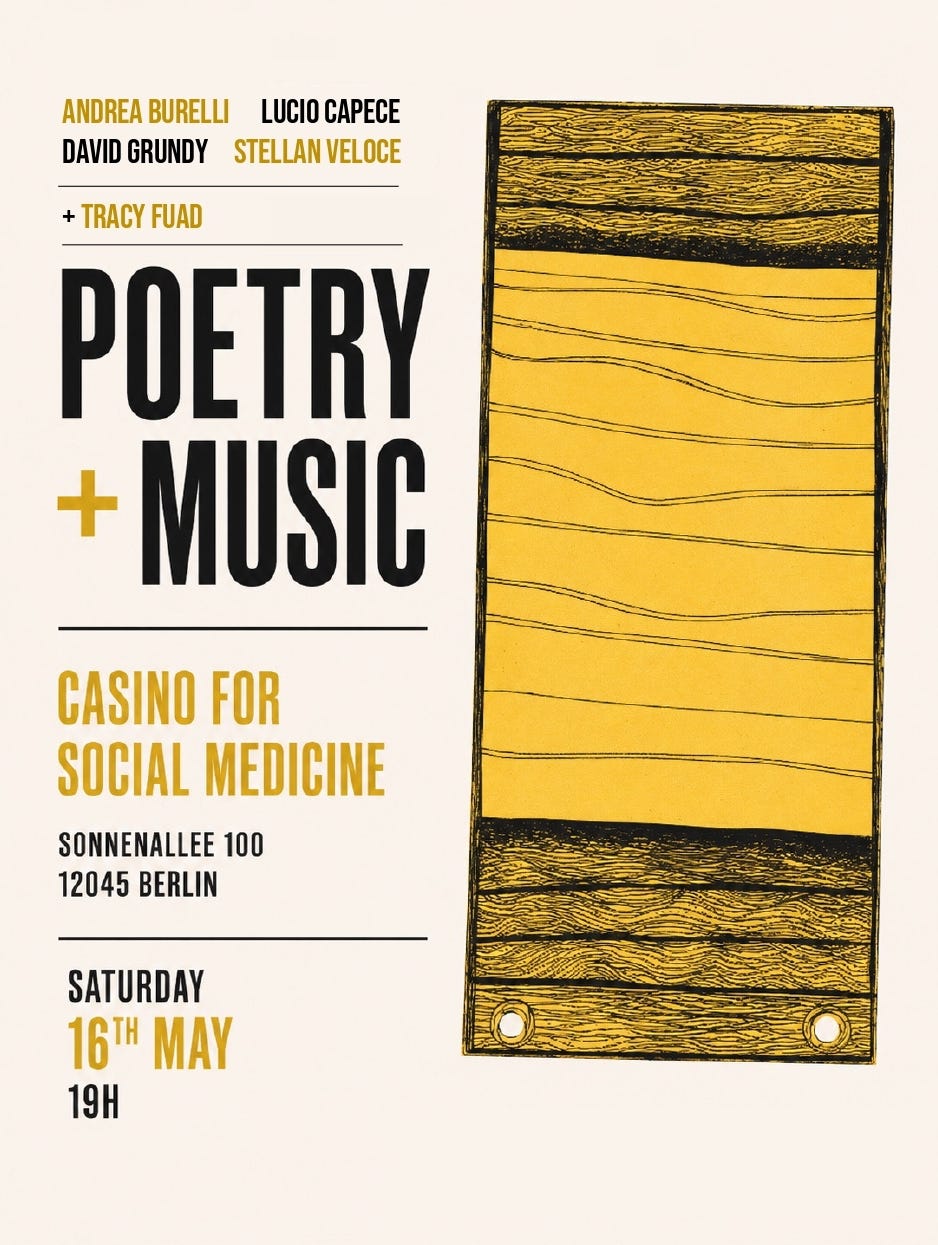
A relatively spontaneous announcement of a relatively spontaneous gig: this for a new quartet combining poetry and music, with myself (poetry), Andrea Burelli (voice, poetry, perhaps violin), Lucio Capece (bass clarinet), and Stellan Veloce (cello). It will happen at the Casino for Social Medicine at Sonnenallee 100, Berlin, on this coming Saturday, 16th May, at 19h.
As a trio, Stellan, Lucio and I worked together twice last year, and
that was beautiful. (Their duo at a performance a few months before the
first of those occasions, after which I approached them to work
together, was even more beautiful). As a quartet with Andrea, we’ve done
one rehearsal so far, and I think it’s entering a whole new dimension,
which I’m very excited about.
Also reading will be Tracy Fuad. And I’m excited about that, too.
Reposting here a piece which just appeared on the excellent online journal Little Mirror alongside Luke Roberts’ collection of Prynne memories. Many thanks to the editors. A longer and more detailed piece on J.H. Prynne will follow elsewhere in due course.
The poet J.H. Prynne died last Wednesday morning.
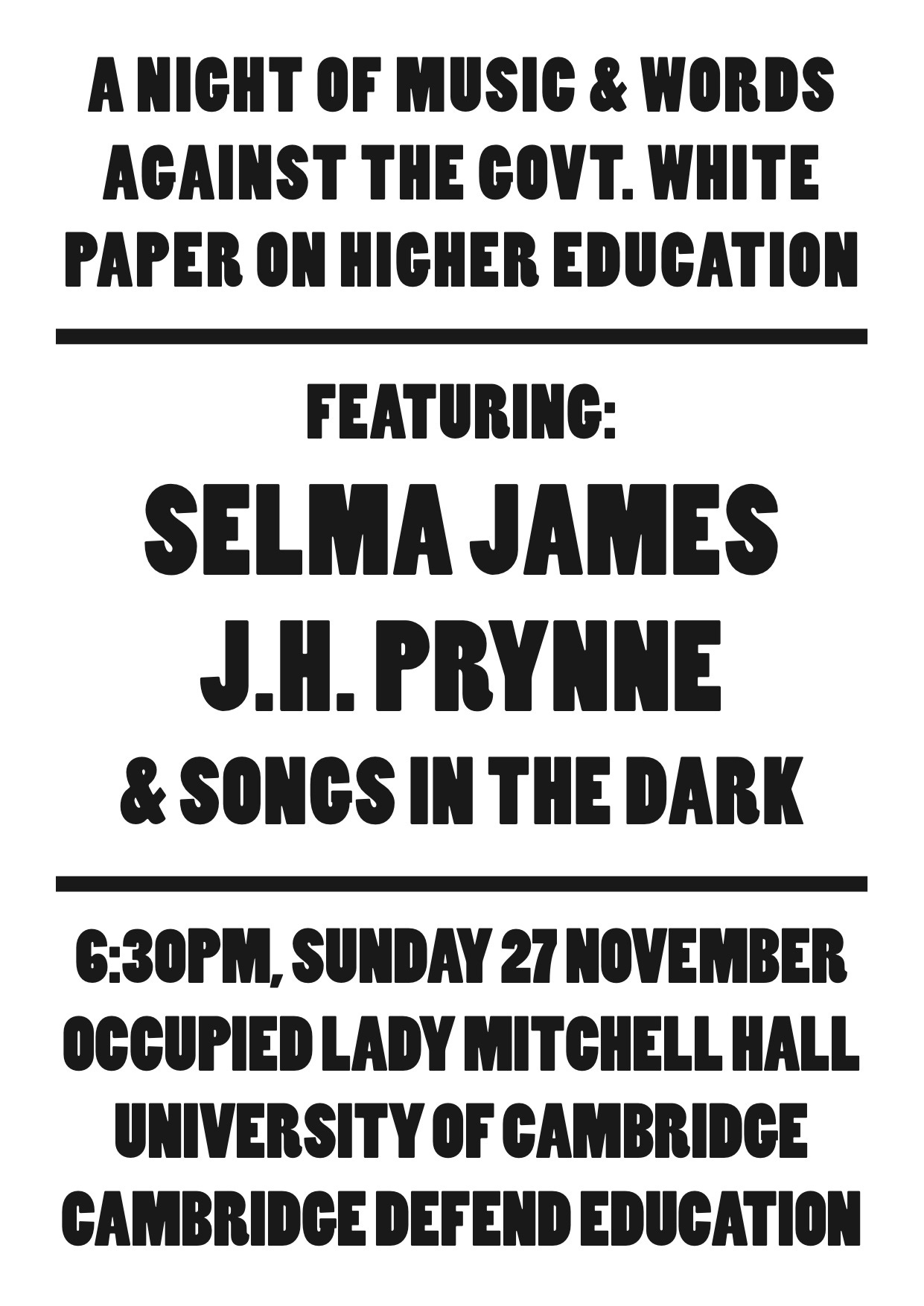
Jeremy was important to a whole host of us down the generations, for a whole host of reasons: politically, personally, and above all, poetically. For his avant-gardism; for his careful, critical, ethical attention to the specifities of poetic language; for his unorthodox Maoism, however that was understood; for his personal kindness and encouragement; for the kinds of permission his work opened up. Of the poems written during the period I knew him, the most important to me remains the life-work summary of Kazoo Dreamboats, written during the era of the financial crisis through the lens of Piers Plowman’s societal vision, via modern scientific textbooks, ancient funeral rites, and Maoist dialectics. A particularly treasured memory is Jeremy’s reading of a substantial portion of this poem to the student occupation of Lady Mitchell Hall, Cambridge in November 2011, alongside the veteran feminist campaigner and author Selma James. Insisting on making this a poem which could speak to the occasion and the political struggle, without compromising the fierce difficulty of the work itself, the reading was forceful and moving. When he read out the line “Rule One: people with top pay are rubbish”, the room was electrically charged, a charge that seemed to come both from the poem and to enter into the poem from outside. What I learned from this moment was that the poem itself does not change its context, nor does the context change the poem: but that their dialectical relation adds something to both.
Poster for the event hosted by Cambridge Defend Education at which J.H. Prynne read from Kazoo Dreamboats, 27 November 2011
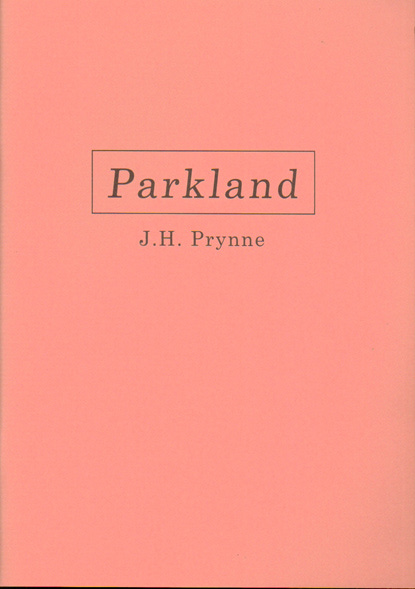
Other works from these years that I treasure: the “bruised compassionate dismay” of Of . the . Abyss, a pamphlet I had the honour of publishing, which overlays Victorian child cruelty and the present migrant crisis; and the enquiry into the entanglement of British imperialism with poetic song in Parkland: a complex, insistent and direct enquiry into how the poet can sing when empire starves those other “fair field full of folk” elsewhere; a poem which movingly and deeply wants to believe in the possibility of poetry as lyric joy, but is totally lacking illusion about poetry as salvation; a poem that ask how the poet can go on singing their song when that song gets conscripted as the national anthem; that treats poetry with a near-devotional cast, yet radically questions whether poetry is morally complicit with corrupt orderings, if not actively harmful, then at least insufficiently attentive to or able to frame harm; a poem concerned with a national verse tradition, that ruthlessly interrogates the bases behind that tradition in the interests of a fervent, anti-imperialist internationalism; a poem rigorously dialectical, as dialectic is a practice of dialogue and question in origin, but as it is also the ruthless criticism of all that exists, and the very conditions for that questioning.
Cover to J.H. Prynne, Parkland (Critical Documents, March 2020)
Language is no innocent playground, yet the ludic is important to Jeremy’s late work (much of it published by Ian Heames’s Face Press), with its insistence that contemplation, play, and purposive activity be not separated. I love, too, the playful and unsettling rhyming poems of Snooty Tipoffs, the dense compaction of Al Dente, the fables and orchards and tales and streams of language that are the river all those late books swim. But maybe most of all I love the text ‘No Universal Plan for a Good Life’, a didactic summary in clear prose of the ethical position Jeremy believes poetry to hold, written for the context of people’s struggle in Nepal. I treasure both the text itself and the act of imaginative extension and solidarity it performs. And this is what I want to hold onto, about J as a person and about his work, this act of imaginative solidarity, this absolute belief in the power of poetry, this ethical rigour, this thinking through of the question of spirit and matter, this permission and this belief that poetry matters. I think I’ll carry that with me throughout my life. I hope I do so.
At play and at work there in language, into which he has now gone—at play and at work and now and then at rest—a life.
 Sonny Rollins on the Williamsburg Bridge, October 7, 1961 ©
Atsuhiko Kawabata (photographer) /Hanako Kawabata. First published in Jazz Times.
Sonny Rollins on the Williamsburg Bridge, October 7, 1961 ©
Atsuhiko Kawabata (photographer) /Hanako Kawabata. First published in Jazz Times.