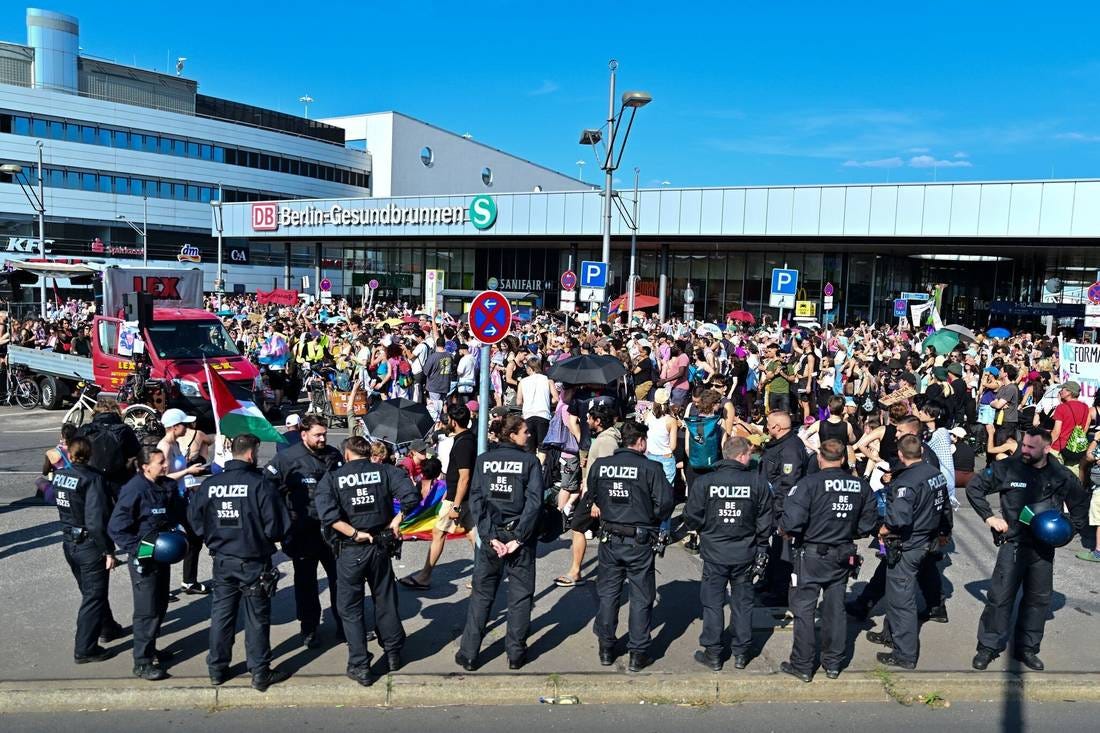
I was at a party on Saturday night when someone came in and said that a van had driven into the Berlin Christopher Street Day parade, killed one person, injuring more. I’ve never been to CSD; go, instead, to the Internationalist Queer Pride demo that, since 2021, has been organised in contradistinction to the corporatisation and pinkwashing of the main CSD demo, whose organisers had called the police to remove pro-Palestinian marchers. Since 2023, this has meant outspoken support for the victims of the genocide in Gaza, and all the attendant policing that involves. So to me Berlin Pride also means cops pepper-spraying and pain-gripping people on the street. Well, it’s in the tradition. In the sun, the heatwave having finally come back after the week’s rain and thunderstorms, finally setting off after several hours, marching past the newly-converted Rheinmetall weapons factory, formerly a builder of car parts, the first time arms manufacture has taken place in Berlin since the Second World War; Rheinmetall, sender of weapons to Israel, to Turkey, to Saudi Arabia, for use in Syria, in Gaza, in Yemen, part of the government’s shift towards increased weapons production since Olaf Scholz’s 2022 Zeitenwende speech and its 100 billion euro fund for war, the willed and ever-expanding horizon of war. The march monitored, not for our own safety, but for the safety of the city’s “white” citizens, by vanloads of armed cops with their machine guns pointing down to the ground; the same cops who let another van drive through or past the protective barriers in the Tiergarten to plough into a path of queers that evening. Not protecting us from the world, but protecting the world from us.
After the parade, in the evening, people start heading off to the parties. The killing happened around ten p.m. and I didn’t find out till around midnight. People had been arguing in the kitchen about the World Cup. Guatemalan funeral music by the San Lucas Band was playing, out of tune, slow. Then Ornette Coleman. The music soared. I felt the world drop out. I don’t quite know how to describe that simultaneity—of hearing that music, which I love and which to me is the sound of possibility and joy and collective potentiality, of what Coleman means by harmolodics, infinitely transposable in whatever register, whatever instrument, whatever key—you could call it queer if you wanted to do that—of hearing that music at the same time as that news. I don’t know what it means, I’m not writing to turn this into a metaphor or an allegory or to makes sense of it, I’m writing it because I have to, I’m writing it to register the loss. Mourning is about revision and return, repeating that initial moment of knowledge, replaying it. It’s a loop, yet it develops; it moves forward, yet it stays in the same place. I’m writing this two days later but I’m still in that kitchen, the world is still dropping out, Ornette is still playing, the San Lucas Band are still playing, and I’m still in that kitchen. I don’t know who they were, the person who was killed, I don’t know their name, and I mourn their absence, that gap. The driver of the van attacked people with a knife or a machete after ramming the van into people on the path and fled. And I don’t know who they were either. And I’m still in that kitchen and already I’m thinking, if it’s an Islamist attack, queers will be used as convenient propaganda—never more convenient than when dead—against whoever it is the state wants to kill, deport. Whoever it was who drove that van could equally well have been one of the white supremacist AfD supporters at the counter-protest staged earlier that day. And if it’s not an Islamist attack, we’re just dispensable: they’ll gloat, those other AfD supporters, CDU supporters, and all their unaffiliated supporters, privately, in their homes, or publicly, online: they’ll cheer the death; they’ll smirk at our loss.
So say what. Stay alert. Some platitude of the sort. Mourn, but don’t let them use us, use you.
I wrote those last lines the same night. The next day, the news comes out in more detail. Wanted posters on digital screens. Perpetrator, Islam, terror attack, plastered everywhere, all over the newspapers, all over the city, and the victim still not even named. The year before, the Chancellor had described raising a queer flag over the Bundestag as akin to treating it as a “circus tent”. Today, the national flag is lowered to half-mast in a gesture that passes as “solidarity”. But I don’t really know what’s worse. This half-mast show, as if there were some sort of unity between the national flag and a flag that should negate the idea of the nation, of this nation, entire. Already the videos coming out, this instrumentalised commentary that is the opposite of mourning, that is like spitting in the faces of the dead. Already the voices of the AfD and its cheerleaders in the right or the so-called “centre” raising themselves. A white blonde Woman on Welt says “Political Islam kills” and talks about Hamas and “irregular migration”, as if that had anything other than precisely fuck all to do with any of this. “Deport all dangerous individuals”, says someone else. (The attacker was born in Germany.)
So mourning is once again becoming a weapon against those it’s supposed to protect. But you still have to mourn. Where does that feeling go. Who becomes a part of the “we” imposed like an unwanted national flag, vampirically, over the bodies of the dead. The flag doesn’t absorb the blood that flows from the body, it doesn’t stanch the wound. Rather, it is the very thing that sucks the blood out: blood spread into its colours, blood the basis of its being.
It’s not my nation and it’s not my flag. But these are, I feel, my dead, not the dead of those nation and flag who opportunistically claim them; not directly, but still, my dead, and I mean that internationally— these dead, not dead to be recuperated by nations and borders but dead who belong beyond those borders; my dead, in whatever way one might take that to mean, without taking any ownership. The person who was murdered was visiting from Poland with her daughter; the killer was German. No nation owns that death.
These dead my dead, because, yes, whatever it was Donne said about diminishment and involvement and nothing in itself entire, yes, that, perhaps, but more specifically: this person is dead because they were queer or they were seen as queer or they were in a queer space, a space that was, for that moment, queered, and because those have been or are my spaces, too. And because of that, because when I heard the news the world dropped out, because this next day and the day after I still can’t get it out of my head—because of all this, I still have to mourn.
I tried to do that by writing a poem. This is hardly a poem. On the afternoon of the next day I pace around inside and it starts to rain and I stay inside and eventually I cycle over to the vigil by the Brandenburger Tor. It starts to rain again, then it stops, then it starts again. This is hardly a poem. Soon after I arrive they finish clearing away the barriers by the gate. A tourist takes a series of selfies in the vacated space, oblivious, smiling away. On the ground on the raised bit of pavement there are rainbow and trans flags, placards, candles. By now, early evening, some hours after the vigil began, swelling to ten thousand people, the crowd is small, but still present. People stand here, they linger, they don’t just pass by, the group becoming in its silence rather than its noise a crowd. “And when he had opened the seventh seal, there was silence in heaven about the space of half an hour” and the opening of the seal signalled the end of whatever world and you know all the noise that will follow. Here, it’s quiet, respectful. I realise I haven’t brought any flowers with me to lay so I leave nothing but my temporary presence. People look dazed. Some quietly crying. Older gays and younger queers, mainly but not exclusively white. Some Zionists holding up a sign saying “this is what happens when you globalise the intifada” are eventually persuaded to leave. Then I notice after a while that the rainbow flag carried by the woman sitting quietly near the centre has a Star of David in the middle. Next to me are some people with a keffiyeh and a keychain with Palestinian flags. Who do you think I felt safer standing next to.
And it’s not, not really, my safety that’s the issue. Or not the me, not the we, the state might take me to be.
I don’t think I’ll ever be able to think of Tiergarten now without thinking about the attack. About its political uses by the predictable barrage of right-wingers calling for “re-migration” and denouncing Islamist terror as proxy for their racist nationalism. About the Zionist flags I saw at the vigil. About the feeling of the ground opening up, the world dropping out, and at the party, when I heard the news, I didn’t know what to say or what to do so said my goodbyes without comment and I left, quietly, as if ashamed.
The driver of the van attacked people with a knife or a machete after ramming the van into people on the path and fled. Later, when he ran at them with the same weapon in an allotment in Spandau, the cops shot him. As if this was some sort of satisfactory conclusion. But likely, it’s only the beginning. They will talk about “protecting” us and there will more cops on the parade to police us and to police real or imagined threats, and white blonde women and straight men on Welt will say things like “political Islam kills” and talk about Hamas and “irregular migration”, and the head of the Alternativ für Deutschland will condemn the killing knowing full well that many of their supporters are delighted by it on all counts, the cops killing the Muslims killing the queers, two birds with one stone.
“And many men died of the waters, because they were made bitter.”
Recorded by ethnomusicologists, the music of the San Lucas Band was nominated for a Grammy Award and the musicians were displaced and probably killed in the Guatemalan Civil War, with its genocide of indigenous populations and activists. The Kaqchchikel musicians, survivors of the Mayan populations decimated by the conquistadors and their massacres and the diseases they brought, tried to bend the western instruments they’d been left and the funeral march melodies and dirges they were playing into the microtonal inflections their own traditions encompassed. It’s as if you can hear the music break under the strain, and yet it stays together.
The evening of the Monday after, the sirens seem to have not stopped sounding. Cops on my road. As if their music were any less sickening or inappropriate than whatever threat it is they are supposed to protect whatever “we” it is they think they are protecting us against.
I refuse it, I refute it, I am not that we.
The vigil was silent but after it I needed to hear something, and so, over these past days, I listened to ‘Atomic Peace’ and ‘Altruvista’ and ‘I Want to See You’ by Alice Coltrane, recorded after John Coltrane’s death, and to ‘Vigil’ by John Coltrane, recorded in watchfulness before his own, and I listened to John Corigliono’s AIDS Sympony, its first movement, titled Of Rage and Remembrance, and I listened again to the San Lucas Band, and they all finish playing. For now, Coltrane’s Meditations is the only purgation that will do, for each sound that comes out on the record sounds like it’s about to break in two. There is no mourning here that is not screaming. No screaming that is not mourning. Multiphonic. Flame. Flowers by a monument in the rain. Flowers by a grave.
And then again silence.
Not to let such a death be used, and not to let it be in vain.
25th-28th July 2026
For the victim of the attack on Saturday
and for all those it will be used against