Showing posts with label Lisa Jeschke. Show all posts

Monday, 3 February 2025

Reprints from Materials

Pleased to finally be able to put back into print a number of out-of-print titles from Materials, among them a re-typeset and re-designed second printing of D.S. Marriott’s Duppies, previously published by Materials in 2017 and in a US edition with Commune the following year, and out of print for a few years now. I’ve wanted to put this back into circulation for some time, especially since the folding of Commune Editions also put the US edition out of print. (I’d also highly recommend D.S. Marriott's subsequent books of poetry, Before Whiteness from City Lights and the forthcoming Letters from the Black Ark from Omnidawn.) Here’s the cover (Clarence Major’s painting At the Turning Point opens up the book inside.)

Screen Shot 2025-01-28 at 13.22.19.png

The full list of books now back in print: 

D.S. Marriott, Duppies (2017)
Lisa Jay Jeschke, The Anthology of Poems by Drunk Women (2018)
Anne Boyer, Money City Sick as Fuck (2019)
Laurel Uziell, T (2020)
Tongo Eisen-Martin, Waiting Behind Tornados For Food (2020)
James Goodwin, Faux Ice (2022)
Candace Hill, Short Leash Kept On (2022)

You can find them all on the Materials website at the links above, or at the main page here: https://material-s.blogspot.com/

~~~


Also:

On newly-available footage of Albert Ayler for The Wire: ‘Eye and Ear Control’.

On Will Rowe for English Studies in Latin America: ‘No More Burial Remedies’.

Saturday, 25 February 2023

News and Views

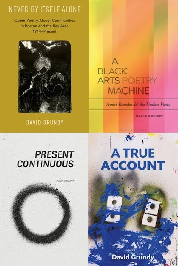
In February I was interviewed about A Black Arts Poetry Machine by João Paulo Guimarães (University of Porto) and Elina Siltanen (University of Turku) for the online Poets Talk Politics Series hosted by the University of Porto. Thanks to João and Elina for the questions and discussion, and to João for the invitation. The event was live-streamed and should be uploaded to the Youtube channel of the Instituto de Literatura Comparada Margarida Losa in the next few weeks. For now, it's available on Facebook, as embedded below (no need for an account) or at this link.


Also online is the video of the online launch for Present Continuous back in January, hosted by Malvika Jolly and with responses from Tyrone Williams, Linda Kemp, Ciarán Finlayson, and Ghazal Mosadeq, can be seen on the Pamenar Press Youtube channel here, or in the video embedded below. Many thanks to Malvika for hosting and Ghazal and Hamed for publishing, designing and typesetting the book!

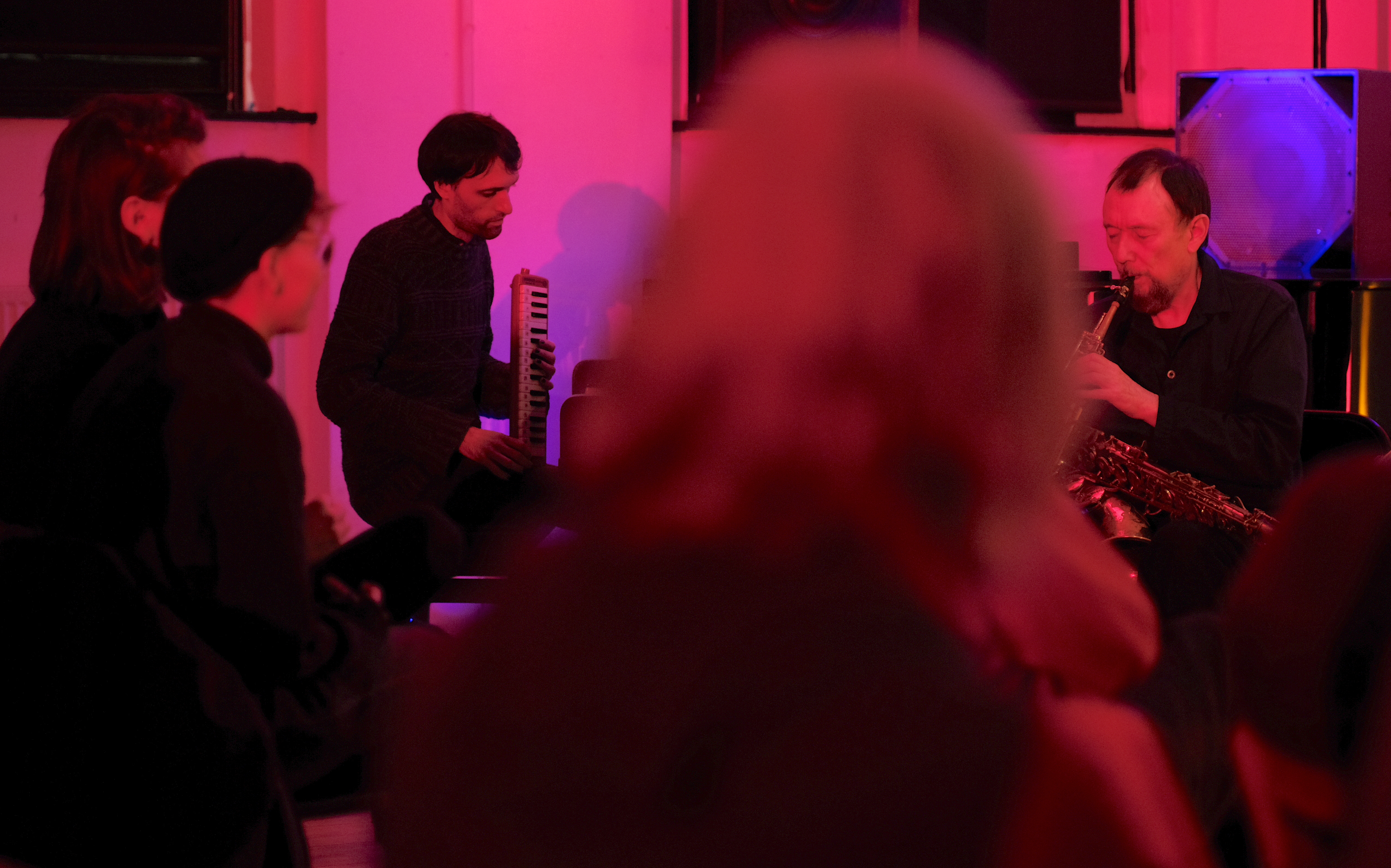
Some photos from the 'Electro-Acoustic Responsiveness' gig at IKLECTIK with Eddie Prévost (percussion), John Butcher (tenor and soprano saxophones), N.O. Moore (guitar), Emmanuelle Waeckerlé (voice, objects), and Tony Hardie-Bick (electronics), courtesy of film-maker Stewart Morgan, whose film on Prévost should soon be nearing completion. 


Photo credit - Stewart Morgan Hajdukiewicz

And some photos from the Materials/Materialien reading at Halle für Kunst Lüneburg, with James Goodwin (launching the new collection Faux Ice), Lütfiye Güzel and Laurel Uziell: thanks to curators Ann-Kathrin Eickohf and Elisa R. Linn. 


James will be doing a UK launch for his book at Café Oto in Dalston on Sunday 9th April; this will also be the launch for Candace Hill's astonishing book-length poem Short Leash Kept On. James will be in conversation with Nisha Ramayya and I'll be in conversation with Candace via Zoom. (Fred Moten will be reading, in his trio with Brandon Lopez and Gerald Cleaver, later in the evening.) Tickets from the Café Oto website.


Finally, in further Materials news, Anne Boyer's Money City Sick as Fuck and Lisa Jeschke's The Athology of Poems by Drunk Women are back in print and can be purchased from the Materials website at the following links: Boyer here and Jeschke here.


Thursday, 28 February 2019

SPLINTER Issue 5


Just a brief announcement that issue No. 5 of SPLINTER magazine is out for the last day of February -- 68 pages of poems from the following poets: Quenton Baker, Elana Chavez, Iris Colomb, D.I., Ian Heames, Lisa Jeschke, Mendoza / MacPherson / Hardy, Montenegro Fisher, Reitha Pattison, Jèssica Pujol Duran, Verity Spott, Catherine Wagner, Emilia Weber. Plus news, reviews and pictures...(The mag includes my review of Quenton Baker's excellent This Glittering Republic.)

Available for £3 (UK), £4 (Europe) or £6 (Rest of World), from: http://splintermag.blogspot.com/


Monday, 15 May 2017

New from MATERIALS: Prynne & Kruk

A sequence of ten poems by J.H. Prynne.


“Oh strike the light, float the boat, for
sake of common peril they are fallen away
as gathered up in sight of lamentable in-
difference and will go down against us”. 


16 pp, card covers (blue), saddle-stapled.

Also announcing the opening of the German wing of MATERIALS, MATERIALIEN, run from Munich by Lisa Jeschke. First publication, Stecknadel, a German-language translation of Frances Kruk's Pin by Koshka Duff.


More info on both here.

Wednesday, 9 September 2015

“As life is to other themes”: Ian Heames’ Sonnets.

[Been neglecting this blog for a while: more to come soon, hopefully, on Ryan Dobran's Story One and on the first issue of Asphodel magazine. Stay tuned...]

[There are six books of Sonnets so far, all published by Face Press:
[1] June 2014 [red cover]
[2] October 2014 [navy blue cover]
[3] January 2015 [pink cover]
[4] February 2015 [grey cover]
[5] May 2015 [black cover]
[6] August 2015 [silver cover]
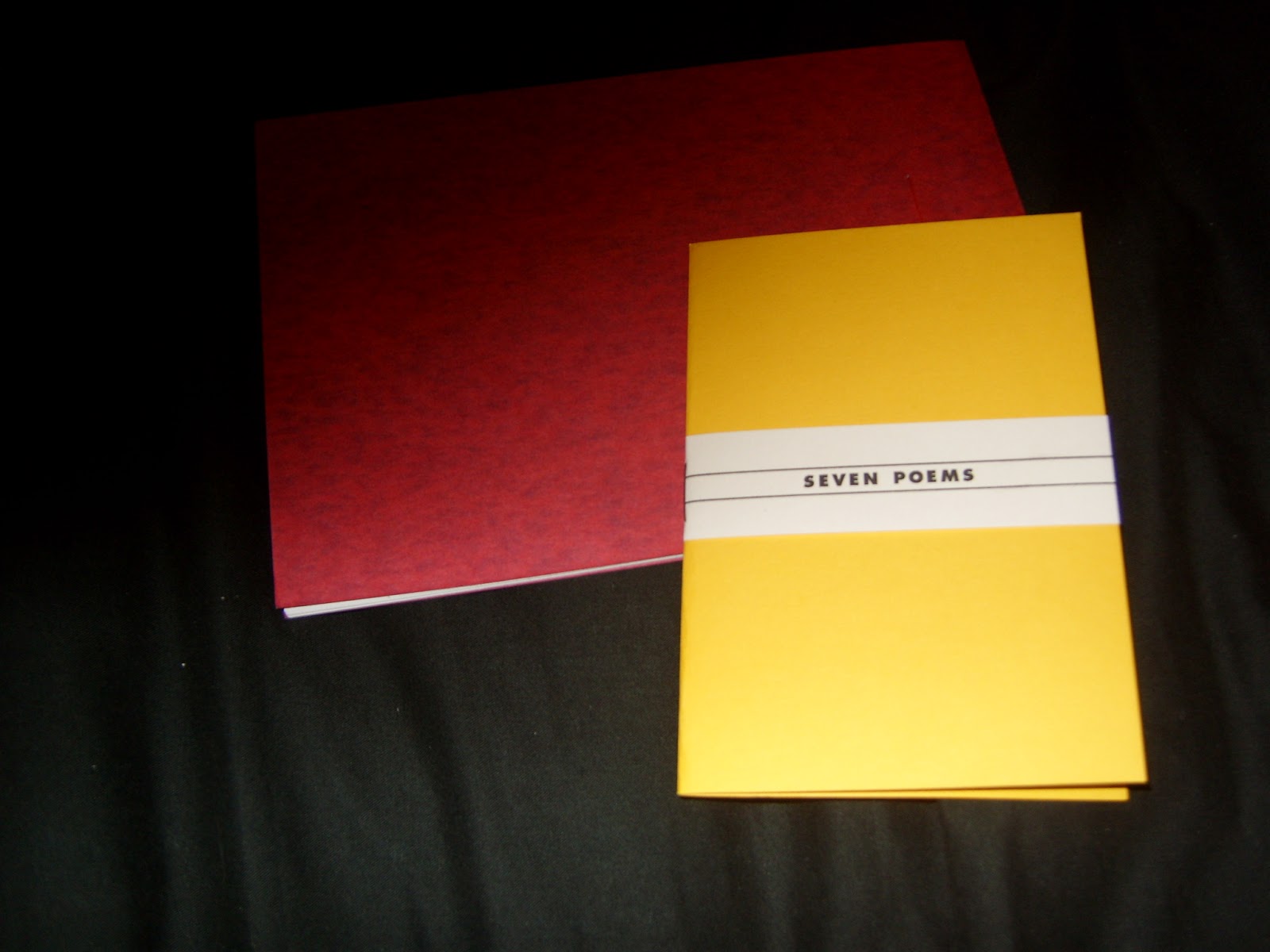
(also, ‘Seven Poems’, 2014).
The first book uses material by Jonty Tiplady (constituting roughly half the sequence), and a couple of lines from Tiplady appear in books 2 and 5. Given that all the pamphlets are simply titled ‘Sonnets’, I’ll refer to them by the colour of their covers in order to delineate between them – e.g. Black Sonnets, Red Sonnets, etc.]

Something like a veil is placed over the experiences in these poems; they are reports, or descriptions, of actions (“walking earlier tonight along the motorway / beside the science park”, Black Sonnets, 1), or observations, of emotional states: these often seen through a screen, whether that of the cinema to which the speaker goes to at night, alone, or of a computer game, an internet search, or the history of poetic reference itself – resonant figures such as the ocean, tropes of death, mortality and poetic immortality or afterlife, love poetry, loss, the heart. Cultural references to Lars Von Trier, dubstep, Villon, Keats and the like may seem to stand in for something they gesture towards, ciphers which could be mined for meaning but which also point to the provisionality with which their placement imbues them. Current and past history is figured through Versailles or 9/11, an atmosphere of industry or technology – the recurring power plant, the motorway, the computer game. The poems are above all about the cultivation of a precision of atmosphere, but not really as objectivism: what is there (the ocean, the power plant, the cultural artefact, even a particular feeling apparently easily named through conventional tropes) slides into something else, the levels are not clearly delineated; this often happens through puns, palindromes, and the like. Thus, in the first sonnet of the blue book, the cave in which the internet is “most weak” refers to broadband but also perhaps, as John Bloomberg-Rissman suggests in his recent review, to Plato’s cave: the shadows on the wall. Actors, puppets, shadows and ghosts, arranged by the poet with power and precision but also a self-effacing awareness or presentation in which that poet (as persona) seems not to be fully in control, doomed to obsessive repetition and tweaking, reaching for inadequate speculative or assertive descriptions of both grand geo-political events and the workings of love: climate change, the militarisation of the police, technology, warfare and the like.

The poems also conduct something that is not exactly a polemic or a sustained argument with trends in the poetry scenes of the last decade or so from which their poet has emerged, but which is, nonetheless, one of the ranges of reference or concern, as a kind of satire so diffuse as to remain fairly oblique: as, in the earlier ‘Gloss to Carriers’, “the white hot temples / Of Capitalism and Love / Its dismal optic carbine”, or, here: “We both write language-critical lyric poetry / without meaning. We both speak without meaning to.” (Red Sonnets, 9). In the latter instance, “language” could be both language itself – a lyric poetry that, though itself made in and of language, reaches for the familiar trope of a feeling exceeding the bounds or bonds of language that yet structure it, and allow it expression; or, in a specific context, L=A=N=G=U=A=G=E poetry and its perceived depersonalisation, its removal of the bourgeois lyric subject for a more open mesh of discourse. The fact that this poetry, whatever it is, is “without meaning” reflects a familiar criticism of what gets called ‘innovative poetry’, though it’s somewhat modified by the following “meaning to”; poetry as containing meanings that might go beyond intention, if we read ‘meaning to’ back onto the initial ‘meaning’.

If, according to one reading of the above lines, this poetry rejects the apparently critical function of L=A=N=G=U=A=G=E writing for a still-sceptical lyric address, such an address nonetheless does not come from a place of subjective stability of authority. The first sonnet in the first of the books contains the lines: “I think I am in danger / of becoming someone else.” The poems are often insistently first-person, but this first-person is ‘the poet’ or ‘the speaker’, (generally) doing believable things, preoccupied with familiar themes, characterized by a particular attitude towards experiences, yet with slippages – the use of found text, the wider registers of geopolitics, etc. The lines above sound like something from any kind of cheap melodrama, though they also, of course, by their placement, play on age-old poetic tropes of persona and identity. But in fact, how much in the poems is this actually a ‘danger’, the compromising of the integrity of the poet as a person? Rather, might this slippage between self-contained or coherent person or personality and the ranges of discourse they deploy be a central operating mechanism?

From the third sonnet in the same book: “You […] want to say / you are not really the sort of person who spends their time / alone at night, eating a lot of food and admiring the internet.” This is put in the second person, though it could equally refer to the speaker. It also claims that ‘you want to say this’, which implies that you haven’t already said it, and perhaps won’t, or can’t; that, consequently, you worry you really are this sort of person. In any case, you would only be ‘not really’ that sort of person – there would still be an element of that in you, and in what you do. From the fifth sonnet: “You (the entity receiving / the above)”, which parodies the idea of the idealized love object, the insistently real, though distant person, or, indeed, the ‘common reader’. The addressee becomes merely an ‘entity’, perhaps not even human, though ‘receiving’ implies that a message has been ‘sent’, presumably with the intention of transmission and communication (even as the following parodically suggests an extreme solipsism – “Nothing is as interpersonal as being alone” (Black Sonnets, 5).

The poems, then, frequently work on address – ‘you’, ‘we’, ‘I’, but the object of address (often, as in lyric, apparently a love object) is infrequently specified, and might be just as often a fantasy, a celebrity – “My love for you is like everything I said to Jena / Malone in private” (Red Sonnets, 5), “Natalie” who has “dark eyes” in ‘AI in Daylight’ (preceded by the line “Ilium is toast”). These celebrities function like the idealized mythological or literary figures that ‘Ilium’ suggests: as muses, as convenient (dis)placements into poetic history that both allow and conceal the emotional weight with which they are freighted. (Red Sonnets, 7: “All of us / build inhabited worlds around impossible objects.”)

Nonetheless, the gendering of the sonnets is in general less problematic than it has been in some of Heames’ previous work, where the association of an unnamed female figure with a fetishized technological apparatus, as well as a mendacious militarized force (the latter association perhaps deriving principally from Prynne’s ‘Her Weasels Wild Returning’), was a recurring theme. Here, though, as we’ve noted, there is something of this (Jena Malone), the love object tends not to be specifically named or gendered, and we even find lines which (perhaps) suggest some sort of utopian escape from gendered norms and gendering, even as they also suggest the highly individualized, competitive and, again, often militarized world of computer games which again threads its way through the work: “In my dreamworld, where genius / is genderblind” (Black Sonnets, 3).

In this regard, the love poem might also suggest, not just a two-way or otherwise intimate relationship, but games of strategy and alliance, whether in computer games or political systems: from ‘Seven Poems’, “like a love poem / to the other side / this is to toy with.” Indeed, the same is true of enmity and hatred (though Heames doesn’t really seem interested in hatred as an emotion). The poem might name ‘enemies’ or ‘opponents’, who are not definable political entities (as they might be in the contemporary work of Sean Bonney, Lisa Jeschke & Lucy Beynon, or Verity Spott, however much the formulations of such attacks challenge the fostering of violent feelings or strategies onto a particular person, rather than to the system they represent and embody) or those who have wronged the poet (as they might be in Villon), but, are, rather unseen players on an internet game: “You have opponents on the internet you don’t see. / You can’t see the joy on their faces / driven off by flame.” (Blue Sonnets, 7).

Politics thus uneasily meshes with love and hate, displaced as a possible horizon of activity from the poet, observed through the sceptically-viewed frames of internet and television reportage. Thus, lines from the fourth sonnet in the black book – “Freeing us / to protest as holograms” – refer to the hologram protest devised to circumvent and draw attention to legal clampdowns on public protest in Spain earlier this year. The way it occurs in Heames’ poem is not, however, as political possibility, but another distancing effect in which protest can only occur through technological displacement, as a kind of stand-in for the movement of bodies on the ground. Protest or mass movement is hinted at in the poems, but what generally appears is the image of the apparatus of its repression – helicopters, the White House, the police, and so on. “Suddenly the poems were full / of riots shields and a cool intelligence” (Red Sonnets, 4).

The poems sometimes seem to throw up their hands altogether, in relation to the possibility of love, hate, politics, knowledge, of holding on to and examining any object: “no trace anywhere / except / lost it now” (‘Seven Poems’). Indeed, one might ask if these are poems characterized by a melancholy acceptance, a desire to find beautiful though self-critical affect within a horizon of defeat, loss, an inability to totalize or systematize, merely to play with the pieces of the puzzle that can never be wholly defined: a derangement that is sensual, and with the affect of rationality, but more often felt as arrangement (‘Arrangements’ was the initial title of an earlier project reworking some poems by Jonty Tiplady). The nearest definition to what ‘we all’ are is “some general ferocious longing” (Blue Sonnets, 3).

Certainly, one of Heames’ primary interests here is how particular systems or ranges of affect – often, computer games, cinema (“like snow in Von Trier”), certain forms of music (“melodic dubstep”) – function, what it is like to inhabit their worlds, which mesh with the real world of history, contemporary reference, walking around, dreaming, looking at things, deciding whether or not to speak. A frequent feature is the use of found language (“I like this Trebuchet” (‘Array One’), “Someone flew / a drone through Chernobyl and the result is haunting” (Pink Sonnets, 10)) for its particular affect and how that affect can be changed by displacement and re-placement within the poem. Heames I think values this language for its affective qualities, rather than (or as well as) using it to make some sort of culture-industry critique – hence his interest in the work of Will Stuart, its use of pop songs, not for ironic reasons, but as markers which are re-inscribed, away from their familiarity, into the context of an avant-garde theatre piece where they can be revived as actually containing particular hopes and expressions (individual responses) of how to cope with the world. (In a paper on Stuart’s work given a few years ago [http://streamsofexpression.blogspot.co.uk/2012/05/how-long-is-this-theatre-of-will-stuart.html], Heames argued that Stuart’s deployment of JLS’ ‘One Shot’ might cause us to question what ‘sympathy’ we could have the range of different feelings the song might prompt in individual listeners, feelings that cannot be disentangled from the song’s forms (or, indeed, their material frames of production), leading to something like a feedback loop of sincerity and depth.) In the Sonnets, the poet is somewhat distanced from these forms, or they are distanced in the poem, considered as textual objects but not for a laboratory examination, a sociological survey, a cultural critique, etc; they are allowed their own integrity. Such forms might often be ameliorative, might mesh with economic set-ups that discourage dissent, but for Heames, they are not entirely conformist, are not merely methods of coping with a politically-flattening affect or effect.


‘Seven Poems’, from 2014, is not part of the Sonnets sequence, but handily encapsulates many of its concerns. Here, we find political references which, though oblique, are obviously related to contemporary situations – in this case, the militarisation of the police in America, and, to a lesser extent, the UK (Boris Johnson’s purchase of water cannon) – “war gear flows to police departments / you still heart”. “Heart” here functions perhaps as verb, via the literalisation of the facebook emoji in which ‘love’ is replaced by an icon of a heart, and subsequently translated into ‘hearting’ something (where ‘love’ tends to means something more like ‘like’) – though the line breaks which surround the phrase make its object unclear (perhaps the police departments of the previous line). The fact that ‘you still heart’ – that you have a heart, are still capable of love – might thus be placed against the fact of militarized police forces (the book’s original title was ‘Stuffed Toys in Patrol Cars’), yet it might also suggest that you still love the police (or the following “team that wins”) despite evidence as to the fact of their mendacity. Or heart might again be a noun – “you still heart” – suggesting death, the stopped heart (the poem opens with an injured ‘tsar’ lying in “the palace of human purpose / of the human heart”). Hearts recur in this sequence – the pun on “widely red [read]” in the first poem, in which a heart that can be ‘re[a]d’ by a single person only functions as tool of intimacy, or the putting of lips on the heart in the second, a visceral image of love, or of giving voice to the heart’s most intimate concern, followed by a line from Wieners’ ‘Supplication’ – “take this curse off of early death” – as if giving expression in this way might, as Wieners supplicates poetry to do, provide the poet with all they lack in life.

From the first sonnet of the blue book: “poetry that we experience as heartache.” Heames’ interest in a poet like Wieners, who makes enormous claims for poetry saving his life, with poetry as that which filters yet might also exacerbate experience almost too painful to be lived – homophobic and class-based persecution, institutionalisation in mental hospitals, the living through of a paranoia that has very real causes in police violence and the like – is one that gives credence to, or at least admires in some sense that amping-up of emotional effect (a result very much of lived experience, and patently not false). However, the sonnets never do this themselves without deploying some sort of diversionary strategy, an ironic deflating move which might be characterized as self-protective. Such self-protection might arguably both allow, or enable, the flow of these sonnets, in books after book, and limit what they can do. At the same time, the sonnets rely on the particular affective register of almost haiku-like lines which often centre on familiar tropes associated with emotion, as we might find in Wieners – the heart, love, loss, weeping – which chart what happens when individual or shared self-protection falls away, yet which, framed as a retrospective story, almost akin to the opening structure of a fairy-tale, still maintain some measure of distance which Wieners generally and painfully avoids. “Once when we were entering a universe we were yet to love, / our eyes welled, tender from the freak event of being open”. (Silver Sonnets, 2) Poetry itself can replace the person who writes it: “Some poems want flesh / to replace them, / mine just want somebody to come round / to the accident of their being. / Poetry begins to hurt.” (Silver Sonnets, 3) The poems are both fascinated by and sceptical of “taking your own inner life seriously”, and hence that poem, the third sonnet, immediately moves on to computer games, a sphere of displacement for an inner life – “some people just want to hate god and collect gemstones.” The process of desired replacement attributed to “some poems” (rather than, as one might expect, ‘some people’) allows a dance between poem and person which relies both on craft and ‘accident’. Poetry itself ‘hurts’ as if wounded, but ‘hurts’ as a verb could also be active – that it is poetry itself that is hurting someone, something – perhaps the reader, or the poet themselves.


Coming now to the lines from which I’ve taken my title, from the first sonnet in the blue book: “Text is to whole conduct / as life is to other themes. Love that / corrects nothing.” This seems as good a set of lines as any to take as a possible dictum for the poems’ method or concern, their scepticism. Text – the poem – relates to ‘whole conduct’ – an ethics? – as life does to other ‘themes’ – everything reduced to ‘themes’, and again folding back to text. The ‘love’ the poem might express ‘corrects nothing’; poetry does not have an educative or ameliorative function. (See, of course, Auden and Spicer.) This seems to be amended or expanded in the silver sonnets book, the latest of the six so far, with the fifth sonnet, which concludes: “Poetry is just / a beautiful simple way / of being wrong.” How are we to take this? At face value, as something of a guiding principle; or as ironic and ridiculous; or as some measure of both? The tone, as it is throughout, is intentionally hard to place and judge.

In this regard, the fourth of the pink sonnets has: “Trying to suggest tone / without claiming either / there is truth, but there is much more, / or there is healing pain”. The syntax is pretty knotty here, but we could parse the alternatives as being the fact of there being truth, but also ‘much more’, or the existence of ‘healing pain’ – in which healing could either function as an adjective in a paradoxical construction where the experience of pain heals, or a verb in which pain is healed. In either case, it’s unclear how exactly the two are contradictory. The sentence comes across, again, as a meta-commentary on the poems’ own processes and concerns. Tone is suggested, but not inhabited – indeed, such cautiousness and self-reflexivity is itself a tonal move.

Such folding-in in happens a lot, and not just in terms of tone – rewriting a history of language and poetry as it relates to the world, in counter-intuitive and sometimes deliberately provocative ways: “Language arose, / at least in part, / as a response / to an aesthetic / modernism.” (Silver Sonnets, 5) What might be a self-confessed weakness in poetry – its wrongness and inability to correct anything – is also, potentially, for the poet of these poems at least, a strength. From the first sonnets book: “At least you can say that / in poetry you are less sure”. Poetry here is a necessary ground or sanctuary for uncertainty (tying in with the desire “not to breathe / my thesis over anyone” (see below), ‘beautiful’ and ‘simple’. The line-break here inflects the meaning: another way of reading the lines might be, “at least you can say that [somewhere else, but] in poetry you are less sure”, which perhaps amounts to the same thing – poetry, again, as a space of greater uncertainty, whre the only thing you can say is that you are ‘less sure’ about what you’re saying. Poetry, then, offers, not scientific clarity, but a space to examine contradiction, complication, complexities of feeling.

Yet at the same time, it might dictate exactly what those feelings are. “Some of the things said dictated / what you could love” (Black Sonnets, 9). Language modifies the object onto which various feelings are put – which could be, as we noted earlier, an object deliberately chosen for its abstraction or spectacular / removed nature: a celebrity, a historical muse, a poet whose surname stands for what they have said in their poems rather than the person Keats or Villon themselves. Rather than allowing the poet to find out and work through what it is possible to love, the poem has set up the field of what can be done in real life, and in that sense functioned as an imposition, rather than allowing a mode of access to knowledge – whether self-knowledge or knowledge of others and the world (the two of course connected). This statement of apparent doubt is itself modified by comic deflation, in a phrase with the metrical set-up of a well-turned out poetic line but one whose reference is the apparently banal and inappropriate one of a game of football: “with no keeper to round” (cf. the more obviously comic “I will buy he in FIFA”, or “Injuries have been a plague all season”). ‘Keeper’ could of course have the double sense of ‘a keeper’ – a term used to describe someone with whom a romantic relationship could and should be sustained – in which case ‘round’ becomes hard to read: whether to ‘go round’ (the sense it has if we read the phrase as being about football), or, perhaps to ‘shape’. Because this follows on from the lines about what one can (and by implication, cannot) love, this suggests an absence. What has been said has shut off the possibility of the ‘keeper’, of a sustained relation, and the poet is left with the shifting field of objects of attention onto which they fix their attention with a self-critical eye, even as this range of objects often works on the logic of a kind of obsessive repetition and recurrence (though not usually transformation). When transformation or expansion does occur, it deliberately overreaches itself: “my love for you […] is a way of life / and has allowed oceans” (Pink Sonnets, 8); “breathing in / the polis of a billion years” (Pink Sonnets, 5) (the pun, or at least the sonic prompt here would seem to be on polis and pollen).

Similarly, the tenth and final sonnet of the grey book begins: “So, / if I ever die, / I will write you / such a decent poem / that the plant melts / and becomes / heart-shaped. / I will call it Anglophone / poetic practice / as a way of feeling”. The absurdity of “If I ever die” (cf. “I’m not going to die” (Red Sonnets, 9)) is further destabilized by substituting the italicized acadamese of “Anglophone / poetic practice / as a way of feeling” for ‘poetry as a way of feeling’. The abstraction of ‘poetry’, as well as the claims so often made in its name (as they are, albeit sceptically, throughout these sonnets), is changed into something more like a research or conference paper proposal (or, indeed, a doctor’s practice, a healing possibility – cf. “or there is healing pain” (Pink Sonnets, 4)). One might expect ‘way of life’ here, certainly implied as a contrast to death: in any case, the lines suggest that feelings denied or shut off to one ‘IRL’ are allowed to blossom within the poem (cf. “Simplification is at the heart of real life” (Red Sonnets, 4). Poetry contains a transformative aspiration – the melting of the power plant into a heart shape, a kind of parody of swords into plougshares or something of the sort – but one that also risks cultivating the notion of a somewhat abstracted ‘feeling’ and elevating it to a poetic pinnacle where it is perfected and removed from life, more so than being generated by or responding to life.

Something like the converse of this, though, occurs in the fourth sonnet of the silver book, where the poet writes: “I don’t want to breathe / my thesis over anyone”. Thesis, in its Greek etymology, relates to ‘putting’ or ‘placing’: so that while the poems are insistently concerned with placing and (re-)arranging various new or recurrent tropes and (often vaguely-delineated) speakers and addressees, they do so, not from an intended position of power or manipulation, but in order to leave a certain openness to the reader with whom they make their contract, leaving their images or the particular intonation of line-broken phrases open for interpretation. The poems in general perform few of the radical deformations of syntax often associated with avant-garde poetry: they are often constructed through propositional, grammatically-coherent statements – theses, if you like. It’s the links between these and the absence of an overarching narrative – one exacerbated by the constant hints at and promises of narrative, which are generally borrowed as fragments from other, familiar storylines, whether the news reporting of 9/11, global warming, or the presence or absence of the lover – that cause complications, that aim to make the process of reading a pleasurably elusive task. For the speaker not to breathe their thesis means for them to apparently abdicate, and certainly to distrust, their own position as someone with something of worth to say, because they are a poet, or because the thing is in a poem; not as a political or utopian model of democracy, consensus, etc, but as a working-through and setting-up of various constraints.

A thesis has to be proved against counter-attack, and must thus set itself out strongly. One could propose that refusing this perhaps closes off the possibility of counter-argument, that the poet’s apparent self-removal might thus also seem like an evasion. But we should also understand the term in relation to the fact that Heames is currently working on his own Ph.D thesis – the poem must not become merely an illustration of something for academic point-scoring, must be its own, independent entity. Finally, thesis, in its original, prosodic sense, means the stressed syllable in poetry or music, by which one sets down the foot or lowers the hand in beating time; the fact that the syllable is stressed connects to the strength of assertive proposition that the word has more generally come to signify. The poet’s breathing of a thesis is thus part of a sounding of the poem too, but poetic stress and stress of argument aren’t meant to batter the reader over the head with skill or virtuosity: if the analogy is to be musical, we could take Satie (that combination of glacial, stately movement and surface and some sort of melancholic emotional pull) as opposed to, let’s say, the strenuous bombast of certain variants of nineteenth-century Romanticism.

The poems, then, aren’t meant to be ‘decoded’ – “The secret impresses no one” (Blue Sonnets, 3) – even as they also aren’t meant to be clear, propositional statements of position (theses) – or just ‘atmospheres’ “without meaning.” Instead, they frequently dwell in a “dreamworld”: an alternative region which, in the history of poetry, has, of course, often functioned as a space to make veiled political critique, as well as to speculate on the origins of poetic inspiration and the tasks of the poet. Without the cosmological frame available to Chaucer or Langland, though, dreams must appear slightly differently; there’s less stability. Thus, it’s hardly comforting that it can sometimes feel as if the speaker is wandering through a perpetual waking dream. From the tenth sonnet of the silver book: “I had dream / things to do”. I’ve mentioned activity, and here dreams themselves become active, a list of tasks to be accomplished. In certain religious or mystical traditions, the thinker deliberately dreams in order to find the solution to a problem, to access a higher realm of knowledge; psycho-analysis, meanwhile, might suggest the dream as a means of finding self-knowledge, albeit one which is socially shaped, and has social consequences – and one which is, moreover, not self-discoverable, but must be expounded, admittedly through one’s own talking, to the analyst as a necessary added presence. Surrealism’s use of dreams for social critique would be an obvious frame of reference for modernist poetry, but that particular strain doesn’t really seem to be part of the tradition Heames is working within. In the tenth sonnet of the red book, “knowledge is itself” described as a “collection of strange dreams / used to describe feeling”. One might expect the formulation to be reversed, at least if the poem were operating according to a scientific model by which dreams and feelings (and, by extension, the sphere of the aesthetic) are often left alone because not discoverable by evidence-based methodologies. But this is a poem, and, while it’s interested in problems of knowledge, verifiable data, and feeling, it appears to trust neither empiricism nor a reliance on the strength of emotional feeling rhetorically pulled off to make the poem ‘work’, to be persuasive or moving. In that sense, the sonnets move across the two halves of the statement – the one thing used to describe the other thing, whether dreams or feelings or knowledge – as their operating territory; themselves, probably quite deliberately, coming across as ‘strange dreams’ in which feelings and knowledge (whether bits of found language, quasi-argumentative statements, assertions, etc) are certainly invoked, if not always described in detail.

This might even have a utopian dimension, if we consider lines from the third sonnet of the blue book: “That the dead obsess / in their own fractal proto-socialist dream time / is their own / terrain.” (Blue Sonnets, 3) Yet there seems to be a negative or critical inflection here – the dead are obsessive, their socialism is only a ‘proto-socialism’, more akin to fractals’ infinite reproduction of the same forms on various scales than to a complex social arrangement concerned with a more just society, and it is their business whether or not they obsess, not ours. Indeed, immediately following is the sentence “Come to grief”, which might suggest what has happened to the dead, whether or not through their obsession; or, perhaps more likely, allowing us to retrospectively re-read ‘obsess’, not as the action of the dead over an unspecified concern, but as your or my own obsession over the dead, placed in a passive construction in which that obsession is framed as if performed by the dead. In that sense, ‘come to grief’ could refer to the speaker or addressee’s fate if they become too concerned with the ‘dream-time’ of the dead, or to what happens to the dead in ‘their own terrain’; or a means of avoiding obsession through the working-through of mourning, in which obsessing over the obsessive dead might finally be moved on from (even as such obsession is so often the work of poetry).


In an (unpublished) introduction to a reading Heames gave in Cambridge late last year, Lisa Jeschke describes his work as containing images “which make you laugh on the inside, but, because the image is so forcefully contained, restricts your ability to laugh on the outside, or at least restricts your ability to laugh convulsively on the outside.” I wonder about laughter here – that perhaps part of the atmosphere of these poems, what I’ve called their veiling, or screening, or filtration, has to do with presenting material with the structure or quality of a joke (“I will buy he in Fifa”, “O mate I do”) but without allowing one to laugh, leaving one uncertain, not only as to the intended effect, but to what exactly this means for the experience of the poem. This forceful containment could be, as Jeschke believes it to be, a mode of useful rigour, a refusal of the easy punch-line, though laughter (even ‘convulsive’, ‘outside’ laughter) itself – as much as it can reinforce cruelty, community self-definition by exclusion or in-group homo-social smugness, ‘getting it’, etc – is not always a bad thing. Jeschke goes on to use the phrase “openly repressed”, which is nice – not so much because it suggests the neat argument it would be easy to make, where repression in the poem reflects repression in social, economic (or, predominantly for Heames) affective relations, but because it captures something of the poems’ tonal qualities, their simultaneous ease and uneasiness with that ease. For Jeschke, Heames’ poems “do not use media and games jargon in relation to the war on terrorism or the financial crisis as a declaration of something like the world-as-simulacrum, but, on the contrary, as a declaration of the fully material relation between language and the real world.” This insistence on formal containment – or games, veilings, filtration, repression, etc – puts “pressure” both ways, between poem and “outside world”, so that what appears to be “formal perfection” actually turns out to be “the representation of perfection”, one which “ultimately presents an image of absolute error and mistake: ‘just when I thought / I was perfect / I find this big weird mistake.’” So, once again, Jeschke here argues, not that the poetry reflects the unreal perfection-repression of the world as constituted by global capitalism, but that its containment as textual object –as poem – moves in and out of that world, taking bits with it.

This might relate, though it seems a little different in emphasis, to what Heames himself writes in a 2010 review of another sonnets project, that of Geraldine Monk: “words will have and go their own way.” We could parse this as something like the social unconscious of language, we could bring in Voloshinov; words, though they seem to act in transcendent fashion – or as other organisms, other life-forms we can maybe set in motion but can’t quite control, that, in fact, control us – are also socially determined, but can be worked through and with. That might not sit quite right, with either that statement, or the poems, but no matter. More work can be done on that later.

OK. So I’d still venture that there may be limits to these poems. There is so much one could write about them, and they encourage this. The methods Heames has found to generate and arrange material seem potentially inexhaustible – the sonnets could just go on forever within their discrete units, offering a wealth of material for close-reading and for what I earlier described as the cultivation of atmosphere. Both formally and in terms of statement, there’s a thoroughly built-in self-critique and sceptical handling of material. For instance, in terms of the sonnet as medium, there’s much play with intensely varied line lengths. The sonnets don’t appear to follow a discernible rule controlling this, though, like much of Heames’ poetry, there does seem to be some sort of private compositional system governing them, which is there more for the purposes of the writer than the reader – in a similar fashion to what Jeschke half-seriously calls the “pedantically numbered” system of ‘AI in Daylight’ (or indeed, ‘Array One’ and ‘To’, the other books which, with ‘AI’, combine to form the sequence Arrays). Yet this potentially limitless generation and questioning of material perhaps risks being unable to fully trouble its own premises. The open-ended gestures, in which the poet refuses to “breathe [their] own thesis on anyone”, also mean that argument itself remains diffuse, poetry reduced to being merely a “beautiful simple way / of being wrong.” Is this enough? The poems are certainly accomplished, skilful. And form is never more than extension of content, etc – but, beyond accomplishments of form, I guess what I’m gesturing towards is the sense that poetry might importantly allow something between, or elsewhere to these particular poems’ focus. Thus, on the one hand, the near-obsessive concern with the filtrations of what constitutes ‘daily life’ (in certain cases, for certain subjects with certain horizons of concern and activity – “the sort of person who spends their time / alone at night, eating a lot of food and admiring the internet”); certain cultural practices or references; particular affects of alienation; the academic and vocational interest in poetry. And on the other, a different kind of view of the polis and of poesis, where – and here I’m borrowing phrasing from the introduction to Robert Duncan’s Bending the Bow, itself borrowed from Olson, which has recently been helping me to frame the work of a very different poet, David Brazil – the “boundary” between poem and world, or town, or ocean, or power plant, or computer game, or whatever, sits slightly differently. Life as more than just another ‘theme’. In any case, the question I just asked, about whether ‘this’ is ‘enough’, is perhaps absurd – the demands placed upon poetry, and addressed in these poems themselves, cannot be singular, and the critical move of enlisting the textual object under examination for a particular aesthetic-political project has its pitfalls. I guess what I’m trying to get at is how I personally respond to the sonnets, what use I feel I can make of them – even if that doesn’t appear all too clear itself in this review. Needless to say, this will differ from reader to reader.

Monday, 10 February 2014

Some Intimacies and Objects


Lisa Jeschke in Dusie 16: “You have addressed me by means of words, which is nearly love, a bit of.” The bit might be the muzzle in the horse’s mouth, the gift horse looked upon with all its soldiers inside as love or as love disguise offered up, the imposition of such gifting; and too might be the broken object, not integrated to be split, in good and bad bits, the good breast the bad breast as present or absent, loved or hated, incorporated or lost, word sucked in as the other’s sucked in, swallowed and eaten to be part of me, my nutritious inner self, registers of privacy or intimacy as recognition of the other instead making address the mere taking over of that other in linguistic conquest, violence at the root of love, exclusion of others to focus on this one object, exclusion of this one object to focus on that focus itself, object standing in for that x lost thing now existing as “you” or as “me”, pronoun in substitution and deferral. Here are some of the words by which “you” might “address” me, from Robert Kiely’s ‘Intimacies’, in the same issue: “I want you to whisper your PIN in my ear slowly.” Intimacy here becomes parody of communist sharing as sexual sharing, as that conduct in sexual relation in which socialism must also manifest itself and be constituted: where sharing here instead is merely my access to your money as my power over you, as a come-on, as a whispered token of love, my access to all your tokens of love, the money shot, the money store. PIN is Personal Information Number: the number that therefore I am, the “bit of” me broken off to info-cash. Recall: Jeschke and Lucy Beynon’s 2012 piece 'Self-Portrait', satirizing a project for theatrical intimacy, in which Beynon’s National Insurance Number was blown up to gigantic art-display size and put up on a wall, as ‘revelation’ of self, the category of self as categorized state, as State Category, self-surveillance, a resolutely non-erotic display of intimacy. Jeschke’s ‘No’ as negativity, Levinas parody - “Love has assumed the FACE of the person one loves,” as mere greeting “Hey, good to see you!”, you become object, “I am a PIECE of FURNITURE,” that object merely filling the space, to be sat down in like the ‘commentary’ on sex-race fetishism on whose spread-eagled legs sits the wife of everyone’s favourite Russian billionaire oligarch Roman Abramovich, performaing art. “We” are “part of the furniture,” taken for granted, objects constructed by craftsman whose labour’s obscured, fixed, “still at any particular”. It’s a “hotel,” with the movement through, the strait gate through which at any time the Messiah might enter only in parody, as parody Messiah, the worker bringing us our meal, room service, for us to feel them up. We are experts in taste and we have chosen you as our lover, and something dies, inside, nothing is moving, the “you” that is “leaking” as “matter” is just a corpse to show you it was once alive, you only notice it when it starts to smell, it’s history’s angel blown into the window like a pigeon and splattered on the carpet. It is all too far and seperate and broken, made to work, to be used, for “EMPLOYMENT”, the storm itself is calm, the tempest blowing the angel forward and away from the past rubble to be righted, its has become internalized as a static chair with the sun in our face and our hair, a frozen rictus grin. The conversation itself has died, la petite mort, a horrible sexy trinity, its third ghost term no transformation of the one by and into the other, no dialectic overthrow, no negative transformation and just instead this beautifully smooth corpse in the freezer, cryogenic preservation for future activation deferral and or a stalled past stall, dragging limbs over limbs in listless list, inscribed and restricted by terms as terminal no-space middle-ground, not alive but not not alive, dead inside and outside in hell getting by. It is cold, and you are centuries late.

Friday, 15 March 2013

Starcrusher Night: Cambridge, 09.03.13


This was again at the Judith E. Wilson Drama Studio in the Faculty of English in the University of Cambridge, ok, so, an 'institutional' or 'academic' space, but thru its temporary inhabitants granted some extended drunken spirit. After an endless projection of a lo-fi(lm) the less of which said the better (save that J. Hardingham’s Klaus Kinski is a fine Klaus Kinski_), interval spillage spilled over into wine-table chatter sprinkling the edges of the opening drones of one O. Evans, down with the flu but freshly haircut & armed w/didgeridoo, kaoss pad & assorted other implements electronic & acoustic. His 20 minute set, billed as 'noise', began proper with a reading of the night's wall-tacked schedule, announcements of multiple intervals drawing an incredulous 'oh my god' from a certain attendant Poet of High Repute; preceding between the advertised noise and the more luxuriant melancholia of pre-recorded loops, Evans' set went on to incorporate treated blarts from a (non-indigenous) patterned didgeridoo and an in-progress set of homophonic translations of the work of Henri Michaux, said by their translator to concern the relation between drugs and the state. No hippie nostalgia here, then, that refusal carried

over (after one of the aforementioned intervals) by the decidedly anti-hippie Sean Bonney, for whom, as his 'Letter on Harmony and Crisis' makes clear, any indulgence in a past history of supposed radical art must be questioned as recuperated nostalgia (“Old films, old music: abstractions, commodities[...]Old songs made an integral part of the phrase velocity of the entire culture”) even as such past history must be simultaneously clung to for the possibility it offers of continuing resistance in this here ("the circulation of these songs does contain within itself the possibility of interruptions"). For the past couple of years now, Bonney's writing has taken a turn towards prose - as he said of the series of 'letters' from which he read, of which that concerning Harmony and Crisis is one, “these are not poems” (tho' at the time he had first started writing them, caught off-guard by this unanticipated formal turn, he was describing them as ‘prose poems’). Instead, one might read them as something like communiqués, bulletins, reports from some kind of front-line in which the speaker - described by Bonney as a 'fictional character' but in many ways obviously identified with the poet himself - hangs around in his East London flat or wanders the supermarket meditating on, among things, the riots of August 2012, the growing rhetoric stacked up by the U.K. gov't against the unemployed, and the history of oppression woven into Cecil Taylor's 'Unit Structures', in which each note is said to form part of a "a kind of chain gang, a kind of musical analysis of bourgeois history as a network of cultural and economic unfreedom." This would seem of a piece with the bulletin-type quality of Bonney’s poetry over the past few years, a quality exacerbated or perhaps in some way produced by their first appearances at his blog, abandoned buildings. "like getting a telephone call from the barricades, the Paris Commune.” Yet it seems that the move from poetry to prose is not a simple transition to ‘the bulletin’ or somesuch: indeed, one might, it seems, say things with more directness in a poem, which indicates something both about how little poetry is taken to matter nowadays (hence the fact that censorship controversies occur over hip-hop records or rock lyrics rather than ‘poems’ per se: a case such as the prosecution’s use of Amiri Baraka’s poem ‘Black People!’ in court is pretty much unthinkable now), and about relative levels of censorship with regard to differing forms. This is what Josef Kaplan is getting at, in however deliberately controversy-courting and politically bull-headed a manner (verging on some kind of anarchistic nihilism), when he makes a statement like this: “Poetry itself doesn’t do shit. Which is why you can have things happen in poetry that would be horrifying or terrible if conceived of in spheres outside of poetry. Which is honestly the best part about poetry.” And OK, without having to entirely agree or disagree with that (it seems to verge on the sort of justifications used by repellent neo-Fascists like Peter Sotos), you can see how lines of Bonney’s like “slaughter the Fascist BNP” or “if you meet a Tory in the street, cut his throat”, would mean something entirely different in one of the Letters than they do in the poems. I think. I may be wrong. But there’s no easy trajectory here, whereby both poetry and prose can be taken as allowing a political discourse that it is more direct than the other; and Bonney seems to have felt the change in registers or formal structures as something of a crisis in itself, at one stage wondering in public if he was even a poet anymore.

The acuteness of this privileging of poetry over prose as knowledge-repository, for the kind of thinking in form that it allows might seem to those perhaps not as (emotionally, intellectually) invested as Bonney in the world of poetry as an over-reaction – why should working in prose be a betrayal, or an incapacitation of certain strains of thought? And yet it is a dilemma that we might see enacted in the work of the writer on whom Bonney has recently finished writing his Ph.D, Amiri Baraka: the sense that, to write a political poem, one must nearly destroy the qualities that make the poem a ‘poem’, that the content of that poem moves beyond the form(s) in which it originally appeared so that the poet suddenly finds themselves spinning out lines of what are, essentially, lineated prose. In Baraka’s case, this takes an extreme in his first collection of Marxist-Leninist poetry, ‘Hard Facts’, tho’ at the same time there is an increased emphasis on the poem as ‘score’ for reading, as oral repository rather than as object fixed by eye-reading – even as this rhetorical register might just as well be said to echo the political speech as the ‘poem’ itself (“Malcolm the artist. Touré the artist. Nyerere the artist. Karenga the artist” writes Baraka in an earlier, Black Nationalist essay in which he ends up claiming, Situationist-style, that “THE LARGEST WORK OF ART IS THE WORLD ITSELF”). In Baraka’s more recent work, which has barely received any critical discussion, something of a rapprochement is enacted between a self-consciously ‘poetic’ form and an attempt at dialectical thought, often centred around puns in a manner more than a little reminiscent of the esoteric-playful signifying practices of Sun Ra or Rammellzee’s coded alphabets. Indeed, an essay such as ‘The Blues Aesthetic and the Black Aesthetic’, collected in the recent book of essays on music, ‘Digging’, shares very similar territory to the poem ‘The Book of Life’, excerpts of which are included in Aldon Nielsen and Lauri Ramey’s anthology of African-American poetry, ‘Every Goodbye Aint’ Gone’: the same puns occurring in both works, the notion that rhythm and the entirety of life itself is a dialectical process being one that is presented, accessed or reached as much through the afore-mentioned puns as it is through logical argumentation. One might argue that this process is itself anti-historical, given that the suggestive connections Baraka draws are based on double-meanings that only work when one considers, for example, an ancient Egyptian word as an English one ('Isis' becoming 'Is/Is') – it is hardly a philological or etymologically-sound approach, a tracing of the actual history embedded in language. Yet perhaps this is not the point – the work exists half-way between actual, fully-thought theory and a scattering of suggestive and playful notes, hinting at lines of thought without quite pinning them down with exactitude. Certainly, to posit that the rhythms of African-American music embody the materialist dialectic, as opposed to the stale old Adornian dismissal of jazz or the Left’s continued miring in Bragg-Seeger folksong-sterilisations/ aspic-encasements, is a step forward, even if it risks over-generalisation and a reliance on a-priori concepts; and the re-writing of Islam, within the poem ‘Allah Mean Everything,’ as an assault on capitalism, the suppression of women, and the monetary system, assumes political relevance within current Islamophobic trends.

But further discussion of this really does get us way off point, and the details of Baraka’s poetry/prose dialectic(?) perhaps don’t apply so much to Bonney, whose poetic style, as much as it is fed by the same African-American musics that Baraka champions, cannot operate out of that same cultural or racial community, emerges from a different situation and a different tradition, originally (just as, in the 1960s and 70s, European Free Improvisation emerges from Free Jazz but takes it in a different direction). And Bonney’s prose, if we’re calling it that, is very different from the sloganeering aspects of Baraka’s most dogmatically MLM poetry: rather than preaching from a pulpit and attempting to create a black-working class revolutionary alliance through sheer rhetorical force, Bonney’s speaker, the letter-writer caught between requests for money and patronage from his relatively well-off, employed friend, and contempt for that friend’s bourgeois conformity, is acutely aware of the poet’s own implication within a recuperation of discourses and, above all, the peculiar economic status of the poet, the scholar, or the artist in general within capitalism, both critiquing and feeding off the system. Certainly, the poems of ‘The Commons’ in particular are acutely aware of the problematic status of what Bonney elsewhere calls “legitimate ruins like the letter I”, i.e. the fabled lyric I, rescued from Language Poetry’s complicit dismissal-disguise and re-asserted as a kind of collective I/eye borrowing from folk song, thieving its sources like the cuckoo bird – but, in assuming a seemingly much more stable subject-position, within the prose letters or, as Bonney suggests, ‘short fictions’, of the recent works, different conventions are played with. {{One might draw parallels with the return of an almost joyfully-over-emphasized ‘I’ as the seeing subject of J.H. Prynne’s most recent poem, ‘Kazoo Dreamboats’ – the visionary seer of medieval dream poetry periodically asserting “I saw” – yet, in Prynne’s case, this very return of what had been, according to many ‘critical’ accounts of his late work, in any case, banished and removed, may in fact be an attempted means of extinguishing subjectivity once and for all.}} If Bonney’s letters play with conventions of, I don’t know, the epistolary novel, collections of letters from Benjamin, Olson, Rosa Luxembourg, whomever, they are also a means of heightening the relation between addressor and addressee that the poems, in their spasmodic creation of enraged community, particular in performance, are less explicitly concerned with, assuming a shared register, for ‘us’ and against ‘them’. That rhetoric certainly continues through here (the description of bourgeois ‘understanding’ as the bullet in the brain that ends the life of the Headmaster in Lindsay Anderson’s ‘If’), but with an acute sense of complication, of the urge to lunge forward in rhetorical-overstatement but of the gap that this lunge raises between theory and practice; of the dependence of the letter-writer on the very system his entire writing project is predicated on destroying; or the containment into commodity from not only of human lives and labour but of the artistic ‘products’ often simplistically supposed removed from that cycle. (Bonney’s comments on the recuperation of Cecil Taylor’s ‘Unit Structures’ into (shelf-)units(albums) or over-priced Royal Festival Hall tickets echo the dilemma described acutely in Iain Anderson’s article ‘Jazz Outside the Marketplace’, whereby the attempted economic self-organisation and resistant dissonances of 1960s free jazz were steadily incorporated into university professorships, Guggenheim grants, support from the Rockerfeller foundation, removed from the black communities for which they claimed to speak and, in many cases, reduced to another ‘high art’ commodity.)

This simultaneous turn to a foregrounded subjectivity, however loosely identified with the author’s own person (parallels with Baraka again, his semi-autobiographical practices in ‘The System of Dante’s Hell’, ‘Tales’ or ‘Six Persons’ through to ‘Tales of the Out & Gone’), and the self-critical positioning of that subject as distinctly non-heroic, trapped within the obscure mathematical or scientific systems that Bonney outlines as the workings of capital (“the intense surges of radio emissions we’re trapped inside. Cyclones and anticyclones” // “the base astrological geometry of th[e] supermarket […] revealed as simplistic, fanatic and rectilinear”) might be characterised as part of the ‘turn’ from poetry to prose, even as this narrative is complicated by the fact that Bonney still occasionally writes lineated poems and that such discourses of the trapped are present both in ‘working notes’ and poems that have appeared on his blog. Perhaps, then, the letters are a synthesis of these working notes and poems, filtered through the foregrounded subject-character as new stylistic amalgam that is more than ever concerned with “the problem [of] how to make whatever it is that is trapped in aesthetics, idealism and in history learn to speak,” but that has decided to do so through an examination of methods, life-minutiae and habits rather than some more ‘elevated’ form of exhortatory utterance. "It's difficult to talk about poems in these circumstances."

That summation, tho', still implies a chronologically over-simplistic description of the move 'away' from poetry towards a more discursive style as a reaction to a particular political situation, a growing dissatisfaction with the constant gap between the purported heroic potential of king-killing poetic utterance and the actual indifference various fugitive publications and scenes might provoke in the actual sphere of political action. True, there have been discussions of a return to the distribution of oppositional poetry thru, say, handing out broadsides on street corners, printing multiple leaflets of poems to hand out on marches as displacement of the usual SWP factional-evangelical pamphleteering; there have been readings at occupations. And these various measures have never seemed to go quite far enough, or to fulfill their objectives even when 'implemented'. Bonney:
"Yeh, I turned up and did readings in the student occupations and, frankly, I’d have been better off just drinking. It felt stupid to stand up, after someone had been doing a talk on what to do if you got nicked, or whatever, to stand up and read poetry. I can’t kid myself otherwise. I can’t delude myself that my poetry had somehow been “tested” because they kinda liked it."
Similarly, Kent Johnson's suggestion to the UKPoetry List run from Miami University that the supposed thriving underground of British radical poets should all join the SWP also falls flat, (particularly given the rape-apology scandal now engulfing the party), even as its provocation towards political organisation remains pertinent. But while this might all have to do with poetic or prosaic form, it might equally not. Still, it's worth considering here the use of prose sections in Keston Sutherland’s recent work, forthcoming in the ‘Odes to TL61P’ - in particular ‘The Clearance of Trafalgar Square’ - even if Sutherland describes these as simply (or not simply!) an extra-long verse line; or, similarly, Justin Katko / Jow Lindsay’s ‘Trigger Warning’ -- both examples written as reactions to specific political events which seem to invoke a particular stylistic register that, while full of exclamation, invective, invocation, lends itself to the prose line rather than to shorter ‘poetic’ lineations (even as both Katko and Sutherland have also been recently and simultaneously working with much more ‘old-fashioned’ forms of poetic affect that strike an equally surprising register). Perhaps J.H. Prynne’s ‘Kazoo Dreamboats’ also (in sharp contrast to the monosyllabic clippings of ‘Streak ~ Willing ~ Entourage ~ Artesian’).

In any case, whether or not the Letters’ generic indeterminacy (maybe not the right word) occurs as a specific formal reaction to political crisis, said indeterminacy (wrong word, Cageian), does indeed render them hard to pin down in a manner very much congruent with certain strands of politically-aware ‘artistic’ writing. As much of Bonney's work over the past 10 years has done, they include appropriated slogans, quotations and phrases from a wide variety of communist writers and African-American politicians and artists, Marx on surplus value jostling up alongside Eldridge Cleaver ("all else is suffering and madness at the hands of the pigs") in a style certainly departing from (as in beginning, but also diverging or being suspicious of) certain Situationist tenets -- re-appropriation, the use of arcane vocabularies as a kind of underground cell of resistant language - the alternative tradition Bonney earlier identified in Blake, Bob Cobbing and Abiezer Coppe, and which increasingly comes manifested in an African-American tradition of Amiri Baraka, Cleaver and Cecil Taylor, or the radical kernel at the heart of the work of Arthur Rimbaud, 'translations' of whose work draw parallels between its engagement with the Paris Commune and various protest movements in the UK. This appropriative practice was figured primarily through music in Bonney's major sequence 'The Commons', which he has described as a 'modern folk song', taking its cue from the re-ordering of collective folk fragments described, for instance, in Greil Marcus' treatment of 'The Cuckoo Bird' in his book 'Invisible Republic': here, the sonnet form ("this thing has fourteen lines / as in picket lines" Bonney writes in a later poem) collided with black American music of (roughly) the 1930s to 1970s, Adorno, B-movie zombie register of a kind found more obliquely in the work of Bonney's partner Frances Kruk, current political discourse, and a debate on the nature of the lyric 'I', in a highly wired, jerky, spasmodic series of short lines characterised by a jammed-up connectivity that terms borrowed from other disciplines like 'montage' or 'collage' would not do well to define, a sense of simultaneous foregrounded breakage and forced elision, where the song of the cuckoo becomes the song of Betty Davis (‘he was a big freak’) or the sound of a gun-shot ("the cuckoo is a / BANG"), the disruption of pastoral idyll by urban energy and the suppressed underclass that allows the aristocratic fantasy of the healing power of the countryside its arcadian shadiness (shades as in spectres, of course). And while the Letters are often about music (and specifically the notion of harmony as cover for a system of social order(ing) that covers and masks injustice – see here in particular the discussion of the Pythagoreian antichthon in an article called ‘Non-Cognitive Aspects of the City’ that can be found here), in contrast to 'The Commons' their affect is of a different kind that can’t really be called ‘musical’ (as even ‘The Commons’ itself wasn’t, really, so much, given that the term is so often banded around in vague broad-brushing of a general area that might be better identified as ‘has strong emotional/rhythmic qualities in performance that produce similar convulsions as listening to certain kinds of music’).

But, OK, here’s what I’m getting at – with the change in the style of writing, so a change in the style of reading, of the style of reading that the style of writing demands (because, after all, poets don’t necessarily write what they write as a guide to how they might read it; they might write it and then have to find ways to read it – this is something you hear people say a lot, e.g. “I haven’t really found a way to read this poem yet,” and so on.) So, Bonney’s reading itself, in Cambridge, began quietly – as he notes, the Letters are not really meant to be read out loud, in a way that it was immediately obvious the poems of ‘The Commons’ were, as he launched into them with foot-jerking intensity. But, and not to valourize the following as some sort of sense of (the appearance of) suffering-artist-intensity as lending a particular kind of privileged vatic ‘truth’ to utterance (somewhat akin to what Anthony Braxton calls “the sweating-brow syndrome,” in which the more sweat a jazz musician dispenses, the more ‘authentic’ they are deemed to be, with all the problematic racial stereotypes that implies), that sense that the poem or the thing you are reading, because recent, because wrestling with formal dilemma and thus all cracked and imperfect and wrong, is wrenchingly awkward and painful to read, almost embarrassing, is something that has resulted in some of the most powerful readings I’ve seen in recent years. Say, for example, Justin Katko’s rendition of his own afore-mentioned poem about the 2011 riots, ‘Trigger Warning’, at about this point last year: in which Katko sat in a chair and appeared distrustful of the very rhetorical vehemence and shouting intensity that his reading eventually moved into and that the poem itself fully and completely inhabits and provokes. Certainly, or partially, anyhow, in Bonney's reading, that quality of nervousness mixed with the occasional vehemence of the work read out went some way towards approximating or paralleling the mixed stylistic and theoretical register of those works themselves, the desire and necessity to strongly speak undercut and yet somehow reinforced by the self-questioning webs of implication that that poet’s voice implied. I’m not saying that this frisson of difficulty and strain should be applauded as an end in itself, but that its evidence that poetry might still be thought (as in, it might still be a form for thinking) gives some sort of hope, even as there are not ever easy answers here.

Lisa Jeschke’s reading style is almost the opposite of this, avoiding emotive effect for something that is certainly not ‘neutral’ but that comes to a very different place than, say, Bonney or Katko. The recently-written piece she read on the night emerged from a dissatisfaction with the form of her own recent work – almost an opposite trajectory to that of Bonney, in fact, in that her own previous pieces (collected in ‘Materials 1’) often consist of large undifferentiated blocks of prose which she would have described as ‘poems’, but which she has come to view, following recent discussions & symposia, as, in terms of, formal categorisation, something of a cop-out, an inattention to poetic form as poetic form. Hence this new piece, each line exactly seven syllables in length, often relying on deliberately clanging and obvious rhyme, as a kind of parodic return to rhyme that questions its own affect but that cannot quite be described as simple ‘irony’ or ‘parody’ (interesting parallels here, again to Katko: the first poem of his ‘Songs for One Occasion’, with its “ocean grave”s and waves). Also some play on English-German translation, reversed verb forms: references here less (as in previous works) to (a) personal ‘life experiences’ (meeting a drunk man in a park; burying a childhood friend under a pile of earth; &c.) or (b) critico-theoretical-theatrical debate-terminologies, more to - what? A change in voice, anyhow, “neutral chide,” some sort of unplaceable bite.

Ian Heames following, reciting the second half of ‘Array One’, of which I’ve written at length here, and a new poem, 'Orca Plaintiffs', which seems to continue that poem’s mix of computer-game and poetic register (“my opponent believes that the universe is made of fire”) shot through with the discourses of techno-capitalism. And Tomas Weber, whose ‘Another Word From Me Out of Uniform’ has just appeared from Tipped Press, and whose running-on of different register-phrases is, again, very different from all of the above: if Heames’ poetry is clipped aphorism, sequential thought, cross-referencing, Jeschke’s concerned with (various) form(s) as restriction, Bonney’s again with form and voice and the political, Weber’s seems in some way unforced, even distinctly pleasurable: Biggie Smalls meets F.R. Leavis but not in any music-journo Metaphyiscal Poets mash up bastardisation (this from 'Ausculation': “and I will never rhyme / like party and bullshit” […] “it wasn’t really / Leavis who said the way / the British do war is still true / to English mannerism and so I love you forever / & always or was it”). Yet in the recent long(ish) poem, ‘Performing for the Troops’, the run-on joins that make much of his work so pleasurable are deliberately not soldered, the links not fashioned, so that there is something brutal to it, even as it gets a hearty audience laugh (“Who’s that fuck? / Shut up, fuck”). It's hard to write about because it resists the more broadly theoretical frameworks into which one might place the other poets, and that might make it seem more ‘insubstantial’ or something; certainly, earlier work had a strain of lyricism to it that still perhaps functions a little (traces of American pastoralism tho’ by no means unconscious of imperial complicity) - the poet actually wanting their heart to be a plane, I can’t remember the exact reference – but here lyric most often moves into exchanges of selves as collections of clothes or children or radio stations or youtube videos that aren’t so much lang-po playful or even, in the vein of O’Hara’s ‘In Memory of My Feelings’, self-critically-camp-playful (partly because Weber isn’t American and so the register is different, even if American culture as filtered over to the UK and in summer travels is very much present), but poised more obliquely between laughter and something more sinister, even disturbing, as in those lines quoted above, the subject not allowed voice, mocked in authority-figure mimicry -- shut "that fuck" up, “wants to be / some speaking thing.”

That combination of poets constituting quite a long reading, intense continuance, so interval spills over, again: music set-up, second noise set, O. Evans again kaoss padd’d, this time w/added Minton/Patton-esque screaming and even at one point a trace of school melodica; Gregor Forbes’ industrially-reverb’d Pure Data factorials, some other PA’d laptop & pickup-to-practice-amp feedback’d human, but I think it all merged into one blart of sound in which individual contribution was less important than general sonic mass (though perhaps a little more ‘improvy’ than Japanoisy?). It had started to fucking snow outside & bits of it had melted and were dropping off people’s hair. I think Nas replaced Bad Brains as interval music @ this point, then in fact the longest section of the evening, Nat Raha and Verity Spott the final poets of the night. Raha read, among other things, poems for Sonic Youth to the accompaniment of vintage cassette recorder as lo-fi voice-multitracking, youth against fascism – “it’s the song I hate” – the words themselves not really decipherable, the effect more akin maybe to something that might have come out of the choral-voice experiments of 1970s NYC (Hannah Weiner, Jackson MacLow &c.) and the more unexpected for that. The poems without tape that started things off were from Raha's new collection, ‘mute exterior intimate’ - where exterior might be buildings, might be faces, bodies in spatial negotiation, indie or shoegaze leakings thru with seagulls into critiques of neo-liberalism, memorials for victims of transphobia, the spectral presences of Mayakovsky and love, the “doctrine of bliss and suffocation.” Spott’s was the longest reading of the night at maybe over half-an-hour, certainly the most intense, and not only in terms of sheer length, veering between grotesque-choke sound poetry, @ one point even throwing the pamphlet read from down on the floor and repeatedly punching it. The audience laughed a lot, and this seemed right, but, like a lot of the laughter that punctuates readings like this, it came back rebounding on itself because the work itself is hardly comfortable, is scatological, grotesque and highly sexual - infant sexuality too, a long joke about fucking poets turning into a dialogue between two children centering around the many implications of the activity implied in the familiar insult ‘motherfucker.’ Kind of traumatizing, really, but (and) for sure visceral in a way that, say, the noise set before even really wasn’t, and hard to process in that way because less precise than, say, Heames or Jeschke, throwing itself all over the place with words and words and words in often uncomfortable excess. Spott herself describes it as “digusting and ungainly”, which it is in parts, deliberately and distinctly so.

And that kind of intensity necessitates another interval, and then Business Lunch make their debut with a three-song set, absent singers and last-minute rehearsals shaping, at this stage into the evening, into something fitting right in place, some noise keyboard too over the bass & guitar riffs in the more extended last piece. Shudder and jump // "got the swing" // more rock music at readings, yes? Jeremy Hardingham closes the evening with a-cappella songs and some karaoke to Die Toten Hosen which is hardly karaoke as ‘we’ know it. He reads a poem about the killing of a bird with an oar and then sings it, closes with a tender ‘goodnight’. There’s again a lot of laughter here, but I think that to laugh in this way would be to take the songs @ a face value that does a disservice to their non-naïve non-irony: many parts were, you know, moving. Tho’ the “fist full of piss / apostrophic bliss” barnstormer, well, yeh. It's been in my head for days. At one point Hardingham sang literally with a silver spoon in his mouth, but again, that was hardly boringly symbolic even as the joke-resonances of it being symbolic were of course not discounted. The room heaved. It was still snowing outside. (The equivalent event last year was called ‘Spring Decoys’. There are daffodils outside the English Faculty. The area around Grange Road in which the faculty and the University Library are situated is ghost-empty at night, darkness on the edge of town. 'Cambridge', as much as this university-sphere-cocoon constitutes it, is so far from the real world, whatever world might be made inside black boxes. Why not throw an egg out of a moving white van outside one of the gated colleges, built to be thus gated, enclosed? But these big one-off events might be made to move into something else even if no one from the ‘town’ was ever going to come down to the university bowels, the City of Dis. By which I mean, maybe there will be some sense of a series extending somewhere (viz. http://starcrushernites.tumblr.com/.) Onward christian soldiers.