Preview of a subscriber post on Substack on Nellie Wong and Harmony Holiday.
In the past month, two articles of mine on two quite different poets
appeared in The Poetry Foundation and the newly founded Hythe Review.
This post goes into a bit more detail on the background to those pieces and
serves as an additional tribute to the late Nellie Wong, who passed away
earlier this year.
It’ll be followed in the next while by material relating relating to two further recent publications, on jazz poetics and on the relation between jazz and hip hop. More on those in due course.
Nellie Wong: Typing Back
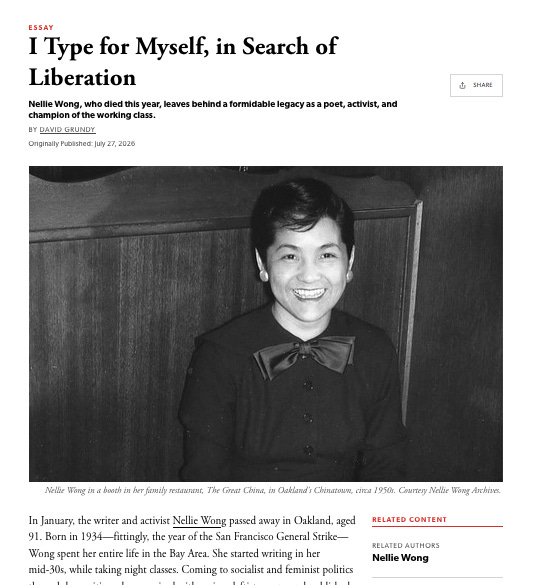
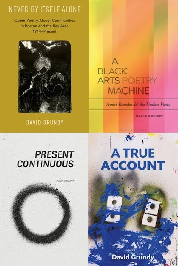
Based in San Francisco for many years, Nellie Wong features in a chapter of my 2024 book on Boston and Bay Area queer poetry, Never By Itself Alone, focused on her comradeship with fellow poets and activists Merle Woo and Karen Brodine. Wong wrote of labour, of class struggle, of family history. Her first book appeared in the late 1970s, when Kelsey Street Press published Dreams in Harrison Railroad Park; her final book will appear posthumously in this new century, now moving beyond its first quarter.
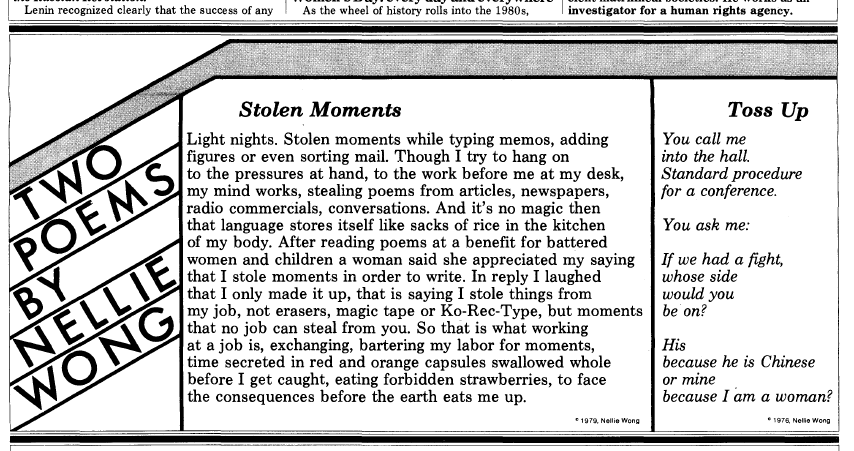
Employed as a secretary, typing others’ words, Wong used her own poetry and prose to write back, to write over the words of bosses. To write, Wong reminds is, is also to be involved in labour—physical labour, or labour that removes traditional, hierarchical distinctions between intellectual and manual labour, that attempts to deny the workings of the mind within the workings of the body and of the body within the mind. Poetry, activism, and education were a way out of those frames and into herself, into the fullness of her own life, but using precisely the means of that gendered labour—the typewriter, reproducing the words of others as a way of reproducing oneself for a wage, become now a weapon, a way into words and language and struggle.
To type back, Wong discovered, is to fight back, to discover and invent, to transmit. There is a friction here, and it is this friction that poetry operates like a lever. To type back is not the current invisibilising process of automation, of Large Language Models which anticipate and erase waged labour without any alternative recompense. Rather than the erasure of bodies, such writing attests to their presence within the system, insisting on their agency, their potential for sabotage, and their own inherent worth.
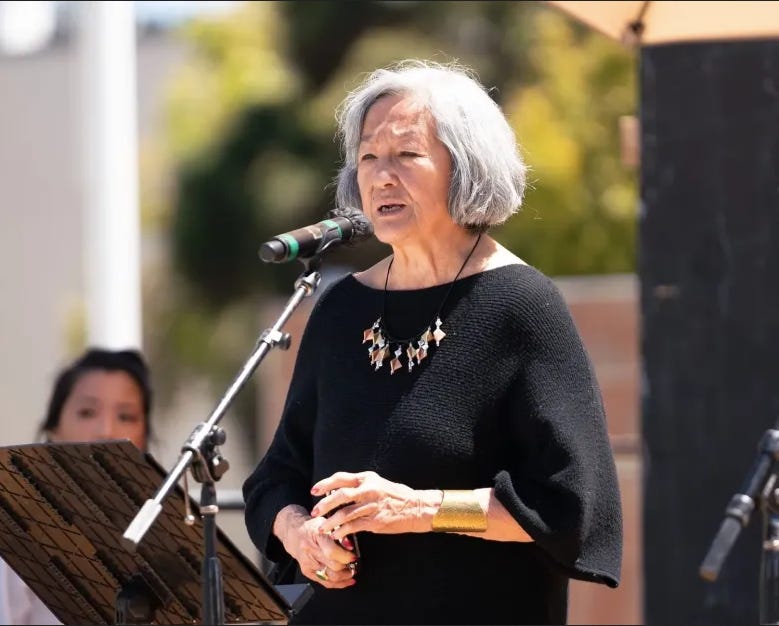
Last year I was privileged to attend an online discussion with the socialist feminist organisation Radical Women. Wong was involved with both RW and the affiliated Freedom Socialist Party until her passing, and was there herself on the Zoom call. I was deeply honoured by her presence, and struck by her modesty. Here’s the conclusion to the Poetry Foundation piece:
An individual writer’s work makes a contribution toward something whose contours will exceed those of their own life. “You will not survive the work that still needs to be done,” Wong wrote back in 1981. “You will be gone when the questions of the future arise like wildflowers on the plains of this earth.” To write is to live, but also to accept death. Wong’s late poems reconcile themselves to transience in the belief that human struggle might build a better world. As she wrote in “Under Our Own Wings” in 1979:
If you begin I begin
If you sing I sing . . .
In death our bodies regress to the innocence of bones.
In love we work to live in America under our own wings.
Beyond the introductory work of that article, readers should head straight to the source. There are multiple rare recordings of Wong available at the invaluable Archive.org, among them:
—a 1978 reading with Susan Griffin (including the unpublished dialogue ‘The Interrogation of Ms. Security-Runs-A-Risk’);
—speaking on Asian American writing for KPFA radio the following month;
—Allie Light’s 1981 film Mitsuye and Nellie: American Poets, featuring Wong and Mistuye Yamada, who is at the time of writing an astonishing 103 years old;
—reading her comrade Karen Brodine’s poems in Washington for Radical Women in 1991, as well as delivering a lecture on ‘Racism, Sexism, and War’;
—interviewed on the KMVT15 Community Media TV channel, in a programme entitled ‘A Banquet of Poems’;
—and speaking on family and creativity with her siblings Flo and William at the Headlands Center for the Arts in 1996.
Wong’s illuminating 2017 reading and conversation with Genny Lim at the San Francisco Poetry Center can also be accessed via the Poetry Center website. In July 20025, she read with the Laborfest Writers Group at Bird and Beckett Books: the full reading can be viewed on Youtube, as can the memorial reading held in January 2026. A lovingly-maintained website can also be found here. And the organisations with which Wong was involved—a part of her life just as important to her as her writing, and inseparable from it—can be found at their respective websites: Radical Women here and the Freedom Socialist Party here.
In these traces, in her work, in her impact on many lives, Nellie Wong lives on.
Harmony Holiday’s broken epic
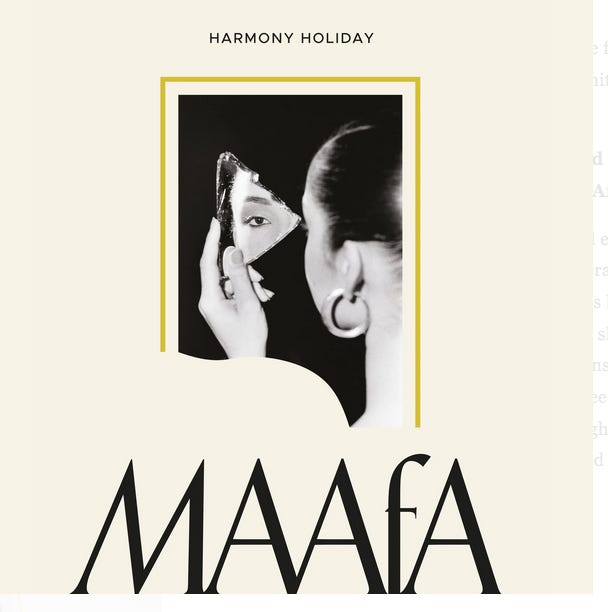
Also just published, a review of the expanded UK edition of Harmony Holiday’s epic poem Maafa, on The 87 Press’s new open-access journal The Hythe Review. For those who don’t know, Holiday’s Substack, Black Music and Black Muses has been running for several years and documents her ongoing writing on music. But music suffuses almost everything Holiday writes: her essays, her ongoing biography of Abbey Lincoln, her collections of poetry.
Maafa’s soundtrack would be Prince; it would be Pharoah Sanders; it would be the music of Holiday’s father, Jimmy Holiday, of Billie Holiday, to name some of Holiday’s touchstones, those named within its pages and the pages of her other books.
The rest of the post can be read by subscribers on Substack here.




No comments:
Post a Comment