Showing posts with label Candace Hill. Show all posts

Sunday, 15 March 2026

Abstractive

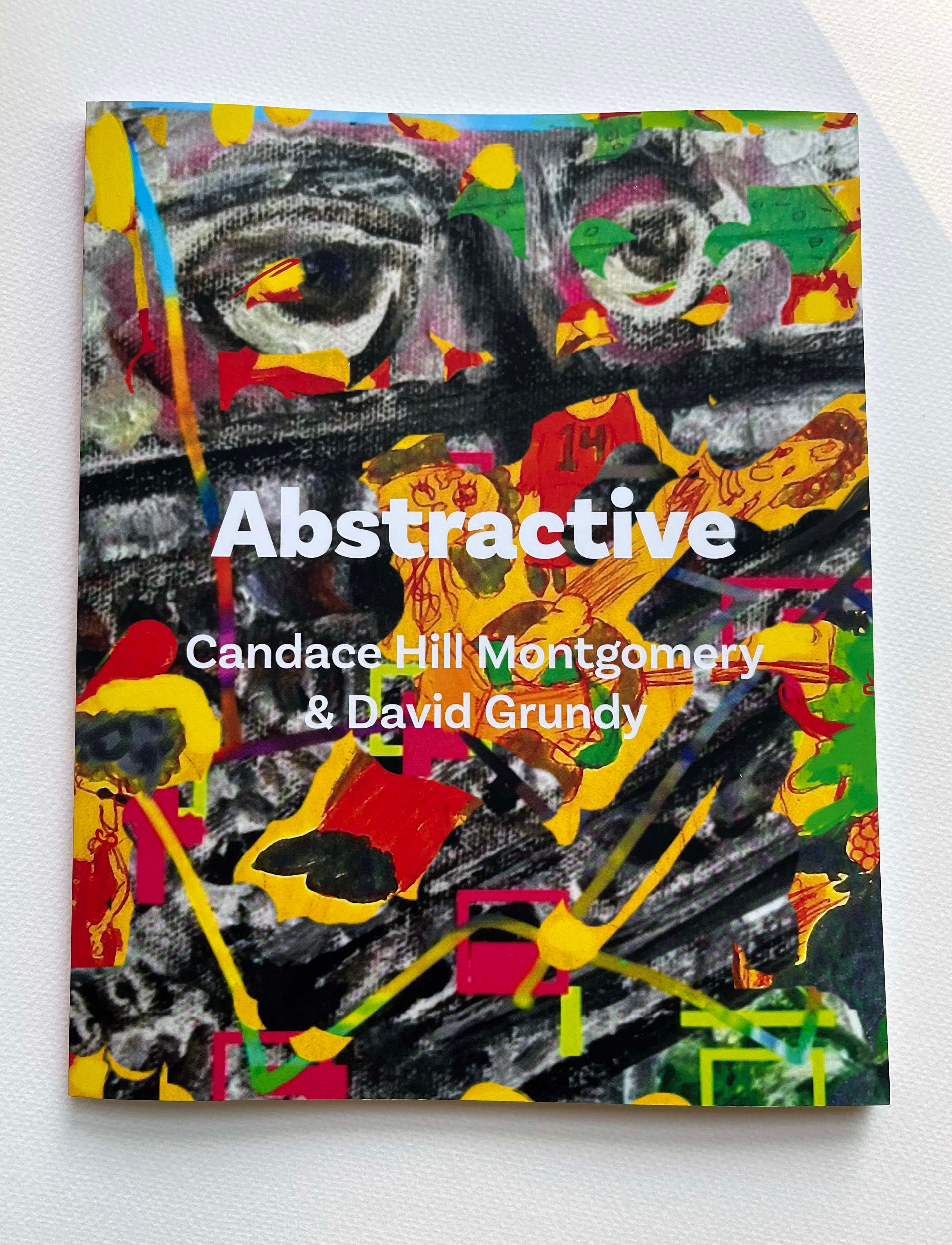
Very pleased to announce the publication of Abstractive, a new collaboration between myself and Candace Hill Montgomery, begun in Sag Harbor in 2024 and just published by Further Other Book Works. It’s been an honour to collaborate and many thanks are due also to publishers CJ Martin and Julia Drescher. Please see the publisher’s announcement below for more details.


Candace Hill Montgomery & David Grundy
Abstractive

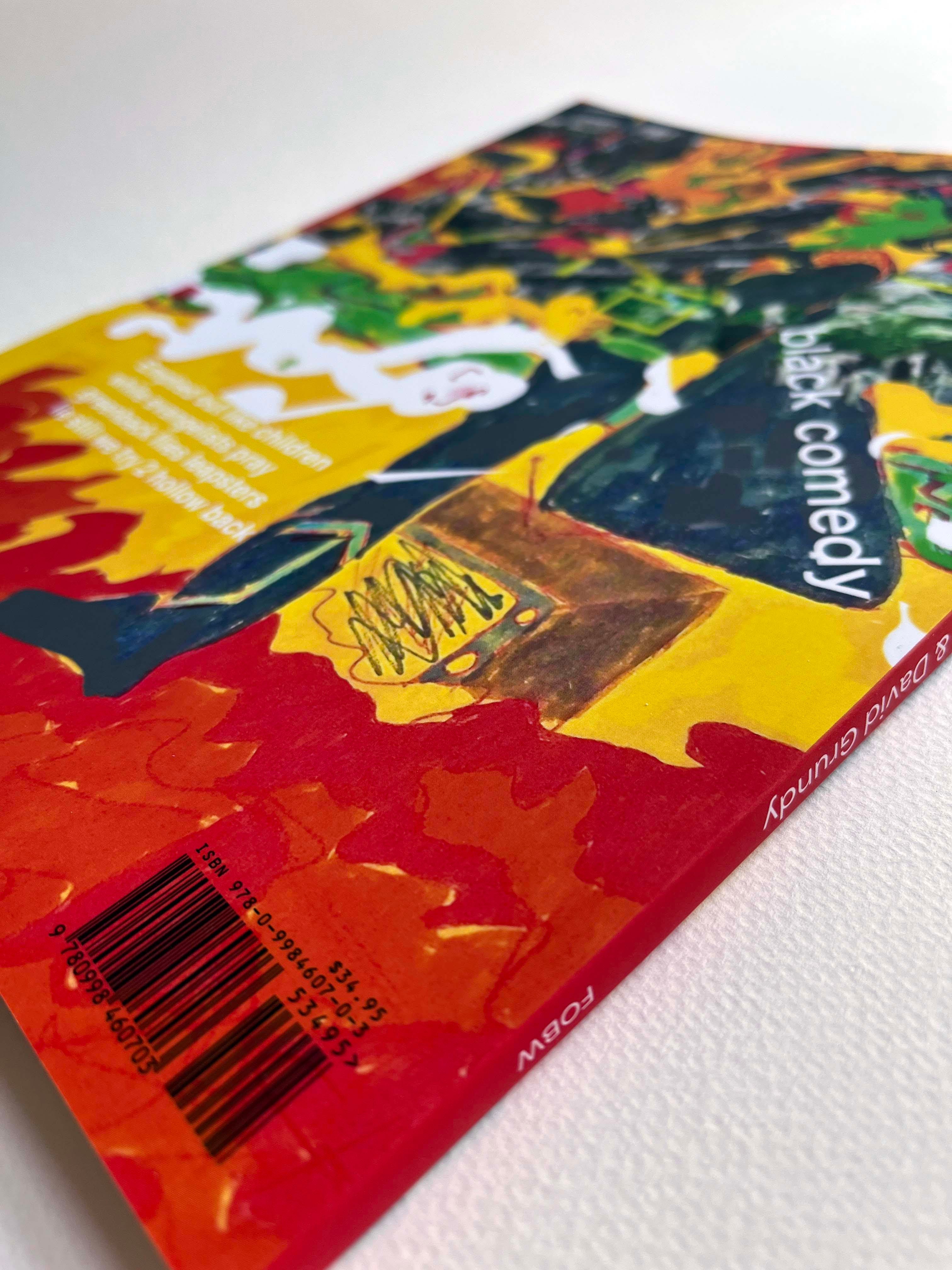
ISBN: 9780998460703
142 pages
Full Color Paperback
$34.95
April 2026

Buy Now

Praise for Abstractive:

“For Russell Atkins, the ‘psychovisualist’ composes structured relationships that can be viscerally felt by the mind’s eye. In Abstractive, readers learn to lean on the way those structures snare hidden connections: between visual and language arts, music and emotion, and everyone out there searching for the ancient heavenly connection. We are on the cusp.”—Craig Dworkin, author of Radium of the Word: A Poetics of Materiality

“Here is vivacious visual and textual collaboration where melodic lines act as a counterpoint of philosophic riffing so that signification is expansively flung open delivering vantage points galore, tantalizing consciousness. ‘Form sets off everywhere’. We are treated to a cacophony in words accompanied by intense, colorful images. Candace Hill Montgomery and David Grundy conjure the living legacy of Russell Atkins and the results are exquisite!”—Brenda Iijima, author of Presence

“Candace Hill Montgomery and David Grundy set off a collaborative sensory sweep via these polyphonic and polyrhythmic poems, ‘ensorcellating’ an expansive tonality playing within and around image and word. These poems seek a mental music that ‘avoids fitting into the chord,’ ‘innuendoewing’ around the breakage of each eroding word. We are borne through the revelation of a doubled ‘mind in flight’: poetry as ongoing, unceasing dialogic process. Following Candance Hill Montgomery’s incredible long poem, Short Leash Kept On (Materials 2022), this is a thrilling and essential work.”—Geoffrey Olsen, author of Nerves Between Song

About the Authors:

The work of Candace Hill Montgomery spans painting, photography, installation, assemblage, textiles and writing. Making and exhibiting since the 1970s, Hill Montgomery was born in 1945 in Queens, New York, and now lives and works in Bridgehampton, New York. In 2024, she presented a solo exhibition, Pretty Birds Peer Speak Sow Peculiar, at Blank Forms, New York. Recent group exhibitions include From the Studio: Fifty-Eight Years of Artists in Residence, Studio Museum in Harlem (New York, 2025); Here Is a Gale Warning: Art, Crisis & Survival, Kettle’s Yard (Cambridge, 2025) and Reluctant Gravities, Hollybush Gardens (London, 2024). Her latest publications include the collection Muss Sill (Distance No Object, 2020) and Short Leash Kept On (Materials, 2022), a long poem inspired by detective fiction and the writing of Lloyd Addison and Russell Atkins. In 2023, a major essay on her work, “Candace Hill-Montgomery, Against Containment” by Amy Tobin, was published in Art History, Volume 46. She is represented by Hollybush Gardens in London and will present her first solo exhibition with the gallery in June 2026.

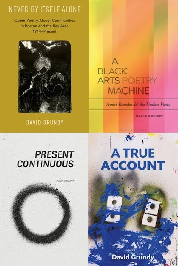
David Grundy is a poet and scholar. He is the author of the critical books A Black Arts Poetry Machine: Amiri Baraka and the Umbra Poets (Bloomsbury, 2019) and Never by Itself Alone: Queer Poetry in Boston and San Francisco, 1944–Present (Oxford University Press, 2024); A True Account (The 87 Press, 2023), a book of poetry; and Present Continuous (Pamenar Press, 2022), a book of lyric essays; and co-editor, with Lauri Scheyer, of Selected Poems of Calvin C. Hernton (Wesleyan University Press, 2023). He runs the small press Materials.

Wednesday, 19 November 2025

November Updates

In the past few weeks, I’ve been working quite intensively on a long essay on Cecil Taylor’s poetry for what looks to be an expansive collection on Taylor’s work edited by Peter Valente. Having long thought a book like this should happen, I’m delighted it finally is! Taylor’s work has meant a lot to me for what seems like forever—certainly, since writing, or trying to write an MA thesis on his poetry back in 2011: a somewhat wobbly first step, or what Taylor himself would call an ‘Excursion on a Wobbly Rail.’

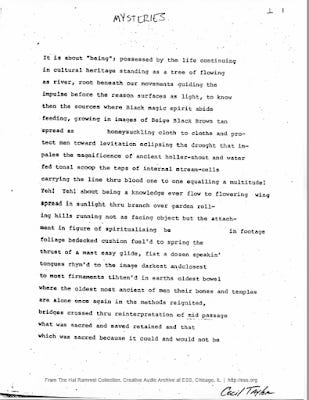
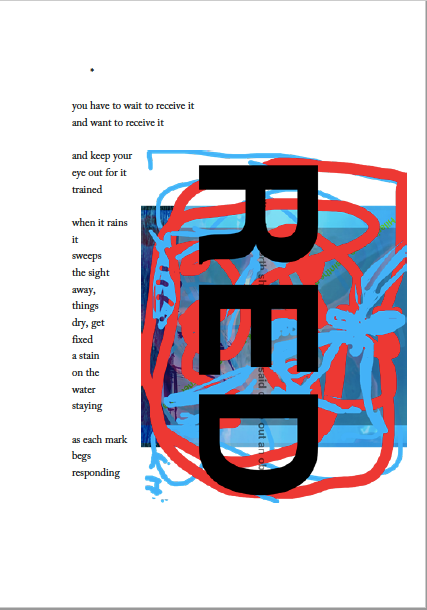
This latest iteration is part of what I think of as a suite of writing on Taylor’s work, particularly his poetry: a memorial post in 2018, a piece for Chicago Review in 2019, and an essay on Taylor and vodou for Point of Departure in 2020. It updates all that with some new reseearch—the conference on Taylor’s work at CUNY in 2019, Phil Freeman’s recent biography of Taylor, In the Brewing Luminous, a valuable chronological synthesis of existing materials and new interviews, and—not least—seeing a copy of Taylor’s unpublished poetry manuscript, Mysteries, of which the first page is above.

Besides that essay, I’m planning for other writing on Taylor, its final form yet to be determined, to find its place in two current manuscripts on music, Survival Music and Ensembles. Taylor’s work continues to mean a huge amount to me. An all-consuming music, an all-consuming vision. Here’s a bit of the work in progress:

In the film Imagine the Sound, Taylor speaks of making “the commitment to poetry”. But what did poetry mean for Cecil Taylor? Poetry was, I argue in this essay, where he theorized his artistic conception. It was poetry he credited with saving his life, and in turn, it became part of the way he understood the nature of life, his own life, and that of life in general; of how to live one’s life, of how to approach art with charm, with ferocious grace, and with the unstinting courage of conviction.

Lots to catch up on in the meanwhile....In the not too distant future, I’m hoping to post here some writing on Wadada Leo Smith and a report on the Berlin Jazz Festival. Some other things are in the works as well. For now, news and some capsule reviews, notices of new work...

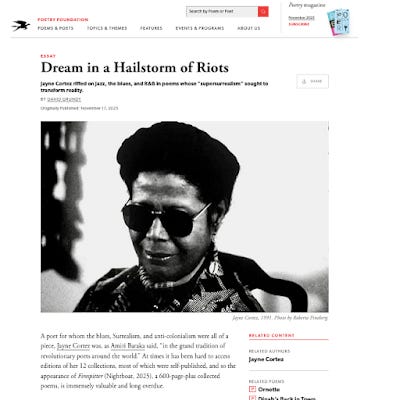
—‘Dream in a Hailstorm of Riots’, a long piece on the new collected poems of Jayne Cortez, is up at the Poetry Foundation.

From the mid 1960s through the early aughts, Cortez wrote about the political crises of her times: Attica, Allende, Palestine, Rwanda. But like fellow African-American Surrealists Ted Joans and Bob Kaufman, she was as interested in transforming reality as in documenting it. She bursts generalities and stereotypes in startling catalogues of surreal images that build around repeated phrases like the riffs of an improvising soloist. In her work, observations of everyday life and political events turn into dream visions, apocalyptic landscapes, meditations, and exhortations that crackle with energy, rage, and love. Above all, she is perhaps the poet of what her generation referred to as “The Music,” the various traditions of jazz, the blues, and R&B that soundtracked the freedom dreams of the Black liberation struggle. Cortez wrote poems in tribute to musicians and led her own band, the Firespitters, for decades. Hers is a voice—both on and off the page—that speaks with authority, curiosity, and an unshakeable faith in the power of poetry to change consciousness and change lives.

—Honoured to receive this attentive review by Eric Keenaghan of Never By Itself Alone at Resources for American Literary Study. Eric’s own work on queer coalitions, and with the writing of Muriel Rukeyser is, are necessary projects of historical reclamation and reminders of traditions of principle, resistance, and the complex negotiations of struggle for committed writers in times of crisis—needless to say, perhaps more relevant than ever.

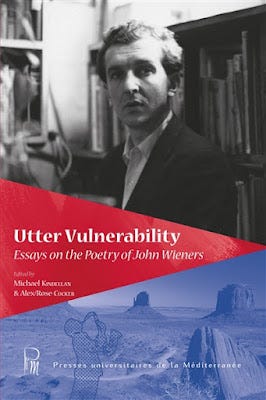
—An essay on John Wieners from almost ten years(!) ago, now in print in Utter Vulnerability: Essays on the Poetry of John Wieners, edited by Michael Kindellan and Alex/Rose Cocker, published by Presses Universitaires de la Méditerranée. This was the first thing I wrote after handing in my Ph.D thesis and it feels like a signficant part of the work I did since then flowed out of this way of thinking. It’s about love and poetry and fire and Wieners’s relationship to his first love, Dana Durkee.

This chapter addresses what John Wieners claimed was the most important romantic attachment of his life—that with his partner of six years, Dana Durkee—and the eventual ending of that relationship. As I’ll show, this loss can be said, in part, to have prompted Wieners’ fully-fledged entry into the world of poetry, prompting the composition of his breakthrough volume The Hotel Wentley Poems (1958), and it seeps into the minute fabric of his language itself, whether through conscious acts of address, revision and removal, or sublimated elements of textual echo which at once memorialise and disavow the object of loss. By introducing this element of biographical resonance, I do not wish to reduce Wieners’ poetry to a pained lyric exceptionalism, the poet as an exemplary figure of suffering removed from the social conditions that produce that suffering. Rather, such information serves as a means of heightening the way loss and despair intersect with socially produced domination, and the problems of community and desire in the face of persecution and its constant threat. As Denise Levertov astutely noted in 1965, in Wieners’ work, “Confessional” subjects such as mental breakdowns and the pain and loneliness of queer love are “not autobiographically written about, they are conditions out of which it happens that songs arise”.

—And last but not least, I’m very pleased that CJ Martin and Julia Drescher’s Further Other Book Works have taken on Abstractive, the book of poems and visual art works I wrote with the great Candace Hill Montgomery last year (with some final tweaks this past month). More details will be forthcoming. For now, as a sneak preview, here’s a page of the manuscript….

Monday, 3 February 2025

Reprints from Materials

Pleased to finally be able to put back into print a number of out-of-print titles from Materials, among them a re-typeset and re-designed second printing of D.S. Marriott’s Duppies, previously published by Materials in 2017 and in a US edition with Commune the following year, and out of print for a few years now. I’ve wanted to put this back into circulation for some time, especially since the folding of Commune Editions also put the US edition out of print. (I’d also highly recommend D.S. Marriott's subsequent books of poetry, Before Whiteness from City Lights and the forthcoming Letters from the Black Ark from Omnidawn.) Here’s the cover (Clarence Major’s painting At the Turning Point opens up the book inside.)

Screen Shot 2025-01-28 at 13.22.19.png

The full list of books now back in print: 

D.S. Marriott, Duppies (2017)
Lisa Jay Jeschke, The Anthology of Poems by Drunk Women (2018)
Anne Boyer, Money City Sick as Fuck (2019)
Laurel Uziell, T (2020)
Tongo Eisen-Martin, Waiting Behind Tornados For Food (2020)
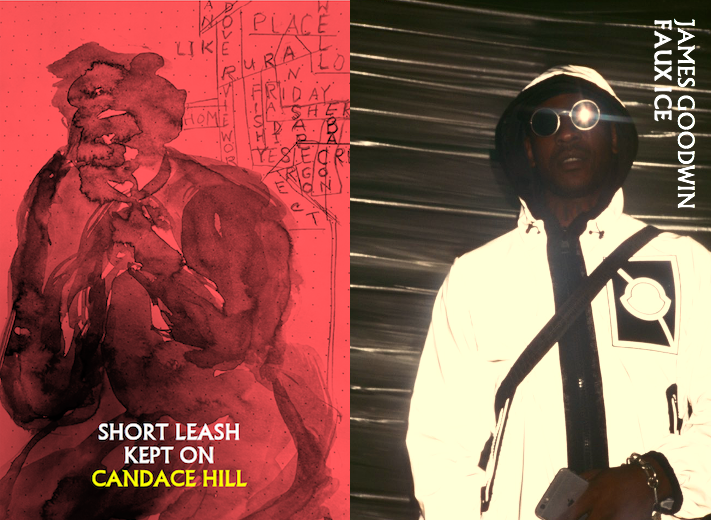
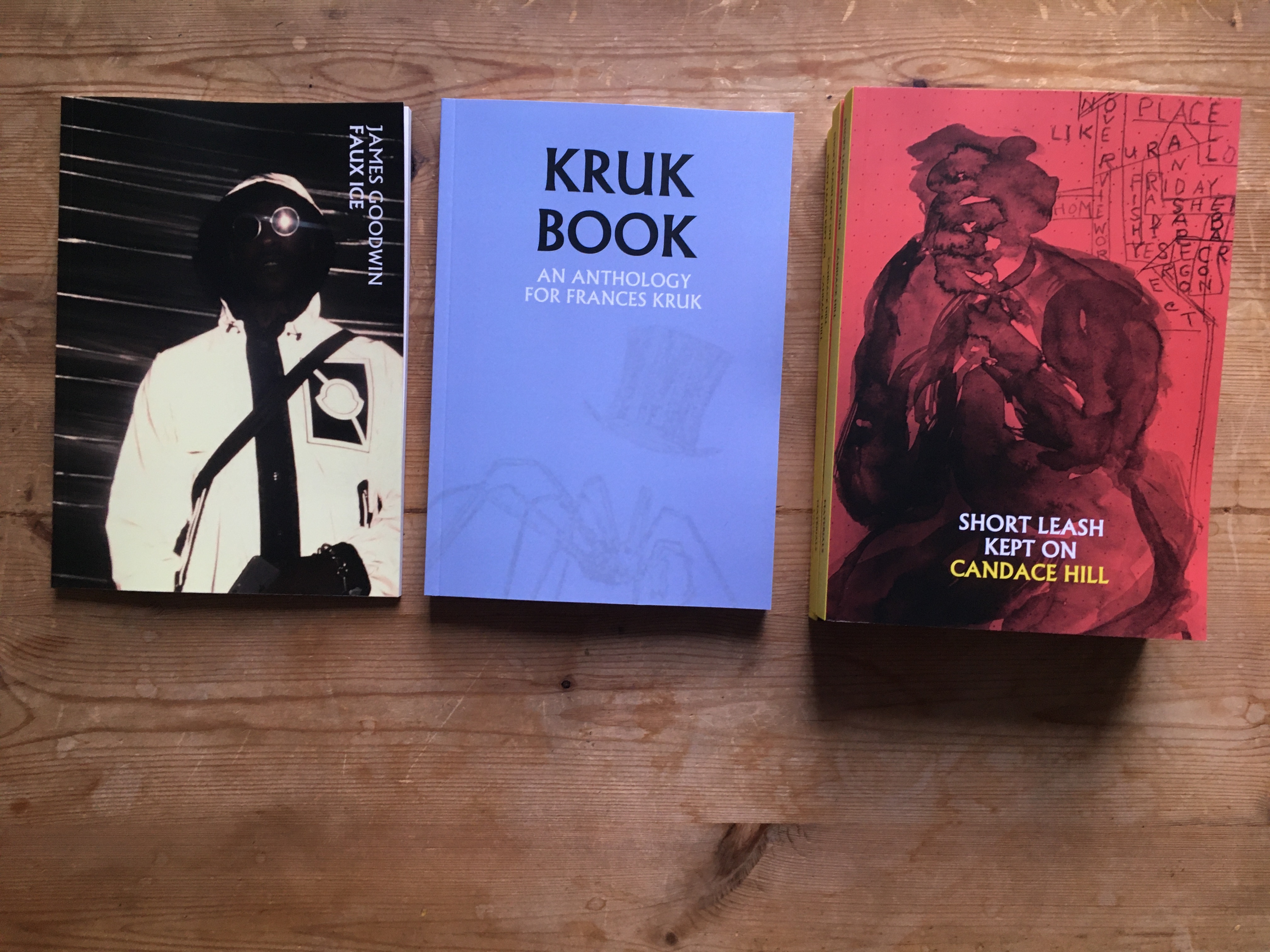
James Goodwin, Faux Ice (2022)
Candace Hill, Short Leash Kept On (2022)

You can find them all on the Materials website at the links above, or at the main page here: https://material-s.blogspot.com/

~~~


Also:

On newly-available footage of Albert Ayler for The Wire: ‘Eye and Ear Control’.

On Will Rowe for English Studies in Latin America: ‘No More Burial Remedies’.

Friday, 3 January 2025

New Year


Back at the start of 2022, I posted some kind of new year’s resolutions list on this blog. Technically, it was more an expanded to-do list, which I suppose is the ambiguity of the form itself--an internalized work-discipline where ‘character-building’, personal fulfilment, achievement of goals, etc, etc, all merge together: pseudo-movement, changing and continuing, like Mike Kelley’s Banana Man, surrounded by a crowd of people who declare themselves all to be moving but who seem to be standing still, lying in a crater in the earth flapping arms and legs and pretending to be an angel, dressed as a stagnant pond that recirculates but doesn’t move. So too, the resolution form, stuck between a series of goals, achievements, work tasks, and something more numinous that doesn’t just turn life into a series of targets and believes in some actual possibility of change. 

But who thinks about lists for so long? So here, a few years later, another list, a placeholder for myself as much as anything: an accumulating pile of projects, some of them already initiated back in 2022, others more recent, all of them overlapping so that nothing is ever truly finished--a way of not ending, somewhere between useful motivation and pathology.

Working collectively, collaboratively, is one way to see writing as part of something that reaches beyond itself, beyond selves, as something with a future. And working together this past year, in person and virtually, with Candace Hill on a poetry-and-art book called Abstractive has been a joy--the manuscript now done and in search of a publisher. It’s been a pleasure, too, to open up an ‘infinitive conversation’ document with Nhã Thuyên, in lieu of conversations in person and on foot round the city, and a real honour in the summer to publish Don’t Hide the Madness, a chapbook excerpt of the longer manuscript Taste of Water, in Kaitlin Rees’s expert and fastidious translation. Don’t Hide the Madness and a of Askia Touré’s Songhai! were last year’s Materials titles: in the works next year are Howard Slater’s translation of Abdellatif Laâbi, some other new titles to be announced, and newly typeset-reprint of D.S. Marriott’s Duppies, and fresh runs of temporarily out-of-print titles by Anne Boyer, Lisa Jeschke, James Goodwin, and Tongo Eisen-Martin.

Since 2020 editing work with Tonya Foster and Jean-Philippe Marcoux on the two-volume anthology The Umbra Galaxy has been a constant presence. Four years on, the books are moving ever closer to the finish line, and after years of online meetings, it was a thrill to discuss it in person and in public with Tonya and Jean-Philippe at the Furious Flower conference in September, the next iteration at the Louisville conference on literature and culture this coming February. 

Outside collective work, there a number of manuscripts in some sort of progress: there’s the makings of a critical manuscript on contemporary poetry, maybe called Working Notes, still to be hashed out; a book on free jazz, Survival Music, continues to be researched and slowly written, as does another planned book on music, Ensembles, accumulating and expanding before (hopefully) to condense a little; there’s an in-progress poetry manuscript, On Musical Objects (a bit of it here), and along the way I may have accidentally ended up writing a book of daily/political essays, though that’s perhaps best left to brew a little. And outside writing--and back to collective working--continued music-making in duo with Tansy Spinks (so far, largely in a studio on a hill overlooking West Norwood, occasionally in other places like Cafe Oto), and in trio with GUE, as well as in another duo with Unk in a bunker near, if not quite beneath, a heath; ‘expanded improvisation’ workshops with Mattin, and a related project on freedom and improvisation.

But enough of lists! All these enumerations of projects tends toward the logic of the CV, the accumulation of writing or writing about writing experienced on substack or social media or whatever other data-harvesting curated venue tend towards the personal brand competing for attention, rather than as part of the collective (fractured, fragmented, sometimes cohesive) struggle within language that one would hope writing would strive towards. As European right-wing social democracy continues to destroy itself, the ‘centrist’ media narrative continues to cling to ‘liberal hope’, the Macrons and von der Leyens and Ampels and Harrises of this world seen as a bulwark against the rise of fascist and neo-fascist parties. But, as a friend put it to me the other day, this imagined centre is, in fact, the centre of the right-wing, as the political climate lurches (is pushed) towards the anti-migrant, anti-woke manufacturing of culture wars with quite material effects, the fusion of nationalist rhetoric and international capital, the accelerated race to hell. For over a year now genocide has gone on unchecked in Gaza, murder on murder on murder, and still the weapons flow, the US has elected a president who promises some unforeseen fusion of old and new right in alliance with tech billionaires, who in turn contribute funding and support to the fascism that rears its head in France, in Germany, in right-wing riots in the UK, the rhetoric of the border on the one hand, the flow of capital, the flow of weapons on the other. Increasingly, we’re going to be writing our way into fascism, however directly it affects us, some insulated, some on the front lines. Our writing, our music, our art, our action, is going to have to rise to this. Our ‘our’.

Today, for once, the sun is shining, though snow is forecast; a squirrel is running around outside gathering or burying its food; plants, still half-way between life and death, lean out towards the window and towards the light.


Thursday, 2 November 2023

A True Account


A True Account, a book of poems, recently came out from The 87 Press, with cover art by the great Candace Hill-Montgomery. Here's the write-up:
A True Account collects works written between 2013 and 2020, published by a variety of small presses in the UK and the US. Here are variously refracted the student movement, austerity, general election, referendum, the crisis of 2020 or 2019 or any year you care to name; the Massacre of the Innocents, the housing question, the October Revolution in November; Sappho, Mingus, Storm Ophelia; Rukeyser, Rilke, Rodefer; the aesthetics of resistance, the insistence of history: luxury and voluptuousness, peace and pleasure, beauty and order, the questions that still remain unanswered and the problems that remain unsolved. “Wanting poetry to save my life, to shame my life, as LONG as the WORLD is WIDE, and as WIDE as the WORLD is LONG.”

“Lyrically gorgeous and real poetry. This book is a bright spot in a bleak time.” - Peter Gizzi 
You can get the book here, and I'll be launching the book in person in London at Cafe Oto on December 8th.


--Also out, a cassette release of me reading my 2014 long poem The Problem, The Questions, The Poem on Ben Hall's cassette label Ornette Coleman Fiend Club--available here. 


--Jazz poetry primer in The Wire.


--On Christian Wolff in Artforum. This piece came out just days before the disgraceful firing of AF's editor David Velasco over the publication of the 'Open Letter from the Art Community to Cultural Organizations' against the ongoing mass murder in Gaza, and the subsequent resignation of Zack Hatfield and Chloe Wyma, whose editorial guidance over the pieces I've published in Artforum over the past few years has been exemplary. An open letter of October 27th, criticizing the actions of AF's owners, Penske Media Corporation, can be found and signed here.

***

Meanwhile, in person, for those of you in or around Berlin, I'll be giving two talks in December, both at the Freie Universität: on Monday, December 4th I'll be giving a lecture on Amiri Baraka and the Advanced Workers (details here), and then the following Tuesday, 12th December, I'll be giving a seminar on my current project on free jazz, Survival Music (Room 319, John F Kennedy Institut for American Studies, Lansstraße 7-9, 14195 Berlin, 2pm-4pm). And this month, at the kind invitation of Dimitra Ioannou, I'll be giving a talk at the A Glimpse of Festival, critical institute for Arts and Politics, Politechniou 8, 104 33 Athens, Greece, on the weekend of November 25th/26th.

Monday, 22 May 2023

News of News


Some recent writing:

--On So Much for Life, the new Mark Hyatt Selected Poems edited by Sam Ladkin and Luke Roberts, for The Poetry Foundation.

--On Elaine Mitchener's forthcoming performance of Peter Maxwell-Davies's Eight Songs for a Mad King for The Wire here. A longer piece on Eight Songs and its contexts is brewing somewhere along the line.

And some upcoming gigs:

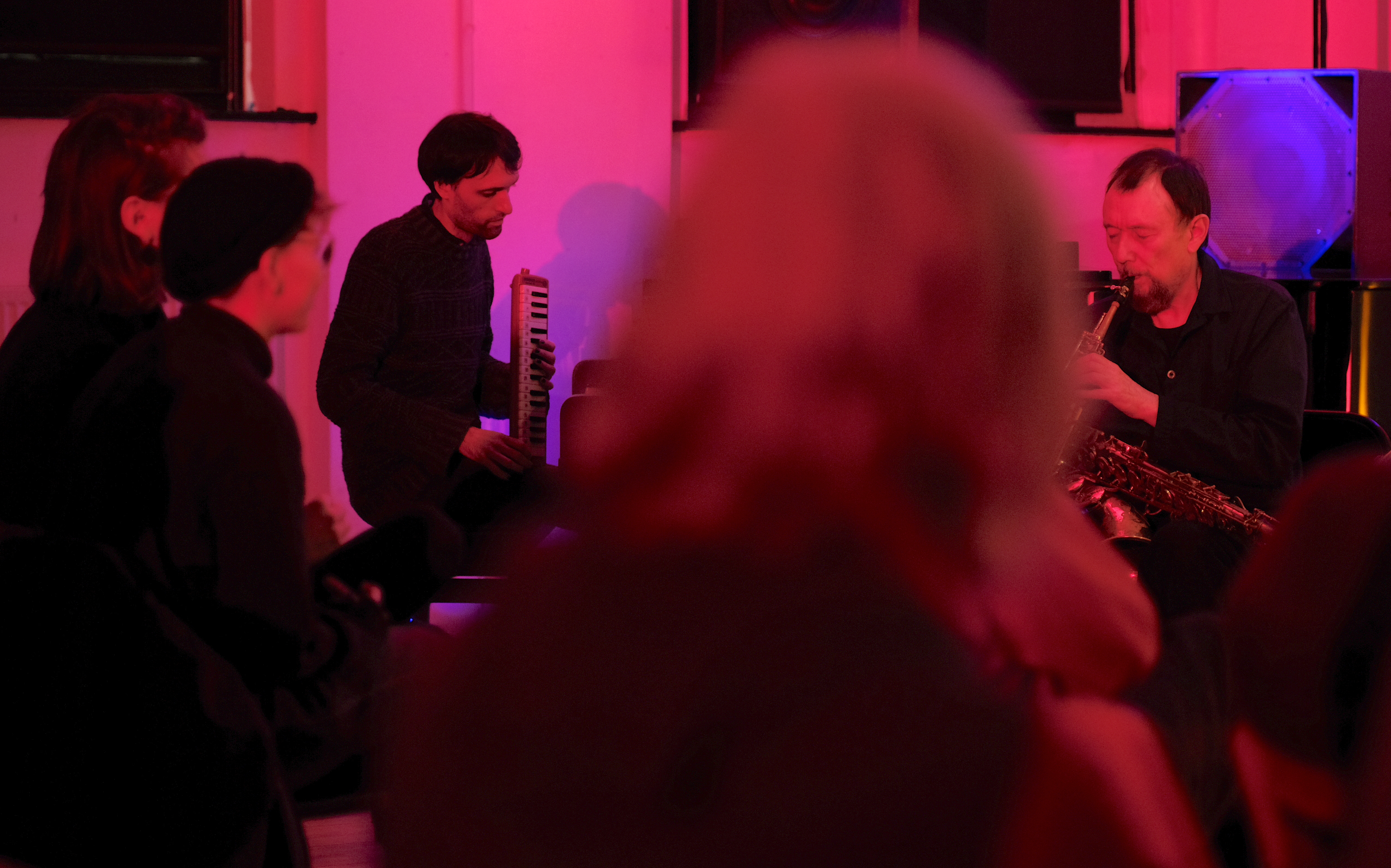
--Following a gig at waterintobeer last month, a second outing for Multiple Melodicas (me, Douglas Benford, Steve Beresford, Georgina Brett, Martin Hackett) at Cafe Oto on the afternoon of Sunday 4th June, along with a solo piano set by Steve Beresford and a duo set by me on piano and Tansy Spinks on violin. Details here. 


--Also planning another gig by G.U.E. (me, Jacken Elswyth, Laurel Uziell) on a bill with Tom Betteridge making what I believe is a live solo debut and Regan Bowering on electronics/objects/snare drum. This one will be at waterintobeer in Brockley on Tuesday 13th June, doors at 18:30. Tickets here.

We've been going through hours' worth of GUE recordings made over the past year or so so a release of some sort will be on the cards at some point soon.


And in other news...

--Following the launch reading with James Goodwin and Candace Hill last month, Howard Slater's review of Candace's Short Leash Kept On at Northern Review of Books here. (The book is available at the Materials website.)

--And there's also a nice review from Tom Allen of Present Continuous at LA Review of Books.

Finally, Materials will be relocating to Berlin in July, joining Materialien in Germany, which may involve some logistical shuffling and slower processing for orders. But expect more news the other side of the move...

Thursday, 20 April 2023

Latest

My essay, 'Songs for the Future', on Askia Touré's Songhai! and the African American epic, is out now in Paideuma, Vol.48, as part of a special tribute to issue to Touré's book that also includes essays by Addison Gayle, Jim Smethurst, and Kathy Lou Schultz. Many thanks to Ben Friedlander and Betsy Rose.

The UK reprint of Songhai! will be out soon from Materials.


A review of the Fred Moten/Brandon López/ Gerald Cleaver show at Cafe Oto in Artforum here, with some words on Candace Hill's phenomenal reading the same afternoon along the way.

Review of Jason Moran's superb James Reece Europe tribute From the Dancehall to the Battlefield in The Wire 471.


And soon forthcoming, a long piece on the new Selected Poems of Mark Hyatt, a scholarly labour of love by Sam Ladkin and Luke Roberts, at The Poetry Foundation.

Sunday, 2 April 2023

In other news...

On Sunday April 8th (next weekend) we'll be launching the new Materials books by Candace Hill and James Goodwin at Cafe Oto in Dalston at a 2pm matinee reading. James will be reading from his new book Faux Ice and in conversation with Nisha Ramayya, and this will be a rare opportunity for UK audiences to hear from the astonishing Candace Hill--artist, poet, weaver, author of the 200 page epic Short Leash Kept On--who'll be reading and in conversation via video link. Come for the afternoon and stay for the Fred Moten reading at the same venue in the evening! Details and advance tickets here.
 
On Thursday April 13th I'll be playing with a new group, Multiple Melodicas, at waterintobeer in Brockley, South London: myself, Georgina Brett, Steve Beresford, Douglas Benford, and Martin Hackett on melodicas, along with solos sets from Eddie Prévost and N.O. Moore. Unit 2, mantle court, 209-211 mantle road, brockley, se4 2ew. Doors: 6:30pm for a 7pm start. More details and advance tickets at the eventbrite page.


Then at 7:00pm on Wednesday April 19th I'll be reading from Present Continuous for a Pamenar Press spring reading at Thingy Café in Hackney Wick. Details here.

Finally, at 7:00pm on Wednesday April 26th I'll be taking part in a performance by members of the Eddie Prévost workshop at IKLECTIK, Waterloo, as part of the here.here series, for which Eddie will also be in conversation with Emmanuelle Waeckerlé.

---

And from a previous here.here, here's footage of my conversation with Eva-Maria Houben, Emmanuelle Waeckerlé, and Artur Vidal as part of the concert Social Virtuosity with Eva-Maria Houben curated by Emmanuelle at IKLECTIK in March. The video presents the whole concert: Artur's performance of dreaming legends, Artur's and Eva-Maria's performance of loose ties, and the string ensemble piece the green that is almost a yellow, performed by Lara Agar, Angharad Davies, Isidora Edwards, Finn Froome-Lewis, Dominic Lash, and Hannah Marshall, and the post-performance conversation. The performance of the string piece in particular was astonishing, its silence full and shared, its overlapping lines a perpetual making and unmaking of space as shelter; Eva-Maria's and Artur's performance with organist Huw Morgan the previous Friday was equally exceptional: I'm hoping to work up a longer piece on that (via Straub-Huillet's Cézanne) at some point in the not to distant future...


Meanwhile, elsewhere on the internet, the Poetry Center has been digitzing some astonishing readings from the 1970s. Filmed in San Francisco State University's Creative Arts Building, Lorenzo Thomas reading 'Grandpa's Spells' (named for the Jelly Roll Morton piece) is nothing short of breathtaking. Musicked speech indeed...

But, as well as music, this work is also conversation--talking (talking to, talking about, talking with, talking back). "I want to talk about the tears and sorrows of the people", he says in his introduction. And this concept of "the people" is a global one, Thomas reading his poem in memory of Neruda and translations of work by African poets--that internationalist, multi-lingual aspect running through his work: poems by Francisco José Tenreiro, Agostinho Neto, Marcelino Dos Santos, the latter then emerging from the victorious struggles against Portugal in Angola and Mozambique. Thomas' work of the 1970s, as he honed the finely-poised ironies of his earlier work through the lens of his experience in Vietnam and his reading in writers like Christopher Caudwell, is a contribution to a left populist poetry that has been virtually ignored: far too few notices of the Collected Poems edited by Aldon Nielsen and Laura Vrana have made it into print. (I've so far been unable to place my own review.) But being able to watch this video, to hear Thomas' cadences, his sonorous rise and fall, helps to newly bring that work alive: a poetry that charges the space, crackles with fierce energy and moral compulsion.   

Thomas read with David Henderson, fronting the nine-piece band Ghetto Violence--as singer...(in this harking back to his early career with vocal group the Star Steppers, as documented in Henderson's classic early poem 'Boston Road Blues' (for the poem, scroll down to page 41 here.) In the U.S. Bicentennial Spring, Henderson and the band deliver "Hail to the Chief" ("agit-rock...dedicated to the next Presidential election". In the event, Jimmy Carter would replace Gerald Ford, who'd pardoned Richard Nixon for his Watergate crimes, in the recurring cycle of putatively 'democratic' debasement. It continues.

(The full recording of Thomas' and Henderson's reading is here.)

Also from the Poetry Centre's Digital Archives, another gem: Karen Brodine and Meridel LeSueur reading in 1981, two generations of Left feminist writing looking into the jaws of the 1980s with implacable courage. What's particularly valuable is to have this document of Brodine reading the entirety of the sequence Woman Sitting at the Machine, Thinking, written from her experience of workplace organising as a typesetter (and her reading of Engels). I'm working on a chapter on Brodine, Merle Woo and Nellie Wong for a forthcoming book on queer poetry in Boston and San Francisco which hopefully will be fully drafted in the next few months. Last year, I spent a valuable week in Brodine's archives at the James C. Hormel Center on the top floor of the San Francisco Public Library, Tim Wilson and the other librarians patiently bringing me box after box and allowing me to see, in her unpublished notebooks, drafts, teaching preparations, and talks, how, for her, poetry articulated her sense of herself as woman, as lesbian, as worker, as socialist, the clarity of the way she theorizes language, the specific uses she sees poetry as fulfilling: conceptions well beyond the cliche of poetry as a kind of transparent vehicle for messages, on the one hand, or as 'neutral' abstraction on the other. For Brodine, poetry's form is its argument: which is to say that "form" is inseparable from, dialectically related to "content", the distinction between which she skewers in her unpublished pieces on aesthetics. We all know the rhythms of our days, shaped by labour or its absence, in our different ways, some feeling the pinch more than others, and spending time with 'Woman Sitting' in particular, going over it and again, still enables a reckoning with and refiguration with the violence of that time, the violence of Brodine's and our times: this poem which is so much about time, about the work week and the ways workers work within and resist capitalist time.

knowledge this power owned, nor shared
owned and hoarded
to white men [...]
                           wrench it back
knowledge is something we have 

Here's Brodine's reading: 


And from the same reading it would be negligent not to mention Meridel Le Sueur's poems of fierce solidarity, reading the global and gendered division of labour in ways that, once again, are firmly internationalist, are about mapping the general and the particular in precise and specific ways that poetry--specifically--can be used as a tool to pry open, a compass for navigation. And Le Sueur's opening denunciation of Eliot's The Waste Land as nihilistic male modernism remains as hilarious and as provocative as it's meant to be...

Saturday, 25 February 2023

News and Views

In February I was interviewed about A Black Arts Poetry Machine by João Paulo Guimarães (University of Porto) and Elina Siltanen (University of Turku) for the online Poets Talk Politics Series hosted by the University of Porto. Thanks to João and Elina for the questions and discussion, and to João for the invitation. The event was live-streamed and should be uploaded to the Youtube channel of the Instituto de Literatura Comparada Margarida Losa in the next few weeks. For now, it's available on Facebook, as embedded below (no need for an account) or at this link.


Also online is the video of the online launch for Present Continuous back in January, hosted by Malvika Jolly and with responses from Tyrone Williams, Linda Kemp, Ciarán Finlayson, and Ghazal Mosadeq, can be seen on the Pamenar Press Youtube channel here, or in the video embedded below. Many thanks to Malvika for hosting and Ghazal and Hamed for publishing, designing and typesetting the book!

Some photos from the 'Electro-Acoustic Responsiveness' gig at IKLECTIK with Eddie Prévost (percussion), John Butcher (tenor and soprano saxophones), N.O. Moore (guitar), Emmanuelle Waeckerlé (voice, objects), and Tony Hardie-Bick (electronics), courtesy of film-maker Stewart Morgan, whose film on Prévost should soon be nearing completion. 


Photo credit - Stewart Morgan Hajdukiewicz

And some photos from the Materials/Materialien reading at Halle für Kunst Lüneburg, with James Goodwin (launching the new collection Faux Ice), Lütfiye Güzel and Laurel Uziell: thanks to curators Ann-Kathrin Eickohf and Elisa R. Linn. 


James will be doing a UK launch for his book at Café Oto in Dalston on Sunday 9th April; this will also be the launch for Candace Hill's astonishing book-length poem Short Leash Kept On. James will be in conversation with Nisha Ramayya and I'll be in conversation with Candace via Zoom. (Fred Moten will be reading, in his trio with Brandon Lopez and Gerald Cleaver, later in the evening.) Tickets from the Café Oto website.


Finally, in further Materials news, Anne Boyer's Money City Sick as Fuck and Lisa Jeschke's The Athology of Poems by Drunk Women are back in print and can be purchased from the Materials website at the following links: Boyer here and Jeschke here.


Monday, 16 January 2023

New from Materials

Announcing three new titles from Materials: Faux Ice by James Goodwin, Short Leash Kept On by Candace Hill, and Kruk Book: An Anthology of Frances Kruk. All three can be purchased from the Materials website: http://material-s.blogspot.com/

A long-awaited reprint of Askia Touré’s Songhai is also available for pre-order and will be printed in early 2023.


Monday, 10 August 2020

"Airpower coming out of my mouth": Candace Hill

Candace Hill, Muss Sill (London: Distance No Object, 2020)

Just out from London-based small press Distance No Object, this 67-page volume has, over the past few days, provided some welcome flickers of light in early August’s pandemicked heatwave. Hill is best known as an artist working in photography, mixed-media collage, and watercolor—her painting ‘The N.Y. Pigeon’ stands as front-cover sentinel. Though she’s previously worked with words as part of images, this is her first collection of stand-alone poems. But it doesn’t easily fit the paradigm of artist’s book, book by artist, studio journal, manifesto. Hill instead more closely resembles—in level of focus, if not the work itself—artist-poets like Etel Adnan, for whom the disciplines of art and poetry are not subsidiary to each other, nor mirror reflections, but equally-weighted paths of investigation. The poems are ‘stand-alone’ in being purely textually based: but they also ‘stand alone’ in their distinctiveness. They’re poems that fit most every definition of ‘unique’, ‘individual’, ‘not like any other’: at the same time, they rarely rest for any authority on the originating or binding consciousness of the mind’s I that spawns their strings of creative association. That’s to say, they sound like nothing but their (multiple) selves. Sometimes ecstatically beside themselves, sometimes in the position of the sardonic observer standing to the side, the poems are clearly the product of a very particular, very individual linguistic consciousness: they reflect a very specific way of seeing, hearing or speaking the world in words that’s unlike other, more familiar ways of seeing, hearing, or speaking the world; that, in the dictionary definition of idiolect, manifests “the speech habits peculiar to a particular person”—a condition after all, that governs the productive tensions of speech itself.


It’s like this: “ ‘She nodded’. Whoever she is. Move the huh huh huh / Huh’s in”. As a whole, the book is a sometimes frenetically overlapping ensemble of shorter pieces, anything from a few lines to a few pages in length, perhaps best appreciated through its parts rather than its sum. After several read-throughs, I’ve found that they have their fullest effect when taken in small doses. Chorically chaotic, a swarm of sounds, impressions, senses, noises, flashing insights, fast and lively, it can be hard to keep up, and zooming in on a few pages at a time helps to elucidate their workings with greater richness. When sampled this way, it’s all the more readily apparent how these poems dance with a slapstick precision; how they fizz with the sheer delight of language, the sonic preponderances that are poetry’s particular unbounded domain; how they zip and pop with a delight in the mysteriously material mechanics of language, spectrally earthy, morphing on the tip of a poised tongue. This is not poetry which will do what you want or expect it to do, but in its quick-linking, jump-cutting double-takes, it whirligigs everything that comes into its path—including that individually generalised figure, ‘the reader’, shaken and delighted by its pun-riven audacity.


For all their individuality, Hill’s poems operate in a tradition of African American experimental poetry—that territory critics like Aldon Nielsen have so painstakingly tried to bring into the consciousness of a literary-historical model that almost entirely ignores them. Gertrude Stein may or may not have met Langston Hughes, as the book’s preface notes (recall Hughes’ audacious political reading of Stein’s statements in the context of US race prejudice and imperial practice, written in 1949), but Tom Postell saw her on the Down Town El to New York City (in the first edition of Yugen) and Harryette Mullen trimmed her into the shape-shifting free-play constraints of her prose-poetic frames. Langston Hughes gets name-checked a number of times across these poems, though he doesn’t sound very much like anything you’d hear here; Hill’s delight in puns is, however, very much in the vein of Julie Ezelle Patton or Russell Atkins or Julia Fields or Elouise Loftin or Lloyd Addison, and their practice of what Patton dubs “phonemenology”.


In Hill’s case, this approach means that within the space of a single line you might find—to pick an example at random—Marie Curie and Nat Turner jostling for space, as the poem seems to construct a discourse on racialised divide-and-conquer strategies of artworld curation: “Lets rate hate hate hate curate hate hate hate / madam Curie mate Nat Turner hate hate hate curate”. (The next lines spin through Shakespeare, St Francis of Assisi and (possibly) Louis Armstrong-style scat and the 1938, Sabu-starring imperialist vehicle The Drum: keeping up with the trains of association enough to construct a summary would be a fool’s errand.) Let’s say that these poems are something like Coltrane’s sheets of sound, perhaps (exploring every single permutation, every harmonic implication of a particular phrasal or chordal structure, both directions at once), or the pleasure of recognition and defamiliarisation in hip-hop’s multiple samples, a plunderphonic spree in curlicued rhapsodic stutter (the kind of stutter that’s the subject of a poem that muses on the mooring and unmooring, the tethering and untethering of ‘poem’ to ‘meaning’). This process can be both exhilarating and vertiginously risky: the fast breath of ecstasy a split second from the asphyxiating hyper-ventilations of anxiety attack.


Um um um um

Stutter stutter stutter

Omission of jay words

Grunts my incomplete sentencers

Er er failure


The book’s preface suggests as another frame of reference scrolling or rolling news and all the contemporary old/new catastrophes that implies—that out-of-time contemporaneity that time operates in the news’ cycles of the catastrophically unstoppable ever-same — “oh wait it’s 2016”. But there’s material heft, grit, graft, that knottily resists digital simulacra even as it engages with/in its frames: the wastage and resistance of the material that, even in rotting, serves as remainder and reminder of histories those news narratives would rather forget— imprisonment, death, racialised violence and patriarchal power. “Wrongful imprisonment can you hear me up / In damn Antarctica touching freedoms”, begins a poem in which the figures of chairs, walls and livelihoods take place within claustrophobic sculptures that run from the plight of miserable children to the general condition of carceral capitalism, where “nails run / down jailers’ wall’d victory”. But this is also—as a necessity of survival—the realm of those inventive responses that circumvent the given frame. The poem ends on a combination of bitter irony and tentative affirmation:


[…] Slip up on a Motown riffty kinda day yes will win

Stay sporadic & still be gay prayful as we sit

In modernised Jim Crow hay.


In such conditions, there’s no such thing as originality—language as virus or Martian, as the colonial language of the enemy, the linguistic cleansing of class-based grammatical control, a condition of being ‘seized’, from the hold to the cell, the ship to the tower-block, that (re)collects with precious little tranquillity.


Think about jest or originality do you know a mess

it’s close to cunning collected language

What will the will to do do

will the me in me seizure plate.


Collection plates, collected poems, the unchanging will to change, these phrases haunt these lines that are jokes or gestures or death’s jest-book. Yet more often than not—as in that “Motown riffty kinda day”, the poems manage to inhabit a resonant space of conviviality accessed above all through music. Jazz in particular forms an aural soundscape in which the poems can breathe, as Ben Webster free associates into Illinois Jacquet; Jean-Michel Basquiat, famed for painting to bebop, pays a cameo visit; Mal Waldron suddenly turns up in the middle of a seafood cookbook recipe; Billie Holiday’s arm directs an orchestra, suddenly clarifying in a single gesture some particularly bewildering preceding lines, like a couplet’s open closure. This is not musical poetry because it references or describes music; rather it is, in a way, music in itself. Driven insistently, even obsessively by sound, syllables tumbling after each other in a vowel-driven string of association. 


Hill also delights in visual puns—seemingly misplaced apostrophes that radically call into question the English language’s orientation towards property/possession; the use of numerical abbreviations (‘2’, ‘4’) from the early days of SMS messaging turning into numbered lists, or parodies of lists, ways of enumerating relation that form a non-totalising total, a fractiously equalised sum. It would be lazy to read any of the poems as manifesti, as analogous to art practice—this book is notable precisely for not fitting that traditional model of the artist who dabbles in poetry as a kind of testing ground for ideas more fully realised in their art. Rather, the practice of making visual art exists alongside, say, listening to music, going on dates, or cooking seafood. Such practice is most obviously present in the collection’s penultimate, and longest text, a prose poem in 4 sections called ‘Not to Worry’. “Representational painting isn’t much my thing (except the window / thang slidin’) not showing”, writes Hill, suggesting the need to avoid too easy a mimetic switch or slip in the way we think about art: “mix the paint tip the brush standing in for vibes”. In the third section of the poem, Hill asks “Why not write about the inside of creation”. For someone who works with externals, the visual, in another medium (language) that supposedly acts as conduit between interior and exterior, Hill would prefer to wobble that tightrope in delirious pleasure, operating on paradox, wit, and nerve: “Completes compositional destructively / Uncivilly proportionally”. There’s power in play, in pleasure reclamation and yet a reckoning with “forgetting’s bloodletting”: such “bodacious intelligence” may approach the infantile (“dirt do doodles shit’s”; “this is an unryhmed poem an anecdotal / Hammertime individual a winning poo poo reaction”) but it’s a serious embodiment of thought and thought of embodiment that provides material to pore over for days, struck each time by the stringent delirium of invention, laughing out loud at the audacity of a string of puns like a string of pearls sliding all over the floor. 


The book's back cover to the book presents us with an (invented) dictionary definition which explains its odd title. “Muss sill” is said to be “the underlying brown mess small flowers make having been left too long without adding fresh water or rotating in any porous receptacle; the window sill dust over time when left wanting”. Flip to the legit dictionary and muss is a 19th century variant on ‘mess’, a state of disorder, or more often a verb of messing something up, generally with affection—mussing (up) someone’s hair, say. A window (“the window / thang slidin”), opening and closing; the sill an edge on top of an edge, a link between exterior and interior, “the inside of creation”, where “want” and mess, decay and rot nonetheless create possibility, fertilisation, flowers from the shit. At the end of the long prose poem, the poet catches themselves burning food, having left the flowers to rot, and it feels glorious: 


After-all I left corn on grill under candles muss sill

all day sure’s you born still feels good. 


Indeed it does.