Showing posts with label Free Improv. Show all posts

Monday, 24 November 2025

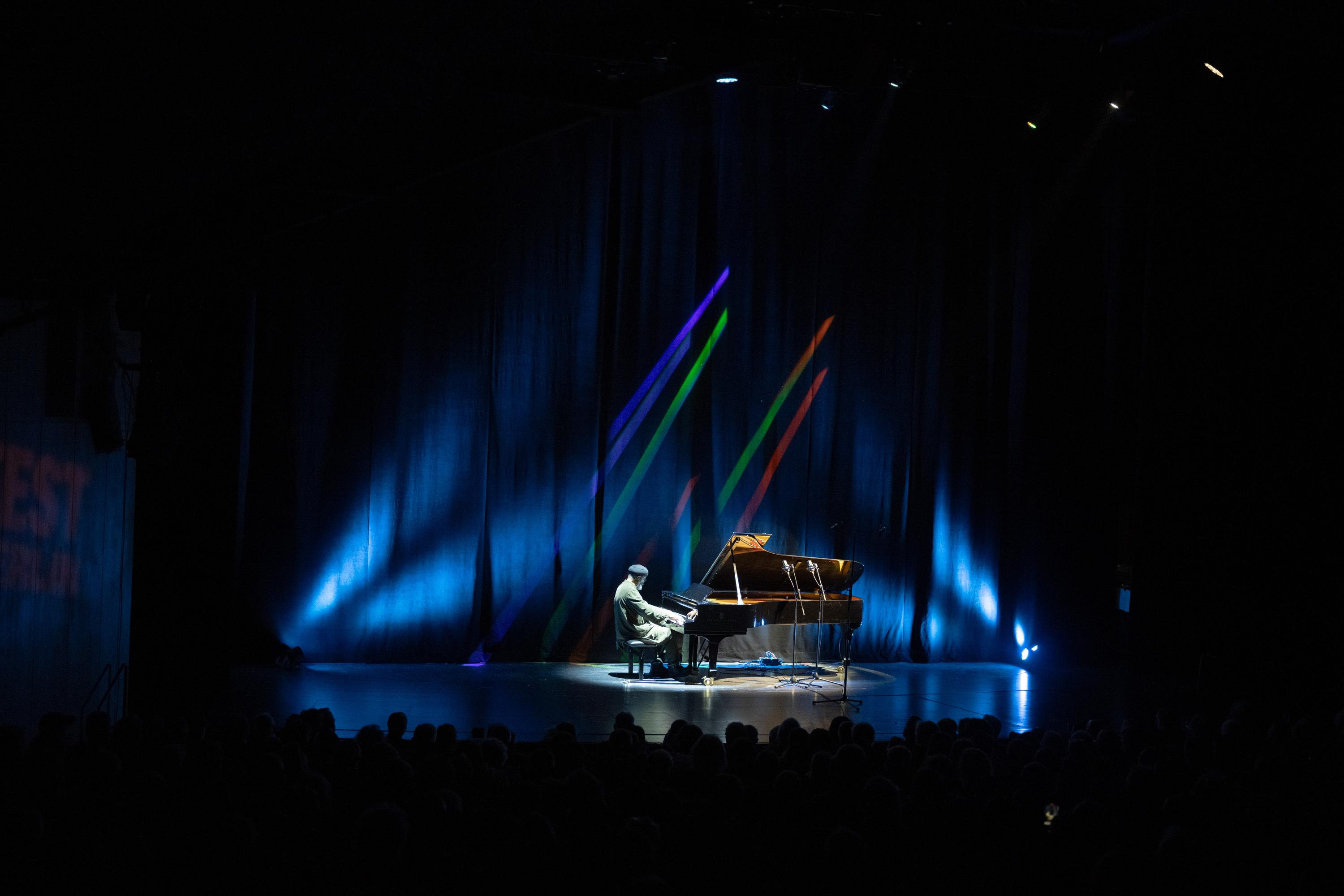
Pat Thomas, Architecture, Abstraction (Preview)


Pat Thomas, JazzFest Berlin, November 2, 2025 © Berliner Festspiele, Camille Blake

(The second of three subscriber posts on Substack on this year’s Jazz Fest Berlin. The first two are longer essays on particular sets by Wadada Leo Smith and Vijay Iyer and by Pat Thomas, the third a more general overview of the festival.)

Thomas manifests absolute presence on stage: gregarious off it, on stage he is all business, sitting down and playing without the need of announcements or framing beyond the music itself. In an improvised solo set in the vein of the recent records The Solar Model of Ibn-Shatir and The Bliss of Bliss back to Nur in 1994, Thomas played what were essentially a series of short pieces: not quite miniatures, but relatively brief, each a study in a particular technique or texture. (One might call them études, perhaps.) Two were studies in rhythm and the harmonics that ring off a scraped or plucked piano strong, particular down the lower end of the instrument; the others focused on thick, splashy clusters and hand-over-hand runs dispensing with tonality as old news.

The full post can be read here.

Thursday, 21 October 2021

Dominic Lash Ensembles at Café Oto


Photo by Roger Huddle.
 
John Butcher (tenor and soprano saxophones), Pat Thomas (piano), Dominic Lash (bass), Steve Noble (drums / percussion); Consorts (various musicians—full list below). Café Oto, Dalston, 21.10.2021.

Last year, bassist Dominic Lash began a record label, Spoonhunt, releasing music by three of his own ensembles: on Limulus, a quartet featuring, among others, saxophonist Ricardo Tejero, another quartet on Discernment, John Russell’s final recording alongside John Butcher and Mark Sanders, and a large ensemble called Consorts, heard on a record called Distinctions. Much of this music in turn arose from Lash’s 40th Birthday gig at Café Oto, and so it was fitting that, with the easing of pandemic restrictions, it was at Oto that the releases could be officially launched. The venue isn’t open at full capacity until next Monday, but there was still a good turn-out for what was by no means a flashy or hip gig or something with a visiting act as a draw: an indication of the health of the UK free improv scene, pandemic or no pandemic, and of the respect in which Lash and his music are held.

Given Russell’s passing, and the unavailability of Discernment’s original drummer, Mark Sanders, the quartet that played the evening’s first set had quite a different sound to that heard on the record, with Pat Thomas—originally supposed to be on the original date—replacing Russell and Steve Noble standing in for Sanders. This could have gone anywhere: Thomas sticking to piano, rather than electronics, always promises a certain amount of contained thunder, Noble a perhaps more buoyantly rhythmic approach, but the band might equally well have trod into the more abstract/rhythmically unmoored territory of quote un quote non-idiomatic playing. (By this I mean, a certain idiom that also gets called ‘European free improvisation’, whether that’s meant to imply geography, artistic tendency, style, or genre; usually, some sort of combination of all of those). Expectations of the latter arose in large part thanks to the presence of Butcher, whose earlier work with Russell and Phil Durrant (who was heard in the evening’s second half on electronics) gives his work some affinity with the beginnings of the more minimal school of improvisation that ends up with New London or Berlin silences, while the painstakingly precise multiphonics of his solo saxophone work (latterly, often amplified with electronics or in resonant spaces), suggests a kind of bridge between minimal tendencies and the more reactive scrabble of EFI. This kind of generic hair-splitting, of course, doesn’t go anywhere near to suggest the studious fluidity of Butcher’s playing, or the expansive range of Lash, Thomas, and Noble across numerous contexts. As I say, this could have gone anywhere.

As it turns out, the set—maybe 40-minutes or so in length, though I didn’t check the time—was surprisingly like free jazz. (Surprising, that is, given the tendency of the sectors of EFI with which Butcher would normally be associated to distinguish themselves from ‘energy music’ tendencies.) The quartet didn’t suggest free jazz so much in terms of dividing the music up into ‘themes’ and ‘solos’ or even pulse, but more in certain harmonic gestures and levels of energy/volume, generally initiated by Thomas and picked up on by Butcher, working some way outside his usual vocabulary. This is not, perhaps, Butcher’s preferred territory, but it didn’t show: particular on soprano, which he alternated with tenor, with I think two turns on each instrument apiece, he touched on scalar, declarative iterations that bordered on late Coltrane at its Live-in-Japan woolliest, repeated melodies echoed—not in the rote-repetition that screams “I’m listening and reacting”, but in genuinely surprising and fitting echoes—from musician to musician to musician. Butcher began in jazz when he was starting out in the early ’80s, playing in groups with pianist Chris Burn while studying physics at Surrey University and continuing to play in Burn’s big band while beginning a Ph.D on ‘charmed quarks’ in London. As Burn remarks in an interview with Simon Reynell: “I always joke that what started off as a 22 musician big band playing jazz compositions ended as a free improvisation duo.” (By 1992, the band sounded like this.) And jazz, free or otherwise, has largely left both Burns’ and Butcher’s vocabulary since then, though an unexpected and surprisingly effective duo with Matthew Shipp—convened at the invitation of Trevor Brent in 2010, also at Oto, and followed by an equally unexpected trio with synth player Thomas Lehn—saw a rapprochement of a sort. (A 2016 interview in which Shipp and Butcher sketch out the respective traditions from and out of which they emerge makes for interesting reading: it can be accessed here.) Likewise, one of the highlights of the performance by the Lash-convened quartet was seeing Butcher adjust to a climate that—largely through Thomas’ playing—had more of an idiomatic connection to free jazz than might be expected in this setting. Particularly in a solo context, Butcher plays virtually every note with an extended technique—multiphonics, false fingering, overblowing etc—veering away from any conventionally pitched vocabulary. That certainly figured here, so ingrained is it in his style: notably, on soprano, eerie, ultra-high altissimo, whistle-pitch sounds, or whispered wind ghosts floating through the body of the instrument after the mouthpiece had been removed. Yet these were juxtaposed or combined with melodic and rhythmic shards strongly suggestive of jazz, fragments of stories that Butcher seemed surprised he knew, but which he was able to re-tell, to spin towards and away from, with authoritative relish. What might have been par for the course in the work of more free jazz-oriented group thus attained the genuine “sound of surprise” here because of its variance from the norm of Butcher’s particular idiomatic tendencies, and in any case, I don’t think Butcher, inveterate Cubist that he is, could leave those phrases entirely intact.

Pat Thomas’ approach to the piano is historically rooted yet utterly distinctive. Spaciously hammered, thick, thick two-handed near-cluster; sparingly used and stringently lush ninth chords; repeated figures that are not quite riffs, not quite melodic fragments, more like rhythmic stutters that sound like a succession of mini-hammers. Deliberately so, there’s something beautifully paradoxical about his approach: gracefully ungainly, liquid granite, utterly poised in consciously distorted fashion. It’s immutable, authoritative, declarative, but entirely adaptable; the hyper-arpeggiated, glissandi-thick, rolled and clustered figures he gets in the upper register are nothing like that of Cecil Taylor, with which such playing inevitably gets compared—partly because of Thomas’ very different sense of space, his tendency to play in measured bursts rather than continuous streams (the unbroken sections of playing tend to focus on repetition rather than constant development); likewise, I don’t think any other pianist has quite the control of the lower register that Thomas has; and his use of the pedal is inevitably much subtler than the morasses of sound he conjures up with it might at first suggest. One chord he played maybe half-way through the set saw him release the pedal before the natural stage of decay where others would have simply let the note ring out; like Butcher, Thomas reminded us, in a kind of hyper-materialist, self-conscious meta-gesture, of the sources of sound production, drawing on the power of the gesture—the reverent haze or dramatic cloud the sustain pedal allows—while also drawing attention to its provisional quality (but with none of the studied fussiness that description suggests). Meanwhile, Steve Noble’s scraped or struck, perhaps bowed, small gongs and cymbals, along with other ways of playing the drum kit as pitched more than rhythmic instrument (his kit was out of my eyeline so I could only guess as to the origin of the sounds) kept things texturally open and spacious. And Lash, of course, has it all down—bowed harmonics, free arco hinting at but never settling into walking patterns, careening caterwauls and ship-wreck groans, the perfectly-placed pluck pinging into the space like a falling droplet that sends ripples from the centre to the edges of a body of water, be that puddle or pond.

During the course of the set, there were ‘episodes’, the conclusion of one and the beginning of the next generally signalled by Butcher switching instrument, but they felt more like movements in a suite than the variable incidents of a typical free improv set, moved between as they were with total, fluid assurance. The first such transition, about five minutes in, saw the music suddenly stop—one of those serendipitous pullings of the emergency-brake that generally sees the musicians wryly laugh and the audience begin to applaud, as if willing the music to end there. Here, the silence was sustained, and things immediately moved in a different direction: a focussed adjustment characteristic of the set to follow. Thomas was often the driving force behind the quality of each particular ‘movement’, though his playing was anything but grandstanding: repeated chords suggested, even as they slid away from, a harmonic direction or area. Yet it was above all a collective music, a conversation between equal musical personalities. Take away any one of the parts and the quality would radically have changed. It’s rare to see a purely improvised set of such cohesion, no hesitancies or verbiage or over-staying of welcome, each transition natural and surprising and fitting, everyone in sync, knowing when to sit out and when to step back in, no one treading on each other’s toes but no one hiding around the corner waiting for things to get going either. I trust the set was recorded, and I hope it might see release in some form or other.


Consorts, kind of chamber ensemble-cum-big band which, as far as I know, has only previously performed on the 40th Birthday gig which forms the basis for the group’s Spoonhunt release. Here’s the full line-up, taken from that release’s info sheet.
Douglas Benford - harmonium and percussion
Steve Beresford - electronics
Marjolaine Charbin - piano
Chris Cundy - bass clarinet
Seth Cooke - steel sink and metal detector
Angharad Davies - viola
Phil Durrant - modular synth
Matthew Grigg - guitar/amplifier
Bruno Guastalla - cello
Martin Hackett - Korg MS10
Tim Hill - baritone saxophone
Tina Hitchens - flute
Sarah Hughes - zither
Mark Langford - bass clarinet
Dominic Lash - double bass
Yvonna Magda - violin
Hannah Marshall - cello
Helen Papaioannou - baritone saxophone
Yoni Silver - bass clarinet
Alex Ward - clarinet/amplifier
I don’t think this was entirely reproduced on the night—Lash was playing electric guitar rather than bass; I didn’t see Alex Ward, Bruno Guastalla, Sarah Hughes, or Helen Papaioannou; Seth Cooke didn’t appear to be playing a steel sink and I’m not sure if the objects he was crouched over next to a small amplifier were metal detectors or not—but I think it’s largely representative. And whatever the individual components, the ensemble is in a sense also the piece they play, even if that piece is only loosely structured, certainly not formally scored or even conducted. With this line-up they could conceivably function in any way Lash decided, from the more conventional Improvisers Orchestra format, with its conductions and exercises, to full-on Alan Silva Celestrial Communications-style skronk. Full disclosure—Dom asked me to write the liner notes for the group’s album last year, but was more interested in what I might have to say about the music without knowing the methods that produced it than provided with the nuts-and-bolts of its structure. And I think that concern with what the music sounds like, rather than how it’s structured, is the point: an exploration of large-group texture that deliberately avoids the aforementioned large-group improv tendencies to density and information over-load while also gesturing towards—and departing from—the more minimal tendencies with which Lash’s has been involved in the Set Ensemble and other Wandelweiser-related endeavours.

As I understand it, the Consorts piece is essentially a set of sustained tones building to a crescendo, and those are the only guidelines: no score, no conduction, no other signals. (And in the rehearsal/soundcheck last night, apparently no mention of sustained tones was made.) So in part Consorts can be understood as a sort of exercise in orchestration, a textural experiment. As an exercise in orchestration, there’s a kind of giddy delight in textural variety—I’ll take not one but three bass clarinets, combine a string section with various electronics, ‘small’ or otherwise, round out the bottom end with a baritone, throw in two guitars. The group Lash had chosen is not ‘star-studded’—though who wouldn’t want a violin section with Angharad Davies in the corner! —which is, in fact, all the more index of their dedication in a music that is, after all, at its best, never about egoic fulfilment: players who quietly work away, in London or Cheltenham or Oxford or Bristol, at their craft: Martin Hackett’s inimitable Korg MS10, the tripled bass clarinets of and Mark Langford, Yoni Silver and Chris Cundy; Hannah Marshall’s richly adaptive cello; Steve Beresford in small electronics mode. From my seat, the only musicians in view were Marjolaine Charbin on piano, Mark Langford, the nearest of the bass clarinet players, and Hannah Marshall on cello (with Lash’s guitar popping in and out of view behind her). Consequently, I only realised, for example, that there was a flute in the mix about 30 minutes in, and had no idea Angharad Davies had been in the mix until Lash called out her name at the end. All this meant that I had to concentrate on it as a group sound rather than focusing on the individual sources of any particular sounds. Which is to say that being able to see the individual members of the ensemble perform both does and doesn’t make a difference. The ability to identify by eye, and thus by ear, the individual contribution of a particular instrument/individual helps one pick out one texture in the weave, one dot of paint in the pointillist whole, or any other such metaphor you might choose, but it doesn’t really reveal much more than how the parts are put together—which, as Lash’s reticence about explaining the piece’s structure implies, isn’t really the point of the exercise. Hearing snippets of sound and realising half an hour in that there was a flute in the ensemble, for example, is rendered all the more serendipitous, and the overall texture all the richer.

On Distinctions, the peak crescendo section has something of the quality of the more avant strands of doom metal; the 2021 iteration, while not quite as glass-rattling, certainly reaches for an effect you might call overwhelming, for its sheer, sustained volume, and the thick intensity of its accumulated textural thicket. The groups imperceptibly reaches a massive cataclysm of sound—driven, I think, by Phil Durrant’s very loud electronics, or perhaps it was Seth Cooke’s amp and whatever objects he had plugged into it; or maybe Matthew Grigg was also doing some small-scale Hendrix things with a guitar and amplifier; or Charbin was deploying e-bows, piano strings, and sustain pedals to give similar clouds. Either way, the sound was, thick and immutable, catharsis or textural exploration, followed by a shorter de-crescendo out (though it apparently lasted around ten minutes). Live, as opposed to on record, you can really feel the music fill the space; in providing contrast to the ‘climax’ and a mirror to the opening, the de-crescendo emphasizes the piece’s architectural, or is that architectonic, qualities. It reminded me a bit of taking part in a Michael Pisaro large group piece—also at Oto—back in 2015, in which everyone played ppp so that the overall volume was the strange effect of a very large group playing at a kind of medium volume: like an orchestra with a mute on it. Harry Gilonis also suggested the piece might be set alongside new music exemplars of the crescendoing sustained/repeated tone like James Tenney’s ‘On Having Never Written a Note for Percussion’ or Stockahusen’s Inori, to which I’d add some of Giacinto Scelsi’s orchestral pieces. (Lash himself mentions Phill Niblock, whose music he’s performed and on whom he’s written academically.) The Tenney is an exercise in solo texture and focus, with its own influence on a strand of improvised music—think Mark Wastell’s tam tam or Eddie Prévost’s bowed cymbal—as well as the general ‘swell piece’ structure found in larger groups. It would be interesting, meanwhile, to think what an improvised ‘swell piece’ like Consort’s does that those composed pieces don’t, and vice versa. If Scelsi and Stockhausen’s experiments in the form associated it with a specifically ritualistic quality (in Stockhausen’s case, unexpectedly Messiaen-type sonorities, allusions to the 'Dies Irae' melody, etc), there was almost nothing ‘ritualistic’ about Consorts. Let’s call it a more materialist approach to sustained tones that aims to be a study in texture and group contributions to an overall sound rather than a trance-inducing exercise. (Of course, the whole crescendo thing might also be seen to originate in the serious musical joke that is Ravel’s ‘Bolero’.)

These are all open-ended hints rather than a final say on the matter. Suffice to say I enjoyed both halves of the evening very much: unusual in the level of contrast between the sets and the level of focus throughout. But of course, given the calibre of the players, entirely to be expected. Roll on the next series of Spoonhunts!

Thursday, 21 January 2021

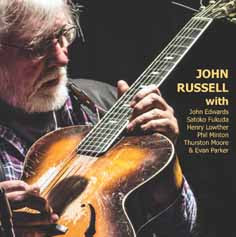
John Russell (1954-2021)


John Russell, who has died at the age of 66, made an enormous contribution to improvised music in the UK and beyond: an enormity that lies precisely in the supremely modest way he went about it. John believed selflessly in the collective nature of freely improvised music--its emphasis on group playing, on working things out in the moment with care and respect--a care mirrored in the organisation that surrounds a perennially neglected form. He spent nearly 50 years organising concerts (his first in 1973) and the emphasis on group interaction, on a joint search, and the rejection of a star system that characterise the music also characterise the way he went about facilitating gigs, festivals and events. Like most involved, he knew that this music was never going to make much money or a career for those in it--particularly in the UK, with its ever-eroding support for the arts--and this commitment led to a kind of optimistic advocacy--manifested from his announcements onstage--and a steadfast belief that was neither benighted nor bitter, but rather enthusiastic and practical. Over the years, he continued to organise Mopomoso (short for "Modernism-Postmodernism-So What?"), first at the Red Rose club in Finsbury Park (about whose closure I wrote something in the early days of this blog), and during the previous decade at the Vortex Jazz Club in Dalston; even the pandemic, and John's own serious illness, didn't get in the way, and the series has continued online since last March. (It can be watched on the Mopomoso youtube channel, which also includes footage of most of the performances at the in-person incarnation of the series, diligently recorded by a small but dedicated team; notably, director Helen Petts, who was responsible for much of the series' web presence and filmed every concert for the first five Vortex years). Late in 2019, I took part in the annual Christmas jamboree--dozens of performers, John compering in Christmas regalia, the combination of the whimsical, the devoted, the serious, that characterises the musical diversity of the current UK improvised scene. Amidst the multiple groups, John played a few times, I think, but, as ever, it was really his role as organiser and facilitator that stood out. He was selflessly dedicated to this music and its continuance, to the extent that his own musical contribution can get overlooked. 

That contribution was, however, a singular one. He discussed some of this in an interview I did with him back in 2009, available here--https://eartripmagazine.wordpress.com/interviews/interview-john-russell/--as well as in some more recent interviews (many of them linked on his website), and in a lecture from 2019, likewise available online. John came to the scene in the early 1970s at a time when free improvisation in the UK was moving away from the associations with free jazz that had characterised the early manifestations of European improvised music; and while his approach suggests at times suggests the very faint ghosts of rock music ("John Russell and the riff" would make for an interesting paper some day), his concern was rarely with identifiably generic material. Studying privately with Derek Bailey, Bailey is the obvious point of comparison: but the obvious differences include the fact that, until 2014, John concentrated exclusively on acoustic guitar, drawn to the physicalised sounds, the fact that one can't conceal inventiveness and detail with technological or timbral effect. The instrument would offer a seemingly boundless series of possibilities over the next five decades. Early on, he'd experiment with an electronic set-up, during a period in which other musicians such as Evan Parker, Tony Oxley, Paul Lytton and most of all Hugh Davies, were likewise expanding their set-ups at a time when electronics were cumbersome and time-consuming to transport and operate. As he put it in our interview:
For us earlier on, the search for new sounds was part of it, but the nub was to find material that could prove useful to improvising. If you like; to find an essence or core to a way of playing music. I did try various things with the electric guitar (preparations, feedback etc. and always trying to avoid the ‘I’ve got a new device mentality) but I quite consciously moved to the acoustic instrument to get closer to what being a guitarist meant.
Of note here is that this was not any old acoustic guitar, but an Archtop model designed in the 1930s to compete with the louder brass instruments in swing bands ("the modern dance orchestra")--that's to say, an acoustic instrument with some of the qualities of the electric. John provided a scan of the original manufacturer's advert on his website.


In part, John's style emerged from this very concern with the physical nature of this instrument: the instrument serves as the source both for problems and for their solution, a working that forces the mind to keep alert and that draws attention to the materiality of music-making. In that sense, the improvisation is not just between one musician and others in the group, but between the musician and the instrument itself.
Another point is that the instrument has very little sustain and the timbral range is also fairly limited so whereas someone on a different instrument might employ sustain and a shifting texture I have to work that much harder. The, if you like, ‘melodic’ or ‘lead’ part is in there, but I often disguise this by changing reference points, so it can seem like it’s just a bunch of notes to some people.
Changing reference points is a useful way of thinking--while the oft-debated 'non-idiomatic' characterisation which served as Derek Bailey's way of describing the music has, as is again often noted, certainly become an identifiable style in itself more than a half-a-century on, it's a style based on shifts and on the unexpected. Where the confusion arises is perhaps in the idea that such shifts would constitute major and obvious stylistic changes rather than the careful and patient working-through of material on a micro-level: the kinds of response, surprise and pleasure that, indeed, happens within any social, interactive frame. This requires a level of humility that John possessed in bucketloads. As he put it:
It just came about from letting the music come first. I think that if people want to turn things into movements, directions etc. that comes later and is for them. I personally don’t find that productive.
John was always a devotee of group playing, and generally associated with the school of improvised music focused in general more on interaction and on individual events (the Spontaneous Music Ensemble's 'pointillist' as opposed to AMM's 'laminar' approach, and its legacies in 'eai' (electroacoustic improvisation)). The spontaneous combinations and re-combinations of the 'Fete Qua Qua' events held since 1981--descendants or cousins of Bailey's famous Company Weeks--of which there is manifold evidence is available on the Mopomoso youtube channel--are perhaps the best recent example; there were also longer-running small groups with the likes of Evan Parker and collaborations with many, many others, a large number released on the Weektertoft label which he ran with pianist Paul G. Smyth. 

Whether on record or not--this is, after all, a music that has a complex relation to the freezing of the moment implied in recordings--I suspect that many people's memories of John's music will reside, not so much in single performances, but in the entire spread of his work: multi-faceted, kaleidoscopic. I  took this snippet of a duo with the late trumpeter Henry Lowther back at the Old Red Rose; their occasional duo embodies many of the virtues of this music. Of other collaborations that stood out, there was, of course, that with Evan Parker across many configurations, including the trio House Full of Floors with bassist John Edwards; duo work with percussionist Roger Turner, whose focus matched John's in a very different, more clattery and intense manner;  solo--the lovely recording 'Hyste', on Parker's psi label (and Helen Pett's short film 'Guitarist', focusing in minute detail on the interaction of finger and string); and a series of duos with string players: the recording with cellist Martine Altenburger on Simon Reynell's label Another Timbre (which provoked some of the best critical writing on Russell's music, including Jesse Goin's lovely and thorough review); with violinist Satoko Fukada; and with another violinist, Phil Waschmann. Those just for starters.

In the early 90s, the group News from the Shed expanded from its initial trio format (John Butcher on saxophone, Phil Durrant on violin, Russell on guitar) to a quartet with trombonist Radu Malfatti, and arguably played an important role in developing what was being known at one point as 'eai', 'reductionism', 'New London silence' and so on for which Malfatti would be a controversial lead figure. Malfatti, whose work in the UK improvisation scene in the 1970s saw noisy and ebullient playing with groups like Brotherhood of Breath, had increasingly reduced down his approach, emphasizing silence, space and placement surrounding notes almost as much--perhaps more--than virtuosity or phrasal content; an approach that led to some vigorous controversy debate (much of it conducted in online forums like Bagatellen or I Hate Music a decade or longer ago). But, as the quote above suggests, John was hardly one for prescriptive or dogmatic insistence. For him, this mode of music was a permission to, rather than a prohibition of, and the avoidance of certain harmonic, melodic and generic patterns, the insistence on an almost completely improvised approach, were ways to facilitate rather than claims to always being in the advance guard. Thus, the approach taken to be News from the Shed came about for practical reasons--as John noted, it was hard to get the acoustic guitar heard--free improvisation can often be noisy, all the more so once groups expand to more than about three participants--and the group, even before Malfatti joined, had been concerned with developing approaches that wouldn't simply drown out quieter instruments. As this suggests, John's playing was never about grandstanding or drawing attention to himself. Instead, his approach was resolutely unfussy--a careful, quiet and intense concentration that might be called 'workmanlike' were that not--unfairly--a term of abuse: if we rephrased that word to suggest the work that this music does, this mode of playing that is also, crucially, a mode of listening--listening to and with the others in the group, or the others in the room--that is one of labour and love.

In a review from 2010, Stuart Broomer praises such playing--in terms that we might equally well read as practical, musical and philosophical--for its "sense of balance"--both internally, in and between individual guitar lines, and when playing with others. Broomer notes the use of the guitar's fingerboard as a seemingly endless resource: "He finds new tones in the same place, new relationships in the same gesture. A second trip across the fingerboard is always a different excursion". These trips frequently deployed harmonics. In Broomer's words: "the harmonic is a transparent sound: silence and ambient sound pass through it. It accounts for Russell's unhurried pace and his sense of order, even when he's playing fast" there's simply so much going on". This balance--between the known and unknown, the given and the newly discovered, the other-worldly and the resolutely material--is, for me, one of the great virtues of freely improvised music, and John's playing embodied it to a T.

The performance below is John's last ever performance in public, given at Cafe Oto--just down the road from the musical home-from-home of the Vortex--in March, just before national lockdown—a solo of little more than five minutes that encapsulates the virtues of his music: methodical, calm in method, intriguing in many ways. Emotion is not always the point of this music, but Daniel Spicer is I think right to note a certain tendency in Russell's playing that he calls "meditative -- even tender". This aspect of the music is easy to emphasize given the circumstances of this gig--right on the eve of pandemic lockdown, a situation that has often seemed to worsen everyday since then--and the fact of John's illness--which combine to give an extra-musical pressure to this piece, but the playing itself rises to the occasion precisely by continuing as it always had: focused, crystalline, with the authority of a summative statement and the openness of an ongoing, life-long negotiation with the material and devotion to the demands of the moment. John Russell will be much missed.

Friday, 16 August 2013

BRÖTZMANN / ADASIEWICZ / EDWARDS / NOBLE -- CAFE OTO 12.08.2013


The relative engagement of Brötzmann performances tends to vary on the particular set of instrumental collaborators he’s playing with, & this quartet was certainly an unusual take on things. (By ‘engagement’, I don’t mean Brötzmann’s own - he does his thing, and consistently - more the contextual framing of that thing, its relative predictability or consistent hitting of the area known in sports parlance as the ‘zone’.) The vibes setup inevitably set ‘Out to Lunch’ connections in orbit (particularly as I’d be running through Dolphy tunes in my head on the cycle ride over), but Adasiewicz is a very different, much busier vibes player than Hutcherson, just as Brötzmann is a very different player to Dolphy, far less angular, with an approach far less obviously accommodating to a pairing with vibes. Whereas Hutcherson on OTL will strike a note with a clang, followed by an unexpected, jagged, slightly extended pause, in tandem with the crisply off-kilter rhythm section of Richard Davis and Tony Williams, Adasiewicz favours (or did in this setting) strategies such as the repeating of a particular phrase with ever increasing dramatic emphasis, and virtuoso jazz runs up and down the vibes, notes a-flying in all sorts of directions. This latter, especially when combined with a predilection for setting up a pedall’d cushion around his sound, tends to fill up the space rather than leaving it, as Hutcherson does: none of that understated approach from OTL in which tension is amped up through contrast and a patient spacing and varying of approach; or, indeed, that of Archie Shepp’s ‘New Thing at Newport’, cocktail jazz put through the wringer and turned into sensuous, barfing disquiet, quiet love and rage, controlled yet unexpected eruption, elongation and foreshortening. Live, Adasiewicz is nothing if not demonstrative, to almost comic effect. One particular physical move sees him shift on his feet to strike some notes, then lift one foot off the ground and move to the sound, as if the physical after-effect of the power of striking that note is about to topple him to the floor like an out-of-control child, one who’s temporarily lost control of their limbs. In another, he lifts the keys up on their string and furiously rattles them about as additional un-tuned percussion to Noble’s drumming. Periodically, he wipes his dripping face and beard down with a towel like a tennis player between points.

So, the presence of vibes and of their particular deployment took some getting used to, particularly given that I was in the far left corner of the room, where the combined force of Noble’s extremely loud drumming, Adasiewicz’s also loud vibes and physically demonstrative performance, and the hyper-amplified sound of John Edward’s double-bass, at times threatened to drown out Brötzmann himself. This was especially evident in the passages of most extreme intensity, where the group became a churning morass of sound, an effect rather like listening to one of the bootleg or semi-legit recordings of 1960s free jazz, in which drumkits, cymbals in particular, create a near white-noise wash, bleeding into the near-undifferentiated cloud of volume and density formed by the rest of the group; from that cloud will emerge the most piercing and burred blasts and blarts of reed-bitten saxophone squall, blasts sounded because they are the only thing that will rise above the storm they also encourage and propel. Such a description might suggest typical Brötzmann fare, the ecstatic group effect that draws in free jazz fans again and again, but, in truth, his own playing tended as much towards the melancholy ‘ballad’ approach he’s favoured over the last couple of decades, a vibrato-heavy pathos-shading which one might best describe as an improvised impersonation or filtration of a tradition of tough-tender jazz saxophonists, from Ayler to Shepp to Coleman Hawkins. Often, he would enter with phrases that slowed the music down, that saw a sudden drop or transition in energy levels, sticking fairly closely to that phrase-area as the other musicians began to dip and rise, to boil away underneath, never letting the music actually enter straight jazz ballad territory, now a few blurts from the upper register, a deliberate shift, and then into ‘full blast’ territory.

The two sets performed were continuous and quite lengthy pieces, the first in particular lasting as much as an hour; after spending some time at one of those noise-peaks, Brötzmann would take a breather and come back in with another horn, during which time Adasiewicz would do his vibes thing, including one very sympathique, more lyrical linking up with the ecstatically-focused Edwards at some point during the second set. Noble seemed permanently restless in his refusal to let the music dip substantially, often hitting a pronounced thwack as if to rudely interrupt or prevent the opening up of too much space, to insist that the music stay on the high road, the speed-freakery of the autobahn. As with his recent performance with Anthony Pateras at the LCMF, it was an extremely solid and seasoned display, the reflexes of an improviser who’s played long enough and at a high enough level to be able to think automatically, without going through the motions. Yet somehow it felt like the sort of improv performance a rock drummer might get behind, over-emphatic in its effects and affect: sustained and fairly steady or ‘straight’ rhythms would be set up which forced the music into particular areas, such as the mallets passage at the start of the second set, and the consistent loudness felt like a particular mode of attaining intensity that is not necessarily always the best or must effective way of building a dynamic group sound - it’s almost a short-cut, one might say. Indeed, Noble’s playing, as much as the presence of Adasiewicz’s vibes, probably accounts for the rather more unusually and heavily jazz-flavoured passages that surprisingly proliferated: at times, Edwards would even play walking bass. There were moments when I found this a little uncertain, wasn’t sure how to engage with it, felt that it somehow made Brötzmann’s playing sound somewhat limited (as if throwing out some free-bop choruses might have better fitted the setting, though no-one would have wanted that). But there were also points at which I really liked the effect, the contrast between Brötzmann’s playing, which stuck to his usual two general areas (loud/full-blast and wounded balladry), and that backdrop, into which he would also fit his phrases rhythmically. A case in point, the final section, a kind of mutant blues swagger, Brötzmann on tenor, which moved out of the melancholy / despair tinges of the first half into something more assertively, if ambiguously joyous, even, though somehow devastating in its effect - or perhaps that was simply the cumulative effect of something like two hours of music. The Oto crowd, which had fairly packed out the space, filtered out quickly, off into the night, space to digest, exhaustion, the slow come-down.

Thursday, 8 August 2013

LONDON GIG DIGEST: LATE JULY / EARLY AUGUST 2013


Mopomoso - Scatter etc.
The Vortex, Sunday 21st July 2013.


Just over the road from the more hip Café Oto, the Vortex tends to focus its gig schedules on jazz and, for want of a better-word, ‘EFI’-based improv, though of course the same musicians can be found in different combinations at both venues. On this occasion, the group I was particularly interested in seeing was Scatter, a quartet of Phil Minton (vocals), Pat Thomas (piano), Dave Tucker (guitar) and Roger Turner (drums), and they set out a fine sound, Tucker’s guitar sometimes jerky and spasmodic (and using e-bow without ever-resorting to the easy drones that accessory so often rather predictably entails), Thomas alternating between inside-piano shards of his own and more rolling chordal and melodic passages, Minton’s face doing its usual panoply of expressive character-impressions as he switched from bird-like whistles to old-man croaks and eerie high tones, Turner with that combination of ramshackle clattering and complete rhythmic and group focus that makes his playing simultaneously reliable and unpredictable. Maggie Nicols and Minton exchanging yodels between stage and audience at the end of the closing set, that of Nicols, violinist Mia Zabelka and Russell.

AMM#7: Alan Wilkinson and THF Drenching on Vimeo.


Full Moon Launch of Ben Watson, Derek Bailey and the Story of Free Improvisation (paperback edition)
Cafe Oto, Monday 22nd July 2013


I only traipsed in for the tail end of this, on what was apparently the hottest day of the year, catching Watson’s sound-poetry with Oscillatorial Binnage, various sets with his children improvising along on vocal-gobbledeygook and harmonicas, ending with the reason I’d turned up at all, Stuart Calton, a.k.a. TFH Drenching and Alan Wilkinson engaged in a loud and piercing alto / dictaphone duet, blasting off Oto’s candle-drenched sweat like a cool shower; or, indeed, an acid bath. The feel of the evening, as far as I was able to catch it, was of a kind of community catch-up, no doubt in the style of Bailey’s Company Weeks: as if Oto had been temporarily taken over, booked out for a private function, though I don’t mean that in a negative sense. This wasn’t the kind of evening for hangers-on, for people who’d popped in with little idea of the actual music because Oto is a ‘happening venue’, and then spent the entire set playing a game on their phone (as, unbelievably enough, I saw one audience member do during a ten-minute Roscoe Mitchell circular-breathing workout) or whispering away during the relatively quiet and restrained final section of a Wastell / Allbee / Beins set, and so, even if most of the audience had some sort of personal association with Watson and his work (to judge from the bulky cigarette crowd outside the door when I arrived), it felt far less of an in-crowd set-up. If the music itself tended to be a little forgettable, then, that feeling of warmth and dedication from the situation per se was nonetheless welcomed.

Wagner, Tristan Und Isolde
Robert Dean Smith, Violeta Urmana, BBC SO / Semyon Bychkov
BBC Proms, Royal Albert Hall, Saturday 27th July 2013


Sitting in the choir meant a focus on orchestral textures, which isn’t necessarily a bad thing, and moments when singers or instrumentalists would position themselves above the stage came out bright and clear, the cor anglais solo at the start of act III in particular. If Dean Smith’s vocal projection, as Tristan, left something to be desired, an impression corroborated by reports from other parts of the hall, the other performances were generally of a fine standard; and perhaps the semi-staged approach solves some problems in Wagner interpretation, even, or perhaps because it (semi-)stages its own absurdity (in the final act, a singer sitting down meant that they’d died), of a piece with the perfunctory manner in which Wagner deals with that kind of dramatic narrative action; the music itself can outweigh the datedness or the historical problematics that saturate every aspect of staging decisions in full productions.


London Contemporary Music Festival
Bold Tendencies, Peckham
Thursday 25th-Sunday 28th July / Thursday 1st-Sunday 4th August


This packed double-weekender of (mainly) composed music from the second half of the twentieth century took place at Bold Tendencies, the Peckham arts / bar project (Franks’ bar is on the roof) located in a multi-story car-park conveniently located opposite the overground station. A huge range of music, with the result that even with a single gig it often felt as if there was barely any time to process things: one might, say, transition in under a minute from the ferocious and exhilarating complexity of a Michael Finnissy piano piece to an intense Anthony Pateras improvised solo on the same instrument, and that’s before the Ferneyhough had started. That the programme was full enough to require this level of unremitting intensity – the concerts still tended to last for at least two hours, even without intervals – is dizzying (and was perhaps a strategy decision as well, to prevent the inevitable loss of concentration and bar-wards drift that an interval in this setting would have provoked) and exciting, which perhaps explains the relative lack of critical response thus far, despite the high levels of attendance and the presence, no doubt, of various ‘official’ and ‘unofficial’ critics in the audience. Anyhow, I ended up attending most of the concerts and this is the first attempt, ‘official’ or ‘unofficial’, at setting down any of the things that have been simmering through my head since then.

I’ll start off by saying that is most certainly the first time I’ve ever queued for nearly an hour to see a performance the music of Helmut Lachenmann (pieces for piano coupled with some of the more obscure avant-garde works of Ennio Morriconne), and whether hearing those Lachenmann pieces in this particular location, as opposed to, say, the Aldeburgh recital hall where I heard them last year, serves the music particular well or not, it’s certainly an impressive feat of publicity, networking, and all the rest, to achieve that level of popularity. That said, I do think we need to examine the notion of ‘popularity’ that too easily gets bandied about in talking of the undoubted successes of this festival, and to examine the way events like this serve or do not serve the political connotations to which Lachenmann’s music strenuously addresses and commits itself, commitments which may be equally compromised within the usual bourgeois concert settings, but which it wouldn’t necessarily be right to argue are better or more fully heard outside them either. This isn’t to say that we should turn to Luigi Nono’s ’70s mode of playing his electronic compositions to factory workers, though that practice does at least grant those not privileged with a particular level of education a capacity to ‘understand’ difficult art that would never in a million years be granted by patronizing culture industrial discourse machine of today. I’m hardly the son of factory workers myself, and my educational history began (somewhat eccentrically) and has continued on a level of relative privilege; but I discovered Messiaen, Schoenberg and the whole world that opened up (alongside John Coltrane, Thelonious Monk, et al) not through some ‘High Culture Programme’ but at the local library of a not-exactly ‘culturally-minded’ M4-corridor town and through tuning in and taping broadcasts on the radio, and I suspect a lot of people committed to this music (perhaps more as listeners than as performers, though that might be a spurious distinction) followed similar paths. (A friend discovered this world through playing the lone Stockhausen LP that had somehow found its way into his state school library, for instance.) In some ways, that might be a more far-reaching and long-lasting mode of ‘access’ than an event which ultimately attends to a very particular social bracket of young, hip, 20-or 30-somethings from London – not that this negates the value of such events, simply that we must be careful, in talking about these things, not to ignore other, less spectacular means by which ‘high culture’ escapes particular exclusionary brackets.

Moving classical music into locations outside the concert hall, then, does not necessarily entail a broadening of the class (and race) base of its audience; perhaps even the contrary, because in a spirit of ‘cool’ or ‘radical’ disguise, it actually participates in the process of gentrification which, in its pretended solidarity with the working class neighbourhoods it first inhabits, then displaces, in the upward-spiral of rent set in motion by the cultural cachet with which it has now imbued those neighbourhoods. The audience becomes younger, but it relative wealth bracket, albeit one slightly more precarious in terms of its financial security, less fixed in its job positioning, than that of the more comfortable members of a typical Aldeburgh or Glyndebourne festival programme, is still hardly that of the working class: this audience is the bourgeoisie in its hipster guise, or, as Keston Sutherland put it when he read at Bold Tendencies a few weeks previously, in an insult that was masochistically lapped up, or simply unnoticed, by the very crowd he was addressing, “the rich of peckham”. ‘Hipster’ is, of course, an over-used and under-defined term, less economically specific than the sharp ‘rich’, which cuts through all the lifestyle dress-up to the naked financial truth, or half-truth, underneath; but if you’re going to find hipsters, it’ll be at Bold Tendencies, with its £4.50 lagers, its 30-minute queue for the roof-top bar (with a queue that long, you just know it’s achingly hip), its rolling tobacco and its Derek Jarman garden (as the bouncers inform you, you can sit on the pieces of railroad timber designated as benches, but not on the ones immediately next to them which are part of the garden itself). Indeed, the Proms, with their attracted audiences of eccentric and cranks and music-lovers of all ages (still, of course, predominantly white) somehow feel to me more inclusive than this free festival in a Peckham car park. And a man in a sleeveless suit who approaches multiple members of the queue while mumbling something nigh-on inaudible about having composed the initial, more fulsome orchestral version of ‘Tristan Und Isolde’, is far more deeply and fundamentally an outsider than the immaculately-turned ‘personal twists’ of fashion and hairstyle modeled by the hipsters from and attracted to Peckham.

But it’s not as if I’m outside this bracket; the slight tinge of guilt I felt every time I stepped out from the station and turned into the car-park, following the hordes of other jean-wearing twenty year olds in an escape from halal shops, African hairdressers, and the likes, to White Cultural Heaven (where sometimes the only black person in the entire venue, it seemed, was the bouncer), is perhaps simply an exacerbated version of that which I’m insulated from in organizing and attending events within educational institutions that are much more fundamentally dedicated the exclusion of non-white, non-public-school-educated students, and are pervaded by an undercurrent of sometimes barely disguised sexism. Furthermore, I should also point out at this point that I’m extremely glad the festival took place, for which the organizers Sam Mackay, Lucy Railton, Aisha Orazbayeva and Igor Toronyi-Lalic, and all the musicians and volunteers should be praised (Mark Knoop’s performances in particular were frequently astonishing, and I can imagine getting big-name musicians like Tony Conrad and Charlemagne Palestine over to play on the same bill, or, indeed, bringing in Glenn Branca, was quite an organisational task). Along with the various contemporary Kings Place concerts (my review of Orazbayeva’s Nono performance can be found a year or so ago back in these blog archives), the LCMF’s existence is evidence of a younger generation’s interest in, and active promotion of a contemporary music that’s too often relegated to bit-parts alongside old warhorses in regular classical programmes, and of a thinking about that music’s role within the wider climate of contemporary culture. These organizers and musicians are clearly deeply serious and organizationally sound, whatever the slight hiccups of, say, the persistent feedback caused by pedalled passages down the lower end of the piano, or unavoidable conflicts between the fairly noisy, semi-open environment and some of the quieter pieces that were scheduled (say, the battle between the regular passing train and the finger-key clickings of Lachenmann’s ‘Guero’; which actually turned to entirely appropriate and rivetting effect as the train passed again during a much more thunderous part of Lachenmann’s ‘Serynade’.) Perhaps this latter indicates some of the reasons that car-parks aren’t more often used as venues, the actual virtues of having an enclosed space in which people are more restrained by spatial etiquette in terms of wandering in and out of the performance space and to the bar and conversing through parts of the music they don’t like, the enforcing of particular qualities of attention and listening that are not in themselves bourgeois or stuffy values but of a serious engagement with music that refuses to reduce it to social occasion or aural wallpaper. Not that the LCMF wasn’t characterised by intense close-listening on the part of its core audience (the culprits being more those who passed by the concerts on their way to and from Frank’s bar upstairs, passing comment as they went). Lots of these things, of course, couldn’t have been anticipated at the planning stage, or even mitigated against if they were, but I think it’s important to raise them, not so much as a specific criticism of or dig at the LCMF, but as part of the problems that will have to be seriously thought about if a sustained movement towards alternative venues for the performance of contemporary music is to be considered.

Setting this aside for the moment, let’s consider the concerts presented. The first Friday: Lachenmann’s piano pieces generally came through well – ‘SeryNade’ in particular struck my as extremely strong, this being the second time I’d seen it performed in concert; it makes much use of pedal-work for complex resonance-effects, and includes one particularly gripping section in which chordal repetition creates a kind of paralyzed, frozen or stuttering quality of obsession, weirdly resonant with the way John Coltrane might approach and worry at a phrase from every angle, trying to exhaust and work through its every harmonic implication. The piece, despite its title, seems to work through the residue and sediment left by the history of the classical piano repertoire, and particularly that of Romanticism, absorbing its gestures and re-fashioning them in critical fashion: a music of deep historical engagement, with a very particular way of working through such issues. The Morricone pieces, which I was quite stoked about before-hand, proved disappointing, by contrast; I understand the programming was inspired by Lachenmann’s comments about Morriconne being his favourite composer, but I suspect he means the better-known film music (mitigating his reputation as a high-modernist hermit who scorns all forms of popular culture) rather than the rather structurally-inane ‘avant-garde’ pieces we heard on the night. ‘Proibito’, for eight trumpets, saw those trumpets moving through particular sets of extended techniques in somewhat disconnected fashion, and felt as much as anything like a student composition: a composer trying out ideas without much sense of how to formally string them together. The piece for solo viola and tape (‘Suoni per Dino’) was more structurally coherent, and had obvious similarities to particular sequences Morriconne will write in tension-filled scenes from his Western film scores, in which a sparse but repetitive figure on timpani or some other form of percussion will underlie a series of more abstract sounds. But whereas that rhythmic quality contributes directly to the tension in those scores, here it felt like an unnecessary sop to the slowly-overlapping looped harmonies above it, which might even have taken on a Feldman-lite quality if they hadn’t been thus bolstered. That said, I’d imagine these pieces are rarely performed, and it’s certainly good that the opportunity was given for them to be heard.

I missed Glenn Branca on the Saturday for Wagner at the Proms (see above), but stayed for the full nine-hour-or-so whack on the Sunday, a ‘drone day’ culminating in the Palestine / Conrad double-bill. Jem Finer’s opening ‘Slowplayer’ struck me as the worst kind of satisfied, funding-sated dross, perhaps acceptable in a gallery or installation-type setting, but completely unsuited to a concert context: working through a stack of records which appeared to include Eric Dolphy, Ornette Coleman and the stooges, he proceeded to play them on the specially-modified record-player which gave the ‘piece’ its title, a player which didn’t give above 7RPM. So we got the elongated groans and drawn out gasps of barely-distinguishable records, sometimes with somewhat desultory mixer-manipulation from Finer, who wandered around the space taking photographs of the audience or picking through the record-stack. Somehow paralyzed in my seat, I stayed for the full two-hours, but the suffering involved was somewhat mitigated by the follow-up of Eliane Radigue’s ‘Chry-ptus’, transitioning into James Tenney’s ‘Having Never Written a Note for Percussion’, that crescendo-diminuendo piece for tam-tam which fully exploits the resonant possibilities of that instrument in a way that requires complete physical and mental focus on the part of the musician and, if they’re willing, the audience. If I felt lethargic and fed-up at the end of the Finer, by the end of the Tenney, I felt some combination of blissed-out, exhausted and emotionally eviscerated (perhaps simply a result of tiredness and temporary fragility, and thus not the best indicator of ‘objective’ reviewing standards). Rounding the afternoon off, Brian Eno’s ‘Music for Airports’, as arranged for a polite electric-guitar-vibes-keyboards-reeds-and-strings ensemble, was hardly in the same league, though I have a soft spot for an album I haven’t heard for years, and it was nice, if nothing more, to encounter it again in live form. Barely an hour’s break saw the main event. First half, Tony Conrad and Jennifer Walshe’s duo Ma la Pert with an hour-long improvisational piece: Walshe stuck mainly to vocals, though she’d occasionally join Conrad’s amplified violin and table-based bass string droning with bits of cello - a big range of extended techniques and a tendency towards a kind of vaguely ‘ethnic’ emotionalism grew a little wearying over the full time, as if she was unwilling to allow the drone full space to develop – perhaps the piece would have benefited from being a little shorter (but perhaps I’m also being churlish). Charlemagne Palestine’s stuffed-toy-tumbler-and-talking routine doesn’t really do much for me, but the ‘Strumming Music’-style exploration of piano resonance was at times mesmerising, even if I have perhaps less time for it than I did on initially hearing the original album: it felt a little too obvious and over-dramatic in its emotional effects and affect (rather like elements of Walshe’s singing), verging, even, on the sentimental (and not in a good way). But the final encore, a short trio featuring all three performers, was, to paraphrase the title of a particularly beautiful archive recording of Palestine and saxophonist Terry Jennings, ‘Short and Sweet’, if at times a little hesitant (but live first-time collaborations can be forgiven for this).

So that was the first weekend. In any case, despite the tinges of unease that prompted the vicious introductory splurge above, it wasn’t until the penultimate day of attendance at the LCMF’s second weekend that I noticed the wall-scrawl ‘Triumph of the Bourgeoisie (Upstairs)’. Weirdly, or not so weirdly, that little descriptor came back towards the end of the festival’s final scheduled piece, a performance of Philip Corner’s ‘Piano Activities’ - or rather, the performance of the performance of Corner’s work by Wolf Vostell, Charlotte Moorman, George Macunias, etc, in 1962, in which the piano was destroyed. But whereas Macunias at least partially justifies this violence by claiming that the piano had cost $5 and it would have cost more to hire removals to take it away than to destroy it, the Bold Tendencies realisation was clearly geared towards a kind of mild-shock, the actual impact of the shock softened by the fact of its hipster-event cushioning (putting a couple of pianos in a car-park anyway is something of a shock, perhaps). This isn’t to say that some of the sounds coaxed out weren’t compelling - they were, particularly mic’d-up - but the thing is that these sounds could equally well have been-produced through close-micing of non-destructive piano activity: rubbing the strings needn’t be done with a giant chain, only a small one (or, as per Cage’s 14, with horsehair), tapping the resonant underside of the instrument could equally well be done with fingers or first than with a hammer, and so on. Corner’s initial score was designed precisely towards this end, as an extension of Cage’s extension of the piano through preparations, and in that light, it would have fitted perfectly into a programme which had seen Anthony Pateras, the day before, switch between piano, prepared piano (the same model, indeed, that was destroyed as the festival’s final event) and analogue synth, and in which Mark Knoop’s astounding recital had approached the issue of piano-writing (albeit mostly keyboard-and-note based, unlike, say, Lachenann’s previously-performed Guero) from many different angles. As Knoop impeccably segued into the Corner, assistants emerging from various points and audience converging around the piano like vultures; Knoop and co. handing out smashed piano keys and various other bits of piano gut to the audience like saints’ reliquaries. If, here, I seem to be falling into exactly the position of the Guardian article by Ben Beaumont-Thomas which has generated a mini-stream of twitter debate where the organizers, perhaps understandably, take BB-T to task for making this one event characterise the festival as a whole (and see also this response with regard to the availability of pianos), I think that, regardless of economic issues or of the issue of allowed bourgeois destruction, as an interpretation (or translation) of an interpretation of Corner’s score, the piece is partial and based on a particular, spectacular incident in its performance history which does not encompass or fully and accurately represent the piece itself. And yes, Fluxus did happen forty years ago, and more. And yes, the entire history of the incorporation of various forms of performance art into recuperative institutional frameworks and the co-option for the potentially political radical for high-bourgeois ends needs to be taken into consideration. One might argue that the same could be said of any piece of western classical piece performed or written on a fairly expensive piano, but I think that would be to dodge the issue. Food for thought, anyhow.

With that out of the way, onto the rest of the festival. If I didn’t necessarily buy the equivalence drawn between ‘New Complexity and Noise’ (the Friday gig’s title) – Michael Finnissy’s hyper-complex piano music is very different structurally to the apparently equally-virtuosic but formally rather slick piano improvisation by Anthon Pateras that followed it, and Russell Haswell’s noise set concealed its rhythmically rather square machinations behind sheer PA’d volume – turn it down and it’d sound rather uncomfortably caught between IDM and noise music proper, as if, I don’t know, Cremaster had met Autechre but they hadn’t quite clicked. Finnissy’s ‘English Country Tunes’, ferociously played by Mark Knoop, were what stood out the most of anything on the evening. Seeing them live really reinforces their value: I periodically watch Finnissy videos on youtube and am never quite sure how to engage with the work or what to think of it, though in some rather un-delineated sense I get the sense of admiring them or the very fact of their existence, but here, an extended, two-to-three minute passage featuring simultaneous writing in the extreme high and low ends of the piano achieved a concentrated ferocity comparable to the improvisations of Cecil Taylor; rather than just being the timbral shock effect it could have been, the material was rhythmically and harmonically compelling, and the juxtaposition with a more overtly folk-influenced or –haunted register felt entirely appropriate and not in the least like a disjoint or a cop-out. Pateras and Steve Noble did a series of improvisations in various solo and duo combinations; their playing was flashy but somehow almost always entirely safe, with none of the risk that good improvisation, in this particular, more ‘interactive’ mode at least, to me tends to entail. Perhaps the best piece was the one for prepared piano and drums, in which Pateras hammered out a percussion all of his own, using the full range of the instrument and making it seem like a resourceful instrument in and of itself; nonetheless, here, as in the other pieces, it felt as if both musicians were somehow afraid of being bored and of boring the audience – rather than sticking with, locking into any particularly compelling area that opened up, they would discard it and move onto something else, almost as if to show that they could, so that the logic was smooth but disjointed, an endless flow of ideas all given equal weight and thus in their totality giving the feeling of a kind of insubstantiality, impressive moment to moment and even in terms of a kind of general effect which would get the audience talking afterwards, but, in their actual totality, almost rather bland. Of the remaining pieces, Ferneyhough’s ‘Cassandra’s Dream Song’, the solo flute piece, doesn’t strike me on nearly the same level as the Finnissy; Aaron Cassidy’s solo pieces, for trumpet and trombone are clearly doing interesting things in terms of notation and timbral exploration, though they perhaps haven’t quite worked out what to do with these areas in the ways that Finnissy’s have (Cassidy is, after all, a much younger composer than either of the two F’s). That said, it was the earlier piece, ‘songs only as sad as their listener’, which struck me most, with its tremulous and sparse repeated note, muted but amplified so as to emphasize maximal fragility within the human-instrument interaction, emphasizing the externals of breath and mouth-positioning so that the brass sometimes seemed to be an extension of a human wheezing and crying, a half-choked plaint: as if the trumpet part to Ives’ ‘The Unanswered Question’ had been cut down to its bare minimum and left to stand without the accompanying orchestra, perhaps.

Saturday I skipped, out of concert-/ cultural-overload exhaustion. Sunday afternoon, mainly consisting of new pieces selected from competition entries for the festival, was mostly desultory: the opening piece, for wandering trombones, might have suggested a Scratch Orchestra-style performance strategy, but it was material of the worst sub-minimalist kind, utterly banal and with no redeeming features that I could see or hear; somehow, the perfect existential accompaniment to a five-minute failure to light a half-smoked cigarette on a windy car-park rooftop. Michael Haleta’s piece for forty musicians moving in delineated squares while dragging or banging various junk-instruments (a giant plastic flower-pot (which pretty much drowned out everything else as it was enthusiastically dragged and scraped against the car-park’s concrete floor), a cymbal-round-the-neck, various shakers, a set of clothes pegs tied together with wire, a rock on a string) superficially seemed close to the performance strategies of James Saunders’ pieces, but with apparently none of the close thinking and attention to structure that goes into them: the division into four movements seemingly entirely arbitrary, and the various possible permutations of a fairly simple idea with regard to partially-improvised group dynamics and negotiations, even in such basics as speed and area covered, left unexplored. The pairing of vocal works by Mark Applebaum-Pauline Oliveros was at least intriguing, if sometimes a little too self-consciously wacky in its performative shenanigans (though Richard Bullens’ piece for perambulating clarinets was perhaps the more gimmicky, given the apparently complete lack of relation between a potentially interesting exploration of spatial dynamics and the actual substance of its conservative-modernist musical material). A series of works for acoustic guitar and electronics were dire. I would suggest a diet of early Taku Sugimoto, Derek Bailey, and sackcloth and ashes. The concluding piece, Rzewski’s ‘Coming Together’, is a reminder of the existence of a political minimalism, though I doubt many of the audience had much idea about the Attica Riots that form its text: the indeterminacy of its notation also suggests a connection between early minimalism and more avant-garde performance strategies that second, or third-generation minimalists (and the, probably fourth-generation, by now near-total recuperation of minimalism into the de-rigueur TV-and-movie soundtrack and advertising ambient-background score go-to style) almost completely ignore. The piece itself perhaps tends towards sentimentality in its second movement, but its patient extension of sparse text fragments is actually handled without histrionics and with a sense of implacable conviction that is quite moving, and certainly a million times less gimmicky or formally glib than almost all of the commissioned pieces that had preceded it.

The evening’s lengthy keyboard ‘recital’ (or more accurately, set of recitals) opened with Jane Chapman’s harpsichord programme. The miking of the instrument rendered its relative clunkiness and stringy, twittering-machine-like quality nakedly apparent; perhaps a disadvantage in more traditional repertoire, but of a piece with the programme, in which Ligeti’s hyper-virtuosic moto-perpetuos and Louis Andriessen’s rather uncomfortably extended melodic permutations sat alongside to me rather glib electronically-aided explorations (or illustrations) of the instrument’s inner workings by Paul Whitty, and some wonderfully exaggerated cliché parodies or near-parodies from a few centuries earlier by Joseph-Nicolas-Pancrace Royer, perhaps my favourite of all the set’s constituent parts. Leon Michener’s recreation of Terry Riley’s ‘Persian Surgery Dervishes’ was advertised as taking place on an electric organ, but in the event, occurred through a combination of an apple laptop, a midi keyboard, and a baby grand; undoubtedly a labour-intensive reconstruction (Riley’s piece was at least semi-improvised and was never turned into a score), though the techno elements were a little baffling (one half-wished he’d go the whole hog and turn the whole thing into a techno-remix; or that we’d actually hear some Riley-influenced techno; or that the approach was more purist). But Mark Knoop’s piano recital on that same baby ground was nothing short of astonishing: playing entirely from an ipad, he transitioned between quite widely diverse pieces without missing a beat, leaving no space for applause between individual compositions and thus building up an extremely focused set of associations and networks between the items on the programme. The effect was sometimes comic, as when Mozart would be followed by a crashing modernist chord, sometimes seamless, as when early Feldman turned into early La Monte Young, so that the Young initially sounded like the final phrase of the Feldman repeated and extended. If the two recent pieces, by Adam de la Cour (conceptually neat and simple, featuring a loud boxing-ring bell sound which transitioned between (from what I can recall) vaguely Joplinesque parody-passages and ferocious, Finnissy-like keyboard-scampering) and Lauren Redhead couldn’t hope to ‘compete’ with Mozart, or Schoenberg, or even Leo Ornstein, they nonetheless fitted well and didn’t seem overtly out of place: certainly, they were far superior to any of the new pieces played earlier on in the day. The other Piano Activities that rounded things, and the piano itself, off, we’ve touched on before, so no need to re-tread that controversial ground. But, really, I haven’t seen this much varied contemporary music jostled together in such a short and packed space of time ever, I don’t think, at least outside of Aimard-era Aldeburgh or some of the South Bank’s Total Immersion weekends, and I’m still somewhat buzzing and exhausted from it – in the best possible way, I’m sure…

Mark Wastell / Mensch Mensch Mensch.
Cafe Oto, Tuesday 6th August 2013


Much more low-key, this: a modest crowd, as perhaps expected. Wastell’s tam-tam work couldn’t help but force me into a compare-and-contrast exercise with the performance of James Tenney’s ‘On Having Never Written a Note for Percussion’ at the LCMF a week or so before; whereas that piece has a clear crescendo-diminuendo structure, moving from the barely-perceptible to a roaring rush of resonance in which one might fancy oneself hearing disintegrated choirs of spectral human voices (no, really) - a piece which, unexpectedly enough at the time, felt curiously moving to me – Wastell’s investigations are less linear and thus, tougher to follow: not because of an excess of activity, but rather because of their extended concentration on particular areas of the tam-tam’s surface and register that transition into similar areas with a minimum of fuss, aided by electronic amplification. Café Oto is, as always, incredibly hot, and I was already tired, so my attention wandered at times, but it was a thoughtful set, certainly. Mensch Mesnch Mesnch (Liz Allbee and Burkhard Beins’ mainly electronic duo), by contrast, engaged in various explicitly ‘theatrical’ structures in a set that was curiously balanced between the tightly organized, a mode of performance that was explicit in the effect and affect it was going after at a particular time or in a particular section, and the improvised space for meandering or for sudden and disorientating shift. Looking at Beins’ set up afterwards, I discovered a number-list which delineated the various areas to be explored: trumpet, synth, sine-waves and tuning forks, sampled piano note, etc - and this of course made perfect sense afterwards, the semi-composed sectionality of that approach, the way that transitions between sections would be clearly and almost violently demarcated by the apparently sudden decision to stop or start a particular action in which one was engaged - Allbee putting down her trumpet, Beins cutting out a sustained rumbling bass sound, and so on. I’m perhaps more interested in the moment in more explicit compositional strictures as spur for improvisation – and perhaps that general delineation of areas restricted the music in a way that lessened risk, rather than forcing a great concentration and focus – but it was a nice set, overall, starting with great fanfare-like blasts of trumpet from Allbee, who pointed her instrument, which had a bike-light inserted into its bell, at various spots in the darkened room as she played, and ending in completely different territory with an exploration of tuning-fork and sine wave resonance into which Wastell’s guest tam-tam blended seamlessly. Peter Brötzmann will be something else again.
Sunday, 3 February 2013

Roscoe Mitchell at Cafe Oto, 29.01.2013


(Mitchell played with John Edwards, bass, and Tani Tabbal, drums. This was the first night of a two-night residency.)

Mitchell can be heard saying to Tabbal, 'you start it off'. All the musicians have sheet music discrete on stands, and at first it seems as if Tabbal might be playing a notated drum part, repeated figure dropped as announcement -- entrance-utterance, entrance into trance, with little variations, the slightest temporal differences between repeats, as an ever-so-slight suggestion of elasticity in a mode of playing that enthrals by its engrossing steadfastness. Tabbal -- whom I don’t recall knowingly coming across before, tho’ he’s a long-time collaborator of Mitchell’s -- is all about clarity, a kind of loud directness rather different to the usual more skittery & insectoid playing along the European free improv model that we’re used to hearing in these parts. He thinks above all melodically, with the variant and elastic pulse-work that we expected from both free jazz and free improv players, true, but with an added and keen focus on repeating and working thru an area or phrase until he feels it’s done, even as he’ll also interrupt his own phrases in complexifying flying outburst. (Think, perhaps, and rather distantly, of Ronald Shannon Jackson’s blasts & back-beats with Cecil Taylor on ‘One Too Many Salty Swift & Not Goodbye’.) If this variation within a given area is exemplified by Tabbal in particular, the same is true, in a different manner and to a differing extent, of the leader's playing: his is much more deliberately smeared, notes bent & multiphonic'd & flutter-tongued as the scalar figures he so relishes, on which so many of his composed & improvised lines are built, are edged away from the orthodoxies of 'correct' western pitch, the mellifluousness of almost never-ending circular-breathed cycles stretched & snapped by a whorled wildness that slurs & veers from an almost sloppy-sounding intonation to the most tight & piquant of pitch-jumping figures: all raw smooth progression, it cuts like a knife. I mean, if you think the alto playing of Jackie McLean or the soprano playing of Steve Lacy is 'tart' or 'sharp', Mitchell, in a way utterly distinct from either player (as they are utterly distinct from each other in turn) makes 'tartness' and 'sharpness' a kind of credo. When he gets going on his excursions, minutes and minutes at a time get just sucked into spinning vortex hold, speed round constantly-shifting centre in incremental momentum advance, or not-advance, running like crazy in that spot.

It's hard to focus on details so much as on the block impact of sound - a kind of twitching, leg-shuddering 'high energy' maelstrom that sets its variations within a broadly-defined territory of circular, repeating-type figures that might be described as a sort of minimalism. But there’s no holy or bright pop-py ease here; rather, something more akin to voodoo possession, trance as excess energy burst, play of control & uncontrol, refusal to bend individual model to conformity, yet within a music that depends for its success on group interaction, pin-drop or -point con- and di-vergence. Mitchell’s cheeks puff in-out, neck veins pop, leg lifts and body bends in his overlarge suite & hollers finger-flayed mouthpiece-yelped peak out to Tabbal’s delight, a sustained smashing cymbal barrage almost drowning out the leader as Edwards’ grunted exhortations lift him in full thwacking thump, in dance with his bass, his foot too lifted, Tabbal grinning at commitment as physical force thru momentum & sustained polyrhythmic locking-in: Mitchell will stop, and sit down, and drink his water, & Tabbal will take a solo, again, as at the very start of the whole performance, going round his kit in ritualized repeated melody, or he and Edwards will duet in closest sustained concentration, Edwards sticking his bow behind the strings so it jerks and shudders against them as he rides and slides up and down those strings like effects pedal treatment; Mitchell picking up on the simplest of rhythmic phrases, of Tabbal’s, and turning it into a space-filled in, back in to the music, starting with one blast, as if by accident, doing the simple two or three note phrase as unpredictably rhythmical semi-synchronicity with the others, before you know it into another storm of rippling repetition which references that initial simple spur before totally moving on to some other place. You close your eyes to try and get some sense of how this kind of playing’s shaped, how RM’s constancy leaves or leads his bandmates to swell and drop behind, at points going into full body juddering train, runaway adrenaline ride, others chipping and jerking into spaces behind the still-continuing squall. But in the end that analytical framework just won’t really work as a way into the music, at least not in this moment of live listening, even as a sense of the structural dynamics at work is for sure involved in the dynamics of listening involvement as much as it must be for the players. What I mean is that part of the pleasure of the set is seeing how these blocks fit together, & that there’s an amazing willed surrender at the moment when you realize Mitchell’s GONE again, out there a minute (more than that!), and you settle in for the ride.

This music is like that, then, blocks with a potentially almost infinite amount of possibilities as variations within quite deliberately limited areas, bookended or juxtaposed with more stop-start ‘interactive’ passages, often involving Edwards & Tabbal while Mitchell recovers himself after another hollering storm. They play two sets, the first more broken up in that Mitchell plays for less extended periods, switching alto & soprano, and after the long piece does a lovely soprano ballad thing, unexpected in contrast, like an absolutely classic melody he never quite fixes to the ‘songbook’; & just stops after say two minutes of this with intermission announcement, and that way it sticks so much more firmly in mind. The second set begins with a long composed section, again on soprano, partly played solo, then the curious slow graciousness of RM’s notated melodic lines, serpentine in their unfolding, sinuous and extended, in contrast to rhythm boil underneath, Edwards’ bass at one point into harmonics so gently plucked as to suggest a less twanging mbira, those uncanny moments when he finds pitch and timbral ranges which almost exactly duplicate those sounds Mitchell’s at that moment exploring, then the exhilaration when he swings to more orthodox free bass territory. They almost get a fractured swing thing going at one point, Mitchell making his playing sound in the jazz lineage it does contain, way past Coltrane, speeding out on a different train, at the start of the second set someone sitting on a beer barrel in the corner obnoxiously playing an actual game on an actual mobile phone! As if trekking out to Dalston in this winter cold didn’t justify actually looking up and involving oneself in the music that one of the great abrasive players was throwing up, for you, and true enough he couldn’t continue once Mitchell had flown, and the bar glass clink and coughs that set up a protective barrier against quietness and space and attention – yes, that attention you might actually have to pay – dispelled into an audience caught dancing into the clipped, clattering, rhythmic interaction of severe viscera, cerebral is not the word, intensity of purpose, intents and purposes, the hipsters in the mist who peered thru the windows only to move on, scoffing at the old saxophone dude w/the shut-eyed jive, didn’t know what in hell they were missing. If Thurston Moore were here the place would be packed, rammed, jammed up to the rafters, to the gills with sweat & self-congratulatory celeb-anticipation. But what wd they know, this just is, still, ‘the new thing’, if newness is what shoots round yr body as electric current and dementedly mental concentration, material in space, music the matter of time, manifesting time in body-mind machine; RM’S infernal machines, perpetuum mobile, into the future in that simultaneous felt manifestation & erasure of time, moment into moment into climax as sustained, plateau & drop, & out you go –- WIRED! -- into that good night.

Saturday, 25 June 2011

Keith Rowe At The LRB Bookshop

Keith Rowe (Solo)
London Review Bookshop, 22/06/2011


During a brief introduction, Rowe explained that he would be playing two sets: interpretations of, first, a page from Cornelius Cardew’s ‘Treatise’, and second, Christian Wolff’s ‘Edges’. In certain anniversary years of Cardew’s birth, he plays Treatise throughout the year; this year (the 75th anniversary), he was up to page 68 (which is slow progress, apparently). However, as he made clear, the piece was being used as a point of departure, rather than being ‘played’ as such: thus, while he began the performance by keeping a fairly close eye on the score (looking at it continuously as he made one particular manoeuvre), things soon started to lead away from that in the flow, or succession, of improvised ideas. In any case, Treatise is a particularly open piece, designed to encourage thought, care and attention in interpretation, but also to allow the individual to make the music they might make anyway, in a more coherent, or at least, structured, manner: to group ideas that might, otherwise, flow somewhat diffusely or digressively, around a central series of specific points. One might also note that there’s a rather different set of parameters involved in solo, as opposed to ensemble interpretations: whereas (according to one way of playing the score) the ensemble may feed back on itself, certain people’s interpretations of certain symbols informing other individuals’ interpretations in dialogic fashion, the solo performer is interacting solely with the score itself. Rowe remarked, in deadpan fashion, that we wouldn’t notice much difference between the Cardew and the Wolff pieces – he was placed very much in the foreground, with the two composers somewhere in the background of his musical thinking, perhaps serving to focus the occasion (rather than taking an entirely free ‘let’s see what happens’ approach, an exploration of playing as a wholly sufficient and interesting category in itself, à la Derek Bailey), but by no means providing a ‘key’ to understanding the performance, which one could appreciate in and for itself with no knowledge of the scores that were being played (or departed from).

Before describing the music, it might be useful to mention the reduced size of Rowe’s set-up – a small mixing board, two radios (one tuned to BBC Radio 3 (perhaps pre-recorded, as three distinct, and quite different pieces of classical music were used), the other to BBC Radio 5 Live (mainly John McEnroe offering his pundit’s opinion on the second day of the Wimbledon tennis championships, which was happening at the same time across the city)), a fan, an electric toothbrush, brillo pads, stones, pedals, metal objects, and, of course, the ‘guitar’ itself – a modified fretboard, laid flat on the table. I’ll come back to the point later, but it struck me that this set-up offered, on the one hand, an element of risk – what if none of the sounds on offer really seemed to be working, and another option was desired that simply wasn’t there? – and conversely, of stability – the opportunity to really focus in on a specific set of materials and concerns, generating an immediate sense of focus, a certain usefully freeing limitation (if that makes sense).

Anyhow, 'Treatise' began abruptly, one might even say violently: abrasive, sharp, metallic sounds of fairly short durations, chosen deliberately for their jarring effect: at several points, as Rowe scraped a string or rubbed it with a brillo pad, a grimace of concentration, even anger, seemed to cross his face – albeit mixed with a certain glee in pushing things ‘out there’, in taking a particular action to its noisiest extreme. As the set progressed, a more familiar approach asserted itself, with drones coming in and out (often generated by holding an electric toothbrush over a particular string, e-bow style) – this leading at times to the sort of beating frequencies and timbres that have become common in the more drone-oriented areas of ‘eai’. Things were, however, still broken-up – one sensed that, despite having (presumably) decided to take this approach before he started, Rowe was still feeling his way in, which gave the music a palpable sense of discovery, invention. Things weren’t ramshackle, but they were unconcerned with propriety (despite the parallels he likes to draw between his own work and classical music, and his use of fairly substantial classical excerpts in the second set). It was above all about improvisation (in contrast to the more conceptual work on the recent duo with Radu Malfatti, during which, at certain times, one senses that Rowe was rather less than comfortable (for instance, the fact that the recording of Jurg Frey’s ‘Exact Dimension Without Insistence’ had to be pieced together from three separate takes, because Rowe found it too hard to limit himself to the score’s narrow confines). (I don’t mean to disparage the collaboration, or the Frey score, but to suggest that Rowe may be heard at his best in a situation more akin to the LRB gig.)) Actions here are directed, intended, precise – particularly given the use of the aforementioned small set-up, much reduced in size from those we have seen used in the past– but relations between sounds do not follow a straight narrative pattern. One might say that the second set did follow some sort of linear trajectory, beginning from sparseness – slow, scrubbing and scooping of metal on metal, as objects were moved up and down the strings, with ‘peripheral’ white hiss faded in and out – and moving into the loudest section of the evening, a particularly violent scraping action that made the blue lights on the PA flash and crackle. Nonetheless, this very loose movement towards crescendo (and I’m inevitably simplifying the actual process, the attempt to recall what happened flattening out the actual details of its unfolding) was hardly smooth progress, and certainly not indicative of the general feel the music took. Let’s consider, as more representative, the endings of the two sets: Treatise stopping when Rowe dropped a metal object onto the floor by mistake (he’d just about finished anyway, but the sudden accidental clang made a nice abrupt snap out of ‘the zone’.) A wry smile; “That’s it.” And that was it. Edges, meanwhile, finished with Rowe reaching over and switching off the small desk-lamp which had been lighting the score, as the sounds he’d been making simultaneously ceased. A brief silence (traffic whooshes and whispers leaking in from upstairs), but not luxuriating in it – and from the darkness, “that’s it,” again. There was something very unaffected about this, possessing more in common than one might think (contrary to my earlier suggestion) with Derek Bailey’s no-nonsense approach: the desire to use one’s materials (developed as they are through detailed and constant thought and philosophical investigation) in the situation that exists as one finds it, rather than imposing ‘high art’ into a world it won’t fit. One thinks of the story about Zen archers that Rowe likes to repeat, illustrating as it does the importance of knowing the room, judging the room, being a part of ‘a perfectly ordinary dimension of reality’. Or again, his insistence on not practicing, on not rehearsing, of being actually terrified of his instrument: this is not, as solo improvising can so easily become, the slotting together of a selected assortment of tricks, effects, techniques, patterns in a slightly different order to your last performance, but what he calls “searching for the sound in the performance.”

Some might argue that this shows a sort of contempt for that audience – as if, because Rowe doesn’t woodshed at home, his stage performances become that wood-shedding, rather than a considered, crafted musical piece – and the process is somewhat (ok, very much) antithetical to the notion that dominates some forms of popular music, of putting on a choreographed stage show in which each element fits. (Then again, perhaps that extreme choreography is more a characteristic of an increasingly commodified and ‘whitened’ strain of pop – Madonna, Lady Gaga – where spectacle, costume changes, and dance routines take the place of shifts and discoveries in the music itself. James Brown, by contrast, might have put on a tight –a very tight – show, but there was still space for the music to breathe, for discoveries to be made within those tight parameters that were the music’s raison d’etre.) What Rowe is doing, then, is not showing contempt for his audience (which, in any case, consists on this occasion of no more than thirty or forty people (the venue, in the LRB basement, wouldn’t allow for any more)), but respect for them: taking for granted their willingness to participate in the thought processes he manifests through the sound he creates, to follow the music where it goes, to embrace the possibility of abruptness or jarring transitions or seeming ‘failures’ (where a new technique is tried out and falls flat or seems out of place). It’s an attitude that, perhaps, emerges only from years of playing this music, of developing something of a thick skin, but also of knowing that one is performing in an intimate setting, for an audience who are sympathetic and willing listeners, willing to go (again) where the music demands: an attitude exemplified by the way he played through the sound of a mobile phone going off, that sound then becoming, briefly, a not-unwelcome part of the texture, rather like the found material heard on the radios – not to suggest that “anything goes”, or that any interruption is valid (as in Cage’s 0’00”) (and, indeed, the use of radios seemed rather more pre-ordained, in the manner of sampling, than random or aleatoric) – but that there is a high degree of flexibility to the aesthetic, a flexibility that doesn’t compromise serious dedication to a particular set of goals and methods. Accident and discipline here go hand-in-hand: as in the occasional sounding of the ‘guitar’s’ open strings as ‘accidental’ by-product of other actions, rather the main intention. Another example: at one point during ‘Edges’, a low wadge of feedback conjured up, for me at least, the ‘hard’ sound of the rock guitar – but it happened so quickly that it barely registered as such. While I’ve suggested that Rowe could be considered more and more as a player of ‘electronics’ in recent years, his use of a modified, table-top version of the guitar (like a small chunk sawn off from a ‘real’ instrument), and that aforementioned occasional striking of open strings, reminds one that he does still have some interest in the instrument as such, even if aspects of its heritage rankle with him. Perhaps it’s simply the uncontrollable resonance of history and tradition, asserting itself against or despite departures from it (in contrast to the parodic play with cliché and genre in Amalgam days, and in contrast to the very conscious use, in this performance, of radio’d classical music as something to dialogue with, a technique somewhat reminiscent of the way that Keston Sutherland’s ‘high modernist’ poetry consciously dialogues with poets of the past, even as it studs and stutters itself with mangled fragments of the hyper-modern, the global-technological-late capitalist sphere). In fact, though, it may be that very emergence of historical fragments from outside immediate intention which allows individual artistic development to take place: the shock of something unexpected – either unexpectedly new, or unexpectedly, and disturbingly, familiar – leading to that existential moment where one is forced into a decision – ‘where do I go from here? what do I do now?’ – and where one then makes that decision, where one then acts. From the Paris Transatlantic interview, once more:
“You can't escape history, you can't escape memory - but I can honestly say, even now I will discover things I've never done in my life, and I constantly search for that. To a casual observer it might sound like something I've done before, and I know it isn't. I'm the judge of that, and I'm pretty severe with myself. I do not like the idea of reproducing something I've done before. I will happen on it, I'll suddenly find myself doing something I've done before…

DW: And then do you say "Whoa, I've done that before.." and stop, or do you accept it?

KR: I'll accept it, and then quickly counterpose it with something…Stop it abruptly, so something unethical to it…”
Un-ethical? The fact that Rowe even talks in terms of ethics brings us back to Cardew – ‘Towards an Ethic of Free Improvisation’ – and brings home the fact that this is, in fact, profoundly ethical music-making; well-suited to the visual coincidence (or was it intention?) that found Rowe setting up his table between LRB bookshelves marked ‘Music’, ‘Religion,’ and ‘Cultural Studies.’ Not that the music inspires religious devotion (though Richard Pinnell’s review of the gig under consideration is indeed a fervent response), but that it argues, and earns for itself a certain weight, a certain importance that one might be hard-pressed to think music could now have (except as all-encompassing distraction, as identikit-background-noise to music-video theatricals.) And, really, thank fuck for that.