Showing posts with label N.H. Pritchard. Show all posts

Tuesday, 10 December 2024

N.H. Pritchard, Albert Ayler...

An essay I began a few years ago on N.H. Pritchard, II, is out now in African American Review, with thanks to Aileen Keenan and Nathan L. Grant. Here’s the abstract:

In 1967, Wilmer Lucas wrote that N. H. Pritchard’s poems “decompose the reader by sight and sound.” This essay follows Lucas’s prompt in several ways. It examines Pritchard’s early poetry in the context of the New York art scene and the Umbra Poets Workshop, outlining his development of the concept of “transrealism” and the subsequent visual reorganization of his work, before focusing on the sonic dimensions of his poetry, and suggesting that his approach ultimately led him toward silence. The conclusion emphasizes Pritchard’s legacy in the work of new generations of experimental musicians and poets and its continuing relevance today.

And, since I drafted the essay, Pritchard’s previously-unpublished “exploded haiku” The Mundus, versions of which I discuss in a section of the essay, has come out as a book from Primary Information, edited by Paul Stephens. Here’s my blurb. 

Rumours of N.H. Pritchard’s long-lost poem, The Mundus began to surface a few years ago, summoning us to imagine the mystic, Black radical work to transform society. Pritchard’s was always a music of language, a chanting on the page, a sonic visualisation that troubles the edges of both poetry and music alike. He broke apart form at every level—word, letter, sentence, phrase—sounding out mutable mutating beauties and metamorphosing phonic propositions that resound into our present. It is a remarkable work by the standards of any time.

Meanwhile, over on the Jacket 2 website, Charles Bernstein has helpfully posted a funding letter Pritchard wrote in 1967, summarising the project, which expands, corrects and (hopefully) extends some of my guesses in the essay.

~~

Elsewhere...

A sequence published in the winter issue of Almost Island, with thanks to Mantra Mukim.


Reviews of the Donaueschinger Musiktage in the latest issues of The Wire (you can find also find a long versions in an earlier post on this blog) and the new Beam Splitter/Phil Minton album, along with a contribution to the magazine’s year-end reflections and charts. 

And stay tuned for reprints of out-of-print titles from Materials, which should be here in the next couple of weeks (hopefully before the year is out)...

~~

And finally…

A few days ago, astonishing new footage of Albert Ayler was uploaded by Jay Korber to his Youtube channel: one ten-minute piece from Munich and one full set from Berlin, both filmed on a 1966 European tour featuring the three-front line of the Ayler brothers and violinist Michael Samson. What’s perhaps most striking about these, given Ayler’s reputation, is the amount of time spent playing melodies. There are relatively few sections of the ‘free’ improvisations for which Ayler was infamous: instead, medley, melody, the ‘folk’ element of the music are more pronounced, not in the somewhat constrained pop forms into which Ayler’s music attempted to fit on New Grass, but as a continuous stream of cadential, decorated, ornamented, amplified, reiterated, singing declaration.

As Peter Niklaus Wilson notes in the recently-translated biography Spirits Rejoice: Albert Ayler and his Message, the Ayler band had been touring Europe as part of a package tour organised by impresario George Wein, what bassist Bill Folwell called the “B tour” to the star turns of Sonny Rollins, Stan Getz, Max Roach and Dave Brubeck. It was on this tour that what was for a time thought to be the only footage of Ayler was recorded at the London School of Economics for the BBC’s Jazz 625, tapes subsequently destroyed in a cull of old recordings (so does Britain value art). Samson recalls ecstatic response to the group’s music on some of the gigs from the tour, comparing their reception in the Netherlands and France to the Beatles, though this doesn’t seem to have applied to the West German gigs: the audience in the footage, respectable and be-suited, appear indifferent, if not hostile. Yet the music Ayler was making had been designed precisely to reach out, to create a collective experience whose call the audience seem on this occasion to have been unable to hear.

Wilson labels the period 1965 to 1968 as the transition from ‘free jazz’ to ‘universal music’, with melodic material less a “catapult theme” for improvisation than something which “take[s] on an unprecedented weight in the playing process - firstly, through their length (for they are now often relatively extended, multi-joint structures), secondly, through the chorus-like recurrence of thematic passages between the solos, thirdly, through the clear shortening of the improvisations”. Wilson sees this as “a populist quality Ayler consciously worked towards”—what Ayler described to Nat Hentoff in 1966 as “trying to get more form in the free form […] something […] that people can hum. […] I want to play songs like I used to sing when I was really small. Folk melodies that all the people would understand.”

Wilson also quotes Samson, who suggests that those melodies drew from Ayler’s past in the Baptist church, where communal participation through singing had a pride of place. Ayler’s extended songs were an attempt to create participation, ‘spiritual unity’ , to bridge a real or perceived gap with the audience in a collective experience (in the next stage in his music, he’d go further, adding words and singing himself, alongside musical-romantic partner Mary Maria Parks).

This was not an about-face, a betrayal of the abstract freedoms of Ghosts and Ayler’s earlier music—an accusation Ayler would face in response to the more overtly R&B-oriented New Grass—and nor does it invalidate or represent a progressive maturation from that earlier music. Rather, Ayler’s ‘free’ playing represents one dialectical outgrowth of the syncretic traditions of song his melodies reference: marching band music, church songs, the nursery rhymes or folk songs he’d heard as a child. The multiple overlapping lines of counterpoint or call and response concentrated to occur all at once, at the same time, in multiphonics and atonality, not so much tonality’s absence as its saturation, its density, all the keys at once. Likewise, the restatement of those formative elements, with the Ayler brothers playing counterpoint lines while Samson vigorously bows along in rough-toned obbligato, manifests an element that was latent in the free improvisations, just as those improvisations manifest an element that was latent in the kinds of melodies on which Ayler drew. As Wilson notes, Ayler is not improvising less than in the more abstract earlier phase, where those improvisations were clearly separated from brief opening melodies. Rather, his various decorative figures offer a nearly-continuous micro-improvised commentary on the melodic figures that, in more conventional jazz frames, would be understood as the ‘heads’ preceding the main business—the virtuosic improvised solo.

Noise is an extension of melody; melody contains within itself the sound of noise.

In his contemporaneous reception by the French press, Ayler was often positioned as either a kind of racialized musical primitive or a dadaist in the anarchic vein of European avant-gardists: either atavist revenant or European modernist, the actual, dialectic quality of his music was often not fully grasped. (Greg Pierrot gave a good paper on this at the International Surrealism conference in Paris last month.) This was, though, the changing same, the radical tradition: continuity and rupture, old-time religion and present-day revolution (spiritual, musical, or otherwise), the tiger’s leap into the past. So, while I refer to ‘folk’ qualities of this music—a term Ayler himself used—‘folk’ here, I think, stands as much for vernacular traditions outside or to the side of the developing pop vocabularies of the culture industry, enmeshed as those were with Cold War economic developments. It does so, not in the sense of the revivalism of the US folk movement, or indeed the European folk songs on which Ayler drew, for instance, for the melody of ‘Ghosts’, based as it is on the Swedish ‘Torparvisan (Little Farmer’s Song)’ (Gunde Johansson’s version is here), as a kind of musical romantic anti-capitalism. Rather, it’s shaped by the experience of modernity, as opposed to evoking a static, idealised image of a real or imagined past. It stands at once for particularity, for the personal memories of the songs first heard and sung that Ayler evokes in the Hentoff interview, that maternal transmission (recall W.E.B. Du Bois and his great-grandmother’s lullaby, his infant’s initiation into the sorrow songs), and for the collective dimension that—as Du Bois’ account of the sorrow songs reveals—those songs open onto. Like ‘jazz’ itself, it is syncretic, drawing in all the ear can hear: folk music not as backwater, tradition to the side, but as part of a relation to modernity, to the problems of the world, away from those labels that would limit, ‘folk’ as much as ‘jazz’. As Wilson writes: “From baroque to country music to the European avant-garde: in the abundance of these allusions Ayler’s music [of this period] really transcends every jazz idiom, no matter how broadly conceived, and makes one understand why Ayler shied away from the jazz label at the time, preferring to speak of the vision of a ‘universal music’”.

‘Ghosts’, said Don Cherry, “should become mankind’s National Anthem!” Nation within a nation, nation without a nation, internationale, outernationale. Spirits rejoice.

(Peter Niklaus Wilson’s book is available through wolke verlag, joining their impressive cast of recent titles including a first English-language publication of materials relating to the singer William Pearson, Timo Müller’s German-language biography of Anthony Braxton, Phil Freeman’s Cecil Taylor biography, the anthology Composing While Black…)

Wednesday, 13 April 2022

Houben / Oliveros / Mitchener / Thomas

(Some thoughts on three recent concerts as spring gradually emerges...)

Claire Chase presents Pauline Oliveros, part of SoundState, Queen Elizabeth Hall Foyer, 3rd April 2022


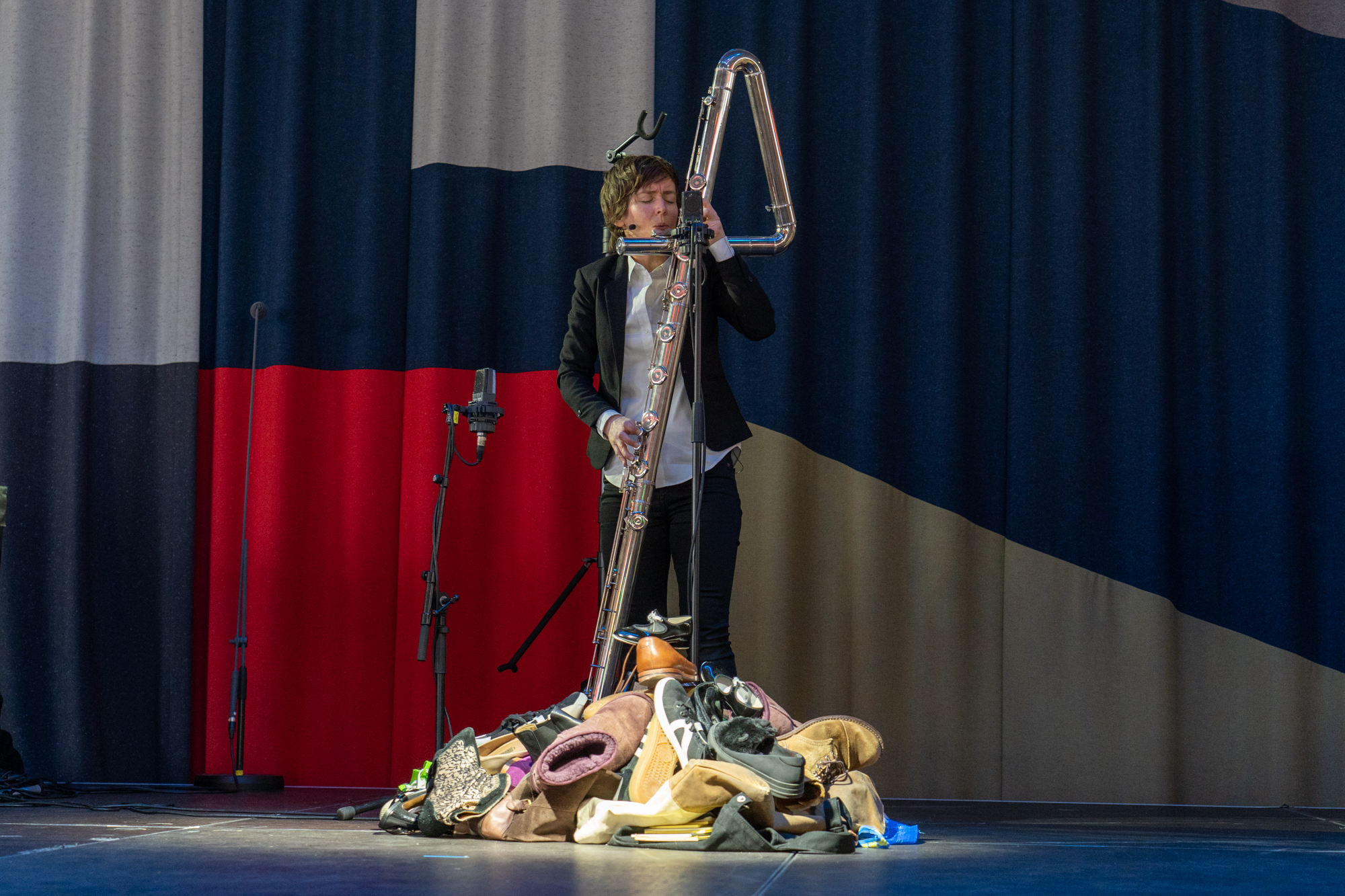
(Image by the Southbank Centre's music director, Gillian Moore

This free concert in the foyer of the Queen Elizabeth Hall paid tribute to the late Pauline Oliveros, exemplifying the social, and sonic pleasures of the late composer’s work. Playing an array of flutes and whistles, Claire Chase was accompanied by Senem Pirler, working with the electronic ‘Expanded Instrument System’, a “computer-controlled sound interface” Oliveros first designed in 1963. For the first piece, ‘Sounds from Childhood’ (1992), Chase instructed the audience to remember a time in childhood “when it was a lot of fun to make sounds”, and then to make those sounds. The collective texture—raspberries, sighs, groans, ululations—was then played back through the EIS as a chorus at once disjointed and with the pleasures of togetherness; memory taken forward into the present and, via the EIS, the futuristic. For the text score ‘13 Changes’ (1988), Chase read out each of the textual prompts before interpreting them for an array of flutes. The titles thus served as entities in themselves, by terms pithy, humorous, and thought-provoking, from ‘Songs of ancient mothers among awesome rocks’ to ‘Rollicking monkeys landing on Mars’. The EIS gave the resultant whirling of breath and air an edge sometimes mechanical, sometimes digital, the pieces rendered something like epic bagatelles, condensed but imaginatively vast and expansive.

The duo concluded with the most substantial work on the programme, ‘Intensity 20.15, Grace Chase’ (2015). Oliveros wrote the piece for Chase’s enormous bass flute—or ‘Bertha’, as she dubs it—but with the kicker that the flute would only be deployed briefly at the end. For the rest of the piece, Chase would have to find other sound-producing means. After extended discussion, Oliveros and Chase hit upon the idea of using texts by Chase’s grandmother, Grace. Diagnosed as schizophrenic in her 20s and subjected to electroshock, Grace had self-medicated through art, writing unclassifiable texts in hundreds of notebooks, their inveterate punning subverting linguistic and patriarchal authority.

“In adulthood I have taken up a load of childlike things”, Chase proclaimed, neatly inverting the Biblical declaration of maturity. She proceeded to unload carrier bags of notebooks, bells, whistles, and percussion instruments, turning the stage into a kind of children’s music workshop run riot. This was music as dispersed play rather than concentrated training, un-learning the hierarchies embedded in the world of ‘classical’ music. A linguistic riff—“And I step on you and you and you”—saw Chase using countless pairs of shoes as percussion instruments, ultimately striking a giant bass drum with a high heel in a neatly subversive feminist gesture. The piece ended with an extended bass flute drone, a meditation that eased us back into the present. Throughout, the legacies of the women Chase described as her spiritual grandmother (Oliveros) and her biological grandmother (Grace) provided a non-essentialist model of feminist energies, accessible to all: airing what was unaired in order to bring in new airs for us to breathe together.

A few minutes in, I overheard a small child in the row behind me whisper: “this is cool, I’d actually like to stay”. The ‘avant-garde’ or ‘experimental’ here is accessible, not despite, but precisely because of its experimentation, the particular openings it offers onto the world—to childhood and adulthood, to suppressed memories and lost histories—and above all, to the sheer pleasure in sound-making as participatory endeavour. Oliveros would have been proud.

Eva-Maria Houben / GBSR Duo, Together on the Way', Southbank Centre, 3rd April 2022


(Image again by Gillian Moore)

Immediately preceding the Oliveros concert in the foyer, the QEH's inner concert hall saw a performance by the composer and the GBSR Duo, of Eva-Maria Houben's Together on the Way for organ, piano, and percussion, premiered at Huddersfield in 2021, a performance recently released on Another Timbre. Whereas that performance took place in a small church, the expanded space of the QEH allowed the work to breathe in a new way, even as so much of Houben's music is about doing away with hierarchies of vast auditoriums, prosceniums, scale as a performance of cultural legitimacy: a case outlined in her book Musical Practice as a Form of Life and elsewhere, which might in part be about returning to a pre-19th century way of thinking--the tradition of the local church organist, say (Houben's first professional job in music was as a 12-year old church organist), a different relation between composer, performer, and listening community than that of the giant concert hall--as well as elements of 19th-century Romanticism that might be reclaimed beyond the idea of the Romantic composer as an isolated, bourgeois "political bonehead".  Breathing in a new way, cast in a different light.

Today, bathed in a resplendently subtle light show, Houben was playing the QEH organ that literally rises from underneath the stage (sadly not a spectacle the audience got to witness): emergence from the depths not so much as cthonic grandiosity (Phantoms of the Opera), nor the portentous religiosity that horror film aesthetic builds off, but a more modest inhabiting of environment, of space: what's not there, hidden in the corners, the barely there, that which will disappear again. (Houben's ever-present concern with the paradox a sound that exists in its disappearance, with the "presque rien" indications on Berlioz's scores.) For though, to say it again, the organ has reputation as grandiose, enormous cathedral spectacular, in fact Houben reveals it as a wheezing, mechanical instruments of stops and clicks and wheezes ("the organ is for me a Hoffmanesque instrument", as she says in an interview about the piece here), and at the same time a delicate, airy instrument of breath, of near-silence, sustaining a kind of cloud of sound that hangs in, through and as air, through pipes and stops and keys, at once intangible, evanescent, and weighted, heavy, with freighted tradition, with its un- and re-making...


On stage, Houben was flanked by the two members of the GBSR Duo, Siwan Rhys's piano gently prepared with horsehair, but more often played in a series of unadorned notes, melody reduced to its simplest means--one note, two notes, a few notes that almost, but don't quite, build up a scale or an octave transposition--or gently struck dissonances, reverberating in the sustain pedal and a finger-dampened string; George Barton's huge array of percussion played as a series of barely-audible taps, synchronised and overlapping piano and percussion entries over a single organ chord, sustained over the course of the entire work, not so much as a "drone" as a near-transparent texture, wheezing, breathing, enormous yet transparent, what Houben calls a "shelter" or a kind of sounding silence in which the players can each occupy their separate spaces, spread out on the stage; rather than Cage, for whom it's de rigueur to compare Wandelweiser music, I kept thinking of Nono, Houben's image of "the way" and his borrowing of Machado in the "no hay caminos..."  motto that suffuses his late work, or the interplay of the piano and its outsides, its surrounding echoes and silences in "...sofferte onde serene", of the creation of sound as an environment, a way of remaking the space it's in.
Nono: "It is the inaudible, the unheard that does not fill the space but discovers the space, uncovers the space as if we too have become part of sound and we were sounding ourselves".

Houben: "all together are rather more listening than playing. 
all together become aware of the different ways their sounds decay."
At one point the breathing of someone in the row above me was louder than the music coming from the stage, but there was almost no "actual" silence: a veil, a representation, a mediation. Somewhere in all of this a meditation on decay, on the anxieties of environment as not simply a "natural" space but a contested terrain of despoliation and the imminent ending of life--Houben's programme notes nodding to the anthropocene--or the histories closer to home, the current conflicts and conjunctures that seep into a place that doesn't, as the cliche goes, close itself off from them in a cocoon, but lets them enter and disappear. This is a historical music, a music maybe at the end of something, with the melancholy that implies, but also with the possibility of remaking and rethinking ("when the chord is unfolded, it sounds for a while, then the process of deconstruction begins"...)--spread out, as the performers were on stage, over large distance, chasms, yet with a kind of intimacy, a human scale, the possibilities of bodies in space, the possibilities of hearing as a mode of relation: a music that models eternity or infinity, as per Cage's ASLSP, its centuries-long sounding organ, yet which is in itself concerned with the material of decay, with a focused materialism. After an hour or so--just under or just over--the work ends, signalled with uncharacteristic drama or force by an inexorable, regular set of drum taps, one after the other, over and over: I didn't count exactly, but perhaps as many as fifteen times, a regular, barely reverberating stroke, flatly thudding, inexorably placed. A host of associations invoked: Beethoven's fate, Wagner's forge, yet the taps here also remove drama, ostentation, military forthrightness: and while those connotations can never render this a gesture "purely" formal or abstract, the context of the work as a whole, the manner of its delivery, lend this conclusion a non-forced materiality, at once transparent clarity and a refusal to be reductively read, rendered symbol.

Afterwards, Houben remarked that the piece, which exists in a different configuration each time it's performed, and is thus in essence never the same piece twice, might be considered as still sounding, still being performed. More to write and think about this...

Pat Thomas/Elaine Mitchener--Cafe Oto, 10th April 2022


(Image by David Laskowski)

This was the first time Mitchener and Thomas had performed as a duo, though they appear with Orphy Robinson and the visiting duo of William Parker and Hamid Drake on the expansive Some Good News album, also recorded live at Cafe Oto a few years ago, on which Mitchener is essentially the guest--and entirely at home--with two established duos, that of Robinson/Thomas and Parker/Drake. No prerequisites or expectations as to 'genre' here, this Sunday afternoon in early April; either musician could go anyway, together or separately. It's playing as listening, improvising, holding a line or--more often--knowing when to let it drop and hold back; Mitchener stepping to the side of the stage to listen to Thomas, solo, or vice versa. Both supplemented the complex 'basics' of piano and voice: Thomas with two i-pads functioning as kaoss-pads--an updated version of his earlier rougher, analogue electronics and tapes of the 90s, where he'd deploy tapes recorded off the TV, lo-fi musique concrete cut-ups and blarts of noise, but nonetheless treated with the same expert capacity for a kind of brusque disruption, a refusal to use electronics to coast or provide ambient texture; Mitchener with objects on a table, selectively deployed--a couple of whistles, a thumb piano, some rattles and shakers, used for specific and precise textures at particular points. No prerequisites, no expectations--and the opening five or ten minutes in particular all about finding ways into listening: Thomas scraping or stroking the piano's inside strings, Mitchener's quiet articulations, sometimes the amplifier buzz louder than the sounds they made; audience quiet and focused, this warm spring afternoon, so much lighter and more lifted than the lockdown of two years ago, a social space open to be whatever it might be, the openness of matinees like this, where the music can just be open and relaxed in its exploration, in its unforced listening.
 
Both Mitcher and Thomas have a penchant for intensity and volume: Thomas' electronic walls or, on piano, trademark thick chords, often clusters played with palms, the piano at once treated in its harmonic richness and rhythmically, as drum; Mitchener's virtuosity, her to turn any note into a series of gasps or rhythmic stutters, gargles, fluid yodels, effects for which the term "extended techniques" will have to substitute for a more precise technical designation--ululations reminiscent of transmuted marketplace or muezzin cry or folk music buzz, echoes of jazz--though almost never 'scat'--occasional avant-classical high pitches, pure and biting like laser beams, sirens, piercing through. But this was not a showcase of techniques, a kind of masterclass or workshop in displaying virtuosity; those impulses initially, and often throughout, kept muted, finding their way in, not forcing the music. 

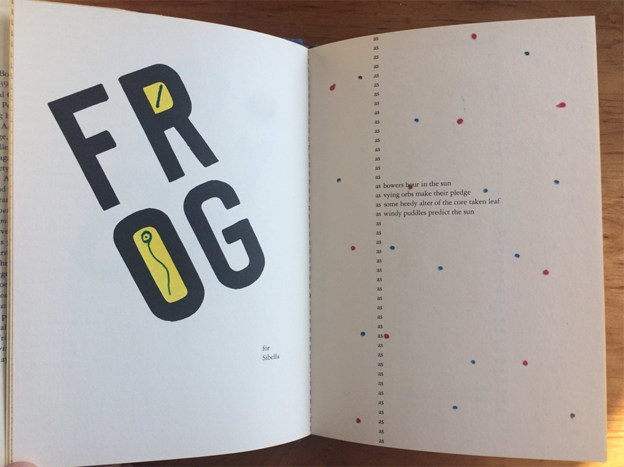
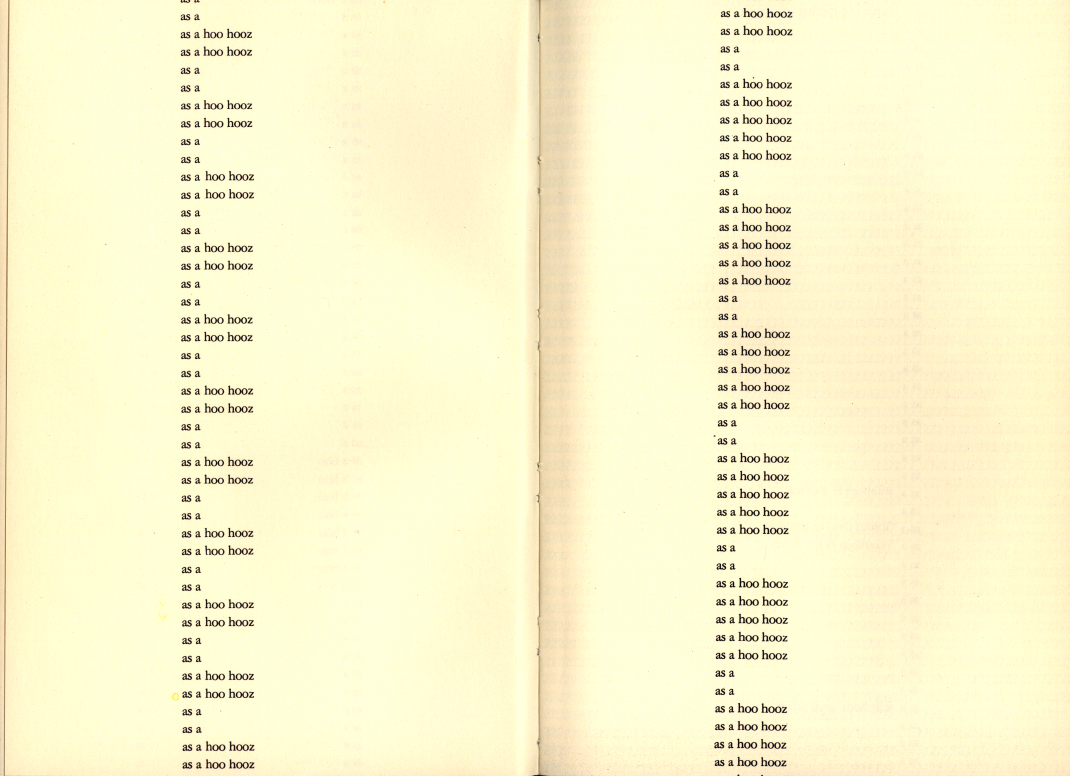
What was performed, with the interruption of a brief set break, was essentially one long piece divided into natural, unplanned episodes and pauses--though occasionally the audience broke in with applause to 'end' a section. Absent of a score, Mitchener used a series of texts--a Cecil Taylor poem on the elements and on creation("thrice water in air..."), Mingus and Jeanne Lee quotations on creativity, and, the most extended, poems by N.H. Pritchard, mainly from his second book, EECCHHOOEESS--which she moved through, improvising on or off, a word revealing itself gradually, cohesively broken down; the text not so much as a script but as a repository to give the voice shape, as texture and also as a space, a placeholder, a holding place for thought, for suggestion, for image. Pritchard in particular, who she's worked with before, formed the basis for the most extended (re)articulations of the set--the ecstatic yelling of the word "FR/OG" that closed the first set with aplomb, the poem of that name taken up again in the second half, Pritchard's splitting of words, so that "echoing" is reversed, mimesis of the aural effect rendered visually and then resounded--"ing echo", Thomas picking up on that echoic play with a rare melodic echo of Mitchener's pitched tones. An echo is one mode of relation, between the sounding and the sound, the semantic and the 'purely' sonic, the intentional and the unintended, the spoken and the spoken-for. Another--language's connecting words, the way they tie and fry, they fray: the spoken-sung recitation of Pritchard's mediation on and with the simile, "as a / as a / as a / hoo hooz", the call of an owl or the questioning of possession or colour gradation, "whose", "hue", words slipping and sliding, nature imitation, night birds or crickets, Thoreau's loon, nocturnes, clouds forming, faces in the sky, ("VISAGE / BLACK CLOUDBANK / FORMING/ ELSE WHERE") a kind of mystic-material inquiry rooted in (perhaps) American Transcendentalism, the reading of nature's hieroglyph as Emerson put it--letters, sounds, transparent eyeballs, bells--or theosophy, Toomer's Gurdjieff, his sound poems ("vor cosma saga [...] vor shalmer raga"), or a (post)structuralist enquiry into language--metaphysics or metaphor, any number of enquiries..."As a" as a repeated loop between speech and song, Thomas sometimes picking up with piano figurations that offered rhythmic support of staggered dance, more often with electronics on the i-pad that fed in insectoid cracklings or multi-layered clouds sustained then dying away.


(Pages from N.H. Pritchard's EECCHHOOEESS performed by Mitchener/Thomas)

I had a thought, but it was more a feeling, transmitted in the performance's vibrations, its sensations of tone, that this was all above all about material, about the piano as material, as object, as percussion, as an instrument with an inside and an outside, about how Thomas' performance "outside" on keyboard and "inside" on strings activated both, refusing distinctions between them; and how Mitchener too articulated inside and outside, clicks from the back of the throat while singing, the way the entire palette and throat is drawn into and made visible as articulation. It's about time, too, and poise, how listening gets articulated visually as well as sonically, in the way Thomas would hover over a chord, fingers in position, decide not to repeat it, move instead to the inside of the piano or the i-pad; the way both he and Mitchener insistently and unforcedly avoided the cliches of 'responsive' improv (echoing, playing 'together' in too obvious ways, as if that were the only way to play were to overcompensate by demonstrating you were 'listening' by imitation--which is not really listening at all, just a kind of language-learning game, a preliminary to the real listening that never really happens). Often Mitchener channeled an entire band in rhythm and lead parts herself, accompanying doubled vocal lines with a shaker, with a rhythmic articulation that supplemented and separated and merged from a melodic line (like an avant-garde Bobby McFerrin, occasionally); Thomas instead responding with a series of tranquil dissonant chords, or silence, or an electronic crackle, or in one delightful moment, a sudden burst of club music that faded in and out like the ghost of a different sociality, invoked with (im)perfect humour and (im)perfect ting, art brut, joyously knowing. Only at the end did he join or lead in a jazz-tinged series of chords that channelled a host of optimistically rueful medium-tempo solos exemplified by the solo Monk playing over the sound system when I entered the venue, and that maybe aurally echoed in his playing, that lent itself to song-like song-line close on Jeanne Lee's words on the experience of life as process, on life as living: not stasis, not object; and on those words, those chords, that song, synchronous, asynchronous, warmly to end.

Wednesday, 9 June 2021

Recent Writing (June)

Not posted much on this blog of late, but a fair bit of other writing elsewhere, of which a digest follows...


Over the past month I've been working on a long article on the great organist Larry Young / Khalid Yasin, now up on Point of Departure. The piece covers all the periods of career: early work in the soul jazz idiom from 1960 to around 1964, progressive jazz with the class Unity in 1965, free jazz (or a synthesis of free jazz with elements) from 1966 to around 1969, and then 'fusion' from 1969, first with the Tony Williams Lifetime, then with his own 'Love Cry Want', 'Lawrence of Newark' and 'Fuel' bands. The gist of the piece is that Young provides a lens for all kinds of trends, movements, placements, moving from doo wop to soul jazz to the advanced end of bebop to free playing to fusion of various kinds, along the way reinventing the sound of the Hammond organ. (To hear just how radically he'd transformed what could be done with the instrument, take a listen to this astonishing solo piece). It's often said that Young's training as a pianist is at the root of what was so unusual about his approach--e.g. taking the influence of McCoy Tyner's fourths and Monk's use of space and adjacent, dissonant notes, rather than the Jimmy Smith licks and held-note vocabulary ubiquitous amongst soul jazz Hammond players from the late 50s on. At the same time, of the technical achievements of his playing-are developments from  materiality of the instrument itself, as a kind of proto-synthesizer/big-band-in-minature, and from the vocabulary of soul jazz, even as they explicitly move away from it. So' for example, when he transitions from soul jazz on albums like Unity, Young explicitly moves away from the Jimmy Smith technique of holding a single note over the tune's chord pattern in an ecstatic imitation of tenor 'screamers', blues 'shouters' etc. But in the 1970s, that technique returns, transformed into a series of  sustained drones and 'washes' of sound which create dissonances, clusters, white noise blocks as the harmonic pattern surrounding them departs radically from the soul jazz patterns with which Smith worked. Similarly, the doubled thinking required to play both bassline in the footpedals and comp/solo with hands on the keyboard leads to a dialogic conception that in turn influences his playing within a group--a collective approach that in turns leads naturally to free jazz (Of Love and Peace in 1966) and the groove-based large-group improvisations of Love Cry Want and Lawrence of Newark in 1972 and 1973. And in terms of genre, the roots for the free jazz/ avant-garde playing of c.1966-69 are laid in soul jazz and hard bop of c.1960-62--in itself a kind of 'fusion' of elements of progressive jazz (bebop) with urban pop music (R&B)--which then presage the jazz fusion of c.1969 onwards, as the harmonic ambiguity of free jazz combines with the harmonic simplification of fusion and its focus on rhythm and groove. Which means that this at once a dialectical process--as per the Hegelian sense that hovers over fellow Newarker Amiri Baraka's earlier account of the movement from bebop to cool/hard bop to free in Blues People in 1963--and Baraka's 'changing same' circa 1967--which is and is not dialectical, at least in the same sense. (Clearly more thought needs expanding on this!). Baraka's not invoked arbitrarily here--he provided liner notes for an early Young album and was immersed in/emerged from the same thriving music scene in Newark. Which is the piece's other argument--that Young, along with Alan and Wayne Shorter, Grachan Moncur, Woody Shaw, Tyrone Washington, etc etc--marks a strand of Newark-originating playing in the late 50s/early 60s that often challenges strict divisions between 'mainstream' and 'free' and suggests another stream to the music. So that circa 1967/8--the year, after all, that Baraka writes 'The Changing Same'--there are a number of recordings which suggest a continuum between R&B, free jazz, mainstream hard bop, etc--Young's Contrasts, Washington's Natural Essence, Eddie Gale's Ghetto Music, even (less successfully) Ayler's New Grass--that are a kind of 'fusion' in advance, but alway in terms of Black music, rather than the way that fusion later becomes, too often, a kind of code for white virtuosos coming in and making the money. (As producer David Rubison put it, "Jazz fusion meant white people playing Black music"). All these arguments end up becoming somewhat speculative in part because Young (and Washington, Gale, etc) was never documented as much as he should have been. There's roughly a record per year when he had a contract with Blue Note (1965-1969), but after that--which is precisely when his playing really takes off--the documentation is a lot more sporadic: Lifetime's best work was live, but can only be heard on a few bootlegs; there's only one recording apiece for the Love Cry Want and Lawrence of Newark bands; I'm still wondering if tapes of the trio with Dewey Redman and Rashied Ali at Slugs' Saloon in 1968 exist...(Highly unlikely that are recordings with Frank Wright, Cecil Taylor and Coltrane, all of whom he played with at various points.) For that matter, it's impossible to get hold a copy of his final record, The Magician, a Germany-only release by his much-maligned final fusion band, Fuel. 

So that piece is now out on Point of Departure, along with three other reviews: George (E.) Lewis' Recombinant Trilogy, three works for solo instruments with electronics; The Locals (Pat Thomas et al) Play The Music of Anthony Braxton, which I noted back in Februrary on this blog; and new poetry-and-sound releases on Fonograf Editions from Nathaniel Mackey and the Creaking Breeze Ensemble and Douglas Kearney/Val Jeanty (Kearney's book sho is also out from Wave Books).


(Image of N.H. Pritchard from the East Village Other)

Back in April, I reviewed the reissue of N.H. Pritchard's The Matrix for Artforum: since then, I've been working on a longer piece based on this research as well, encompassing Pritchard's other books, EECCHHOOEESS, which is the first publication from Adam Pendleton's Daba Press, and some uncollected and unpublished work--of which there's a ton out there, including Pritchard's novel Mundus. Watching his appearance as a preacher in Elaine Summers' and Rev. Al Carmines' Another Pilgrim thanks to the digital versatility of the New York Public Library was a highlight of this--a real slice of place and time.


Also Umbra-related: Honoured to have been asked to write on Askia Touré's work for a special issue of Paideuma which republishes his 1972 book Songhai! Researching his poetry and thinking about the role of the African American poetic epic and Islam was fascinating work; it's astonishing that there's so little criticism on it. The piece, 'Songs for the Future', should be out soon.

Also out soon, a final Umbra-related item: from the University of Buffalo, Edric Mesmer's Among the Neighbors is a primarily bibliography-focussed pamphlet series on little magazines associated with the New American Poetry. My contribution to the latest batch offers a chronology and a brief introduction to Umbra, followed by a bibliographic listing of the contents of the five magazines produced between 1963 and 1974. This emerges from a much bigger Umbra bibliography project I began last summer, which aims to track the publishing activity of all the major Umbra poets and other poets associated with Umbra, providing details of major publications, as well as secondary criticism and other relevant material. The draft of that document runs to over a hundred pages, and I'm not sure as to what will be done with it--perhaps part of an online resource at some point. (If you'd like a copy, leave a comment below this post and I can send you the draft.) Many thanks in any case to Edric for his work on the Among the Neighbors pamphlet, which I hope will be a useful resource, given the rarity of the Umbra magazines themselves. (I'm also excited to be working on a two volume Umbra project with Tonya Foster and Jean-Philippe Marcoux, which should be out in the next few years. Watch this space!)


Boston Review are running a piece of mine on Yours Presently, the selected John Wieners letters recently out from University of New Mexico Press. It was edited by Michael Seth Stewart over a period of ten years, and having read the entire, unedited version--Seth's thesis at CUNY--which runs to around 1000 pages, I can attest to Seth's editorial acumen in producing this shorter version, still scrupulously annotated with a wealth of contextual and biographical information. (Let's hope too that Robbie Dewhurst's equally vital work on the biography and the complete poems--the latter provisionally entitled Ungrateful City--might see publishing fruit.) And props to Ammiel Alcalay and CUNY's Lost and Found programme for supporting scholarship like this. Hearing Ammiel, Seth and Eileen Myles talk at the online launch last month, setting this in its context, was a perfect illustration of the spirit in which the enterprise was conducted--Ammiel recalling meeting Wieners at Grolier's bookstore as a thirteen-year old, hanging out and talking, about the government persecution of Billie Holiday, about Wieners as part of the 'outside'--queer activists, anti-war activists, drop outs, and so on--that was much bigger than it is now, as Ammiel put out; Seth reading out a funny and engaging letter in which Wieners puts down Kerouac and Ginsberg and comes out with casually brilliant and moving phrases imbued with the poetry that shot through his life; and Eileen Myles likewise come up with phrases of music and casual poetry--"the basketweave of the soul" a phrase I half remember; all this was a moving affirmation of Wieners' importance. 


The Boston Review review comes out of a bunch of other work on Wieners I've been working on over the past few years--in particular, an essay on Wieners' great book Behind the State Capitol, editing and typography, just out in the Queer Between the Covers collection edited by Leila Kassir and Richard Espley, which emerges from a conference at Senate house Library back in 2018. The whole book can be read here and also includes work on Valerie Taylor's lesbian pulp novels and the government attacks on London queer bookshop Gay's the Word in the 1980s. On the Wieners front, a piece I wrote four years ago on Wieners and Dana (of "God love you Dana my love" fame) for an edited collection on Wieners' work called Utter Vulnerability might hopefully see the light of day in the not too distant future (for now it can be read at academia.edu); and there will likely be a couple of Wieners chapters in my current book project on queer poetry in Boston and San Francisco, focussing on the lesser-known parts of his career--his early work as editor with Measure magazine and in the context of the Boston 'Occult School', and--supplementing the Queer Between the Covers chapter--further details of his time in the orbit of Fag Rag and Charley Shively. Fag Rag and Gay Community News alumnus--and author of the excellent Culture Clash and Queer History of the United States--Michael Bronski has been super-helpful and generous in discussing this work, along with Seth, Raymond Foye, and all the others contributing to what seems--hopefully--to be a bit of a mini-Wieners revival. Not that he ever went away, but there's so much more to be said and discovered about this work. Michael and I did a long interview about his life in activism, scholarship, publishing, Fag Rag and the rest, back in December and are hoping to publish that at some point.


Over to the world of music--and honoured to have been asked to write the liner notes to the new Anthony Braxton boxset, Quartet (Standards) 2020, selected documentation of the band's European tour last year out from the Tri-Centric Foundation / New Braxton House on June 18th. The group's three-day residency at Cafe Oto--one of the last bits of live music, if not the last bit of live music I saw before the pandemic hit--was extraordinary (my write-up came out in Artforum here), and it was likewise great to grapple with the entirety of the set: 67 tracks in all, of standards familiar and obscure alike, with Alex Hawkins on piano, Neil Charles on bass and Stephen Davis on drums providing far more than merely a 'rhythm section'.


Some recent liner notes also out to a fascinating released by a large-group ensemble led by UK bassist, improviser, composer Dominic Lash, one of the first batch of physical releases from his Spoonhunt label (the bandcamp page also has some excellent digital recordings, including work with Christian Wolff, Nate Wooley, etc). Distinctions is a 40-minute recording for an ensemble called 'Consorts', working in particular with sustained tones and the relation between acoustic and electric sound: seems like it finds intriguing solutions to many of the problems of large ensemble improvisation (though the relation between composition and improvisation, as ever in Lash's work, can't be eaily parsed). The other CDs in the batch are equally worthwhile: the wholly-improvised Discernement offers one of the final recordings from the late John Russell, in a group with Lash, John Butcher and Mark Sanders; and Lash's quartet with Alex Ward (in guitarist guise), Ricardo Tejero and Javier Carmona on limulus showcases some of Lash's distinctive compositions, in and around (but never quite inhabiting) whatever we call 'jazz'. Get them here.


If Braxton's take on standards represents the latest stage in a decades-long engagement with jazz history in theory and practice, a different take on the music's relation to history emerges in a recent volume curated by Sezgin Boynik and Taneli Viitahuhta, out from Rab-Rab Press. Free Jazz Communism collects a number of historical essays, interviews, source texts and polemics, focusing in particular on the performance by the Archie Shepp-Bill Dixon Quartet at the 8th World Festival of Youth and Students held in Helsinki in 1962. Though the event's been mentioned in a fair few studies of the music, it's rarely been examined in detail, and is an interesting flashpoint for questions concerning free jazz, Cold War politics, and the like.  Pierre Crépon and I reviewed the book at Critical Studies in Improvisation/Etudes Critiques en Improvisation.


As well as Larry Young, recent listening has involved heavy rotations of Hasaan Ibn Ali's 1965 Atlantic date, long thought lost, which has finally been rediscovered and released as Metaphysics, out on Omnivore Recordings. A quartet set, it was recorded a few months after the 'Legendary Hasaan' trio date with Max Roach, with Hasaan's then-protegee, a young Odean Pope on tenor. Hopefully I'll have more to say on this one elsewhere--suffice to add that the archival buzz is more than justified in this instance.


Finally, a poem from Local Apocalypse (published by Materials in 2020) is up at the 87 press, with thanks to Azad and Kashif: https://www.the87press.com/post/digital-poetics-2-1-unhide-when-true-david-grundy.

(Writing not on this blog listed/linked on Linktree and the 'Writing Elsewhere' page on the sidebar.)