What is it that's so unsatisfactory about this film? And what can that tell us? Before answering that question, a brief run-through of the plot. Glenda Jackson's frustrated bourgeois housewife, having gone to the spa town of Baden-Baden for unspecified reasons, maybe or maybe doesn't have a brief affair with Helmut Berger's young gigolo. In town on a botched drug deal, Berger operates through a combination of what we might term freelancing: as a car or drug smuggler but, it seems, principally as a gigolo whose opening line is that he's a "poet". (The role he plays here, as a class-ambiguous outsider who both manipulates and is manipulated by bourgeois families seething with tension, mirrors that of Visconti's then-recent Conversation Piece--or, indeed, Terence Stamp in Pasolini's Teorema, at once far more ambiguous and far more socially incisive than either film.) Meanwhile, back in British suburbia, Jackson's husband, writer Michael Caine abandons plans to work on a novel to begin a screenplay based on his jealous imaginings of his wife's Baden-Baden sojourn. When Berger telephones Caine to announce that he's an admirer of his work and turns up (literally) "for tea", the stakes are set for the triangle to play out, with the added drama in the final third of Berger's drug connections, among them the poker-faced Michael Lonsdale, turning up in a kind of lugubrious pursuit.
No spoilers here, though the film doesn't aim at resolution so much as a kind of blank termination. The title is bitterly ironic, a phrase spoken by Berger's gigolo about the various ways he's paid for his services: with the utmost discretion by European women; with a kind of throwaway vulgarity by American women--"here, go and buy yourself some shirts"; and with a kind of guilt passion by English women, who wish to invest, not simply their money, but their whole beings into what for the others is more clearly transactional. Hence "romantic". Social roles, the film's ending seems to suggest, are fixed: the characters know this, they analyse it, generally with bitter cynicism or contempt, sometimes with frustrated outbursts of drunkenness, rage, or desire, but their knowledge does nothing to change it; attempts to move beyond these constraints in the name of 'freedom' are in themselves played out according to similarly hierarchical and fixed positions; desire cannot escape these prohibitions. The film exacerbates this sense by focusing on a limited range of characters and settings. These are bourgeois characters within bourgeois spaces: the house and garden; the hotel and its surroundings; the occasional visit to a dismal restaurant or club. Even as these characters, given the narrative events, spend much of the time engaged in international travel, the journeys through a setting that would reveal a fuller social world--a town, an airport, a port--are reduced to a truncated snapshot of empty spaces, seen at their edges. They move within a confined world and take that world with them wherever they go, in a grim and claustrophobic myopia. When they look out of the window--as in the shots of Jackson aboard a train that play over the credits--they see a mirror.

In this deliberate limitation to a confined social setting, the film echoes Losey's earlier The Servant, The Go-Between, or Boom! In The Servant, principally the increasingly claustrophobic house; in Boom!, the luxurious island getaway, isolated from the mainland; in The Go-Between, the wide-open spaces of a lushly filmed Norfolk countryside whose empty flatness comes to stand for a kind of myopic claustrophobia characteristic of a particular class at a particular time. In The Servant, desire is manipulated as part of an endless, circular game of power relations and hierarchies, negotiated across lines of sexuality, gender and class; in Boom!, it's a Burton-Taylor tete-a-tete which is both a kind of "battle of the sexes" and an allegorical struggle with mortality; in The Go-Between, forbidden desire across class lines and the fetishised mediations of smuggled messages leads to a denouement in which the outsider protagonist represses all thought of desire as a founding trauma. Losey's films of the 1960s and 1970s--the period in which he reinvented himself from a filmmaker of social problem pictures and taut, gritty noirs, to an arthouse director--were often criticised for the essential vacuity of their gestures. Losey, it was said, took the formal innovations of Resnais-ian temporal ambiguity or self-conscious echoes of the history of art (as when Jeanne Moureau's
Eve strikes a pose from Massacio's Explusion from Eden) and presented them for their own sake: they became empty signifiers, somewhere between costume dramas and the arthouse, in which a self-evident critique of a decaying social class was presented with gimmickry and trickery; or at worst, in which the formal presentation nullified the critique that was being made. (Is The Servant, for example, with its presentation of the usurpation of the power a member of one ineffectual, privileged class by another shown to be cynical and grasping, as Amy Sargeant suggests in her BFI Film Classics guide, ultimately a reactionary film?)
Such criticism was neither entirely right nor entirely wrong. During the '60s and '70s, Losey made films that were various combinations of flawed, highly skilled, and near-disastrously misjudged. In The Go-Between, things come together with a tact and taste that has far more beneath its surface than the costume drama feel implies. (It's a film, in other words, that's easy to misread as simply nostalgic, Downtown Abbey-style, particularly given the lush Michel Legrand score all all those sweeping shots of green fields--as Serge Daney punningly put it, "the depth of field which is often the depth of the fields, very green, crossed diagonally and nervously.") In Boom!, meanwhile the misjudgments are so far off that the film achieves the status of camp--quite brilliantly. (Not for nothing is it highly regarded by John Waters.) With Losey, quality--both the actual quality of cinema, or the pretentious trappings of a "cinema of quality"--was never absolute. 'Accident' was followed by the startling incoherence of Secret Ceremony and Boom! but in turn by The Go-Between. The Romantic Englishwoman and an indifferent Galileo--the literal return to Brecht--were followed by the incisive Mr. Klein, a film which actually felt to reckon with the weight of history, all framed through characteristic Losey-ian preoccupations. Tracing a through-line in Losey's work thus becomes both all too easy--given its auteurist excesses--and one that's frustrated by how unevenly it's executed. What we watch, at least from Eve onwards, is a set of variations on a theme, more or less successfully rendered. (And Losey's detailed breakdown of the making of his films in Michel Ciment's exemplary 1985 book Conversations with Losey gives a lovingly detailed sense of continuity between the more apparently diverse elements of his ouevre.) The Romantic Englishwoman has all the features of Losey's Pinter collaborations (for this script, one playwright--Pinter--is replaced by another--Stoppard; Losey had of course worked with a perpetually stoned Tennessee Williams on Boom!, as per the waspish recollections in Conversations with Losey), but without the deceptively minimal clarity of analysis--particularly relating to social class--that Pinter's presence afforded those films.
Take the classic Losey-Pinter structure of flashbacks and flashforwards--longer or shorter inserts of scenes whose relation to the main narrative is not immediately revealed, which might later resolve into being seen as "earlier" or "later" than that action, or which might reveal themselves as a particular character's subjective fantasies, and which serve to offer an ambiguity of subject position and narrative temporality that, as Losey argued, was specific to the cinema, in what are at once intensely filmic and intensely literary adaptations of often dense source texts (novels by Nicholas Mosley--who, as the son of the British Fascist leader, knew all about power relation and masculinity--and L.P. Hartley, respectively). This device has been used to particularly good effect in the late '60s/early '70s Pinter collaborations Accident and The Go-Between. Its most obvious antecedent lies in Resnais--and indeed, Losey directed an obscure sequel to Resnais's La Guerre est Finie which shared its original star, Yves Montand, ten years after the original. Its use by Losey is, however, perhaps closer in spirit to a lesser-known film which, like Losey's, shares a more ambiguous mainstream/arthouse cachet: the 1968 melodrama Petulia, directed by that other American abroad, Richard Lester (and sharing with The Go-Between the presence of Julie Christie, radically different in both films). In Resnais, the most obvious forebear for this technique, the dense intercutting of multiple temporal levels furthers a political analysis, with--for example--narrative puzzle as analogy for the way that politics is subsumed or repressed vis-a-vis the Algerian war of independence and political torture in Muriel, or the workings of the political underground in La Guerre est Finie. In Petulia, they serve as a cynical demolition of the Californian 'summer of love' and its reverberations among the liberal (or not so-liberal) wings of the bourgeoisie--along with the presence of racism and intimate partner violence--and in Losey's Pinter collaborations, as a careful analysis of the ways that gender and class replay among networks of power--the ivory tower of Oxford University in Accident, on the one hand, and the English country house in The Go-Between, on the other.
Most of these examples are films about the past: or, if about the present, about the inability to reckon with the legacies of the past that serve as the return of the repressed, particularly in a gendered violence, done by men to women, which assumes unspoken structural dimensions. In the car crash and its aftermath that opens and closes Accident, a particular moment reveals itself as made up of a mosaic of different perspectives, while Losey/Pinter through various methods also suggest that much of what's seen exists within the warped imagination of Dirk Bogarde's central character, the Oxford don whose repressed desire leads him to commit an unforgivable act. In The Go-Between, meanwhile, the traumatic repression of an incident seen only at the end of the film (the discovery of the illicit, cross-class lovers in flagrante delicto, leading to social exposure and suicide) is cinematically expressed through the insertion into a broadly chronological narrative of brief flashforwards to its conclusion which function something like involuntary memories. While these might technically be experienced as flashforwards, they ultimately take place within what is essentially a flashback structure, in which the adult Leo is finally able to recall his suppressed childhood experiences, as signalled by the famous Hartley line heard in voiceover at the start of the film: "the past is a foreign country; they do things differently there". In either case, from the perspective, both of its making in 1971 and the publication of the novel in 1953, the narrative is framed as a retrospective, deceptively nostalgic one, towards its clearly outmoded Edwardian setting (and one with an oblique nod to the colonial relations that, in Resnais' Muriel, exist on the peripheries of the narrative, yet are central to its puzzle-like meaning.) These are films in which we see country houses, Oxbridge colleges, games of cricket: the signifiers of nation and history that exerted a particular fascination for an exile like Losey, driven by McCarthyism to the old colonial heartland.
More contemporary in its setting, The Romantic Englishwoman is less clearly oriented towards the past, and its flashbacks become something more like premonitions: memories of an event that may never have happened, whose presence causes that event to affect the course of future events. These flashes--whether forward or back--centre on an incident that occurs, as in Accident, near the start of the film: the moment Jackson and Berger take a lift together in their hotel and may or may not initiate a sexual relationship. Yet, whereas in Losey's other films, devices of literary narration were incorporated or subsumed into what were, as he notes in Conversations, fundamentally cinematic temporal structures, enabling the recurring snippets of a traumatic event to oscillate through the film like shards of glass or wisps of smoke, here, the literary, constructed nature of memory is turned into a kind of clunking, meta-fictional conceit, in which in life imitates arts as the paranoiac, jealous fantasies of Caine's novelist/screenwriter--the encounter in the lift, and, ultimately, the wife's decision to abandon her husband and the entry of gangsters as the story turns into a 'thriller' (a more contemporary--and cinematic--mode of storytelling than that of The Go-Between's "costume drama")--come to life onscreen and in the narrative.
In their initial appearance, these scenes are compelling enough. What happened in the lift in Baden-Baden? From whose perspective do we see this? What are the lines between desire--whose desire?--and action? In its opening third in particular, the incident in the lift serves as a central focus for the insinuation of various triangulations of a bourgeois marriage--a kind of infinite range of scenarios, generally operating according to the same pattern, on the various real or imaginary pairings of the heterosexual couple and a third partner: the frustrated wife and the younger gigolo; the frustrated husband and the young au pair; and so on. Yet as we see Caine type on screen and then see the fantasy come to life with Berger's arrival at the house, the film curls on in itself in a way that begins to shut off other possibilities. (Losey himself later expressed discomfort with the way the scenes of Caine writing fitted into the texture of the film.)
Like Fassbinder, Losey argued that the power dynamics so coldly dissected in his films are operations of sexuality in general, as opposed simply to those of heterosexuality: "With [the 1962 film Eve--perhaps the first of his 'arthouse' or auteur films] I wanted to make a picture - as I still and always do - about the particular destruction and anguish and waste of most sexual relations, whether heterosexual, homosexual, bisexual or whatever". (Hence what is in effect a bisexual triangle, or quartet, or, at the film's end, a kind of expanding circle, in The Servant.) In The Romantic Englishwoman, they are particularly focused on the ways that such power dynamics play out within the context of heterosexual marriage. As with much of his work, the film couldn't easily be called either a feminist or an anti-feminist film: Caine's obnoxious outburst at Jackson's friend, a visiting gossip columnist, for repeating feminist statements about female homemaking roles, represents one pole; yet, in a film such as this, as, to a different extent, with Moureau's more liberated Eve, Jackson's dreams of liberation from marriage can occur only through another man, and no real possibility of sociability outside the heterosexual contract is offered. We simultaneously watch the playing out of male jealousy--Claude Chabrol-style--though Caine's character, apart from this one outburst, never reaches heights of Chabrolian murderous rage; and of Jackson's "romantic" desire for escape--the doomed template of much melodrama. Too often, though, the film simply presents this double-bind as is, with little other perspective on what we already know. Truth becomes truism, even fatalism. Does the presence of the gangster subplot imply an equivalence between the workings of organized crime and those of bourgeois marriage and the affairs and transactional sexualities that exist alongside it--the one 'legitimate' and the other the necessary other to allow that structure its legitimacy?
If this were an early Fassbinder film, it might. Here, however, Losey is so preoccupied with formal exactitude that a more layered sense of meaning--allegorical, narrative, ideological--evades its grasp.Yes, the film allies form to content--as in Resnais, as in Lester, as in Losey's other films. The flashback-flashforward structure insists on the claustrophobic way in which its characters play out pre-ordained social roles--again and again. It insists on this at a formal level, at every stage.
But to what end?
***
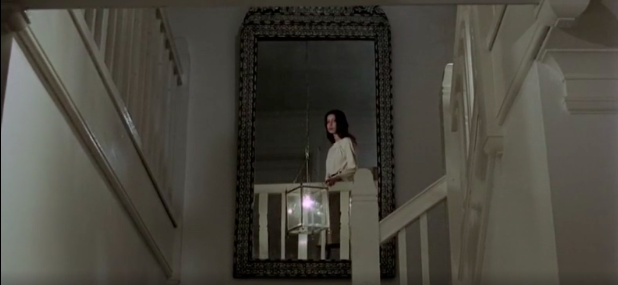
As the auteur model hardened into a kind of doctrine, within both mainstream and arthouse cinema, its worst characteristics--the delineation of directorial vision through mannered stylistic over-emphasis and the obsessive replaying of certain themes or preoccupations from film to film--ossified. Often, this gets called "self-indulgence": there can be a pleasure to that, as in the obsessive zoom lenses and luxuriant sweeps of historical decor in '70s Visconti (especially Ludwig), a critique from within of its own decadence with some parallels to that of Losey. But it can also become excessively mannered--perhaps mannerist. In The Romantic Englishwoman, the flashback-flashforward device takes its place alongside other characteristic Losey features such as the obsession with shots which use mirrors to produce a kind of mise-en-abyme or double framing, incongruously languorous, lushly romantic orchestral scores, and bitterly ironic cut-aways. By now, however, it has become an example of a technique, a device, a tic used to more or less good effect in earlier films--the mirrors of The Servant, the cutaways of Accident, the Michel Legrand score to The Go-Between--that simply replays itself, as if one could part the parts together to put something that, while in perfect working order, seems to have been produced without any real necessity. Yes, style and form enact narrative content: and on top of this, the meta-scenario of the script, in which Caine's screenplay becomes a kind of self-fulfilling prophecy, renders narrative itself a mise-en-abyme. But form and content here are too perfectly tied: the parts fit so neatly that any social commentary is reduced to a bare-bones outline.
Losey feels obliged to attract the attention in terms of social relations toward a visual mechanism which was always designed to conceal these relations.
Perhaps this is the central issue. The cold distancing that such a style produces--one watches every shot, not so much as a moving, breathing thing, but as a kind of fastidious construction, like a well-made watch--superficially offers something approaching the analytic operations of early Resnais or the alienation effects of Losey's mentor, Bertolt Brecht, but without the content of thought and critical reflection on the mediations of the aesthetic medium that effect was intended to foster.
As Jackson and Caine arrive back at the house where a party awaits them--the end of the affair, real or imagined, that disrupts the bonds of the couple form, the reiteration of the social bonds of bourgeois life--it's evident that there's no way out. We see this from the outside, looking in on the goldfish bowl--a bowl we may well ourselves have no access to, as the screen shows us yet more images of bourgeois life and tells us they are unhappy. The viewer is placed determinedly outside the frame, where they can stand with the arch-framemaker, Losey himself.
Yet what kind of outside is this? In the Brechtian model, the artwork prompts a self-critical reflection on what is being shown and how it's being shown aimed to combat deception, smoke-and-mirrors, and the replaying of art as the endless perpetuation of a bourgeois perspective. And this is why Brecht's work--or the work of, say, Straub-Huillet--still feels so alive, however difficult. In a film like The Romantic Englishwoman, however, we seem to stand outside the characters for no particular purpose. Brechtian engagement is replaced by a kind of deadened admiration of craft for its own sake. Perhaps this is why the film feels so "cold", so dead, such an exercise in style.
In Conversations, Losey recalls the picture as one in which he had relatively little interest. "I don't like the characters", he remarks.
And they're not likeable [...] Helmut's character [...] [is] the only one in the whole film who has an articulated, concrete philosophy. It's an anarchistic philosophy but at least it's there. The others are just kidding themselves one way or another. I've made that picture a thousand times, maybe not as well, but - you know, it's a remake essentially. It deals with an impossible situation in which a bourgeois life encases people and they don't get out of it and to that extent it's The Prowler, Accident, Eve.
Yet, beyond Losey's own dismissal of the film as a begrudging rehash of the kind of story he'd told before, the fact that it exists perhaps tells us something else about the evolving nature of cinema as the reactionary years of the seventies settled across the Euro-American world. What does it mean that such a film was made? Who was it for? There's more thinking to be done on this question that I have the capacity for here, but suffice to say that, for all its faults--in fact, because of those faults--
The Romantic Englishwoman has something to tell us about the peculiar status of a particular model of cinema--not quite arthouse and not quite not-arthouse--that had evolved out of the ruptures and eruptions of what
Getino and Solanas termed 'Second Cinema' and made a kind of uneasy
rapprochement with Hollywood's 'First Cinema': a cinema within which, paradoxically, or so Daney argued, Losey had been able to make more socially subversive films than in the apparently more radical work of the
auteur years--
The Boy with the Green Hair, The Dividing Line, and so on. Losey's own comments on his film suggest that he had by this point himself become entrapped within the same world as his characters: a circular series of representations of a circular series of relations, the bourgeois life whose lovingly detailed exposure had become the
de facto image of art cinema of a certain kind (Antonioni, Visconti, Losey...)
In Losey's final film, La Truite, released seven years down the line, Isabelle Huppert plays what is in effect an updated version of the Jeanne Moreau character in Eve, or, indeed, of the Helmut Berger character in The Romantic Englishwoman: a figure whose act of rebellion and survival within a bourgeois world are both entirely directed against it and entirely dependent on and circumscribed by it: "an anarchistic philosophy but at least it's there". Once more, though the characters spend a lot of time travelling within settings of various opulence, there's, really nowhere for them to go. As Daney writes:
Losey looks at this small world, this modern fish tank, with a slightly indifferent tenderness. He continues to pretend undoing the terribly tangled web of the plot, even though it is no more important than mishmash.
In the fishtank of formalism, aesthetics is divorced from pleasure: everything is a copy, nothing changes. Or, to adopt another metaphor, the picture that the puzzle portrays will always be the same, however the pieces are jumbled. Daney's "tenderness" might be read as "sympathy"--sympathy for Moureau and Berger and Huppert's acts of revolt, sympathy for the roles in which all the characters, without exception, are trapped--a sympathy so all-encompassing, and so low-level, that it can hardly be called "humanism", which protests, not with the anguish of Sirkian restraint or the caustic exaggeration of Fassbinderian satire, but with something colder, flatter, both closer in spirit to its bourgeois subjects and immeasurably further from any kind of transformative analysis of the situation in which it finds itself. And perhaps, after all, this is where certain aspects of Euro-American cinema, of Euro-American society, still find themselves, half a century on.