Showing posts with label Amiri Baraka. Show all posts

Saturday, 15 August 2026

The Changing Same (Part 1) (Preview)

Preview of a two-part Substack post on jazz and hip hop poetics.


The next two posts here will explore some background to two book chapters I worked on in the past few years, both just published in edited collections. In the next post, I’ll write more about “A Question of Form: Jazz in Joans, Kaufman, and Cortez”, a chapter in The Cambridge History of African American Poetry, a monumental volume edited by Keith Leonard. This first post, though, focuses on “Nation Time(s): Jazz and Hip-Hop’s Changing Same”, published in Hip Hop and American Culture, also from Cambridge University Press, and edited by academic and Wire magazine columnist Rob Turner. The book chapters themselves will also be available to subscribers behind the paywall.

It is—or should be—uncontroversial to say that the criminalized treatment of contemporary hip hop artists is hardly different in content to that of the blues and jazz artists of the past—in itself a continuity, though hardly of a desired or desirable kind. Nonetheless, the question of whether hip hop, half-a-century since its inception, fulfils or negates various traditions, radical or otherwise, can be the subject of some controversy. At stake in hip hop’s use of jazz as lyrical and sonic trope is the status of cultural heritage, perceived relations to history and community and the question of what this music, what any music, does, the question of what it can or could or should do.

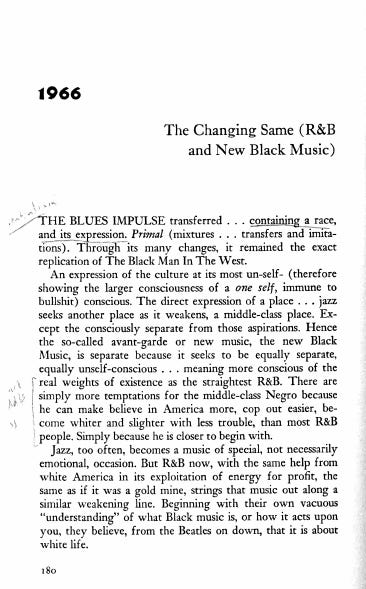
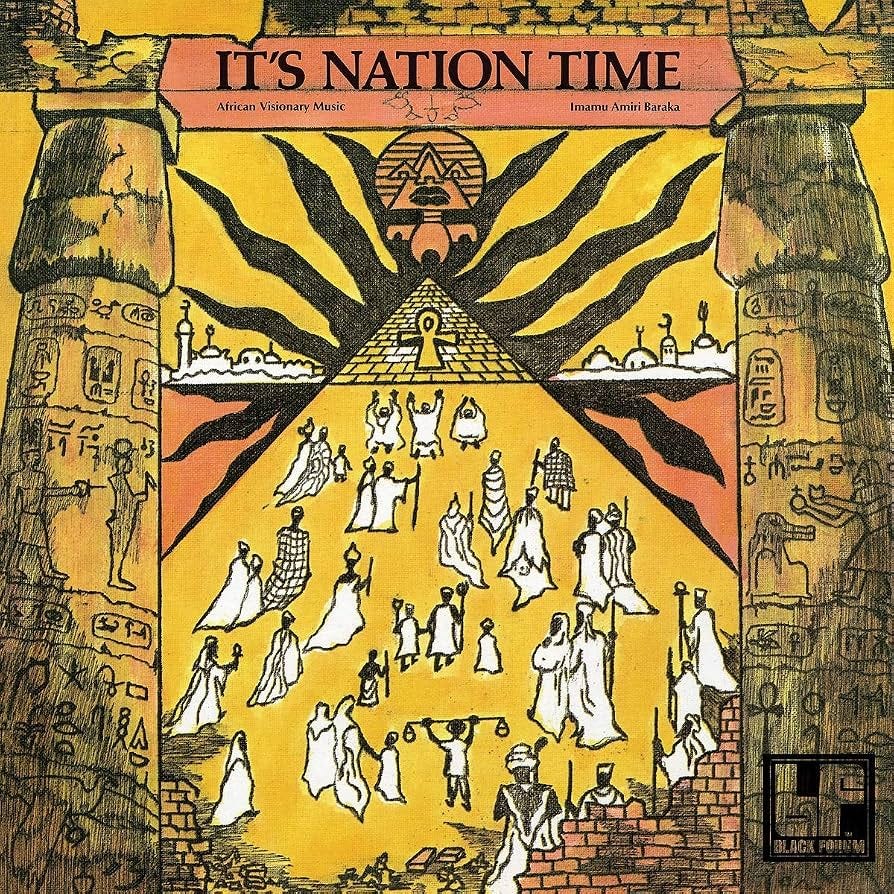
The chapter focuses on the relation of jazz to hip hop via Amiri Baraka’s notion of the “changing same”, and proceeds through some close readings of lyrics and jazz samples from “Golden Age” hip hop. Baraka’s 1966 essay caps off Black Music, that still-foundation survey-statement on the jazz of the decade’s first half, and the New Thing, the New Black Music, free jazz in particular. As Baraka started to conceptualise how the Black Arts might expand, political coalition-making had its artistic equivalent. Popular art, so a simplified version of the argument might go, had a social appeal that the New Music lacked; the New Music had a political content or focus that popular music lacked. Each could infuse the other: a coalition aimed at challenging the economic, aesthetic and political structures within which Black music and Black musicians were presented and exploited. Baraka himself put this into practice not only in his criticism but in his own artistic work, recording his own poetic-musical collaborations across doo wop—Black and Beautiful, Soul and Madness (1968)—free jazz—A Black Mass (1968), with the Sun Ra Arkestra, and ‘Black Art’ (1965), with Sunny Murray et al—and the combination of four separate groups, each within a different genre, on It’s Nation Time (1972).

Such work is, in turn, fairly regularly cited, along with that of Gil Scott-Heron, The Last Poets, and the Watts Prophets, as a key precursor to hip hop. So the story goes, a form of poetry-with-music that grew out of, and often had as its subject, the heritage of blues and jazz, evolved into what would ultimately become a multi-million dollar industry, shaping the global sound of popular music.

But there is, of course, some ambivalence here. In his later writing on music collected in books such as Digging, Amiri Baraka himself espoused the position, fairly standard among those of the Black Arts generation, that hip hop was of value when more politically outspoken, when continuing the specifically political frameworks associated with Black Art. The artists of value were Public Enemy or The Roots, with the latter of whom Baraka recorded that astonishing version of ‘Something in the Way of Things (In Town)’. Not party music, but Party music (“and when you asked what truths their party taught…”) As with the coalitional impulse of R&B, free jazz, blues, and oral poetics espoused in ‘The Changing Same’, it was the more niche forms of art—as jazz had become, as the New Music had generally remained—in which aesthetic and political values were enshrined, while popular music was too easily susceptible to capitalist capture, to the self-perpeutation of stereotype, and to a-political hedonism or nihilism. When not guided, it went off track—which was precisely when it became popular.

Baraka turned to Marxism-Leninism a few years after recording It’s Nation Time, and the Leninist strain to this argument is aesthetically prefigured in its Nationalist iteration in ‘The Changing Same’ era. The Advanced Workers, the Vanguard, emerging from within the masses, have to direct the masses away from the distractions of disco or gangsta rap and towards consciousness, towards revolution. At the same time, they must work within those forms to shape them, and the aesthetics of those forms rub off. Pleasure and its precise direction becomes hard to happen, libidinally wayward. Perhaps nowhere is this better illustrated than it Baraka’s attempt to make a disco record, the 45” recorded with the Advanced Workers and the Anti-Imperialist Singers in the later ’70s, in which he literally gives a speech in the middle of the record, while, over danceable beats, singers chant that their listeners should not be dancing at all, but “marching in the street”. It’s a dialectical move, and in itself, a clever twist on the way that Martha and the Vandella’s ‘Dancing in the Street’ was repurposed as an anthem of urban protest in the previous decade. But can the dialetic be guided this way? Is this how art works?

The rest of the essay is available to subscribers via Substack here.

Friday, 14 October 2022

New

My introduction to the new Blank Forms republication of Amiri Baraka, A.B. Spellman and Larry Neal's classic Black Arts Movement music magazine The Cricket: Black Music in Evolution is out now, alongside facsimile reprints of all four issues and a preface by Spellman himself.


Also out, a piece on the new Igor Levit recording of Hans Werner Henze's Tristan at Artforum.


More to follow...for now, some recent listening...

'China Fights'


Karl Amadeus-Hartmann, an important figure for Henze, emerged from his period of "inner emigration" during the Nazi era to find himself at first championed as an un-tainted figure who might take up a position in the new, "Year Zero" Germany, and then, in the era of the Truman Doctrine and the Cold War positioning in West Germany, once more at risk of external or self-censorship for his socialist sympathies. I've been reading a thoroughly-researched and persuasive article in Twentieth-Century Music by Ulrich J. Blomann And Jürgen Thym that demonstrates how Hartmann ended up either actively suppressing many of his Nazi-era socialist/anti-fascist works or incorporating the musical material into 'neutral', non-programmatic instrumental forms. Blomann and Thym's case study is China kämpft / China Fights, originally the opening movement in the Sinfoniae Dramaticae (1941–3), based on the Chinese revolutionary song ‘Meng Jiang-nuin, and dedicated to Soviet writer Sergei Tretyakov--himself killed in the pre-war purges--and to Tan Shih-hua, the hero of Tretyakov's novel A Chinese Testament. Eventually premiered at Darmstadt in 1947, US influence meant, according to Henze, that attendees were encouraged to boycott the premiere, and on subsequent performances, Munich newspaper Das Steckenpferd denounced Hartmann and Käthe Kollwitz as the "creator[s] of a socialist approach to art" for this "free reworking of a socialist song from the Chinese civil war". Hartmann revised the piece, denying that it was based on anything but a 'neutral' folk-song. Likewise, the final movement of the symphony, ‘Vita nova’, contained declamations from Shelley’s ‘Mask of Anarchy’ in Brecht’s translation: Hartmann wrote to his publisher suggesting that publication would be inadvisable, given the Cold War political climate, and the movement has since been lost. As a self-described "leftie without a country", unwilling to move to a socialist or Soviet country and mindful of the complex position faced by the likes of Shostakovich, but also aware that his socialist and anarchist sympathies rendered him at risk of losing his job in "the West", Hartmann, the authors argue, once more found himself in a period of "inner emigration" in which the politics of his works had to remain disguised between the 'neutrality' of symphonic form. Beyond Hartmann's specific case, there's much more to say about this conjuncture, and how it plays into the discourse of serialism, the legacy of Schoenberg and Webern--with whom Hartmann studied--and the [false] binaries between Zhdanovshchina and CIA-sponsored modernism with which Hartmann, Henze and others had to battle in the post-war period...

Marion Brown in Paris


The extraordinary Vintage Music Experience channel at Youtube continues to put out a wealth of extremely rare recordings on a daily basis, most recently a radio broadcast by a Marion Brown quartet featuring Gunter Hampel, recorded shortly before May '68. I'd need to double-check, but I don't believe any of these compositions made it onto an official record...

Wayne Shorter's 'Universe'


The late Wallace Roney performing Wayne Shorter scores written for Miles Davis, full of the expansive majesty of Shorter's orchestral writing that has only been widely showcased in recent years. I've not found a way to hear Shorter's collaboration with Esperanza Spaulding on the opera Iphigenia, so if anyone reading this has any tips, do let me know...

Mal Waldron in Amsterdam


An excellent late Mal Waldron quartet with Sean Bergin on tenor driving things into 'out' territory on a few numbers--this group, as far as I know, never made it onto an official release.  

Marion Bauer's 'Lament on an African Theme'


Finally, Marion Bauer's 'Lament on an African Theme': though Bauer had a reputation in the post-war period, she's little-known today, and is not a composer I know much about. Likewise, I can't find out much about the piece, but I believe it's an orchestration of a movement from her string quartet, with the "theme" in question subjected here to a series of austere yet stirring variations. Would love to know more about the source of the melody and how it relates to the history of white American composers' use engagement with African diasporic material...

Wednesday, 10 August 2022

Hip-Hop, Genre and History: Pink Siifu Live

Pink Siifu and Tha NEGRO Alive Experience
Southbank Centre, August 6th 2022


Part of the ongoing show In the Black Fantastic currently on display at the Hayward Gallery, just round the corner of the Southbank’s concrete maze, the setting for this summer gig was an unusual one: the foyer of the Queen Elizabeth Hall had been transformed into a gig space, with a stage set up in a corner and people wandering round the edges into the zone where the music was happening. This perhaps affected the vibe of the show—people wander around, find it hard to focus, the open-plan setting risking relegating the stage itself to a kind of background item. But perhaps that’s also the point—the music as part of a social environment, albeit one bracketed by ticket prices and cultural expectations. Trying to channel the vibe of a party inside an art space makes for an odd feel: but increasingly, as hip-hop and R&B artists enter the artworld, these are the social dynamics that the music has to reckon with. “Make some noise if you’re working class”, Goya Gumbani shouts out at one point in his set. About ten people respond.

Opening act muva of Earth led a solid, jazz-tinged band in songs about nature, positivity, and self-acceptance, accompanying herself on a couple of numbers on rippling, Alice Coltrane-esque harp, alongside the band’s trumpet, acoustic bass, cello, keys, and a drum machine. The music knows its vibe and stays there: a kind of hinterland between jazz, particularly the gentler end of the Afrocentric music of the sixties and seventies, (neo-)soul and R&B: a soundscape shaped by the sounds of the past as connotating a certain mood, a feeling successfully transmitted. That channelling of the sounds of the past as vibe—encountered as much through samples as through—in Goya Gumbani’s set. Another jazz-tinged band—bass, guitar, keys, and again, a drum machine—launched in with one of the familiar Ahmad Jamal samples prevalent in ’90s hip-hop. In their use by the likes of Pete Rock, those samples suggested a kind of critical nostalgia—the music of a prior generation, now often associated with middle-class attainment, repurposed to soundtrack contemporary urban realities. I wonder what their replaying now signifies, and how the relation between these different layers and levels of musical history relates to the broader project of the Black Fantastic exhibition. What attitude toward history might be taken here? Perhaps, though, these questions are too much for any one show to handle. London-based but Brooklyn-raised, Gumbani’s delivery tends towards a gentle upward inflection at the ends of line, as if every line were at once question and statement; the music gently strolls along at a jazzy mid-tempo. Gumbani is an engaging stage presence: the vibes are invariably good, even if the set lasts perhaps a little too long.


The pairing of the opening acts with Pink Siifu is in some ways a strange one. Presumably, they were chosen because all reference jazz within a context also shaped or inflected by hip-hop. But Siifu, it seems, has an entirely different sense of what jazz is. He can do mellow—and on other projects proves well capable of delivering the sort of woozy, jazz-sampling, gently mumbled post-Cloud Rap soundscape recently popularized by the likes of Earl Sweatshirt, Mavi, Mike, and producers like The Alchemist. But for this project, based on his incandescent 2020 album NEGRO, jazz, when it appears, is associated with a strain of politically-inflected Black experimentalism about as far from mellow as can be imagined. On the album—a sprawling of twenty tracks, doubled in number in a subsequent Deluxe edition—Siifu’s vocals—often distorted and buried in the mix—move through churning guitars, bursts of free jazz, everything from Amiri Baraka’s ‘Nation Time’ to the Black Panther Coloring Book, in response to the wave of police violence and the rebellion against it in the United States during the spring and summer of that year. NEGRO often challenges the distinction between music as energy, pleasure, and excitement, and music as reaction to trauma: notably on ‘ameriKKKA, try no pork’, where news reports on racist police killings build up into a chattering, feedbacked backdrop. Its opening words recounting a killing streamed live on Facebook, the track sparks reflection on the spectacular mediation of anti-black violence, the scopic fantasies delineated in David Marriott’s Haunted Life. Live, the news fragments form the introduction to an energetic number in which Pink Siifu encourages the audience to rock out, uneasily blurring the boundary between aesthetic pleasure and spectacle of blackness and class with which the history of hip-hop, and its representation in white-controlled media, has played such a pivotal role.


‘Tha NEGRO Alive Experience’ include a number of musicians who collaborated with Siifu on the album itself; this group previously toured Europe last year, but the music hasn’t grown old in that time. Chris Williams plays trumpet—often heavily processed—channelling the hard edge of seventies Miles Davis, where the trumpet seemed to swallow itself and be reborn as a kind of hybrid guitar/hornet/cornet. Many numbers are drenched in Grant Jefferson’s guitar feedback and Parker McAllister’s booming electric bass, while drummer Mekala Session. Siifu himself, wearing a vest and giant skiing goggles, moves round the stage, an electric presence even when he’s letting the band have their say. He functions as catalyst, bandleader, and lead singer, but he’s also part of a group: the energy is collective and shared. That energy draws much of its sound and fury from hardcore punk: ‘Run Pig Run’, played early on in the set, is a good example. Siifu encourages people to mosh at the end, and they do. But the music consistently refuses both genre and a stable pattern of mood or tempo. Following a high energy number, the band switch into a ballad on gentle guitar strums, but cut it off before people can settle in. A number from Siifu’s newest album, Gumbo—its title aptly suggesting his musical aesthetic—gets reconfigured from smooth and mellow to gnarly and edgy.

On both NEGRO and Gumbo, Siifu takes the feel of the contemporary, online playlist, whether curated or algorithmic—constant switches, a logic that’s sometimes rendered more subliminal than apparent—and takes it somewhere else. The music constantly chafes at the constraints of the well-crafted pop: the songs are too long or too short for smooth narrative trajectories, more like shards of avant-garde poetry than crafted short stories. Likewise, it has an ecstatically coruscating sense of the relation between genres, and of the signifiers—particularly racialised—that genres contain. In interviews, Siifu has invoked—among others—George Clinton, Sun Ra, Dungeon Family, and Bad Brains, to the latter of whom the guitar-based punk energy of this show is clearly akin.

This kind of thinking is not new. In the late sixties, Amiri Baraka’s essay ‘The Changing Same’ suggests a kind of united front of Black Music, from free jazz to R&B, putting this into practice on his album It’s Nation Time-African Visionary Music a few years later. Siifu’s invocation of Baraka’s ‘nation time’—here a kind of mellow, spaced-out reflection that sounds as if Siifu is either flying or floating from the heights or from subterranean depths—suggests an ongoing reckoning with musical strategy deeply imbricated in the ongoing history of anti-racist struggle in—and beyond—America.

Hip-hop is over four decades old. Siifu channels its original, hybridising spirit—not as a recognisable genre as such, but an assemblage of elements from seemingly incompatible sources, channelled through the verbal and moral authority of people who use their voice as instrument or the instrument as a voice, whether speaking, rapping, singing or screaming--all of which Siifu can and does do. Listening to and moving with Siifu’s relatively short set—perhaps thirty minutes in length—I also think of Miles Davis, whose music of the ’70s the seventies and its kinship with the hip-hop generation was so memorably chronicled in the writing of the late Greg Tate. At times, in spirit as much as in sound, the music also channels the various New York-based Downtown scene fusions of the early eighties, with its interface of jazz, punk and no wave, or the equivalent scene of British experimentalism, from The Pop Group to God, in which vocals are treated as a kind of structural or instrumental element, breaking down definitions of what we mean by ‘song’. Pink Siifu’s music is clearly what might be labelled ‘experimentalism’, even as the term ‘experiment’ is a misnomer: it draws on numerous predecessors, follows an exciting and still-relevant lineage. Is it an art music or a popular music, and is that an either/or question? The gig took place in a gallery. The music is available for free online: the record or cassette will set you back double figures. Whatever all this tells us about the future of hip-hop, its intersection with class, with social space, and with the available frames for art, Pink Siifu’s music is a real force, and this gig gave a good snapshot of its energies.

Sunday, 17 April 2022

Anna Mendelssohn / Amiri Baraka (More Recent Writing)


Two pieces on poets whose work--in very different ways--is intimately concerned with the relation of poetry to politics, to social movements, to the carceral policies of the State and the aftermath of the mass dissent of the 1960s, to an international and internationalist tradition moving across the Black Atlantic, across diasporas of various kinds, within and outside institutions from university to political party, that are constantly sites of sedimented power and constant contestation, no less today than in Anna Mendelssohn's or Amiri Baraka's work written decades ago.

"I worship at the Shrine of Poetry": An essay for The Poetry Foundation, introducing the work of Anna Mendelssohn (Grace Lake) and the astonishing, sprawling new Collected Poems, I'm Working Here, edited by Sara Crangle from the voluminous Mendelssohn archives at the University of Sussex, and available from Shearsman. (A tranche of recent Mendelssohn scholarship is available in a recent special issue of the Journal of British and Irish Innovative Poetry, co-edited by Vicky Sparrow and Eleanor Careless, and available free and open-access here.)


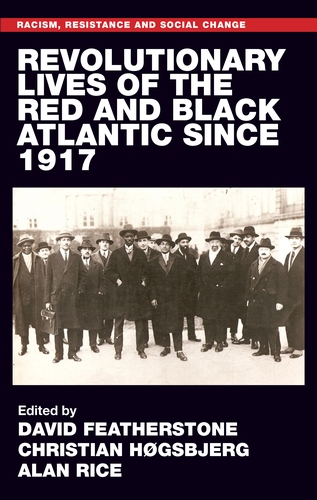
"Hard Facts": An essay on Amiri Baraka's turn to Marxism-Leninism in the 1970s, for, emerging from The Red and the Black - The Russian Revolution and the Black Atlantic conference, held on the one-hundred year anniversary of the 1917 Revolution at the Institute for Black Atlantic Research at the University of Central Lancashire, Preston. The essay is the final chapter in the second volume of two books relating to the Red and the Black conference: this one, Revolutionary lives of the Red and Black Atlantic since 1917, edited by  David Featherstone, Christian Høgsbjerg and Alan Rice, also has work by Hakim Adi, David Austin (whose book on Linton Kwesi Johnson, Dread Poetry and Freedomcame out from Pluto a couple of years back), on Hubert Harrison, Wilfred Domingo, Cyril Briggs, Grace P. Campbell, Raya Dunayevskaya...


The essay itself moves through Baraka's turn from Black Nationalism to Third World Marxism--including the key role played by female comrades such as Amina Baraka, Jamala Rogers and Vicki Garvin--the organisational transition from the Congress of Afrikan People to the League of Revolutionary Struggle, the question of Black Marxism and historical forgetting. It ends with Baraka's neglected Marxist poetry, in the collections Hard Facts and Poetry for the Advanced (the latter available only in his 1979 Selected Poetry, an essential but out-of-print volume), along with the musical recordings by the Advanced Workers (two of which are embedded below), arguing for these poems emblem and tool of his developing political hopes, in which the relation between, poem, performance, and the context by which it is activated and which it in turn hopes to activate, is more prescient than ever in Baraka's work: "art as verb rather than noun, process rather than product". For too long, the general image of Baraka has smoothed over the inconvenient fact that he was and remained a Marxist for the majority of his career, and I hope this, along with work like James Smethurst's brilliant recent Brick City Vanguard and Anthony Reed's Soundworks, begins to change the story we have of Baraka, and of Black Radical culture in general, in a time when historical forgetting is perhaps more prevalent than ever. 


Wednesday, 29 September 2021

Autumn

Autumn officially begun on Wednesday 22nd September, so I'm told: a little before that my physical copy of the Anthony Braxton Standards Quartet boxset from New Braxton House--released earlier in the year on the NBH bandcamp site--came through the letter box. Beautifully produced and designed as ever and, for my money, one of Braxton's best standards groups, recorded on a European tour just before the pandemic hit in early 2020. Samples and the digital download here (the physical box contains my liner note essay 'New Whats in the Tradition').


Other recent writing includes: a review of drummer Ches Smith's fascinating jazz / vodou project We All Break at Point of Departure, in which I touch (very briefly!) on the complexities behind the figuration of 'Latin Jazz' and the specific relation of jazz to Haitian music.

A poem in the new issue of UK little magazine Ludd Gang. All proceeds go to the Poets' Hardship Fund, one of the few sustained examples of mutual aid in the small press poetry community of recent years, and a vital service as the creative arts are particularly hit as the effects of the corona crisis are everyday exacerbated by the grasping ruling of a government of millionaires, denialists and bigots. As they put it:

After a decade of punitive austerity and a brutally mismanaged pandemic, the Poet’s Hardship Fund UK provides a channel for getting some money to poets who require it, without the kind of means-testing processes attached to similar kinds of efforts. While the scale of what we’re dealing with far exceeds any of our individual capacities for making change—the problems we’re seeking to address extending far beyond any discernible ‘poetry community’—we see this fund as, at least, ‘a start’. The premise is simple: give when you can and take when you can’t.

An introductory piece on Amiri Baraka's encounters with censorship, from the Floating Bear trial to 'Somebody Blew Up America'.

An obituary for saxophonist and composer Jemeel Moondoc at Artforum.

Also a sad recent loss, Maryanne (Patterson) Raphael has passed away. One of ten children, she grew up in Ohio, while at university joining a Black sorority as the only white student in a protest at racial exclusion, for which she was featured in Ebony and Jet; studied at the Sorbonne; and met poet and journalist Lennox Raphael in Jamaica in 1961. Facing discrimination as an interracial couple, the two travelled together over several continents, living variously in Rio-de-Janeiro, Morocco and Hawaii, and, in New York, joining the Umbra workshop. Raphael had a decades-long career as an author-predominantly of non-fiction--including a biography of her friend Anais Nin, The Voyage Within, a guide to surviving as a freelance writer, and a co-autobiography, with Lennox Raphael, of their life together (here reviewed by Umbra editor David Henderson). Her memoir of mental health, Along Came a Spider: A Personal Look at Madness provides wrenching but measure accounts of her struggles, also suggested in her correspondence with mental health activist Judi Chamberlin. Her work manifested a concern with social justice--whether mental health, the problems of child runaways, in a 1974 book on 'America's Lost Youth', or America's continuing racialised catastrophes. Though her best-known work was in prose, she also wrote poems and translated poetry. The 'Latin / Soul' issue of Umbra magazine, produced from California by David Henderson, Barbara Christian, and Victor Hernandez Cruz in the 1970s, contained the Raphaels' translations of seven poems by Cuban revolutionary poet Nicolas Guillen, whose work had earlier been translated by Langston Hughes. A few of those poems can be seen below.


And here's Raphael's own poem 'Into Iron Cages' from Umbra's second issue, engaging with Civil Rights in the year of the March of Washington, singing across to the concerns of the Guillen translations in lines at once sardonic and social (sur)realist.


Despite the endorsement of Anais Nin, Henderson and others, and despite the strong sales of books like Runaways, Raphael's career never received much attention from literary scholars--a fate suffered by writers associated with Umbra in general, but all the more so the women associated with the group. As ever, the passing of such a life--as with that of Jemeel Moondoc--should prove further spur to the much-overdue work of recovery by which we can begin to re-tell the story of U.S.--and world--culture during the revolutionary years of the '60s and beyond, maintaining its fervid and necessary hopes even in an age of catastrophe. (For what age has not been!)

Monday, 2 March 2020

'Why?' Alan Shorter's Parabolic 'Free' Jazz

A heavily revised and much expanded version of these initial notes now appears in Point of Departure, Issue 71 (June 2020): http://www.pointofdeparture.org/PoD71/PoD71Shorter.html. Thanks to Bill Shoemaker.

Spurred by the randomised algorithm of online listening to pay attention to some things I hadn’t heard, or, really, thought about, for years, I thought I’m going to briefly focus here on the two records released under his own name by Alan Shorter: trumpeter and flugelhorn player, elder brother of Wayne, obscure even amongst the already obscured field of the 1960s “New Thing”. Growing up in Newark, New Jersey, with Wayne, friends with Amiri Baraka, Shorter initially played saxophone before switching to trumpet, perhaps due to Wayne’s growing fame. Baraka knew the ‘weird Shorter brothers’ in Newark, NJ (back when Alan was a bebop player) and provides a helpful essay in the CD reissue liners to Shorter’s debut album Orgasm, noting that they reconnected at Howard University – where both were blackballed from the fraternity – and Shorter’s switching from saxophone to trumpet. Though nowhere near Wayne's soon-meteoric rise, spurred by membership in the Jazz Messengers and Miles Davis’ ‘Second Great Quintet’, the elder Shorter nonetheless had some sort of presence within the burgeoning New York free jazz underground, playing with the New York Art Quartet (hitherto-unheard tracks have recently surfaced on the massive ‘Call it Art’ boxset), and on dates by Marion Brown and Archie Shepp – most especially, Four for Trane (1964), as well as some more obscure later dates from later 1960s and early 1970s, when both Shorter and Shepp were plying their trade on the European circuit – as well as a kind of cameo on Wayne’s own The All Seeing Eye with a recording of his piece ‘Mephistopheles’.

On the latter, Herbie Hancock, normally the expert builder of solos full of melodic and harmonic invention, is reduced to repeating a single note at the lower end of the piano while the Shorter brothers take slow, odd solos that promise to build to a climax that never comes. Piano disappears on Shorter’s first record, Orgasm, recorded in 1968 with a quartet format of Shorter (playing flugelhorn on all but one track), a ‘fire music’ tenor player as a foil (on Orgasm, the role if filled by Gato Barbieri; on Shorter's sophomore album, Tes Esat, it's the more obscure Gary Windo). Don Cherry had made similar use of Pharoah Sanders and Barbieri on his own records from a few years before, in which bands move through suite-like structures, full of changing moods and generic nods. On Shorter's record, Charlie Haden’s bass and Muhammad Ali’s splashily boxy drums offer a more insistently forward momentum (check out the back-beats on ‘Rapids’!), and Barbieri’s solos more often swirl around iterations and reiterations of melody – as well as harmonics that sound like the Surrealist meeting, not so much of a sewing machine and an umbrella, as of a drill and a lyre bird. Shorter’s heard more here than he will be on Tes Etat, his solos brightly buzzing. The playing sounds less burnished, less introspectively moody than his contribution to 'Mephistopheles': both the bright openness and the thinner buzzing around the edges of that sound recall Cherry, but the odd pauses are something else again. Shorter seems always to wait just that little bit too long before re-entering with another melodic variant or set of fast-repeating, trilled burrs, giving a kind of ante-chamber, limbo, waiting room feel – a destabilising effect that’s not so much the sardonic, ironic, quizzical sound pianist Andrew Hill was getting in this period from a similar playing with time, as a constant holding-in of breath, sound of claustrophobia, anxiety, but more on the part of listener than player, perhaps. In the multiple sense of musical 'playing', something’s been toyed with, though that toying's not necessarily playful.

The same is true of the composed melodies to the pieces, which are just as important as the improvisations that follow. They’re slow, but not ballads, knotty, but not fast or virtuosic. They sound very much composed (to the extent that the drummer will often seem to be playing the melody with the same melodic and rhythmic accentuation as the horns), and they’re repeated many times – they’re not just throwaway prefaces to ‘blowing’. One review describes them as ‘sinister’ - and, indeed, Wayne Shorter notes that Alan was inspired by Dracula and Frankenstein movies (Wayne himself preferring musical and sic-fi) – and this sense of the (bend) sinister, the left-ward curve, maybe has to do with that sense of waiting again, the expectation of something, but a something of which one’s not quite certain, an expectation of expectation. Their emotional tenor lacks – to run through a fairly random list - the rhapsodic or hopeful quality of one strain of free jazz – the Noah Howard, Coltrane, Pharoah Sanders kind of melody – the ecstatic religious fervour of the Ayler variety, the Romanticism of Cecil Taylor’s composed pieces, the spring-in-the-step joy of Ornette or Cherry. This lack of placeability (which often gets named in the little commentary there is on Shorter ‘intellectual’ – for want of a better word, as ever) is both why Shorter’s music has been neglected (as well as the massive shadow of his brother) and the reason it still fascinates.

Orgasm is not the title one would immediately associate with the music – hence, perhaps, the re-issue of the session under the name of another of the tracks, Parabolic. There’s deliberation if not ecstasy (one always knows who’s doing what on this record), a sustained plateau of concentration, intensity and pleasure if not particular moments of release. But metaphors are not what's important here. If this is music that always suggests an elsewhere - a scene of action that's taking place outside the sphere of the music itself - it doesn't have a the vocabulary to express this elsewhere that metaphor in language provides. In his retrospective liner note essay, Baraka describes the music as “weird, thorny, stylishly tenuous”. That’s stylishly, not stylistically – the music is tenuous, yet it also has a kind of forward momentum, an insistence - “the march or marked stride of something portentous, even dangerous”. Yet, as Baraka put sit in a later poem of his ownL "I seen something / You seen it too / You just can't call its name". And so this intuition, this half-knowledge, this inkling of a mood or a thought may bring a forward “thrust” to the music – perhaps the insistent drumbeat (so different to Tes Esat, at times approaching the military taps that the Ayler band would channel) - yet that "thrust" will always be belied by a sense of uncertainty, or possibility – “it could be this way, but then again…who knows”. Parabolic. In Baraka’s narrative account, Shorter will periodically turn up in the same social orbit, from high school to university to New York bohemia to the Black Nationalist context of the Congress of African Peoples (CAP), but it’s never clear what directions he’s going in musically (he may have switched instruments, or styles). For Baraka, this is reflected in the music, which he links more broadly to the uncertainty of the '60s jazz avant-garde or ‘new music’ in general, an uncertainty central to the awkward ways in which that music was phrased in relation to what Werner Sollors famously dubbed, from a phrase of Baraka's own, a ‘populist modernism’.

“New, but relative to what?” Baraka asks. “Aggressive and determined […] not altogether certain of what”. The music is meant to “call for a ‘new dispensation’, perhaps, of the whole order of things”. Note that perhaps. Clarity and uncertainty, declamation and the tenuous, “mood and emotion”. Baraka links Shorter’s use of flugelhorn to Miles Davis (on those 1950s Gil Evans records) and the notion of ‘cool’ – a certain secrecy, a holding back which yet gives a sense always that there is more to say, held back either deliberately, out of diffidence, out of calculation, hesitation, control. A new dispensation of the entire order of things: the destruction and remaking of the world itself. These are the revolutionary and cosmic messages of much music of this era, of Baraka's own writing from that era too - these later liner notes, written in 1997, adopting a more reflective, diffident approach in keeping with Shorter's own music, and in that weird sense, making Shorter's music seem all the more timely in the '90s than in the present of its recording. What we have here -- 'perhaps' -- is the fantasy of a music that does not yet exist (which includes both the mysteriousness and apparent incompleteness of Shorter's own discography and the incompleteness of the music in general) poking out from around the corner of these traces that do. Baraka’s vocabulary suggests that this music is a "warning", a "short, fearsome message", offering bursts of "proto-rational description": not celebration, not ecstasy, but cryptic declamations, reports on a state of reality that, for those who mendaciously broker power and for those who do not stop to think on it, does not appear to actually exist. This is emphatically not mystical, however, but a rational report on states of collapse, of transfers to other states, other ways of being. It's interesting too that Baraka sees Shorter’s solos not, in the vocabulary familiar from much free jazz criticism, as ‘explosions’, but ‘implosions’, "somehow removed, as a statement from the whole […] as if he is commenting on, rather than existing as part of the whole". For Baraka, this is to do with Shorter not having found his own voice as soloist – the compositions containing the real sum of his individuality, even as they sometimes sound like the "outline of a tune" more than the tune itself.


If, then, free jazz is often seen as a model for and reflection on social conditions – both in terms of protesting existent arrangements and offering models of cooperation that could challenge it – Shorter’s concerns seem more abstruse. As Wayne puts it, "Alan created his own world. He had some ideas about breaking through the old of the mass-aimed [i.e. commercial] forms […] no bands behind him, no arrangements." This meant that Alan "was always in confrontation, or there were confrontations on the horizon…with record executives, rehearsal places, front offices, professors in school." Similar tensions emerged in the recording session for Orgasm, though it seems, not this time at his own instigation – in the liners, Rashied Ali recalls how he accused producer Esmond Edwards of deliberately playing with the musicians by requesting multiple takes of a piece that already had a successful recording, ultimately walking out of the studio. This led to the music being recorded by two rhythm sections on two separate dates, with Charlie Haden and Rashied's brother Muhammad subbing for Reggie Johnson and Ali. Though there's little to go on apart from this story, we might speculate that Edwards' apparent hostility had to do with lack of familiarity with, or hostility to, free jazz (Edwards had come up as a pioneering photographer and producer during the 1950s, working for prestige records). Whatever the case, what emerges here is a doubleness: the enforced framing of artistic vision within the confines of recording booth, the control of a producer managing and controlling expectation; and the doubled recording session.

A more conducive home seems to have been found in Europe, though again, recorded evidence is sparse: some dates with Shepp (the sprawling and somewhat unfocussed Pitchin' Can, Coral Rock, Doodlin', and 'Full Moon Ensemble' albums, and appearances in large group contexts with Alan Silva, Francois Tusques, and apparently (though this seems somewhat unlikely) the Kenny Clarke-Francy Boland big band. Two years after Orgasm, Shorter recorded his only other album as a leader, Tes Esat, in London. In the liner notes, Shorter tells Val Wilmer: “Everybody is a leader, there’s no sidemen any more – sidemen are decadent. Free music has a kind of leadership of its own”. Certainly no ‘decadence’ here, no excess or ornamentation – this is free jazz as sometimes austere focus, implosion rather than explosion, muted and mysterious even in its outbursts. Tes Esat – the title is uncertain, an anagram, a play on sitting and having sat, or a test, a private joke? I guess the obvious word is ‘estates’ – not ‘states’ (states of being – Shorter in the liners talks about ‘living’ rather than what one is doing while living) – but legacies, propertied repositories of wealth or dispersed traces of preceding lives. Anagrams involve the rearrangement of fixed elements, a working with, worrying at the edges of, the given, that works in terms of the spirit if not the structural operations of Shorter’s music. One feels here not so much that the musicians are discovering new ideas in their playing as working at the cracks of what already exists, and finding that as mysterious, as inexplicable, filled, perhaps with horror, or a more inscrutable sense of dread, as the ostensibly unknown. As we've seen, Shorter’s best-known piece is called 'Mephistopheles' – the broker of the devil’s bargain in the search for knowledge; the risks of the unknown, but also the risks of the given. Ostinato rumble, smoothly off-tumble, extended wail, clipped report / retort. Again, Baraka’s notions of 'description', combined with his notions of ‘cool’ – an apparent oddity when talking about the ‘heat-filled’ music of free jazz – fit well here. Description is about telling what you know; cool, often, about holding back what you know to give the impression of knowing more than you're letting on--secrecy, holding-back, as tools of power. Shorter's music falls somewhere in between.

Cool jazz for the free jazz age? Perhaps. In any case, this is not music about soloing, or virtuosity. What’s extraordinary about Tes Esat, even more so than Orgasm (though Orgasm is probably the better record overall) is how little Shorter's own playing is foregrounded, and how little in fact the horns appear at all. Before the melody statement comes in, tracks will open with a minute or two of just bass and drums, in a kind of abstract territory where a lot is happening, in terms of notes and switches of register, but at the same time almost nothing seems to be happening: again, we’re in an anteroom, a pause, a limbo, waiting for the ‘head’ that we know will appear. (Instead it’s a bass player rather than one of the horns that dominates the record: the great Johnny Dyani’s slipping, sliding harmonics, swooning and scrabbling, as well as his piano playing on the first track.) When the melodies do appear, they’re somehow both curt and extended, always played in unison by the horns with long held, repeated notes that are stabbed out over a busy backdrop, their repetitive stasis all the more emphasized by the business of bass and drums. Shorter’s music is far from Ornettish, a comparison that’s been made on the basis of the piano-less format of his two albums as leader. While some free jazz melodies/heads are overtly stripped down, essentially just preliminaries to free playing, Shorter’s – like, say, Albert Ayler’s – are very much a part of the piece, and thus, more than ‘heads’. Not that the improvisations take place on their harmonic frame, but the sound of the composed material being articulated at the beginning and end of the piece is as vital to the piece as are the improvised sections. Can one imagine a through-composed free jazz? Where's the freedom here, what spaces do we traverse. When the 'freely' improvised sections do occur, Shorter tends to lay out, while Windo’s saxophone, possibly put through some sort of electronic effect (unless it’s just the distortion on the recording), is as abrasive in its tone as any I’ve heard, not through playing hard and fast so much as the well-judged screech or smear, sounds which sometimes appear as if from another world – I think some of these are also the yelps, the vocalised exhortations, the bits of percussion and so on that Dyani employs. But really, that’s the total effect of this music too. Music that’s present yet somehow doesn’t fully reveal itself, material in its sometimes limited focus yet ghostly in its otherness. “Listening to Alan Shorter gives one the impresions of being felled by a feather duster” writes
poet Ron Welburn
. in a rare review of his work in a 1973 issue of Black World . Or “an open night, with things flying around in it”. Mechanical birds, organic industrial objects, claustrophobic ghosts on an open plain.


On the album cover to Tes Etat, the musicians are caught in a spotlit against a dark background, dressed in Afro-centric dashikis and wearing shades in the 'cool' vein of which Baraka speaks. Though we see Shorter relaxed and laughing in a studio shot on the back of the LP sleeve, the light's harsh glare here seems designed to appear intimidating, capturing the musicians, catching them (out). Yet rather than looking caught -- whether in cop-headlights, military searchlights, the spotlights of an often hostile 'entertainment' business -- they stand, even sit, their ground. They're not going anywhere, won't be read. And so this music, its insistent (un)availability. Wrecked estates, plentiful absences, the dip and curve of parabolic reverie or nightmare; even, of some kind of detached rest, if not peace. As Wayne Shorter notes of Alan in an interview with Baraka printed in the reissue notes to Orgasm, "Teachers would mark his papers, and he would ask 'Why?' on top of the teacher’s marks."

Alan Shorter’s music continues to ask questions – of us, the world, itself.

Thursday, 7 February 2019

A Black Arts Poetry Machine


My book, A Black Arts Poetry Machine: Amiri Baraka and the Umbra Poets is out today from Bloomsbury today -- with many thanks to series editor Daniel Katz, and to the readers and peer reviewers who helped shape it into being. Here's the blurb:
“A vital hub of poetry readings, performance, publications and radical politics in 1960s New York, the Umbra Workshop was a cornerstone of the African American avant-garde. Bringing together new archival research and detailed close readings of poetry, A Black Arts Poetry Machine is a groundbreaking study of this important but neglected group of poets. David Grundy explores the work of such poets as Amiri Baraka, Lorenzo Thomas and Calvin Hernton and how their innovative poetic forms engaged with radical political responses to state violence and urban insurrection. Through this examination, the book highlights the continuing relevance of the work of the Umbra Workshop today and is essential reading for anyone interested in 20th-century American poetry.”
I guess that needs some background...The Umbra Poets Workshop was formed in the early 1960s in the atmosphere of artistic and political radicalism that saw African-American protestors disrupt the business-as-usual order of the UN building in New York in protest at the murder of Patrice Lumumba. One of the participating groups, the On Guard Committee for Freedom -- a political organisation -- essentially then coalesced into a more artistically-focused group, the Umbra Workshop. The group held regular meetings at Tom Dent's flat, in which they would get together to discuss each other's in-progress work, and were an active presence in the New York poetry scene of the time. Consisting of a fluctuating, but always large, membership, they aimed to form a publication, workshop and reading environment at a time when the poetry scenes around them were almost exclusively white. The group also started a magazine, of which two issues were produced during its most active period, with further issues appearing at periodic intervals later on, after the group had officially disbanded.


Copies of the magazine are rarer than hen's teeth these days -- there was talk of an Umbra reader coming out from CUNY's Lost and Found programme, but I haven't seen or heard any news of that for a while. Let's hope that something happens! But Umbra was always more than just a magazine. Calvin Hernton described the explosive impact Umbra Poets would make at readings within the predominantly white New York poetry scene of the time: sometimes appearing eight-to-ten at a time, they appeared, in his words, like "a dynamic, well-rehearsed black arts poetry machine". So while Baraka has often been essentially credited with 'founding' the Black Arts Movement, establishing the Black Arts Repertory Theatre/School in Harlem after Malcolm X's death in 1965 -- an enterprise in which members of Umbra were involved -- Umbra should be understood as laying the ground -- and, perhaps, offering examples of roads not taken. Umbra are sometimes credited in histories of the period as precursors, but their work is almost never considered in depth. Hence this book! (I'm also played to say that another book, by Jean-Phillipe Marcoux, is in the works -- watch this space...)

Of course, the Black Arts Movement challenged easy divisions between the political and the aesthetic, and politics was also key to Umbra. The book's first chapter discusses the 1961 UN protest and the emergence of Umbra, along the way offering readings of poems that emerged from the protest and its environment by Ishmael Reed, Raymond R. Patterson, Askia Toure, Ray Durem and Lorenzo Thomas. Here's one of them:


I use this chapter to argue that, at this point in time, tradition of African-American internationalism was already in existence -- involving Baraka, to be sure, but alongside many other now-forgotten figures, not least the Umbra poets. Umbra itself was short-lived, but it set in motion a number of hugely important careers -- to list them partially, beginning with perhaps the most famous, that of Ishmael Reed, but also of Lorenzo Thomas -- later on, a Black Arts scholar, and throughout, for my money, one of the most unjustifiably-neglected poets in America of the second-half of the Twentieth Century (though thankfully a collected poems is forthcoming -- this is a bit of a boom-time for Umbra, it seems!); and of Tom Dent, 'New Orleans Griot' (likewise, an invaluable Dent Reader came out last year -- edited by Dent's friend and comrade Kalamu ya Salaam, you can get it here); of David Henderson, maybe best known as the first biographer of Jimi Hendrix, collaborator with Sun Ra, Ornette Coleman and others, poet of what he calls the 'third eye/world' of diasporic culture in America; of Calvin C. Hernton, author of the controversial Sex and Racism in America, attendee of R.D. Laing's Kingsley Hall and meetings of the Caribbean Artists Movement, novelist and poet; of N.H. Pritchard, whose experimental concrete poetry has recently been addressed by Fred Moten and in Anthony Reed's Freedom Time; Lloyd Addison, perhaps the most experimental of the Umbra poets, author of prodiguous, often self-published output, allusive, punning and singular; Askia Toure (then Rolland Snellings), today one of the eminent grises of the Black Arts Movement; Rashidah Ismaili, whose Autobiography of the Lower East Side has been getting some recent praise, and who should (as is the case with all these writers) be far better-known; Steve Cannon, still an active figure in New York artistic scenes; did I mention that Archie Shepp and Cecil Taylor were also involved?! -- and all that's just the half of it...

Within a single book, I wasn't able to write on every member of the workshop, so, after the ensemble first chapter on the Lumumba Protest, each subsequent chapter focuses on one principal writer. Though Amiri Baraka was never a member of the workshop, he knew a number of the Umbra poets and invited them to perform in the Black Arts Repertory Theatre / School. (Here's Clayton Riley's review of the event for Liberator, alongside some images from the feature on 'five young afro-american poets' in French left magazine Revolution, which sets Baraka alongside Umbra poets Lorenzo Thomas and Joe Johnson, as well as A.B. Spellman and a very young Sonia Sanchez.)


While Baraka's Black Arts work is too often taken in isolation, as if suddenly it emerged in an explosion of provocative militancy, setting it against the backdrop of Umbra helps us -- I hope! -- read it anew. So the book's second chapter turns to Baraka's response to urban insurrection and stereotypes of African-American militancy in the iconic mid-60s poems 'Black Dada Nihilismus', 'Black Art' and 'Black People!'.

Guerilla: Free Newspaper of the Streets, Vol.2, No.1, 1968. Broadside edited by Allen Van Newkirk of the group Black Mask.

The third chapter concentrates on David Henderson's poetry, charting the complexities of New York racial politics at the time -- as he writes, 'Harlem to Lower East Side, space of a nation' -- and in particular the 1964 Harlem Rebellion, from which emerged his poem 'Keep on Pushing'. We then get Calvin C. Hernton's writings on riots, in poetry and in an incendiary essay 'Dynamite Growing Out of their Skulls!', published in Baraka's and Larry Neal's anthology Black Fire; and another Hernton chapter, on his poem 'Medicine Man', read for its complex and tortured address to the American South.


Next up, a chapter on Tom Dent, which touches on his work with The Free Southern Theatre, who courageously toured the South, eventually settling in New Orleans, and thence his own poetry emerging from the city -- notably, the long poem 'Return to English Turn'. Finally, there's a chapter on Lorenzo Thomas's poem 'The Bathers', one of the great poems of the Black Arts Movement, and its (re)writing of the 1963 protests in Birmingham, Alabama. (I also touch here on Ishmael Reed's amazing early prose-poem 'The Ghost in Birmingham' -- subsequently the first item in his collected poems, it appeared in the magazine Liberator in the early 60s and is as good an indication as any of just how the good the writing coming out of Umbra could be.)


Anyhow...There's still so much more to be done on Umbra, and on this moment in African-American writing: let's hope that this is just the tip of the iceberg!