Preview of a two-part Substack post on jazz and hip hop poetics.

The next two posts here will explore some background to two book chapters I worked on in the past few years, both just published in edited collections. In the next post, I’ll write more about “A Question of Form: Jazz in Joans, Kaufman, and Cortez”, a chapter in The Cambridge History of African American Poetry, a monumental volume edited by Keith Leonard. This first post, though, focuses on “Nation Time(s): Jazz and Hip-Hop’s Changing Same”, published in Hip Hop and American Culture, also from Cambridge University Press, and edited by academic and Wire magazine columnist Rob Turner. The book chapters themselves will also be available to subscribers behind the paywall.
It is—or should be—uncontroversial to say that the criminalized treatment of contemporary hip hop artists is hardly different in content to that of the blues and jazz artists of the past—in itself a continuity, though hardly of a desired or desirable kind. Nonetheless, the question of whether hip hop, half-a-century since its inception, fulfils or negates various traditions, radical or otherwise, can be the subject of some controversy. At stake in hip hop’s use of jazz as lyrical and sonic trope is the status of cultural heritage, perceived relations to history and community and the question of what this music, what any music, does, the question of what it can or could or should do.
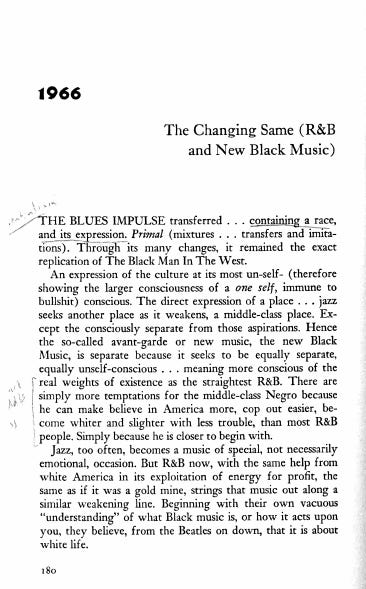
The chapter focuses on the relation of jazz to hip hop via Amiri Baraka’s notion of the “changing same”, and proceeds through some close readings of lyrics and jazz samples from “Golden Age” hip hop. Baraka’s 1966 essay caps off Black Music, that still-foundation survey-statement on the jazz of the decade’s first half, and the New Thing, the New Black Music, free jazz in particular. As Baraka started to conceptualise how the Black Arts might expand, political coalition-making had its artistic equivalent. Popular art, so a simplified version of the argument might go, had a social appeal that the New Music lacked; the New Music had a political content or focus that popular music lacked. Each could infuse the other: a coalition aimed at challenging the economic, aesthetic and political structures within which Black music and Black musicians were presented and exploited. Baraka himself put this into practice not only in his criticism but in his own artistic work, recording his own poetic-musical collaborations across doo wop—Black and Beautiful, Soul and Madness (1968)—free jazz—A Black Mass (1968), with the Sun Ra Arkestra, and ‘Black Art’ (1965), with Sunny Murray et al—and the combination of four separate groups, each within a different genre, on It’s Nation Time (1972).
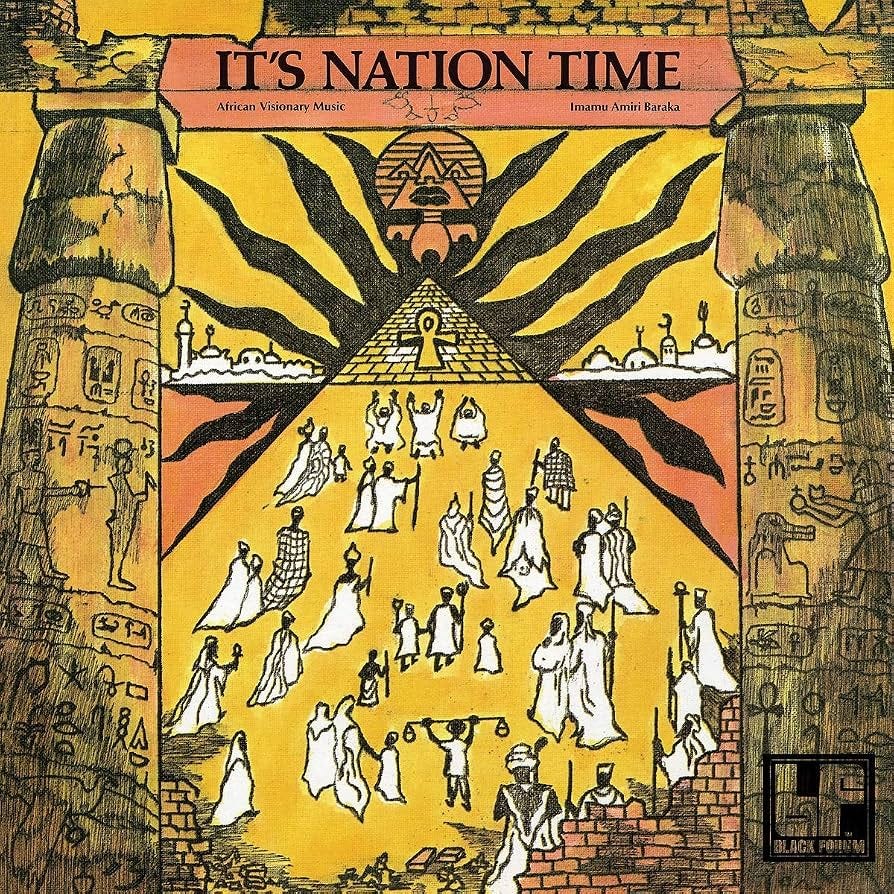
Such work is, in turn, fairly regularly cited, along with that of Gil Scott-Heron, The Last Poets, and the Watts Prophets, as a key precursor to hip hop. So the story goes, a form of poetry-with-music that grew out of, and often had as its subject, the heritage of blues and jazz, evolved into what would ultimately become a multi-million dollar industry, shaping the global sound of popular music.
But there is, of course, some ambivalence here. In his later writing on music collected in books such as Digging, Amiri Baraka himself espoused the position, fairly standard among those of the Black Arts generation, that hip hop was of value when more politically outspoken, when continuing the specifically political frameworks associated with Black Art. The artists of value were Public Enemy or The Roots, with the latter of whom Baraka recorded that astonishing version of ‘Something in the Way of Things (In Town)’. Not party music, but Party music (“and when you asked what truths their party taught…”) As with the coalitional impulse of R&B, free jazz, blues, and oral poetics espoused in ‘The Changing Same’, it was the more niche forms of art—as jazz had become, as the New Music had generally remained—in which aesthetic and political values were enshrined, while popular music was too easily susceptible to capitalist capture, to the self-perpeutation of stereotype, and to a-political hedonism or nihilism. When not guided, it went off track—which was precisely when it became popular.
Baraka turned to Marxism-Leninism a few years after recording It’s Nation Time, and the Leninist strain to this argument is aesthetically prefigured in its Nationalist iteration in ‘The Changing Same’ era. The Advanced Workers, the Vanguard, emerging from within the masses, have to direct the masses away from the distractions of disco or gangsta rap and towards consciousness, towards revolution. At the same time, they must work within those forms to shape them, and the aesthetics of those forms rub off. Pleasure and its precise direction becomes hard to happen, libidinally wayward. Perhaps nowhere is this better illustrated than it Baraka’s attempt to make a disco record, the 45” recorded with the Advanced Workers and the Anti-Imperialist Singers in the later ’70s, in which he literally gives a speech in the middle of the record, while, over danceable beats, singers chant that their listeners should not be dancing at all, but “marching in the street”. It’s a dialectical move, and in itself, a clever twist on the way that Martha and the Vandella’s ‘Dancing in the Street’ was repurposed as an anthem of urban protest in the previous decade. But can the dialetic be guided this way? Is this how art works?
The rest of the essay is available to subscribers via Substack here.




No comments:
Post a Comment