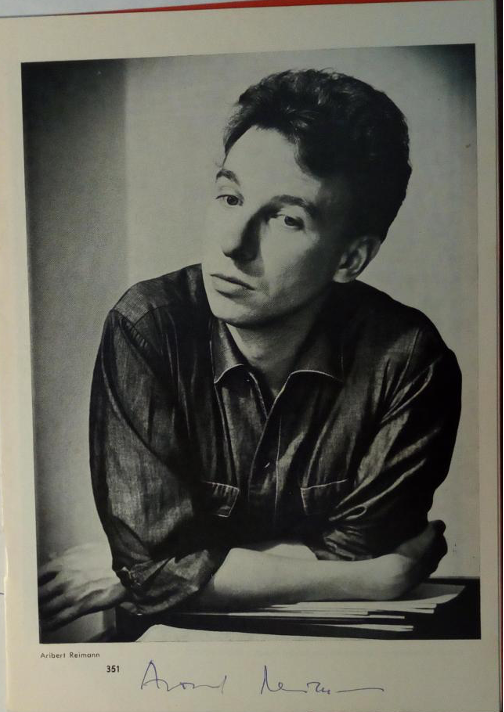
A couple of nights ago, I went to see the opening night of the new Komische Oper production of Aribert Reimann’s opera Lear, directed by Barrie Kosky and staged in the Oper’s temporary location in a hangar at Tempelhof Airport. I reviewed it for Bachtrack, and you can find that review at this link. On Substack are some s further reflections on the opera and its staging, along with storms, tone-rows, Romanticism, bombardment, and howling. An excerpt here:
Reimann’s is “music that admonishes”, wrote the critic Stefan Amzol of the composer’s settings of Paul Celan, who had requested him in the 1950s to set his work. “Forces are suddenly released you never even knew existed”, Reimann remarked of his experience of wartime bombardment as a six-year old child. Last night in a bar, I overheard someone declare himself a “Nazi” to awkward silence. It was, it seemed, an act of provocation, a kind of empty gesture, but one backed up with real consequences: the man also declared his intention to vote for the AfD at the weekend’s elections.
The Nazi-era violence that was a kind of primal scene of Reimann’s creativity is, too, the legacy of the years of Fascism as they raise their head once more today. Such violence, and everything that led to and from it, is not necessarily the overt “subject” of Lear, but, perhaps, Reimann’s opera still has something to tell us about it: a warning, a haunting. For if there’s one thing we’ve learned of late, it’s to say, with Shakespeare’s Edgar: “the worst is not / So long as we can say ‘this is the worst’”.
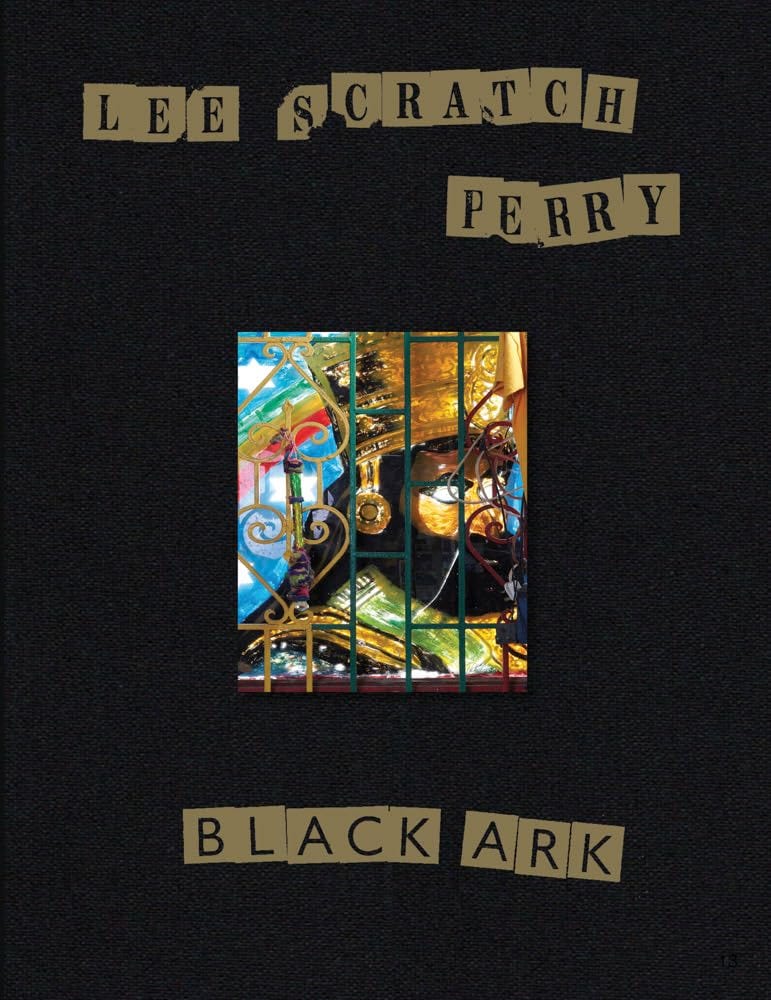
Just out in Issue no.264 of Aperture magazine is my capsule review of the photobook Lee Scratch Perry Black Ark(Edition Patrick Frey, 2026), a visual inventory of what remains of the producer’s legendary Kingston studio. To read the review, see the print and digital versions of Aperture. I've posted an altered and extended cut for subscribers on Substack, of which here is a preview.
Rarely has a single space been so productive in such a short span of time as Lee “Scratch” Perry’s Black Ark. Here, in a studio compound located in the front garden of his family home at 5 Cardiff Crescent, Washington Gardens, Kingston, Perry produced hundreds, if not thousands of records, released and unreleased. Perry’s ear for eccentric sound effects and mysterious production techniques on basic electronic equipment opened up hitherto unknown dimensions in what musicians would play around him, swathed in clouds of ganja smoke, as Perry mixed, exhorted, encouraged, blessed proceedings with Bible verses or obscure rituals of his own devising. Singers like Susan Cadogan and Max Romeo called to lovers or called down Babylon or chanted down the devil, while Perry, the self-proclaimed “Ghost Captain” or “Mad Scientist”, alternated between resonant solemnity, prophetic fervor, and madcap humour, sometimes at the same time, providing sound effects of crying babies and mooing cows, sampling British sitcoms by holding the microphone up to the TV, turning reverb and echo into new constructive principals remaking ideas of rhythm and space.
As Kodwo Eshun writes of Perry’s work in More Brilliant than the Sun: “As soon as you have echo, listening has to completely change. Your ear has to chase the sound. Instead of the beat being this one event in time, it becomes this series of retreating echoes, like a tail of sound. The beat becomes a tail which is always disappearing round the corner and your ear has to start chasing it.” The music wrongfoots. Where one might expect to find a cymbal splash, instead a gaping void. Yet it all seems contained within a cavernous single entity, that, like the Black Ark itself, expands into mysterious rooms, corridors, voids: beneath it all, the thickness of a bass so resonant it came to seem a holy principle, the church on which Jah might build his rock.
New sign, new mind, echoplex [...]
With that echoplex, Ethiopia
With that echoplex, Africa [...]
With my echoplex, anything can happen
Who knows what coming next?
In the ritual space of the Black Ark, the line between visionary experimentation, eccentricity and mental instability became increasingly blurred. In 1978, when a truce had been briefly brokered between the rival gangs supporting the political parties, the conservative JLP and the democratic socialist PNP, Perry had become involved with the Nyabinghi Theocracy, a Rastafarian offshoot ocused on theological discussion who conducted intensive drumming sessions that could last hours or days at a time, and with whom Perry planned a never-completed album. Millenarian imagination abounded. Through music, not only peace in Jamaica, but world peace might be achieved. Perry emblazoned the entrance to the Ark with the words “THEOCRACY MUSICAL GOVERNMENT”. By the following year, however, the truce had broken down. Consumed by paranoia, and amidst the backdrop of Jamaica’s political turmoil, Perry had evicted almost all visitors from the compound. As David Katz recounts in his comprehensive biography, People Funny Boy: The Genius of Lee “Scratch” Perry, he now refused to allow in anyone with dreadlocks, and insisted to the Black Star Liner record label that he would work only with white musicians.
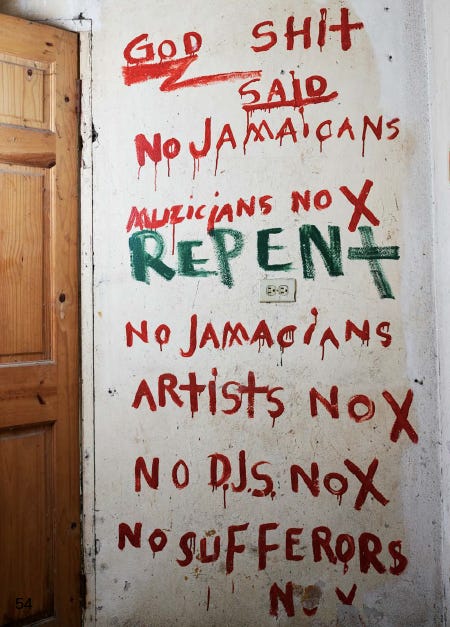
Perry was increasingly uninterested in treating the Ark as a musical space. Instead, he seemed intent on turning it into a kind of private art installation. Musical instruments and audio equipment—pianos, keyboards, guitars, basses, speakers, mixers—became objects used in private rituals of his own devising, organised around the natural elements—earth, air, fire, water. Electronic equipment filled up with sand or rocks, instruments were painted and repainted according to internal mystical symbolism, and, in bursts of graphomania or “hypergraphia”, covering every inch of the Ark with graffitied text and symbols deriving, in part, from Nyabinghi symbolism (in which, for instance, X stood for the Devil and D for Death). Visiting Perry in 1979, photographer Dave Hendley recalled that Perry “had written on absolutely everything”, from the objects within the space to the space itself. When singer Susan Cadogan asked him why, he replied: “Well, if you don’t write, you wrong!”
“I am a madman”, Perry declared in a later song of the same title. “I am a cultist / I am a badman [...] The heart is a drum / my mind is the bass”. As scholar Michael Veal writes in the foreword to the new photobook Lee $cratch PerryBlack Ark, a documentation of the space as it stood in 2021, “it became increasingly unclear whether Perry viewed the Black Ark as a recording studio, a religious shrine, a nature reserve, the command module of a space capsule or, at the most extreme moments, a mental health ward”. “The studio must be like a living thing, a life itself”, Perry remarked. In what Veal calls “his increasingly eccentric attempts to force the hi-tech sound technology around him into a more organic relationship with nature”, Perry let the equipment decay, dug holes in the floor so that the drumkit would be suspended over the element of water. He miked up a palm tree to record “the living African heartbeat”, buried tapes in the soil for protection. Enacting a constant fusion of modern technology—electricity, fire, light—and soil, earth, roots, for Perry, metaphor and reality constantly crossed over.
In spring 1982, one of the elements with which Perry was obsessed—fire—took ever, when the studio control room burnt down. Over the years, Perry repeatedly claimed that set the fire himself as a kind of “sacrifice” or exorcism of the bad energy that had accumulated in the space. Did Perry burn it down himself as a “sacrifice”, frustrated at the gangsters who’d infiltrated his circle and attempted to extort him? Or was it, as family members claimed, the result of an electrical fire while attempting to revamp the space? One interpretation has the Black Ark fire as catastrophe, the logical endpoint of a period of destructive decline; alternatively—an interpretation Perry himself sometimes leaned towards—the fire was a cleansing force from whose ashes Perry arose, phoenix-like, to reinvent his art from within its ruins. Whatever the truth, it would form a key part of the myth Perry would build around himself and others would build around him in the remaining four decades of his career. As in the fire in the Dante Hotel which, in 1979 burned poet Bob Kaufman’s possessions and manuscripts—charred pages of which editor Raymond Foye rescued from the flames—the barrier between symbolism, metaphor, literary imagination and life itself seems to have been definitively removed.