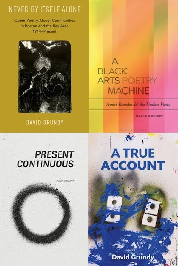
A short essay called ‘ “Key to a Savage Sideshow”: The Magazines of the Occult School of Boston’ up at Post-45 in a Little Magazines feature edited by Nick Sturm, focusing mainly on the one-shot Boston Newsletter assembled by Jack Spicer, Robin Blaser, John Wieners, Stephen Jonas and Joe Dunn one Boston summer. The issue also contains some fantastic pieces including Iris Cushing's piece on the first issue of Umbra magazine. Great to see Umbra scholarship continuing to develop and Iris’s piece will be very useful for those who haven't managed to see a copy of the magazine itself.
Also Umbra-related, my review of the Lorenzo Thomas Collected edited by Aldon Nielsen and Laura Vrana is out from Tripwire--online and it will also be out in the next print edition. I wrote this a few years ago--pre-Covid--so it’s nice for it to finally be out, with many thanks to David and Caleb.
A longer essay, ‘ “The Arc of Struggle”: Poetry and Defeat in the Work of Sean Bonney’, is out in‘No Future: Poetry of the Current British Crisis’, a special issue of Études anglaises edited by Dan Katz.
And the Multiple Melodicas set from Cafe Oto earlier last month is up at Douglas Benford's Soundcloud page: Douglas, myself, Georgina Brett and Steve Beresford all playing multiple melodicas, multiply. Recording thanks to Billy Steiger.
(Some pieces of writing recently published in other venues.)
“Attica is in front of me”, an essay on musical responses to the Attica uprising by Archie Shepp, Frederic Rzewski and Charles Mingus, appears online in a special issue of the Blank Forms journal, edited by Ciarán Finlayson, commemorating the uprising fifty years on.
A piece on the Eddie Prévost residency at Café Oto in July is at Point of Departure. There were four concerts in Bright Nowhere, celebrating Prévost’s eightieth birthday: the piece has write-ups of all four--a multi-saxophone concert, the ‘Sounds of Assembly’ group, a Workshop concert, and the last ever gig by AMM.
And at Artforum, a shorter write-up of the AMM gig from the same residency.
An edit from a much longer interview I did with Eva-Maria Houben last month is up at VAN magazine. (The full interview will be out in the fullness of time--watch this space: I also wrote about the recent performance of Houben’s ‘Together on the Way’ at the Southbank Centre a few months back.)
Other odds and ends:
A review of Decoy and Joe McPhee’s gig at Café Oto came out back in the July issue of The Wire, of which there’s an image below; there’s also a review of the Explore Ensemble concert of music by Poppe, Dunn, Dillon and Miller in the October issue, of which I’ve just posted a longer version on this blog.
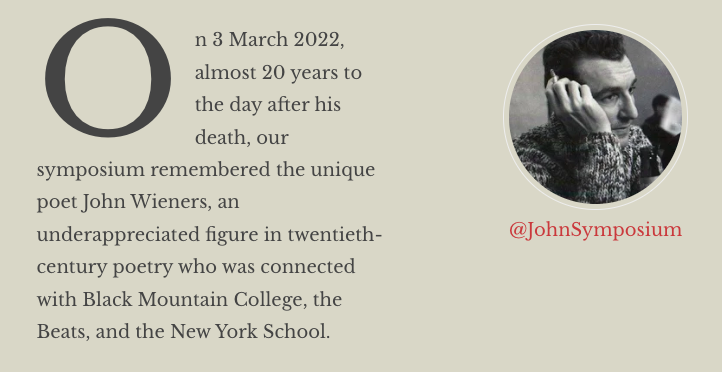
And even further back, in March, organiser Mark O. Chamberlain kindly read out my short paper at the online John Wieners symposium hosted by Durham University: video of that and the other papers can now be viewed online here.
In the near future, among other things, a piece on Igor Levit’s new disc based around Hans Werner Henze’s Tristan, ajournal special issue, a poetry pamphlet from Andy Spragg’s and Jimmy Cummins’ RunAmok, new titles from Materials/Materailien, and the Blank Forms reprint of Baraka, Neal and Spellman’s The Cricket, to which I contributed a short introduction. Lauri Scheyer and I are also putting the finishing touches to Calvin Hernton’s Selected Poems with Wesleyan University Press, a project that’s been in the works for a few years and which we’re very excited to see moving to completion...
(Some thoughts on three recent concerts as spring gradually emerges...)
Claire Chase presents Pauline Oliveros, part of SoundState, Queen Elizabeth Hall Foyer, 3rd April 2022
(Image by the Southbank Centre's music director, Gillian Moore)
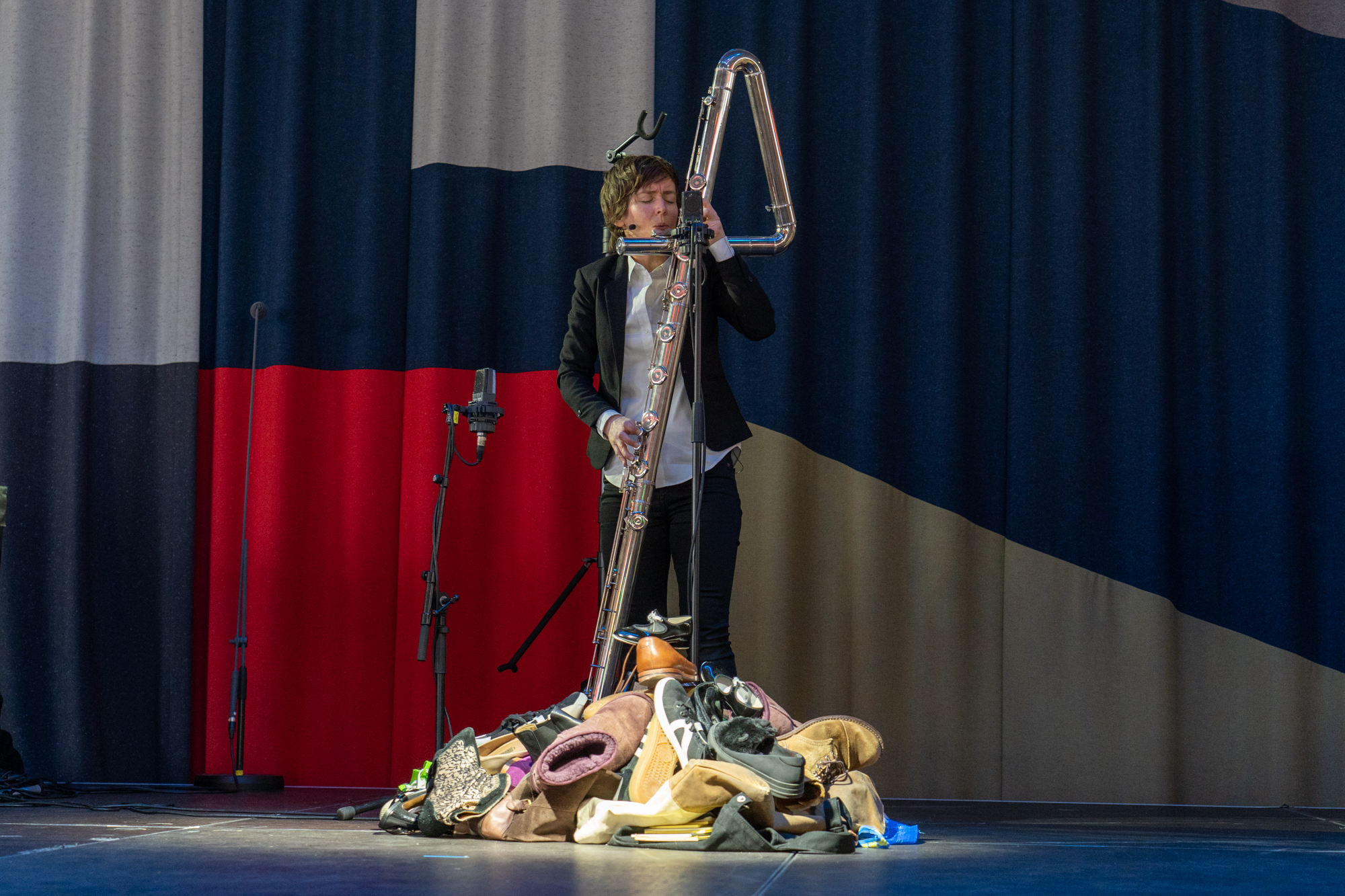
This free concert in the foyer of the Queen Elizabeth Hall paid tribute to the late Pauline Oliveros, exemplifying the social, and sonic pleasures of the late composer’s work. Playing an array of flutes and whistles, Claire Chase was accompanied by Senem Pirler, working with the electronic ‘Expanded Instrument System’, a “computer-controlled sound interface” Oliveros first designed in 1963. For the first piece, ‘Sounds from Childhood’ (1992), Chase instructed the audience to remember a time in childhood “when it was a lot of fun to make sounds”, and then to make those sounds. The collective texture—raspberries, sighs, groans, ululations—was then played back through the EIS as a chorus at once disjointed and with the pleasures of togetherness; memory taken forward into the present and, via the EIS, the futuristic. For the text score ‘13 Changes’ (1988), Chase read out each of the textual prompts before interpreting them for an array of flutes. The titles thus served as entities in themselves, by terms pithy, humorous, and thought-provoking, from ‘Songs of ancient mothers among awesome rocks’ to ‘Rollicking monkeys landing on Mars’. The EIS gave the resultant whirling of breath and air an edge sometimes mechanical, sometimes digital, the pieces rendered something like epic bagatelles, condensed but imaginatively vast and expansive.
The duo concluded with the most substantial work on the programme, ‘Intensity 20.15, Grace Chase’ (2015). Oliveros wrote the piece for Chase’s enormous bass flute—or ‘Bertha’, as she dubs it—but with the kicker that the flute would only be deployed briefly at the end. For the rest of the piece, Chase would have to find other sound-producing means. After extended discussion, Oliveros and Chase hit upon the idea of using texts by Chase’s grandmother, Grace. Diagnosed as schizophrenic in her 20s and subjected to electroshock, Grace had self-medicated through art, writing unclassifiable texts in hundreds of notebooks, their inveterate punning subverting linguistic and patriarchal authority.
“In adulthood I have taken up a load of childlike things”, Chase proclaimed, neatly inverting the Biblical declaration of maturity. She proceeded to unload carrier bags of notebooks, bells, whistles, and percussion instruments, turning the stage into a kind of children’s music workshop run riot. This was music as dispersed play rather than concentrated training, un-learning the hierarchies embedded in the world of ‘classical’ music. A linguistic riff—“And I step on you and you and you”—saw Chase using countless pairs of shoes as percussion instruments, ultimately striking a giant bass drum with a high heel in a neatly subversive feminist gesture. The piece ended with an extended bass flute drone, a meditation that eased us back into the present. Throughout, the legacies of the women Chase described as her spiritual grandmother (Oliveros) and her biological grandmother (Grace) provided a non-essentialist model of feminist energies, accessible to all: airing what was unaired in order to bring in new airs for us to breathe together.
A few minutes in, I overheard a small child in the row behind me whisper: “this is cool, I’d actually like to stay”. The ‘avant-garde’ or ‘experimental’ here is accessible, not despite, but precisely because of its experimentation, the particular openings it offers onto the world—to childhood and adulthood, to suppressed memories and lost histories—and above all, to the sheer pleasure in sound-making as participatory endeavour. Oliveros would have been proud.
Eva-Maria Houben / GBSR Duo, Together on the Way', Southbank Centre, 3rd April 2022
(Image again by Gillian Moore)
Immediately preceding the Oliveros concert in the foyer, the QEH's inner concert hall saw a performance by the composer and the GBSR Duo, of Eva-Maria Houben's Together on the Way for organ, piano, and percussion, premiered at Huddersfield in 2021, a performance recently released on Another Timbre. Whereas that performance took place in a small church, the expanded space of the QEH allowed the work to breathe in a new way, even as so much of Houben's music is about doing away with hierarchies of vast auditoriums, prosceniums, scale as a performance of cultural legitimacy: a case outlined in her book Musical Practice as a Form of Lifeand elsewhere, which might in part be about returning to a pre-19th century way of thinking--the tradition of the local church organist, say (Houben's first professional job in music was as a 12-year old church organist), a different relation between composer, performer, and listening community than that of the giant concert hall--as well as elements of 19th-century Romanticism that might be reclaimed beyond the idea of the Romantic composer as an isolated, bourgeois "political bonehead". Breathing in a new way, cast in a different light.
Today, bathed in a resplendently subtle light show, Houben was playing the QEH organ that literally rises from underneath the stage (sadly not a spectacle the audience got to witness): emergence from the depths not so much as cthonic grandiosity (Phantoms of the Opera), nor the portentous religiosity that horror film aesthetic builds off, but a more modest inhabiting of environment, of space: what's not there, hidden in the corners, the barely there, that which will disappear again. (Houben's ever-present concern with the paradox a sound that exists in its disappearance, with the "presque rien" indications on Berlioz's scores.) For though, to say it again, the organ has reputation as grandiose, enormous cathedral spectacular, in fact Houben reveals it as a wheezing, mechanical instruments of stops and clicks and wheezes ("the organ is for me a Hoffmanesque instrument", as she says in an interview about the piece here), and at the same time a delicate, airy instrument of breath, of near-silence, sustaining a kind of cloud of sound that hangs in, through and as air, through pipes and stops and keys, at once intangible, evanescent, and weighted, heavy, with freighted tradition, with its un- and re-making...
On stage, Houben was flanked by the two members of the GBSR Duo, Siwan Rhys's piano gently prepared with horsehair, but more often played in a series of unadorned notes, melody reduced to its simplest means--one note, two notes, a few notes that almost, but don't quite, build up a scale or an octave transposition--or gently struck dissonances, reverberating in the sustain pedal and a finger-dampened string; George Barton's huge array of percussion played as a series of barely-audible taps, synchronised and overlapping piano and percussion entries over a single organ chord, sustained over the course of the entire work, not so much as a "drone" as a near-transparent texture, wheezing, breathing, enormous yet transparent, what Houben calls a "shelter" or a kind of sounding silence in which the players can each occupy their separate spaces, spread out on the stage; rather than Cage, for whom it's de rigueur to compare Wandelweiser music, I kept thinking of Nono, Houben's image of "the way" and his borrowing of Machado in the "no hay caminos..." motto that suffuses his late work, or the interplay of the piano and its outsides, its surrounding echoes and silences in "...sofferte onde serene", of the creation of sound as an environment, a way of remaking the space it's in.
Nono: "It is the inaudible, the unheard that does not fill the space but discovers the space,
uncovers the space as if we too have become part of sound and we were sounding
ourselves".
Houben: "all together are rather more listening than playing.
all together become aware of the different ways their sounds decay."
At one point the breathing of someone in the row above me was louder than the music coming from the stage, but there was almost no "actual" silence: a veil, a representation, a mediation. Somewhere in all of this a meditation on decay, on the anxieties of environment as not simply a "natural" space but a contested terrain of despoliation and the imminent ending of life--Houben's programme notes nodding to the anthropocene--or the histories closer to home, the current conflicts and conjunctures that seep into a place that doesn't, as the cliche goes, close itself off from them in a cocoon, but lets them enter and disappear. This is a historical music, a music maybe at the end of something, with the melancholy that implies, but also with the possibility of remaking and rethinking ("when the chord is unfolded, it sounds for a while, then the process of deconstruction begins"...)--spread out, as the performers were on stage, over large distance, chasms, yet with a kind of intimacy, a human scale, the possibilities of bodies in space, the possibilities of hearing as a mode of relation: a music that models eternity or infinity, as per Cage's ASLSP, its centuries-long sounding organ, yet which is in itself concerned with the material of decay, with a focused materialism. After an hour or so--just under or just over--the work ends, signalled with uncharacteristic drama or force by an inexorable, regular set of drum taps, one after the other, over and over: I didn't count exactly, but perhaps as many as fifteen times, a regular, barely reverberating stroke, flatly thudding, inexorably placed. A host of associations invoked: Beethoven's fate, Wagner's forge, yet the taps here also remove drama, ostentation, military forthrightness: and while those connotations can never render this a gesture "purely" formal or abstract, the context of the work as a whole, the manner of its delivery, lend this conclusion a non-forced materiality, at once transparent clarity and a refusal to be reductively read, rendered symbol.
Afterwards, Houben remarked that the piece, which exists in a different configuration each time it's performed, and is thus in essence never the same piece twice, might be considered as still sounding, still being performed. More to write and think about this...
Pat Thomas/Elaine Mitchener--Cafe Oto, 10th April 2022
(Image by David Laskowski)
This was the first time Mitchener and Thomas had performed as a duo, though they appear with Orphy Robinson and the visiting duo of William Parker and Hamid Drake on the expansive Some Good News album, also recorded live at Cafe Oto a few years ago, on which Mitchener is essentially the guest--and entirely at home--with two established duos, that of Robinson/Thomas and Parker/Drake. No prerequisites or expectations as to 'genre' here, this Sunday afternoon in early April; either musician could go anyway, together or separately. It's playing as listening, improvising, holding a line or--more often--knowing when to let it drop and hold back; Mitchener stepping to the side of the stage to listen to Thomas, solo, or vice versa. Both supplemented the complex 'basics' of piano and voice: Thomas with two i-pads functioning as kaoss-pads--an updated version of his earlier rougher, analogue electronics and tapes of the 90s, where he'd deploy tapes recorded off the TV, lo-fi musique concrete cut-ups and blarts of noise, but nonetheless treated with the same expert capacity for a kind of brusque disruption, a refusal to use electronics to coast or provide ambient texture; Mitchener with objects on a table, selectively deployed--a couple of whistles, a thumb piano, some rattles and shakers, used for specific and precise textures at particular points. No prerequisites, no expectations--and the opening five or ten minutes in particular all about finding ways into listening: Thomas scraping or stroking the piano's inside strings, Mitchener's quiet articulations, sometimes the amplifier buzz louder than the sounds they made; audience quiet and focused, this warm spring afternoon, so much lighter and more lifted than the lockdown of two years ago, a social space open to be whatever it might be, the openness of matinees like this, where the music can just be open and relaxed in its exploration, in its unforced listening.
Both Mitcher and Thomas have a penchant for intensity and volume: Thomas' electronic walls or, on piano, trademark thick chords, often clusters played with palms, the piano at once treated in its harmonic richness and rhythmically, as drum; Mitchener's virtuosity, her to turn any note into a series of gasps or rhythmic stutters, gargles, fluid yodels, effects for which the term "extended techniques" will have to substitute for a more precise technical designation--ululations reminiscent of transmuted marketplace or muezzin cry or folk music buzz, echoes of jazz--though almost never 'scat'--occasional avant-classical high pitches, pure and biting like laser beams, sirens, piercing through. But this was not a showcase of techniques, a kind of masterclass or workshop in displaying virtuosity; those impulses initially, and often throughout, kept muted, finding their way in, not forcing the music.
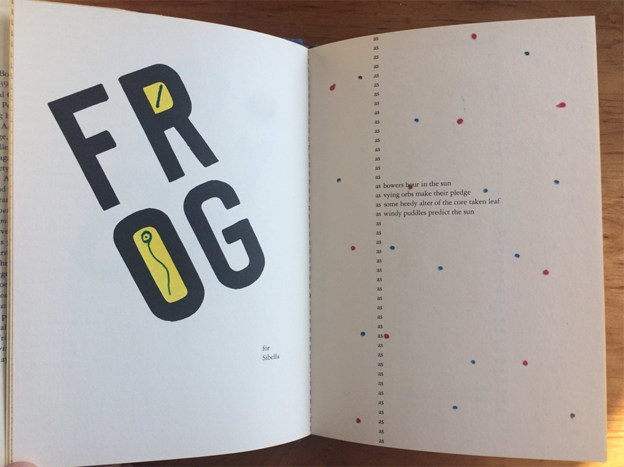
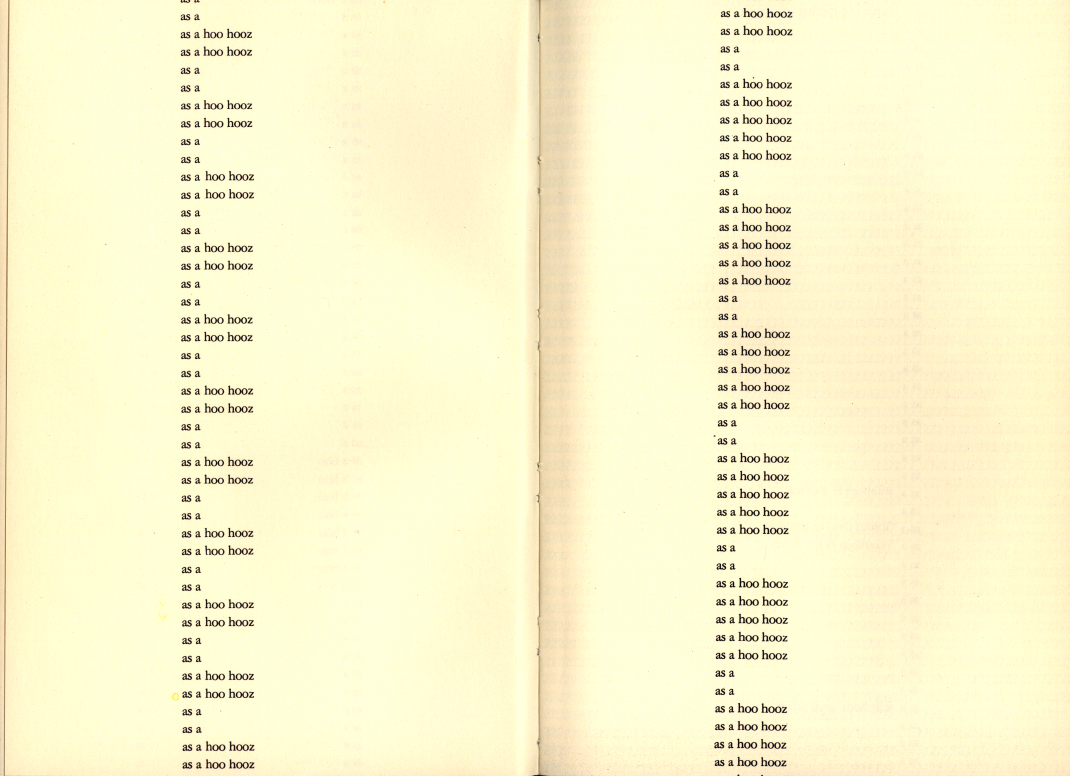
What was performed, with the interruption of a brief set break, was essentially one long piece divided into natural, unplanned episodes and pauses--though occasionally the audience broke in with applause to 'end' a section. Absent of a score, Mitchener used a series of texts--a Cecil Taylor poem on the elements and on creation("thrice water in air..."), Mingus and Jeanne Lee quotations on creativity, and, the most extended, poems by N.H. Pritchard, mainly from his second book, EECCHHOOEESS--which she moved through, improvising on or off, a word revealing itself gradually, cohesively broken down; the text not so much as a script but as a repository to give the voice shape, as texture and also as a space, a placeholder, a holding place for thought, for suggestion, for image. Pritchard in particular, who she's worked with before, formed the basis for the most extended (re)articulations of the set--the ecstatic yelling of the word "FR/OG" that closed the first set with aplomb, the poem of that name taken up again in the second half, Pritchard's splitting of words, so that "echoing" is reversed, mimesis of the aural effect rendered visually and then resounded--"ing echo", Thomas picking up on that echoic play with a rare melodic echo of Mitchener's pitched tones. An echo is one mode of relation, between the sounding and the sound, the semantic and the 'purely' sonic, the intentional and the unintended, the spoken and the spoken-for. Another--language's connecting words, the way they tie and fry, they fray: the spoken-sung recitation of Pritchard's mediation on and with the simile, "as a / as a / as a / hoo hooz", the call of an owl or the questioning of possession or colour gradation, "whose", "hue", words slipping and sliding, nature imitation, night birds or crickets, Thoreau's loon, nocturnes, clouds forming, faces in the sky, ("VISAGE / BLACK CLOUDBANK / FORMING/ ELSE WHERE") a kind of mystic-material inquiry rooted in (perhaps) American Transcendentalism, the reading of nature's hieroglyph as Emerson put it--letters, sounds, transparent eyeballs, bells--or theosophy, Toomer's Gurdjieff, his sound poems ("vor cosma saga [...] vor shalmer raga"), or a (post)structuralist enquiry into language--metaphysics or metaphor, any number of enquiries..."As a" as a repeated loop between speech and song, Thomas sometimes picking up with piano figurations that offered rhythmic support of staggered dance, more often with electronics on the i-pad that fed in insectoid cracklings or multi-layered clouds sustained then dying away.
(Pages from N.H. Pritchard's EECCHHOOEESS performed by Mitchener/Thomas)
I had a thought, but it was more a feeling, transmitted in the performance's vibrations, its sensations of tone, that this was all above all about material, about the piano as material, as object, as percussion, as an instrument with an inside and an outside, about how Thomas' performance "outside" on keyboard and "inside" on strings activated both, refusing distinctions between them; and how Mitchener too articulated inside and outside, clicks from the back of the throat while singing, the way the entire palette and throat is drawn into and made visible as articulation. It's about time, too, and poise, how listening gets articulated visually as well as sonically, in the way Thomas would hover over a chord, fingers in position, decide not to repeat it, move instead to the inside of the piano or the i-pad; the way both he and Mitchener insistently and unforcedly avoided the cliches of 'responsive' improv (echoing, playing 'together' in too obvious ways, as if that were the only way to play were to overcompensate by demonstrating you were 'listening' by imitation--which is not really listening at all, just a kind of language-learning game, a preliminary to the real listening that never really happens). Often Mitchener channeled an entire band in rhythm and lead parts herself, accompanying doubled vocal lines with a shaker, with a rhythmic articulation that supplemented and separated and merged from a melodic line (like an avant-garde Bobby McFerrin, occasionally); Thomas instead responding with a series of tranquil dissonant chords, or silence, or an electronic crackle, or in one delightful moment, a sudden burst of club music that faded in and out like the ghost of a different sociality, invoked with (im)perfect humour and (im)perfect ting, art brut, joyously knowing. Only at the end did he join or lead in a jazz-tinged series of chords that channelled a host of optimistically rueful medium-tempo solos exemplified by the solo Monk playing over the sound system when I entered the venue, and that maybe aurally echoed in his playing, that lent itself to song-like song-line close on Jeanne Lee's words on the experience of life as process, on life as living: not stasis, not object; and on those words, those chords, that song, synchronous, asynchronous, warmly to end.
John Butcher (tenor and soprano saxophones), Pat Thomas (piano), Dominic Lash (bass), Steve Noble (drums / percussion); Consorts (various musicians—full list below). Café Oto, Dalston, 21.10.2021.
Last year, bassist Dominic Lash began a record label, Spoonhunt, releasing music by three of his own ensembles: on Limulus, a quartet featuring, among others, saxophonist Ricardo Tejero, another quartet on Discernment, John Russell’s final recording alongside John Butcher and Mark Sanders, and a large ensemble called Consorts, heard on a record called Distinctions. Much of this music in turn arose from Lash’s 40th Birthday gig at Café Oto, and so it was fitting that, with the easing of pandemic restrictions, it was at Oto that the releases could be officially launched. The venue isn’t open at full capacity until next Monday, but there was still a good turn-out for what was by no means a flashy or hip gig or something with a visiting act as a draw: an indication of the health of the UK free improv scene, pandemic or no pandemic, and of the respect in which Lash and his music are held.
Given Russell’s passing, and the unavailability of Discernment’s original drummer, Mark Sanders, the quartet that played the evening’s first set had quite a different sound to that heard on the record, with Pat Thomas—originally supposed to be on the original date—replacing Russell and Steve Noble standing in for Sanders. This could have gone anywhere: Thomas sticking to piano, rather than electronics, always promises a certain amount of contained thunder, Noble a perhaps more buoyantly rhythmic approach, but the band might equally well have trod into the more abstract/rhythmically unmoored territory of quote un quote non-idiomatic playing. (By this I mean, a certain idiom that also gets called ‘European free improvisation’, whether that’s meant to imply geography, artistic tendency, style, or genre; usually, some sort of combination of all of those). Expectations of the latter arose in large part thanks to the presence of Butcher, whose earlier work with Russell and Phil Durrant (who was heard in the evening’s second half on electronics) gives his work some affinity with the beginnings of the more minimal school of improvisation that ends up with New London or Berlin silences, while the painstakingly precise multiphonics of his solo saxophone work (latterly, often amplified with electronics or in resonant spaces), suggests a kind of bridge between minimal tendencies and the more reactive scrabble of EFI. This kind of generic hair-splitting, of course, doesn’t go anywhere near to suggest the studious fluidity of Butcher’s playing, or the expansive range of Lash, Thomas, and Noble across numerous contexts. As I say, this could have gone anywhere.
As it turns out, the set—maybe 40-minutes or so in length, though I didn’t check the time—was surprisingly like free jazz. (Surprising, that is, given the tendency of the sectors of EFI with which Butcher would normally be associated to distinguish themselves from ‘energy music’ tendencies.) The quartet didn’t suggest free jazz so much in terms of dividing the music up into ‘themes’ and ‘solos’ or even pulse, but more in certain harmonic gestures and levels of energy/volume, generally initiated by Thomas and picked up on by Butcher, working some way outside his usual vocabulary. This is not, perhaps, Butcher’s preferred territory, but it didn’t show: particular on soprano, which he alternated with tenor, with I think two turns on each instrument apiece, he touched on scalar, declarative iterations that bordered on late Coltrane at its Live-in-Japan woolliest, repeated melodies echoed—not in the rote-repetition that screams “I’m listening and reacting”, but in genuinely surprising and fitting echoes—from musician to musician to musician.
Butcher began in jazz when he was starting out in the early ’80s, playing in groups with pianist Chris Burn while studying physics at Surrey University and continuing to play in Burn’s big band while beginning a Ph.D on ‘charmed quarks’ in London. As Burn remarks in an interview with Simon Reynell: “I always joke that what started off as a 22 musician big band playing jazz compositions ended as a free improvisation duo.” (By 1992, the band sounded like this.) And jazz, free or otherwise, has largely left both Burns’ and Butcher’s vocabulary since then, though an unexpected and surprisingly effective duo with Matthew Shipp—convened at the invitation of Trevor Brent in 2010, also at Oto, and followed by an equally unexpected trio with synth player Thomas Lehn—saw a rapprochement of a sort. (A 2016 interview in which Shipp and Butcher sketch out the respective traditions from and out of which they emerge makes for interesting reading: it can be accessed here.) Likewise, one of the highlights of the performance by the Lash-convened quartet was seeing Butcher adjust to a climate that—largely through Thomas’ playing—had more of an idiomatic connection to free jazz than might be expected in this setting. Particularly in a solo context, Butcher plays virtually every note with an extended technique—multiphonics, false fingering, overblowing etc—veering away from any conventionally pitched vocabulary. That certainly figured here, so ingrained is it in his style: notably, on soprano, eerie, ultra-high altissimo, whistle-pitch sounds, or whispered wind ghosts floating through the body of the instrument after the mouthpiece had been removed. Yet these were juxtaposed or combined with melodic and rhythmic shards strongly suggestive of jazz, fragments of stories that Butcher seemed surprised he knew, but which he was able to re-tell, to spin towards and away from, with authoritative relish. What might have been par for the course in the work of more free jazz-oriented group thus attained the genuine “sound of surprise” here because of its variance from the norm of Butcher’s particular idiomatic tendencies, and in any case, I don’t think Butcher, inveterate Cubist that he is, could leave those phrases entirely intact.
Pat Thomas’ approach to the piano is historically rooted yet utterly distinctive. Spaciously hammered, thick, thick two-handed near-cluster; sparingly used and stringently lush ninth chords; repeated figures that are not quite riffs, not quite melodic fragments, more like rhythmic stutters that sound like a succession of mini-hammers. Deliberately so, there’s something beautifully paradoxical about his approach: gracefully ungainly, liquid granite, utterly poised in consciously distorted fashion. It’s immutable, authoritative, declarative, but entirely adaptable; the hyper-arpeggiated, glissandi-thick, rolled and clustered figures he gets in the upper register are nothing like that of Cecil Taylor, with which such playing inevitably gets compared—partly because of Thomas’ very different sense of space, his tendency to play in measured bursts rather than continuous streams (the unbroken sections of playing tend to focus on repetition rather than constant development); likewise, I don’t think any other pianist has quite the control of the lower register that Thomas has; and his use of the pedal is inevitably much subtler than the morasses of sound he conjures up with it might at first suggest. One chord he played maybe half-way through the set saw him release the pedal before the natural stage of decay where others would have simply let the note ring out; like Butcher, Thomas reminded us, in a kind of hyper-materialist, self-conscious meta-gesture, of the sources of sound production, drawing on the power of the gesture—the reverent haze or dramatic cloud the sustain pedal allows—while also drawing attention to its provisional quality (but with none of the studied fussiness that description suggests). Meanwhile, Steve Noble’s scraped or struck, perhaps bowed, small gongs and cymbals, along with other ways of playing the drum kit as pitched more than rhythmic instrument (his kit was out of my eyeline so I could only guess as to the origin of the sounds) kept things texturally open and spacious. And Lash, of course, has it all down—bowed harmonics, free arco hinting at but never settling into walking patterns, careening caterwauls and ship-wreck groans, the perfectly-placed pluck pinging into the space like a falling droplet that sends ripples from the centre to the edges of a body of water, be that puddle or pond.
During the course of the set, there were ‘episodes’, the conclusion of one and the beginning of the next generally signalled by Butcher switching instrument, but they felt more like movements in a suite than the variable incidents of a typical free improv set, moved between as they were with total, fluid assurance. The first such transition, about five minutes in, saw the music suddenly stop—one of those serendipitous pullings of the emergency-brake that generally sees the musicians wryly laugh and the audience begin to applaud, as if willing the music to end there. Here, the silence was sustained, and things immediately moved in a different direction: a focussed adjustment characteristic of the set to follow. Thomas was often the driving force behind the quality of each particular ‘movement’, though his playing was anything but grandstanding: repeated chords suggested, even as they slid away from, a harmonic direction or area. Yet it was above all a collective music, a conversation between equal musical personalities. Take away any one of the parts and the quality would radically have changed. It’s rare to see a purely improvised set of such cohesion, no hesitancies or verbiage or over-staying of welcome, each transition natural and surprising and fitting, everyone in sync, knowing when to sit out and when to step back in, no one treading on each other’s toes but no one hiding around the corner waiting for things to get going either. I trust the set was recorded, and I hope it might see release in some form or other.
Consorts, kind of chamber ensemble-cum-big band which, as far as I know, has only previously performed on the 40th Birthday gig which forms the basis for the group’s Spoonhunt release. Here’s the full line-up, taken from that release’s info sheet.
Douglas Benford - harmonium and percussion
Steve Beresford - electronics
Marjolaine Charbin - piano
Chris Cundy - bass clarinet
Seth Cooke - steel sink and metal detector
Angharad Davies - viola
Phil Durrant - modular synth
Matthew Grigg - guitar/amplifier
Bruno Guastalla - cello
Martin Hackett - Korg MS10
Tim Hill - baritone saxophone
Tina Hitchens - flute
Sarah Hughes - zither
Mark Langford - bass clarinet
Dominic Lash - double bass
Yvonna Magda - violin
Hannah Marshall - cello
Helen Papaioannou - baritone saxophone
Yoni Silver - bass clarinet
Alex Ward - clarinet/amplifier
I don’t think this was entirely reproduced on the night—Lash was playing electric guitar rather than bass; I didn’t see Alex Ward, Bruno Guastalla, Sarah Hughes, or Helen Papaioannou; Seth Cooke didn’t appear to be playing a steel sink and I’m not sure if the objects he was crouched over next to a small amplifier were metal detectors or not—but I think it’s largely representative. And whatever the individual components, the ensemble is in a sense also the piece they play, even if that piece is only loosely structured, certainly not formally scored or even conducted. With this line-up they could conceivably function in any way Lash decided, from the more conventional Improvisers Orchestra format, with its conductions and exercises, to full-on Alan Silva Celestrial Communications-style skronk. Full disclosure—Dom asked me to write the liner notes for the group’s album last year, but was more interested in what I might have to say about the music without knowing the methods that produced it than provided with the nuts-and-bolts of its structure. And I think that concern with what the music sounds like, rather than how it’s structured, is the point: an exploration of large-group texture that deliberately avoids the aforementioned large-group improv tendencies to density and information over-load while also gesturing towards—and departing from—the more minimal tendencies with which Lash’s has been involved in the Set Ensemble and other Wandelweiser-related endeavours.
As I understand it, the Consorts piece is essentially a set of sustained tones building to a crescendo, and those are the only guidelines: no score, no conduction, no other signals. (And in the rehearsal/soundcheck last night, apparently no mention of sustained tones was made.) So in part Consorts can be understood as a sort of exercise in orchestration, a textural experiment. As an exercise in orchestration, there’s a kind of giddy delight in textural variety—I’ll take not one but three bass clarinets, combine a string section with various electronics, ‘small’ or otherwise, round out the bottom end with a baritone, throw in two guitars. The group Lash had chosen is not ‘star-studded’—though who wouldn’t want a violin section with Angharad Davies in the corner! —which is, in fact, all the more index of their dedication in a music that is, after all, at its best, never about egoic fulfilment: players who quietly work away, in London or Cheltenham or Oxford or Bristol, at their craft: Martin Hackett’s inimitable Korg MS10, the tripled bass clarinets of and Mark Langford, Yoni Silver and Chris Cundy; Hannah Marshall’s richly adaptive cello; Steve Beresford in small electronics mode. From my seat, the only musicians in view were Marjolaine Charbin on piano, Mark Langford, the nearest of the bass clarinet players, and Hannah Marshall on cello (with Lash’s guitar popping in and out of view behind her). Consequently, I only realised, for example, that there was a flute in the mix about 30 minutes in, and had no idea Angharad Davies had been in the mix until Lash called out her name at the end. All this meant that I had to concentrate on it as a group sound rather than focusing on the individual sources of any particular sounds. Which is to say that being able to see the individual members of the ensemble perform both does and doesn’t make a difference. The ability to identify by eye, and thus by ear, the individual contribution of a particular instrument/individual helps one pick out one texture in the weave, one dot of paint in the pointillist whole, or any other such metaphor you might choose, but it doesn’t really reveal much more than how the parts are put together—which, as Lash’s reticence about explaining the piece’s structure implies, isn’t really the point of the exercise. Hearing snippets of sound and realising half an hour in that there was a flute in the ensemble, for example, is rendered all the more serendipitous, and the overall texture all the richer.
On Distinctions, the peak crescendo section has something of the quality of the more avant strands of doom metal; the 2021 iteration, while not quite as glass-rattling, certainly reaches for an effect you might call overwhelming, for its sheer, sustained volume, and the thick intensity of its accumulated textural thicket. The groups imperceptibly reaches a massive cataclysm of sound—driven, I think, by Phil Durrant’s very loud electronics, or perhaps it was Seth Cooke’s amp and whatever objects he had plugged into it; or maybe Matthew Grigg was also doing some small-scale Hendrix things with a guitar and amplifier; or Charbin was deploying e-bows, piano strings, and sustain pedals to give similar clouds. Either way, the sound was, thick and immutable, catharsis or textural exploration, followed by a shorter de-crescendo out (though it apparently lasted around ten minutes). Live, as opposed to on record, you can really feel the music fill the space; in providing contrast to the ‘climax’ and a mirror to the opening, the de-crescendo emphasizes the piece’s architectural, or is that architectonic, qualities. It reminded me a bit of taking part in a Michael Pisaro large group piece—also at Oto—back in 2015, in which everyone played ppp so that the overall volume was the strange effect of a very large group playing at a kind of medium volume: like an orchestra with a mute on it. Harry Gilonis also suggested the piece might be set alongside new music exemplars of the crescendoing sustained/repeated tone like James Tenney’s ‘On Having Never Written a Note for Percussion’ or Stockahusen’s Inori, to which I’d add some of Giacinto Scelsi’s orchestral pieces. (Lash himself mentions Phill Niblock, whose music he’s performed and on whom he’s written academically.) The Tenney is an exercise in solo texture and focus, with its own influence on a strand of improvised music—think Mark Wastell’s tam tam or Eddie Prévost’s bowed cymbal—as well as the general ‘swell piece’ structure found in larger groups. It would be interesting, meanwhile, to think what an improvised ‘swell piece’ like Consort’s does that those composed pieces don’t, and vice versa. If Scelsi and Stockhausen’s experiments in the form associated it with a specifically ritualistic quality (in Stockhausen’s case, unexpectedly Messiaen-type sonorities, allusions to the 'Dies Irae' melody, etc), there was almost nothing ‘ritualistic’ about Consorts. Let’s call it a more materialist approach to sustained tones that aims to be a study in texture and group contributions to an overall sound rather than a trance-inducing exercise. (Of course, the whole crescendo thing might also be seen to originate in the serious musical joke that is Ravel’s ‘Bolero’.)
These are all open-ended hints rather than a final say on the matter. Suffice to say I enjoyed both halves of the evening very much: unusual in the level of contrast between the sets and the level of focus throughout. But of course, given the calibre of the players, entirely to be expected. Roll on the next series of Spoonhunts!
March 2020 has moved incredibly quickly, for reasons of which anyone reading this will be all too aware. Likewise, this will be no doubt littered with typos and overly-elongated sentences: perhaps others share this feeling that there is right now too much to say, all at once, and, simultaneously, that one feels numbed to not being able to say anything at all, overtaken by events, swept up in them, left behind. Yet at the same time, things have ground to a weirdly atemporal standstill, with all the glacial suddenness of what seems to be an imminent world historical leap: the treading of a fine line, a balance (though hardly balanced), between slivers of hope—that the current cruelty of economic and “social” arrangement might collapse, and that in its place agitation for transformed notions of social justice might emerge—and premonitions of horror and catastrophe, as the atomisation of social life reduces the possibilities for collective action and agitation, sharpens the knife edge that so many without the luxury of a comfortable “day-to-day” already face. This process exists on every level, from local to international to global. There's the chaos—the most noisily and easily-trumpeted—into which even the wealthiest of Western powers are plunged: powers whose arrogance assumed this could never happen, and thus made and (failed to) deploy utterly inadequate containment measures. Then, and inseparable from this, are the global inequalities by which, for the West, pandemic is always “elsewhere”—othered, racialised—and by which those who suffer the most and are the most at risk, those who are sacrificed on the pyre, those who are rendered expendable and peripheral, are always those who are already othered, racialised, those who, pandemic or no pandemic, are pushed to the mere brink of survivable life. London—where the UK government’s incompetent and disastrous laissez-faire refusal to act, followed by abrupt about-faces and the ever-present risk of authoritarianism, has allowed a high and sudden spread in cases, caught between “business-as-usual” (economic flow over human life) and war-footing “Blitz spirit” measures—is an uncertain place in the lately-woken spring sun.
Maybe it seems either callous or more important than ever—or both, or neither—to focus on music in this instance. But I’ll do so anyway. Since the earlier announcement of “social distancing” measures—in which the population seemed to temporarily took the lead over a government which briefly flirted with the absurd notion of “herd immunity” as (non)containment strategy—Café Oto switched its usual roster of gigs to a series of livestreams, in which musicians performed to an empty venue, broadcast on the web. Tuesday’s was the first I’d managed to catch, and just as the livestream began, the UK government announced what—in the often disastrous confusion that’s typified the governmental response to the increasing spread of the Covid outbreak over the past few weeks—seemed to amount to a full-on lockdown (police presence, trips outside rationed, most businesses closed—all with unclear provision for those on precarious contracts, with no fixed abode, and for all the various reasons that the cosy option of “working from home” is hardly an option for many). So this would be the last of these livestreams (now archived online: https://www.cafeoto.co.uk/archive/), the announcement exacerbating the already eerie fragility of two solo sets to a split and invisible audience (for it’s the coming together—to borrow Rzewski’s title—of audience that makes the socius of such music as much as it is the coming together of musicians, and as much as that coming together can occur across temporal and physical spaces, via recordings, scores and the like). That announcement also threatened to overwhelm the music, and I found it hard to focus on Kerry Yong’s performance of the first three of Messiaen’s Catalogue d’Oiseuax, fine though the performance was. Instead, all I could notice really were physical details: Yong acting as his own page-turner, moving the sheets on top of the piano—as if, like Igor Levit, he were giving the recital from his own living room—the way Yong’s hands seemed to glide with a kind of serenity down the keyboard even as he was actually executing some of the more tricky of Messiaen’s trilled avian notation-fantasias. Or maybe this was just a function of the inevitably glitchy nature of the livestream format, by the fact that, for the past few days of house-bound distancing, when I open the window all I hear is birdsong and building work and sirens and I’m not sure if silence or noise is more reason for alarm.
The second half was originally billed as Elaine Mitchener with bassist Neil Charles—who gave a superlative performance as part of Anthony Braxton’s Standards Quartet at Oto a few months ago, when all this seemed barely a blink in anyone’s eye—but ended up being Mitchener solo. For at least an hour, Mitchener crooned, howled, answered back, debated, channeled, chattered, dug deep and floored things in a solo vocal display astonishing not just for its virtuosity—Mitchener has Cathy Berberian levels of wild skill—but for what that virtuosity enabled her to do. This was emotionally heightened by the official announcement, and by all the uncertainty of the previous weeks, and of the weeks or months to come. Mitchener seemed to take that uncertainty in and on, to fully inhabit it, making it a ground from which to begin, while also offering the rock-like comfort against it. This comfort, this alternative, is something already central to Mitchener's music-making. By this I mean an alternative mode of temporality, which has two elements. Firstly, a total openness and ability to move within the moment—improvisational capacity, expressively buoyed by a variety of physical movement and gesture that responds to / echoes / drives the sound. Secondly, the aim to suggest, or even inhabit, alternative temporalities—cosmic, spiritual, non-Wester—the lyrics of Sun Ra, their afro-Futurist refusal of the killing constraints of presentness through projections into (imagined) past and (imagined) future, their atopic utopianism which is, of course, more material than any of the capitalist realist lies we’re daily told even as they break/thrive under the pressure of crisis. That’s an imprecise way of rendering what, in the experiential necessity Mitchener’s vocal work demands of performer and listener alike, is absolutely clear. You can stop reading and just click below if you want to know what I mean.
Mitchener began wordless, voiceless, lighting a bag of cheap candles (tea-lights, right?) on one of Oto’s signature tables, ringing a service bell every time one was lit. I wondered if it was a ritual for the dead—as Mitchener has previously memorialised the victims of criminal negligence in Grenfell Tower—so, here, those who have died so far of the virus, or perhaps those to come—or if that was placing too much symbolic freight on it, or if, as prelude and ritual, it was something that existed as a space deliberately open to interpretation: an entering in. Moving to the microphone, Mitchener began the recital’s musicked part with words that only after a minute or so made themselves manifest as decipherable words—stretched, distorted, chopped by their staggered speech-sung emergence, like a voice that’s trying to get out but at the same time trying to hide, operating within contradictory impulses, and it’s only from such contradiction that the full soar of sung note, of melisma or melody, can emerge; must be earned. The words, as far as I can tell, pertained to (a particular interpretation of) ancient Egyptian mythology—”the focus of oneness in time and space”.
Ra is the first principle which emerges out of the Primeval Waters. He is the subtle, singular principle of Creation, the focus of oneness in time and space. The Primeval Ocean itself transcends time and space and is beyond existence and non-existence. Ra is the first principle to emerge out of the Absolute (as Ra-Tem). His emergence signifies the beginning of existence
Point from which creation begins, as Oliver Lake put it—a singular principle that is yet subtle, the beginning of existence yet itself somewhere in between realms. It’s easy to metaphorize this:creation as a point which is not a point in time or space but refuses those categories, yet which maintains a necessary cohesion akin to that of any creative being; creation recreated every time we add to it through human activity. So in a sense that fragmented phrase—in Mitchener’s rendition, removed from origin, emerging in barely decipherable form (and decipherment only working backwards, as one stitches together a word from a syllable, a syllable from a string of notes, etc)—serves as another way of entering in, another statement of purpose, but also a statement of elsewhere, not as escapism, not as evasion of the moment where we are—for the rest of the performance channeled that with a ferocious and necessary intensity—but as the opening up of alternatives to the (mis)management of death in which our lives, more than ever, are now variously and unequally entwined.
The rest of the ‘recital’ passed in something of a blur, though it was beautifully precise, moving through a series of demarcated and holistically-constructed pieces, as Mitchener removed each page from her music stand (whether scores of simply words / prompts, I wasn't sure, and it didn't seem to matter), laying them on the floor. About half-way through, some Sun Ra lyrics appeared, as well as some pieces from Mitchener’s “sings the Black Avant Garde“ project, in which vocal pieces from ‘free jazz’ repertoire are treated as occasions for recital, given the seriousness they deserve as compositions, in the processing restoring the presence of the voice (particularly the gendered female voice) to free jazz, in which it is essential (Linda Sharrock! Patty Waters! Jeanne Lee! June Tyson!), but from which it is too often excluded. Remembered in no particular order, the other pieces included Archie Shepp and Jeanne Lee’s “There is a Balm in Gilead”, one of the great recordings of the 1960s, no doubt, Mitchener here echoing not only Lee’s own relatively un-extemporized renditions of the melody, but also the counter-melodies by Shepp’s tenor saxophone and Lester Bowie’s ghostly trumpet. There were Ra lyrics, removed from their original melody and rendered more tonally abstract, to the accompaniment of a shaker. There was an echo of classic Berberian-esque performance-art/avant-garde ‘New Music’ theatre featuring a trio of squeaky toys (a doll, a pig, and a long-necked rubber chicken)—more extraordinary here than the seriousness with which Mitchener treated these as instruments, the refusal to play for laughs or excess, was the fact that she managed to pull this off. Another pieec (perhaps the second), which began as a kind of spoken dialogue, of interpellation, hailing and refusal, sometimes seeming to touch on the present moment—spectres of people hoarding food and fighting in supermarket, as Mitchener listed various ingredients and foodstuffs—and in which voice’s internalised and externalised, inherently dialogic nature, could be tracked not only in the range of sound Mitchener produced—closer to Phil Minton or Maggie Nicols than Lee or Berbarian here—but in the viscerally expressive gestures by which she slapped, caressed, and framed her face and body; gestures of balancing and centering, of falling way and apart, holding the music in and letting it, letting oneself collapse but keeping it all together. Towards the end, Yong, who'd been sitting the whole time at the piano to the right of the stage area, silent and observant, briefly joined, with some brief rumbles of strummed piano strings; but it was Mitchener alone who ended things with an utterly devastating rendition of ‘Amazing Grace’. Written by a slaver-turned-abolitionist, the piece of course transcends its nature as white guilt-exculpation and religious apologia (Newton’s spiritual conversion predating by some years his ceasing to participate in the slave trade) to become a vehicle for libration, sung on Civil Rights marches by Fannie Lou Hamer, Mahalia Jackson and others—as Judy Collins put it, “to give magical protection – a charm to ward off danger, an incantation to the angels of heaven to descend”. So that history, the felt presence of the melody as something so familiar most of the audience could probably sing it—something Mitchener half-jokingly suggested when she said “sing along if you like”—but very quickly Mitchener, her live vocals dragging behind I think two or three voices of pre-recorded, multi-tracked rendition a la the phased unison/separation of Feldman’s ‘Three Voices‘, swayed a long ways from the familiar melody, her live line more and more hanging behind the pre-recordings and progressively omitting words, consonants, articulation in an elongated slur, so that the final round of the tune’s familiar contour essentially lacked either the melody or words except as sounds in the memory. As this process occurred, Mitchener sunk lower and lower to the floor, and closer and closer in to herself, the world around kept out—in its mendacity—yet allowed in—as something like Collins’s protective spell—for those who need it. "I was not sure the magic worked outside the church walls ... in the open air of Mississippi", noted Collins. "But I wasn’t taking any chance". Likewise today: who knows if such spells work. Who knows what that would mean. But I just want to register for now the strength in vulnerability of this performance as exemplary, as gift, benediction, and the rest: both a farewell to past certainties and a beginning to a situation we’re only, really, beginning to contemplate.
[performed by Aisha Orazbayeva (violin) and Mark Knoop (piano)]
Disregard any first-half record players positioned to ‘play’ suspended microphone-suspended violins as any old visual, cod-performance, cod-aural gimmick, complete with the dressing of quasi pop-songs spicing up the classical world in utter dilution –ok disrupt things, but for fuck’s sake do it well, not just some tolerated hoop everyone jumps through or watches someone else jump through because someone’s told someone that someone else thinks it’s cool, and everyone politely knows better. But no one really came for that, anyway. Listening to the Feldman, then, feeling the simultaneous sense of some sort of serenity, but that isn’t the right word, really, and some sort of despair or panic; things are held, things are slow and quiet but then suddenly they speed up like a tiny breathless race only to move back to something else. The piano and violin in unison or alternation unwind a scale, a unison which is always slightly morphing, always slightly off-centre. There are about four or five moves which get repeated, transitioned between: in one of them, the violin repeatedly bows a single note over piano chords, extremely high, like a constantly-repeated whispered scream, then moves back to a more conventionally varied scheme, hands execute a dance up and down the strings, the violinist could execute a note perfectly and it will still sound fluffed, edged with harmonics, scraping away at the instrument’s romantic cantabile capacity to get inside and beyond all that. At those moments of scream, the music almost gets unbearable, though it’s not a scream in terms of harshness of pitch, more in terms of long drawn-out held-in intensity which never fully extends itself, releases itself, always moves back into a repetition or a variation of a different kind of thing. Sometimes it’s actually actively funny, an obvious tonal repetition, a scale, a unison passage, a child rehearsing and repeating the simplest things with the patience a child would never have. Transposition, the return of the same material, movement without movement. It could go on. A particular scalar move starts to recur more and more towards the end, a refrain of sorts. The piece doesn’t feature much silence or many pauses, if any, the piano sustain-pedalled almost throughout, or so it seemed, not so much as a cavernous resonant quasi-religious ex-cathedra echo chamber easily posing as mystical aura, dispensing the gravity of aesthetic beauty and wisdom, extending in time that feeling of enlarged space, but instead a structural mode of slight extension and discontinuous continuity. Mostly the two instruments play together or in close proximity / alternation, sometimes one will ‘solo’ briefly. Material is shared, the players almost seem to try and trip each other up, are made to so, in tricky synchronicity, Knoop looks up each time they need to make a dual entrance, land on the same point. Orazbayeva’s legs on the floor extend into weird shadows, simultaneously extended and huge and miniaturized into a shadow-homunculus, both infinitely extended and infinitely reduced as Feldman’s late music might be said to be. Development, progression, the concerto argument of the subject extending in or against collectives, etc, the whole romantic bourgeois-revolutionary or religious tradition or nature tone-poems or what have you, has no place here, the music is not even a dialogue so much, though there are aspects of that, instruments are in the same place and the music is a whole, written for all of them. Is it a private music? In a sense it’s so familiar and so easily recognizable as a style that anyone could do it now, or think that they could do it, but what does it yield up to us or to each listener specifically and personally, what emotion is there or do I read in, shooed away for Yoko Ono to bring her jam to town when we just wanted to sit there to recover, still in that position of enforced physical stillness, the slowing down of breathing. Feldman’s music, at this length, is easy to follow, though there are inevitably moments of slight drift, even if its similarity of materials wouldn’t enable a reconstruction of the piece absolutely chronologically or in its entirety, that kind of summary. But the reduced set-up perhaps makes it less easy to get lost in, washed over, as, say, ‘Coptic Light’, the focus is easier, though equally absorptive. This is not music of drama, or struggle, except as that is, whatever, where it has come from, been distilled from, or not; not even like those moments in, bad comparison, Helmut Lachenmann, where you get musical history through the ruins, or that sort of thing – even, say, the comfortably regressive melancholy variant of that you might find in post-minimalists or post-Romantics like Valentin Silvestrov; not even that, or not at all, the concern above all with process, extension, limitation, temporal exploration, sticking with a thing and doing it, development of attention, not to some spuriously opened framework of the aesthetic beauty of hipster’s farts, toilet door squeaks, police sirens and passing trains in the extend intervals between a barely-sounded e-bowed squeak, but to the piece itself, listening to its expanded inwardness, inwardness of expansion, a room of people giving quiet regard to the work while people outside are looking in at the windows, the spectacle of a roomful of listeners to a sound you cannot hear highlighting some sense of social absurdity, open for everyone to see. You could valourize this discourse of enclosure, safety, a carved-out space against some vulgar monster outside, but would you really want to: the music is all those terms dropped out of the magic moments hat – patience, delicacy, fragility, monotony – but it is also extremely assertive, violent even, in its following-through of intention, or steadfastly pragmatic, whatever goal is or is not in sight, if that’s really the term to use – in, for instance, its insistence on extending a territory for longer than might be thought ‘necessary’ or ‘comfortable’ and then, once that extension’s been settled in, moving on to something else again. Not boring, not sentimental or easily open but tender, not easy but absolutely there in its surface, being nothing else except what it is, you there, too, sitting quite still, not even sure what to think or what to feel.
Charles Gayle - tenor saxophone, piano
Ksawery Wójciński - bass
Klaus Kugel - drums
The write-up on the Cafe Oto website suggested – or perhaps this was just my impression on an over-hasty glance that morning – that Charles Gayle might have ‘mellowed’, become more interested into forays into different traditions than the Aylersque intensity for which he’s known; almost an apology in advance, for those who might be disappointed by this direction. Presumably the reference was primarily to his piano playing – which, however, anyone with a more than passing acquaintance with his career will be aware has been present for a while, operating in quite a different area to his saxophone work – but the set as a whole was full of bark and bite, the thickness and grit which gives his playing its, shall we say, ‘purer’, more stripped-down, more difficult dynamics, in comparison, say, to someone like the late David S.Ware, buoyed on and up by Matthew Shipp’s riffs and by a luxuriant ‘godspelized’ balladry; this in large part due to the fact that Gayle prefers working in trio settings, the only piano playing his own, decidedly chunky, resolutely un-flowing.
Gayle’s upper-register playing is like nothing else; or, it’s like plenty else in that post-Ayler repertoire, but the moments when he goes there for thirty seconds at a time, pauses, goes back, pauses, goes back, the sudden release and clamp down and release of a flock of screaming birds, their placement, are his own, decidedly material, for all the controversial, whatever, Christian rhetoric and framing. (Spirit is material, of course, in the conception of any number of African-American musical traditions; is the material working through and on tradition within the physical body of the performer who performs in and as that music’s history, with its back-up and with its challenge and weight.) Listen to that upper register neither as the clichés of yawps of glory of cries of pain by which the whole biographical focus on homelessness glorified as martyr-suffering revelation would force the critical terminology, but as a concentrated area of concern. Technique, whatever. Carved out of and carving a space; thinking, spatially. To be taken up, you take yourself there, force the flight. For any heaven that he wants to reach, Gayle will be climbing up Jacob’s ladder, stepping or slipping on each rung.
Seymour Wright, who was in the audience, sometimes plays sets in which he almost exclusively focuses on this kind of area – I’m thinking in particular of one absolutely ferocious in its intensity and focus, played by his trio with Paul Abbott and Daichi Yoshikawa, lln, in a freezing warehouse in Cambridge back in January. But whereas an improviser such as Wright might take that element from someone like Gayle and move it away from obvious idiomatic references to jazz, with Gayle, it’s part of a vocabulary that comes from a different place, with a different idiomatic tinge. For instance: a moment with notes tugged and wailed as a melody heaves itself out; a foot insistently tapping over walking bass, tone still rough and shouting. There was a similar section in Peter Brötzmann’s performance here earlier in the summer; but whereas Brötzmann’s occasional turn to that kind of frame is perhaps part of a conscious decision to reference various forms of jazz history – certainly in spoken interviews, also partly in the playing – Gayle’s always been more overtly and referentially of various traditions, doesn’t need to ‘turn’ to them. There are bits of late Coltrane in the steeliness of the lower register, though the rhythmic approach is often quite different; with Ayler is shared an emphasis on blocks (rather than sheets) of sound; the rhythmic focus or interplay comes out of the pauses that are left between these blocks, in interaction with the rhythm section, which might lift or drop, sustain or undercut or emphasize them; you get a real sense of this from watching Gayle’s body language, making, for instance, two attempts, two lunges, spitting out into the mouthpiece, mouth pursed forward, until finally the sound blasts forth on the third attack; ducking his knees, bending down and bouncing up as a kind of visual or physical anticipation of the sound whose appearance is in a kind of rhythmic dialogue with that precursor, a different kind of movement. This of course isn’t visible on record, but no doubt it inflects the rhythmic emphasis that can be heard there; somewhere between Gayle catching himself off guard, deliberately, keeping himself on his toes, in both the literal and figurative sense, and a more unconscious state of being in the music – or both at once, an element of technique that wouldn’t necessarily be theorized as ‘technique’ as such, but is a vital part of the music’s physical, material process of making.
So Gayle’s body language is a part of his style in itself, knees bending lower and lower while the top half of his body remains straight; all the more striking for his gaunt frame, perhaps not as stick-thin as Roscoe Mitchell but with a slight frailty that manifests itself when he finally takes a breather, switches instruments, allows the other players to solo. Early on a burred blast is followed by a brief burst of coughing; Gayle later apologizes, he has asthma. He seems almost taken aback by the warmth of applause, willing him on and back, wiping his brow, announcing his co-players and almost embarrassed when they mention him in turn.
As for the piano playing, it’s shot through with Monk, with, say, a characteristic TSM trinkle-tinkle flourish turned into the key-rolling cluster-run of the avante-garde; Gayle favours a left hand motif strongly reminiscent of the opening phrase of Misterioso; elbow or open-palm slams granite reiteration will alternate with a kind of deliberate awkwardness with chord changes or, at one point, a semi-quotation from Body and Soul, the avant-garde flourishes (or not so much flourishes, there for crushing heft and weight rather than virtuosic note-excess) interrupting the shadings of standard voicings and melodies which are in turn interrupted by a hefty thwack or thump.
The bass player is a virtuoso, no question; his bowing technique in particular is stunning, bow lifted off strings, glancing off them, wisps of sound as if overhead and caught in passing on some wind, Aeolian. The drumming is less impressive, or at least draws less admiring attention to itself; certainly noisy, at times rather distractingly so (particularly during a lengthy second set section in which bass and drums are still locked in a kind of high-energy free jazz mode which gives Gayle’s more balladic piano no room to breathe); but with pleasant colouristic additions from a small set of mini-gongs and bells to the side of the kit and some nice feathery brush playing, glancing off cymbals and surfaces under the impressive first bass solo. These moments occurred in the first set, which overall had more focus (though moments in the second, such as Gayle’s sudden decision to switch instruments and insistent following two-handed thump on the piano keys, or his insistent tenor re-entry on the final tune, were as fine as any of the evening). I didn’t really snap out of the impression of that first set for five minutes, even as the interval music came on over speakers to force people into bar mode and mood, that interlude ritual; perhaps what I’ll remember most of all is Gayle’s first piano excursion, top half of his body this time bent almost double, bending out of or into the piano’s shade, letting out occasional exhaled groans or grunts, slowed to a crawl; that almost ponderous exactness, pedalled emphasis, reminiscent not only of Monk but of Mal Waldron – or maybe it’s just that I’ve been listening to Waldron on and off quite a bit recently – though the effect is far less that of the inexorable build-up or following of the contours of a tune in which Waldron specializes, more of a kind of deliberate non-smoothness, a succession of grinding, halting blocks, squeezed out. I didn’t even know if I liked it at the time, which is the resistance that tells ‘us’ or me or whoever that something is being done that is real and challenging work; work that is not easy, not easily taking off into wished energy music catharsis, not the vital scintillation and buoyancy of (in particular) the first track on Touchin’ on Trane, its fleet dance, but something more characteristic, perhaps, of ‘late work’. Or maybe by bringing up the spectre of late work I’m doing that very biographical inflection I criticized earlier, basing this on the hesitancy, the physical vulnerability of Gayle’s stage persona, itself not seeming a ‘persona’ as such as the real reactions to live events and the particular community of music venues of someone who’s not worked on a ‘persona’, or who, when he does, makes the kind of mis-step that brings down almost universal approbation or confusion or scorn, as the mute ‘Streets the Clown’. Still, that idea of ‘late work’; late at night, late in life, whatever; slower, more stumbling, not so much honed and perfected as the achieved end of a process; perhaps, even, more or differently compelling because less sure of itself and thus harder won; dragging on, wrenching; forced out of and into the moment with attention, with the possibility of failure, present and real.
The relative engagement of Brötzmann performances tends to vary on the particular set of instrumental collaborators he’s playing with, & this quartet was certainly an unusual take on things. (By ‘engagement’, I don’t mean Brötzmann’s own - he does his thing, and consistently - more the contextual framing of that thing, its relative predictability or consistent hitting of the area known in sports parlance as the ‘zone’.) The vibes setup inevitably set ‘Out to Lunch’ connections in orbit (particularly as I’d be running through Dolphy tunes in my head on the cycle ride over), but Adasiewicz is a very different, much busier vibes player than Hutcherson, just as Brötzmann is a very different player to Dolphy, far less angular, with an approach far less obviously accommodating to a pairing with vibes. Whereas Hutcherson on OTL will strike a note with a clang, followed by an unexpected, jagged, slightly extended pause, in tandem with the crisply off-kilter rhythm section of Richard Davis and Tony Williams, Adasiewicz favours (or did in this setting) strategies such as the repeating of a particular phrase with ever increasing dramatic emphasis, and virtuoso jazz runs up and down the vibes, notes a-flying in all sorts of directions. This latter, especially when combined with a predilection for setting up a pedall’d cushion around his sound, tends to fill up the space rather than leaving it, as Hutcherson does: none of that understated approach from OTL in which tension is amped up through contrast and a patient spacing and varying of approach; or, indeed, that of Archie Shepp’s ‘New Thing at Newport’, cocktail jazz put through the wringer and turned into sensuous, barfing disquiet, quiet love and rage, controlled yet unexpected eruption, elongation and foreshortening. Live, Adasiewicz is nothing if not demonstrative, to almost comic effect. One particular physical move sees him shift on his feet to strike some notes, then lift one foot off the ground and move to the sound, as if the physical after-effect of the power of striking that note is about to topple him to the floor like an out-of-control child, one who’s temporarily lost control of their limbs. In another, he lifts the keys up on their string and furiously rattles them about as additional un-tuned percussion to Noble’s drumming. Periodically, he wipes his dripping face and beard down with a towel like a tennis player between points.
So, the presence of vibes and of their particular deployment took some getting used to, particularly given that I was in the far left corner of the room, where the combined force of Noble’s extremely loud drumming, Adasiewicz’s also loud vibes and physically demonstrative performance, and the hyper-amplified sound of John Edward’s double-bass, at times threatened to drown out Brötzmann himself. This was especially evident in the passages of most extreme intensity, where the group became a churning morass of sound, an effect rather like listening to one of the bootleg or semi-legit recordings of 1960s free jazz, in which drumkits, cymbals in particular, create a near white-noise wash, bleeding into the near-undifferentiated cloud of volume and density formed by the rest of the group; from that cloud will emerge the most piercing and burred blasts and blarts of reed-bitten saxophone squall, blasts sounded because they are the only thing that will rise above the storm they also encourage and propel. Such a description might suggest typical Brötzmann fare, the ecstatic group effect that draws in free jazz fans again and again, but, in truth, his own playing tended as much towards the melancholy ‘ballad’ approach he’s favoured over the last couple of decades, a vibrato-heavy pathos-shading which one might best describe as an improvised impersonation or filtration of a tradition of tough-tender jazz saxophonists, from Ayler to Shepp to Coleman Hawkins. Often, he would enter with phrases that slowed the music down, that saw a sudden drop or transition in energy levels, sticking fairly closely to that phrase-area as the other musicians began to dip and rise, to boil away underneath, never letting the music actually enter straight jazz ballad territory, now a few blurts from the upper register, a deliberate shift, and then into ‘full blast’ territory.
The two sets performed were continuous and quite lengthy pieces, the first in particular lasting as much as an hour; after spending some time at one of those noise-peaks, Brötzmann would take a breather and come back in with another horn, during which time Adasiewicz would do his vibes thing, including one very sympathique, more lyrical linking up with the ecstatically-focused Edwards at some point during the second set. Noble seemed permanently restless in his refusal to let the music dip substantially, often hitting a pronounced thwack as if to rudely interrupt or prevent the opening up of too much space, to insist that the music stay on the high road, the speed-freakery of the autobahn. As with his recent performance with Anthony Pateras at the LCMF, it was an extremely solid and seasoned display, the reflexes of an improviser who’s played long enough and at a high enough level to be able to think automatically, without going through the motions. Yet somehow it felt like the sort of improv performance a rock drummer might get behind, over-emphatic in its effects and affect: sustained and fairly steady or ‘straight’ rhythms would be set up which forced the music into particular areas, such as the mallets passage at the start of the second set, and the consistent loudness felt like a particular mode of attaining intensity that is not necessarily always the best or must effective way of building a dynamic group sound - it’s almost a short-cut, one might say. Indeed, Noble’s playing, as much as the presence of Adasiewicz’s vibes, probably accounts for the rather more unusually and heavily jazz-flavoured passages that surprisingly proliferated: at times, Edwards would even play walking bass. There were moments when I found this a little uncertain, wasn’t sure how to engage with it, felt that it somehow made Brötzmann’s playing sound somewhat limited (as if throwing out some free-bop choruses might have better fitted the setting, though no-one would have wanted that). But there were also points at which I really liked the effect, the contrast between Brötzmann’s playing, which stuck to his usual two general areas (loud/full-blast and wounded balladry), and that backdrop, into which he would also fit his phrases rhythmically. A case in point, the final section, a kind of mutant blues swagger, Brötzmann on tenor, which moved out of the melancholy / despair tinges of the first half into something more assertively, if ambiguously joyous, even, though somehow devastating in its effect - or perhaps that was simply the cumulative effect of something like two hours of music. The Oto crowd, which had fairly packed out the space, filtered out quickly, off into the night, space to digest, exhaustion, the slow come-down.