A subscriber post on Substack, on the great bassoonist Karen Borca.
Outside the by-now better-known names of free jazz, Borca’s work
offers few external hooks or ways into the music: no Sun Ra
theatricality, no Cecil Taylor ritual, no Archie Shepp radical
traditionalism. It is a music that speaks for itself, and that demands a
commitment of understanding on the part of the listener that moves
beyond the merely illustrative. The music does not illustrate something:
it is that thing itself. It asks the listener to dig as deep as the
musicians dig, to stay with it, to sharpen their faculties on its
sharpening invention. But to do so, to stick with it, is one of the
richest rewards this music offers.
Borca’s music is work,
in all its sense: playing as labor and as invention, the work of
intense involvement with the material of sound and its transformation,
dancing on the edge, dancing in your head;
the work required by the listener to join the dance and be spun up too
in it; work as in a product, a body of work, meaningful evidence offered
up to the world as to the impact and beauty and grace and power of a
person’s art, their contribution to the world. And as work, it seems to
sing of the negation of work as exploitation and the emergence of some
other form of situation, of invention, the rearrangement of the self in
the multiple networks of the social, following the line, worrying it,
seeing where it might lead. Work. Good news. And yes, the blues.
We can study this, we can listen to it, we can thrill to it, we can learn from it.
Unit Structures: The Art of Cecil Taylor
October 23-26, 2019
The Graduate Center, CUNY and Brooklyn College
Cecil Taylor is often noted and acclaimed for his pivotal role in twentieth-century music. But his work is still too often misunderstood. October 2019, just over a year on from his death, saw the first academic conference devoted to Taylor’s work, an interdisciplinary affair held at the Graduate Center, CUNY and Brooklyn College, spanning four days, and comprising papers, poetry listening sessions, workshops and concerns involving figures like Fred Moten and Nahum Dimitri Chandler and a large-group performance led by Taylor’s long-time collaborator Karen Borca. Taylor’s aesthetic system was vast, its references drawn from Haitian voodoo to Mesoamerican irrigation, West African to ancient Egypt mythology, biological science, jazz to ritual, poetry to experimental dance, and it has much to tell us about the century from which it sprang and the century we’re in now. The conference had the advantage of length, but it still felt like we were only scratching the surface. There was so much to take in here that I’ve only just now managed to properly organize my thoughts into this report, which is offered especially for those who couldn’t make it. Hopefully, in any case there will still be material of interest, the conference’s temporality going beyond its immediate excitement.
Amiri Baraka famously said of Albert Ayler that the existent recordings were only ‘rumours’, inadequate traces of music whose full force could only be experienced live. Taylor’s traces are more varied than Ayler’s. Only a handful of recorded interviews with Ayler exist. Taylor, on the other hand, left hours of interview material in video, audio and printed form: Chris Felver’s film All the Notes, for instance, provides some memorable examples. In these interviews, we hear the same elements recycled like licks, riffs, refrains: a set of particular stories, often focusing on his early artistic development, his childhood, formative experiences as a teenager or during his struggles to make it as a musician caught between the poles of too much exploitative work—playing bog-standard jazz standard material for hours on end in a tiny club for a pittance—or no work at all—no clubs being willing to put on or pay him for performing his music. Taylor would also tell these stories to his friends, admirers, fans: the expression that keeps coming back is ‘holding court’, drinking champagne, smoking American Spirits, talking for hours at a time as people listened. The stories constitute a kind of meandering, circuitous autobiography. Entangled in any one of his long, circuitous, repeating anecdotes, the stories of his life and intersections with stars, auratic presences: seeing Billie Holiday enter a club as a ‘vision’, being made to read Schopenhauer as a child by his mother, meeting the poet Bob Kaufman and listening to him read his poems for six hours straight. Journalists were entranced and bemused by Taylor’s persona in equal measure, and, more than this, frequently confused by music that went well beyond the usual vocabularies of ‘jazz’. One thing this conference usefully did was to suggest that our assessments of Taylor’s work will have to work through, not only the tendrils of his own discourse, but the ways in which that discourse was framed by those who didn’t always understand it. The idea, for instance, that Taylor had somehow studied the music of avant-garde composers of the Darmstadt School when he was a young man makes very little sense, but is frequently repeated, with the result that the influence of jazz – Holiday, Dave Brubeck, Bud Powell, Duke Ellington – is de-emphasized, despite Taylor’s own insistence on its centrality to his work.
[Day 1] Poetry Listening Session
Wednesday October 23rd, James Gallery, CUNY Graduate Center
Given this, it was the neglected aspects of Taylor’s work that often received attention in the four days of this conference, not least amongst these Taylor’s poetry. It was appropriate that the conference as a whole began with a ‘listening session’ in the James Gallery at CUNY, amidst an excellent display of material relating to the Cold War Triconntinental movement, its bright, Third Worldist images blaring off the walls. Brent Hayes Edwards and Fred Moten began with some brief scholarly spurs – Moten linking Arturo Michelangeli’s tendency to approach every note with equally intensity (Michelangeli was apparently a favourite of Taylor’s) to Taylor’s own poetic recitations, in which virtually ever phoneme seemed stressed. For Moten, Taylor was concerned with the sounding of every aspect of a word, manifesting a desire “to infuse ‘content’ with something extra”, as well as a concern with displacement in which topography, the obsession with bridges and engineering, and the Olsonian mapping of the ‘field’ of page/sound resonate with longer, diasporic histories. Edwards, meanwhile, noted that, like his music, Taylor’s poetry was apparently composed by ‘cell’, each phonemic element susceptible to an infinite “efflorescence of inflection”, a “poetics of testing” with parallels to the ways Taylor’s music could improvise off a single figure or (in his characteristic letter notation) ‘tree’ of notes for up to an hour.
Moten and Edwards then proceeded to play us a bunch of rare and not-so-rare recordings of Taylor’s readings—in some cases familiar, like the brief ‘Ellel’ from Garden (where Taylor sort-of-sings something between ritual invocation, field holler and defiance of death), but in many cases new, unexpected and revealing. Not least of these was a book called The Book, a joking title for someone who never published a ‘book’ of poetry per se. Apparently a privately-printed gift, of which one copy was made for one person, the text sits alongside an audio recording on CD which is an integral part of the work, and from which we heard excerpts. Though Edwards and Moten didn’t remark on this, it sounds like what was happening in some instances here was that Taylor would speak—a discourse half-way between the mythopoetics he would deliver in performance, spanning world religion, biology, musicology and the like, and the anecdotal conversation he would deliver in private or in interview. This was most evident on a piece called ‘improvisation’, which as bassist and composer Dominic Lash nudged me to note, sounds like just that – an improvised description of the relation of improvisation and composition that was then notated. This did make me wonder if the whole of The Book was composed that way – one of the other pieces, an anecdote about ‘Barry’ (who, it turned out, was dancer Mikhail Baryshnikov) having a scandalous affair with the daughter of a famous film star), juxtaposed with Betty Carter’s epic ‘Sound’, soon span off a long ways from its initial, gossipy starting point.
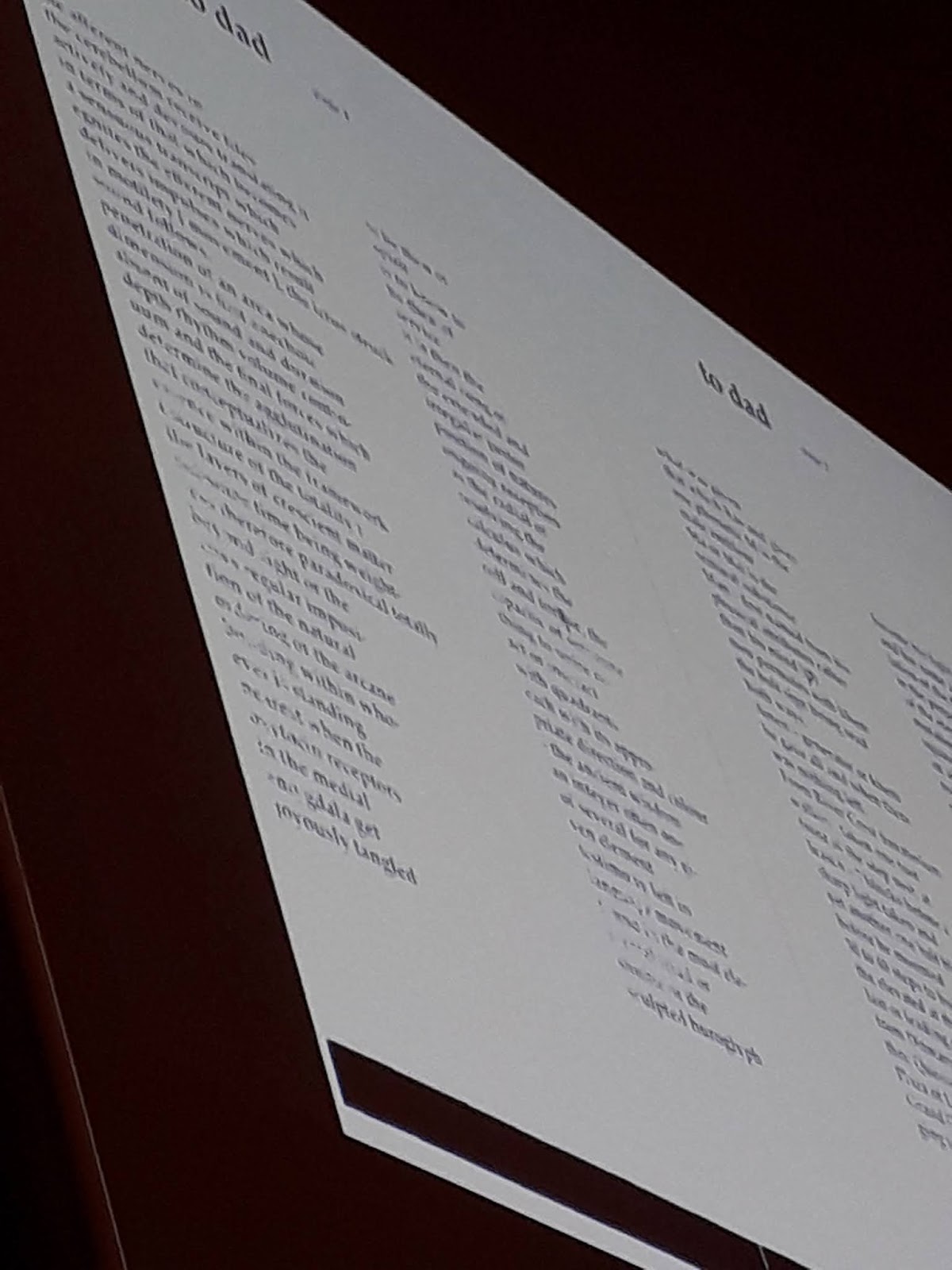
The standout out of all the pieces we heard and saw from The Book was perhaps the piece simply called ‘To Dad’, a moving reminiscence of Taylor’s father, and a meditation on (literal) biology and familial lineage as emotional, social, and biological, and, ultimately, on the “paradoxical totality” of what a person is, what the soul is. It made sense of a lot of the references to biology in the late work as heard on bootlegs, live performances and the like – a rare fusion of inter-personal, intimate connection with the ‘abstract’ registers of scientific discourse. The poem presented Taylor’s father – here described as a “Southern oracle”, who, as Taylor remarks elsewhere, was a storehouse of oral tradition, of song, and who supported Taylor financially after the death of Taylor’s mother and while Taylor struggled to make ends meet in the early stages of his career – after he’d ended up at the Rivercrest Sanatorium: as the poem had it, having given all he had until there was nothing left. It centred on a description of trying to walk through New York, changing trains, his walk inflected by a life of labour, and made all the stronger Taylor’s own seeking to liberate the body through performance, music dance. Body attitude, body gesture, these are not abstract categories, but ways of responding to, surviving, challenging the dread and drudge of the work routine, of exploitation and misery, and the apparently esoteric or ‘intellectual’ content of Taylor’s work shouldn’t blind us to this.
(Above) ‘To Dad’ from The Book (unpublished); manuscript page of the text to Chinampas (1987)
A few pieces from The Book, such as ‘Abata’ and ‘Before Time’ were recognisable from similar bootlegs (this 2007 performance, for instance) but most of the texts were brand new to me. Though much of this is still speculation, one thread emerging here was that, often, there simply wasn’t a single, stable text for a poem. Moten noted how, when Taylor read, he’d hold up one piece of paper written on from several angles, treating a single page as a book in itself. The Book, then,is more than a book, intrinsically related to a CD recording of its poems; and any release of Taylor’s writings would have to reckon, not only with the disorderly state of the archive, but with the fact that these often handwritten manuscripts were scores for performance—that the discovery Moten and Edwards presented of (some of) the pages of the first poem from Chinampas are not the holy grail, not ‘the poem’ itself. As Moten noted, the recording is the poem: Taylor deliberately didn’t print the poems in the liner notes to his one poetry record. Against duality, binaries, Taylor wants to see it all as a totality. This said, Moten and Edwards briefly alluded to the fact that they, along with Chris Funkhouser, are to edit several volumes of Taylor’s work in print: it’s likely that one of these might be The Book, along with a Reader of the uncollected work that does exist in print, long in the making, and perhaps an annotated copy of a book by poet David Henderson. Due to the complications of the estate, this might take a few years, but it’s at least on the horizon. [Day 2] Concert: Matthew Shipp / William Parker / Andrew Cyrille
Thursday, October 24th, Elebash Recital Hall, CUNY Graduate Center
The second night relocated a few doors down the same building to the Elebash Recital Center for a trio performance by Matthew Shipp (piano), William Parker (bass) and Andrew Cyrille (drums). Cyrille – with Taylor’s late-1960s and earlier 1970s Units – and Parker – a long-term collaborator later in the Taylor’s career, notably in the Feel Trio with Tony Oxley, were two of Taylor’s most important collaborators; each musician gave a short talk on what Taylor’s music had meant to them. In fact, over the course of the conference as a whole, Cyrille turned out to be the only musician who’d worked closely with Taylor heard from at length, in a spontaneous narration of his time with Taylor, playing in front of artworks by Miro, touring Europe. “We could play for two hours straight – just blasting – just taking off”. Those metaphors of jet-propelled, rocket travel, of flight, are common ways to figure the intense energy of this music of course – at the same time, and against the stereotype of ‘free jazz’ as ‘angry’ or ‘disturbed’, Cyrille emphasized the healing dimension of this music. Playing with Cecil got easier and easier, he noted – at times he felt as if he were floating on a cloud, the experience therapeutic and restful, looking at each other and laughing and having a good time.
In the performance itself, Cyrille was unbelievably crisp, his snare-drum rolling out loud into the auditorium, his timing utterly precise, combined with a melodic sense of tuning and placement – he could play a whole gig on just snare and hi-hat, the key instruments in his kit. Shipp didn’t try to be Cecil, his a more lugubrious, dogged insistence, stabbing out two-handed chords along with free-bop runs that emphasized their own virtuosity, Parker’s arco bass smearing, sliding and bending the string. From the opening, AACM-like spaciousness, as Cyrille’s triangle rang out into the auditorium, to passages of collective, melodic insistence, this was fine stuff.
[Day 3] Papers / Concert
Friday, October 25th, Elebash Recital Hall
The first day of papers took place in the same building. A panel on Taylor’s early developmentlaid some useful ground in challenging certain long-held presumptions in the way Cecil’s work has been framed, even by well-meaning critics. For instance, Christopher Meeder’s paper on Taylor’s training at the New York Conservatory and the New England Conservatory of Music fills in some of the gaps in Taylor’s own account rendered in A.B. Spellman’s Four Lives in the Bebop Business (further work has also been done independently by Allan Chase, and can be found online). “Your music is mood music”, a member of faculty apparently told him. “That’s OK as long as it’s not Mood Indigo”. Fitting into neither the model for classical composition – due to his race – nor for ‘popular’ music – his conception already moving in the direction of the avant-garde – Taylor was stuck arranging music for toothpaste commercials. Having escaped these sort of presumptions and beginning to make his way in the jazz world, Taylor still faced well- or badly-intentioned misinterpretation. Lewis Porter’s presentation of a 1959 interview with a Swedish journalist – Taylor’s first – initiated an important topic of discussion that would recur throughout the conference: that an interview is another performance in which the musician seeks to frame themselves, sometimes in contradistinction to the framings imposed by the journalist, for the implied public to whom they must present a certain face. This conversation was continued by Matthias Mushinski’s paper from the same panel on Taylor’s reception in Jazz-Hot magazine and the role of leftist French journalists of the 1960s as ‘participant-observers’ in the New York jazz scene (the next day, Dominic Lash’s paper on the documentary on Taylor produced as part of Luc Ferrari’s ORTF series Les Grandes Répétitions, ‘The Other Side of the Tracks’, extended this to the realm of film.) This sort of work can sometimes seem excessively detailed – exhuming student correspondence, attendance records, and the like – but following the paper trail in this way is necessary in order to challenge the ill-informed characterisations of Taylor mentioned at the start of this report. As one audience member said, listeners and critics tend to hear any sort of dissonance as invoking “modern classical” – but of course there are as many varieties of dissonance as there are of consonance, and no one says that consonance, or western harmony, is limited to any one genre…
Fumi Okiji, in the first extended paper of the day, extended some of the theoretical concerns that inform her first book, Jazz as Critique: Adorno and Black Expression Revisited (2018), which turns Theodor Adorno’s notoriously anti-jazz aesthetic theory against itself, using it as a way to explore jazz’s contribution to the history of freedom and the history of music in general. Against a loop of Billie Holiday’s arm, picking up from the cues laid in Taylor’s poem ‘Sound Structure Of Subculture Becoming Major Breath / Naked Fire Gesture’ –“As a gesture Jazz became: Billie’s right arm bent at breast moving as light touch” – Okiji picked up on notions of correspondence and community through the notion of the fragment and non-identity, the principal theorist here Adorno’s friend and Frankfurt School colleague Walter Benjamin rather than Adorno himself. Like a number of the papers, the force of this piece came through as much from its at times prose-poetic style as through the more analytically-argued papers seen on other panels, but a number of very suggestive threads were laid, gestures of their own.
The second panel developed the notion of ‘gesture’ first mentioned in Okiji’s paper in a variety of ways: Chris Stover through an analysis of Taylor’s early readings of standards, in which he suggested that the musical syntax later developed in more characteristic form
in Taylor’s own compositions was already developed in these early performances; Anthony Caulkins, through some diagrammatic visualisation of Taylor’s ‘gesture-classes’ and ‘gesture flow’ ; while John Rufo – himself a poet – focussed in less analytic fashion on Taylor’s controversial 1978 collaboration with Mary Lou Williams, Embraced,, and what it might have to tell us about the principle of collaboration, solidarity and the like not only within musical contexts but political / activist ones too. In a sense, what mattered here was not so much the accuracy of the observations – Benjamin Givan has written an exhaustive and thoroughly-researched essay on this encounter (seeds laid in the Williams chapter from Brent Hayes Edwards’s Epistrophies: Jazz and the Literary Imagination) which would seem to be pretty much the definitive word in scholarly terms – but for the metaphoric extension to politics, for the undoubted political valency that lies within Taylor’s theorisation of improvisation and collaboration within the musical ensemble.
The third panel offered primarily artistic responses to Taylor’s work – Jeff T. Johnson live-typing a poem / essay along to Taylor’s Indent as part of a digital poetics project; Charles Sharp rather strangely juxtaposing the philosophy of Hans-Georg Gadamer with a slowed-down version of a Taylor piano solo; Magdalena Dukiewicz discussing her own self-decomposing sculptural works alongside the organic-synthetic decay of the cover to Taylor’s Solo (1973) – though frustratingly, she didn’t mentioned the artist who produced this cover art, along with Taylor’s other release on the Japanese Trio Records, Akisakila, Hiroshi Sato (I can find very little information about Sato and would like to know more). Finally, Scott Gleason’s talk focussed not so much on Taylor, but on the visual artwork of Morgan O’Hara, whose drawings of musicians’ hands literalize and fix the questions of gesture (Taylor being one of the artists who were O’Hara’s subjects). After a break, the day’s second keynote saw musician and writer David Grubbs extrapolate some more ways into Taylor’s poetry, principally through the lens of a poem that Taylor read at the ceremony for conferment of an honorary degree at Brooklyn College in 2012 (where he was patronisingly introduced as someone who’d played with “Johnny Coltrane”), at which he read an untitled poem “in appreciation and for the moment we are surrounded by these beautiful trees…” (See video below.) The poem begins “it leans within the scented parabola”, and Grubb’s paper nicely curved around the questions of performance, utterance, speech and music also explored in his own book-length prose poem, Now that the Audience is Assembled (2018).
The evening concert, given the rather grandiose title ‘In Sonic Discourse with Cecil Taylor’s Unit Structures’, and taking place once more in the Elebash Auditorium, was a more mixed affair than the previous day’s Shipp-Cyrille-Parker set, in general straying closer to a contemporary classical vocabulary. The piece most likely to have stuck in audience minds was the ‘anti-fascist action’ by Black Bloc-masked group Mayakov+sky who bashed and sawed away at both grand and upright pianos, violin and electronics, as well as showering the audience with slogans-as-confetti (“housing for all or the city will fall”, “#deathtocapital”); it may not have resonated much with Taylor’s own performance or music aesthetic, but provided an unexpected detour at least. Lewis Porter presented solo piano improvisations of his own on material from Taylor’s Unit Structures, in general trading a more conventionally jazz-based vocabulary than Taylor’s own. That’s not meant as a criticism – indeed, Taylor’s improvising style and personal musical vocabulary seem so linked to his own compositions that it’s hard to imagine anyone playing them outside the context of his own bands. (The only examples that come to mind are Steve Lacy’s very early recording of Taylor’s ‘Air’ in the 1960s, and Mal Waldron’s ‘Variations on a theme by Cecil Taylor’ from Update (1987).) Porter, then, interestingly presented the little-explored notion of Taylor’s own compositions becoming something like standards in the hands of those who musical vocabulary is very different. Of the remaining pieces, Chris Stover’s ‘Four Assemblages’ was a fairly muted piece of chamber music with echoes of the unison grandeur of Taylor’s own composed themes; and Sandow Sinai’s ‘Anacrusis’(which I missed, turning up slightly late) likened the titular figure – the pause before note or poetic syllable, a notion explored as a structuring concept in Taylor’s Unit Structures – to the process of coming out as a (trans)(gender) woman. To my mind, the best piece was that by conference organizer Yom – virtual space of air / reverse apocalypse, for piano (once again played by Sinai), flute and no-input mixing board feedback ‘breath’ sounds, the lengthy programme note riffing off unheard melodies, a number of poems by Taylor (“theory not of numbers / and quantity but of states […] existing before / the mathematical congregation / of abstract figures / which existed in nature”).
[Day 4] Papers / Concert
Buchwald Theater, Brooklyn College
The second day of papers moved to Brooklyn College, where, as Grubbs had reminded us, Taylor has read his “scented parabola” poem seven years before. This day was perhaps more focused on musicology: there were interesting talks on the day’s opening panelconcerning Taylor’s letter notation systems from Jeff Schwartz – noting how Taylor students Glenn Spearman and Marco Eneidi used Taylor’s letter notation as a means to set down, not only pieces by Taylor himself, but standards and their own material – and Scott Currie, who provided valuable participant insight into the Taylor piece he commissioned for the Sound Vision Orchestra in 2002, ‘With Blazing Eyes And Open’d Mouth.’ (A bootleg recording can be found here, and is quite something; images of excerpts from the score can be seen below.) Jessie Cox gave a more philosophically-minded paper which usefully linked Taylor’s work to Glissantian theories of créolité (particularly significant given Taylor’s interest in Haitian voodoo). And the panel was rounded off by what was perhaps the single most impressive work of scholarship of the whole conference, Mark Micchelli’s transcription and analysis of a solo performed by Taylor for the film Imagine the Sound (1981). Obviously, intricate readings of musical detail are not the only way to approach Taylor’s holistic conception, but this music is of such complexity that analysis does seem a necessary way in. The attention to pianism, to the role of physical gesture, was impressive here; having studied the filmed performance and experimented himself at the piano, Michelli noted, for instance, that Taylor had to shape his impossibly fast runs down the keyboard the way he did (striking notes with the side, rather than the tips of the fingers) because otherwise his knees and elbows would have hit the keyboard. Another angle on ‘gesture’, then: building on previously published analyses of Taylor’s solo music by Lynette Westendorf and Kaja Draksler, there’s much to be done here…
(Above) Images from Taylor's score With Blazing Eyes and Opened Mouth (2002) from Scott Currie's presentation.
After the break, Ben Young presented a lengthy ‘listening session’ in which he talked about the recordings that exist in the Taylor archive and played an excerpt from a late-1960s performance featuring the explosive tenor of the Reverend Frank Wright. This was part of a project of public listening which, for Young, is essential to continuing the legacy of this music one the musicians who played it are no longer around to deliver it live, as well as the lengthy process of researching and writing Taylor’s biography, about which there were understandably eager questions. It seems as if, as with the proposed volumes of Taylor’s poetry discussed by Moten and Edwards on the first day, we might have to wait a few more years yet…
The first afternoon panel focussed on voice, live presence, the personal dimensions of encounter. Jeanette Lambert raised the necessary spectre of misogyny within jazz performance context. Having taken part in a music workshop in the Canadian Rockies at which Taylor was visiting artist, she noticed how Taylor defended her against the misogynist abuse and harassment she’d received, linking his poetry, native Americans roots and queerness to his refusal to tolerate the macho behaviour of the white straight men. Taylor was, as any number of anecdotes will tell you, a difficult person, but Lambert’s story – as with Andrew Cyrille’s the night of the first concert – emphasized the other side, that of generosity and kindness. (Lambert’s own summary of her paper is here.) Chris Funkhouser played a collage of out-takes from his hugely important 1994 interview with Taylor on poetry, an edited version of which was printed in Nathaniel Mackey’s Hambone and has long been available online; one Taylor became many, the cadences of his speaking voice and the multiple tendrils (or what Edwards had called ‘efflorescences’) of his conversational style forming a pleasing weave. Dominic Lash’s previously-mentioned paper provided some useful analyses of Taylor’s film experience from both a musical and a Film Studies background – those questions of framing and gesture again coming to the fore (a shot of Andrew Cyrille with a metronome on his drumkit belying the notion that time in ‘free jazz’ is totally ‘free’). Finally, Chris Felver presented out-takes from his excellent Taylor documentary All the Notes, shot on and off the fly over a number of years: a genial and enthusiastic presence, this was one of the more purely enjoyable parts of the conference.
(Above) Andrew Cyrille with metronome...
The final panel of the day featured my own paper, on the centrality of Voodoo to Taylor’s poetry and aesthetics – rushed through on the day, a more considered version is imminently forthcoming in Bill Shoemaker’s journal Point of Departure (http://www.pointofdeparture.org/). Kehinde Alonge, currently a masters student at the University of Buffalo, likewise focused on Taylor’s poetry – principally the ways in which it gets framed through its printing in the liner notes to Taylor’s albums, against the context of Black musical collectives such as the Jazz Composer’s Guild and the role of musical and poetic socialities / collectivities as part of what he called the “hidden archive of blackness” that exists in and against the nexus of exploitation, commercialism and misunderstanding within which musicians like Taylor had no choice but to work. There were some wonderful turns of phrase here – the notion that a poet’s duty is to create language, working with the given to go beyond it – that will stick with me for some while, and it’ll be exciting to see how this scholarly work develops as part of Alonge’s broader graduate study.
The panel concluded, not with a paper, but a poetry reading. Steve Dalachinsky had originally been scheduled to read from his pamphlet of poems for Taylor, The Mantis, but sadly himself passed away a few months before the conference. An enormous presence on New York poetry and experimental jazz scenes, his absence was not so much filled as attested to in readings by Ammiel Alcalay, Elliott Levin, and Anne and Devin Waldman. Alcalay’s brief introductions usefully linked Taylor to the Olsonian ‘projective verse’ continuum, as well as to histories of racialised and classed labour which shouldn’t be left out of our readings of Taylor’s work. Alcalay’s own poems linked his own memories of New York labour and living with Taylor’s performances at venues such as the Five Spot. He also read from The Mantis, a kind of impressionistic form of poetic music criticism – Dalachinsky observing how Elvin Jones, in duo with Taylor, turned even his ‘fiercest moments’ to intimacy, or pleading “Let us remain locked to each other. / Let us remain”. Elliott Levin played saxophone and flute and also recited poems. Levin played in a number of Taylor’s large ensembles since meeting Taylor when the latter was artist-in-residence at Glassboro University in 1973; Taylor encouraged him to present poetry within the context of the music, and in 1988, when Levin wrote a poem in memory of his friend Kathy Chang, who’d self-immolated in protest at American foreign policy, Taylor allowed him to open a concert by reciting the poem while he danced in accompaniment. (Levin also tells this story here.) As with Jeanette Lambert’s paper, that more generous side to Taylor emerging again; a generosity returned when Levin wrote and played a flute solo to a semi-conscious Taylor, then on his death-bed. Levin played the piece again to close his set. Finally, Anne Waldman read – or rather, sang – from her manuscript Acousmatic, dedicated to Taylor, accompanied by her nephew, saxophonist Devin Waldman. As Waldman noted, she’d first met Taylor when her mother took her to see him perform in 1964, and she’d later invited him to read his poetry at the St Mark’s Poetry Project, her intention being to honour his poetry and to ensure that he was seen within that poetic history that Alcalay also emphasized. “Cecil! No death”.
(Above) Anne and Devin Waldman in performance; cover collage to Steve Dalachinsky, The Mantis (2009)
The force of Nahum Dmitri Chandler’s often moving keynote, delivered via skype from Japan, lay as much in the measured, near-glacial delivery as in the words themselves. It began as a meditation on friendship – Taylor and Chandler spent long hours together, and Chandler delivered a eulogy at his funeral – and on why Taylor might have chosen to turn to solo music – he had no Ellington orchestra of his own. (This is certainly true of the official record; that said, on this point, it was precisely access to large and willing ensembles that Taylor did have in the early 1970s when he had teaching appointments at Antioch College and the University of Wisconsin. Though this period is completely undocumented in the official discographies, archival discoveries in this field might reveal another dimension to Taylor’s large group music.) Chandler then detoured via Japanese architecture and the ‘cantilever spar cable-stayed bridge’ of Spanish structural engineer Santiago Calatrava, a particular obsession of Taylor’s – before ending with a reading of the title to Taylor’s solo record Air above Mountains (Buildings Within) its resonances with the Book of Corinthians and with Afro-Christian figurations of body and spirit in the context of slavery. For Chandler, Taylor’s poetry is a Dantean epic trying to get us out of hell – a characterisation which, along with the brutally humorous Ralph Ellison anecdote Chandler told in the questions – I haven’t been able to get out of my head since.
(Above) Nahum Dimitri Chandler.
The concluding event of the festival was a set in the same auditorium by big band led by Karen Borca, and featuring several participants from the festival and additional musicians who’d played with Taylor such as Levin, Ras Moshe Burnett and Bobby Zankel. Taught through a combination of Taylor’s letter notation scores and Borca’s own memories of playing the material, the band’s performance was based in charts from Taylor’s magisterial Winged Serpent (Sliding Quadrants) (1984). The band had little time to rehearse, and there was no Taylor to feed the band chunks of melody or streams of notes (Judging from accounts from those would could hear him on the stage itself, Mark Micchelli by provided an impressive parallel, but his performance was inaudible from the audience, despite the fact that in rehearsals he played with such energy that a key flow off the piano and one could see the piano lid almost levitate). The performance was dominated by the horns, with everyone playing at once more than solos per se, Borca cueing unison melodies, structured as unison monody or as simple counterpoint, grandiose and moving in a way unique to those Taylor ensemble melodies (of which he apparently wrote hundreds – Alex Ward provides a useful analysis of some of them here: ). However ragged the performance itself, moments were moving indeed, in large part due to those Taylor pieces. Do we call this aesthetic florid, Romantic, melodramatic, existential? Do we need to call it anything, except to note the way it moved everyone in the room to some other level, some other inner building in the basement air above mountains? (Above) Big band conducted by Karen Borca in compositions by Cecil Taylor.
It was fitting, in any case, that the festival found as much time for music as for scholarship, and this balance will be an important one to bear in mind if and when ‘Taylor studies’ takes off. We might bear in mind Ben Young’s comments on public listening sessions, at which interested listeners gather to listen to rare recordings, as the way we hear this music now that Taylor has passed, form one element; likewise, the musicological papers on or from those who’d studied with him might impact the music of others, and more work from his collaborators would be welcomed. Finally, aside from Levin in the poetry reading, Parker and Cyrille in the first evening concert, and Currie on Taylor’s Sound Vision Orchestra Piece, we didn’t hear that much from musicians who worked with Taylor, and there would no doubt be valuable insights to be gleaned here. (I have, for example, learned a lot from talking to Bobby Zankel about Taylor’s time at Wisconsin and Antioch in recent weeks.)
By the end of his career, Taylor had won a MacArthur ‘Genius’ grant, the Kyoto Prize, and many other prizes, grants and the like; he performed regularly, on good pianos, and received critical acclaim, even if his elements such as his use of poetry and dance, or the apparent influence of European avant-garde classical music on his style, continued to be widely misunderstood. Taylor’s late career stability – albeit one which was inevitably precarious, as his Brooklyn home was in frequent needs of repairs, which saw him swindled out of his Kyoto Prize money—has to be understood in context as a victory against the indifference, contempt, neglect and (sometimes) exploitative, patronising inclusion with which America treats its artists. After suffering an illness, Taylor told critic Ben Young “I’ve had to be invincible for some years now”, a statement poet-scholar Ammiel Alcalay picked up on as a key instance of what this context might mean. Take the work of other musicians from the same or slightly earlier generations than Taylor who did not make it as far as he did: not only the more famous instances of Charlie Parker, Billie Holiday and Bessie Smith, but Thelonious Monk (whose unorthodox style and personal eccentricities were often framed in similar ways to those of Taylor, and whose mental health issues went misdiagnosed, as he was forced to keep playing on seemingly endless tours of Europe and America), Mal Waldron, Holiday’s accompanist in the last years of her life, and himself subject to electroshock therapy, his breakdown so severe that he had to relearn the piano from his own records ; Coltrane, dead by 40 after years of addiction; and Albert Ayler, dead in the Hudson river at 34. Taylor’s legacy is so valuable because he managed to survive for so much longer than many of these musicians, at a cost we can perhaps hardly begin to imagine. And of course, to quote graffiti that sits behind Bill Dixon in Imagine the Sound, countless other “forgotten rebels died”. Yet, too, there’s William Parker’s more hopeful onstage claim during the second day concert: “we stop playing, but the music never stops”. There will always be more: more to do, more to say, but this was a fine start.
Cecil Taylor died last week, at the age of 89. I think a lot of people had been preparing for this moment for some time, the occasional appearances and cancelled performances representing a slow tailing-off after consistent concert activity for decades before (in recent years, especially with regular sparring partner Tony Oxley); a sense that Taylor was ill and that the fire was finally burning lower, or at least, more intermittently; the last performances characterised by a slower, more limpid lyricism – which had always been there, but more often juxtaposed with those characteristic Taylor fireworks, those extreme instances of virtuosity that rendered him the most relentless and exciting and full of ideas of almost any musician, ever…
A couple of years ago, after Taylor had performed at the funeral of Ornette Coleman, another of that generation of pioneers of the late 1950s and early 1960s, I wrote down a dream.
CT was doing what may be a final performance, in some sort of large genteel university room. There was a really large group and I was really stoked and moved to see this valedictory thing. they started off by playing the piece “Taht” from Winged Serpent, but as they went on, I noticed that CT himself, though he was initially there, was no longer sitting at the piano and had disappeared. There was a team of other pianists, deputizing, some of them also adorned with various little instruments, whistles, recorders, etc. The overall feel of it was intensely sorrowful, like something enormous and beautiful and necessary had been lost and would never be captured again.
What can you say. Taylor’s music has changed (“changed utterly”) my listening life – my life itself, perhaps – in more ways than most. At times of concentrated listening, I can think of nothing else like it, nothing else as nourishing and beautiful and complex, music that can and should and does seem to go on forever, thinking and emotion and speed and a gorgeous, overwhelming intensity of purpose, of group concentration, communication, interaction, interconnection, conjunction, contradiction – all those adjectives, those nouns, don’t go there. I wrote about Taylor’s poetry for an MA dissertation some years back, and got deep into that as well. (Often the only way his poems are accessible, given the sparse publication record, are on live performances, and I made a stab at transcribing those – probably virtually impossible for the musical performances…) Those twin things are what I want to get down here – and again, what can you say, never enough, never more than a scattering of enthusiasms, but the gift keeps on giving, the vast discography, so much still to be said. What I thought I’d do was to provide a brief index of highlights and favourites, some of them more obscure, from the music, then go on to the poetry in a second part post. Of course, providing examples in this way risks becoming simply a by-the-numbers enumeration – a list of records, when each one in reality was a small volcanic explosion, an eruption into the atmosphere which might utterly change anyone who heard it. There are no bad Taylor records, pretty much, if we judge them on any other standards than those his own music so relentlessly and consistently establishes -- each one of them manifesting utter commitment, grace, poise, ferocity, intensity, all those adjectives critics fumble for, his piano running ahead of them in flurries and runs and clusters and sudden dropped chords of astonishing, heart-stopping beauty.
Bearing in mind too, this advice from the Taylor documentary All the Notes:
It's fun, if you don't let them make you write-all-this-stuff-down-forever, when all that shit'll drive you mad. Cause that's not fun, and everything should be fun, it should be a celebration of life.
Or, as Pheeroan Ak-Laff puts it, Taylor’s enormous appetite for knowledge, enacted and embodied in performance, “made mincemeat of the mere intellectual”; made mincemeat of body-mind dualism, of the imperial trajectories of western thought. Someone writes somewhere that each of Taylor’s notes is a monolith; someone else calls each of his notes a continent; a world. Some of those worlds below.
Early Taylor: This Nearly Was Mine
Taylor’s early records are of course awkward in the sense that, while his style is beginning to properly form out of Brubeck (passed beyond, after watching Brubeck on a double-bill with Horace Silver, copping his licks, as recounted in the invaluable interview with A.B. Spellman for the book Four Lives in the Be-Bop Business), Monk (a different room in the monastery), Bud Powell (the scene changing), he’s often cramped by the rhythmic straightness of the hard-bop/bop continuum he’s forced to work within (Ornette got over this by getting rid of the chordal instruments – no comping! But Taylor was the chordal instrument…Let alone having to play “tunes”). Taylor had played with saxophonists before – Steve Lacy’s tartly cool soprano; a slightly mis-matched post-bop date, set up by others, which catches him with Coltrane perhaps before the latter was quite ready (imagine the collaboration a little further down the line!); and a bit later, CT would sometimes play in informal settings with Albert Ayler (one precious, 20-minute recording survives on the massive Holy Ghost box-set). But I think it’s really when Archie Shepp, himself a rookie out of blues / R&B and the new influence of Coltrane, comes into the picture, that things really get interesting. I know a lot of people think Shepp’s a little awkward here, but for me, especially when he’s paired with Jimmy Lyons, there’s a rough and smooth, sweet and sour combination that’s later echoed by the Jimmy Lyons / David S. Ware combo of the late 1970s CT Unit and that really gels with Taylor’s melodic and ensemble conceptions. One of my favourite performances from this era – and one I’ve noticed cropping up on a number of other tributes as well – is the near-15-minute take on Richard Rodgers’ musical chestnut “This Nearly Was Mine”, a kind of lolling, lollop-ing, languorous, passionate, utterly, utterly gorgeous stretching-out, Shepp in perfect sardonic melancholic mood, Cecil rolling through on that same melodic stream.
Into the Hot
Into the Hot is a great, great album; released, confusingly, on a split album with the John Carisi ensemble (as Amiri Baraka put it in his review, “cool progressive”), credited to Gil Evans, who appears on the front cover in an obvious cash-in on his own Out of the Cool, but who by all accounts barely even produced the record. (The tracks were reissued, more sensibly, alongside a side by Roswell Rudd, later on in the 60s.) Three pieces, Lyons and Shepp, a real compositional sense, arranged, really, classic avant-garde big-band, careful and full of emotion, just perfect pieces, lessons for how to do jazz composition without the tricksy twiddlings of the Third Stream. There are moments, especially on “Bulbs”, of absolutely heart-stopping beauty, that rich stream of emotion Taylor could tap and which could not always – could almost never – be tied to a single adjective, containing multitudes.
Conquistador
The Café Montmartre recordings in the trio with Lyons and Sunny Murray were obviously a massive breakthrough – Nefertiti, The Beautiful One Has Come, those long, long work-outs where Taylor seems to be taking “comping” to a whole new level (as Monk did) – and then the mostly unrecorded participation in the October Revolution in Jazz, The Jazz Composers’ Guild and the militant democratisation and self-organisation of New York’s free jazz musicians. As Taylor puts it in the opening chapter to A.B. Spellman’s Four Lives – which is still the best economic insight into the music, and vital for explaining Taylor’s subsequent trajectory – to the academy (briefly – his orchestral conception in the 1970s definitely developed from his regular workshopping with students at Antioch, and you hear this influence too in a recording release by Jemeel Moondoc’s Muntu from around this time), and to Europe (where the pianos were at least better, and the Mafia itself was not involved in jazz clubs, even if rip-off merchant agents and promoters abounded). As Taylor puts it there:
That's what the Jazz Composers' Guild was all about. We had hoped to get together and to try to make conditions that were more the way we felt would benefit the musicians and, like, not necessarily the gangsters that we usually have to deal with.
So this is where Bill Dixon comes in. (*see below) Conquistador, on Blue Note, Dixon as part of a band including two basses (Alan Silva and Henry Grimes), Andrew Cyrille, Lyons on alto. These are new compositions, two of them, perhaps more jazz-inflected than Unit Structures from the same period (US and Conquistador were Taylor’s first recordings for four entire years…US is less percussive, more intricate, chamber-textures – this partly due to the “avant-classical” sound of Ken McIntyre’s oboe – and the limpid strangeness of “Enter, Evening” has few parallels in Taylor’s work). On Conquistador, things build to a new, ecstatic energy, and might be seen as the bridge between the orchestral conception developed on Into the Hot and the later music of the Cecil Taylor Unit.
This is I think, still my favourite Taylor record. Of course, a lot of this is to do with first acquaintance – the way something sticks as the first time you encountered an artist whose work would change life, to the extent that I can’t imagine a life in listening without Cecil’s music there, nor, really, the first time I heard it as a moment of revelation – I think it may have been Conquistador on college radio, though, definitely Conquistador was early. And still, the moment when the second theme on the title track comes in, about six minutes into the track, may still be one of the most exhilarating moments of all time in music, the way the unison melody surges out over Silva's and Grimes' vertiginous doubled-basses, like wings lifting the rest of the music – light and heavy at the same time, exemplary of Taylor’s melodic gift, capacity for ensemble mobilisation, and the transformative lift his music could make: gravity and grace at the same time.
(*Dixon played an unreleased duo with Taylor in 1992 – there are, needless to say, bootlegs – and then there’s the late album in trio with Tony Oxley, a live performance from Victoriaville is one of the sparsest albums in the entire Taylor discography, and it’s telling of the respect in which Taylor must have held Dixon that it’s Dixon’s processed, echoing trumpet that dominates; usually, at this stage, Taylor’s collaborators were along for the ride, riding the wave of Taylor’s established re-juxtapositions, re-combinations, pattern-playing, but here, things are open in a strange and surprising way. Needless to say, critics were not impressed.)
“The orchestration of one man’s piano” (Taylor / JCO)
The later 1960s were a time of transition. Remember, Taylor had barely been able to perform during the earlier part of the 1960s, helping Joe Termini’s the Five Spot to become the hotbed of the hip cognoscenti, but unable to sustain a long-term booking there, reduced to washing dishes, lacking the time and the space to develop his conception (compare to any number of classical pianists providing the umpteenth version of a Mozart sonata…) This sense of frustration is well-captured in the Spellman book – released in 1966, it catches Taylor on a cusp, having signed for Blue Note (a label with some clout), but increasingly looking towards Europe. Out of the initiatives which saw things like the JCO and the October Revolution had brought musicians together, and several large-group experiments resulted. Of the free jazz greats, it was perhaps Sam Rivers (and later, Braxton and Henry Threadgill) who would really develop the big-band as a medium; but the JCO, formed by Mantler and Carla Bley out of the JCG, released a fine album of what are essentially concertos for various soloists by Mantler entitled Communcations. Mantler’s charts, as on most of the other pieces, are gnarly, punchy, serving as swelling crescendo and riff punctuation for Taylor to give full rein to his virtosity. The charts have a kind of doomy heaviness to them; this is probably one of Taylor’s noisiest and most exhilarating recordings, a true piano concerto. Mantler calls it “the orchestration of one man’s piano”, and when that piano is already an orchestra in itself, and the orchestra in question has twenty musicians – no less than FIVE bass players – and when some of them include Gato Barbieri, Lyons, Cyrille, well…
The late 60s into the early 70s: Europe / Antioch College
Around this time, given the economic situation, Taylor increasingly began to perform in Europe, on often-exhausting tours, and to develop the Unit music with Lyons, Sam Rivers and drummer Andrew Cyrille (documentation of this in a live performance from Paris in 1969, and the documentary produced for Luc Ferrari’s series on avant-garde music, Les Grands Repetitions, broadcast on French TV, which features footage of the Unit rehearsing in what appears to be an old chateau in 1967). Student Studies is one of the more intriguing items from this period, recorded in 1966 but unreleased until 1973. This sees perhaps the first recorded appearance of “the lick” (see below), and also a kind of interestingly glacial, slowed-down version of the compositions Taylor would play with the newer version of the Unit in the later 1960s. Listen to how responsive Cyrille’s drumming is here – such crisp snare! – and Lyons’ almost sardonic delivery of the melodic lines – the pauses giving the music a real tension, a patient building – this, it strikes me, may be due to the extremely reverberant acoustic they’re playing in – maybe they had to let the phrases hang out at first. In either case, the slowed-down approach (at first at least) allows us to hear the logics behind what would be played at much more furious pace later on, and the music feels, in a sense, more open – there are passages approaching atonality, Silva’s bass is loud and singing, Cyrille is totally on it, open yet precise, Lyons is Lyons – this feels like real, collaborative endeavour, within a heavily-rehearsed, composed framework. Shit, in its use of space, it's almost psychedelic...
(Student Studies)
(Les Grands Repetitions)
It was also at around this time that Taylor also began to perform solo. He taught at Antioch College from 1969 to 1973, which gave him a much-needed opportunity to hone his conception – adequate rehearsal time, access to instruments, and to a steady stream of talented students who formed parts of large rehearsal bands. Though his students were not as starry, this time arguably parallels what, some years later, what Anthony Braxton would do at Wesleyan. Sadly, much of this work is unrecorded (or at least, buried deep in the Taylor archive). From the Antioch period come recordings like the solo Indent; Japanese recordings with the Unit (Akisailka) and solo once more; Taylor also started up his own label, Unit Core, who released a split solo / Unit platter calledSpring of Two Blue J-s, which I’ll discus more in the poetry post. Each one of these recordings is great, and the solo music in particular is caught at a fast pace of development which might become a little more stabilized later on. My favourite is maybe the solo from Japan, just over half-an hour in length, but pretty much a perfect encapsulation of this stage of the solo playing. Two tracks in particular carry through the years: “Asapk in Ame” (full of "the lick", which we’ll return to below), and the more melancholy side of things slipping through on “Lono”.
Piano-on-Piano, Mark 1: Friedrich Gulda
Perhaps a curiosity, but one I’m fond of: this a short duet between Friederich Gulda and Taylor, recorded at Moosham Castle, Austria, in 1976. (Taylor's solo 'Air Above Mountains' was recorded at the same location.) The rest of the album finds Gulda, better known as a classical pianist, freely improvising with Albert Mangesldorff, Barre Philips, John Surman, Stu Martin and Ursula Anders (I think Taylor may also be involved, but don’t quite recall…) Telling, of course, that the youtube comments criticise Taylor for “not being able to play Mozart” while Gulda “could play jazz”. The beneficence. While Gulda had some jazz chops, what’s interesting about this collab is the territory they take – the motoric low-end figures, based on staggered explosion and release, that Taylor was exploring a lot in his solo work, become even more jittery when echoed and amplified by Gulda – at times it sounds like Gulda is doubling Taylor, a weird kind of stereo-matching or mapping or mis-matching effect. It’s certainly sparky – in fact, the few piano-on-piano collaborations Taylor made, far from crowding each other out, tend to create a nice contrast: of course the Mary Lou Williams performance addressed below is controversial, but there’s also a late film of a collaboration with Taylor devotee Yosuke Yamashita (probably one of the best of Taylor’s imitators, and one with a broader conception than that, in the “total piano” style of someone like Don Pullen or Jaki Byard).
Piano-on-Piano, Mark 2: Ayizan
Embraced: billed as an encounter; a meeting of generations, between Taylor and Mary Lou Williams, this album is often seen as one of the lesser-items in Taylor’s discography, as a kind of failed experiment. And that language of embracing is perhaps encapsulated as much in the poems (“Choir” and “Langage” – two of Taylor’s best) that are printed in the liner notes, as in the music itself. Carnegie Hall was booked, the concert was widely-billed – Taylor apparently doing a lot of persuading for Williams to feel comfortable. Williams wanted Taylor to play written music which moved through the history of jazz, from boogie-woogie to free, but Taylor preferred to improvise in his own fashion; what emerges, with Williams backed by more straight-ahead be-bop musicians, is sometimes awkward, rhythmic fixity underneath torrents of notes. And the concert and the resulting album were controversial as an apparently confrontational merging of styles that belied its title, and Williams herself wrote to Taylor that “being angry you created monotony, corruption and noise.” (See Linda Dahl’s biography of Williams for the full account). Yet this encounter is instructive in a number of ways as more than a case of simple communicative failure. As an encounter between members of successive avant-garde traditions, a flamboyant gay man and a woman in a male-dominated field, in particular – and, musically, sometimes, as on this track, “Ayizan”, it can gel all the more beautifully for the moments of ill-fit; when Williams’ own gnarlier tendencies off-set Taylor’s, or mesh with his balladry, it feels achieved.
Petals: The Late 1970s unit
It’s in the late 1970s that the Unit reaches its peak: first, with the version from 1976, featuring tenor player David S. Ware and the similarly powerful Marc Edwards –documented on what seems to be any people’s favourite Cecil album, Dark to Themselves, and on some absolutely incredible bootlegs from the same period. Ware is in the role that Archie Shepp fulfilled on the earlier records like Into the Hot, to inject some fire alongside Lyons’ as “straight” man (read, slippery, endlessly sliding away from the proposed, to use Baraka’s phrase of John Tchicai). It’s a performance by this group from a (quite well-recorded radio broadcast) bootleg at the aptly-named Power Centre, University of Michigan, in 1978 that provides their finest hour: a piece called “Petals”, different to the piece o the same name on the solo concert Silent Tongues, and as far as I can tell, not recorded on any official releases. From the announcement, it sounds like this might have been a first performance – Taylor says “Petals, just once through” – which intriguingly suggests that the repetitions of the melody were actually written as part of the composition. It’s not a “head” repeated twice, but a vital part of how it’s structured. The melody has that that lift I mentioned earlier in relation to Conquistador: the ostinato “James Brown shit” of the piano left-hand, the horns unison singing out over the top, the emotional shift, hard to characterise, from hopeful assertion to a kind of almost sardonic resolve in the melody’s second part. Then Marc Edwards’ powerful drumming, the contrast between Lyons and Ware – someone should release the Power Centre performance for absolute sure.
One Too Many Salty Swift…
The next instance of the Unit takes shape around 1978 (if we’re going by the official discographies), and features CT and Lyons with Ramsey Ameen on violin, Raphe Malik trumpet, Lyons, Sirone and Ronald Shannon Jackson giving it a funk edge. Resulting records include One Too Many Salty Swift and Not Goodbye, from HatHut, and two more compositional records for New World Records: the self-titled Cecil Taylor Unit, and the totally astonishing Three Phasis. As Phil Freeman notes in a piece on the 1978 unit, One Too Many Salty Swift, the last in the leg of a European tour, building its energy from the disrespect of promoters who refused to let Taylor use the grand piano reserved for classical pianists (who would have used about half the resources of the instrument that Taylor regularly exhorted from it), takes its time to build, in a series of staged duos between group members, but then, when the full unit plays collectively, reaches such sustained plateaus of intensity (plateaus, not waves – this terminology I think coming from a discussion I had years ago with the pianist Alexander Hawkins, one which helped to shape the way I understood Taylor’s structures no end), that it can almost be unbearable – you feel like you might leave your body, you don’t know how the musicians themselves sustained this kind of peak, night after night, let alone the listener processing or not processing this absolute information density. Truly ex-stasis (the title of a late Taylor body), group being transporting, within the body, out of the body, within the individual, out of the individual…
Solo
Tayor solo seems to be some people’s favourite. And it’s a strain of the music that forms a parallel to the group work, something of an equal focus, particularly as time went on (and, of course, it’s cheaper for promoters to pay one musician that an entire group, let alone rehearsal time…) There are some amazing records that emerged from this, and Taylor solo is, needless to say, like no one else solo. Yet, though astonishing in itself, I always feel that the richness of texture and density found in the Unit music is what I always come back to, what I always find the most sustaining – the compositional mindset, that structural way of thinking, is clearer in the solo work. The early solo material is in some ways my favourite, before Taylor settled into achievements of style (late style?), the same licks and patterns recurring from performance to performances. Carmen with Rings, which I believe might be his first solo performance in public ever, or at least the first recorded one, is surprising in that regard – closer to atonality (this from the student studies phase, also Unit Structures, where Cecil’s music is leaner, more angular, less suffused with ripe melodicism, fascinatingly barbed and spiky) – also an album released I believe on a Greek label,Praxis. Silent Tongues is clearly great; Air Above Mountains; the shorter, more concise pieces on Fly! Fly! Fly! Fly! Fly!; an earlier solo record from Japan in 1973; For Olim, from the late 1980s; The Willisau Concert, on the turn of the millennium, on which the lower note register of the Bosendorfer grand on which he insisted later in his career are really exploited to the full. But my favourite is still Garden, a double album alternating between longer and shorter pieces. There’s a six-minute or so piece here, Pemmican, which may just be the greatest thing he ever recorded. It contains a chord that Vijay Iyer says changed his life.
One chord he plays changed my life. It’s in the middle of the head, 1 minute in (and recurs on the repeat) – an A octave in the bass, and a B, G, B in the right hand. Andrew Hill also favored such a voicing, as in the piece “Subterfuge” on Black Fire. It’s a mysterious and spectral sound, stable and yet void, an anti-chord. When I first figured out what it was, it was like peering into the abyss.
I don’t think that’s an exaggeration. This is probably the most exquisite solo piece Taylor recorded, and it’s six-minute length – typical of the “ballad sections” he’d often deploy in performances fro the 1970s on – encapsulates his compositional-improvisational thinking, in “layers” as he calls them, abyss to astral…Pemmican is food for the journey, nourishment – a Native American word, Taylor has Native American ancestry. Survival food, survival music. Structurally, the piece is fascinating – elements held in suspension, in juxtaposition, in parallel, not so much ‘progress’ and ‘development’ but the alternation of expertly-moved blocks, what Taylor might call “cells” or “units”. Vertical organisation rather than horizontal, as I’ve heard some people call it. But it’s far from a dry technical exercises -- emotionally, what it’s “mood” exactly is, or how it could be described is complex. Melancholy is the word everyone uses, and it has that, but the pleasure of it too – lament, sorrow too deep for tears, restraint – words don’t go there.
Carrying on from the Unit of the late 1970s, the early-mid 1980s was largely a large-group phase: records like It is in the Brewing Luminous, The Orchestra of Two Continents with Borca, Rava, Stanko, Tchicai, Frank Wright, et al; much work with dancers, Rashid and Brenda Bakr (the latter’s vocals and poetic contributions really bringing out this element of Taylor’s work). This saw some of Taylor's most developed orchestral music (much of it which went unrecorded, given reports of large groups), and late on saw him with the Italian Instabile Orchestra and leading a few big bands in club residencies, sadly mostly unrecorded.
Here’s a video of the “Orchestra of Two Continents” – notably not styled as the “Unit”, suggesting maybe that the Unit is conceived of as a smallish ensemble (say, five to eight members), while Taylor’s big band / orchestral conception embodies a slightly different mode of thinking of organization (maybe more akin to Mingus’ Workshop groups). This is a smaller version of the big band that plays on Winged Serpents, and I think they're playing some of the same tunes (the first piece is the one that's called “Taht” on that album). Some really wonderful moments – especially at the end, where the applause comes in and then they all start vocalizing while Cecil does this amazing camp dance with what appears to be a shopping bag – and then Jimmy Lyons is the only person left making noise, whispering some words into the microphone, before Frank Wright whispers into his ear, I guess that Cecil's finally disappeared off stage, and he walks off – something really beautiful and sad about that moment, I guess because Lyons would die soon and there seems something apposite about him being left there, having the last word. Karen Borca's bassoon playing is something else – check out the extended solo 20 minutes or so in – how someone can get sounds like that of the instrument is hard to fathom, and the invention, as with Lyons’, seems just fucking ceaseless – John Tchicai gets in some shudderingly ferocious tenor and some great joyous vocals, there's something I love too about that unison passages where they're playing those characteristic Cecil melodies, almost classic big-band style, playing off the soloist, or the soloist playing off them, Cecil really laying in, palms and elbows all over the keyboard...
Jimmy Lyons: The Transition
In 1986, Jimmy Lyons died of lung cancer. His collaboration with Lyons had been the closest musical relationship of Taylor’s entire career, lasting over 25 years; for Taylor, Lyons was like Danny Richmond was to Charles Mingus, a corner-stone, unobtrusive, a totally individual stylist, but one equally happy to keep things crackling from a totally non-grandstanding position, neither background nor foreground, but absolutely indispensable to things, without whom the whole structure could collapse, or simply meander. In terms of his own playing, Charlie Parker entering the free-jazz age is the usual comparison, but that absolutely doesn’t do justice to things: totally alive with melodic invention, never stale, always surprising and fresh (check his solo career – the album with Lester Bowie, Other Afternoons, or the amazing groups he led with his wife, the aforementioned bassoon player extraordinaire Karen Borca), Lyons was the link between Taylor and the band, transmitting ideas, solfege, internalising the way both the melodic structures and the broader compositional frameworks of Taylor’s Unit music could incorporate discipline and wild, far-out improvisational openness. Though Taylor taught the entire band the materials, it seems that it was Lyons who really helped in transmitting those ideas – think of the way it’s always him who introduces the luxuriant melodic ‘heads’ on ‘3 Phasis’ and the 1978 ‘Cecil Taylor Unit’ recording). Without Lyons, I doubt we’d have reached the peaks of the late ’70s Unit, where performances would last for over two hours and the music would reach such a peak of information density and total commitment of energy that it seemed to erase linear time in favour of an endless, ecstatic, hyper-kinetic present: a kind of eternity in music created, not from the stasis and peace that the word 'eternity' might suggest, but from pushing things to the limit of mental and physical possibility in a process filled, packed, crammed with action.
Reportedly, Taylor couldn’t go near a piano again for several months after Lyons death. The first tour made by the Unit, the year after, was marked as a Jimmy Lyons Memorial Tour, and Taylor never found a collaborator who could quite accomplish that anchoring function (particularly in relation to the more arranged, through-composed orchestral conception present in the music from Into the Hot through to Winged Serpents) again (though William Parker and Tony Oxley were persistent and consistent late companions). In an interview from 1987, Taylor recalled:
I met Jimmy Lyons at a coffee shop on Bleecker Street (in Greenwich Village) the week that Hemingway committed suicide […] He (is irreplaceable in all respects--musical loyalty, humanity, friendship, love, responsibility to the music that I wrote, the best interpreter of the music, my right arm, my best friend.
Several years later, Taylor recorded a poem for Lyons on the trio album In Florescence:
J
in the centre of…stone death-mask
a sacrifice
twenty-six years
a life
loving
given with generosity
(my transcription)
Critics have often noted that Taylor worked far less frequently with horn players after this – Carlos Ward appears on the first few efforts after, but Taylor predominantly worked solo, trio or with drummers. The most important indication of Taylor’s new work – again, a shift to Europe, though paralleled with lots of work in America- comes in the series of performances documented on the massive, and now out-of-print FMP box-set Cecil Taylor in Berlin – 10 CDs and a booklet documenting all sorts of collaborative encounters with the great and the good of European free improv, a clearly energizing force. It’s not as if Taylor hadn’t played with European free improvisers before, notably on the Orchestra of Two Continents tour, but these up-close encounters, particularly with drummers, generate new sparks. In fact, some of my favourite moments of the box-set are with the big-band groups– a favourite of mine is Legba Crossing (I think only released as a limited edition with the first few copies of the box-set, so obviously doubly-inaccessible…), on which he doesn’t play piano at all, but transmits voodoo poetics to the group, who I imagine crouching and spreading over the auditorium in a true ritual – Alms Tiegaarten / Spree, on which he does play piano, is also very fine. And another called Melancholy…
Dance—Movement—Style
At this stage, it’s worth pausing on what Taylor’s conception had now become. Particularly with Lyons out of the picture, things tended to full on his piano style, and the performative elements of his concerts, the use of poetry (more on this in the second post) and dance. Taylor had collaborated with dance companies, Dianne McIntyre in particular (and later, Min Tanaka -- see below), and was extremely knowledgeable about the history of dance. Some clips of performances with dancers from 1983 have recently surfaced…
In performance, Taylor himself had begun incorporating what are not exactly dance “routines”, but improvised introductions, ways of owning and placing himself in the performance space – generally as part of solo performances. Taylor's dance movements sometimes resembled a kind of kinetic sculpture, as he raises an arm and a leg and stands poised (posed) on one foot, while declaiming off a sheet of hand-written paper stashed inside the body of the Bosendorfer, or holding a mallet between thumb and forefinger, ready to strike and scrape the piano strings in a manner that actualizes his frequently-cited description of the instrument as '88 tuned drums.' As he put it in an interview with Whitney Balliett:
They used to snicker at Monk when he got up and dances during his numbers, but what he was doing was simply a natural extension of his music. My motions are the same.
Movement is key here; and the dance extends to the dance at the piano. Again from the interview with Balliett:
I think of what I write as blocks or grids – these are the bases of my improvisations. I don’t improvise on the melodies I write. I improvise on their intervals. I’m in a state of trance when I play. I think of groups of sounds. I think of groups of rhythmic ideas. I think of quality of speed and quality of sound. A student asked me once where the pulse is in my music. I asked him how many different rates of breathing there are. I told him that what I’m interested in in my music is the variety of pulses that exist in a given moment. I’m very conscious of body movement when I play.
So if we think of the sounds Taylor produces as physical – his shifting on the piano stool, his peddling – the dance between stool, hands, keyboard – if we actually take seriously that oft-quoted statement from the Spellman book, “I try to imitate the leaps in space a dancer makes” – then the repeated figures in his music, and the movement they enable, begins to crystallise nicely. Watch videos of his performances, the close-ups in particular, notice how his hands turn into sharp, jabbing prongs during those infamous dissonant runs from the top-end down, the two strongest fingers of each hand doing the hard work while the others curl up for a moment of temporary respite. Here we might also recall the title of Taylor's first duo encounter with Oxley, 'Leaf Palm Hand', and note the way that, at times, Taylor looses the tight muscular control which forms the basis for his extreme virtuosic style, instead simply letting his fingers slip and slide across the keys in rippling, downward runs, or banging out fortissimo clusters with his palms. What’s missed here is attention to his footwork, and his use of pedalling is central to his style – easy to miss, but incredibly sensitive, as Derek Bailey noted with some astonishment in an interview with Ben Watson for Watson’s Bailey bio:
One of the many remarkable things about Cecil is his pedalwork. He does get a lot of different sound out of the piano. I’ve played with a lot of Cecil imitators, and the one thing that’s constant all the time – usually – is the sound of the piano. Cecil does some amazing shit, just shifting the sound, and I think it’s his pedalling. Occasionally he refuses to accept that it’s a piano, he goes down to one finger. Sometimes he’s the ultimate piano player, a nineteenth-century kind of piano player, at other times he’s pointing out everything that’s wrong with the piano. (Quoted in Watson, 357)
Over the years Taylor managed to transform himself into a full band or even an orchestra in himself: he takes care of the bass end of the music, with those punched-out figures right down at the bottom end of the Bosendorfer (what he's called his 'James Brown shit'); the rhythmic/percussive side (in everything he plays); the harmonic middle-ground; and the top-end usually occupied by the horns. When you add other players on top of that, there is the danger of an overly dense and muddy texture, but what is particularly amazing is how rarely this happens: in fact, the only occasion I can think of is the twenty-first century big band performance with the Sound Vision orchestra, which entered the sort of free-jazz territory exemplified by Alan Silva's 'The Seasons' or 'Luna Surface. As William Parker, who played in these contexts with Cecil from the early 1980s on, puts it:
When it really started, “letting go” was like a field holler. It was related to the old music. Create that steam. And that’s what the end result of the music was. We rehearsed five days, eight hours a day and then when the gig came, all the music he’d given us and the notes and the sounds and the structures, now it began to come to life in another kind of way.
By contrast, the solo work, as it developed and coalesced and crystallized over the years, has become more luminous and clear and straightforwardly beautiful than ever. A good few years ago, I wrote:
Cecil, who, early in his career, bemoaned the narrow- and simple-minded criteria of the white jazz critics of the day, has subsequently succeeded in creating such an imposing body of work that it is near impossible to digest, analyze and absorb is output in any completely systematic way. When each performance contains enough material to last about ten releases from anyone else, one’s hard put to compare and contrast things too much: you simply have to let things wash over you, focusing in on particularly striking details and familiar touching posts as anchors and absorbing everything else by osmosis.
Taylor’s style has become more and more firmly established as a unique, inseparable imprint, a form of thought that flows throughout everything he plays. One cannot imagine him ever recording as a sideman; everything has to take place on his own terms, a rare place and one that he’s earned with strenuous effort over a period of half a century – more.
“The Lick”
It’s at this period that we really start to notice – perhaps because there are often fewer horns, so the melodic focus is on Taylor’s piano, the recurring presence of a particular melodic figure that is virtually unavoidable if you listen to any recordings from the last couple of decades. “The lick”, as Hank Shteamer dubs it, had been present from at least the late 70s, if not earlier (Tony Harrington dates it back to “Student Studies”, from 1966) – and the solo performances from Imagine the sound (1981) and Fly! Fly! Fly! Fly! Fly! (the same year) focus on it pretty heavily. Again, I’d stand by what I wrote previously:
It can by now be said to constitute a kind of rhythmic thinking hard-wired into his brain: just as certain poets become such masters of their craft that they can think in verse, their thought emerging through and in metrical form rather than existing separately from it, so Taylor's specific harmonic and rhythmic tics mark a total absorption in, and control over, the formal qualities of his music. The ‘lick” has formed an ever-present, yet fluid compositional element in almost all of the pianist's improvisations during the latter third of his career.
it's like Taylor's pet melodic cell. he tends to always play The Lick, and its attendant variations in this sort of locked-hand pattern, i.e., his two hands play in rhythmic unison. The Lick is this bluesy little figure that's like "boo-ba-doo-ba DWEN-ga DWEEEEN-ga" or "boo-ba-da DWEN-ga DWEEN-ga." it's sort of an infinitely variable pattern (sometimes the "boo-ba-doo-ba" or the "DWEN-ga DWEEEEEN-ga" are extended), but The Lick acts like this center of gravity--in "Garden" and so many other performances, Taylor uses it to build momentum. those "DWEN-ga DWEEEEN-ga" sections are the real signature accents.
gradually he works up to what i call his Flurry playing, those stabbing torrents of notes that he plays with his index fingers perpendicular to the keyboard. this mode of playing almost invariably comes at the climax of a piece, i.e., after he's worried over The Lick for several minutes. he usually alternates those single-note Flurries with grand, pounding chords and little interludes of The Lick, usually played more rapidly and elaborately than in the intro sections.
There’s also a nice recent account of this on The Wire by Tony Herrington, where it gets dubbed (via a Diamanda Galas blindfold test) “a bad riff”:
It begins with Cecil rolling a bass figure, that bad riff, under the fingers of his left hand, feeling it out, applying sensual pressure at all the significant points, keys yielding to the touch; then with both hands he slides it up through the registers, amplifying the intensity with increasingly urgent motion, before tying it off by hitting a sequence of blue-hued notes with laser precision, but injecting them with just enough harmonic ambiguity to keep you suspended in the heightened eroticism of the moment. It’s a process that takes just three seconds to unfold, and Cecil repeats it numerous times over the next five minutes, each time mutating and expanding the original phrase with variations in attack, sonority, note choice and timing until it has been transformed into a long unbroken line that is sent flying through the upper registers.
[…] the pianist must have played this phrase, this bad riff, hundreds of times before: it appears on most of his records from 1966’s Student Studies onwards. As with Ornette Coleman, that other historically imbued revolutionary agent of 20th century black American music, Cecil Taylor’s music was partly an art of quotation and recontextualisation, or cut and paste. His improvisations drew from a vast library of fragments – favourite phrases, motifs, licks and riffs; intervals, inversions and voicings – which he summoned forth into the here and now each time he soloed, reconfiguring and recombining them, impacting them into one another at great speed and with immense force. This is why listening to a Cecil Taylor performance can bring forth sensations of déjà vu (historical echoes) and future shock (revolutionary statements) simultaneously. In an ongoing act of vernacular surrealism, the familiar was made strange again by being rendered in utterly new conjunctions. […] But to get back to that bad riff, and to expand on Cecil’s own description of a single struck note, it is a whole continent, a world in itself.
So it’s a kind of microcosm that generates the whole – and to which the whole always returns. You can look at in on different levels, “angels of incidence” – as the ‘bass-line’, the equivalent to comping, the germinal “seed” (a concern of several of his poems, on literal and metaphoric levels), that which begins and which ends, “the point from which creation begins” as the Black Artists’ Group would have it. Sometimes its presence could feel exhausting (exhaustive?), a strange resort to the jazz lick which seemed almost a throw-back – was not the freeing-up of the New Music to do with a rejection of licks, a constant search for the new? – and sometimes it can seem fresher than others. But, for better or worse, that was what Taylor had come down to, that was what exemplified the compositional approach; and from it he could generate worlds up on worlds upon worlds.
Tony Oxley
Back to the chronology! So, after Lyons’ death, this era is associated in Taylor's discography with the mammoth box set of recordings from his 1988 Berlin residency, released on FMP; it was there that he first played with Tony Oxley, who in the following twenty or so years, has proved to be one of his most frequent collaborators, and clearly loves the sparks thrown out by Taylor's fleet-fingered pianism. Watch the video Burning Poles, basically the Feel Trio (Parker and Oxley) plus Andre Martinez, a frequent collaborator at this time (so once more the dual percussion line-up). In performance, his upper body stays quite still, his eyes remaining focused on the drumkit while his arms swing round it almost casually, producing a sweeping wash on the cymbals, or accentuating the leader's fiercely rhythmic attack with metallic interjections and clattery, herky-jerky rhythms of his own. When he does look up, catching Taylor's eye (both men momentarily playing by touch and locking each other's gaze), the pleasure he gets from being in such a context is clearly visible. There's a real twinkle in his eyes and a smile on his face; he looks as if he might burst into laughing at the sheer joy and exuberance and energy of all that sound just pouring out all around him. It’s fitting, then that Oxley was present at Taylor's last performance, though apparently playing electronicis rather than percussion). There are numerous duos and trios and group performances with Oxley over the years – here’s a live one from the 2000s.
Later Collaborations
Sometimes it could feel as if there wasn't an equal counterbalancing voice as there had been with Lyons -- a sense that other musicians, however skilled and responsive, were going along with the flow rather than adding to the pile -- but the collaboration with Derek Bailey, two performances, one of them released as Pleistozaen Mit Wasser, the second available in a short extract on youtube at the tonic, was something else. Not always successful, and the better for that, in a sense -- Cecil plays the first half hour playing the inside of the piano, complementing Derek's clanging angularity, and vice versa). But at its best, pretty astonishing.
I'm quite fond of Nailed, a pretty explosive quartet with Evan Parker on sax and Barry Guy on bass, plus Oxley. Guy and Oxley go absolutely full tilt, and Parker lays out a fair bit, but when he plays, we get some of the energy present in the earlier Unit: perhaps due to Parker’s jazz lineage, the increasing Coltrane influence that’s increasingly come through in his playing after the more of his earlier, scrabblier EFI work. Definitely one I return to.
And there are moments on Momentum Space, with Elvin Jones and Dewey Redman, one of the few other occasions with a horn player, and with two players with a heavy history –Jones, with whom Taylor also played in duo, establishing the Coltrane connection, and Redman with Ornette Coleman. The record as a whole feels a bit bitty, perhaps. When Redman enters, with passages of chunky melodic bite, his presence is really felt – at one point even quoting Lonely Woman – but he tends to sit on top of Cecil's unstoppable filigree, never quite achieving the long-form interaction or simultaneity that Lyons could initiate, interaction that felt like it could go on forever. This perhaps due to the absolute honing of what was essentially a compositional aesthetic in later years. The more open performances happened in unexpected collaborations -- with Bailey and a late collaboration with Pauline Oliveros available on an obscure DVD has some surprises as well. Precisely the edges that show, the potential for failure, give it that edge. In big-band contexts, too, there's a kind of roiling openness that approaches 'classic' free jazz much more than most of his later work -- a bootleg of a huge big-band in a club residency -- or with the Italian Instabile Orchestra. (Very different in that sense to Bill Dixon's late orchestral work, where Dixon is more compositional -- or the traditional big-band revivals of Shepp’s Attica Blues Big Band -- to name early collaborators, and people featured on Imagine the Sound. Seeing the contrast on Imagine the Sound – Shepp basically a straight hard-bop player, albeit fizzling with energy, Dixon gnomic and unpredictable, Taylor, in solo format, honing the licks and compositional aesthetic. A bootleg with vibes player Joe Locke from the 90s at Yoshi’s offers some rare and scintillating surprises – Taylor has, as far as I can tell, not played with a vibes player since the strange luminosity of the very early album in which Earl Griffiths takes Bobby Hutcherson-esque vibes duties (this is probably Taylor’s most Monk-ish album). It should still be up on that veritable treasure-trove, the Inconstant Sol blog. Many more things: an in some ways strange pairing with Anthony Braxton, apparently fraught with personal tension – this was my only experience of CT live, back in London in 2007, and the 45 minute group set, basically Braxton plus the Feel Trio, had some excellent moments. Numerous groups in America. The aforementioned trio with Oxley and Bill Dixon. CT was recording more and more in this period, and there’s a risk of exhaustion – you simply can’t keep up with all. But dive in.
Min Tanaka
Taylor’s late performances were often in collaboration with butoh performer Min Tanaka: notably, a duo at the Tokyo Prize, which Taylor won in 2013 (and out of whose prize money he was swindled, making the papers more so than his music did – a sad but unsurprising indication of the media’s prurient interest / lack of interests in the arts); then again in the performances given at the Whitney Museum as part of their Taylor exhibition in 2016, his final public outings, which were sadly unrecorded, though there are plentiful reports and reviews online. There’s also, apparently, a film by Ammiel Courtin-Wilson, who was working on a full-length Cecil documentary; predictably, no distributor as yet, mainly just a few festival circuit showings – the review I’ve read suggests an almost pure performance film, Taylor and Tanaka in his apartment, moving with grace in loving and respectful dialogue, full of humour and quixotic pathos. The Tokyo performance reminds me a little of those beautiful duo performances by the Kurtags, not so much in that it represents a life-time bond as close as theirs, but in the sense of late style, of a clarity that performing at that age can bring, all the bullshit cut through straight-away, as achieved precondition: respect without trepidation, each performer at home in their uniqueness, as Cecil puts it in a poem, “in otherness’s ourselves”. Indeed, what makes Tanaka such an ideal collaborator is perhaps because he comes from an entirely different discipline – one based on improvisation, on movement, but in visual terms, with none of the grammar of jazz or European free improvisation to negotiate, but to approach Taylor’s music on its own terms, and on his own terms. That opens up, not a gap, bridged by a shared musical grammar (or style, or idiom), but by a conjuncture of converging differences. And the weirdness of Tanaka’s performance, his facial grotesqueries, his awkward elegance, elegant, virtuosic awkwardness, match and highlight just how brilliantly strange Taylor’s own style is, emerging from a whole history of musicological and esoteric study into being nothing but itself.
Ornette Coleman’s Funeral
One more: his performance at Ornette Coleman's funeral. Just five minutes or so – though he apparently read a poem before as well – and at the time I remember thinking that it might be his final performance, it's got such a slow and measured pace, luminous, crystalline, that often-noted echo of Debussy (particularly La Cathedrale Engloutie), a comparison often deployed in earlier critical writing on Taylor, but only really coming through in this late work. That performance somehow felt valedictory for both for Taylor and for Ornette, particularly given the context. It turned out not to be the last – the Whitney performances, in trio with Tanaka and with Tony Oxley (on electronics!), and in a new Unit, from all accounts, combined that new-found late luminosity with characteristic energetics. But it is the last available, and it seems fitting to close on that.