Very pleased to announce three new titles from Materials, now available for pre-order from http://material-s.blogspot.com/.
They are:
—The Eye and the Night, by Abdellatif Laâbi, translated and with a foreword by Howard Slater, with an introduction by scholar Khalid Lyamlahy, a glossary, and Abdellatif Laâbi’s original afterword to the 1982 edition. (We’ve been working on this book, Abdellatif Laâbi’s “literary birth certificate”, for the past three years, so I’m especially pleased to announce it.)
—Acacia by Camila Blavi, translated and with an afterword by Will Rowe.
—Notes from the Marshes, by Haytham el-Wardany, translated by Wiam El-Tamimi and Yasmin Zohdi.
All titles involve translation into English, from French, Spanish, and Arabic.
============================================
ABDELLATIF LAÂBI—THE EYE AND THE NIGHT
Translated by Howard Slater
Published October 2026
============================================
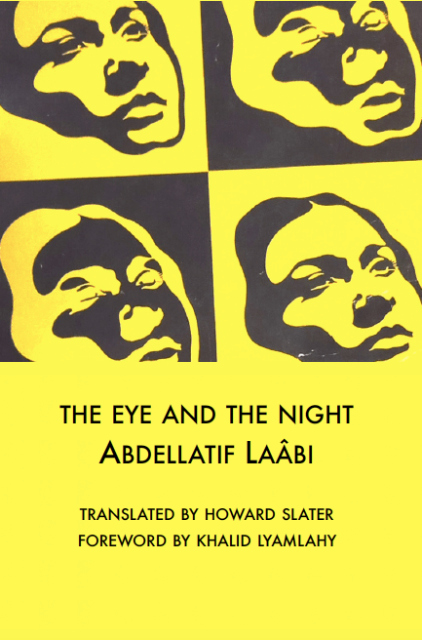
Available for the first time in English translation, The Eye and the Night was Abdellatif Laâbi’s explosive debut book. Written in Rabat between the popular uprisings of 1965 and the Six Day War of 1967, and first published in 1969 during Laâbi’s involvement with the radical anti-colonial journal Souffles-Anfas, Laâbi’s itinéraire”, a poetic novel or poem in prose, combines Surrealism’s spirit of revolt with the influence of Arabic literary, oral and musical traditions, the innovations of the Nouvelle Vague and Third Cinema with the soaring songs of Umm Kulthum, their tales of enormous feeling and impossible love.
From Casablanca to Hiroshima to Franco’s Spain, The Eye and the Night takes places in the squares of public defiance and the shadows of clandestine revolutionary gathering. At once novel, poem, pilgrimage and escape route, it is a classic of Francophone decolonial literature comparable to Aimé Césaire’s Cahier d’un Retour au Pays Natal and Etel Adnan’s L’Apocalypse Arabe. And it is living proof that, as Laâbi writes in his most recent collection, “poetry is invincible”. Published with new introductions by scholar Khalid Lyamlahy and translator Howard Slater, a glossary, and a 1982 preface by Abdellatif Laâbi.
Jamil Buthayna, Majnoun Laïla, necklaces of migratory doves.
Al Hallaj suffering the Truth and his millionth pyre [...]
Pass. This night is ours. Our final test.
ABDELLATIF LAÂBI (عبد اللطيف اللعبي) is one of the most important authors to have emerged from the Arab world in the twentieth-century. A founder member of the Moroccan journal Souffles-Anfas (1966-1972), a radical journal which played a key role in a renaissance of left-wing, anti-colonialist, and internationalist Maghrebi culture, he was imprisoned and tortured for “crimes of opinion” when the journal was banned in 1972. Released in 1980, he went into exile in France in 1985, where he has published numerous books of poetry alongside plays, novels, essays, children’s books and translations, and been awarded numerous honours, including Commander of the Order des Arts et des Lettres, the Alain Bosquet Prize, the Prix Goncourt de la Poésie, the Académie française’s Grand Prix de la Francophonie, and the Mahmoud Darwish Award for Culture and Creativity.
HOWARD SLATER is a writer and translator and former mental health support worker whose work has appeared in small press magazines, independent publishing initiatives and websites since the early 1980s. The author of Anomie/Bonhomie & Other Writings (Mute, 2012) and Anti-Wall (Kudaorg, 2017), he was the editor of Break/Flow and a founder member of the radical history archive May Day Rooms, London.
A5, perfect-bound, colour covers, illustrated, 168 pages.
============================================
HAYTHAM EL-WARDANY—NOTES FROM THE MARSHES
Translated by Wiam el-Tamimi and Yasmin Zohdi
Published October 2026
============================================
“After the genocide, language must become a means for striking fascism and overcoming property relations.”
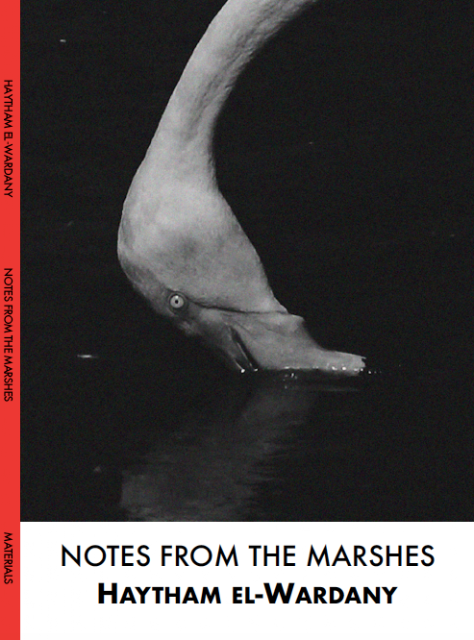
Haytham el-Wardany is one of the most compelling writers of our moment. Following The Book of Sleep (2021) and the recent pamphlets Gaza 2035 (2025) and The Difficulties (2025), Notes from the Marshes contains two prose texts and a sequence of poems. In the title sequence, written in English, verses from Refaat Alareer are read amidst military bases in Cyprus, turtles lay their eggs in an alley, a sister asks: “What is fascism?” Alongside these stanzas are two prose texts, translated from Arabic. ‘What if the word we’ ask questions about the possibility of collective voicing, when “the grammar of revolution” is “cut by the syntax of the state”. In ‘Needle in the Eye’, the author walks with a severed hand in their pocket down a Kreuzberg street, seeking for the language beneath the rubble of Gaza, for the wounded vowels and wounded words among the bodies; for a way to keep communion with the dead intact. Notes from the Marshes asks: Where now?
A5, perfect-bound, colour covers, 64 pages.
HAYTHAM EL-WARDANY is an Egyptian writer and translator. He lives and works in Berlin, and writes short stories and experimental prose. His praxis focuses on fiction, especially short stories, and nonfiction formats, like essays, and fragmental prose.
WIAM EL-TAMIMI is an Egyptian writer, literary translator, and editor whose work has been featured in publications such as The Paris Review, Granta, AGNI, Ploughshares, Freeman’s, Literary Hub, ArabLit, and The Common. She is an editor-at-large at The Avery Review, and is currently writing a nonfiction book.
YASMIN ZOHDI is a writer, translator and film critic based in Cairo, Egypt. She holds an MFA in Fiction Writing from Sarah Lawrence College, New York. A former culture editor at the independent news website Mada Masr and an alumna of Berlinale Talent Press, Zohdi is interested in the intersections between literary and cinematic forms, and how they continue to inform one another.
“Haytham’s exceptional prose and remarkable originality make him one of literature’s most distinctive voices today. Across fiction, creative nonfiction, and experimental writing, he unsettles genre boundaries and reinvents storytelling with each new work.”
—Iman Mersal, author of The Threshold and Traces of Enayat
“I think the greatest writer I have met, quite frankly, is the Egyptian modern writer Haytham el-Wardany.”
—Siddhartha Lokanandi, Wasafiri
========================
CAMILA BLAVI—ACACIA
Translated by William Rowe
Published October 2026
=======================
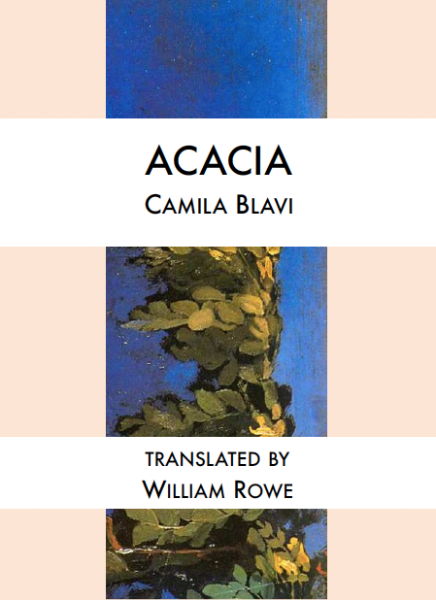
Acacia: genus. Acacia: flower. Acacia: a thousand species. Acacia: oryx and mother; Acacia: plant, person, poem. This book-length poem has from the start abandoned the form it was given and must proceed: through the burning of roots and the swelling of buds, the flow of flesh and the flaming inside; hunger and plunging, tendrils and shoots, the sea and the shore, the house and the flood, actions echoing across a landscape in constant metamorphosis and constant collapse. In Acacia, Camila Blavi asks what allows a person to say “I”, what it means to give birth and to be born. Acacia: spider crab, wren, seagull. Acacia: oryx, tern, plover, branch. Acacia: to find that “love is not what they said”, in bitterness, anxiety and howling, in drowning and living, observing what it is that organises us in the world. Acacia: everything you can see.
CAMILA BLAVI (Santiago, Chile, 1988) is the author of Contaminaciones (Komorebi Ediciones, 2022), Puna (Bokeh Press, 2025; Provincianos Editores, 2026) and Acacia (Provincianos Editores, 2025). She studied at the University of Santiago de Chile and Pompeu Fabra University, Barcelona. She has twice received a grant from the Chilean Ministry of Culture.
WILLIAM ROWE’S Collected Poems were published in 2016 by Crater Press. He has translated a number of Latin American poets, including Raúl Zurita, Néstor Perlongher, Magdalena Chocano, and César Vallejo. He is Professor Emeritus at Birkbeck College, University of London, and a co-founder of Veer Books.
“Acacia is poetry returned to its original, genuine, stripped-down form, crafted from precious words awakened by a reborn alchemy.”— Edgardo Dobry
A5, perfect-bound, colour covers, 112 pages.



No comments:
Post a Comment