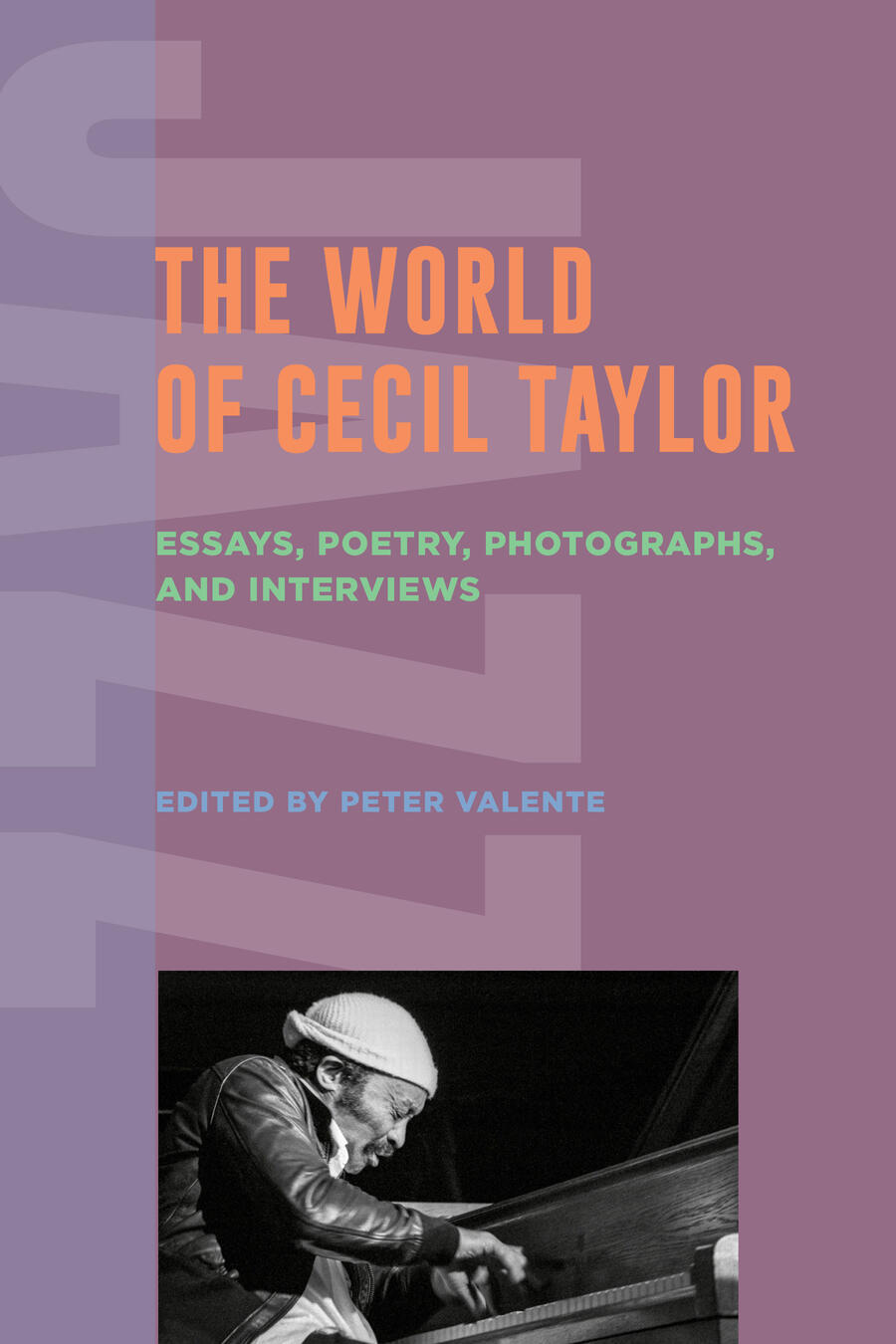
When poet and scholar Peter Valente wrote to me a few years ago to ask if I’d like to contribute to a book on Cecil Taylor, I was delighted. I’d felt this should be done at several points over the years—most notably after the collective energies of the Cecil Taylor conference organised by Michelle Yom at CUNY back in 2019, which I wrote about here—and I was grateful that someone was finally doing it. Early on I sent a list of recommended names, to which Peter has added and expanded and done all the labour of editing with the result now a marvellous book, just out from SUNY Press, and named for Taylor’s album of 1960: The World of Cecil Taylor. For those of us devoted to Taylor’s work, the appearance of this shortly on the heels of Philip Freeman’s biography of Taylor from Wolke Verlag is a great boon, and the mixed form—scholarly essays, poems, personal reminiscences, feels true to the all-encompassing environment that was—and is—Taylor’s art, his world.
The book’s contains are too capacious to summarise in any detail, but it contains essays by Gary Giddins, Steve Lake, Damon Smith, Art Lange, Matthew Shipp, Bill Shoemaker, Gunther Schuller, and Ed Hazell (whose book on Sam Rivers’ Studio Rivbea, Energy Center, appeared this October), by Valente on Taylor and drummers, by David Grubbs (also on Taylor’s poetry); impressions and appreciations by those who knew and worked with Taylor—Marc Edwards, Taylor Ho Bynum, Mark Hundevad, John Bruschini, Yuko Otomo, Joel Lewis, Elliott Levin, Jackson Krall'; poems by Will Alexander, Joel Lewis, Anne Waldman, Lisa Bernstein, Candace Hill Montgomery, Steve Timm, Elliott Levin and Clark Coolidge; scholarly essays by Allan Chase (on Taylor’s education), Mark Miller, Jeff Schwartz (on Taylor’s alphabet notation), Matthew Goodheart, Matthew Landis, Alex Ward (on the role of composition in Taylor’s 1978 Unit), and Kaja Draksler; interviews with Taylor by Robert L. Doerschuk and Ted Panken; and my own Biblio-Discography of Taylor’s poetry.
Small wonder that it’s over 400 pages in length!
Peter had initially asked if I’d consider a reprint of the essay I’d published on Taylor’s ‘Voodoo Poetics’ for Point of Departure back in 2020 (an expansion of the material I’d presented at the Taylor conference the year before). I said yes, sure, but I’d like to do something new on Taylor’s poetry. I had some ideas, they’d just need a bit of fleshing out. The resulting chapter, ‘Cecil Taylor and the Commitment to Poetry’—which I briefly wrote about here last year while I was in the processing of writing it—extends previous work on Taylor’s poetry on my blog (2018), for Chicago Review (2019) and in the Point of Departure essay—adding information on the unpublished book manuscript Mysteries which Taylor wrote in the ’70s, and which at various points almost appeared through City Lights and Turtle Island Press, and elucidating some of the biographical circumstances around Taylor’s writing. But it also, I hope, adds a further dimension to my reading of the meaning of the poetry itself.
Drawing on biographical information collated in Freeman’s biography as well as from my own research over the years (looking back over the chapter, I realize that it contains a total of 122 footnotes!), I wanted to draw together the sense of poetry’s role for Taylor and in particular its relation to his queerness and his relationship to his parents. Paradoxically, a poetry that is often about impersonality—or that which is beyond the human, whether in Egyptian or meso-American or West African mythology, or in the discourses of biology, genetics, and the engineering of bridges—emerges from an impulse that is immensely personal, that is about healing, or trying to heal the person, a process that was, for Taylor, as it is, probably, for any of us, lifelong.
By this I don’t mean to reduce poetry’s role in his life and work to a kind of therapy—though the seeds of his writing, as well as his mature musical conception, may have first emerged during a period of therapy after the death of his father—nor to suggest that this biographical rooting provides it with an ultimate ‘meaning’. For roots are also routes, and the tree exists in its arborescent flourishing above ground even more than in its anchoring in the earth below. And poetry always exceeds the individual from which it emerged, even as it gathers richness from knowledge of the ways it intersected with that life—a life that, I assert in the chapter, it helped to save. Taylor’s poetry was as paradoxical and confusing as his life and his music, and that accounts for its immense richness, is why I keep returning to it, why, over the years, I’ve learned so much from it. The chapter is an attempt to say a little bit more about that.
Here’s an excerpt.
Trauma, it’s now commonplace knowledge, is passed down, inherited. Taylor believed that the cancer that killed his mother and others in her family in their mid-thirties resulted from their intense rage, a result of upwardly mobile class aspirations. Often filled with rage of his own, in the year 2000 he commented, “The age that I am now [. . .] is twice as long as I ever thought I’d live.” Fifty years after Almeda Ragland’s death, Taylor told Chris Funkhouser, “I’m going through this whole thing about making these belated discoveries about mother dear” — a set of discoveries that had become part of the process of writing a poem. For Taylor, art was part of this work on the self: the process of how to get beyond anger, of how to get beyond trauma, of how to turn the idea of the familial, of inheritance, of ancestral memory, of practice and discipline and devotion to art, from hatred to love.



No comments:
Post a Comment