Saturday, 10 May 2025

MaerzMusisk 2025 Report: Part 3

[Extended cut of a much shorter review out in The Wire, split into parts for ease of reading. Part 1 is here, Part 2 here.]

Part 3: Ty Bouque, Laura Bowler, Marco Blaauw, Mazen Kerbaj, Raven Chacon
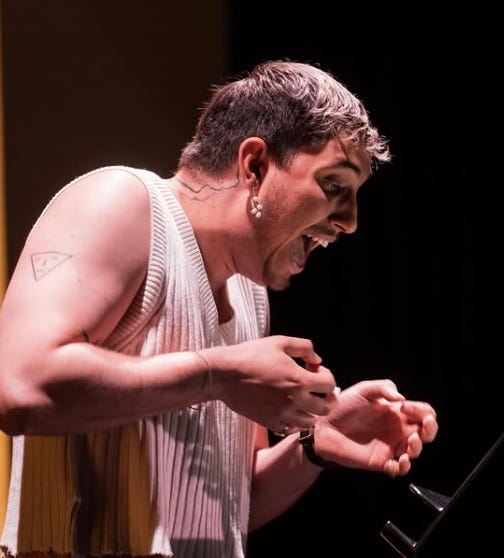
Image © Camille Blake

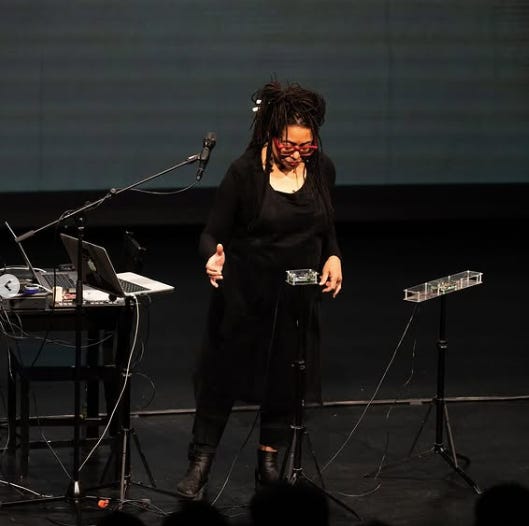
If the previous concerts by La Barbara and Pamela Z treated voice as an instrument in which ‘extended vocal technique’ means not only the extension of sound produced by acoustic meets, but through electronics and microphone work, baritone Ty Bouque’s solo acoustic set went for a different kind of expanded corporeality, sometimes barely audible in the high tower of the Silent Green Kuppelhalle (dome or copula hall). It was as demanding on the capacity for attention as Kerbaj’s set had been, but from the opposite angle: intense quiet rather than intense loudness, interruption and fragmentation rather than continuous contour.

Six of Georges Aperghis’s Quatorze Jactations—a word meaning alternately tossing to-and-fro during mental or physical illness, or a false boasting or bragging—judder between twirling nerviness and swooning slides up and down, toward or away from held notes, or a kind of breathy, shouted whisper. Speech blurs into song like a tremor, becomes agitatedly rhapsodic, gets carried away on lyrical flight, while song judders into speech, on the brink of articulation: not discourse, per se, but a constant, choppy and sometimes frantic swimming of the para-linguistic stream. This sense of convulsion, where sounds seem to get trapped in the throat even as they rise out of it, also characterizes Evan Johnson’s A general interrupter to ongoing activity. A whine turns to a gargle to a raspberry to a series of barely audible clicks, neither quite singing nor quite speaking. In a short, spoken introduction, Bouque suggests that, while Johnson’s work is sometimes seen as the failure or interruption of speech or the inability to speak, what it in fact reveals is that speech itself is a way of interrupting the natural flow of breath. In that sense, or in the sense it attains in this work, voice is precisely unnatural, queer: it “goes its own way”.

Perhaps the most compelling of the three works Bouque performs is Timothy McCormack’s Seated at the Throat, a work the composer has called a “queer blood-séance”. Breath, Bouque suggests, is “articulable” but “unpossessable”. Likewise, HIV becomes a second body growing inside one’s own: a body that isn’t yours but is impossible to get rid of, like being haunted by a spirit. If Johnson’s piece seemed to concentrate on sounds produced through exhalation—such as whistling—McCormack’s concentrates on inhalation—the open mouth taking in air to produce sound, a kind of open border between inside and outside. Pitched growls become tender moans, a kind of dulled pain or protective embrace, out of which emerges the word “passage”, vowels extended, consonants trailing along as if an afterthought. The work gets steadily quieter and quieter, at that border of sound and silence where sounds seems to cling for life: an effect eerie and somehow very moving.
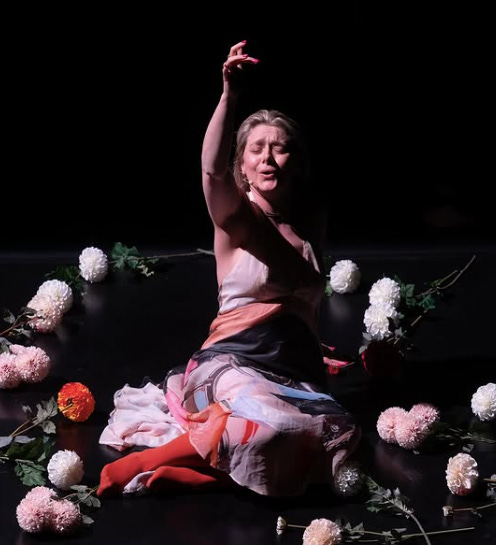

Image © Camille Blake

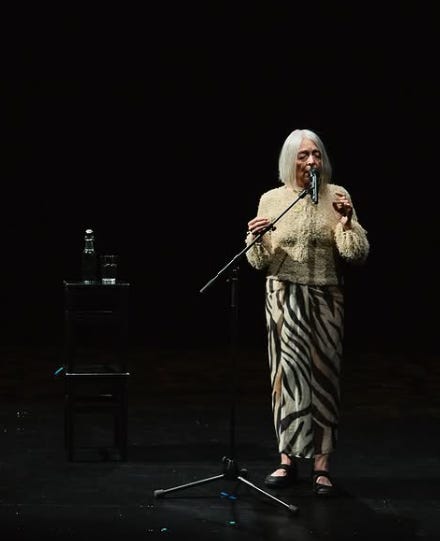
The following day, against at Silent Green, singer Laura Bowler offers a set that’s less a recital and more a carefully-choreographed collection of semi-staged monodramas, in this case by Nwando Ebizie and Sivan Cohen Elias. Ebizie’s Dahlia (and you will be there forever and ever) opens with Bowler lying onstage amidst a ring of roses, live-filmed projected onto a screen above the stage. The work moves through a number of episodes: a burst of song-like melodicism, music-box-like fragments or synthesizer chords, vocal counting or wordless intonation, a brief, beat-driven section. Singing with eyes closed, Bowler gradually rises from the floor, vocal pitch ascending, intoning the names of colours, finally coming to rest. Elias’s piece Who-He-Huh sees Bowler seated at a desk, miming office typing, running through the titular phrase in tones ranging from amusement to panic, voice distorted by electronics, before playing the part of a grinning, mannequin-like figure, an “avatar health educator” who repeatedly strikes a metal plate on the back of her head with a bang—the comic violence of a Punch and Judy, the uncanniness of the possessed ventriloquist’s dummy. The various video treatments and effects seems a little unfocused, and the piece arguably lasts for longer than it should, but perhaps that’s appropriate. The work is, it seems to me, a piece about not really knowing what affect to have, a kind of non-specific anxiety particular to a certain digitized era, a certain experience of a certain generation or class, in which loss of agency is, paradoxically, dramatized through a supremely-controlled and virtuosic performance.
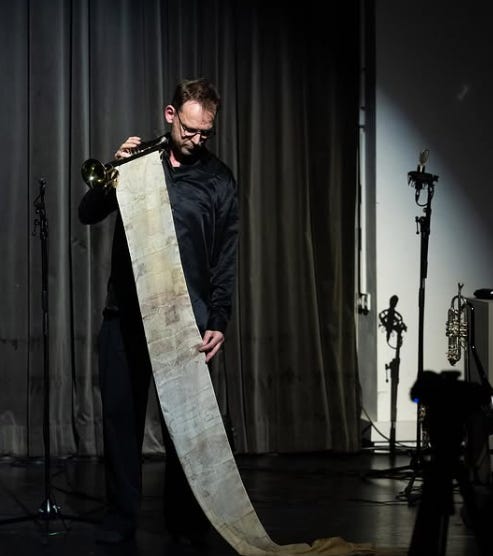
Image © Camille Blake

Another supreme virtuoso, trumpeter Marco Blaauw is particularly active over the two concerts, much of the work drawing from his ‘Global Breath’ trumpet, an attempt to gather the sounds of trumpets or trumpet-like instruments from all over the world which also forms the basis for a sound installation in the venue. The first of these sets, four works written in the last three years, concentrates on the double-bell trumpet, which allows, for instance, one bell to be muted and the other open, creating the possibilities of ever-shifting timbral combinations. Elena Rykova’s Vicissitudes layers the trumpet with plentiful delay, à la late Bill Dixon, notes burred with growled vocalising or splintering into high upper partials. Ayana Witter-Johnson’s Songs of the Abeng opens with a spoken recording explaining the history of the titular instrument, a horn used by maroon communities in Jamaica to signal the approach of slavers, using a code never divulged to outsiders. Blaauw passes a map of Jamaica, printed on cloth, round the audience, later furling it round the trumpet as a kind of flag: amidst an electronic part, live and offstage acoustic trumpets play through fragments of familiar tunes, held calls, before the recorded voice returns to urge attention to history amongst whirring, buzzing breaths, the work ending with Blaauw blowing the abeng itself as a kind of closing call to attention. George Lewis’s Buzzing, one of Lewis’s ‘Recombinant’ series for solo acoustic instruments extended by electronics, begins with the mouthpiece alone: with the rest of the horn added, Blaauw squeals up to high, tight pitches and rasping low dives, swooping open horn delay and pitch-shifting mutes. At one point, the electronics drape the trumpet in a cloud of sound as if a virtual horn section: echoes of the Ellington orchestra perhaps, or the halo of delay that surround Miles Davis on his tribute to Ellington, ‘He Loved Him Madly’, as the collective sounds through the desolation of the bereft soloist. The mood is buzzier, brighter than Davis’ lament, however: a series of lively episodes aimed to show off the trumpet’s tonal qualities to best effect. Aaron Holloway-Nahum’s I Contemplate Snippets of Silence and Find them Few adds Ty Bouque’s baritone, engaging Blaauw in a comically self-referential dialogue on the process of making sound (“The process is very intense. Is it a nice feeling? No”). Bouque alternates falsetto leaps and deep growls, grinning as Blaauw “speaks” through the horn in a virtuoso passage requiring visible straining, covers his mouth like a substitute human mute. Full of camp theatrical swagger, one might call a study in how the voice is like a trumpet and the trumpet is like a voice.
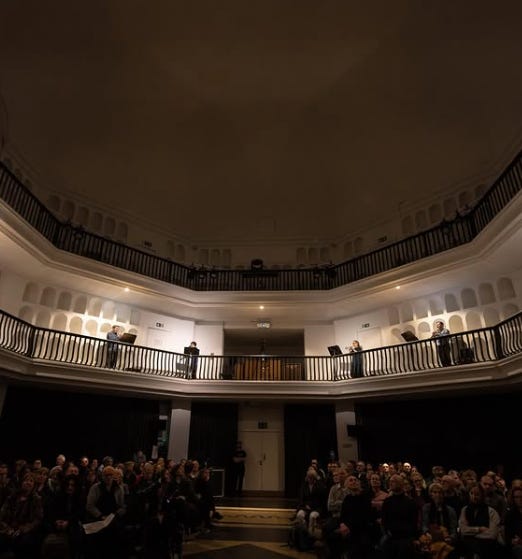
Image © Camille Blake

Following Laura Bowler’s performance, a further set led by Blaauw’s Global Breath moves through works by Milica Djordjević, Dai Fujikura, Liza Lim and Georg Friedrich Haas, with dramatic and compelling interventions by dancer-choreographer Edivaldo Ernesto. Djordević’s Monochrome, light blue darkness, sees eight trumpets up in the gallery, held tones passed around in a slow relay. The piece traces a regular process, daisy chain echoes across the ensemble through a range of tone colours: now muted movements introducing a rhythmic spinning to the harmonic cloud, like slowly running on the spot, how high whoops, bright and open, followed by muted effects as if the ensemble had temporarily dipped underwater. The sound is generally compelling, though at times it can feel a little too much like a run-through of techniques—perhaps a temptation for any composer working with Blaauw’s ability to seemingly play anything. Edivaldo Ernesto’s first dance intervention offers startling contrast: thumping the chest, breathing and grunting in a constant level of anguished energy that seem simultaneously directed outward and inward, like a kind of broken martial art that’s as much self-harm as self-defense.

Dai Fujikara’s new Shimmer is one of the most compelling pieces of those written for Blaauw—perhaps because, as Fujikara notes in the programme note, though he’s “a big brass fan, [...] I don’t like the typical brass sound used in classical music”, instead aiming to “make the trumpet sound sensual without giving the impression of a fanfare or some sort of powerful brass sound.” Two double-bell trumpets, four mutes, call to each other across the gallery, the notes sounding as if electronically-faded in, their edges cut into a level of piquant, perpetually wah-wah’d tremolo: a brief, trilled ballad, moves to a slow and stately melody spread across the two voices, then sounded in unison, an introverted, muted, dialogue, a slow flickering.

Liza Lim introduces Shallow Grave, written for the replica of a terracotta Neolithic horn found in a cave in Southern France. The instrument itself already supposes a level of mediation: not an animal horn—the original form of the instrument—but a replica, a ceremonial or ritual displacement whose ritual or practical function is, of course, long lost. Blaauw plays it lying down on a table on his back, holding a single, resonating noe then repeating it with added, vocalized multiphonics, the sound progressively blurred and layered, as if the human voice had possessed the horn and the horn’s voice had possessed it. The connection to the second part is not all that clear: Blaauw stands, on alto trumpet, clear calls and whoops alternating with desultory low blarts. Lim’s programme note suggests that it’s a variant on that sense of grave, possession, discovery in the first place, where “the living haunt the dead”: virtuosity as excess, perhaps, a flashiness that re- or displaces ritual function, like a kind of sardonic version of the Neolithic call.
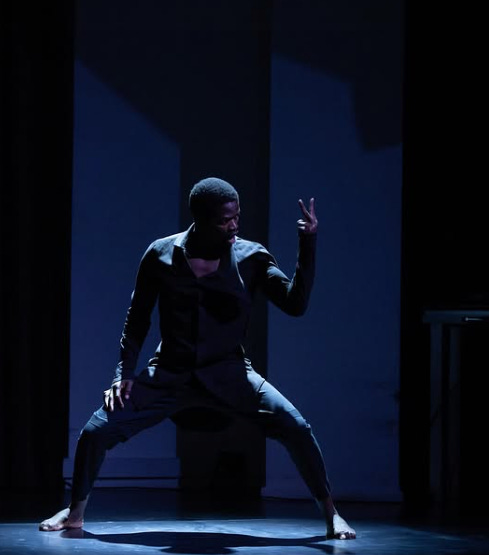
Image © Camille Blake

Georg Friedrich Haas’s I can’t breathe, dedicated to Eric Garner, comes out of a Black Lives Matter moment now a dedicated in the past, with the political situation worsening and little in the way of structural change. Ernesto here performs alongside Blaauw and, truth be told, the impact of the dance upstages the music, Ernesto stomping and running in circles down the aisle and up to the stage, moving towards the audience, gazing into the middle distance, as if the urgent capacity to announce something for which no words emerge. But neither does the music ‘fill in’ or ‘speak for’ what the speechless—but by no means silent—dance enacts. The martial arts element, the link between arts of war and arts of dance—I think of Milford Graves’s yara, for instance—is again there, and again, in contrast to the affirmative stance of Graves, of a kind of brutal, self-harming kind. The dancer seems to mimic the damage done to the body by an invisible other, a glitch or a body under stress or torture, in contrast to the more subdued lamento of the music. And, in a kind of defiance of the choking of Eric Garner, breath is very much present, albeit of a flailing, panting, kind, the by-product of physical effort that turns into a kind of musical cry in itself. Ernesto now stands directly in front of an audience member in the front row, stares at them, then mimes shooting themselves in the head and falls with a crash to the floor before springing up again in a kind of grotesque, slapstick resurrection. The discomfort of this kind of visceral physicality, the insertion of the black body into the (literally) white space of the Kuppelhalle, feels precisely that it’s putting something at stake.
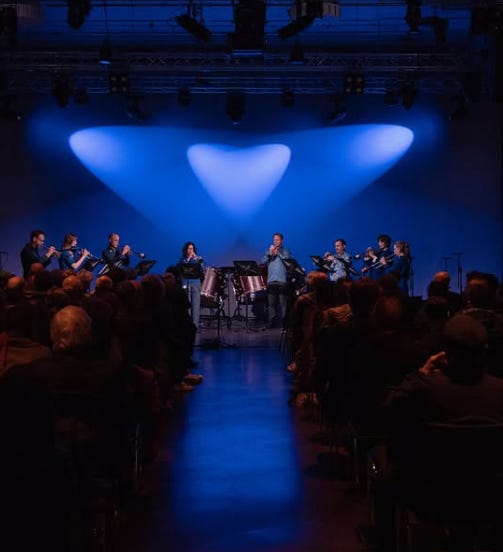

Image © Camille Blake

Down to Silent Green’s other concert venue, the underground Beton (or concrete) Halle, for the second set by Mazen Kerbaj. From One War to Another reflects on how “the memory of violence firsthand...replaced by the voyeurism of violence inflicted on others”, Kerbaj’s prior first-hand experience of conflict—the Lebanese Civil War and the later Israeli bombing of Lebanon—in the current moment, giving way to watching the horrors in Gaza on screen. Lungless concentrated its energies in a fixed space: for this piece, movement through the space gives the work a dramaturgic structure, Kerbaj beginning at the back of the hall, stopping at various points to circular-breathe a single, low note on a pocket trumpet played with a saxophone mouthpiece via an extended piece of tubing, a kind of ominous anti-fanfare. Onstage, he modifies the sound, moving the bell across two microphones, then sets up a loop and, setting the trumpet aside, proceeds to feedback blarts and whooshes from a modified version of the battery-powered crackled synth. Distorting vocal sounds from a contact mic placed inside his mouth amplify inhalation as a roaring, a ring-modulated groaning, a sudden silence pricked by high-pitched, strangled squeals set off by a brillo pad. As the synth emits a wailing SOS signal, Kerbaj pushes the table into the centra aisle down the first few rows of the audience, letting the sound play itself out as he raises the speakers to modify the sound, bringing them down onto his chest as if performing CPR, then waiting for the battery to run down to silence. Taking the applause onstage, he thanks the audience “for keeping your eyes, ears and hearts open to what’s going on in Palestine”.

Running through without breaks for applause, another set by Blaauw’s Global Breath adds percussion and wind to brass: Milica Djordjević’s TRI, a compelling trio for contrabass clarinet (Carl Rosman), trumpet (Blaauw) and percussion (Dirk Rothbrust), opens with a percussion solo, the sound of ceramic tiles rubbed with stones. Unison clarinet and trumpet melodies roll out gong-like tones from struck metal sheets, shivering into high peals. It’s a structurally measured work, full of interesting sonorities given space to breathe. Blaauw’s own Enigma is played on six conch shells distributed through the room. Beginning with quiet, breathing sounds, a gentle white noise, it builds up to the resonant calls for which the instrument is best known, rich tones swirling round the ears in spatial stereo.

Wadada Leo Smith is, of course, best known as a trumpeter, but the new piece premiered here is for solo percussion. In its instrumentation, The Celebration of Unity with the Indigenous People’s Nations Across the USA combines West African, East Asian and Euro-American elements—Gankogui and Atoke bells, Tibetan singing bowls, four giant bass drums—not for a romanticized foklorism but within its own, specific timbral vocabulary. A huge bass drum boom sets things in motion, the drums’ enormous vibrations contrasting with the comparative delicacy of the struck tuned percussion beside them. The piece moves in gestural bursts, those booms vibrating into silence, rather than setting up continuous rhythmic patterns: rhythm as much about alternating melodic and motivic material as propulsive momentum. Soprano Katrīna Paula Felsberga joins for further pieces by Liza Lim and Oscar Bianchi, the bright tones of voice and trumpet chasing each other in virtuosic trails and flurries.

By this stage I’ve pretty much reached saturation point—the two concerts on this day total six hours alone—but there’s one final set, two compositions by Raven Chacon played by Blaauw’s ensemble The Monochrome Project bookending book-ending a Chacon solo noise set. Interviewed for the journal Disclaimer last year, Chacon call his use of high-pitched sounds which “sit above everything, maybe even to the point of inaudibility” a “signalling towards urgency”: dog whistles and sine tone generators are treated with pedals which play the sound forward and backwards and at different octaves at the same time so that they “don’t quite resolve [...] The sounds arrange themselves into cycles, but they’re always offset and shifting.” This kind of tense stasis differs from the composed pieces, in which clear processes are followed and mapped out: improvisation, even if within certain defined parameters, blurs those processes at the edges, offers greater timbral and temporal ambiguity. In that sense, Chacon’s solo reflects Kerbaj’s crackle-box work, in which electronic effects which must to a certain extent be improvised, or even chance-determined—the crackle-box an instrument with a mind of its own, as when the battery runs down at the end—electronics not as backdrop or extension to instrumental prowess, but as entities in themselves, shaping musical structures to unpredictable ends.

Chacon’s compositions, by contrast, follow deceptively simple processes. What the listener sees and hears is what the piece is. In Whistle Quartet—now almost 25 years old—the ‘leader’ blows a dog-whistle in waves of breath, picked up and repeated in unison in turn by the other whistlers before the leader steps back, dramatizing, or illustrating, a process of learning through repetition and the eventual loss of the teacher.

The more recent Call for the Company, in the Morning, commissioned by hcmf in 2022, offers, largely, rhythmic variations on a single tone, taken from a handbook of fox-hunting calls. One trumpet blows the call, introducing various degrees of extended-technique variation, before a brief ‘noise’ intervention by another signals the rest of the ensemble to join, modifying the sounds in terms of speed and timbre to varying effect. The process is repeated until each of the eight trumpeters has played one solo, the final ensemble played as the musicians process to the back of the hall through the audience. In these pieces, sound is not so much an aesthetic object as a social process or problem. Sounds assoicated with a different formal context of participation in a ritual, a game, a structured social interaction are removed from that context and placed in a new, ‘purely’ formal context which sparks reflection rather than participation—in the case of the hunting calls, a kind of tempered exhilaration, tinged with menace. What does it mean to aestheticize these signals associated, in the British context, with aristocratic blood sport, signals to organized violence? Slowed down, each repeated noted comes to sound like a kind of hollow fear, a grotesquely elongated wailing, interminable, beyond meaning, a collapse into the opposite of that bloodlust, a resistance, a lament.
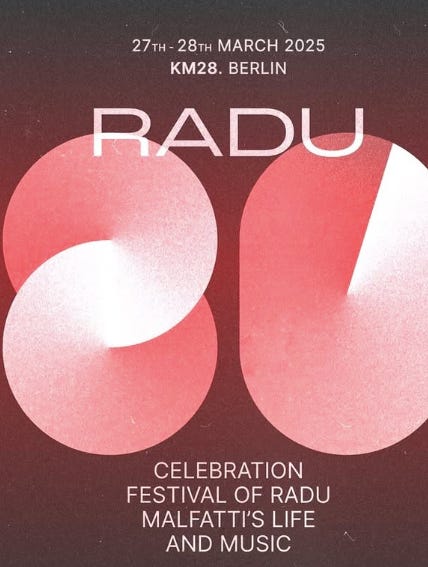

In place of any kind of summary or conclusion, a coda. Over at KM28 (not part of the festival), Lucio Capece had organized a two-day 80th birthday festival for Radu Malfatti with some twenty participants. In need of a change of pace after being saturated in music over at silent green, I caught the second night, the ensemble spread out throughout the room as if the sound were emerging from the audience or the walls themselves. In two ensemble pieces with varying degrees of silence, held tones merged and contrasted in a mixture of bowed strings, breath, and the irregular punctuation of performers gently tapping instruments or music stands, as if to present too much luxuriation, reminding us of structure, to pay attention to the sound and the silence as much as getting lost in it. But the highpoint came in the final set, which Malfatti played solo: a bass harmonica, a microphone and a single guitar chord repeating on tape, making the world at once disappear and pull itself into presence. “You must never blow into a microphone”, Joan La Barbara had instructed the audience at her Q&A a few days before, “you must always inhale”. (Anyone who’s ever used a mic is familiar with the grating burst of noise she had in mind.) But Malfatti found a way to do so: at first blowing through the harmonica holes, held away from his mouth, then bringing the instrument closer to the microphone so that the tone gradually came into volume and tonal presence, and finally, removing the instrument altogether and breathing at a distance to create a gentle white noise. As the guitar chord kept repeating—heartbeat, iteration, signpost—it came to seem like a study in what it means to be, and to remain alive. One could hardly ask for more.

MaerzMusik 2025 Report: Part 2 (Mazen Kerbaj, 'Lungless')

[Extended cut of a much shorter review out in The Wire, split into parts for ease of reading. Part 1 is here.]

Part 2: Mazen Kerbaj, Lunglesss

At Silent Green—formerly the first crematorium in Berlin—a packed programme presents a series of lengthy concerts, each of which offers three recitals in one. The music is spread over two days. There are premieres by trumpeters Mazen Kerbaj, working with new instruments, and Marco Blaauw, playing the double bell trumpet as well as a ‘Neolithic’ ceramic horn as part of his international ‘Global Breath’ project, gives a solo set of works by Elena Rykova, Ayanna Witter-Johnson, George Lewis, and Riot Ensemble conductor Aaron Holloway-Nahum, joined by electronics and, on one piece, Laura Vukobratović’s offstage trumpet; the next day, Blaauw’s eight trumpet project The Monochrome Project takes part in a set of work for varied instrumentation by Milica Djordjević, Wadada Leo Smith, Liza Lim, Oscar Bianchi and Blaauw himself, followed by a set with Raven Chacon: composed works for eight whistles and for fox hunting horns and an improvised set for solo electronics. There are also further sets by Blaauw (including Dai Fujikura’s Shimmer for two double bell trumpets and a striking piece for ‘Neolithic’ ceramic horn and alto trumpet by Liza Lim), and solo vocal sets by baritone Ty Bouque and singer Laura Bowler, including work by Nwando Ebizie, Aaron Holloway-Nahum, and others. But of all these sets perhaps the most striking is the first.


Image © Camille Blake

Best-known for his work as a trumpeter, and long a presence on the Berlin improv scene, Mazen Kerbaj opens the first with a piece called Lungless on an instrument called ‘Putin’s organ’, the nickname for artillery used in the current war in Ukraine made by instrument builder Thierry Madiot. His contributions here and on the second day draw on memories of growing during the Lebanese civil war, and later, the 2006 Israeli bombing of Beirut famously duetted with in his piece ‘Silent Night’.

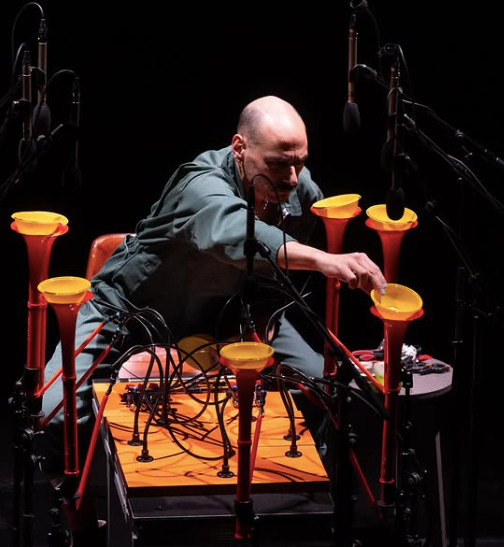
The Putin’s organ consists of a tabletop seven red plastic trumpets rising from a table like pipes, amplified by mics ranged above, and powered by an air compressor which Kerbaj controls with hands rather than breath (even though, as a helpful audience member next to me pointed out, in this case, unlike an organ, the air comes out from the top, rather than the side of the pipe.) The title, Lungless, suggests a trumpet with no mouthpiece, no breath, but also the sense of not having a voice, as Kerbaj thinks back to the divided Beirut he witnessed growing up during the Lebanese Civil War and the silencing of the voices of Palestinians—and those in support of Palestinian rights—that has taken place across the western world, but whose impact has been particularly felt in Germany and the US. During the world wars, German organ pipes were sometimes melted down for use in weaponry. Meanwhile, ‘Stalin’s organ’ was the nickname given the Katyusha, a huge Soviet rocket launcher with a distinctive howling sound used during the second world war, and then again in the Lebanese conflict, the updated name reflecting the current war in Ukraine.Here, the metaphor which turns musical organ pipes into rocket launchers, transforming war to music or music to war, is reversed, as the instrument becomes the metaphorical displacement of the war artillery that had served as metaphorical displacement of the instrument.

After hearing the premiere of Luigi Nono’s A floresta é jovem e cheja de vida in 1966, Italo Calvino wrote to Nono to question his use of “blocks of absolute, total, black noise” to represent the US bombings taken place in Vietnam. Calvino’s was partly a question of realism: having experienced the sounds of bombing and wartime conflict close up as an anti-fascist partisan during the second world war, he asks,

is it right to represent bombardments with noise? Wouldn’t it make more sense to focus on the silence that comes with the exploding bombs? At a closer examination, the prevailing element during an air raid is silence: when the alarm goes off the population strains its ears trying to detect the sound of the approaching planes, their descent over the city, the whistling of the bombs, trying to locate the explosions; and nothing compares to the silence which follows an air raid [...] I am [...] suggesting we look at war in its essence, antinaturalistically and anti-romantically, and A Floresta led me to reflect on the acoustic essence of the war, which is crucial [...]

[T]he tragic reality of the world is being concealed in large parts of the world, where everybody is somehow under the obligation to conceal it [...] But how to articulate this? How to turn this into a worldview, a stylistic process? I can’t say: if only I knew!*

As heard on Kerbaj’s ‘duet’ with the Israeli air force, bombs are not just about aural assault, but the pauses, the silence between. Like Calvino, Kerbaj knows this close up. His answer might be that, rather than looking to turn such facts into a worldview or stylistic process in a programmatic way, one works with what one has: literal, metaphorical. Recorded far from those present bombs, the work does not try to recreate or approximate them, as Nono did. If music is a displacement or sublimation or replacement of violence or trauma or weeping, or whatever various origin stories have been proposed for it, it is nonetheless about presence, and volume is central to the piece Kerbaj creates on the Putin organ. Held notes blare out like saxophone multiphonics, then the hovering air of an organ, a klaxon, a bagpipe, an alarm, capped off with a kind of expiring squeal at the edges, swelling into beating and difference tones. Occasionally, Kerbaj raises or lowers the trumpet ‘pipes’ to slide the pitch, while pieces of foil placed over the bells of two of the pipes creates glints of light on the ceiling and a layer of rustling white noise to the sound, at once a mute reducing the noise and, with its unpitched sound, increasing it, to be replaced in turn by plastic pots which let up a rattling like crickets of fizzling electricity, a kind of out-of-time percussive layer.

At MaerzMusik back in 2019, Kerbaj presented a multi-trumpet project called Walls will Fall: the 49 trumpets of Jericho in the resonant space of the Berlin-Pankow Großer Wasserspeiche and Kraftwerk Berlin. This interested in the dense power of massed, collective sounds of horns—often, as in the Biblical story to which gestures, and the contemporary conflicts onto which it overlayers—with military connotations: signal of alarm, fear or triumph. Here this combines with lament so that the two cannot be distinguished: the trauma from the cause, the wail of sorrow, the cry of terror, the shout of defiance.

Yet despite all these metaphorical overlays—ones emphasized by the programme note, by the name of the instrument—in terms of the experience of listening itself, when everything’s at a blaring, fortissimo pitch, how do we hear the new notes that creep in, how—both literally and metaphorically, do we keep attention on something (a sound, a political crisis or ongoing crime) that pummels to silence, to stunned and stopped listening? In our contemporary soundscape, the sonorism of an earlier moment—say Penderecki’s Threnody for the Victims of Hiroshima, which now appears as the burst heard on a horror movie soundtrack, nullified into the kind of background its piercing massed strings refuses—has lost its impact: noise is style, atmosphere, surrounding rather than interruption. And this is true of the environment of war, of mass death, of genocide on livestream, or the reality of those not watching at a distance, but facing that death.

Even Penderecki’s piece, we might recall, only took on its politicized title at the last minute, after the music itself had been composed with a more neutral name. And what Kerbaj plays on the ‘organ’ is not an attempt to depict programatically, but, as so many shut off their ears to the cries of victims and the cause of justice in the name of realpolitik or simply not wanting to know, an injunction to listen again—to keep listening. Hören, to hear, zuhören, to listen, and aufhören, to stop. At one point, half the row in front of me have their hands over their ears, and, paradoxically, this serves precisely as the figure for what this work does, aiming to free up active listening: a listening with, or listening against, rather than simply a listening to. The continuous cloud or block of sound that the piece generates is not the model of catharsis or ecstasy found in much drone or noise music but instead, a marker of unavoidable presence: survival, refusal.


In Part 3: Vocal sets by Ty Bouque and Laura Bowler, music by trumpeter Marco Blaauw, compositions and improvisation from Raven Chacon, and a further set by Mazen Kerbaj.

*Quoted from Italo Calvino’s correspondence in Carola Nielinger-Vakil’s indispensable Luigi Nono in Context (Cambridge University Press, 2015).

MaerzMusik 2025 Report: Part 1

[MaerzMusik happened in March this year. This is an extended cut of a much shorter review out in The Wire, split into three parts for ease of reading. Part 2 is here, Part 3 is here.]

Part 1: Nguyễn + Transitory, Susie Ibarra, Pamela Z, Joan La Babara

I caught half-a-dozen performances at this year’s MaerzMusik, held across a variety of venues in the city. Since its rebranding as MaerzMusik in 2002 (it was originally funded as the International Festival of Contemporary music in 1967 as a Biennale), the festival has gone beyond the usual remit of Neue Musik to incorporate a wider generic framework, and, under Kamila Metwaly’s curatorship, it feels like an open and generative space aesthetically.

Offering a particular context, MaerzMusik exists within a context. Berlin’s—and Germany’s—state-funded art scene has been in some turmoil of late, increasingly doubling down on the censorship of Palestinian and pro-Palestinian voices during a continuing western-backed genocide and facing funding cuts from a conservative city authority, sure to be doubled down on with the newly elected, right-leaning coalition government in the years to come. At a recent performance I attended (not part of MaerzMusik), after the choreographer spoke out about state censorship and the deportation of friends for pro-Palestinian sentiment, the director of the venue hastily stepped in to distance themselves from the remarks, to boos from the audience. Similar rebuttals around Nan Goldin’s intervention during her Neue Nationale Galerie show have drawn fresh attention to the institutional censorship that has brokered the Strike Germany campaign. In the past month, a particular university prevented a UN representative from speaking after pressure from the city mayor. Criminal cases are ongoing against protesters. And so on. The pro-Palestinian sentiment of artists or audiences and the anti-Palestinian sentiment of institutional funding bodies speaks to the contradictions of the German state position, one which reflects the turns towards general condemnation of Israeli actions against civilians on the part of the German population, a topic on which virtually none of the main political parties are willing to speak out. The state that supplies the weapons and the denials also supplies the art. Given this, these days, in any state-funded event in Germany, despite the rich diversity of art on offer, sometimes what’s not heard is as telling as what is. This is not so much an expression of a crisis we’re heading towards as a crisis we’re already in: the rise of the far right, of authoritarianism in general, of a turn, in Europe, towards an enhanced war economy, with a blind eye to genocide and dictatorship. This all risks becoming a litany that denudes itself of meaning in its rote familiarity. But it bears repeating.


Image © Camille Blake

So to the music. At the riverside Radialsystem, the duo of Nguyễn + Transitory present Drifting to the Rhythms at the Southeast of Nowhere, which, in a post-concert talk, they call a “symphony of intimacies”. The latest configuration of the duo’s ongoing collaborative project, the piece refigures exactly how an audience might think of the relation of music and dance. It is at once an instrument and a score, which is both ‘played’ and composed in real time by the performers, as the dancers move over copper lines on the stage floor and interact with a rope interlaced with copper wires above, triggering electronic sounds in ways that change depending on their movements. This particular iteration opens with the five female dancers, all from Thailand, gathering around a glowing light as if round a fire, followed by collective procession in silence, each dancer sharing the same gestures: a moment of collective regimentation which gives way to a series of highly virtuosic solos, duos and trios. In their essay in the programme, Bussaraporn Thongchai contrasts the fluidity of Thai folk dance with the Thai court dance, focused in Bangkok, a ‘prestige culture’ with fixed conventions, and the dancers thus perform folk dances from more neglected regions of Thailand, especially the North-East.

With some using traditional movements and some merging them into a more contemporary vocabulary, the performance includes dances interacting with spirits and movements from a martial art traditionally performed by men. As the artists discuss in a post-show talk, the all-female piece follows a loose scenario of queer desire—meeting, coming together, strife, negotiation with society, acceptance, and the return to the collective—but it would be a mistake to call it obviously narrative. The four-sided stage is devoid of scenery or backdrop, and while engaging the traditional background in dialogue, the movements themselves are also abstracted from their original context. Tradition—at least in the folk dance that Thongchai describes, a tradition from below rather than from above—is not something fixed, but something which is improvised upon and with, and the dance—particularly for those in the audience, like myself, unfamiliar with this context—creates scenarios that morph and change fluidly without being necessarily illustrative. Throughout all of this, the electronics emit a booming bass drone which forms a kind of ever-present base on which both sound and movement build: moments of erotic intimacy, bursts of energy triggered by samples of traditional music in brief loops, and, in a particularly striking sequence, a kind of battle with copper poles.

The feet are the proletarian of the body, said Etienne Decroux. “Take a walk at night. Walk so silently that the bottoms of your feet become ears”, writes Pauline Oliveros in the fifth sonic meditation, ‘Native’. The foot is where the body encounters the earth. And in this performance the feet are where the sound is triggered. As the show’s title gets us to think: what is the supposed centre we are Southeast from? The foot turns on the axes, shifts them. This sound, this drifting rhythm.


Image © Camille Blake / Berliner Festspiele

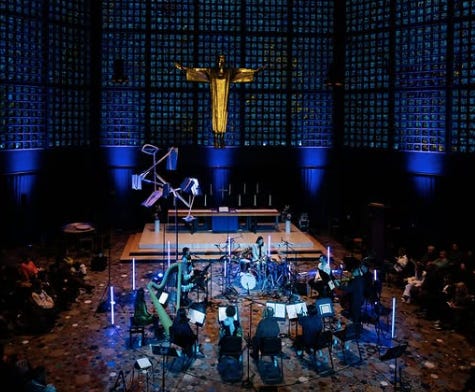
The modern Kaiser Wilhelm Gedächtniskirche stands next to the preserved ruin of the original, bombed church in the midst of a busy shopping square. Slightly sunk into the ground, its stained-glass windows blocking out the surrounding buildings with a light that seems to exist somewhere between day and night, it’s an appropriate setting for a concert-length work by Susie Ibarra, CHAN: Sonnet and Devotions. Largely through-composed, with the exception of improvised accompaniments to the poetic recitations, the piece integrates poets Logan February and Don Mee Choi with a full band including singers (soprano and tenor), harp, bass clarinet, trombone, French horn, acoustic and electric guitar, viola, double bass, the venue’s pipe organ, and Ibarra herself on drumset, gongs, and percussion. Titled for Ibarra’s middle name, which means ‘meditation’, each piece is a kundiman, a type of Filipino love song, with the love in this case devoted to ecosytems rather than individual humans: German forests, Himalayan lakes, the Pasig river in the Manila bay which, declared biologically dead in the ‘90s following industrial pollution, has recently come to life again.

CHAN opens with birdsong, the ensemble joining in the mood largely maintained throughout, of an occasionally restive calm. Over its multiple movements, it changes paces like the gentle fluctuations of breath. Ibarra rarely features the full ensemble, but instead uses it as a set of juxtaposed and overlapping timbral fields: a wheezing organ accompanied by the gentle pluck of harp and acoustic guitar, a soprano and viola duet; a particularly beautiful moment for Hilary Jeffrey’s muted trombone over electronics and Ibarra’s percussive rumbles. The musicians sit in a semi-circle round Ibarra, who plays and conducts from the drumkit. Though her playing is not the principal focus, at one point she offers a beautiful solo, characterised by carefully crafted melodic momentum; at another she rattles hand bells, uses brushes to play the air itself as if harnessing the rhythm of the wind. Most visually striking is the speaker tree sculpture standing to the side of the ensemble: ten speakers branching off a central wooden pole, which over the course of the concert play field recordings, percussion, and at times seem to offer real-time manipulation of sounds. At different points, the poets pick up separate, portable speakers and carry them down the aisles, while soprano Otay:onii (Lane Shi) scatters invisible flowers to audience members from an empty bag. In the final movement, Logan February recites from the organ loft, a poem playing on the classic trope of. the interaction, or distance between, the bodies of human lovers and the metaphorical transfer to a surrounding environment: “you must remain”, they intone, before a final ensemble melody closes the piece quietly. A distinct and beautifully integrated work.


Image © Camille Black

We’re now at the mid-week point, and solo recitals by Pamela Z—a recital called ‘Other Rooms’—and Joan La Barbara—titled after her debut solo album ‘Voice is the Original Instrument’—take place down the road at the blackbox space next to the Festspiele Haus. Alone onstage in black box setting with two laptops, one for voice and one for video, and two gesture-activated MIDI controllers, which trigger live samples like a theremin, Z transforms herself into both soloist and accompanist, a one-person choir, deploying tuning forks struck to ring against the microphone, the snap of popped bubble wrap, and the soaring echo and delay of her voice, in words spoken or soaring into song: counting to twenty in multiple languages, fragments of French, descriptions of spent flares on a pavement “like broken swastikas”, while video projections accompany the pieces, similarly interested in looping and transformation.

Z is interested in the way an object, a concept, a theme, blurs the edges of perception, using the MIDI-controller to “play” the keys of a typewriter in the air as he mimes composing a letter, or using an avian sample to turn herself into a whistling, chirping bird, pitch-shifting, shape-shifting, transforming. There’s something of the stage magician about the intricacy of the display: at once showing how it’s done and leaving one to marvel at the many shapes into which Z twists her body and voice. Fragments of language and gesture are gently tweaked, pulled apart and reconfigured into songs at once tightly woven and with a sense of the glittering slipperiness of an ordinary language that, on the brink of articulation, runs away from us, our assumptions—not least, the idea that there is a singular, un-inflected ‘we’ or ‘us’—and into that space we call music.

Image © Camille Blake

Like Pamela Z, La Barbara also works heavily with the microphone—which, in a post-concert talk with soprano Nina Guo, she describe as “part of her instrument”. Her pieces tend to last for longer, offering morphing soundscapes—“sonic atmospheres” or a “pool of sound”—in which the higher chirps of her younger self on tape—what she calls her “backing tracks”—interact with the deeper register of her current voice: a combination of “sounds that I know and sounds that I imagine”. The scores, she explains, are often “vocal gestures” that are notated graphically: La Barbara experiences sound as shape, and in many cases is working with sounds for which there is no conventional notation—sounds whose operations, at least initially, are as mysterious to hear as to her auditors.

La Barbara stands onstage in a single spotlight, larger pools of coloured light gradually emerging behind her, roughly equivalent with the layers on the work’s tape parts. The first piece, ‘Erin’, comes from 1980, and was inspired by the photograph of the father carrying the coffin of his son who’d died in the hunger strike at Long Kesh. It begins with energetic high pitches, babble and chatter, simulating conversation, perhaps, a collective sharing of stories, swirling round the speakers, before turning into a kind of lament for pitch-shifted low voices, ending on a final burst of the chatter as if to single hope remaining. ‘Solitary Journeys of the Mind’, one of the more recent pieces, serves as a framework for La Barbara’s improvisations, moving round the harmonics of a single note then up to the level of throat-singing or yodel. Technically impressive, the work’s effect is not of virtuosic display, but more of a kind of singing to the self, following a line in meditative exploration, rumination as much as ecstasy. The lament, or at least a quality of reflection, that characterizes ‘Erin’ to some extent goes through all these works. ‘October Music’ offers a portrait of the California night sky realized at IRCAM. Like Pamela Z, though without the MIDI controllers, La Barbara moves her hands to shape the sound: conducting, as a body conducts or carries sounds or force. Only in the final piece, the ‘opera in progress’ ‘Windows’ do we hear any other sound than those derived from La Barbara’s live and recorded voice. Samples from a decades’ worth of instrumental recordings, swirl and build on the edge of climax, in a febrile, moving structure. To the sounds of a ringing bell and gently lapping water, La Barbara sings with a kind of shrugging motion, the music slowly subsiding, now at rest.


Four concerts in, there were still many hours of music to come...


To follow: Part 2—Mazen Kerbaj’s Lungless.

Wednesday, 19 March 2025

Paul Shearsmith (1946-2025)

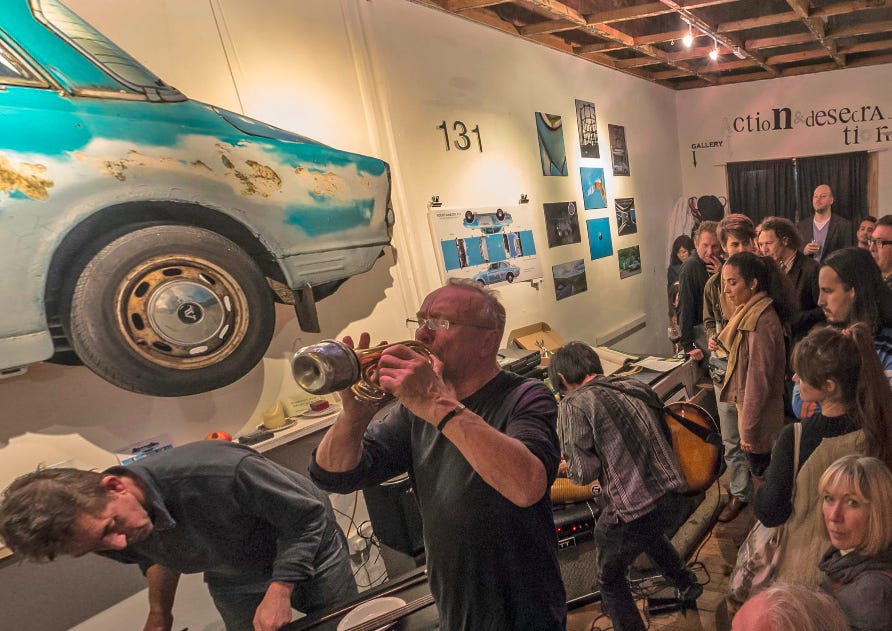
Paul Shearsmith and KMAT performing at the Hundred Years Gallery in 2012.

Trumpeter Paul Shearsmith passed away a few days ago in Stuttgart, aged 78. One of those many presences on the UK free improvisation scene known to—and as—one of the faithful—his German Wikipedia page is extensive, his English Wikipedia page non-existent. So is cultural memory.

Shearsmith grew up in Tadcaster, Yorkshire, where his father was the local blacksmith. Influenced, in his words, by the BBC Sound Effects library, on leaving the Leeds School of Architecture and moving to London, he attended jazz gigs by Stan Tracey. Here, as he tells it, he would stage a weekly heckle. On the basis of this, he was invited by drummer John Stevens to attend his workshops, playing a battered pocket trumpet he’d bought second hand with Stevens and the Spontaneous Music Ensemble and with the London Musicians Collective at the Little Theatre Club in the West End and at the ICA back in the 1970s.

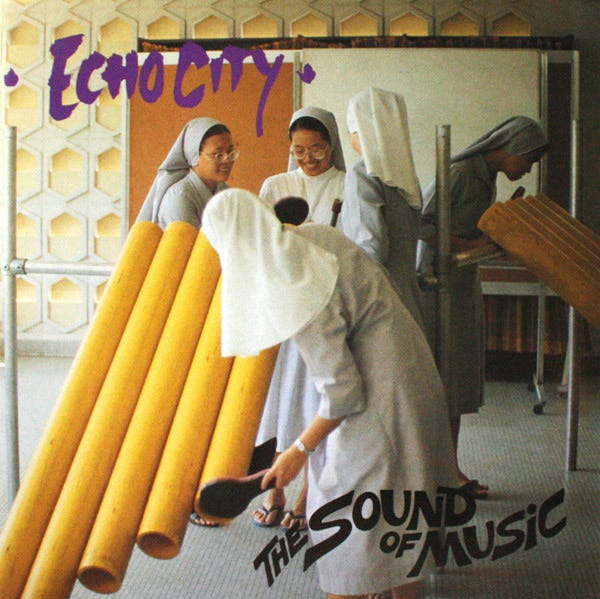
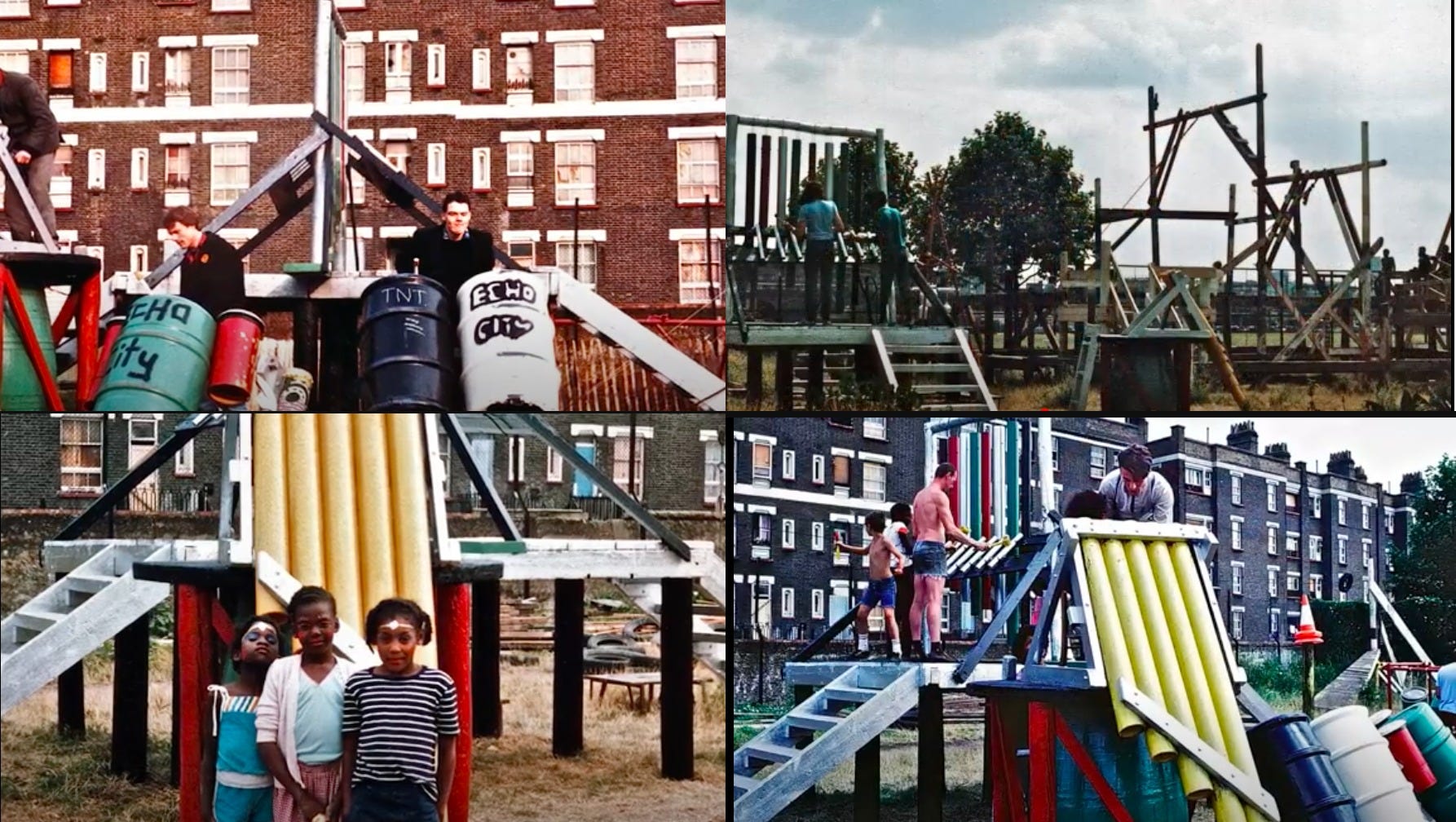
In the early ’80s, he travelled to Indonesia, where he came back with a ‘trompet’, a children’s instrument made from film canisters, a plastic tube, and a reed made from a balloon. Adapting this with a garden hose pipe as the ‘baliphone’, he met instrument-builder David Sawyer and through him joined the collaborative group Echo City with Guy Evans, Giles Leaman, Julia Farrington, Rob Mills, and Giles Perring. Starting in 1983 with a playground in Weaver’s Field in the East End, dubbed by the NME an ‘urban gamelan’, the group built what they called ‘sonic playgrounds,’ inventing tuned percussion instruments, made from old piping and other industrial and storage implements, including ‘batphones’, ‘fibrephones’ and ‘barrel drums’, and running workshops across the UK, Europe, East Asia and North America, including a collaboration with members of the Sun Ra Arkestra on the beach in the Isle of Jura, off the coast of Scotland. In Echo City’s work, music becomes sculpture, part of a public place and a participatory aesthetic. This is not about gigs or records, though they are a part of it, but about a more ongoing and more genuinely collective process. As Shearsmith put it: “I believe music belongs to everybody and can be made by anyone. Don’t let technique get in the way”.

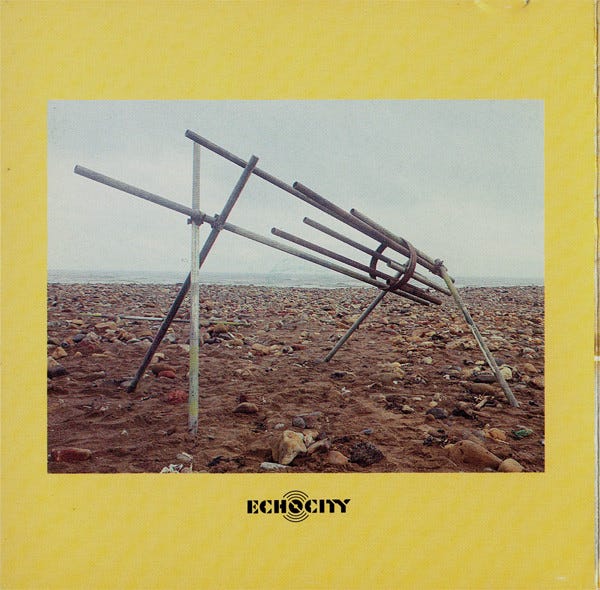
Album art from Echo City’s second album, The Sound of Music (Some Bizarre, 1992)
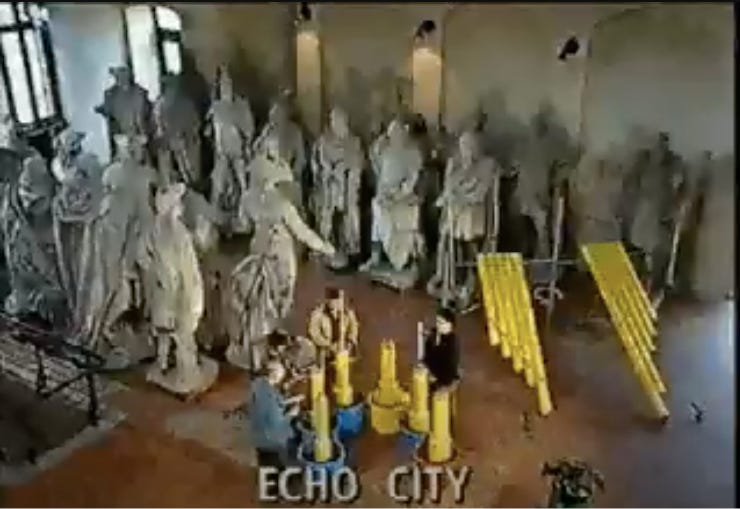
Images above taken from Echo City videos uploaded to Shearsmith’s Youtube page: a gallery performance in Berlin, 1997; an unnamed installation; and the original “sonic playground” at Weaver’s Field, Bethnal Green, 1983-4.

These kind of public projects have always been a key part of UK improv, and, whether in Echo City or elsewhere, it was the spirit of collective playing that informed Shearsmith’s work, from his early work with Stevens to Maggie Nicols’s The Gathering, playing in the groups the Funking Poets and APE with the likes of saxophonist Big Mike Walter and poet Grassy Noel (for the latter, Shearsmith added fire extinguishers to his instrumental arsenal), or in the duo The Fujii with Japanese singer-guitarist, Koichi ‘Fuji’ Fujishima, who he met while the latter was busing in York, and latterly, with Ben Watson’s freewheeling AMM all stars.

Over the years, Shearsmith worked in an architecture firm, practiced photography, turned his car into a work of sculpture, played trombone, tubing, “tuned gas main”, and the baliphone in addition to his trusty pocket trumpet. Back in the day, I played in private a few times with Paul and the other members of KMAT, his trio with guitarist Keisuke Matsui and bassist Graham Makeachan, indefatigable host at the Hundred Years Gallery in Hoxton, where Shearsmith was a regular. It was soon after the election that saw Boris Johnson elected mayor of London: Shearsmith, he reported, had been playing in Ken Livingstone’s “battle bus”, blasting out socialist classics like ‘The Red Flag’. Around that time I remember anti-austerity protests, the student movement, the carnivalesque energies around the Hundred Years and its constellations, a warehouse near King’s Cross with a variant on Henry Threadgill’s Hubkaphone made out of old storage canisters for reels of film, a parade with bells through the streets of Hoxton organized by Mary Lemley in memory of Gabriel Hardisty-Miller, running into Grassy Noel going the other way up the street on a protest where, suddenly, everyone was going joyfully in every direction at once, and the street briefly reconfigured itself, as on protests it does, lines of poems, lines of music that refused to line up or be counted, out of time. And Paul Shearsmith’s pocket trumpet, piquant and strong in the wake of Don Cherry, blowing out little blasts of light.

Free improvisation in the UK and elsewhere developed as a social music and in this often unheralded way it continues, in venues like Hundred Years, the late lamented Iklectik, or the slightly more publicly-visible scene around Cafe Oto. It’s a music that's often politically connected to the traditions of left wing politics that have for decades been under steady attack from both the Right and the Labour party in its Blairite or Starmerite configurations: as well as the Livingstone Battle Bus, Shearsmith recorded an Iraq war protest song, and the Hundred Years Gallery has recently been raising money for the people of Gaza. Heard by small audiences, the music is not ‘popular’ by record industry terms—or the kinds of ‘focus groups’ by which Starmerite lurches to the right are justified—but it is more fundamentally than that a people’s music, one that, because it does not make money and is barely tied to market demands, aims at exploring only itself and its world, that draws, in spirit and sometimes in letter, on the traditions of protest in folk musics of various kinds, in free jazz, in experimental theatre or film and in the various experimental incarnations grouped under the headings of prog-rock or (post-)punk (Guy Evans of Van der Graaf Generator and Susie Honeyman of the Mekons both played in Echo City). The music stages a counter-history and a different way of being to all the various lies and erasures of memory surrounding it.

That was the world Paul Shearsmith believed in. That was the music that Paul Shearsmith made.

Wednesday, 12 March 2025

Recent Poems Read

--Asha Puthli on ‘What Reason Could I Give’.


--Christa Wolf on dividing skies.

--Jayne Cortez telling us that ‘There it is’.


~~

It’s been a while since I’ve done this, so just some reports on some of the latest books to have made their way from the letterbox onto my table, where the shelves have run out of space and the piles continue to pile up. First up, a package in the mail from Michael Klausman and Patrick Tiller’s Colorado-based wry press, continuing their acts of unexpected and pleasing acts of careful recovery and shepherding into print. 
The Cobra King is a small, posthumous book of poems by Oswell Blakeston, whose pseudonym contracts the two names of Osbert Sitwell, or reads, alternatively, as “o swell”. A former drinking buddy of Dylan Thomas (“mouse” to Thomas’s “rat”, so the preface tells us), Blakeston was very much part of the British modernist scene from the 1920s on, though he remains under the radar: among other things he made what is reportedly the first abstract film, watched by Buñuel, wrote prolifically for the important film magazine Close-Up, and was a key part of the circle around Bryher; as well as his involvement in film, he was a painter, a writer of cookbooks, travel books (one of which saw him banned from Salazar’s Portugal), mystery novels and poems. Ian Young’s introduction—which recalls meeting Blakeston in a London pub while editing his gay poetry anthology The Male Muse in the early seventies, and recalls among other things Blakeston’s outré anecdotes of the German dancer, performer and actor Valeska Gert—suggests that there were as many as one hundred books and chapbooks over the years. The Cobra King comes from typescript in the Harry Ransom archives in Austin: described by Blakeston as his “beefcake poems”, they’re short and pithy with a wicked streak, memories of queer love or lust, come-ons, put-downs, alternately melancholic and joyful. The pick of the bunch a free-verse couplet half-way down a poem: “Make love until / we have no faces”.
If the Blakestone book is petite, pocket size, Paolo Lionni’s Headlines is widescreen, the page stretching out to extend the long lines of Lionni’s mixed prose texts and poems, largely emerging from London’s countercultural milieux, and lovingly assembled by Klausman from various underground magazines and from the 1962 manuscript which gives the book its title, found in the papers of yet another neglected poet, Philip Lamantia. More links with the film underground around the likes of Piero Heliczer, including a prose text originally written as the script for an unrealized surrealist film set on an Italian train. As the title suggest, newspapers form an important source, in found text re- or de-contextualized or satirically paraphrased, along with more gnomic addresses to poets like Corso and Ginsberg. As the biographical note suggests, these were mainly the product of Lionni’s itinerant twenties, bursting with energy, and culminating in a kind of ecstatic manifesto, ‘To The Queen’ first published on the front page of the International Times in 1966 after a copy—collectively signed by, among others, Rosemary Tonks, Michael X, Harry Fainlight and Brian Patten—was sent to Buckingham Palace. In such work, as with Blakestone, poetry is perhaps one of many modes, not just of art, but of living: the scattered fragments of a life lived on the move, the very incompleteness and sometimes disjointed energies of the work are a part of its spirit, which tugs at the corners of the pages as if yearning to jump onto the street or road or boat once more.


Not an archival project, but recent poems: Ken Bluford’s Skip Tracing is the first full-length collection, following the collaboration with Tom Weatherly, Climate/Stream. Bluford was part of the scene around Middle Earth Books in Philadelphia, including Bockris-Wylie, hung out at the Poetry Project and Slug’s Saloon, and is, the bio note informs us, the brother of Guion Bluford, the first African-American astronaut in outer space. The 145 pages of poems here were largely first published as facebook posts, antidotes to the ever-shortening streams and screeds of today’s social media platforms and their intersections with the mendacities of US national (and international politics). Bluford instead offers wry, ironic or tender, measured reflection on a variety of subjects: here, for instance, the noirish Robert Mitchum western Blood on the Moon might make an appearance alongside Al Green or Charlie Patton. Bluford’s (non-exclusive) preference is for four-line stanzas, often capped off with an incisive couplet that introduces a new resolution or note of ambiguity, plentiful enjambment constantly moving the twists and turns of poetic thought against the interrupter or continuation of the line-break. The bio notes the way the poems combine the responsive nature of improvisation with the careful workings of form, elements that true students of improvisation knows are in no way incompatible—the paramount example, perhaps, Coltrane’s warp-speed working-through of patterns in ‘Giant Steps’, a track Bluford recalls from a street a few blocks away from where he lived and workshopped and woodshedded, as the “revolving drums” of a concrete mixer merge with a drumset, a Coltrane mural whose blues suggests waves of water or sound, across the stanza, a poem about keeping the memory alive as the mural fades--as one of the tasks of poetry is to keep a cultural memory that fades into nothing even in the very guise of being re-branded, re-marketed and sold on any number of online platforms. Poetry knows a history in the crevices, in the metaphorical association, the quick flash, that the poem taps into with a patient speed: not so much, perhaps, the famous breakneck up-tempo of the famous recording in which Coltrane suddenly calls double, triple, quadruple, quantum time, but one of the slower, earlier takes heard on the Heavyweight Champion boxset. (Not that ‘slower’ means slow.)


(The group’s conversation on the first alternate take, transcribed by Vijay Iyer and Steve Coleman. Coltrane opines “I don’t think I’m gonna improv this—I ain’t goin be sayin nothin, tryin just, makin the changes, I ain’t goin’ be tellin’ no story...Like, tellin them black stories.” “Shoot. Really, you make the changes, that’ll tell em a story.” “You think the changes are the story!” “Right, that’ll change all the stories”. “I don’t want to tell no lies!” “Changes themselves is some kind of story”. The melody, the chords, what rides both to twist away from it.)

One of the sharpest of the political poems, ‘Self-Defense Poem’, avoids the mode of elegy that many of the better-known poems emerging from Black Lives Matter and the Floyd Rebellion have adopted, instead deploying a mordant and incisive irony against the white-right-ring militias and their hysterical fears of antifa and black life, and the rewriting of cops as potential victims of assault who must shoot first, ask questions at the inquest. Imagining that they’ve shot a cop in pre-emptive ‘self-defense’, the poem concludes: “And if I was photographed having a drink or two // With fellas from Antifa with time to kill / Who’s to say this poem isn’t aimed at you”. The tone of world-weary—yet not resigned—wisdom, chastened compassion, or a quick and cutting take-down of the lies that justify continuing anti-black violence, calls to mind the later work, say, of Lorenzo Thomas, in Dancing on Main Street: sometimes in the pacing and tonality too I hear echoes of Bluford’s friend—and Thomas’s literary executor—Aldon Nielsen, who’s thanked in the acknowledgments, and who is himself on a streak of fine poetry books of late—the Selected Poems edited by JP Marcoux from Blazevox a couple of years back, and most recently, the recent book-length interview-cum-autobiography Memewars with E. Ethelbert Miller. Either way, Bluford’s is a very fine first full-length—at the age of 75!—and deserves the expanded set of readers I hope this publication will land it.


Following the trail, also from Blazevox and in the mail, is Edric Mesmer’s Tides that Dont Perturb. As librarian at the University at Buffalo—he was an excellent host when I did archive research there in 2022—Mesmer has excellent knowledge of Buffalo’s literary and artistic lore, and a fine line in bibliographic research with the Among the Neighbors pamphlet series. Buffalo provides some of the referential landscape of these poems, including my favourite in the book, a tribute to Cornelius Cardew, who worked on the manuscript for Treatise while on a fellowship in the town in the sixties—the original version of the score published by Gallery Upstairs Press, who put out the chapbook Pressed Wafer by another temporary Buffalo resident, John Wieners, the same year. On that archive visit, my train out of town towards Massachusetts was delayed for over an hour, I think because of snow: at the station I met a couple who told me stories of the campus in the sixties, the architectural history of the town, a wealth of connections and cross-connections and a generous encounter that stayed with me, but I could never remember the names—until Edric identified them as Max Wickert and Katka Hammond just this past week. (A poem is dedicated to them in the book.) It’s connections like that, coincidences or dots joined up, that the poems specialize in, but that’s not their motivating method, more a part of their texture. The poems have something of the crossword puzzle to them, the pleasure of teasing out their careful and multiple allusions, often framed through classical mythology, but they also have the pleasurable spark of language that doesn’t need to be deciphered to be richly enjoyable, as the sound and play propel forward across Dickinsonian dashes—“trying to capture the cadence of thoughts, and ruptures”, as Edric puts it, in a time when thinking has become fragmentary and disjointed, to make the connections or leave them hanging there. During one of several memorial panels for Tyrone Williams at the Louisville Conference on Literature and Culture this past February, JP Marcoux talked about Tyrone’s use of the em-dash in relation to Fred Moten’s notion of the break, to the picket lines of a sanitation strike, as a pause or a connector which might reach across from life to death and back, an image I just can’t get out of my head: in Edric’s poems, I’m thinking of the em-dash as a bridge, a rope one perhaps, over the yawning abysses or tides that open up under us as we teeter forward into this bad new year. Like stumbling by chance into a talk on St Francis, staring at an aquarium, counting the syllables, moving ahead into the light.


Finally: from the other side of the Atlantic, Tom Crompton and Dom Hale, two thirds of the Poets Hardship Fund, have put together a beautiful petite chapbook from Tom and Alex Marsh’s Gong Farm called Mud Ramps. It’s a prose text of less than a dozen pages—eight to be precise, in fourteen paragraphs—and calling it a prose poem risks putting it too safely in a generic box, but it is in prose and it is fundamentally and committedly about poetry. Perhaps it’s more like an essay, but then, really, it’s a poem, or an essay, or both, in prose, but really, in language. It’s a petite book, with a lovely cover image by Amy Todman, printed at the Leeds Footprint Workers Co-Op, and that size, the modesty of scale speaks to its humility of ambition. It’s not small because it’s seeking to be a collector’s item but because that smallness of scale is where we can widen our view, slip it into our pocket or a letterbox, a carrier pigeon coming in off January winds to bring us a message for the turning of the year. The pamphlet has a polemical edge too—the text feels like a manifesto for our time—but the polemic has a generous edge, and it builds itself, not by defining an in- or out-group in the classic mode of the manifesto. This isn’t about building a movement or a group, but a manual for anyone to use. Like a poem it’s sometimes obscure in the best ways, and it’s in the obscurity that the clarity, really, is to be found: you feel it wandering on the edge, shaded by the landscapes of the north of England or elsewhere, their vocabulary—kerb, cairn, calyx moorsense, borage, scrim—echoing the work of Barry MacSweeney and Maggie O’Sullivan it’s informed by. (O’Sullivan, along with Stephen Rodefer, provides one of the epigraphs, opening up a world in just four words: “Poetry finds my life”.) A few years ago, in an interview broadcast, of all places, on Instagram, the late Jean-Luc Godard said that the Americans invaded Iraq in order to capture the birthplace of writing. I remembered it as him saying they wanted to invade Iraq in order to destroy language from its source. Either way, he’s being proved right as the swirl of banalized language in this era of Global English swallows itself up under the sign of Trump and Musk—what the opening page of Mud Ramps has this down pat in identifying as “the virtual extraction void”, “bot-language” the “devouring machines”. AI is no longer an early millennium sci-fi flop by Stephen Spielberg but the consuming future of warfare, our lives, as Europe rearms and the US inclines itself more and more to domestic neo-fascism. Once you start reading it’s tempting to quote every other line: the best thing, though is to read it yourself. Paraphrase dilutes the mellifluous fluency of its phrasing. But here’s a run-through, some tunes from amidst the overall flow of the song: plotting counter-landscapes, “inventing scales to measure”: the image of the tuning fork in the traffic, “remaking languages is always the first and last principle”, “it’s not freedom but discloses it”, the dissonance of collective life, Dorothy Wordsworth “hallucinating drills and airstrikes” and calling Tom Raworth on the phone to reflect on the making or destruction of landscape. And: the momentary and stupid beauty of the poem that becomes history, down crumbling lanes of the heart, “the ancient and futural horizons of poetry that emulsify all living writing with the brilliant dead”, and the penultimate sentence, what is at the text’s core—“so that who we are is really unimportant in the language”—as what a poet offers is an air that remains beyond the life or name that gave it breath. And so this text, its collective resonance, reverberation, something for the road, for the year ahead. I’m very grateful to have this and I recommend it highly!
 
~~

So ends the round-up. More to come on various things, including Theodore Harris and Amiri Baraka’s Our Flesh of Flames, out in expanded full colour reissue. Still wanting, too, to write on Elaine Mitchener’s stupendous record Solo Throat from last year, to finish off other manuscripts, other projects, tidying, collecting, sifting. More, in time, to be revealed, whatever the rest of March and beyond chooses to bring.

Monday, 3 February 2025

Reprints from Materials

Pleased to finally be able to put back into print a number of out-of-print titles from Materials, among them a re-typeset and re-designed second printing of D.S. Marriott’s Duppies, previously published by Materials in 2017 and in a US edition with Commune the following year, and out of print for a few years now. I’ve wanted to put this back into circulation for some time, especially since the folding of Commune Editions also put the US edition out of print. (I’d also highly recommend D.S. Marriott's subsequent books of poetry, Before Whiteness from City Lights and the forthcoming Letters from the Black Ark from Omnidawn.) Here’s the cover (Clarence Major’s painting At the Turning Point opens up the book inside.)

Screen Shot 2025-01-28 at 13.22.19.png

The full list of books now back in print: 

D.S. Marriott, Duppies (2017)
Lisa Jay Jeschke, The Anthology of Poems by Drunk Women (2018)
Anne Boyer, Money City Sick as Fuck (2019)
Laurel Uziell, T (2020)
Tongo Eisen-Martin, Waiting Behind Tornados For Food (2020)
James Goodwin, Faux Ice (2022)
Candace Hill, Short Leash Kept On (2022)

You can find them all on the Materials website at the links above, or at the main page here: https://material-s.blogspot.com/

~~~


Also:

On newly-available footage of Albert Ayler for The Wire: ‘Eye and Ear Control’.

On Will Rowe for English Studies in Latin America: ‘No More Burial Remedies’.