Thursday, 8 August 2024

Never By Itself Alone


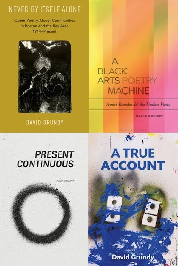
My new book, Never By Itself Alone: Queer Poetry, Queer Communities in Boston and the Bay Area, 1944-Present, is out now from Oxford University Press. Here's the blurb:
Providing an unprecedented exploration of key moments in queer literary history, Never By Itself Alone changes our sense of both the American literary and political landscapes from the late 1940s through the 21st century. Grundy presents the first comprehensive history of post-war queer writing in Boston and San Francisco, intertwining analysis of lesbian, gay, and queer writing, and insisting on the link between activism and literature.

The book centers a host of underrepresented writers, especially writers of color and those with gender non-conforming identities, and challenges the Stonewall exceptionalism of queer historiography. Starting with Robert Duncan's 1944 essay, 'The Homosexual in Society', one of the first significant public defenses of homosexuality in the US, Grundy takes the reader through pioneering works by queer voices of the era, including Adrian Stanford's Black and Queer, the first published book by an out, Black gay poet in the US; the Boston collective Fag Rag and their radical reconsideration of family, private property and the State; the Combahee River Collective, whose Black Feminist analysis drew together race, class, and sexuality; the anthology This Bridge Called My Back, in which women of color spoke truth to power, together; and New Narrative writing, which audaciously mixed Marxism, porn and gossip while uniting against the New Right. Linking these works to the context which produced them, Grundy uncovers the communities formed around activism and small press publishing during this era and elevates neglected voices to narrate a history that before now has never been told in its entirety.

Drawing on extensive archival research, Never By Itself Alone is a rigorous and unmatched work of both literary criticism and queer scholarship which underscores the vital importance of radical accounts of race, class, and gender in any queer studies worthy of the name.
The short version: the book is in eleven chapters and three parts. The first part covers the period from towards the close of the Second World War to the paradigm shift popularly represented by the Stonewall Rebellion, with four chapters, on Robert Duncan and the formative essay 'The Homosexual in Society', Jack Spicer, The 'Occult School' of Boston, with one chapter on Ed Marshall and Stephen Jonas, and another on John Wieners and Gerrit Lansing. The second turns to Gay Liberation-era Boston between 1969 and 1983: there's a further chapter on Wieners, alongside Charley Shively and the Fag Rag collective, followed by a quartet of writers published by the Boston-based Good Gay Poets press: Adrian Stanford, Stephania Byrd, Prince-Eusi Ndugu, and Maurice Kenny; and finally the Combahee River Collective, with particular focus on the work of Audre Lorde and Kate Rushin, along with the still-vital anthology This Bridge Called My Back. The final part focuses on the Bay Area, taking things from 1969 to the present: there are chapters apiece on Judy Grahn and Pat Parker, a chapter on the socialist feminist writing of Karen Brodine, Merle Woo, and Nellie Wong; and a concluding chapter on New Narrative, with a focus on the work of Kevin Killian, Dodie Bellamy, Bruce Boone and Bob Glück. A coda takes things up to the present day via Rob Halpern, Pamela Sneed, and Eileen Myles, among others.

The long version: this is a book about community--poetry communities, activist communities, and the community of the living and the dead that makes up both. And of course no book occurs in a vacuum: so all the more grateful thanks to everyone at the press, especially Hannah Doyle and Alex Rouch, to the peer reviewers, proofreaders, and typesetters, and to everyone who so generously gave of their time, energy and knowledge--poets, scholars, enthusiasts, librarians, archivists, friends--over the course of the research that went into it. (Special mention here should go to Jack Herndon for his generosity in granting the use of the beautiful artwork on the cover, an illustration by the great Fran Herndon for Jack Spicer's The Heads of the Town up to the Aether.)

The title comes from Jack Spicer, writing to Robin Blaser in the Second Letter from Admonitions. Spicer's describing his own poetic process, and his formation of the idea of the serial poem as opposed to the 'one-night stand' of the single, stand-alone poem--the latter still the model for so much contemporary poetry-- but, in doing so, he's also describing the relation of poems to other poems, people to other people, people to poems, the serial chain of community, of love and struggle and competition and compensation and bitterness and generosity and enmity and empathy that makes up the history this book explores--one that is, in part, the history of the local, of coterie, of specific campaigns in specific places, of poets gathering in apartments and communes and university departments, holding Magic Evenings and Consciousness Raising groups and rallies and readings--but one that is also, through this very activity, the history of the global, a way of rethinking the world itself. The book, written through the pandemic and into whatever world we're in now, in lockdown and local libraries and university archives, can perhaps do no more than skim the surface of this thriving underground, this Occult School, this surviving line, broken and unbroken, threatened yet thriving, an alternate tradition of art and anarchism and alchemy, of insurrection and instruction, of the quest, through poetry, for new modes of knowledge, new ways of living, new revelations of expression and thought. The traces are found in archives or through word of mouth, boxes of papers on a café table in the dead of night, pamphlets scanned and photocopied and hastily copied pamphlets in the corner of a library in the day, snow falling or sun shining outside. In gathering them up, I hope that, though writing within various English Departments, I've managed to avoid the trap that Spicer, in that letter, so sternly warns against: "the English Department (and from the English Department of the spirit - that great quagmire that lurks at the bottom of all of us)". This is an academic book, but the knowledge that these poets manifest and pursue, in all the diversity of their lives and their poems and their approaches to life and to poetry, can by no means be circumscribed within the English Department, even if it's high time that the English Department stood up and took notice of these children of the working class, and not just took notice, but learned from them, and the transformations they fought for and accomplished: all the dreams fulfilled or unfulfilled in the richness and the waste, the destruction and the defiance, the love and the loss, the excitement and the struggle and the flaming joy of the lives these poets lived, and that live on through their poems. For neither a poem nor a poet is ever by itself alone.

---

The book can be ordered from OUP here: at the moment, it's a hardback, and thus pricy, but do request a copy for your library! Meanwhile, you can see a video of an online launch of the book for The History Project, Boston, in which I'm in conversation with Julie Enszer and Michael Bronski, below. More in-person launches to follow soon, I hope.

--And a sneak preview of what's on page 99 of the book at the Page 99 Project blog: https://page99test.blogspot.com/2024/07/david-grundys-never-by-itself-alone.html  

Saturday, 27 July 2024

New from Materials: Nhã Thuyên and Askia Touré

Very pleased to announce the publication of two new books from Materials: dừng giấu cơn điên / don’t hide the madness by Nhã Thuyên, translated by Kaitlin Rees, and Songhai! (50th Anniversary Edition) by Askia Touré. More details of both books can be found below, and they are available to order at the following links (payment via paypal):


To those of you who pre-ordered Songhai! when it was initially announced last year, I will be sending out the copies shortly, with apologies for the long delay.

===========================================================
NHÃ THUYÊN—ĐỪNG GIẤU CƠN ĐIÊN / DON’T HIDE THE MADNESS
Translated by Kaitlin Rees
Published July 2024

===========================================================


Nhã Thuyên’s đừng giấu cơn điên / don’t hide the madness contains eight poems excerpted from the forthcoming book vị nước (taste of water). To read this work is to be wrenched out of oneself and into the opening and closing world of language: a world in equal parts vegetal, liquid, human, stone, at once bordered river and open sea, enclosed maze and open field; a labyrinth, but a labyrinth of the utmost clarity; a rising or collapsing building made of words that’s not a ‘dwelling’ so much as a refusal to dwell, which is its loneliness and bereftness and consolation and strength, all at once. “Steps here pulled forth by some line of poetry out of time”, such work “fabricate[s] a bed out of sea, build[s] a house out of tremendous immensity”. It’s the result of a lifelong investigation of the Vietnamese language, deep, joyous, scrupulous and sometimes painful; of a lifelong investigation of the whole deep field of history and time as it’s lived deep within the person and in the field beyond the personal that poetic language affords us. This is a realm, not of simple freedom, but of the struggle for the fullest record and the fullest measure towards which a poet can strive. Don’t hide the madness. Don’t be at peace. [D.G.]

A5, perfect-bound, colour covers, 60 pages.
(Bilingual Vietnamese-English.)

===========================================================
ASKIA TOURÉ—SONGHAI!
Published July 2024 
===========================================================


Askia Touré was there at the birth of the Black Arts Movement. He was there at the birth of Black Power. In the era of decolonisation, Touré’s visionary poems and essays spoke powerfully to the Tricontinental struggle against the forces of colonialism and white supremacy in Latin America, Asia and Africa. They continue to speak to this struggle today. This 50th anniversary edition of Touré’s visionary 1972 book Songhai! is his first UK book publication and provides a powerful guide to the states and stages of Black radical politics not only during and up to 1972, but into our uncertain future.
 
Reprinted with a new foreword and original preface by Askia Touré, original introduction by John Oliver Killens, and a new introduction by David Grundy. Illustrations by Abdul Rahman.
 
A5, perfect-bound, colour covers, illustrated, 122 pages.

Monday, 22 April 2024

History Project Event

My new book on queer poetry in Boston and San Francisco, Never By Itself Alone: Queer Poetry, Queer Communities in Boston and the Bay Area will be out from OUP soon (index just completed!).

In the meantime, I’m delighted to be talking (virtually) about the project with Michael Bronski and Julie Enszer for Boston queer archive The History Project on Thursday May 23rd, at 23:00 GMT (UK)/ 00:00 CEST (Central Europe)/ 18:00 EDT (US East Coast). I’m especially pleased to be able to share the space with Michael and Julie, due to Michael’s first-hand involvement with Boston’s Good Gay Poets, as well as his own scholarship of US queer history and culture, and to Julie’s extensive scholarship of the flourishing of US lesbian poetry and work as editor of Sinister Wisdom and of work by Pat Parker, Audre Lorde and others. Many thanks to them both for taking part, and to Tony Grima for organizing. More details here.


Monday, 25 March 2024

Pollini

Maurizio Pollini has passed: one of the final survivors of a generation of musicians for whom music and political radicalism were not alien to each other, a time in which Pollini could be booted off his own recital for speaking out against imperialist war, the generation in Italy of Nono and Abbado and the Italian Communist Party, which he joined at the beginning of the Years of Lead; the generation, too, of performers like Pollini who were committed, not only to the standard repertoire, treated in all its continuing complexity, rather than as mausoleum or ornament, but to the astringencies with which the modernism of the pre- and post-world war years still offers its challenges fifty, a hundred years on. What survives, the performances, all of them, the official releases and the bootlegs, the unrecorded recitals witnessed by capacity crowds: the tolling bells and flowing waves and hammer blows of Nono's sofferte onde serene, the gleaming un-sentimentality of a Chopin that, precisely by virtue of its unsentimentality, could move to tears; Stockhausen and Boulez and Beethoven and Schuman, reworked and refined in each performance in search of a core, not fixed but changing, always in motion. 

This afternoon I've been listening to a late '70s recital uploaded to Youtube--one of many, and one I'd not heard before. In Salzburg in 1977, Pollini plays Webern's Variations for Piano, Boulez's Deuxième Sonate, Schoenberg's Sechs kleine Klavierstücke, and a Beethoven bagatelle as encore. The Webern opens, played, as it's clichéd but true to remark with regard to Pollini, with a sense of architecture--the beauty of structure, of audible relation and ordering--but also of the pathos that Webern wrote into his expression markings, the condensation of huge feeling into seconds of time, tiny phrases, single notes or pauses. Then the Boulez, played with a speed beyond the limits of physicality or thought, precise at every instant, intoxicating, acerbically glittering; and the leanness of the Schoenberg little piano pieces, like the Webern, enormous in their miniaturism, what their composer called the "burning" associations and connections of feeling rendered precisely through precise articulation of what in its mood shies away from precision; calls from the edge, cries to the future heard from the past and brought into the present and to presence through a touch at once delicate and severe, hard, implacable; a performance that fully lives up to the demands out of which the pieces were written and to which such a performance returns them, questions without answers, or answers for which we don't yet know properly how to ask the questions, as their meaning shifts in time and what seemed graspable, that fire, in all its flawed and visionary expectation, fades away once more. 


I only saw Pollini live once, last June: his recital at the Southbank Centre had already been postponed once, alongside a number of other recent cancellations, and we worried it might not happen; but the event went ahead, and in the event, was probably his final public performance. I don't know if I'll know how to talk about this adequately, that sense of watching a performer who for years was a standard of absolute virtuosity--criticized for an overtly technical approach--yet who in his final decade, as ageing had its effect on something that could anyway only by some sort of super-human means by sustained, had instead been criticized for fluffs, flubs, the disintegration of technique, and whose recital was full of an un-intended drama. It was like no other recital I've seen, in all its confusion and perplexity and what won through: the failure of memory, from the start sudden moments of forgetfulness, like seeing an actor forget their lines onstage; the sudden exit from the stool, to return with a sheaf of scattered sheet music; but returning, in fact, so quickly to the piano that he had no time to order the pages, and, while still playing, kept having to turn to pages to find the place in the score, before finally a page turner was enlisted; and in between, or at some point in the proceedings I can no longer remember, as bridge or patch, a kind of treading water, a playing for time, the unexpected return of improvisation to the western compositional tradition in what sounded like remembered approximations of the pieces to be played, some other music from elsewhere, in the mind or memory, a kind of phantom understudy, dancing out of reach. Were we hearing the advertized Schumann Arabesque, had he switched to the Chopin, or was this in fact some approximation of both, or neither, coalescing before collapse? Playing too fast, or too slowly, phrases and articulation tumbling into each other, unsure if we were hearing errors or had simply been off course by the whole presentation, but whether they were there or not, hearing, as the recital went on, more and more, moments of clarity, whether emotional or technical it doesn't matter, a fierceness, a heaviness, and a cantabile singing that, particular in the Chopin, cut through. Perplexed by it all, we talked about the expectations we put on performers, the idea of the start, the vision of the solo virtuoso, the instrumental maestro, alone on the bare stage, those expectations projected onto them as conduit for the music, the pathos of their failure, as what had been criticized for being virtuosically inhuman became all too human and what transpired was not awed witness to the sublime but a kind of uneasy voyeurism, in which the emotions of watching, listening, expecting, hoping, identification and dis-identification tore at the fabric of the concert ritual that Pollini had so long embodied; not in the politicized way of the famous, interrupted on-stage declamations about Vietnam, but in the reflexes of watching and listening, what it is we come to the music, and to particular performers of it, to hear. In all its difficulty it was both un-representative--as coda, as a heroic if failed effort, at end-of-life, to sustain a peak of performance--yet also representative of the difficult and the challenge that Pollini always presented and represented, suffering waves, serenity, leanness and burning feeling and the last fade to a silence now final, the stage cleared, the piano lid closed, the stool packed away.

Of this 1979 performance of Mozart's B Minor Adagio, what more could be said? Clarity of memory, boundedness of the boundless: "At 57 measures, the length of the piece is largely based on the performer's interpretation, including the decision of whether to do both repeats; it may last between 5+1⁄2 and 16 minutes" (like that of Claudio Arrau). The openness of form and its limits: the repeat and the return as acceptance and defiance at once, in this piece of sober mournfulness. In the 1979 performance, the notes hang into the silence, the raising of the foot from the pedal, the sudden stop, the beginning again, in a kind of declamative whisper. Three years later, Pollini plays it a full three minutes faster; it falls limpidly to a different kind of whisper, a different kind of hush, very much the same piece, but in its emphasis like the change from a patch of sunlight to one of shade, from tragedy to a restrained sadness none the less effecting--perhaps even more so. And these are just the traces of something that was so much richer or deeper than any of the one performances that nonetheless condensed, almost every time, an aspect of that richness. Without performances like this the music, however written, would and could not live: with them its afterlife stretches to a still visionary horizon on which a view is opened every time they're heard, the promise they contain.

Sunday, 17 March 2024

"The holes in history": Tyrone Williams


The poet and scholar Tyrone Williams passed away this March: a bitter blow indeed. Williams had recently taken up a post at SUNY Buffalo after decades at Xavier University; throughout this time, he exemplified the model of the poet-critic or poet-scholar, writing longer and shorter pieces on the work of the past and present that must have numbered in the hundreds, keeping abreast of the teeming world of small press poetry with enthusiasm, warmth and rigour, teaching, appearing regularly at conferences and on panels (we shared a Zoom stage at ALA just a few weeks before he passed, in a panel on Calvin Hernton, organised by Lauri Scheyer). Williams’ strengths would require pages to enumerate in full: the laconic precision of his verse, its apt negotiation of vernacular and vehicular, of the mendacities of US politics and the tenacity of the lives that survive despite it; the wealth of his critical eye and his critical imagination. As noted when Williams’ work was discussed on Jacket 2's Poem Talk (a show he also frequented as guest), “these densely allusive poems” contain “layers of referentiality; yet the layers overlap, are torqued, punned, entendred, homophoned, and doubly and triply and quadrupally historicized — sometimes in one word or phrase, conjuring social, geographical, historical, juridical, psychological, musical, poetic, theoretical registers.” And perhaps that allusiveness--which is not the same as elusiveness--manifests that same generosity, that movement outward--toward others, toward the world--as well as inward--toward the close detail of the text, towards having one's head in a book--that characterised his way of being, in writing, in the world.

Of all of his many pieces, I’ve perhaps most often returned to a short essay published a couple of years ago at Big Other, ‘Reviewing: Ethos and Praxis’, in which he wrote on the role he saw criticism as playing. Williams writes of “thinking beyond the limits of the profession, thinking, that is, of one’s avocation above and beyond one’s vocation, beyond the ever-expanding market and public relations overload, beyond even the end of one’s life.” As he notes, this is a sentiment “espoused often enough by poets, usually in the form of a cliché (I’m writing for my future audience of readers).” But in his case, it took a deeply-felt practical dimension, a contribution to the development and sustenance of poetry community, of the mutual support of poets for other poets, and of an expansion beyond the small world of the small press and the small scene towards a genuinely expanded sense of a readership--even if that expanded sense can sometimes, for better or worse, be more wishful than real. “Having chosen a profession that allows me time to read and write,” Williams observes, “I’ve tried to balance my own reading and writing ambitions with some semblance of a commitment to a larger reading and writing community. It isn’t the best of all possible worlds—that would have been earning a living as a songwriting lyricist while reading and writing poetry in my “spare” time—but it has been a pretty good one.”

Commenting on Williams’ poetry for Poem Talk, Herman Beavers remarked that Williams “sings the holes in history”. Williams’ generosity, his sense of the relation of poetry and community, poetry and history, is something we all could learn from. And I hope that some of his body of critical writing might be collected in book form sooner or later. For now, his diligently-maintained website, Heretofore, contains a wealth of information. And there are short obituaries at Big Other here and from Xavier University here. 

***

--I have a short track track on a Bandcamp release, edited by Will Montgomery, of sound works by poets responding to lines from Tom Raworth’s Ace. Available here: https://selvageflame.bandcamp.com/album/attention-moves

--And an interview conducted a couple of year ago with Aaron Shurin is out in the latest issue of The Poetry Project Newsletter, focusing on his recently republished Ubound, but traversing his whole career from Fag Rag through to the Poetry Wars and to the poetics of today. (A New and Selected Poems is forthcoming next year.)

Monday, 1 January 2024

Blog Posts in 2023

A True Account (November 2023: Update Post)

“Moral Clarity” (October 2023: On Gaza)

News of News of News of News (September 2023: Update Post)
News of News of News (July 2023: Update Post)


News of News (May 2023: Update Post)

Latest (April 2023: Update Post)
In other news... (April 2023: Update Post, Lorenzo Thomas, Karen Brodine...)


News and Views (February 2023: Update Post)
“Myths and Dreams”: The Rolling Calf/Pat Thomas (February 2023)

IKLECTIK Gigs (January 2023: Update Post)
New from Materials (January 2023: Update Post)

(Not so many posts this year, the writing mostly elsewhere. I’ll try to come back to/keep this up this blog though. A hidden corner somewhere, a pile of notes.)

Thursday, 2 November 2023

A True Account


A True Account, a book of poems, recently came out from The 87 Press, with cover art by the great Candace Hill-Montgomery. Here's the write-up:
A True Account collects works written between 2013 and 2020, published by a variety of small presses in the UK and the US. Here are variously refracted the student movement, austerity, general election, referendum, the crisis of 2020 or 2019 or any year you care to name; the Massacre of the Innocents, the housing question, the October Revolution in November; Sappho, Mingus, Storm Ophelia; Rukeyser, Rilke, Rodefer; the aesthetics of resistance, the insistence of history: luxury and voluptuousness, peace and pleasure, beauty and order, the questions that still remain unanswered and the problems that remain unsolved. “Wanting poetry to save my life, to shame my life, as LONG as the WORLD is WIDE, and as WIDE as the WORLD is LONG.”

“Lyrically gorgeous and real poetry. This book is a bright spot in a bleak time.” - Peter Gizzi 
You can get the book here, and I'll be launching the book in person in London at Cafe Oto on December 8th.


--Also out, a cassette release of me reading my 2014 long poem The Problem, The Questions, The Poem on Ben Hall's cassette label Ornette Coleman Fiend Club--available here. 


--Jazz poetry primer in The Wire.


--On Christian Wolff in Artforum. This piece came out just days before the disgraceful firing of AF's editor David Velasco over the publication of the 'Open Letter from the Art Community to Cultural Organizations' against the ongoing mass murder in Gaza, and the subsequent resignation of Zack Hatfield and Chloe Wyma, whose editorial guidance over the pieces I've published in Artforum over the past few years has been exemplary. An open letter of October 27th, criticizing the actions of AF's owners, Penske Media Corporation, can be found and signed here.

***

Meanwhile, in person, for those of you in or around Berlin, I'll be giving two talks in December, both at the Freie Universität: on Monday, December 4th I'll be giving a lecture on Amiri Baraka and the Advanced Workers (details here), and then the following Tuesday, 12th December, I'll be giving a seminar on my current project on free jazz, Survival Music (Room 319, John F Kennedy Institut for American Studies, Lansstraße 7-9, 14195 Berlin, 2pm-4pm). And this month, at the kind invitation of Dimitra Ioannou, I'll be giving a talk at the A Glimpse of Festival, critical institute for Arts and Politics, Politechniou 8, 104 33 Athens, Greece, on the weekend of November 25th/26th.