Wednesday, 20 August 2008

"Caught in Coleman's Spell": Ornette Coleman’s ‘Virgin Beauty’


Ornette Coleman (as, tp, vln) Charles Ellerbee, Bern Nix (g) Jerry Garcia (g -1,6,7) Al MacDowell, Chris Walker (b) Calvin Weston (d) Denardo Coleman (d, key)

1. 3 Wishes
2. Bourgeois Boogie
3. Happy Hour
4. Virgin Beauty
5. Healing The Feeling
6. Singing In The Shower
7. Desert Players
8. Honeymooners
9. Chanting
10. Spelling The Alphabet
11. Unknown Artist

Recorded in New York City, October 1987

I've been seriously digging Ornette Coleman over the past few days. I was on youtube, and, as you do, ended up on a video completely different to that I'd started off with (along the way, I think, I'd be looking at Wayne Shorter's quartet, life-enhancing as ever, and clarinetist Perry Robinson, who's so effective on Henry Grime's recently re-issued 'The Call').

Anyway, there's a bizarre video of Ornette performing a duet with painter/ pianist Mark Kostabi on Kostabi's game-show 'Title This'. I watch it every few weeks, fascinated and perplexed. I still don't feel I can really 'judge' it in a conventional sense. On one level, it's bizarre, absurdly melodramatic, and would probably become unbearable if it lasted for longer than three minutes. But as it is, there's something about it that is enormously compelling. It throws out Coleman's style nakedly; there's no dense three-guitar or three-bass texture, as with Prime Time or Ornette's latest band. Instead, there's just a piano, acting very much in an accompanying role, laying down chords which act as signals for Ornette to let off another intensely human cry or one of those ghostly bebop runs that appear in practically every solo he's ever recorded, most notably on 'Turnaround'.


So, I ended up at this video again - and then went on to some rare solo clips, recorded at the 1972 Berlin Jazz Tage, in which he's on piano (not his most convincing performance - compared to the alto which follows it, it's very heavy-handed and rhythmically lumpen). And then, 'Town Hall 1962', with the superb rhythm section of Moffett and Izenzon - of which a lengthy review will be appearing on Issue 2 of the e-zine I edit, 'eartrip'. And finally, the 1988 Prime Time record, probably best known nowadays for featuring Jerry Garcia of the Grateful Dead on a few tracks, ‘Virgin Beauty’.

It's 'Virgin Beauty' that I'm going to spiel about here. Why? Well, firstly, I can find very little written about it, in comparison to the rest of Ornette’s output, and what there is is mostly negative. The All Music Guide has a typically pithy and rather off-target review which ends up saying something like "messy but rewarding after several listens". 'Messy' is one thing this record is not - despite the crowded texture, it's so clear - in fact, that's probably its greatest achievement (I’ll expand on this later). Meanwhile, Richard Cook and Brian Morton in The Penguin Guide to Jazz call it "dull, MOR funk, in which tougher material is obscured by a clotted rock mix."

OK, so a lot of people seem not to like Prime Time, and I can see why - 'Dancing in Your Head' has never been my favourite, this despite the fact that Ornette's playing is frequently attractive, in a rather more 'down-home' register than usual (as Gary Giddins puts it, "Coleman streams over the backbeat with dynamic certitude, offering one rousing lick after another, almost any one of which would fit the most primitive rural blues setting, or so it seems when one is Caught in Coleman's spell"). Only thing is, that irritating 'Good Life' melody keeps popping up like a jack-in-the-box all over the place, and it really gets on my nerves. Miles Davis was utilizing repetitive melodic cells more successfully in his 70s fusion work.

Let’s put that idea on hold, and make way for a slight deviation – I always remember talking to someone about free jazz, and while they enthusiastically expounded the virtues of Albert Ayler, they dismissed Coleman. I think that sort of critical judgment arises from the fact that people approach Ornette’s music from the wrong direction. Thing is, I've never really thought of him as a free jazz musician. Yes, I know he was instrumental in the development of harmonic freedom and a step away from the reliance on chord changes, and yes I know that he made a record actually called 'Free Jazz.' However, I tend to see that particular enterprise as a one-off in his output - and his version of 'energy music' is very different from that put forward in similar large group enterprises, like Coltrane's 'Ascension' or Ayler's 'New York Eye and Ear Control' - less a form of screaming collective catharsis, more a form of (particularly animated) collective conversation. Let's take the example of ‘White Light’, the Jackson Pollock painting on the cover - whereas Coleman's music is the aural equivalent of the delicate dribbles that act like criss-crossing threads over the canvas (the sort of detail you'd notice if you looked at the painting close up), Coltrane's and Ayler's music has the effect of the canvas seen as a whole, in its monumental, overwhelming impact.
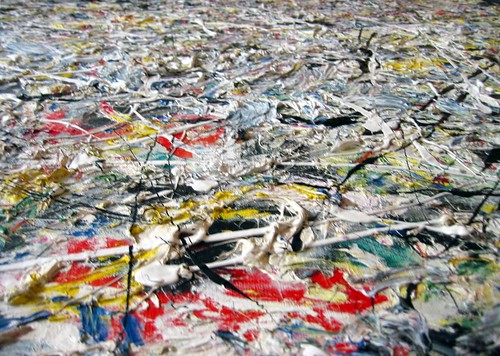


How is all this relevant to ‘Virgin Beauty’, and to the caveats I introduced about Prime Time earlier? Well, despite the instrumentation of Prime Time (drum machines, electric guitars, electric basses), and its incorporation of steady backbeats and funk grooves and rhythms, it's never felt like any other kind of jazz fusion to me, just as ‘Free Jazz’ doesn’t feel like any other kind of free jazz. Maybe it's just the unmistakable quality of Ornette's alto playing, but I think that quality is felt in the tunes as well – both in their particular melodic construction and in the texture which surrounds them. In the Pollock painting, each dribble, each ecstatically wavering line, has equal importance – and with Ornette, each instrument is equally important (and yet the music never looses a sense of order, while retaining a spontaneous edge).

Melody is the primary motivating force behind Coleman's work. At times it can sound like everyone is soloing at once: the rhythm section is not a 'rhythm section' as such, if one thinks of the supporting role that phrase tends to connote – yet at the same time it is very much concerned with generating rhythm. Listen to the deep grooves Haden and Blackwell get into on, say, 'Una Muy Bonita' – it’s not too much of a stretch to see this lineage continuing with the funky guitars, bass and drums of Prime Time. While I agree with Brian Olewnick, who finds Deonardo and Weston's playing on ‘Virign Beauty’ rather too staid and stodgy, without Ronald Shannon Jackson’s spark, it’s clearly not the case that Ornette has simply dumbed-down the backdrop – this is tricksy and complex, carefully composed and stitched together. The lines, or repeating cells that each instrument is playing could be the principal melody – it just so happens that they’ve been arranged so that some seem to be in the ‘lead’ and some in ‘supporting roles.’ It’s not just Ornette playing over lazy funk. If you can’t appreciate this, you’re probably doomed never to fully ‘get’ what Prime Time is about.

Again, it’s about approaching things from the wrong angle. One might easily overlook the complex nature of the music - might even see it as rather stiff, and overly arranged, rather than embracing the 'natural technique' that Ornette is seen as embodying (and does, to some extent). To answer this, the comparison I'd make here is actually Don Van Vliet, who's often cited as having been influenced by Coleman (mostly by ignorant rock critics who think that Vliet's untrained saxophone sound-paintings are somehow similar to Coleman's intricately melodic variations). Yet they share a similar approach to ensemble writing - Vliet's more deliberately 'sloppy' and not holding together, Ornette's always slightly 'not right' (most obviously in his treatment of pitch), yet locked-in more tightly. Each instrument plays lines that may go off in very different directions, individually, yet mesh together to create a coherent diversity. From a musician’s viewpoint, it requires great discipline and attentiveness to what's going on around you, and the fact that it's so easy to overlook indicates just how well this particular group of players pull it off.

The relationship between soloist and rhythm section is best illustrated when things almost fall apart, four minutes into 'Borgeois Boogie' - it seems like the track's going to end up with rather a botched conclusion, Ornette rushing to finish the melody so that it fits with the rhythm section, but you realize that this was all part of the plan when the drums carry on, rock-steady, the basses re-enter with that strange shuddering, repeating riff, and Ornette blasts in on trumpet. Well, maybe it’s wasn’t part of the plan – maybe someone did cock up, maybe Ornette did have to play the melody faster than he’d have liked, but that makes things seem that much closer to the edge, that much more exhilarating. And it’s therefore very apt that it’s a trumpet solo that takes things out – there's something incredibly strange about his trumpet playing - it evades being pinned down technically, and while it's less a 'pure sound' tool in his hands than the violin, becoming increasingly melodic as he grew more familiar with it (it's almost 'straight' on 'Chanting'), it still retains its ‘otherness’ to this day.

There’s so much to admire texturally. The double electric bass texture is delicious; I’m a particular admirer of Jamaaladeen Tacuma's sound (check out 'Honeymooners', where he gets a little space to himself). Those sounds are very 80s, but, in Tacuma's hands, they become something to be savoured rather than deplored (I must remember to check out Weston and Tacuma's work with Derek Bailey on 'Mirakle' again). And that thick guitar backdrop is so clear and yet so dense. My only caveat would be the electronic drums and the synths, which thankfully aren't pushed too far up in the mix (on ‘Chanting’, keyboardist Deonardo is playing some rather nice counterpoint to the lovely trumpet melody, but on a tinny sounding instrument that foregrounds the tendency towards sentimentality already latent in the tune).

Jerry Garcia's contributions amount to the textural rather than, as one might expect, the flashily soloistic, and that’s probably a good thing – we avoid the syndrome of the rock-star guest performer doing their thing regardless of what’s going on around them. Coleman is the only soloist here, even playing some unaccompanied alto on the first half of ‘Unknown Artist’ – and Garcia stands out no more and no less than the other guitarists, Bern Nix and Charles Ellerbee. He doesn’t even appear on some of the album’s best tracks, such as the brief but strong 'Spelling the Alphabet', which sees the band divided up into three groups who throw bits of the melody at each other before uttering it in thrillingly fast unison, Ornette launching off into between speedy and those long, keening notes over a clattering clangour of the electronic drums, bass-dominated repeat of the melody. He’s also absent on the title track, which is one of the most sublime ballads Coleman's ever laid down. One thing that might not be talked about that much is the use of overdubbing - it's very discreet, but very effective. For instance, during the opener, a single trumpet stab recurs at regular intervals, on the beat, or in the aforementioned ‘Virgin Beauty’, what sounds like a slight-slowed down version of the opening melody, low down in the mix, comes in behind Coleman's solo, about two minutes into the piece (and, a minute later, violin underlies the last rhapsodic breath as the melody sounds out one last time).


What stands out most about this music, though, is its sheer sense of fun. Sometimes this means that there’s a tendency towards short, almost throw-away tracks (‘Desert Place’ is almost pop music, or would be if it didn’t feature Ornette’s overdubbed, eastern-flavoured alto/trumpet duet). Yet, most of the time, things come off beautifully. While a title like 'Bourgeois Boogie' might suggest sardonic social comment, even satire, the effect of this track is as intensely joyous as anything Coleman's done. And so, even if, as critic Robert Christgau points out, 'Virgin Beauty' is "the quietest of the Prime Time records--lyrical, sublimely reflective, autumnal at times"; and despite Don Van Vliet's pun on the saxophonist's name as 'Ornate Coldman', such joie-de-vivre shouldn't go unacknowledged. That virgin beauty is still as fresh today as it was twenty years ago.

Thursday, 7 August 2008

Peter de Bolla, 'Art Matters' (2003)


Just finished reading Peter de Bolla’s ‘Art Matters’, having been meaning to look at it for several months after it was recommended to me by a tutor at university (who nevertheless had rather disparaging things to say about it). It’s an attempt to analyse the way we experience art (what he calls ‘the aesthetic experience’), through the author’s personal experience of three works (visual, aural, and verbal), out of which he attempts to draw some more general points. So, book-ended by an introductory and a concluding chapter, we are presented with writing on Barnett Newman’s ‘Vir Heroicus Sublimis’, Glenn Gould’s 1981 recording of J.S. Bach’s ‘Goldberg Variations’, and William Wordsworth’s poem ‘We Are Seven’ (not forgetting an important discussion of British artist Marc Quinn’s ‘Self’ in the first and final chapters).

The subject is a tricky, but fascinating and important one. De Bolla knows a lot more about it than me, but he doesn’t flash this knowledge about – there are few footnotes, and the references to critics and thinkers, such as Kant and Hegel, are sparsely spread out and very much to the point when they do appear. That said, one could criticise his style for being overly wordy, even needlessly impenetrable, setting a maze for itself through contorted syntax, nested clauses, and ‘clever’ wordplay. Here is one of the knottiest passages in the book, and the most glaring example of de Bolla’s facetious punning play on language, which I can’t help feeling rather gets in the way of his argument:
Consequently, in attending to something I am in effect making present presence, and in so doing I experience myself as being present to the object of attention…we may inattend to the unattended to, thereby attending to the unintended. In attending to the unintended through inattention, we make what we have previously kept out of attention sit up and attend to us, to our attentive gaze; we ask it to pay attention….An inquiry into inattention must be a call to attention of attention itself.
(Art Matters, pp.62-3)

I realise I may be being a little unfair in the example I’ve chosen, ripped out of context (it comes in the Bach chapter, from the preliminary section where de Bolla is talking about the way we listen to and concentrate on music). But – and this is precisely the main criticism by university tutor made about the book – de Bolla has the chance to articulate and make clear (as far as that is possible) some very complex and perplexing issues, to really grab the subject of aesthetics by the throat and force it to give up some of its secrets. He does this, but at times so obscures what he is doing through the self-consciously flashy manner of doing it. Yes, these are complex issues, I said that it in the previous sentence. But talking about them needn’t necessarily involve such fussy writing – it would still be possible to make them a little clearer, without compromising the meaning.

Another problem might be that de Bolla, while covering a fairly wide spectrum in the aural and verbal works he analyses – a twentieth-century Canadian pianist’s interpretation of an eighteenth-century German keyboard work (with references to twentieth-century American jazz musicians thrown in as well), and a (very late) eighteenth-century English poem – restricts his consideration of visual art to twentieth-century examples. While the canon of western music that is still listened to today is primarily a more recent phenomenon, covering the past three centuries or so, the visual canon as it remains a subject for discussion stretches further back. To talk about Newman, Quinn and the Chapmans is fine – and, indeed, is probably a far more difficult task than talking about more traditional art-works (abstraction is a tricky thing, and de Bolla manages to discuss it in an extremely perceptive manner) – but I did hanker after at least a mention of one of the Great Masters. How would de Bolla’s arguments pan out if he was talking about a work of art that represented something tangible, rather than simply existing in abstraction? I suppose he does this with the Marc Quinn – which is a life-size cast of a human head – but the modernity of that work (the materials used, the acknowledgment of its ephemerality and changing, decaying nature as the blood turns black and decays) still distances it somewhat from the canon.

Criticisms aside, what are the issues that arise during the book’s 150-odd pages. Briefly, I’ll touch on some of them: the more specific ones that arise from de Bolla’s consideration of the three individual works. The Barnett Newman chapter is concerned with serenity, and with scale: to an extant, de Bolla argues, the massive painting scales us, gives us an altered sense of scale and space, alters our sense of existing in its presence and thereby effects our sense of our own presence in relation to this.
Newman’s pictures overtly pose the question of distance; they ask the viewer to scale him- or herself as an act of witnessing the work. This requires the viewer to accept what I have called the necessity of reconciling two competing statements of presence: that made by the image and that announced by the viewer. In the reconciliation of these two positions the distance between viewer and canvas is all but erased, for the optimum point of sight is identical to the space occupied by the image, suggesting that the canvas itself is a part of the picture-seeing mechanism….What I see is seen under the auspices of what the image presents to sight, what it lets me see. Indeed, to put it one way, the pictures itself ‘sees’ me as much as I see it, and this is certainly a function of distance.
(Art Matters, p.51)


After this, Gould/Bach. Music is perhaps the hardest of the arts to talk about, in that there’s nothing really to grasp onto that will provide a method of entry into describing one’s experience of it (unless we’re talking about music with lyrics, I suppose). Works of literature are written in language, which signifies definite meanings (or, at least, which we expect to do so in everyday discourse – though of course poetry plays on and with the ambiguities inherent within words and syntax), and works of visual art more often than not deal with objects that correspond to something we might see in the world around us (as in the case of a still life, a landscape, or a portrait). But music is fundamentally abstract in comparison. Perhaps because of this, de Bolla’s chapter on Glenn Gould’s 1981 performance of Bach’s ‘Goldberg Variations’ (which, of course, I’ve written about myself, in a post previously published on this blog), is the weakest of the three considerations of individual works of art. It certainly sees him bring in the most contextual information, relating to Gould’s various idiosyncrasies, and, though I agree with his evaluation of the performance, I feel, far more so than in the other chapters, some rather sharp subjective jolts – ‘that’s just your opinion’; why do you define the state this provokes in you as ‘wonder’?


But moving, on we finally reach what is perhaps the pick of the three essays (saving the best for last): an analysis of Wordsworth’s ‘We Are Seven’ that both is and is not a model exercise in ‘close reading’. De Bolla doesn’t really talk that much about specific linguistic features – his analysis tends to focus instead on the philosophical implications of a particular phrase. Rather than discussing rhyme, or rhythm, or syntax, he’ll worry away at a single line for several pages, talking about naming and numbering and the relation between words and reality, language and experience, a child’s and an adult’s perception of the world, of life and of death. It’s masterful, though not exhaustive (and not intended to be so), and leads on to some of the most important ideas/ conclusions in the book.

‘Thoughts that lie too deep for tears’ is a Wordsworthian phrase de Bolla picks up on, and he makes an important argument about what he thinks an aesthetic experience is not. It is not, as one might generally suppose, of feeling (though this is present, undeniably – de Bolla is, as he readily admits, talking about occasions when he was in a state of being ‘profoundly moved’ by works of art). But that is not the most important thing. The most trivial things can spark off torrents of emotion in different people – what de Bolla is primarily interested in is not the trigger to the individual, subjective emotional response that a work of art might provide, but in the knowledge that the artwork might have – knowledge about itself, about the world, even about the viewer. Seeking out art for solely emotional needs, then, leads to it becoming almost commodified (in de Bolla’s example: I’ll listen to Beethoven’s 3rd piano concert tonight in order to give myself (in order for it to give me) the feeling of elation familiar to me from that work – like an artistic happy pill).

In the final section, de Bolla talks about the aesthetic experience and the problems in defining it, for it is at once subjective yet rooted in the ‘art-ness’ of the work itself, which (as Michael Wood also argues in his ‘Literature and the Taste of Knowledge’), ‘knows’ something (though not in any propositional sense – it doesn’t ‘know’ easily-describable/utterable data). Yet to sense this sense/knowledge, we are still rooted (trapped) in the subjective – we can only perceive the quality inherent in the work of art from our own point of view. No two people can have the same aesthetic experience. It is not reproducible outside of oneself.

Perhaps it’s because of this that de Bolla resorts to using generalised words like ‘wonder’, ‘amazement’ and ‘spell-binding’. Perhaps it’s inevitable, something one just can’t get round once one reaches a certain point in the discussion of art. After all, even the resolutely taciturn Derek Bailey approaches the mystical when he talks about the ‘magical side’ to the sort of interaction encountered in free group improvisation (‘Improvisation, Its Nature and Practice in Music’, p.112). Still, I’m a little sceptical of de Bolla’s resort to the word ‘wonder’ to define the essential quality of the aesthetic experience – at first, it seems a little randomly chosen, though I think he just about justifies its use by the time we reach the book’s conclusion. It’s about acceptance of solitude, arising from the subjective nature of the necessarily individual aesthetic experience, as outlined above – although I can convince someone else of the validity of my own experience, I can never convince them to share exactly the same experience. It’s also about sensing a knowledge that one can never quite grasp – the (great) artwork never quite gives up its secrets, and neither does the human condition, the condition of living in the world, the transience and ignorance of being human. Art helps us to accept this, at the same time as forcing us into thinking about it, exacerbating this thought – it tries to cure the wound it creates (or, at least, the wound it dis(un)covers, brings to light). This fragility, this keen balance, this disturbing quality, is what de Bolla so admires about Marc Quinn’s head-constructed-out-of-frozen-blood sculpture, ‘Self’ – though he carefully distances his appreciation of this work from the simple and short-lived ‘shock’ factor purveyed by artists such as the Chapman brothers, which leaves little of lasting value after the initial startling impact. There is, then, a distance/difference between ‘wonder’ and ‘surprise’ or ‘shock’ – the latter being something which must necessarily end far sooner.
Confronted with something new and for which we are unprepared […] we find it very easy to accommodate the new and to render the force of the shock unremarkable. Wordsworth had a good phrase for that which takes a little longer; he called it the ‘shock of mild surprise’, and the milder the surprise, generally speaking, the more enduring the shock…Much contemporary visual art has the capacity to shock in spades: many of the works in the Saatchi Collection displayed at the 1998 Royal Academy ‘Sensation’ show would provide good examples – the sculptures produced by the Chapman brothers that distort the human body and displace the sexual organs come to mind –of how surprise quickly runs out of steam, loses it appeal, fades into the familiarity of being shocked.
(Art Matters, p.142)

It is on the state of wondering fragility, rather than shock, that de Bolla concludes. His is not a perfect book (more criticisms over at http://posthegemony.blogspot.com/2006/02/refinery.html), but it is a valuable one, and timely too, in that it is becoming so common to read and hear misunderstanding definitions of the role and nature of art in modern society. Of course, our appreciation of art is to some extent ideologically driven – de Bolla doesn’t deny this, but he allows art its autonomy, its independence – he goes some way towards defining it what makes it art, its reason, mode, and method of existence. In the process he suggests the ways in which it can teach us some valuable lessons – and the most valuable lesson of all is perhaps that these lessons will be lessons in not knowing as much as in knowing.

Wednesday, 23 July 2008

'Wanted'


Starring: James McAvoy, Angelian Jolie, Morgan Freeman
Music: Danny Elfman
Director: Timur Bekmambetov
Writers: Michael Brandt, Derek Haas, Chris Morgan (screenplay), Mark Millar, J.G. Jones (comic book series)

A blockbuster with a dislikable sneer about it, ‘Wanted’ explicitly addresses the idea of film as escapism, revealing in a way that is fascinating, though repulsive, the impulse lying behind cinema in its modern, entertainment-heavy Hollywood form: you, the pathetic loser working (say) at the checkout till, stacking shelves, stuck in a dreary office job, slacking through life with no discernable purpose, can, in the space of two hours in front of a big screen, get the girl, shoot the gun, drive the car, live through your fantasies, be the hero (invariably, the male hero). But it gives this wish-fulfillment fantasy, perhaps harmless enough in itself, a nasty twist: McAvoy, who’s been transformed from wimpish loser (or “pussy”, as he’s described) to action hero, delivers the film’s final line straight to camera. Having outlined his transformation (just one more time, in case we’d missed the rest of the movie somehow), almost as if he’s ticking off a checklist of goals/targets, he concludes: “This is me taking back control of my life. What the f*ck have you done lately?” Black screen and credits. Here, the scriptwriters have introduced a distance between viewer and film that shatters the usual identification of viewer with hero in a disturbing way – our reaction is perhaps to smirk, but also to cringe. Having satisfied the desire to be the hero that I outlined above, at the last minute the film snatches it away, anticipating the return to drab reality – and, indeed, not just anticipating it, but accentuating it.

One could argue that, though cruel, this maneuver is maybe an important reality check. However, I think there’s more to it than that. The suggestion latent in these closing lines is that, unless you do all the things that McAvoy’s character has done, you’re just a pathetic loser – yet the film’s morals are questionable. A train crashes off a cliff (said crash being partly due to the hero’s actions), so presumably everyone on it dies, but the film-makers aren’t concerned with in the slightest, focusing only on the three characters involved in the plotline. Such callousness advances beyond the norm, maybe – but, in what is becoming an increasingly predictable trend, hordes of extras are mown down in a particularly violent climax (not to mention the advocation of animal cruelty, as rats are wired up with explosives and blown to smithereens as part of the hero’s cunning plan to infiltrate the enemy stronghold).

That climax got me thinking: is it me or is there a trend for every new action film to contain every greater doses of car-crashing, bone-smashing, head-exploding violence? Such excess totally leaves reality, at the same time as maintaining a tenuous enough link to suggest that a particularly extreme form of hooliganism might be rather a fun thing to indulge in – because that hooliganism is essentially what it boils down to. As a zeitgeist, it’s a worrying sign – like the US soldiers listening to rock music and treating Iraq like it was a movie, or a computer game, rather than a sensitive situation dealing with a different culture and with human beings. I can’t help feeling that cinema, with its faceless dead guys being blown to bits on the edge of the screen, feeds this dehumanizing of the ‘other’.

In this mindset, all problems can be dealt with by violence (hence, in ‘Wanted’, McAvoy verbally lashes out at his boss, punches his best friend, who’s been having an affair with his girlfriend, and shoots a lot of people to let out his rage). While people criticize a film such as Kubrick’s ‘A Clockwork Orange’, I fail to see how this is any better – to me, it is far more objectionable and potentially damaging in its effects that Kubrick’s film. ‘Orange’ was disturbing intentionally, and though ambiguous in its attitudes to the gang of thugs, at least such ambiguity made the viewer think. ‘Wanted’ is not intended to be disturbing, or to make the viewer think – and, considering the subject matter, that is what makes it all the more troubling.

Returning to those final lines, then - by “taking back control of my life” (which is presumably supposed to be an admirable thing – sounds like it comes from a self-help manual), what is really meant is a form of macho self-assertion through violence. Huzzah.


So far, I’ve only talked about one character. Let’s move on to the others, then: Angelina Jolie is there primarily to pout and wear leather jackets, though at least there’s no love interest with McAvoy, and she is shown as strong and resourceful (in a nice role reversal, it’s McAvoy who spends the duration of a car chase screaming his head off, while she’s the one who takes control). Morgan Freeman is there to do very little (nowadays, it seems that he doesn’t really have to act at all – he can just turn up in any film and automatically lend an air of wisdom, gravitas, dignity, etc). I was mildly amused when they attempted to depart from his image a little bit, as he spouted some Samuel L. Jackson-style lines (in other words, using the word ‘f*ck’ once or twice). Even Terence Stamp turns up at some point to fill in a few plot gaps.

Interesting issues are raised in the idea of the portentously-named ‘Loom of Fate’, which for a moment leads one to suspect that a Matrix-style philosophical fantasy is about to unfold (though in the end it’s all dealt with rather inconclusively and incoherently). Elsewhere, the screenplay is often unbelievably cheesy. Characterization here is an absolute no-no – not even in the elaborate cartoon sense of the ‘Kill Bill’ assassin back-stories (the one attempt at back-story here (Jolie’s) peters out almost as soon as it began). There’s a complete lack of emotional identification, or the creation of any emotion at all, besides a delight in all the chaos unfolding. The script-writers seem just not to have cared, even stealing the Star Wars idea of the central character seeking to avenge a father’s death, only for the villain to reveal, “No, I am your father.” Ouch!

Perhaps that’s inevitable in a movie based on a comic-strip. Maybe they should have just left out dialogue altogether and concentrated on what really mattered – the special effects – for, as Roger Ebert points out in his review of the film, there are probably only 10 or 15 shots in the entire movie which do not rely on these. How long is it before the latest blockbuster is just two hours of gunfire, explosions and carnage, with no plot to give it even a tenuous reason for existing?

Sunday, 27 April 2008

The dark side of English folk

Phil Minton - The Cutty Wren

Whereas much twentieth-century folk-inspired music seems rather twee and naive (part of its charm for a lot of people), the original material often deals with very grim subject matter, with the realities of life for ordinary people. That's certainly true of this song, which turns out to be about eating policemen! More specifically, about eating the Cutty Wren, the mercenary police who clashed with the peasants during the Peasant's Revolt of 1381. When the peasants managed to kill a 'wren', they would then eat them, to destroy the evidence and stave off starvation.

Phil Minton, more often heard in a free improvising context, takes vocal duties here, with accompaniment from fellow free improviser Veryan Weston at the piano. Minton's extended techniques are massively impressive, though his use of them can verge on the hystrionic. Or, to put it more favourably, he has a great sense of drama. Listen to the way he treats this song, giving it extra shades through adopting different accents and giving it all a gravelly, gritty fervour, as well as adding a dose of macabre humour to proceedings, to ensure that the lyrics' repetitive structure builds up an impressive cumulative intensity. His voice ain't exactly pretty, but then, he's not singing about pretty subject matter...

"...We're off to the woods said John the Red Nose

And what will you do there said Milder to Moulder
We'll shoot the Cutty wren said John the Red Nose

....Oh how will you cut her up said Milder to Moulder
With knives and with forks said John the Red Nose
Oh that will not do said Milder to Moulder
Great hatchets and cleavers said John the Red Nose

Oh how will you boil her said Milder to Moulder
In pots and in kettles said John the Red Nose
O that will not do said Milder to Moulder
Great pans and large cauldrons said John the Red Nose

Oh who'll get the spare ribs said Milder to Moulder
Oh we may not tell you said Festel to Fose
We'll give 'em all to the poor said John the Red Nose
We'll give 'em all to the poor said John the Red Nose."

Comus - The Herald

Comus' music, too, comes from a dark place. A band dealing in British folk/prog-rock, with a touch of jazz, they only released two albums: 'First Utterances', from 1971, and a 1974 follow-up, 'To Keep from Crying'. 'Utterances' is generally regarded as the best, a minor classic (though it was a commercial failure at the time - too dark and rough-edged for folkies, too folky for rock fans), whose songs deal with such happy themes as murder, the occult and rape, among other things. John Milton's poem/masque, from which the band took their name, describes the preying of a wood demon-style figure (inspired by the Greek god of drunkenness, festivity and chaos) on an innocent young girl, and this music has a similar feel of vulnerability, of beauty and innocence struggling to survive in a dark world. Sometimes this is conveyed explicitly, through dissonance and barking, animal-like vocals; sometimes more subtly (and more chillingly), by contrasting a peaceful-seeming musical surface with lyrics that speak of great suffering and anguish ('The Prisoner', which deals with mental illness). Indeed, singer Roger Wootton was in and out of mental hospitals, although managing to make the band's 2007 reunion tour.

This 12-minute piece, the longest on the album, unfolds in several sections, opening with what sounds like a theremin before the main melody comes in. After that fades out, around four minutes in, a beautiful section of fingerpicking guitar, with a feel of beauty in the face of/in spite of adversity, flowers in the mud, making it all the more hard won. There's a questing, roving feel to the harmonies; things aren't quite certain, they're struggling on the edge of settling down but remain perpetually unable to do so. Some flutes briefly join the guitars before that section fades out, and the theremin, and then the main melody, return. It's partly the instrumentation that makes this particular part so evocative, I suspect: viola, oboe, soaring female vocals, delicate guitar strum. As well as its emotional impact and strong sense of tone painting (this music practically screams 'English countryside'), the tune also reminds us of a time when genres converged without such a fusion seeming artificial or forced - you can hear traces of folk, jazz, prog-rock (in the somewhat episodic, suite-like structure), and even a touch of the old film score (easy to imagine this accompanying something like 'Wuthering Heights'). The fades lead me to suspect that his was edited down from a longer performance, or perhaps spliced together from several different ones; either way, a wonderful track.

Thursday, 17 April 2008

Marion Brown - Porto Novo


I don't do this very often (mainly because I don't have superduper hi-fi equipment), but here's an out of print album for download.

It's Porto Novo, by Marion Brown, and it's ripped from my LP at 192 kbps.

The sound engineering on the LP itself is slightly strange, really amping up Bennink's drums (I'm guessing the guy was more used to dealing with rock/pop musicians than the likes of Han), but at the same time giving them a really strange, off-kilter quality that's hard to describe. I think Chris Corsano (of the Flowers-Corsano duo) calls it "fucked-up."

It's a fascinating record, one of the strongest examples of Brown's 'purer' free jazz style (before he began to move towards more lyrical explorations with the likes of 'Sweet Earth Flying' and 'Vista', and, eventually, straightahead jazz (on 'Live in Japan' and 'November Cotton Flower')). Good as his albums for ESP-disk are, and good as 'Three for Shepp', on Impulse, is, they don't hold a candle to this one.

Altena's none too well-served by the aforementioned sound engineering (in the trio passages, it's Bennink and Brown who dominate), but, when he gets the chance to solo, he's heard to good effect, often producing sounds one would tend to associate more with avant-garde classical music than with jazz.

Bennink has moved on a heck of a long way from the somewhat edgy straight jazzer trying to keep up with Eric Dolphy on 'Last Date': he sounds propulsive, confident, brash, energetic, without cluttering the music. His playing here isn't quite up to Sunny Murray levels of cymbal-splash noise-bash (and isn't trying to be); neither is it the Rashied-Ali magic carpet colouristic approach, but HB's own maverick kineticism.

And Brown? Well, despite his neglect, he was certainly as good an improviser the better-known 'New Thing' musicians Shepp and Sanders. All along though, he wasn't so much 'New Thing' as into his own thing - a good dose of classical influence, an interest in ethnic musics (which, admittedly, Sanders and Shepp shared), and, above all, a sparer approach than the other two musicians. Whereas Shepp and Sanders were well capable of emoting to great effect (the prelude section to 'Creator has a Master Plan', or Shepp's gorgeous, impressionistic reading of 'In a Sentimental Mood' (from 'On this Night', 1965)), Brown was more understated, relying on the carefully chosen phrase, on clear motivic development rather than the pure sound/smear/scream tactic. Listen to the phrase he plays in 'Improvisation' (which also crops up in his solo on one of the other tracks). Just perfect.

I won't bother with track-by-track analysis: you can find that out for yourself. And some of these tracks were posted (in a cleaner rip) on the destination...out blog a while back. But I thought people who haven't had the chance might like to hear the whole album.

Here's the link, then. Info and scans included with the music.

http://sharebee.com/842f497d

Monday, 14 April 2008

The Cambridge Free Improvisation Society - Miracle of the Sun (2008)


Just under a month ago, I posted about material by the Cambridge Free Improvisation Society, which was being made available on the internet, and briefly mentioned the album 'Miracle of the Sun', which can be streamed from the CFIS' Last FM page. However, as that page doesn't seem to be getting any listeners, I thought I'd make it easier for people to get hold of this stuff, and am putting up a download link.

The Cabmbridge Free Improvisation Society - Miracle of the Sun

Jacken Waters - electric guitar/ effects
Dan Larwood - electric guitar with delay pedal
David Grundy - laptop, piano, recorder, radio

Recorded at Robinson College, Cambridge
6th February 2008
192 kbps/ 96.7 MB

Get it here! (artwork at top of post)
http://www.mediafire.com/?ydcy9xthxgy

Music with liberal doses of guitar feedback! Please leave written feedback too!

Friday, 28 March 2008

EARTRIP (magazine)

I've been creating the first issue of a new jazz/improv/experimental music magazine for around six months - and now it's finally here. You can download it by following the link, which I've posted at the magazine's shiny new blog:

http://eartripmagazine.blogspot.com/