Wednesday, 22 August 2007

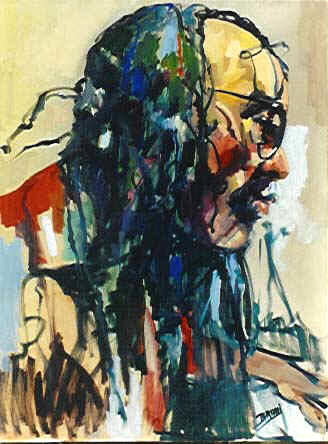
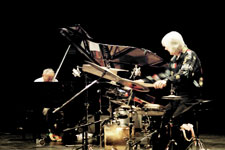
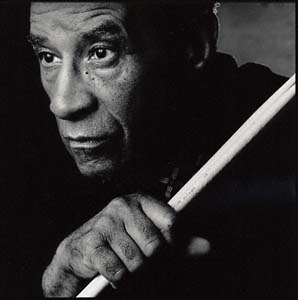
Max Roach R.I.P.


Max Roach: "I always resented the role of a drummer as nothing more than a subservient figure. The people who really got me off were dealing with the musical potential of the instrument..."

Stan Levey : "I came to realize that, because of him, drumming no longer was just time, it was music."

Max Roach: "You have to pursue, pursue, pursue: sometimes it works, sometimes it doesn't, but if you've been around as long as I have, you can afford to take chances."

Legendary jazz drummer Max Roach died last week. He was 83 and had been ill (with dementia/Alzheimer's) for some time. I haven't got round to writing something until now, as I really wanted to justice to his fantastic career and achievements. Still, in a way, I feel that an entry like mine - hopelessly brief, unable to do justice to Roach's huge legacy (huge chunks of which I am not nearly familiar with as I should be) - is not really serving any purpose. But then again, I amin in this blog (somewhat selfishly) to present things that interest and touch me, I also hope that, by doing so, I can say something that will touch someone else, somewhere.

One of jazz's greatest percussionists, Roach's career encompassed a huge variety of styles and collaborators, from his work with Charlie Parker and Miles Davis to MBoom, a percussion orchestra, and duets with avant-garde players Cecil Taylor, Anthony Braxton, and Archie Shepp. In the 1950s, he was one of the prime musicians in the be-bop movement, appearing on legendary recordings with Parker, including the superlative 'Jazz at Massey Hall' from 1953. What made him stand out from earlier styles of jazz drumming was that he didn't just 'keep time' and provide a backdrop/cushion for the 'main men' - the horn players and the piano players - to solo over, but also provided a counterpoint, rhythmic and melodic, to what the soloists were doing, actively interacting with them without ever becoming cluttered or intrusive. As he explained, his experience with the Charlie Parker allowed him greater freedom to develop as more than just a mere time-keeper: "One thing I gloried in, working with people like Charlie Parker, was the built-in rhythm section. You didn't need a drummer or a bass player to know where the time was." But he was not a show-off, grandstanding drummer (as some might have accused Art Blakey of being), acknowledging that "jazz is a very democratic musical form. It comes out of a communal experience. We take our respective instruments and collectively create a thing of beauty.” It was not necessary for him to grandstand; those who did might get noticed more, but Roach's more understated approach showed far more subtelty and sensitivity to the collective whole, as Gary Giddins, in his 'Weatherbird' column for The Village Voice, explains:
"Even Buddy Rich, who knew he could paradiddle Roach or anyone else into oblivion, was obliged to consider the limits of supersonic paradiddling...Rich 'ran Roach out of the recording studio' when they recorded together in 1959, but an earlier unspoken contest tells a different story: the records each man made with Parker, where Roach is exalted and Rich frequently at sea."
Peter Breslin, over at his 'Stochasticatus' blog, puts it more explicitly:
"I have nothing against flash. And Roach had plenty of flash himself (his hi hat solos, for but one example). But Roach also made music. Always. He was an artist first and a drummer second. And I can clearly hear that the end result of this sort of priority is that one becomes massively expert on one's instrument. But the technique is in the service of some sort of statement. Roach was always saying something. Some great drummers are sometimes simply saying 'look at how great I am.' "
(http://peterbreslin.blogspot.com/2007/08/max-roach.html),

Roach founded Debut Records with Charles Mingus, one of the first musician-run labels, and co-led a group with trumpeter Clifford Brown - a group, instrumental in the formation of the so-called 'hard bop' style, that was known as one of the greatest in jazz history. Brown's tragically early death in a car crash affected him deeply, but he continued to record and perform in many different contexts: in an excellent quartet with Odean Pope and Cecil Bridgewater; a 10-member drum ensemble, M'Boom; and with gospel choirs, symphony orchestras, brass quintets and Japanese drummers. He also composed music for dance pieces by Alvin Ailey and for plays by Sam Shepard. In the 1980s and '90s, Roach often performed with a string quartet that included his daughter Maxine Roach on viola, played drums in spoken-word concerts with writers Toni Morrison and Amiri Baraka and even accompanied hip-hop artists. His stature as a giant of the music was recognised when, in 1988, he was among the first jazz musicians to receive a MacArthur Fellowship, or so-called "genius grant." He was ill for the last years of his life, and his last recording came 5 years ago: 'Friendship', a collaboration with 82-year old trumpeter Clark Terry.


I was watching videos of Martin Luther King speeches on youtube (there's also a video on there of Roach playing an improvised drum solo as accompaniment to a recording of King's "I have a dream"), and it got me thinking about how distanced jazz has got from the sort of social and political concern of people such as King. So often nowadays, jazz is seen as something rather glib and shallow, an affected style rather than a music of protest and a music expressing real lives, real problems. Wynton Marsalis' work at the Lincoln Centre, however well-intentioned, has a negative effect that, for me, outweighs any of its positive aspects - that of enshrining the work of the masters of the past with scant regard for the fact that they were masters precisely because they were forward-looking, because their music did not rely on cliche. Sure, tradition is a vitally important part of jazz- Andrew Hill understood that, Charles Mingus understood that, Archie Shepp, for all his reputation as avant-garde firebrand, understood that - yet tradition for its own sake, tradition as a endless cycle of recycled music, of other people's music (or your own music, sounding like other people's), is not, for me, what jazz is about. Jazz is about being on the edge - about the excitement, the hint of danger in testing untried waters (as Roach did when he re-formulated the role of the dummer in his be-bop work with Charlie Parker - be-bop may now seem almost old hat, but back then it was something fresh and wild, something that could make Jack Kerouac "popeyed with awe"). By way of comparison, just imagine if classical music had never moved on from the baroque...The be-bop pioneers, I'm sure, did not think that their style would become entrenched, with minor variations, as what jazz is, fifty years on.

And so Roach, despite his role in some of the greatest jazz groups ever assembled, he never once rested on his laurels, playing with string quartet and orchestra, the avant-garde, MBoom, etc: "You can’t write the same book twice. Though I’ve been in historic musical situations, I can’t go back and do that again. And though I run into artistic crises, they keep my life interesting." As he told Mike Zwerin in a 1999 interview, he was asked by the self-appointed guardians of jazz's past, the fetishisers of tradition -
"You used to play with Charlie Parker. How can you work with these guys [Shepp, Cecil Taylor, Anthony Braxton]?"
"I answered this way," Roach said. "A person like an Anthony Braxton is more like Charlie Parker than a person who plays like Charlie Parker. Bird was creative and different and looked inside himself. He knew what Johnny Hodges and Benny Carter and the rest of them had laid down. That was the foundation. Bird built on that foundation.
"Now you have people like Phil Woods who preserve the tradition. And then there are people who push forward, who perpetuate the continuum by trying out things. Cecil Taylor is more like Art Tatum than a guy who plays like Tatum. It may not always come off, but that's what creativity's about. Anyway, by now people accept me for what I am."
('From Hip Hop to Be Bop: An Interview' [Interviewer - Mike Zwerin, 14 January 1999] http://www.culturekiosque.com/jazz/miles/rhemile29.htm)


KRIS TINER at 'Stop the Play and Watch the Audience' makes a lovely point that it's important not to miss in the flood of tributes.
"If only so many of those who will be lauding Roach from the lofty edifice of jazz education would recognize that he didn't just help to create a style, but that he continued to push the music, and continued to recognize and support others who were pushing the music, far past the crystallization point of bebop in the 1950s."
(http://kristiner.blogspot.com/2007/08/todays-listening.html)

It's something that it will be very easy to miss in the flood of tributes and nostalgia that Max's death will bring, but a point that is incredibly important. Jazz has to be appreciated not as a style, an idiom - 'I like jazz, I like be-bop' - but for what it can do, for whether it's good music or not. (Though of course the question of 'good music' is a minefield!) So, repeating be-bop cliches now may be less relevant than what Cecil or Braxton are doing - be-bop was the revolutionary jazz of its day, after all.

Roach was not just progressive, or non-passive, in musical terms, but in political and social ones as well - in fact, for him, as for many of the 1960s free jazz players, the music and the politics were intimately connected. He put it this way: "art is a powerful weapon that society, or the powers that be, use to control or direct the way people think. Culture is used to perpetuate the status quo of a society. Even though I'm involved in music for the sake of entertainment, I always hope to offer some kind of enlightenment."


Perhaps his most famous recording as a leader was 'Freedom Now!', recorded for Blue Note records with his then-wife, vocalist Abbey Lincoln. With track titles like 'Freedom Day' and 'Tears for Johhannesburg', and a cover depicting a sit-in strike was released, it was obvious from just looking at the record sleeve that this was a politically engaged and concious mode of jazz, and the music itself, with Lincoln's extraordinary, passionate vocals, more than confirmed this imrpession. After the album's release, Roach told Down Beat: "I will never again play anything that does not have social significance. We American jazz musicians of African descent have proved beyond all doubt that we’re master musicians of our instruments. Now what we have to do is employ our skill to tell the dramatic story of our people and what we’ve been through.”

Free jazz saxophonist Archie Shepp was another man who, like Roach, stressed the political messages that lay behind his music, and who, also like Roach, often straddled a line between the avant-garde and more traditional, conventional forms of jazz. The duo albums they released, 'The Long March' (Parts 1 and 2) and 'Force' are long out of print, but should be required listening for admirers of both men. But it was perhaps Roach's collaboration with another free jazz titan that really set the sparks flying - pianist Cecil Taylor.

The duets with Taylor were, as one critic puts it, encounters between the most musical of drummers and the most percussive of pianists, and they saw a true meeting of minds, with the explosive Taylor pushed for sheer stamina and ferociousness of concentration and sound-production by Roach. Gary Giddins in his 'Weather Bird' column for The Village Voice, reviewing a concert Roach gave with Taylor at Columbia University in 2000, gives an example of the spirit in which this muic was made:
"Roach, who leaned heavily on a tuned tom that suggested a tenor timpani, never flinched. Au contraire: After 50 minutes or so, Taylor began what seemed a negotiation for closure; he looked up at the drummer and offered a possible clearing space, to which Roach responded with a furious fusillade that brought the pianist back to the front line. That happened several times, I think—Taylor working toward an exit and Roach slamming all the doors. Finally, at the hour mark, they agreed to desist, or at least ventured enough of a pause for Taylor to walk away from the piano, at which point Roach embarked on a drum solo. These guys, 71 and 76..."

Well, Cecil Taylor still soldiers on, as evidenced by his performance with Anthony Braxton at the Royal Festival Hall earlier this year, but Max Roach's boundless energy and exquisite musical sensitivity and good taste are no more. Rest in peace.

Monday, 13 August 2007

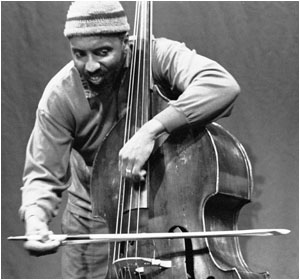
R.I.P. Paul Rutherford and Art Davis

I've been on holiday to Italy for 10 days, and when I got back, I read the sad news that bassist Art Davis and trombonist Paul Rutherford had both died while I was away.

Davis was trained as a classical musician and started out in the 1950s with Max Roach and Dizzy Gillespie. He is perhaps most famous for having played on six of John Coltrane's albums, including Ascension and Olé, often in tandem with Jimmy Garrison; their duets, in which he plays arco over Garrison's thick plucking, creating a mesmeric effect which is particularly in evidence on the title track of Olé. Though the other bassist on that piece is actually Reggie Workman, not Garrison, they venture into similar territory, their double solo culminating in a section where they produce horn like sounds, so that when Coltrane re-enters on soprano sax the textures blend and it almost sounds as if all three are playing the same instrument.

But Davis' relationship with, and influence on Coltrane extended beyond just his recordings with the saxophonist: as Valerie Wilmer comments in her classic book on the American 'New Thing', As Serious as Your Life, the two played extensively in private, "experiment[ing] frequently with various modes, sounds and rhyyhms." Davis assisted Coltrane with some of the chord progressions used on Giant Steps, and, though he was never able to become part of any of his regular working groups because of other engagements, "the high esteem in which he was held was shown by the saxophonist's insistence that his name be listed with the horns rather than in the rhythm section on the sleeve of Ascension" (Wilmer).

As well as Coltrane, Davis played with a large and varied number of leading artists including Quincy Jones, Judy Garland, Bob Dylan, Barbra Streisand, Hank Williams, Erroll Garner, Count Basie, Lena Horne, Ornette Coleman, Roland Kirk, and McCoy Tyner. He also worked in TV orchestras (NBC, Westinghouse Television and CBS), and classical orchestras, including the National Symphony, the New York Philharmonic, the Los Angeles Philharmonic, Radio City Music Hall Symphony, the Westchester Symphony and the Orange County Symphony. However, despite his prodiguous abilities on his instrument (something he proclaimed on his website, describing himself as "the greatest bass player in the world" - not the most modest man in the world!), he also claimed that he had been denied permanent positions in these orchestras because he was black (something Charles Mingus also claimed) - in the 1970s, he even sued the New York Philharmonic for not offering him a full-time position.

As time went on, he drifted away from music (partly because of the protracted court case against the New York Phil, which lead to him being blacklisted (or, as he put it, "whitelisted"). Instead, he became involved in psychology, receiving master's degrees from the City University of New York and New York University and a doctorate from NYU in 1982, and taking up counselling work. By 1986, though, he began to play publically again, touring Europe and Japan, recording with pianist Herbie Hancock and Coltrane's son, saxophonist Ravi Coltrane, and establishing a foundation that awarded scholarships to underprivileged students. He played with David Murray's All Stars in 2000 and organised annual tributes to John Coltrane in Los Angeles but mainly devoted himself to teaching and playing occasionally in clubs in the city.

Steve Voce, in his obituary of Davis for The Independent, has this to say:
It's hard to imagine a more stunning jazz bassist than Art Davis. He was a virtuoso with a fat, perfect sound on the instrument. He was intelligent enough to blend into any kind of group that he chose to play with, be it Louis Armstrong's, John Coltrane's or James Brown's.


Paul Rutheford, meanwhile, was a pioneer of free improvisation on the trombone, pioneering the use of multiphonics and vocalised techniques on the instrument. He talks more about the development of his style in an excellent interview from 2006 on the All About Jazz website (the whole thing can be found at this address - http://www.allaboutjazz.com/php/article.php?id=22016).
I’ve always been radical and I can remember one specific time when I started to play the trombone, I practiced in front of the mirror and watched myself play. I started to investigate the possibility of singing—double-stopping— and it developed from there. I found it to be so unbelievably flexible, and another trombonist might think it was a cumbersome instrument. If you know how to flick the slide, you can play unbelievably fast. I’ve always been interested in that flexibility, which has led me to be more involved in improvisation. I still love playing music in an orchestra, but really my love is just to get on stage and flick the bugle, you know.
Rutherford founded the Spontaneous Music Ensemble with John Stevens and Trevor Watts in 1966, and Iskra 1903 with Barry Guy and Derek Bailey in 1973. His work also encompassed solo playing (including the album The Discreet Harm of the Bourgeoisie from 1974), stints with Mike Westbrook and the London Jazz Composers' Orchestra, and more mainstream commitments with Soft Machine and the Detroit Spinners, a rhythm and blues band. His dedication to the music he played and musical integrity was never in doubt:
I remember one case many years ago in Berlin at the FMP festival, and every year they had a special situation for trombone or saxophone soloists or whatever, and there were five or six trombone players from all over the place. One of the guys who played was involved in contemporary music, [Vinko Globokar] and he had to do a solo one night, another night it was me, and I think another night was Gunter Christmann. Anyway, Vinko came up and said “what are you going to play for your solo?” I said “I don’t know. I’m just going to go out and play.” He said “don’t you have an idea what you’re going to start with?” I said “no, and I don’t want any idea. I’m going to improvise, and I’m going to go on to play improvised music.” This is what actually angers me a little bit about some improvisers is that they go through this little routine of licks, and I don’t want that. I want to go out not knowing what will happen, just getting onto the platform and playing. It will happen anyway.

Though he was a busy man in the 70s and 80s, work dried up towards the end of his life, though he appeared fairly regularly in gigs at the Red Rose in London (including this year's Freedom of the City festival). In a way, what's sadder than the fact that he's died is the fact that, despite being one of the foremost free improvisers on the scene, of the same calibre as Derek Bailey, Evan Parker and the like, he was unable to get regular work in the last few years of his life, leaving him depressed and struggling.
I just get so depressed about it—Christ, I know how good I am, but it doesn’t do me any good money-wise. I’m in the worst economic situation now that I’ve been in my life. There are things you take for granted—sometimes I go out for an Indian meal, and I know it sounds silly, but I can’t even think about that now. Inviting a lady out for a drink or a meal is totally out of the question—I can’t afford it. Simple as that. I’m on pension now—I’m 66 years old—and I’m having trouble with the pension. I’m seriously, seriously depressed and I’m just looking forward to getting to the States.


Not exactly a happy note to end on, but then again, there's no point in sugaring the pill. Improvised music has never found much of an audience in Britain, and, beyond a small group of devoted fans, is never likely to find much financial support, so musicians whose beliefs lead them to commit themselves to such non-commercialy viable work are not in for an easy ride. Anyway, click on the link below for a chance to listen to Paul Rutherford, playing wonderfully, as a member of Iskra 1903, on disc two of the rare 3-LP set 'Free Improvisation', released by Deutsche Gramaphone in the 1970s, and long since out-of-print. http://direct-waves.blogspot.com/2007/03/iskra-1903-wired-new-phonic-art-free.html.

Monday, 30 July 2007

The Great Silence

Today, I thought I'd post a review of a fairly obscure spaghetti western made in 1968, directed by Sergio Corbucci, 'The Great Silence.' It was released on DVD a few years ago, so should be fairly easy to get hold of, boasts a fine score by Ennio Morriconne (perhaps one of his best), and is a cut above your average Italian western. More detailed thoughts continue below the picture...


The setting – a bleak, snowy Utah in the 1840s.

The characters – a corrupt ‘justice of the peace’ who controls the town. A beautiful widow seeking revenge for her husband’s murder. A lone gunman whose speed on the draw is renowned throughout the state. And a group of bounty killers hunting down others for profit.

So far, so very standard spaghetti western. But this is no ordinary western, spaghetti or otherwise, and, while parts of it are stilted and the technical competence is sometimes lacking, it’s probably the bleakest and most thought-provoking film in the genre you’ll see for quite a while.

Certain elements immediately mark it out– the bleak, wintry setting (which was also employed in Andre de Toth’s excellent ‘Day of the Outlaw’ from 1959, starring Burl Ives and Robert Ryan), and the fact that the widow is a negress (played by newcomer Vonetta McGee, a striking actress who’d started out in experimental theatre and been involved in social activism, before going on to act in low-budget European movies, and then carve out a career of sorts in the 70s Hollywood Blaxpoitation boom). Tying in with this, there are a number of oblique references to racism (the villain, Tigrero/Loco, comments, “what times we live in - black’s worth as much as a white man”), something that perhaps raises connections with the so-called ‘political spaghettis’ being made by directors like Damiano Damiani (‘A Bullet for a General’). The fact that the hero, the lone gunman, is a mute who speaks not a word and makes no sound for the entire film, takes the spaghetti western tendency to work through expressive, stylised facial expressions to an extreme level (though the actor, Jean-Louis Trintignant, makes it seem very unforced, and allows us to actually care about the character, conveying a mournful vulnerability as well as hard-nosed brutality – hard to see Clint Eastwood pulling off the same trick.)


The ending sees bounty killers shoot down the crippled hero before massacring a saloon full of men, women, and children, and riding off with the assertion that it’s all been done according to the law (the people they’ve killed are all outlaws – wrongfully so, but still outlaws). It’s exceptionally bleak, as if to say, this was the old west, this is what your nation was built on, this is what passed for justice – in other words, taking a similarly dark outlook to ‘The Ox-Bow Incident’ (one of the rare American westerns to take a less than rosy look at the nineteenth century American west – rare, that is, before the spate of heavy-handed 1970s films which drew parallels between the treatment of the native American Indians and the war in Vietnam – ‘Little Big Man’, ‘Soldier Blue’).

But it’s not just the Americans’ view of their own history which it’s subverting – after all, dig a bit deeper, and you’ll find serious problems being raised earlier on – by Ford in ‘The Searchers’, for instance – in other words, it’s not as if all American westerns took a rose-tinted view of their own history. Ford had even made ‘Cheyenne Autumn’ in 1964, four years before Corbucci’s film, where he portrayed the sufferings of the native inhabitants (and, earlier than that, 1950’s ‘Broken Arrow’ marked an important, if somewhat romanticised, sympathetic portrayal of Indians as far more than murdering savages). No, ‘The Great Silence’ is as much a response to other Italian westerns as it is to American ones. Leone’s Man With No Name trilogy showed the west as a brutal, desolate place, where women were virtually absent and killing and money were many people’s sole motives. The villains in his films were clearly villains, characterised by their hysterical, cackling laughter, their drug-induced reveries, their sadism, and the fact that they were accompanied by a dozen or so accomplices. Yet the heroes only seemed to be heroes, perhaps, because the baroque extravagances of the villains were so repulsive. At the beginning of ‘For a Few Dollars More’, a man riding a horse, seen in the distance, is killed by a long-range rifle shot – we don’t know who he is, whether he’s a good or a bad man – he’s little more than a dot on the horizon – but the fact is, he’s just been murdered. Then we read the screen-card: “where life had no value, death, sometimes, had its price. That is why the bounty killers appeared.” It turns out that these bounty killers are the ‘heroes’ of the film, and presumably one of them has just committed the act we have just witnessed. Bounty hunters had figured in American westerns before (‘The Bounty Hunter’, a fairly innocuous effort starring Randolph Scott, came out in 1954), but the fact remains that these are professionals who kill people for money – unlike sheriffs, who act out of a civic duty, a responsibility to the community that arises out of their position as representatives of justice in action – they’re not really very nice people. Leone softens the impact of this in several ways: (1) by showing how corrupt and inept the lawmen, who should be dealing with these criminals, are (Monco: Tell me, isn't sheriff supposed to be courageous, loyal and, above all, honest? Sherrif of White Rocks: Yeah, that he is. [Monco takes badge off of the sheriff's vest, and gives it to some town folks] Monco: Think you people need a new sheriff). (2) By giving his killers motives (Lee Van Cleef’s Colonel Mortimer in ‘For a Few Dollars More’ wants revenge for the rape and murder of his sister). Or (3) by making a joke out of it, as in the closing exchange of the same film:
Monco (Clint Eastwood): [counting reward sums of outlaws he just killed] Ten thousand... twelve thousand... fifteen... sixteen... seventeen... twenty-two. Twenty-two?
[An outlaw comes from behind, Monco turns and shoots him dead]
Monco: ...Twenty-seven.
Col. Douglas Mortimer: Any trouble, boy?
Monco: No, old man. Thought I was having trouble with my adding. It's all right now.


In ‘The Great Silence’, however, director Sergio Corbucci takes the idea that bounty killers must, by the nature of the job they have chosen to do, have some moral deficiencies, and runs with it – Klaus Kinki (a spaghetti western stalwart, always liable to turn in a scene-stealing psychotic performance, who, incidentally, features in ‘For a Few Dollars More’ as one of the ‘heavies’ in El Indio’s gang), murders and glares his way through the film, his intense blue eyes giving him a look of utter menace. Along with his cronies, he takes the place of the bandits who were the villains in Leone’s films – indeed, here, the starving bandits we meet, hiding up in the hills, are unjustly outlawed men waiting for an amnesty from the governor, and living in terror of the bounty killers who want to kill them for the reward before they are pardoned. In a way, they are similar to Leone’s characters – calculating, quick-draw gunmen who take advantage of the brutal climate they find themselves in for monetary gain – but they are so coldly inhuman that Eastwood and co. seem lovable in comparison. While the hero, Silence, who works against the bounty hunters, is also, partly, in it for money, asking $1000 dollars of Vonnetta McGee’s widow in order to kill Loco, he sticks to certain codes of conduct, such as protecting the innocent, and only shooting in self-defence (he forces his opponent to draw first).

Pehaps the most important thing about this film is that it moves far beyond the moral murkiness of Leone’s trilogy towards a serious examination of the moral implications of such a brutal society as that of the old west. Leone gleefully blasts away all the old myths, but his stylised vision is maybe less ‘realistic’ than one might think – less well-rounded than Corbucci’s ‘Silence’, touching on less complex issues, though, as film-making, it’s perhaps more competent (and more entertaining). The title card at the end of the film, proclaiming the historical basis of the story (something I’m unable to substantiate), adds a note of gravitas lacking from the Dollars trilogy, and the hopeless sacrificial death of Silence actually plays out a cliché familiar from ‘Shane’ - ‘a man’s-gotta-do-what-a-man’s-gotta-do’ – rather than the more superficial, monetary motivations of Clint Eastwood’s character. As Howard Hughes (not the tycoon!) puts it in the Pocket Essentials Spaghetti Western guide, “the nihilistic finale lives long in the memory – a moment when a man has to do what a man has to do, over love, the odds, and reasonable logic.” A damn sight more thought-provoking and moving than counting up the money you’ve earned by blasting away a dozen heavies and driving off happily into the sunset.

This is not an entirely successful film– Corbucci’s response to Leone indulges in many of the same clichés that the other director had established with his trilogy: the stylised shootouts, confrontations, silences, and so on. Its interest lies more in the ideas it presents than the way it presents them – though it is certainly a cut above many other spaghettis, and the snowy landscapes, coupled with Ennio Morricone’s wonderful score and some good performances, ensure that it’s very watchable.


While it may not be the greatest movie, we need more films like this – films that take us out of our comfort zone, that give us enough generic points of reference to lull us into some sense of security, but in the end will not allow us the easy resolution we expect, and make us question the very basis of the generic values and elements that made us want to see the film in the first place.

Thursday, 19 July 2007

Evan Parker and Squarepusher Live, 16/07/2007


The weekend after the historic meeting between Anthony Braxton and Cecil Taylor at the Royal Festival Hall, another intriguing pair was scheduled to perform at the South Bank, this time at the Queen Elizabeth Hall. And, while one of them, Evan Parker, was, like Braxton and Taylor, a veteran of the avant-garde jazz/improv scene, his playing partner, Tom Jenkinson (a.k.a. Squarepusher), was a far more ‘mainstream’ musician, though one with a highly subversive aesthetic. Along with Richard D. James (Aphex Twin), he’s sometimes lumped into the ‘drill n’ bass’ or I.D.M. (‘Intelligent Dance Music’) bracket – for those unfamiliar with the terminology, it basically means that he produces electronic music with enough beats and bleeps to keep any raver happy (and “dancing around like a chicken on fire”, in Jenkinson’s own words), but with plenty of dissonance, noise, and a dash of experimentation. Most importantly in relation to this particular collaboration, there’s also a pronounced jazz influence, especially in his virtuosic bass playing, which he shows off from time to time – though he’s got more in common with fusion-meister Jaco Pastorius than with free music bassists like William Parker or Sirone.

All in all, an unlikely pairing – whose idea was it? Maybe Jenkinson saw what Spring Heel Jack (http://www.scaruffi.com/vol6/springhe.html, http://www.allmusic.com/cg/amg.dll?p=amg&sql=11:knfrxqwgldje) have been getting up to in recent years and thought he’d like to dip his toe into the waters too – maybe Parker, who’s worked with SHJ, was interested in finding common ground with another musician coming from the electronic/dance music scene. But this was probably more than just a random collaboration (both men would seem to have enough integrity not to be thrown into something out of media hype – and in any case, this didn’t get too much attention in the press, though the hall was packed on the night). There is, though you might be hard-pressed to find it on first listen, a certain affinity between their musics, in intention if not execution: Tim O’ Neil (http://www.popmatters.com/music/reviews/p/parkerevan-memory.shtml/) draws a parallel between Jenkinson’s ‘Ultravisitor’, which he sees as an unsuccessful, “schizophrenic” attempt to fuse electronic and acoustic sounds, and Parker’s ‘Memory/Vision’, which “bridge(s) the gap in a more intuitive manner…encourag(ing) the spontaneity of real-time interaction on the parts of both the electronic and acoustic portions of the composition.”

Anyway, encouraged to go out of curiosity as much as a hope that anything genuinely interesting could be achieved (though of course I was hoping for that too), I made my way to the QEH. I can’t say I got full value for money (when you include transport to and from London) – this was a pretty short concert, clocking in at around 70 minutes – and nothing revelatory happened to suggest that this is a collaboration with that much mileage in it, but it was intriguing enough nonetheless. Part of the problem was that Jenkinson restricted himself to the electric bass, discarding the electronics he normally deploys, which could have found common ground with Parker’s own experiments in this direction, such as with his electro-acoustic ensemble. And, despite the fact that this was billed on the strength of being an unusual collaboration, they only actually played together for about 20 minutes: the first half was Jenkinson solo (playing four pieces in a 36 minute set), the second half Parker solo (a 20 minute circular-breathing showcase on soprano), then the two playing together (with Parker switching to tenor). Even though they received rapturous applause (coming from the Squarepusher fanatics, I somehow suspect, considering the fact that there were loud screams whenever he finished playing), they only came out for an extra bow at the end – no encore. I read a rumour somewhere on the internet that Warp Records was recording and videotaping the concert, so maybe you’ll be able to hear some portion of this music in a couple of months – and maybe they’ll work together a bit more in the studio (hopefully with electronics), but, on the night, I felt a bit short-changed, though it was certainly no disaster. Here are some more detailed thoughts on the music.

Though often linked with Aphex Twin, Jenkinson seems somewhat milder, less perversely weird, though he is liable to antagonize the audience (“I’m very into abusing the audience, whatever,” as he told one interview), and is a pretty reclusive figure. On this occasion, he was businesslike – no showmanship, just a man with a bass guitar walking out onto a near-empty stage, acknowledging the raucous cheers of the audience with a gentle wave. Dressed in an open-necked shirt and suit trousers (virtually the same attire as Evan Parker – smart-casual, professional but not stuffy), he proceeded to play, standing still for the most part, occasionally taking a few paces to the side before returning to his original position.

His opening improvisation was lyrical and guitar-like, as was much of his playing in the first set – in a similar vein to ‘Everyday I Love’, the beautiful short piece that closes ‘Ultravisitor.’ Of course, there were elements of Pastorius – how could there not be? – but it was less flashy and less ‘jazzy’ in its idiom, more introspective than Pastorius, an effect complemented by the subdued blue on-stage lighting. Jenkinson exploited the deep, resonant tone of the bass, but played his (fretted) instrument with more emphasis on chords than horn-like lines and runs. The mood was mostly one of gentle lyricism (in contrast to the harsh hyperactivity of something like ‘My Red Hot Car’, his best-known track), but there were louder sections, where, amplified by the sound engineers, he produced some loud and aggressive hard plucking sounds.

In the second piece, he alternated between bursts of loud, rock-inflected playing and lyrical meanderings. By this stage, I was beginning to have a problem – there was a lack of any real sense of development; instead, all we were getting was little snippets which didn’t coalesce very coherently (James Lincoln Collier makes a similar criticism of Miles Davis’ playing in his book ‘The Making of Jazz’). At one point, a song-like invention lead on to a more evocative, flowing passage that would have been at home on a film soundtrack. On the third piece, a muted opening saw more pronounced elements of jazz creep in, along with passages that reminded me of classical acoustic guitar music, before he went for a more prolonged virtuoso section, slapping the body and strings of the bass with relish to draw out some deep, throbbing, and sometimes very aggressive sounds.

Overall, however, it felt like that sort of music that might appeal to musicians for its technical prowess (and you have to hand it to him, he is a very good bass player technically) but lacks heart, or a clear sense of direction – to put it in it simply, noodling. Little bursts of his Pastorius stylings on records may be nice, but hearing him unadorned in this context made me realize how they need the innovative soundscapes he conjures up with electronics and beats to make them really work.

So, after a disappointing first set, I was expecting a lot more from the second half. Evan Parker duly obliged, delivering the sort of performance that has become almost routine for him now (I don’t mean to suggest that it was a routine performance –far from it, it was extraordinary and compelling, and he does it as well now as he ever has). Using circular breathing techniques, whereby the performer inhales through the noise, while air stored in the cheeks is exhaled, through the mouth, into the reed of the instrument, he is able to avoid the usual pause-driven nature of the solo, and instead create mesmeric instant compositions which paint a compelling musical landscape. Constant coils of motion are interspersed seamlessly with high-pitched squeaks, reminiscent of seabirds circling over the rolling, endless beauty of the sea (a somewhat pedestrian and clichéd comparison, maybe, but one that really stood out in my mind at the time). He’s developed a way of playing like two men, creating two parallel lines which are played in such close temporal relation that they seem to occur simultaneously. His left hand maintains a circular run, while his right hypnotically punches out a counterpoint, and the shrill bird-cries (harmonics?) pepper the mixture to add what is essentially a third line, which becomes more and more unearthly as he continues, now evoking flutes, violins, bird calls of course, but above all, he is playing SOUNDS – and sound is what Parker and many other free improvisers are interested in above all. About fifteen minutes in, I realize that he’s been playing the same motifs for several minutes – producing a similar effect, now I come to think of it, to Terry Riley’s classic minimalist works like ‘A Rainbow in Curved Air’ or ‘Morning Corona’ (http://www.ubu.com/film/riley.html). I suddenly notice the feeling of a dance – is Parker playing Eastern European dance themes in the middle of the swirling vortex of sound? Even if that was just an auditory illusion, his improvisation did echo that moment when spinning dancers become whirls of colour only, moving so fast that their form becomes indecipherable and they appear as abstractions.

It was hard to see any similarity between this and the Squarepusher solo set, apart from the fact that they had been performed by two men standing on the stage of the Queen Elizabeth Hall, improvising solo and sharing the same bill. How would they interact? They seemed to be coming from completely different places – Jenkinson technically superb, showing off his chops in fast-fingered runs up and down the bass as well as playing lyrically, yet never really developing his fragments into a seamless whole, while Parker created music of great fixity, change occurring incrementally, imperceptibly, in a piece that felt static (in a good way) despite the constant motion. There were no pauses or discontinuities – just one wave of sound rolling round and round on itself and revising itself before going round again.

But here it was, the event round which the whole concert essentially revolved – the meeting of Squarepusher and Evan Parker. Jenkinson came back on stage (as usual, to tumultuous audience reaction), and Parker switched from soprano to tenor sax. As they began, the bassist concentrated on busy rumblings beneath Parker’s tenor chatterings, both creating a hyperactive, spidery, twitching dialogue. They seemed to be interacting well; Jenkinson initiated a crescendo motif, to which Parker responded, before taking that into a more hyperactive feel, which the bassist picked up on. He didn’t seem overawed by Parker, which could easily have happened, considering his newness to the field of free improv, where Parker’s attained near-venerated status – instead, the older man spurred him on to be much more adventurous and coherent than in his solo set, adapting to the rigorous demands of this style of music-making with aplomb. You could see him watching his partner, listening for the right moment to drop out and come back in again, what to play to complement the saxophone line, to create a separate line that was still in dialogue with the other yet had an independence of its own, that didn’t solely on being complementary, on playing a supporting role (though if anyone could be said to have taken the lead, it was Parker). Certain stylistic tics showed Jenkinson’s background – he would tend to play very fast repeated motifs beneath Parker’s more abstract avant-gardisms, for example – but the music nevertheless had a natural ebb and flow to it, moving from hyperactivity to sparse moments where Parker’s breathy sax floated over Jenkinson’s clanging, bell-like bass. It all fitted Jenkisnon’s left-field image – near the end, he went crazy, hands going up and down the bass in a mad circular motion – but he didn’t subordinate artistic integrity to wanky, hollow ‘freakiness’, and, as a result, this was compelling listening. Consequently, the applause when they finished, as so often happens in improv, quietly, after going through some gorgeous high, rippling, watery sounds, was well deserved.

Wednesday, 11 July 2007

Cecil Taylor and Anthony Braxton at the Royal Festival Hall, 08/07/07:Some Thoughts

"Given Taylor’s holy role as the eternal outer curve of the avant-garde, it isn’t his function to make things easy. When we can listen to him with half an ear, he’s lost."
Gary Giddins


Sunday 8th July, 2007. On a day that Roger Federer was taken to five sets by Rafael Nadal in the final of the Wimbledon tennis championship, eventually winning through to equal Bjorn Borg’s record of five successive Wimbledon titles, musical history was also being made. For the first time ever, two giants of improvised music, pianist Cecil Taylor and saxophonist Anthony Braxton, were playing together for the first time, in a quartet with bassist William Parker and percussionist Tony Oxley, at the newly refurbished Royal Festival Hall. Like Al Pacino and Robert de Niro, two doyens of the crime film genre who appeared in similar films and appealed to a similar audience, their meeting, when it came, took on the air of a momentous occasion even before it happened. And, like Pacino and De Niro’s shared screen time in Michael Mann’s epic drama ‘Heat’, it turned out to be well worth the wait.

The Royal Festival Hall might seem like an odd location, and, indeed, I’ve read comments along the lines that it would have been better to give the group a week-long residency in a small club, rather than a one-off gig in a prestigious concert hall. Yet Taylor’s leading collaborator Jimmy Lyons commented thirty years ago, “I think the music is to a point now where the nightclub can’t handle it…It has to be pushed culturally as it is an advanced music; I don’t think it can be appreciated right in” (quoted in Valerie Wilmer’s ‘As Serious As Your Life’). Perhaps the concert hall is actually Taylor’s natural home, a sign that he has gained the prestige his music deserves – certainly, just as with Ornette Coleman, who performed at the RFH the next evening, it was a long way from his beginnings, where his music was constantly misunderstood, where other musicians would refuse to play with him, and where critical reaction was frequently hostile in the extreme. After all, wherever Taylor plays, he remains resolutely himself, making no concessions to popular taste or critical demand: he plays what he feels, and now he has the status to offer him some security, he has even more freedom to pursue his own unique path.

Aside from the choice of venue, questions remained about the music itself. How would Taylor’s extrovert, flamboyant, no-holds-barred virtuosity sit with Braxton’s more acerbic voicings? Would they attempt to find some sort of meeting ground, or would each man go his own way, leaving an unresolved tension that, while superficially exciting, would also be extremely frustrating for both musicians and audience?

As it happened, these questions would not be answered until the second set. I sat down in my £35 seat (the combination of high tickets prices and travel costs meant that this was an expensive evening), and I have to admit that my heart sank when Polar Bear were announced as the opening act - I was expecting a marathon Cecil session! A quintet led by big-haired drummer Seb Rochford, with bassist Tom Herbert, tenor saxophonists Pete Wareham and Mark Lockheart, and electronics man Leafcutter John, their CD ('Held on the tips of fingers') is tolerable, but a bit too smart and vacuous for its own good. I did enjoy some of the stuff they were doing (Leafcutter John's 'solo' with squeaky balloons and some of the double-sax soloing 'freakouts'), but there are 2 fundamental problems with their music: (1) too often it veers towards empty, slick, groove-based material (tight, arranged, soulless) - though admittedly there is a strain of melancholy introspection which is quite attractive, if left somewhat underdeveloped (it was most present in the first two pieces they played). The line-up is interesting (two saxes, bass, drums, electronics - no chordal instrument), and the use of electronics could have made a difference, but in the end not that much was done with them, as regards texture - they tended to be used as either 'weird' noises or for repeating loops/grooves as the background to some of the more 'far out' stuff. Which leads me to point (2) - though I found myself caught up in some of the 'skronk' solos by Pete Wareham in particular (echoes, however brief, of techniques used by Evan Parker and John Butcher, flitted through his playing), in the end (this was something brought into sharper focus by seeing Cecil afterwards), these avant-garde elements were being used in a fairly empty way - not as a logical, coherent, complete means of expression, a vocabulary with validity in its own right as emotionally fulfilling music, but as a device to seem 'far out' and a bit edgy. As if worrying that an audience might not approve of 'random loud noises' – that they might leave the building or something – there was always some sort of steady, repetitious pulse behind the 'out' sections (either bass, drums, or electronics). Strange considering that most of the audience had come to see two of the most challenging avant-garde musicians of the past fifty years...

And so on to Cecil...I'd been scribbling down notes (impressions, criticisms, etc) in the first half, and continued to in the second, albeit more haphazardly and frenziedly, as Cecil's music is so flexible, metamorphoses from one thing to another with such quicksilver speed, that you have to work fast to capture something you particularly liked! From those, and from what I remember, as well as some views from hindsight, here is what you might call a 'review'...


The performance can be divided into three main sections. Firstly, a duet between Tony Oxley and Taylor, consisting of two pieces (possibly with a composed piano part and improvised accompaniment on drums). Secondly, a bass solo from William Parker. Thirdly, the entire group took the stage. This dividing up of resources ensures both a variety of texture and a chance for all the musicians to showcase their abilities (if being a trifle pernickety I could say that Parker needed his solo feature, as you could barely hear him in the quartet music!).

There was an element of ritual from the start (though it wasn't that apparent late on): a poem reading by Taylor over loudspeakers (whether spoken offstage or pre-recorded was unclear) accompanied Tony Oxley as he wandered over to the drum set, his white hair glowing in the dim lighting, and sat down. It was like some sort of avant-garde play - this performative aspect is very important in a lot of the free music of the 60s and 70s (think Archie Shepp with his late 60s ‘marching band’ phase and pieces like 'Mama Rose', or Coltrane's callisthenics, or the Art Ensemble of Chicago, most notably), and also in Taylor's music. This connects to the African roots he emphasised, as well as to an almost surreal imagination, even mischievousness. Though humour is not the first thing people tend to mention when he plays, I think there is a kind of child-like joy in the sheer uninhibited nature of his work at times - particularly the record he did with the Italian Instabile Orchestra ('The Owner of the Riverbank'), of which there is a wonderful video clip on youtube (http://www.youtube.com/watch?v=r21206DbBaE)). Anyway, Taylor duly capered onstage, shaking some handbells, like a shaman, or an elf...and sat down at the piano, and began to play.

The Taylor and Oxley duo left me somewhat unsatisfied. Taylor appeared to be playing composed music (he had a number of sheets of paper on the piano, presumably a score, and, when the first piece finished, he shuffled them around and pulled out another piece) - even if he wasn't, even if it was improvised, it lacked the fire and invention of his best work. It had the mournfulness that permeates all his music at certain points, but also a Debussy-ian sound to it, even traces of Romanticism. A certain phrase he played seemed directly reminiscent of 'L'Isle Joyeuse.' There was perhaps too much concentration on the middle register of the piano, and on repeated phrases (in a way that approached banality). The thought flashed through my mind that maybe it was the music of an old man, operating at a more subdued ('mellower'?) level than his previous work, which didn't bode well for the rest of the concert (happily, I was to be proved wrong). Even the fleet-fingered right-hand runs up the piano seemed more like Impressionistic excursions than white-hot flourishes.

Taylor and Oxley played two pieces, lasting in total about half an hour or 40 minutes (I forget exactly). They left the stage, and on came William Parker, a large, hulking figure (from a distance, a bit reminiscent of Mingus in build) dressed in a baseball cap and flamboyant multicoloured shirt. Hunching over his instrument, he gave a virtouso showcase of technical dexterity with a real sense of ebb and flow, of structure and emotional logic, even though this was total improvisation (albeit he probably mulled over his plan of action beforehand). Alternating plucked, forcefully rhythmic bursts with bowed passages exploring high, cello-like sonorities and harmonics, sliding from song-like melody to buzz-saw helicopter imitation to a sad, almost pitiful whine, hinting at a middle-Eastern cadence at one point, turning cavernous, playing with dynamics, fading in and out on an obsessively repeated figure, before ending it all with final plucked notes drifting away like a death knell...


What with the restrained nature of the Taylor/Oxley duo and the inevitable echoes of classical music you seem to get in a bass solo, you could be forgiven for thinking that this was a concert of modern classical music (though of course generic boundaries should not be too much of an issue when assessing Taylor - they are far more likely to end up as a stumbling block than an aid). With the final section, though, jazz elements came far more to the fore, in the main because of Braxton's presence. A shudder of excitement as Braxton finally comes onstage (having briefly appeared earlier to position his five or so saxophones), the eccentric professor with his scraggy necktie. Electronics seem to be used (Oxley?), though these are thankfully kept to a minimum. The atmosphere is hushed, expectant. Cecil creeps, elf-like, to the piano, and, hearing the sinister, primal sound of Braxton's contrabass clarinet, elects to pluck the piano strings rather than striking the keys. A cautious start - the musicians feeling their way, the music emerging gradually, the tension building as Braxton punctuates his subterranean rumblings with high pitched squeals, a chiaroscuro technique of extreme contrasts, while Parker bows away and Oxley flitters round the drum set. The contrabass clarinet is, one senses, somewhat unwieldy as a solo voice, yet for sound colour, for texture, it serves a valuable function.

As they feel their way, it strikes me what a disparate bunch of people these are, yet how they manage to interact so naturally, to create a unified sound pattern - Taylor, small, nimble, twitching, forever active, inquisitive; Parker hulking over the bass, his face obscured by his baseball cap, tearing up and down the bass with his fingers or gently gliding his bow over the strings; Oxley white-haired, inscrutable, barely moving, apart from his hands, which are engaged in a kind of circular dance round his drum kit; Braxton, only half his face visible behind the enormous instrument he's playing, eyes closed in an agony of concentration. That's the real glory of free improvisation, I suppose - the fact that individuals can create something that's both convincing as a whole, as a unit (hence the name Taylor used for his bands, the 'Cecil Taylor Unit'), and as a statement of their individual personalities and styles. A truly democratic music that doesn't sacrifice emotional content for such ideals, but puts them into practice with often extraordinary results.

The opening section of rumblings, enquiries, hesitancies, evolves into something more energised - Braxton switches to sopranino sax, inclining his head over to one side as Taylor moves from inside the piano to begin striking the keys, clearly inspired by the pianist's inventions as his runs begin to mimic Taylor's unstoppable note-flows. His playing becomes panic-stricken - a deranged, dying bird's screams as it flutters to death...or something more capricious than that, something even joyfully anarchic, impossible to pigeonhole - Oxley grins, his face finally betraying expression; Taylor looks over at him - a shared moment that betrays the high level of interaction these two have (which was somehow near-absent in their opening duo).

Braxton's moved on to alto - he never spends that long with one instrument, realising the nature of this music, which is of constant change, the possibility to go in any direction (or several at once...) without sacrificing flow or structure. It also shows how aware he is of texture, of the sound canvas the group is producing, and of how he can vary and alter this. He waits there, holding the instrument, eyes closed, nodding and shaking his head from side to side, immersed in what Taylor and the others are creating, waiting for the right moment to enter the fray. When he does, he produces a throaty, hard, almost baritone-like tone. A high-pitched whistling sound from an unknown source - electronics manipulated by Oxley, perhaps (these are often a feature of his solo performances). Braxton is now on soprano and the mood changes to one of introspection, Parker bowing instead of plucking his bass, Braxton's keening, melodic playing bringing out Taylor's innate melancholy lyricism.


He moves back to alto and the interaction between him and Taylor becomes clear, as he picks up on a melodic fragment tossed into the melting pot by the pianist one of his busy runs, expands on it and transforms it into something lyrical. Cecil insists on dialoguing with him, or beneath him - yet, as always, it's as much a dialogue with himself as with the other man, right and left hand existing as independent units, the left hand liberated from the supporting, chordal role it traditionally played in jazz, all part of Cecil's new conception of the soloist. Joe Zawinul's comment about Weather Report - "we always solo and we never solo" - could apply here, albeit in a slightly different way: in a sense, everyone is soloing at once, yet they are connecting to produce a convincing whole, and there is never a feel of egotism or showing-off flashy virtuosity. Taylor and Braxton are trilling; Braxton seems on the verge of playing a line from one of the standards he interprets in solo recitals - say, 'Round Midnight'. How this could be considered 'intellectual', 'forbidding' playing should be a mystery to anyone hearing this man play.

Slight reservations remain in my mind, impressive though this is – a feeling that Taylor and Braxton are interacting on an almost superficial level, focussing on call and response and exchanging motifs, rather than the more organic interaction of Taylor and Jimmy Lyons. It's hard to tell, and it's essentially subjective anyway - what's for sure is that even an inferior Taylor performance (by his standards), one that lacks that certain something his greatest work has, blows Polar Bear's first half set out of the water. This is truly on the edge - unpredictable, full of possibilities, of which only a few can be realised in one evening. A comment Elvin Jones once made about John Coltrane is relevant to this gig - it's like these men are sitting on a mountain of ideas and several flake off every few seconds.

After a more boisterous passage, the music quietens again - preparation, as it turns out, for the final assault. Oxley taps his drum, diminuendo...shhh, shhh, shhh...Patterns have started to emerge, fitting into the ritualistic element introduced by Taylor's and Oxley's initial entrances on stage: Braxton and Taylor throw lines and melodies at each other, the rhythm section going full pelt, before subsiding into calmer lyricism, Oxley dropping out, then surging up again as Braxton pauses, wipes his face with a large blue handkerchief, picks up a different instrument, stands there listening, then re-enters, his choice of notes both being shaped by and shaping the flow of the music...Maybe this is a system they worked out beforehand, backstage, in discussion, maybe it's more intuitive than that - whatever the case, it's utterly convincing, the music progressing like the rising and falling of the ocean tide.


Taylor suddenly solo - yes, yes, yes, he's found something - Braxton's nodding, bobbing, he knows it too - Parker plucks for his life. Oxley knows it - he's grinning, his hands moving more than ever, as if they have a life of their own. Taylor's runs won't stop, Braxton jumps into the stream of inspiration, his fingers fast, fierce, flinging off notes and sounds and colours...Whatever my reservations about what's come before, now I know, and they know that they've finally hit something, a sustained period of brilliance rather than the mere flashes seen previously - Braxton's circular breathing assault, the rhythm section boiling into a frenzy, Taylor inspired, his hands flying up and down the piano at near-superhuman speed....


Taylor ends it all with a short, sharp, dissonant chord. Inside me, a feeling both of elation at having witnessed such great music-making, and of regret at the fact that it was over. On the evidence of these last few minutes, if not the performance as a whole, the standing ovation the group received was well deserved - and where else in the world today could you find such music of such unadulterated sublimity, apart from under the fingers of Mr Cecil Taylor and Mr Anthony Braxton?

Sunday, 10 June 2007

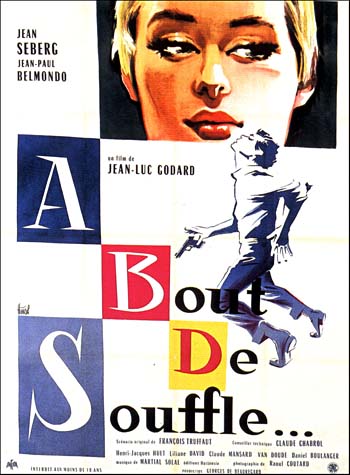
A Bout de Souffle


Thought I'd post some tracks from the soundtrack to Godard's 1959 New Wave film, a classic (by reputation and breadth of influence, at least), with iconic performances from Belmondo and Jean Seberg, and a sense of improvisational coolness and casualness that's (pardon my ignorant Britisher generalisation) typically French (though of course Seberg was American, and speaks with a noticeable American accent throughout the film). The music, by jazz pianist Martial Solal, has a laidback vibe that perfectly suits the aimless, amoral progress of Belmondo's characer through the film, at times turning up the heat for some (deliberately over the top) moments of melodrama ("La Mort"). Solal gets up in some brief but tasty piano solos on "Duo" and "Historie du Cirque," alongside a fairly large jazz band (no idea who the players are, but they acquit themselves well within the fairly limited confines of what they're being asked to do). The main theme, which reccurs throughout the film, is at once mocking and jocular, sinister and jaunty, and is taken through an ingenious set of variations by Solal in these selections, with many shifts in mood and colour. Maybe not one of the great jazz soundtracks (there isn't that much music, for a start - all the CDs on which you can find it combine it with scores for other films), but, still, it's some great 50s 'cool jazz' which perfectly complements the film it was written for.

http://sharebee.com/15d63e43

Wednesday, 6 June 2007

Billie Holiday


Billie's voice, youth, dream,
clarity creeping through smoke
all round, love made sound