Wednesday, 19 November 2025

November Updates

In the past few weeks, I’ve been working quite intensively on a long essay on Cecil Taylor’s poetry for what looks to be an expansive collection on Taylor’s work edited by Peter Valente. Having long thought a book like this should happen, I’m delighted it finally is! Taylor’s work has meant a lot to me for what seems like forever—certainly, since writing, or trying to write an MA thesis on his poetry back in 2011: a somewhat wobbly first step, or what Taylor himself would call an ‘Excursion on a Wobbly Rail.’

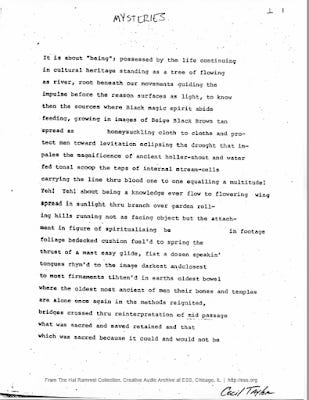
This latest iteration is part of what I think of as a suite of writing on Taylor’s work, particularly his poetry: a memorial post in 2018, a piece for Chicago Review in 2019, and an essay on Taylor and vodou for Point of Departure in 2020. It updates all that with some new reseearch—the conference on Taylor’s work at CUNY in 2019, Phil Freeman’s recent biography of Taylor, In the Brewing Luminous, a valuable chronological synthesis of existing materials and new interviews, and—not least—seeing a copy of Taylor’s unpublished poetry manuscript, Mysteries, of which the first page is above.

Besides that essay, I’m planning for other writing on Taylor, its final form yet to be determined, to find its place in two current manuscripts on music, Survival Music and Ensembles. Taylor’s work continues to mean a huge amount to me. An all-consuming music, an all-consuming vision. Here’s a bit of the work in progress:

In the film Imagine the Sound, Taylor speaks of making “the commitment to poetry”. But what did poetry mean for Cecil Taylor? Poetry was, I argue in this essay, where he theorized his artistic conception. It was poetry he credited with saving his life, and in turn, it became part of the way he understood the nature of life, his own life, and that of life in general; of how to live one’s life, of how to approach art with charm, with ferocious grace, and with the unstinting courage of conviction.

Lots to catch up on in the meanwhile....In the not too distant future, I’m hoping to post here some writing on Wadada Leo Smith and a report on the Berlin Jazz Festival. Some other things are in the works as well. For now, news and some capsule reviews, notices of new work...
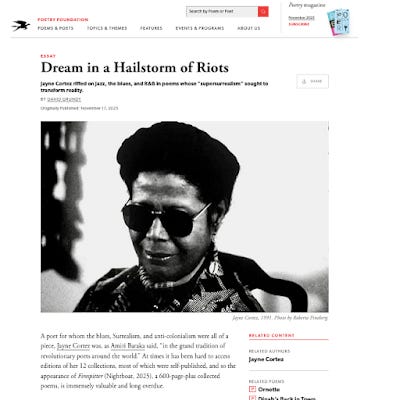
—‘Dream in a Hailstorm of Riots’, a long piece on the new collected poems of Jayne Cortez, is up at the Poetry Foundation.

From the mid 1960s through the early aughts, Cortez wrote about the political crises of her times: Attica, Allende, Palestine, Rwanda. But like fellow African-American Surrealists Ted Joans and Bob Kaufman, she was as interested in transforming reality as in documenting it. She bursts generalities and stereotypes in startling catalogues of surreal images that build around repeated phrases like the riffs of an improvising soloist. In her work, observations of everyday life and political events turn into dream visions, apocalyptic landscapes, meditations, and exhortations that crackle with energy, rage, and love. Above all, she is perhaps the poet of what her generation referred to as “The Music,” the various traditions of jazz, the blues, and R&B that soundtracked the freedom dreams of the Black liberation struggle. Cortez wrote poems in tribute to musicians and led her own band, the Firespitters, for decades. Hers is a voice—both on and off the page—that speaks with authority, curiosity, and an unshakeable faith in the power of poetry to change consciousness and change lives.

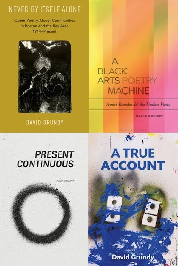
—Honoured to receive this attentive review by Eric Keenaghan of Never By Itself Alone at Resources for American Literary Study. Eric’s own work on queer coalitions, and with the writing of Muriel Rukeyser is, are necessary projects of historical reclamation and reminders of traditions of principle, resistance, and the complex negotiations of struggle for committed writers in times of crisis—needless to say, perhaps more relevant than ever.
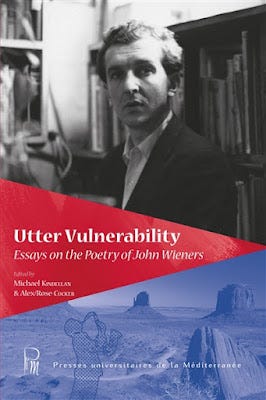
—An essay on John Wieners from almost ten years(!) ago, now in print in Utter Vulnerability: Essays on the Poetry of John Wieners, edited by Michael Kindellan and Alex/Rose Cocker, published by Presses Universitaires de la Méditerranée. This was the first thing I wrote after handing in my Ph.D thesis and it feels like a signficant part of the work I did since then flowed out of this way of thinking. It’s about love and poetry and fire and Wieners’s relationship to his first love, Dana Durkee.

This chapter addresses what John Wieners claimed was the most important romantic attachment of his life—that with his partner of six years, Dana Durkee—and the eventual ending of that relationship. As I’ll show, this loss can be said, in part, to have prompted Wieners’ fully-fledged entry into the world of poetry, prompting the composition of his breakthrough volume The Hotel Wentley Poems (1958), and it seeps into the minute fabric of his language itself, whether through conscious acts of address, revision and removal, or sublimated elements of textual echo which at once memorialise and disavow the object of loss. By introducing this element of biographical resonance, I do not wish to reduce Wieners’ poetry to a pained lyric exceptionalism, the poet as an exemplary figure of suffering removed from the social conditions that produce that suffering. Rather, such information serves as a means of heightening the way loss and despair intersect with socially produced domination, and the problems of community and desire in the face of persecution and its constant threat. As Denise Levertov astutely noted in 1965, in Wieners’ work, “Confessional” subjects such as mental breakdowns and the pain and loneliness of queer love are “not autobiographically written about, they are conditions out of which it happens that songs arise”.

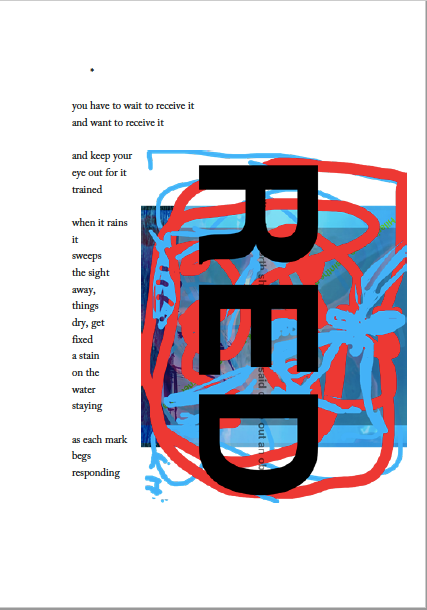
—And last but not least, I’m very pleased that CJ Martin and Julia Drescher’s Further Other Book Works have taken on Abstractive, the book of poems and visual art works I wrote with the great Candace Hill Montgomery last year (with some final tweaks this past month). More details will be forthcoming. For now, as a sneak preview, here’s a page of the manuscript….
Monday, 13 October 2025

Triumph of the outcasts, coming! (Preview)


As a subscriber post on Substack, this piece on a track from Adegoke Steve Colson’s and Iqua Colson’s album Triumph!, along with thoughts on survival, the outcast and, once more, the work of John Wieners.

Often, the poems that give consolation to others don’t always give consolation to the poet themselves, or the time of release is different. The renewal they offer wavers in its power. It saves some and not others, and sometimes it seems like it can save no one or do precisely nothing, but what matters is that it’s still there, if nothing else as testimony and record, as the poems of the martyrs in Gaza, as the poems of the shining martyrs Wieners saw in the queer poets of Boston, as in all the poems being written now, all the poems that have been written and that will be written, triumph of the outcasts, coming!

Tuesday, 7 October 2025

First Nettles, Earliest Persons (Preview)

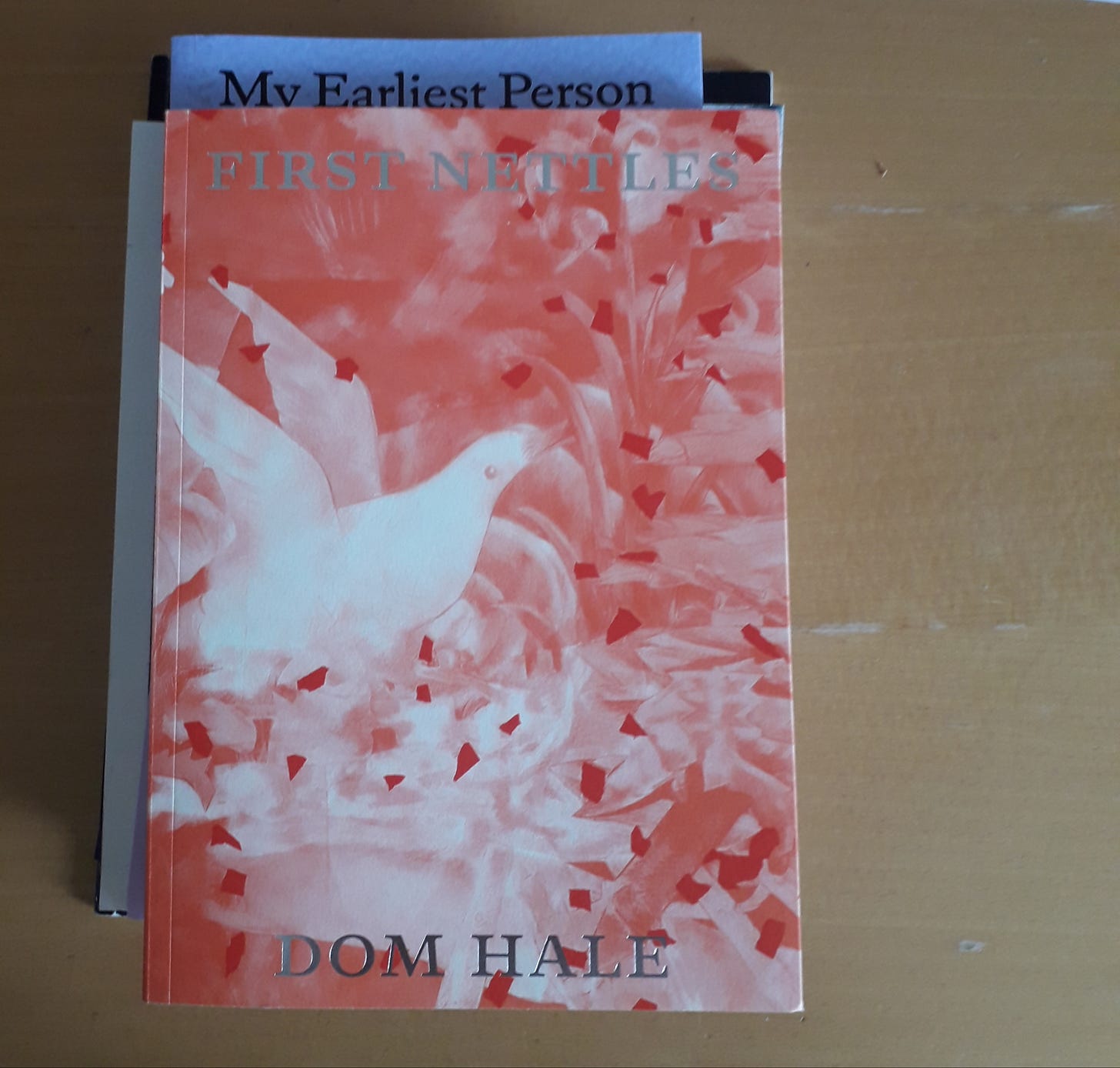
On the Substack version of this site, a review of Dom Hale’s First Nettles and Jennifer Soong’s My Earliest Person, both published by the Last Books. As it’s a long post (6,000 words or so) it’s only available in full behind the Substack paywall. But some excerpts below:

“How did the earlier poets hold it together[?]” asks Hale in the wracked ode ‘Castor and Pollux’, which I first read in a draft from 2021, just this side of the pandemic. “what defence does a poet have?” Not so much a defence of poetry or poetry as defence, but poetry as defencelessness. (“a poets lot is morbid frailty”...) The poem’s epigraph is from Stephen Jonas’s own resplendent ode ‘Love, The Poem, The Sea’—“I shall / with doubt / bloom in my season”. Jonas himself died young, that doubt overwhelming him—the earlier poets, too often, unable to hold it together—but Hale takes the message of loving survival in Jonas’ poem seriously. For, for all their faults, what are we writing poetry for if we can’t learn something from the poems that have gone before us? 

 “I found a pied wagtail and it spokes to me”, writes Hale in a parenthetical aside shot through with a deep Romanticism, as Romanticism emerged during the privatisation of the commons and the beginning of the Capitalocene. A poem takes or borrows its material from the world, but the way it does this is the opposite of the extractivist logic that governs that world system. A refusal to extract, is what a poem is, or could be.

And:

In Soong’s poems, violence, forgiveness, love, exist beyond the theological register that still haunts the way we speak of them: “I say: what to do / with such forgiveness / of the unforeseeable?” Language betrays us: or we exceed it, it exceeds us. “we / leave behind what / we say we can’t”. “what is equal to more / than can be said”. To be equal to, to balance up, to come up with an equation that would solve things, would be one way: the well-made poem, rhyme as resolution, metre as an ordering of the normal disorder of speech. But poetry is not that. It overflows it, unbalances it: seeks instead, dialectically, to acknowledge imbalance and transformation. The poems move in the instability of that line break, that cut, as much as they move in the smoothing, soothing shell of enjambment, sound-pattern, echo. When our speech is choked off, we speak with stumbling fluency through that prohibition: it births our speech. We perform and refuse to move on and our desire is shared with others and others are internalised into us, this ensemble that is the poem. For

we get to where
we can't, having been
taught by the things in
each other.

Poems like Dom Hale’s and Jenn Soong’s sift through the grift, let it stick: not the fine details, but the jagged edges of feeling, which are a thousand small ridges, cuts, wounds, incisions on the break of a line, the placement of a comma, the absence of an apostrophe. Care in the scattering. [...] In our poems, our posts, our criticism: trying to find a form for these things we perhaps cannot even properly say to each other in conversation when we speak, these things we try to put our finger on, while the map moves beneath our pointing digits.

Sunday, 21 September 2025

Recent writing elsewhere

Some recent writing elsewhere...


Pleased to have poems alongside good company in Michael Klausman's and Patrick Tillery's magazine Luigi Ten Co: a sequence called 'Axis and Orbit' and a prose poem from something in-progress...


Thanks to Florence Uniacke for producing this beautiful pamphlet, Two for Notley, for the Cafe Oto summer fair, with proceeds going to the new trans health centre at House of Annetta.


One of the two texts in the pamphlet is an extended version of a text that first appeared on this blog. And a different version of that text is also up at Little Mirror--thanks to Hunter, Jen and Allie.


Also out, a piece on Steven Belletto's extremely well-researched new biography of the great Ted Joans, Black Surrealist, over at The Poetry Foundation: "Nothing to Fear From the Poet but the Truth".


Finally, I've introduced a paid option for my Substack, same name as this blog, over at this link. A paid subscription gets you access to any posts over 1,000 words, which go behind a paywall. The Substack-ification of writing (and the way it negotiates the sphere of paid writing, traditional media, precaritisation of readers and writers alike) is perhaps something to be ambivalent about, but it is, at least, a platform...

What is a reading? John Wieners at Brooklyn College


Just up on Penn Sound—part of a bumper crop of recently-digitized recordings from the Eric Mottram archives—a 1988 reading by John Wieners, hosted by Allen Ginsberg at Brooklyn College, and split into two parts here and here. “Reading” here is not so much noun—a discrete recitation of a set of poems—as verb, Wieners reading aloud from a book, extemporising, elongating, truncating, extending. The book in question appears to be the author’s copy of the then-recently published Black Sparrow Selected Poems, into which he’d collage various images and text fragments. Within the first few sentences, we’ve had text from bodybuilder Charles Atlas about “what it means to be a man”, a mention of the nowadays obscure poet Jean Garigue, displacing the Beat lore Ginsberg tries to extract from Wieners when he mentions their first meeting in New York; a discourse where a character from a film—a bit of digging reveals it to be the war film Candlelight in Algeria—is juxtaposed with a novelist, a poet, and so on: a giant, collaged ensemble.

It’s of a piece with the turn Wieners’ work takes in the ’70s, exemplified in his magnum opus of that period, Behind the State Capitol: disavowing the self through collaging devices, reading-through his own and others’ work without indication, a surface in language jagged and dazzling, scattering clues and then retreating. In this there are echoes of his poetic comrade Bob Kaufman—like Wieners, championed by the inexhaustible Raymond Foye, who helped shepherd work resistant to book publication into texts that could be read by others.1 Kaufman would suddenly speak poetry in the middle of a conversation, improvising off the many poems of his own and others he’d retained in his head. Yet, while Wieners’ Brooklyn College reading often obscures whose words are being spoken and what is being read, he also deploys a-near excessive identification of source. Flicking at will across the book, sometimes reading only a line or two at a time, he identifies each page number, though by the time whoever reading along has turned to the relevant place, he’s off somewhere else, frustrating his host Ginsberg’s bid to keep up and keep track of all the references. In some cases, he even reads out the punctuation, as in these lines from the 1970 poem ‘Consolation’: “It’s best not to think too much. What awaits but death, question mark. A long life of misery, comma.”

In Delirious Verse, a talk on versification recently published by The Last Books, Amelia Rosselli claims that “sound was once so close to the written sign that people wrote without spaces between words”. Wieners treats the normally invisible notational frame of punctuation as part of the spoken text itself, establishing distance in the middle of immediacy. Likewise, when he reads flashes of his more famed, emotionally wrenching lyrics, his voice speeds up and his tone becomes hard to place—sarcastic, or a kind of sigh, as if he can’t wait to get to the ends of the words, which he has to read them, but wants to render incomprehensible. As such, it’s an anti-lyrical gesture. Yet at other points, Wieners whispers, barely audible. And isn’t one of the classic definitions of lyric poetry talking to oneself in public? Wieners is still reading, but not to us, perhaps not even to himself. Selving and un-selving. (“For the voices”, as the dedication to the 1964 collection Ace of Pentacles goes.)

But this is a reading at a college: the event is supposed to have a pedagogical function, something of which Ginsberg, with his history at Naropa, is keenly aware, interjecting to ask for clarification—what exactly is Wieners reading now?—entreaties Wieners gently brushes off, at one point waspishly remarking, “you should call the embassy and tell them you’re Allen Ginsberg and they’ll translate it for you”. But Wieners doesn’t refuse interpretation, though “it’s best not to think too much”. Misreading a phrase as “heartbreak libertarian”, Wieners wonders “who would that be? Jack Spicer?” (His devastating 1965 elegy for Spicer, ‘Hotel Blues’, opens: “Pass by this room, stranger / Heartbreak hides within it.”) This additive approach nonetheless continually calls back to memories of the past, of poets and lovers who are gone yet live on in the poems’ haunted shell: a constellation of references subject to melancholic improvisation. This may be an inability to move on, yet it, too, is a kind of transformation of loss, perhaps at times even a triumphant one, keeping the dead alive.

This is not an easy listen. It refuses the pathos and heartbreak of Wieners’ earlier work. Like Kevin Killian, interviewing Wieners in San Francisco a couple of years later, Ginsberg tries to keep up and give the audience some way in, while Wieners speaks on associatively in a barrage of names, always at an oblique angle to the question (there is a relation, but it might take a few minutes of puzzling to work out exactly what it is.)2 There’s no literary-critical guidebook for how we experience this—and how it’s inflected by our knowledge of Wieners’ biography, of the toll of drugs, heartbreak, psychiatric incarceration. At one point, Wieners refers to the Selected Poems as a “cookbook”. We may not know what the ingredients are, but it’s up to each reader to implement the recipe. As readers, we too, have to improvise. Along the way, some our fundamental assumptions about a reading, what is, what it’s for, poetry, what it is, what it’s for, are at stake.

The imminent reissue of Behind the State Capitol from The Song Cave is eagerly awaited!

1

See Foye’s work on Kaufman’s The Ancient Rain and the 2020 Kaufman Collected Poems, and on Wieners’ Black Sparrow Books, Selected Poems and Cultural Affairs from Boston.

2

The Penn Sound website doesn’t allow external embedding, but scroll down to the March 1990 Cloud House Poetry Archive video embedded here. The image at the top of the post is taken from this video.

Saturday, 14 June 2025

Louis Moholo-Moholo: The Quality of Truth


I come home to find out that Louis Moholo-Moholo died, this Friday 13th, listen to recordings of what I guess was his last band, with Alex Hawkins on piano, John Edwards on bass, the twin saxophones of Jason Yarde and Shabaka Hutchings, on a European tour in 2019.* Free jazz, yes, and music never more free, but freedom, entirely within melody, with the way melody is treated, as, for the first six minutes they do nothing but play the melody, over and over; however many variations are spread around it, how many patches of atonal fights and flurries, at any one point during that time, one person will be playing the melody. And this music above all the music that survives of the twentieth century, perhaps, because of the extremity of its conditions in which it emerged, because of the unshakeable faith and unceasing struggle of the movement with which it was already, whether at home or in exile, in solidarity, this has music has something about it of the quality I can't help name as anything other than truth: where hope is not just an alibi--the fear of facile hope as betrayal--but a present and necessary reality, a utopia and a reality all at once.
 
Moholo-Moholo's is music that knows life because it knows death, and isn't afraid to face up to that, but that finds a way, in itself, in the spirit it is, not in a spirit external to the music, but within the music, and from that, the music can move out into the world, into the (freedom) movement that made it and the movement it maintains. It was like that when I saw Abdullah Ibrahim last year, however old he was and however slowly he played. Each touch of each note weighted with grace. (And in the video we see Alex Hawkins lead the already 80 year old Moholo offstage, up from the drumkit, by the hand, as Ibrahim, too, was guided by the hand, to and from the stage.) So often, as we see in the music of those in their last years, the late performances of Cecil Taylor, say, or, Hal Singer, or whoever you care to name, music strains beyond the limits of a body that would slow down beyond its speed, spirit pushes at the limits where it would usually part from the body. For isn't that what sound and music is, or what we make of it, as it takes on a life of its own and survives its makers? And so often the most moving music played by Ibrahim, Moholo, the Blues Notes--Feza, Dyani, McGregor et al--was a record of loss: most movingly of all, the Blue Notes' records for Mongezi Feza, then later for Johnny Dyani, where the studio becomes a place for a gathering, a wake, a way to put to rest and release the spirit of the individual, collectivized, collectively held in the memory of song. 


So, too, this music from 2019 is lament and celebration at once: it is never not both, the one that cannot exist without the other, their constant dialectic, their co-existence, that struggle of being alive. On Pule Phuto's piece 'Zanele', a Xhosa name meaning "they are enough", they are sufficient, the band hold their instruments and sing Zanele, Zanele, over the piano's gently rocking chords and the crisp crackle and splash of Moholo's snare and cymbals, his whole playing contained, wound-up tight and sharp, propelling the music's hugeness of heart and soaring song precisely through its containment. Music that always exists in and emerges into the condition of singing, the act of singing: to repeat the melody over and over, whether in instrument or to open our mouth and sing it, means we're still alive, we're still alive, we're still alive, and they are enough; and when the band emerge into 'You ain't gonna know me cos you think you know me' and play the melody over and over like a hymn, a benediction, all those words for which the usual designation of 'ballad' is entirely insufficient, for the second time watching the video I burst into tears. What is the point of anything without hope.

(*This is the 'Five Blokes' band that recorded Uplift the People (Ogun, 2018), but to really witness the band's joyous, flowing dynamic, you have to see the videos. Another full-length concert from a few days before the Bimhuis performance above took place at Church of Sound, with Shabaka Hutchings replaced by Byron Wallen and Steve Williamson is here: Part 1Part 2)

Tuesday, 10 June 2025

There's a Riot Going on


Los Angeles, 9th June 2025: for a third day, people come together to fight immigration deportations, Immigrations and Customs Enforcement, to fight ICE with fire, flames and bodies on the street, Mexican flags. The movement of the people everywhere is beautiful, necessary. And though it's what comes after that matters, how it plays out, it's what comes before, too the whole thing. Setting self-driving cars on fire inserts the human, the worker, the saboteur back into the abdication of agency to the hands of tech-bro-billionaires. The protestors put up make-shift barricades, purple tables and benches block the streets, preventing the destruction of community in the name of the greater national body, and its policing of which bodies can or cannot make up a part of that body. 

The President seems to want to declare civil war on the state of California. The state calls in the LAPD and tries to suppress the riots while also resisting the entry of the National Guard and other federal bodies. The protestors say fuck the police, all of them. This is perhaps best understood, not so much as an 'insurrection'--the language the government uses--but as a war of defense, an ongoing rearguard action that gets portrayed as a 'riot'. Or, it actualizes what is already a civil war, as mayors are arrested when inspecting ICE detention centres, as judges try to block presidential orders invoking emergency powers only meant to be used for times of open conflict: a civil war declared by the government on its own people, in their name, or in the name of some of them. 

Later on in the day, the state of California takes the President to court, the President threatens to arrest the governor. What happens next, if someone is killed, how this plays out, the balance of forces, who sits on what fence, is anyone's guess. But when the state turns authoritarian--turns more authoritarian--to fight. And we've seen this before. First there's the democratic election of the fascist, and then the fascist street gangs, or first it's the fascist street gangs and then the democratic election of the fascist, or the two are two heads of a hydra, and the street gangs are not only the street gangs, but the police, and the fascist vigilantes, and they are ICE, and the army. To fight, to fight fire with fire, judging the situation, burning the self-driving car.

*


There's a riot going on.

Sly Stone died today. As his career spiralled, collapsed, he would re-record the parts, the mixes, record entirely different versions of albums that had already been released, accumulated hours, potentially hundreds of unreleased tracks, multi-tracks, turning the self into an orchestra, drum machines, overdubs, as if to take everything up into himself, the inflated grandeur of addiction, its hubris, perhaps, but also the splitting and impossibility of the collective the band as the Family envisaged in its heyday. His cover of 'Que Sera, Sera' on Fresh: a song which he apparently performed in private sitting at the piano with Doris Day. What does that mean. The unexpected, gentle beauty of its fatalism. Lament at the heart of celebration, but perhaps, too, celebration at the heart of lament: giddy, out of control, manic, the kind of grim celebration of holding on and of not giving a fuck, teetering on but never quite entering the state of nihilism, redeemed--redeemed?--by its gospel background, by the collective life in music it emerged from in the church, by the upright stance of 'Stand', or the woozily beatific romance of 'You caught me smiling', for all its pain, its fear of going insane, or the literally childlike chants of 'Everyday People' and its idealized collective beyond hatred and discrimination.
 
And Sly and the Family Stone were always missing the gig, never showing up--but the possibility that he might, that they might, and that the show might be great, transformative, catharsis, release: an image of what we (who?) might be. Making stars into emblems of our hopes, holding them over us, despising them when they fail us, elevating them: this is the practice of celebrity, the altar on which, willingly or unwillingly, Sly Stone sacrificed himself, was sacrificed. The singer channels the collective only at the wealth-excessive cost of becoming a king, a king who then falls, living in a campervan, fed by a local retired couple: that drama of rise and fall, so that what could have been collective aspiration--the Black Panthers' reported demand that he politicize his music, politicize those nascently political hopes--falls by the waysides of addiction and excessive wealth, gold paint sprayed over the walls of the mansion, marble floors scuffed beyond recognition. And what more is there to say. A singer for whom--as for all singers, perhaps--words fail.
 
The title track to There's a Riot Going On is famously silent. And on 'Just like a Baby', on 'Poet', the vocal is present, but receding, just another textural element amidst the instrumental wooze, the bass and drums seeming to become the lead instrument, wah wah whooshes, whether from guitars lifting and dropping pedals or from a chorus opening and closing their mouths, music as a kind of amniotic fluid, or lighter fluid perhaps, ready to be lit: the same oceanic drift, vast energy at a standstill, found in Miles Davis' (instrumental) music of the 70s so influenced by Sly, the rumour that he made his band listen to Sly's 'In Time' on repeat. (But was the song Davis played 'In Time' from Fresh--a song of delay, with its ironic play on Sly's reputation for lateness on stage and lateness in delivering albums--or 'Time' from There's a Riot, with its philosophical speculation on the nature of the universe? And how do those two relate? The time of the commercial cycle, the chart, time as money, and time as a flow that the music accesses along some sort of deeper, mythic substratum: or both times are equally mythic, myths the music is trapped between even as it seeks to reinvent time in a kind of oceanic splendour. Time, the times, temps, durée: marching, dancing, rioting.)

Sly Stone's music was modern, for sure: the insistent use of multi-tracking to build up virtual collectives that supplant or support or challenge real ones, the pop of slap bass, of a drum machine. But archaic, too, in some way: a keyboard that channels a harpsichord, an organ that--as with Davis--moves on past the church and the strains of the horror movie into a kind of synthesized future, or an idea of the future, a construction, improvised in real time. And children's songs, yodels, everyday songs, everyday kitsch. To find a collective there. Fusing them into a kind of indistinguishable stream, of approaching and receding lights--"in time"--where time seems to have lost its meaning, to have retreated--to extend the piece, the jam, beyond the limits of the pop single, to repeat and vary, not so much to ecstasy, increasing heights of energy, but into a kind of chugging gasp, a running on the spot--but beautiful.
 
Drifting past words, Sly Stone's music expresses and oozes that which goes beyond words, yet in doing so it loses words' capacity: the inability to put the riot into words, to formulate the demand. In Sly Stone's music, whether brief achieved bliss or the hazy, narcotized beauty of nightmare, music exists as dreams. Whenever an edge appears it disappears again. Roles are constantly changing. You can live there, get lost there. But when the time comes, you have to come out the other side again. "The universe needs to be a little stronger / Time they say is the answer, huh / But I don't believe it". And time is what we make of it, when dreams and the reality that endlessly in fantasy refigure as utopia or as nightmare, as working-through, crash up against each other and in the present strike a fire, blown by the winds both in and out of our control.

*


And clarity, crisp hard: the other side of the coin. The rhythm sounded by Horace Tapscott in 'The Dark Tree', the version from The Giant is Awakened: Dodot-dot-dash, dotdot-dot-dash. Morse code from another uprising, another time. 

I listen to 'The Dark Tree' and then I listen to There's a Riot Going On and then I listen to them both again. Perhaps the best way to get the truth of the situation would be to play both those albums not back to back, but both once. But to listen to both at once would be cacophony, indescribable, unlistenable. As morse code turns language into abbreviated sonic signals that can then be decoded and turned back into language: a carrier, emergency transmission, made music. Tapscott would tap out that rhythm on the horn of his car or tap on the windows and doors of houses to announce his arrival at friends' houses in the late night rambles he would take towards the end of his life. And perhaps if you decode that rhythm some linguistic clarity, but which would in turn betray its conversion into music, two torn halves, a split. Dotdot-dot-dash, time is the answer, riot, silence. The imperative that we formulate an answer.