Saturday, 10 May 2025

MaerzMusik 2025 Report: Part 1

[MaerzMusik happened in March this year. This is an extended cut of a much shorter review out in The Wire, split into three parts for ease of reading. Part 2 is here, Part 3 is here.]

Part 1: Nguyễn + Transitory, Susie Ibarra, Pamela Z, Joan La Babara
I caught half-a-dozen performances at this year’s MaerzMusik, held across a variety of venues in the city. Since its rebranding as MaerzMusik in 2002 (it was originally funded as the International Festival of Contemporary music in 1967 as a Biennale), the festival has gone beyond the usual remit of Neue Musik to incorporate a wider generic framework, and, under Kamila Metwaly’s curatorship, it feels like an open and generative space aesthetically.

Offering a particular context, MaerzMusik exists within a context. Berlin’s—and Germany’s—state-funded art scene has been in some turmoil of late, increasingly doubling down on the censorship of Palestinian and pro-Palestinian voices during a continuing western-backed genocide and facing funding cuts from a conservative city authority, sure to be doubled down on with the newly elected, right-leaning coalition government in the years to come. At a recent performance I attended (not part of MaerzMusik), after the choreographer spoke out about state censorship and the deportation of friends for pro-Palestinian sentiment, the director of the venue hastily stepped in to distance themselves from the remarks, to boos from the audience. Similar rebuttals around Nan Goldin’s intervention during her Neue Nationale Galerie show have drawn fresh attention to the institutional censorship that has brokered the Strike Germany campaign. In the past month, a particular university prevented a UN representative from speaking after pressure from the city mayor. Criminal cases are ongoing against protesters. And so on. The pro-Palestinian sentiment of artists or audiences and the anti-Palestinian sentiment of institutional funding bodies speaks to the contradictions of the German state position, one which reflects the turns towards general condemnation of Israeli actions against civilians on the part of the German population, a topic on which virtually none of the main political parties are willing to speak out. The state that supplies the weapons and the denials also supplies the art. Given this, these days, in any state-funded event in Germany, despite the rich diversity of art on offer, sometimes what’s not heard is as telling as what is. This is not so much an expression of a crisis we’re heading towards as a crisis we’re already in: the rise of the far right, of authoritarianism in general, of a turn, in Europe, towards an enhanced war economy, with a blind eye to genocide and dictatorship. This all risks becoming a litany that denudes itself of meaning in its rote familiarity. But it bears repeating.
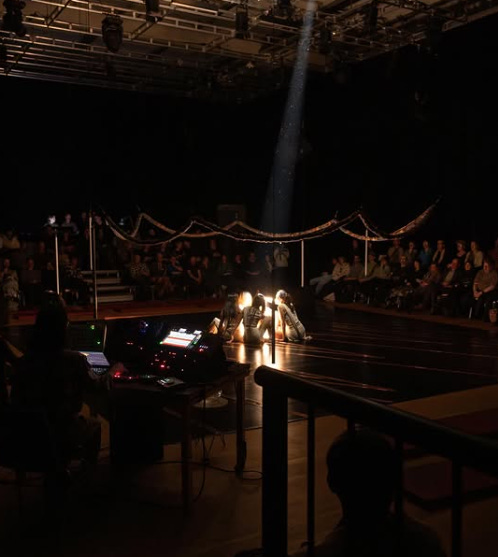

Image © Camille Blake

So to the music. At the riverside Radialsystem, the duo of Nguyễn + Transitory present Drifting to the Rhythms at the Southeast of Nowhere, which, in a post-concert talk, they call a “symphony of intimacies”. The latest configuration of the duo’s ongoing collaborative project, the piece refigures exactly how an audience might think of the relation of music and dance. It is at once an instrument and a score, which is both ‘played’ and composed in real time by the performers, as the dancers move over copper lines on the stage floor and interact with a rope interlaced with copper wires above, triggering electronic sounds in ways that change depending on their movements. This particular iteration opens with the five female dancers, all from Thailand, gathering around a glowing light as if round a fire, followed by collective procession in silence, each dancer sharing the same gestures: a moment of collective regimentation which gives way to a series of highly virtuosic solos, duos and trios. In their essay in the programme, Bussaraporn Thongchai contrasts the fluidity of Thai folk dance with the Thai court dance, focused in Bangkok, a ‘prestige culture’ with fixed conventions, and the dancers thus perform folk dances from more neglected regions of Thailand, especially the North-East.

With some using traditional movements and some merging them into a more contemporary vocabulary, the performance includes dances interacting with spirits and movements from a martial art traditionally performed by men. As the artists discuss in a post-show talk, the all-female piece follows a loose scenario of queer desire—meeting, coming together, strife, negotiation with society, acceptance, and the return to the collective—but it would be a mistake to call it obviously narrative. The four-sided stage is devoid of scenery or backdrop, and while engaging the traditional background in dialogue, the movements themselves are also abstracted from their original context. Tradition—at least in the folk dance that Thongchai describes, a tradition from below rather than from above—is not something fixed, but something which is improvised upon and with, and the dance—particularly for those in the audience, like myself, unfamiliar with this context—creates scenarios that morph and change fluidly without being necessarily illustrative. Throughout all of this, the electronics emit a booming bass drone which forms a kind of ever-present base on which both sound and movement build: moments of erotic intimacy, bursts of energy triggered by samples of traditional music in brief loops, and, in a particularly striking sequence, a kind of battle with copper poles.

The feet are the proletarian of the body, said Etienne Decroux. “Take a walk at night. Walk so silently that the bottoms of your feet become ears”, writes Pauline Oliveros in the fifth sonic meditation, ‘Native’. The foot is where the body encounters the earth. And in this performance the feet are where the sound is triggered. As the show’s title gets us to think: what is the supposed centre we are Southeast from? The foot turns on the axes, shifts them. This sound, this drifting rhythm.
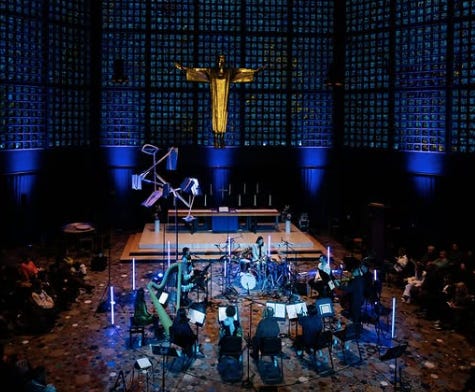

Image © Camille Blake / Berliner Festspiele

The modern Kaiser Wilhelm Gedächtniskirche stands next to the preserved ruin of the original, bombed church in the midst of a busy shopping square. Slightly sunk into the ground, its stained-glass windows blocking out the surrounding buildings with a light that seems to exist somewhere between day and night, it’s an appropriate setting for a concert-length work by Susie Ibarra, CHAN: Sonnet and Devotions. Largely through-composed, with the exception of improvised accompaniments to the poetic recitations, the piece integrates poets Logan February and Don Mee Choi with a full band including singers (soprano and tenor), harp, bass clarinet, trombone, French horn, acoustic and electric guitar, viola, double bass, the venue’s pipe organ, and Ibarra herself on drumset, gongs, and percussion. Titled for Ibarra’s middle name, which means ‘meditation’, each piece is a kundiman, a type of Filipino love song, with the love in this case devoted to ecosytems rather than individual humans: German forests, Himalayan lakes, the Pasig river in the Manila bay which, declared biologically dead in the ‘90s following industrial pollution, has recently come to life again.

CHAN opens with birdsong, the ensemble joining in the mood largely maintained throughout, of an occasionally restive calm. Over its multiple movements, it changes paces like the gentle fluctuations of breath. Ibarra rarely features the full ensemble, but instead uses it as a set of juxtaposed and overlapping timbral fields: a wheezing organ accompanied by the gentle pluck of harp and acoustic guitar, a soprano and viola duet; a particularly beautiful moment for Hilary Jeffrey’s muted trombone over electronics and Ibarra’s percussive rumbles. The musicians sit in a semi-circle round Ibarra, who plays and conducts from the drumkit. Though her playing is not the principal focus, at one point she offers a beautiful solo, characterised by carefully crafted melodic momentum; at another she rattles hand bells, uses brushes to play the air itself as if harnessing the rhythm of the wind. Most visually striking is the speaker tree sculpture standing to the side of the ensemble: ten speakers branching off a central wooden pole, which over the course of the concert play field recordings, percussion, and at times seem to offer real-time manipulation of sounds. At different points, the poets pick up separate, portable speakers and carry them down the aisles, while soprano Otay:onii (Lane Shi) scatters invisible flowers to audience members from an empty bag. In the final movement, Logan February recites from the organ loft, a poem playing on the classic trope of. the interaction, or distance between, the bodies of human lovers and the metaphorical transfer to a surrounding environment: “you must remain”, they intone, before a final ensemble melody closes the piece quietly. A distinct and beautifully integrated work.
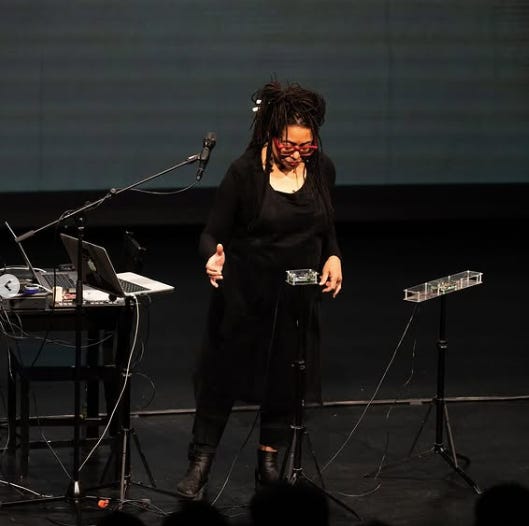

Image © Camille Black

We’re now at the mid-week point, and solo recitals by Pamela Z—a recital called ‘Other Rooms’—and Joan La Barbara—titled after her debut solo album ‘Voice is the Original Instrument’—take place down the road at the blackbox space next to the Festspiele Haus. Alone onstage in black box setting with two laptops, one for voice and one for video, and two gesture-activated MIDI controllers, which trigger live samples like a theremin, Z transforms herself into both soloist and accompanist, a one-person choir, deploying tuning forks struck to ring against the microphone, the snap of popped bubble wrap, and the soaring echo and delay of her voice, in words spoken or soaring into song: counting to twenty in multiple languages, fragments of French, descriptions of spent flares on a pavement “like broken swastikas”, while video projections accompany the pieces, similarly interested in looping and transformation.

Z is interested in the way an object, a concept, a theme, blurs the edges of perception, using the MIDI-controller to “play” the keys of a typewriter in the air as he mimes composing a letter, or using an avian sample to turn herself into a whistling, chirping bird, pitch-shifting, shape-shifting, transforming. There’s something of the stage magician about the intricacy of the display: at once showing how it’s done and leaving one to marvel at the many shapes into which Z twists her body and voice. Fragments of language and gesture are gently tweaked, pulled apart and reconfigured into songs at once tightly woven and with a sense of the glittering slipperiness of an ordinary language that, on the brink of articulation, runs away from us, our assumptions—not least, the idea that there is a singular, un-inflected ‘we’ or ‘us’—and into that space we call music.
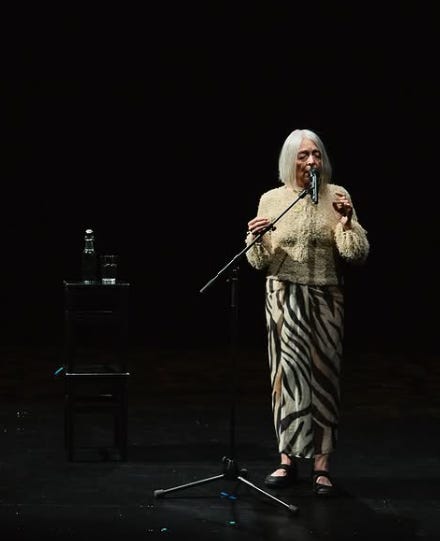
Image © Camille Blake

Like Pamela Z, La Barbara also works heavily with the microphone—which, in a post-concert talk with soprano Nina Guo, she describe as “part of her instrument”. Her pieces tend to last for longer, offering morphing soundscapes—“sonic atmospheres” or a “pool of sound”—in which the higher chirps of her younger self on tape—what she calls her “backing tracks”—interact with the deeper register of her current voice: a combination of “sounds that I know and sounds that I imagine”. The scores, she explains, are often “vocal gestures” that are notated graphically: La Barbara experiences sound as shape, and in many cases is working with sounds for which there is no conventional notation—sounds whose operations, at least initially, are as mysterious to hear as to her auditors.

La Barbara stands onstage in a single spotlight, larger pools of coloured light gradually emerging behind her, roughly equivalent with the layers on the work’s tape parts. The first piece, ‘Erin’, comes from 1980, and was inspired by the photograph of the father carrying the coffin of his son who’d died in the hunger strike at Long Kesh. It begins with energetic high pitches, babble and chatter, simulating conversation, perhaps, a collective sharing of stories, swirling round the speakers, before turning into a kind of lament for pitch-shifted low voices, ending on a final burst of the chatter as if to single hope remaining. ‘Solitary Journeys of the Mind’, one of the more recent pieces, serves as a framework for La Barbara’s improvisations, moving round the harmonics of a single note then up to the level of throat-singing or yodel. Technically impressive, the work’s effect is not of virtuosic display, but more of a kind of singing to the self, following a line in meditative exploration, rumination as much as ecstasy. The lament, or at least a quality of reflection, that characterizes ‘Erin’ to some extent goes through all these works. ‘October Music’ offers a portrait of the California night sky realized at IRCAM. Like Pamela Z, though without the MIDI controllers, La Barbara moves her hands to shape the sound: conducting, as a body conducts or carries sounds or force. Only in the final piece, the ‘opera in progress’ ‘Windows’ do we hear any other sound than those derived from La Barbara’s live and recorded voice. Samples from a decades’ worth of instrumental recordings, swirl and build on the edge of climax, in a febrile, moving structure. To the sounds of a ringing bell and gently lapping water, La Barbara sings with a kind of shrugging motion, the music slowly subsiding, now at rest.


Four concerts in, there were still many hours of music to come...


To follow: Part 2—Mazen Kerbaj’s Lungless.

Wednesday, 19 March 2025

Paul Shearsmith (1946-2025)

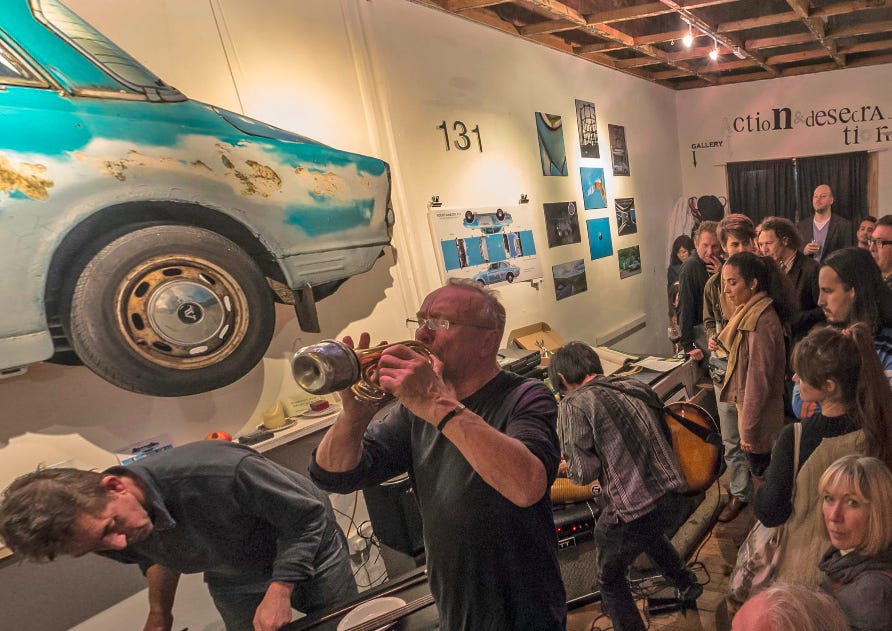
Paul Shearsmith and KMAT performing at the Hundred Years Gallery in 2012.

Trumpeter Paul Shearsmith passed away a few days ago in Stuttgart, aged 78. One of those many presences on the UK free improvisation scene known to—and as—one of the faithful—his German Wikipedia page is extensive, his English Wikipedia page non-existent. So is cultural memory.

Shearsmith grew up in Tadcaster, Yorkshire, where his father was the local blacksmith. Influenced, in his words, by the BBC Sound Effects library, on leaving the Leeds School of Architecture and moving to London, he attended jazz gigs by Stan Tracey. Here, as he tells it, he would stage a weekly heckle. On the basis of this, he was invited by drummer John Stevens to attend his workshops, playing a battered pocket trumpet he’d bought second hand with Stevens and the Spontaneous Music Ensemble and with the London Musicians Collective at the Little Theatre Club in the West End and at the ICA back in the 1970s.

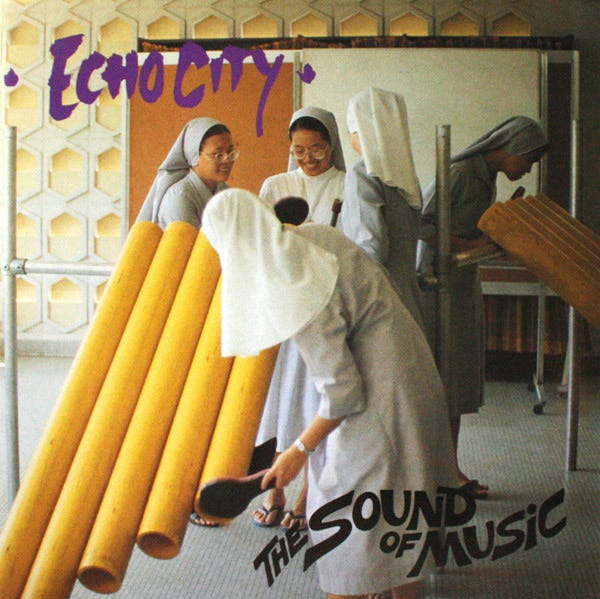
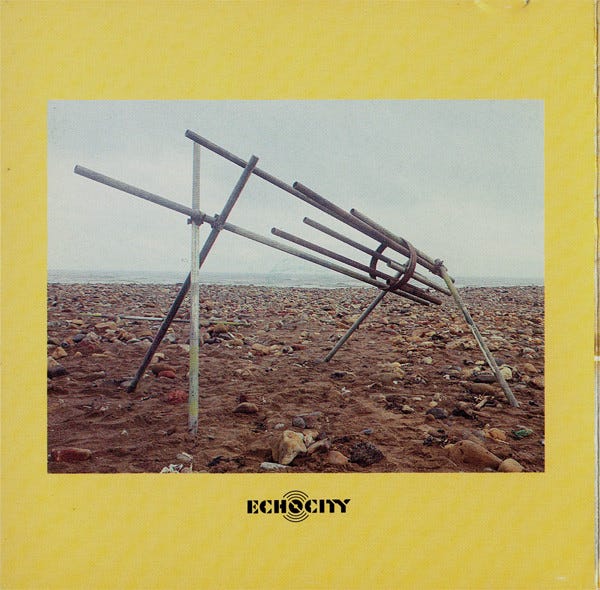
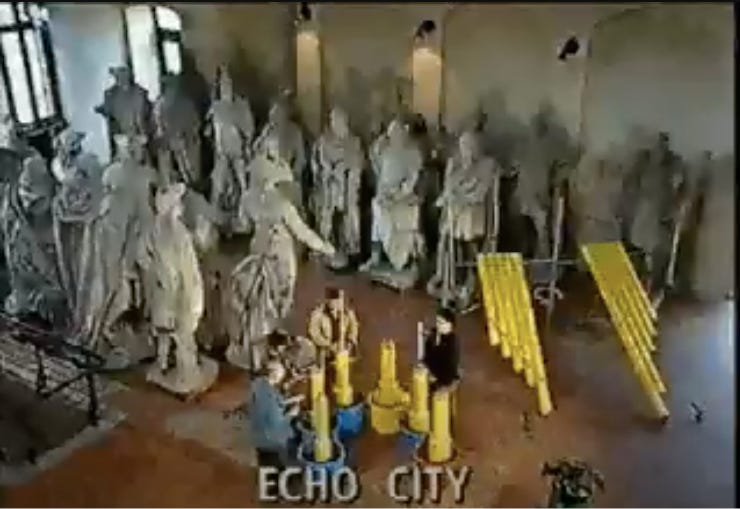
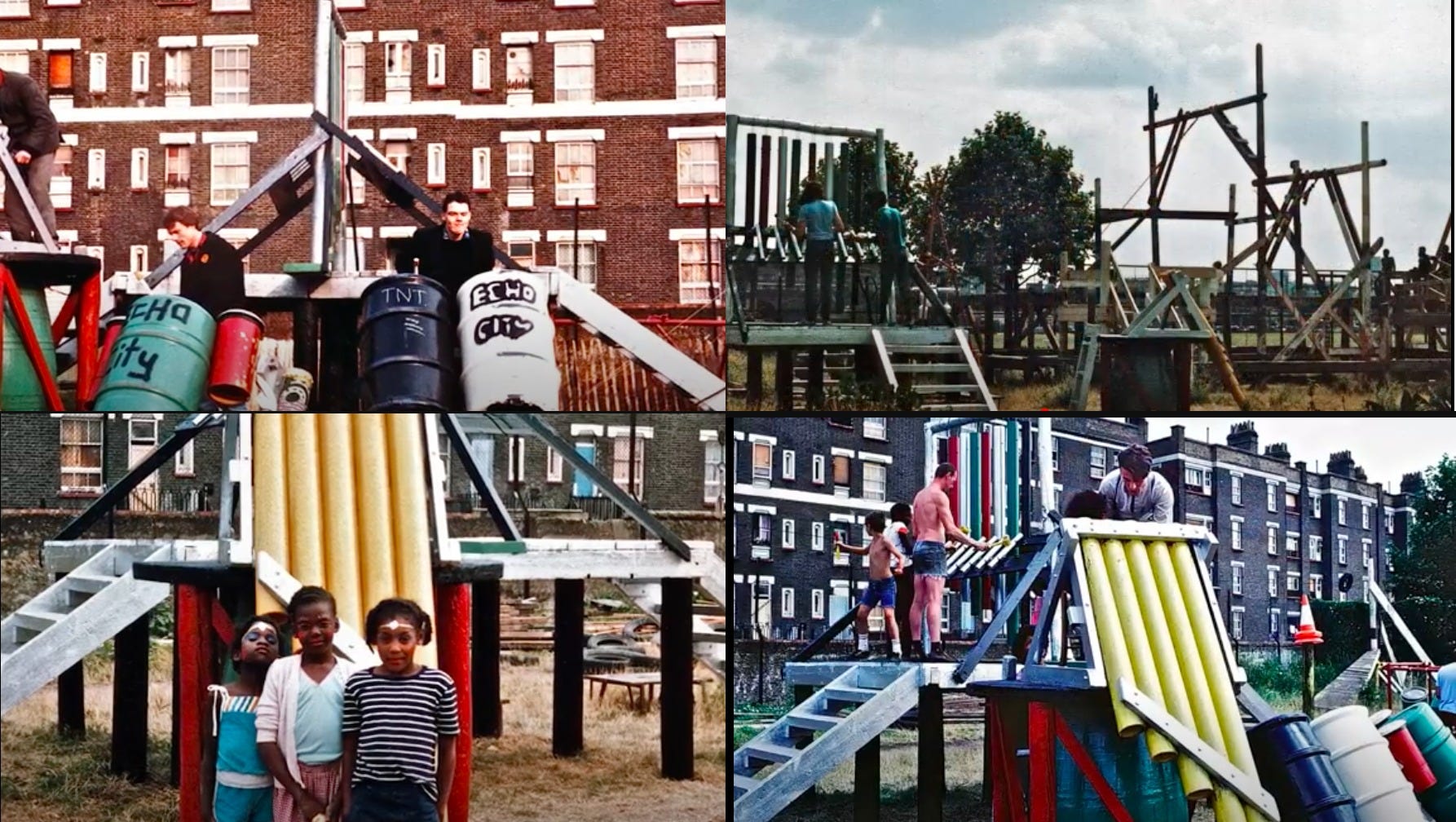
In the early ’80s, he travelled to Indonesia, where he came back with a ‘trompet’, a children’s instrument made from film canisters, a plastic tube, and a reed made from a balloon. Adapting this with a garden hose pipe as the ‘baliphone’, he met instrument-builder David Sawyer and through him joined the collaborative group Echo City with Guy Evans, Giles Leaman, Julia Farrington, Rob Mills, and Giles Perring. Starting in 1983 with a playground in Weaver’s Field in the East End, dubbed by the NME an ‘urban gamelan’, the group built what they called ‘sonic playgrounds,’ inventing tuned percussion instruments, made from old piping and other industrial and storage implements, including ‘batphones’, ‘fibrephones’ and ‘barrel drums’, and running workshops across the UK, Europe, East Asia and North America, including a collaboration with members of the Sun Ra Arkestra on the beach in the Isle of Jura, off the coast of Scotland. In Echo City’s work, music becomes sculpture, part of a public place and a participatory aesthetic. This is not about gigs or records, though they are a part of it, but about a more ongoing and more genuinely collective process. As Shearsmith put it: “I believe music belongs to everybody and can be made by anyone. Don’t let technique get in the way”.

Album art from Echo City’s second album, The Sound of Music (Some Bizarre, 1992)
Images above taken from Echo City videos uploaded to Shearsmith’s Youtube page: a gallery performance in Berlin, 1997; an unnamed installation; and the original “sonic playground” at Weaver’s Field, Bethnal Green, 1983-4.

These kind of public projects have always been a key part of UK improv, and, whether in Echo City or elsewhere, it was the spirit of collective playing that informed Shearsmith’s work, from his early work with Stevens to Maggie Nicols’s The Gathering, playing in the groups the Funking Poets and APE with the likes of saxophonist Big Mike Walter and poet Grassy Noel (for the latter, Shearsmith added fire extinguishers to his instrumental arsenal), or in the duo The Fujii with Japanese singer-guitarist, Koichi ‘Fuji’ Fujishima, who he met while the latter was busing in York, and latterly, with Ben Watson’s freewheeling AMM all stars.

Over the years, Shearsmith worked in an architecture firm, practiced photography, turned his car into a work of sculpture, played trombone, tubing, “tuned gas main”, and the baliphone in addition to his trusty pocket trumpet. Back in the day, I played in private a few times with Paul and the other members of KMAT, his trio with guitarist Keisuke Matsui and bassist Graham Makeachan, indefatigable host at the Hundred Years Gallery in Hoxton, where Shearsmith was a regular. It was soon after the election that saw Boris Johnson elected mayor of London: Shearsmith, he reported, had been playing in Ken Livingstone’s “battle bus”, blasting out socialist classics like ‘The Red Flag’. Around that time I remember anti-austerity protests, the student movement, the carnivalesque energies around the Hundred Years and its constellations, a warehouse near King’s Cross with a variant on Henry Threadgill’s Hubkaphone made out of old storage canisters for reels of film, a parade with bells through the streets of Hoxton organized by Mary Lemley in memory of Gabriel Hardisty-Miller, running into Grassy Noel going the other way up the street on a protest where, suddenly, everyone was going joyfully in every direction at once, and the street briefly reconfigured itself, as on protests it does, lines of poems, lines of music that refused to line up or be counted, out of time. And Paul Shearsmith’s pocket trumpet, piquant and strong in the wake of Don Cherry, blowing out little blasts of light.

Free improvisation in the UK and elsewhere developed as a social music and in this often unheralded way it continues, in venues like Hundred Years, the late lamented Iklectik, or the slightly more publicly-visible scene around Cafe Oto. It’s a music that's often politically connected to the traditions of left wing politics that have for decades been under steady attack from both the Right and the Labour party in its Blairite or Starmerite configurations: as well as the Livingstone Battle Bus, Shearsmith recorded an Iraq war protest song, and the Hundred Years Gallery has recently been raising money for the people of Gaza. Heard by small audiences, the music is not ‘popular’ by record industry terms—or the kinds of ‘focus groups’ by which Starmerite lurches to the right are justified—but it is more fundamentally than that a people’s music, one that, because it does not make money and is barely tied to market demands, aims at exploring only itself and its world, that draws, in spirit and sometimes in letter, on the traditions of protest in folk musics of various kinds, in free jazz, in experimental theatre or film and in the various experimental incarnations grouped under the headings of prog-rock or (post-)punk (Guy Evans of Van der Graaf Generator and Susie Honeyman of the Mekons both played in Echo City). The music stages a counter-history and a different way of being to all the various lies and erasures of memory surrounding it.

That was the world Paul Shearsmith believed in. That was the music that Paul Shearsmith made.

Wednesday, 12 March 2025

Recent Poems Read

--Asha Puthli on ‘What Reason Could I Give’.


--Christa Wolf on dividing skies.

--Jayne Cortez telling us that ‘There it is’.


~~

It’s been a while since I’ve done this, so just some reports on some of the latest books to have made their way from the letterbox onto my table, where the shelves have run out of space and the piles continue to pile up. First up, a package in the mail from Michael Klausman and Patrick Tiller’s Colorado-based wry press, continuing their acts of unexpected and pleasing acts of careful recovery and shepherding into print. 
The Cobra King is a small, posthumous book of poems by Oswell Blakeston, whose pseudonym contracts the two names of Osbert Sitwell, or reads, alternatively, as “o swell”. A former drinking buddy of Dylan Thomas (“mouse” to Thomas’s “rat”, so the preface tells us), Blakeston was very much part of the British modernist scene from the 1920s on, though he remains under the radar: among other things he made what is reportedly the first abstract film, watched by Buñuel, wrote prolifically for the important film magazine Close-Up, and was a key part of the circle around Bryher; as well as his involvement in film, he was a painter, a writer of cookbooks, travel books (one of which saw him banned from Salazar’s Portugal), mystery novels and poems. Ian Young’s introduction—which recalls meeting Blakeston in a London pub while editing his gay poetry anthology The Male Muse in the early seventies, and recalls among other things Blakeston’s outré anecdotes of the German dancer, performer and actor Valeska Gert—suggests that there were as many as one hundred books and chapbooks over the years. The Cobra King comes from typescript in the Harry Ransom archives in Austin: described by Blakeston as his “beefcake poems”, they’re short and pithy with a wicked streak, memories of queer love or lust, come-ons, put-downs, alternately melancholic and joyful. The pick of the bunch a free-verse couplet half-way down a poem: “Make love until / we have no faces”.
If the Blakestone book is petite, pocket size, Paolo Lionni’s Headlines is widescreen, the page stretching out to extend the long lines of Lionni’s mixed prose texts and poems, largely emerging from London’s countercultural milieux, and lovingly assembled by Klausman from various underground magazines and from the 1962 manuscript which gives the book its title, found in the papers of yet another neglected poet, Philip Lamantia. More links with the film underground around the likes of Piero Heliczer, including a prose text originally written as the script for an unrealized surrealist film set on an Italian train. As the title suggest, newspapers form an important source, in found text re- or de-contextualized or satirically paraphrased, along with more gnomic addresses to poets like Corso and Ginsberg. As the biographical note suggests, these were mainly the product of Lionni’s itinerant twenties, bursting with energy, and culminating in a kind of ecstatic manifesto, ‘To The Queen’ first published on the front page of the International Times in 1966 after a copy—collectively signed by, among others, Rosemary Tonks, Michael X, Harry Fainlight and Brian Patten—was sent to Buckingham Palace. In such work, as with Blakestone, poetry is perhaps one of many modes, not just of art, but of living: the scattered fragments of a life lived on the move, the very incompleteness and sometimes disjointed energies of the work are a part of its spirit, which tugs at the corners of the pages as if yearning to jump onto the street or road or boat once more.


Not an archival project, but recent poems: Ken Bluford’s Skip Tracing is the first full-length collection, following the collaboration with Tom Weatherly, Climate/Stream. Bluford was part of the scene around Middle Earth Books in Philadelphia, including Bockris-Wylie, hung out at the Poetry Project and Slug’s Saloon, and is, the bio note informs us, the brother of Guion Bluford, the first African-American astronaut in outer space. The 145 pages of poems here were largely first published as facebook posts, antidotes to the ever-shortening streams and screeds of today’s social media platforms and their intersections with the mendacities of US national (and international politics). Bluford instead offers wry, ironic or tender, measured reflection on a variety of subjects: here, for instance, the noirish Robert Mitchum western Blood on the Moon might make an appearance alongside Al Green or Charlie Patton. Bluford’s (non-exclusive) preference is for four-line stanzas, often capped off with an incisive couplet that introduces a new resolution or note of ambiguity, plentiful enjambment constantly moving the twists and turns of poetic thought against the interrupter or continuation of the line-break. The bio notes the way the poems combine the responsive nature of improvisation with the careful workings of form, elements that true students of improvisation knows are in no way incompatible—the paramount example, perhaps, Coltrane’s warp-speed working-through of patterns in ‘Giant Steps’, a track Bluford recalls from a street a few blocks away from where he lived and workshopped and woodshedded, as the “revolving drums” of a concrete mixer merge with a drumset, a Coltrane mural whose blues suggests waves of water or sound, across the stanza, a poem about keeping the memory alive as the mural fades--as one of the tasks of poetry is to keep a cultural memory that fades into nothing even in the very guise of being re-branded, re-marketed and sold on any number of online platforms. Poetry knows a history in the crevices, in the metaphorical association, the quick flash, that the poem taps into with a patient speed: not so much, perhaps, the famous breakneck up-tempo of the famous recording in which Coltrane suddenly calls double, triple, quadruple, quantum time, but one of the slower, earlier takes heard on the Heavyweight Champion boxset. (Not that ‘slower’ means slow.)


(The group’s conversation on the first alternate take, transcribed by Vijay Iyer and Steve Coleman. Coltrane opines “I don’t think I’m gonna improv this—I ain’t goin be sayin nothin, tryin just, makin the changes, I ain’t goin’ be tellin’ no story...Like, tellin them black stories.” “Shoot. Really, you make the changes, that’ll tell em a story.” “You think the changes are the story!” “Right, that’ll change all the stories”. “I don’t want to tell no lies!” “Changes themselves is some kind of story”. The melody, the chords, what rides both to twist away from it.)

One of the sharpest of the political poems, ‘Self-Defense Poem’, avoids the mode of elegy that many of the better-known poems emerging from Black Lives Matter and the Floyd Rebellion have adopted, instead deploying a mordant and incisive irony against the white-right-ring militias and their hysterical fears of antifa and black life, and the rewriting of cops as potential victims of assault who must shoot first, ask questions at the inquest. Imagining that they’ve shot a cop in pre-emptive ‘self-defense’, the poem concludes: “And if I was photographed having a drink or two // With fellas from Antifa with time to kill / Who’s to say this poem isn’t aimed at you”. The tone of world-weary—yet not resigned—wisdom, chastened compassion, or a quick and cutting take-down of the lies that justify continuing anti-black violence, calls to mind the later work, say, of Lorenzo Thomas, in Dancing on Main Street: sometimes in the pacing and tonality too I hear echoes of Bluford’s friend—and Thomas’s literary executor—Aldon Nielsen, who’s thanked in the acknowledgments, and who is himself on a streak of fine poetry books of late—the Selected Poems edited by JP Marcoux from Blazevox a couple of years back, and most recently, the recent book-length interview-cum-autobiography Memewars with E. Ethelbert Miller. Either way, Bluford’s is a very fine first full-length—at the age of 75!—and deserves the expanded set of readers I hope this publication will land it.


Following the trail, also from Blazevox and in the mail, is Edric Mesmer’s Tides that Dont Perturb. As librarian at the University at Buffalo—he was an excellent host when I did archive research there in 2022—Mesmer has excellent knowledge of Buffalo’s literary and artistic lore, and a fine line in bibliographic research with the Among the Neighbors pamphlet series. Buffalo provides some of the referential landscape of these poems, including my favourite in the book, a tribute to Cornelius Cardew, who worked on the manuscript for Treatise while on a fellowship in the town in the sixties—the original version of the score published by Gallery Upstairs Press, who put out the chapbook Pressed Wafer by another temporary Buffalo resident, John Wieners, the same year. On that archive visit, my train out of town towards Massachusetts was delayed for over an hour, I think because of snow: at the station I met a couple who told me stories of the campus in the sixties, the architectural history of the town, a wealth of connections and cross-connections and a generous encounter that stayed with me, but I could never remember the names—until Edric identified them as Max Wickert and Katka Hammond just this past week. (A poem is dedicated to them in the book.) It’s connections like that, coincidences or dots joined up, that the poems specialize in, but that’s not their motivating method, more a part of their texture. The poems have something of the crossword puzzle to them, the pleasure of teasing out their careful and multiple allusions, often framed through classical mythology, but they also have the pleasurable spark of language that doesn’t need to be deciphered to be richly enjoyable, as the sound and play propel forward across Dickinsonian dashes—“trying to capture the cadence of thoughts, and ruptures”, as Edric puts it, in a time when thinking has become fragmentary and disjointed, to make the connections or leave them hanging there. During one of several memorial panels for Tyrone Williams at the Louisville Conference on Literature and Culture this past February, JP Marcoux talked about Tyrone’s use of the em-dash in relation to Fred Moten’s notion of the break, to the picket lines of a sanitation strike, as a pause or a connector which might reach across from life to death and back, an image I just can’t get out of my head: in Edric’s poems, I’m thinking of the em-dash as a bridge, a rope one perhaps, over the yawning abysses or tides that open up under us as we teeter forward into this bad new year. Like stumbling by chance into a talk on St Francis, staring at an aquarium, counting the syllables, moving ahead into the light.


Finally: from the other side of the Atlantic, Tom Crompton and Dom Hale, two thirds of the Poets Hardship Fund, have put together a beautiful petite chapbook from Tom and Alex Marsh’s Gong Farm called Mud Ramps. It’s a prose text of less than a dozen pages—eight to be precise, in fourteen paragraphs—and calling it a prose poem risks putting it too safely in a generic box, but it is in prose and it is fundamentally and committedly about poetry. Perhaps it’s more like an essay, but then, really, it’s a poem, or an essay, or both, in prose, but really, in language. It’s a petite book, with a lovely cover image by Amy Todman, printed at the Leeds Footprint Workers Co-Op, and that size, the modesty of scale speaks to its humility of ambition. It’s not small because it’s seeking to be a collector’s item but because that smallness of scale is where we can widen our view, slip it into our pocket or a letterbox, a carrier pigeon coming in off January winds to bring us a message for the turning of the year. The pamphlet has a polemical edge too—the text feels like a manifesto for our time—but the polemic has a generous edge, and it builds itself, not by defining an in- or out-group in the classic mode of the manifesto. This isn’t about building a movement or a group, but a manual for anyone to use. Like a poem it’s sometimes obscure in the best ways, and it’s in the obscurity that the clarity, really, is to be found: you feel it wandering on the edge, shaded by the landscapes of the north of England or elsewhere, their vocabulary—kerb, cairn, calyx moorsense, borage, scrim—echoing the work of Barry MacSweeney and Maggie O’Sullivan it’s informed by. (O’Sullivan, along with Stephen Rodefer, provides one of the epigraphs, opening up a world in just four words: “Poetry finds my life”.) A few years ago, in an interview broadcast, of all places, on Instagram, the late Jean-Luc Godard said that the Americans invaded Iraq in order to capture the birthplace of writing. I remembered it as him saying they wanted to invade Iraq in order to destroy language from its source. Either way, he’s being proved right as the swirl of banalized language in this era of Global English swallows itself up under the sign of Trump and Musk—what the opening page of Mud Ramps has this down pat in identifying as “the virtual extraction void”, “bot-language” the “devouring machines”. AI is no longer an early millennium sci-fi flop by Stephen Spielberg but the consuming future of warfare, our lives, as Europe rearms and the US inclines itself more and more to domestic neo-fascism. Once you start reading it’s tempting to quote every other line: the best thing, though is to read it yourself. Paraphrase dilutes the mellifluous fluency of its phrasing. But here’s a run-through, some tunes from amidst the overall flow of the song: plotting counter-landscapes, “inventing scales to measure”: the image of the tuning fork in the traffic, “remaking languages is always the first and last principle”, “it’s not freedom but discloses it”, the dissonance of collective life, Dorothy Wordsworth “hallucinating drills and airstrikes” and calling Tom Raworth on the phone to reflect on the making or destruction of landscape. And: the momentary and stupid beauty of the poem that becomes history, down crumbling lanes of the heart, “the ancient and futural horizons of poetry that emulsify all living writing with the brilliant dead”, and the penultimate sentence, what is at the text’s core—“so that who we are is really unimportant in the language”—as what a poet offers is an air that remains beyond the life or name that gave it breath. And so this text, its collective resonance, reverberation, something for the road, for the year ahead. I’m very grateful to have this and I recommend it highly!
 
~~

So ends the round-up. More to come on various things, including Theodore Harris and Amiri Baraka’s Our Flesh of Flames, out in expanded full colour reissue. Still wanting, too, to write on Elaine Mitchener’s stupendous record Solo Throat from last year, to finish off other manuscripts, other projects, tidying, collecting, sifting. More, in time, to be revealed, whatever the rest of March and beyond chooses to bring.

Monday, 3 February 2025

Reprints from Materials

Pleased to finally be able to put back into print a number of out-of-print titles from Materials, among them a re-typeset and re-designed second printing of D.S. Marriott’s Duppies, previously published by Materials in 2017 and in a US edition with Commune the following year, and out of print for a few years now. I’ve wanted to put this back into circulation for some time, especially since the folding of Commune Editions also put the US edition out of print. (I’d also highly recommend D.S. Marriott's subsequent books of poetry, Before Whiteness from City Lights and the forthcoming Letters from the Black Ark from Omnidawn.) Here’s the cover (Clarence Major’s painting At the Turning Point opens up the book inside.)

Screen Shot 2025-01-28 at 13.22.19.png

The full list of books now back in print: 

D.S. Marriott, Duppies (2017)
Lisa Jay Jeschke, The Anthology of Poems by Drunk Women (2018)
Anne Boyer, Money City Sick as Fuck (2019)
Laurel Uziell, T (2020)
Tongo Eisen-Martin, Waiting Behind Tornados For Food (2020)
James Goodwin, Faux Ice (2022)
Candace Hill, Short Leash Kept On (2022)

You can find them all on the Materials website at the links above, or at the main page here: https://material-s.blogspot.com/

~~~


Also:

On newly-available footage of Albert Ayler for The Wire: ‘Eye and Ear Control’.

On Will Rowe for English Studies in Latin America: ‘No More Burial Remedies’.

Friday, 3 January 2025

New Year


Back at the start of 2022, I posted some kind of new year’s resolutions list on this blog. Technically, it was more an expanded to-do list, which I suppose is the ambiguity of the form itself--an internalized work-discipline where ‘character-building’, personal fulfilment, achievement of goals, etc, etc, all merge together: pseudo-movement, changing and continuing, like Mike Kelley’s Banana Man, surrounded by a crowd of people who declare themselves all to be moving but who seem to be standing still, lying in a crater in the earth flapping arms and legs and pretending to be an angel, dressed as a stagnant pond that recirculates but doesn’t move. So too, the resolution form, stuck between a series of goals, achievements, work tasks, and something more numinous that doesn’t just turn life into a series of targets and believes in some actual possibility of change. 

But who thinks about lists for so long? So here, a few years later, another list, a placeholder for myself as much as anything: an accumulating pile of projects, some of them already initiated back in 2022, others more recent, all of them overlapping so that nothing is ever truly finished--a way of not ending, somewhere between useful motivation and pathology.

Working collectively, collaboratively, is one way to see writing as part of something that reaches beyond itself, beyond selves, as something with a future. And working together this past year, in person and virtually, with Candace Hill on a poetry-and-art book called Abstractive has been a joy--the manuscript now done and in search of a publisher. It’s been a pleasure, too, to open up an ‘infinitive conversation’ document with Nhã Thuyên, in lieu of conversations in person and on foot round the city, and a real honour in the summer to publish Don’t Hide the Madness, a chapbook excerpt of the longer manuscript Taste of Water, in Kaitlin Rees’s expert and fastidious translation. Dont Hide the Madness and a of Askia Touré’s Songhai! were last year’s Materials titles: in the works next year are Howard Slater’s translation of Abdellatif Laâbi, some other new titles to be announced, and newly typeset-reprint of D.S. Marriott’s Duppies, and fresh runs of temporarily out-of-print titles by Anne Boyer, Lisa Jeschke, James Goodwin, and Tongo Eisen-Martin.

Since 2020 editing work with Tonya Foster and Jean-Philippe Marcoux on the two-volume anthology The Umbra Galaxy has been a constant presence. Four years on, the books are moving ever closer to the finish line, and after years of online meetings, it was a thrill to discuss it in person and in public with Tonya and Jean-Philippe at the Furious Flower conference in September, the next iteration at the Louisville conference on literature and culture this coming February. 

Outside collective work, there a number of manuscripts in some sort of progress: there’s the makings of a critical manuscript on contemporary poetry, maybe called Working Notes, still to be hashed out; a book on free jazz, Survival Music, continues to be researched and slowly written, as does another planned book on music, Ensembles, accumulating and expanding before (hopefully) to condense a little; there’s an in-progress poetry manuscript, On Musical Objects (a bit of it here), and along the way I may have accidentally ended up writing a book of daily/political essays, though that’s perhaps best left to brew a little. And outside writing--and back to collective working--continued music-making in duo with Tansy Spinks (so far, largely in a studio on a hill overlooking West Norwood, occasionally in other places like Cafe Oto), and in trio with GUE, as well as in another duo with Unk in a bunker near, if not quite beneath, a heath; ‘expanded improvisation’ workshops with Mattin, and a related project on freedom and improvisation.

But enough of lists! All these enumerations of projects tends toward the logic of the CV, the accumulation of writing or writing about writing experienced on substack or social media or whatever other data-harvesting curated venue tend towards the personal brand competing for attention, rather than as part of the collective (fractured, fragmented, sometimes cohesive) struggle within language that one would hope writing would strive towards. As European right-wing social democracy continues to destroy itself, the ‘centrist’ media narrative continues to cling to ‘liberal hope’, the Macrons and von der Leyens and Ampels and Harrises of this world seen as a bulwark against the rise of fascist and neo-fascist parties. But, as a friend put it to me the other day, this imagined centre is, in fact, the centre of the right-wing, as the political climate lurches (is pushed) towards the anti-migrant, anti-woke manufacturing of culture wars with quite material effects, the fusion of nationalist rhetoric and international capital, the accelerated race to hell. For over a year now genocide has gone on unchecked in Gaza, murder on murder on murder, and still the weapons flow, the US has elected a president who promises some unforeseen fusion of old and new right in alliance with tech billionaires, who in turn contribute funding and support to the fascism that rears its head in France, in Germany, in right-wing riots in the UK, the rhetoric of the border on the one hand, the flow of capital, the flow of weapons on the other. Increasingly, we’re going to be writing our way into fascism, however directly it affects us, some insulated, some on the front lines. Our writing, our music, our art, our action, is going to have to rise to this. Our ‘our’.

Today, for once, the sun is shining, though snow is forecast; a squirrel is running around outside gathering or burying its food; plants, still half-way between life and death, lean out towards the window and towards the light.


Blog Posts in 2024

Pollini (March 2024)

History Project Event (Update Post) (April 2024)


Cassette Releases (Update Post) (September 2024)


Tuesday, 10 December 2024

N.H. Pritchard, Albert Ayler...

An essay I began a few years ago on N.H. Pritchard, II, is out now in African American Review, with thanks to Aileen Keenan and Nathan L. Grant. Here’s the abstract:

In 1967, Wilmer Lucas wrote that N. H. Pritchard’s poems “decompose the reader by sight and sound.” This essay follows Lucas’s prompt in several ways. It examines Pritchard’s early poetry in the context of the New York art scene and the Umbra Poets Workshop, outlining his development of the concept of “transrealism” and the subsequent visual reorganization of his work, before focusing on the sonic dimensions of his poetry, and suggesting that his approach ultimately led him toward silence. The conclusion emphasizes Pritchard’s legacy in the work of new generations of experimental musicians and poets and its continuing relevance today.

And, since I drafted the essay, Pritchard’s previously-unpublished “exploded haiku” The Mundus, versions of which I discuss in a section of the essay, has come out as a book from Primary Information, edited by Paul Stephens. Here’s my blurb. 

Rumours of N.H. Pritchard’s long-lost poem, The Mundus began to surface a few years ago, summoning us to imagine the mystic, Black radical work to transform society. Pritchard’s was always a music of language, a chanting on the page, a sonic visualisation that troubles the edges of both poetry and music alike. He broke apart form at every level—word, letter, sentence, phrase—sounding out mutable mutating beauties and metamorphosing phonic propositions that resound into our present. It is a remarkable work by the standards of any time.

Meanwhile, over on the Jacket 2 website, Charles Bernstein has helpfully posted a funding letter Pritchard wrote in 1967, summarising the project, which expands, corrects and (hopefully) extends some of my guesses in the essay.

~~

Elsewhere...

A sequence published in the winter issue of Almost Island, with thanks to Mantra Mukim.


Reviews of the Donaueschinger Musiktage in the latest issues of The Wire (you can find also find a long versions in an earlier post on this blog) and the new Beam Splitter/Phil Minton album, along with a contribution to the magazine’s year-end reflections and charts. 

And stay tuned for reprints of out-of-print titles from Materials, which should be here in the next couple of weeks (hopefully before the year is out)...

~~

And finally…

A few days ago, astonishing new footage of Albert Ayler was uploaded by Jay Korber to his Youtube channel: one ten-minute piece from Munich and one full set from Berlin, both filmed on a 1966 European tour featuring the three-front line of the Ayler brothers and violinist Michael Samson. What’s perhaps most striking about these, given Ayler’s reputation, is the amount of time spent playing melodies. There are relatively few sections of the ‘free’ improvisations for which Ayler was infamous: instead, medley, melody, the ‘folk’ element of the music are more pronounced, not in the somewhat constrained pop forms into which Ayler’s music attempted to fit on New Grass, but as a continuous stream of cadential, decorated, ornamented, amplified, reiterated, singing declaration.

As Peter Niklaus Wilson notes in the recently-translated biography Spirits Rejoice: Albert Ayler and his Message, the Ayler band had been touring Europe as part of a package tour organised by impresario George Wein, what bassist Bill Folwell called the “B tour” to the star turns of Sonny Rollins, Stan Getz, Max Roach and Dave Brubeck. It was on this tour that what was for a time thought to be the only footage of Ayler was recorded at the London School of Economics for the BBC’s Jazz 625, tapes subsequently destroyed in a cull of old recordings (so does Britain value art). Samson recalls ecstatic response to the group’s music on some of the gigs from the tour, comparing their reception in the Netherlands and France to the Beatles, though this doesn’t seem to have applied to the West German gigs: the audience in the footage, respectable and be-suited, appear indifferent, if not hostile. Yet the music Ayler was making had been designed precisely to reach out, to create a collective experience whose call the audience seem on this occasion to have been unable to hear.

Wilson labels the period 1965 to 1968 as the transition from ‘free jazz’ to ‘universal music’, with melodic material less a “catapult theme” for improvisation than something which “take[s] on an unprecedented weight in the playing process - firstly, through their length (for they are now often relatively extended, multi-joint structures), secondly, through the chorus-like recurrence of thematic passages between the solos, thirdly, through the clear shortening of the improvisations”. Wilson sees this as “a populist quality Ayler consciously worked towards”—what Ayler described to Nat Hentoff in 1966 as “trying to get more form in the free form […] something […] that people can hum. […] I want to play songs like I used to sing when I was really small. Folk melodies that all the people would understand.”

Wilson also quotes Samson, who suggests that those melodies drew from Ayler’s past in the Baptist church, where communal participation through singing had a pride of place. Ayler’s extended songs were an attempt to create participation, ‘spiritual unity’ , to bridge a real or perceived gap with the audience in a collective experience (in the next stage in his music, he’d go further, adding words and singing himself, alongside musical-romantic partner Mary Maria Parks).

This was not an about-face, a betrayal of the abstract freedoms of Ghosts and Ayler’s earlier music—an accusation Ayler would face in response to the more overtly R&B-oriented New Grass—and nor does it invalidate or represent a progressive maturation from that earlier music. Rather, Ayler’s ‘free’ playing represents one dialectical outgrowth of the syncretic traditions of song his melodies reference: marching band music, church songs, the nursery rhymes or folk songs he’d heard as a child. The multiple overlapping lines of counterpoint or call and response concentrated to occur all at once, at the same time, in multiphonics and atonality, not so much tonality’s absence as its saturation, its density, all the keys at once. Likewise, the restatement of those formative elements, with the Ayler brothers playing counterpoint lines while Samson vigorously bows along in rough-toned obbligato, manifests an element that was latent in the free improvisations, just as those improvisations manifest an element that was latent in the kinds of melodies on which Ayler drew. As Wilson notes, Ayler is not improvising less than in the more abstract earlier phase, where those improvisations were clearly separated from brief opening melodies. Rather, his various decorative figures offer a nearly-continuous micro-improvised commentary on the melodic figures that, in more conventional jazz frames, would be understood as the ‘heads’ preceding the main business—the virtuosic improvised solo.

Noise is an extension of melody; melody contains within itself the sound of noise.

In his contemporaneous reception by the French press, Ayler was often positioned as either a kind of racialized musical primitive or a dadaist in the anarchic vein of European avant-gardists: either atavist revenant or European modernist, the actual, dialectic quality of his music was often not fully grasped. (Greg Pierrot gave a good paper on this at the International Surrealism conference in Paris last month.) This was, though, the changing same, the radical tradition: continuity and rupture, old-time religion and present-day revolution (spiritual, musical, or otherwise), the tiger’s leap into the past. So, while I refer to ‘folk’ qualities of this music—a term Ayler himself used—‘folk’ here, I think, stands as much for vernacular traditions outside or to the side of the developing pop vocabularies of the culture industry, enmeshed as those were with Cold War economic developments. It does so, not in the sense of the revivalism of the US folk movement, or indeed the European folk songs on which Ayler drew, for instance, for the melody of ‘Ghosts’, based as it is on the Swedish ‘Torparvisan (Little Farmer’s Song)’ (Gunde Johansson’s version is here), as a kind of musical romantic anti-capitalism. Rather, it’s shaped by the experience of modernity, as opposed to evoking a static, idealised image of a real or imagined past. It stands at once for particularity, for the personal memories of the songs first heard and sung that Ayler evokes in the Hentoff interview, that maternal transmission (recall W.E.B. Du Bois and his great-grandmother’s lullaby, his infant’s initiation into the sorrow songs), and for the collective dimension that—as Du Bois’ account of the sorrow songs reveals—those songs open onto. Like ‘jazz’ itself, it is syncretic, drawing in all the ear can hear: folk music not as backwater, tradition to the side, but as part of a relation to modernity, to the problems of the world, away from those labels that would limit, ‘folk’ as much as ‘jazz’. As Wilson writes: “From baroque to country music to the European avant-garde: in the abundance of these allusions Ayler’s music [of this period] really transcends every jazz idiom, no matter how broadly conceived, and makes one understand why Ayler shied away from the jazz label at the time, preferring to speak of the vision of a ‘universal music’”.

‘Ghosts’, said Don Cherry, “should become mankind’s National Anthem!” Nation within a nation, nation without a nation, internationale, outernationale. Spirits rejoice.

(Peter Niklaus Wilson’s book is available through wolke verlag, joining their impressive cast of recent titles including a first English-language publication of materials relating to the singer William Pearson, Timo Müller’s German-language biography of Anthony Braxton, Phil Freeman’s Cecil Taylor biography, the anthology Composing While Black…)