Sunday, 21 December 2008

Prime Cut (1972)


Starring: Lee Marvin, Gene Hackman, Sissy Spacek
Music: Lalo Schifrin
Director: Michael Ritchie
Screenplay: Robert Dillon
Director of Photography: Gene Polito


I popped this one in the VHS player not exactly sure what I was going to get. Probably helped that I was hazy as to the plot outline before I watched it – I was expecting some sort of vaguely Point Blank-style hired-killer thriller – because ‘Prime Cut’ certainly skewed some expectations. This is truly a bizarre movie, and I feel a bit bad spoiling its strangeness by spelling it out below. If you want my advice, watch the film before you read my thoughts. It’s best taken unprepared.

The basic facts, then. We have Lee Marvin as Nick Devlin, a hired gun for the Irish mob. We know they’re Irish because of their names: Shaughnessy, O’ Brien, Devlin. In fact, reading the credits is almost as much fun as watching the film itself – listed are such wonderful-named characters as ‘Weenie’, ‘Mary Ann’, ‘Clarabelle’, ‘Ox-Eye’, ‘Farmer Bob’ and ‘Big Jim’. Mary Ann, as it turns out, is actually the main villain, played as repellent (but oddly charming) by Gene Hackman. Hackman is slightly underused, but is on true grinning, slimy, malevolent form (like Popeye Doyle, but on the wrong side of the law, and nastier). The film’s plot is sketchy enough: Marvin’s Chicago bosses want back their money, which former employee Hackman is swindling off them. Off trots Marvin/Devlin, with a couple of other city gangsters, and the city-boys-in-the-country scenario dutifully unravels itself into a series of well-staged action climaxes (with a white slavery sub-plot thrown in for good measure). The first of the big set-pieces, enlivened by some judiciously used hand-held shots, as well as some panoramic sun-baked vistas, begins at a county fair and soon turns into a fast-paced foot-chase, quickly followed by a menacing stalking-by-combine-harvester (with some nice point-of-view shots of the fleeing victims from between the churning blades). Things continue to build, and, before we know it, the climax has been reached: we start off with a shootout in a field of sunflowers (bizarrely enough), involving much hiding behind high vegetation that’s somewhat reminiscent of scenes from westerns like the Burt Lancaster vehicle ‘Apache’ or Sollimas’ ‘The Big Gundown’; the action then proceeds, via a particular destructive truck, to a large barn (the same place in which we’ve witnessed Hackman and Marvin’s first confrontation, and been introduced to the white slavery racket), where we see plenty more gunfire, and more dodging behind things (hay-bales, this time). A truly odd coda follows (and more on that later). But what to make of it all?

Well, few of its characters are well-drawn– it’s a film of few words, concentrating primarily on the sheer oddity of its premises, and on the action of its set-pieces, for effect. There are many unusual and intriguing touches – the climactic battle takes place while a thunder-storm brews overhead, the ominous thunder rumblings sitting nicely alongside gunshots. Full advantage is taken of the unusual location, with set-pieces in corn and sunflower fields. And some of the other things that fill the film make those elements seem pretty tame!

The 70s being the 70s, there are some political undertones, though these are by no means as obvious or heavy-handed as in some other movies of the time: they seem to arise as a side effect of the film’s general weirdness more than being fore-grounded as major thematic strands. Some sort of American dream is being undercut, though it’s a dream already so bizarre that it’s hard to believe anyone would have bought into it in the first place – the sort of thing Norman Rockwell might have thought up if there had been some handy ’shrooms nearby. Basically, this undercut dream boils down to Hackman’s comments to Marvin about being a ‘true American’, during the portion of the fair scene before the chase begins: we see what this involves as he paternally congratulates young kids, raising them into an atmosphere of acquisitive capitalism (giving one kid first prize for the steer he’s bought along, he hands him a wad of cash and proceeds to take the animal away from him. “But he’s a pet!” “Fatten some more up for me,” Hackman shoots back. The kid cottons on. “Want a goat?”) And of course, as the film progresses, we see what else this American dream involves. Meat-eatin’, gun-totin’, salivatin’ – Hackman and his cohorts (the local law enforcement officers included, or so we might judge from a shot in the fairground chase scene) are pretty much the opposite of Marvin’s debonair gangster (“you eat guts” he says with contempt as he encounters Hackman’s character for the first time in the film. “Sure I do,” comes the reply. “I like ‘em!)

While such subversion was common to most genres at this period, it was something which always been particular prevalent in the western, that form where the founding myths of American cultural dominance where both created, celebrated, and ruthlessly questioned. As Bill Harding argues in his fine book, ‘The Films of Michael Winner’ (track down a copy – currently a mere £0.01 on amazon.co.uk!): “The Western used to be the staple provider of action; now the urban thriller has taken over, and Clint Eastwood, Gene Hackman and Charles Bronson personify the excitement lacking in contemporary life.” This might not be strictly true – there were still a fair number of westerns being made in the 70s, with such big stars as Bronson, Eastwood, Marlon Brando, Jack Nicholson, and the like –(and it wasn’t really until the failure of ‘Heaven’s Gate’ that the death-blow really came). So, at this point in time, westerns were still being made – and good ones at that, mixing their doses of post-Wild Bunch gore and brutality with slightly more complex moral treatments (or, in the case of Michael Winner’s ‘Chato’s Land’, exceedingly problematic ones), as well as much Vietnam-era parallels. In 1972 alone, the year of ‘Prime Cut’, we got ‘The Culpepper Cattle Company,’ a much underrated piece which is probably the best cattle-drive movie ever made, Robert Redford’s mountain-man flick ‘Jeremiah Jonson’, Robert Aldrich’s exploration of atrocities perpetrated both by settlers and native Americans, ‘Ulzana’s Raid’, and the afore-mentioned ‘Chato’s Land’. But, even if I seem to have mentioned Harding’s statement only to knock it down, it does reinforce the point I’m about to make: that ‘Prime Cut’ is, in some ways, a western in gangster dress. The inexorable build-up to a climax of righteous gunfire, the American-Dream-subversion, the idea of outsiders wreaking havoc in a corrupt and hostile community – yup, ‘Prime Cut’ is basically a western.


And it shares some westerns’ idea of violence as being, more often than not, a good thing – or the best solution at the time. Marvin is shown as completely justified in the final action he takes – as with Peckinpah, we relish the climactic confrontation, because the villains are so unbelievably depraved. Think ‘Straw Dogs’ (another western in modern dress), where you’re willing on Dustin Hoffman to dispatch those Cornish yokel nasties in unpleasant ways, just as you’re willing on Marvin to blow away the Aryan/dungaree-wearing/white trash yokels of ‘Prime Cut’. At least it’s not as salacious in its violence as Peckinpah – in fact, the violence is relatively restrained, in terms of actual blood and guts, perhaps more so than it feels, given the film’s lurid (in a deadpan sort of way) atmosphere. (On a side note, one could trace a kind of ‘anti-pastoral’ strain in films from this time – Straw Dogs, Open Season (starring Peter Fonda) and of course Deliverance).

So, redemptive violence: that’s morally dubious reservation number one. Did I mention the exploitation element? The whole white slavery plot element, while not as salaciously handled as might have been, does result in a fair number of nude shots with their fair show of objectification. Sissy Spacek, in her movie debut, is pretty much there to be ogled (by viewer as well as white slavers) – let’s say she plays wide-eyed wonder and infantile trust, with boobs. As with much of the movie, though, this is pushed to the limit – the film tests its own audacity in what could either be a piece of anti-misogynistic self-criticism, a shrug of the shoulders in the face of good taste, or a mixture of the above. Key moments: a pair of scenes set, first of all, in a hotel restaurant, played for laughs as Marvin grins at the old couple disapprovingly eyeing Spacek’s see-through dress, and then back in the upstairs suite, where the naïve orphan reveals how she used to snuggle up to her best pal in a ‘touching’ (literally!) lesbian relationship. It’s so close to male-wish fantasy that it must be taking the piss – musn’t it? (“Say my name.” “Poppy.” “Say it again”. Lee Marvin looks like he wants to burst out laughing, although of course he keeps his cool – impeccably. I don’t think Roger Moore would have been able to).

Indeed, the film does seem to be attempting to make some kind of anti-objectification statement. The title, ‘Prime Cut’ establishes the money/meat link – women as meat, drugged up (just like we shoot up the cows). The aggressive acquisitiveness I mentioned earlier finds a metaphorical parallel in the Hackman crowds desire to consume – cows for meat, women for sexual pleasure. Hackman’s oaf brother is always chewing on something, even attempting to stab Marvin with a (phallic?) sausage as he goes through his death throes. And the drugged-up girls are displayed in enclosures which are later used for pigs. Appropriate enough, then, that Hackman ends up being half-eaten by a pig…

As you might have gathered, animals and meat are the main thematic link in the film, if that’s important. The movie opens with a documentary-style scene following the process of death in a cattle slaughterhouse (though, one might note, without quite the graphic touch one might expect, given the rest of the film – one might contrast it’s tone with the scene in Barbet Schroeder’s ‘Maitresse’ (a very different sort of film) from a few years later, where Gerard Deapardieu’s protagonist witnesses the bloody death of a horse). The ‘Prime Cut’ sequence is more about putting the viewer off, catching, like the film as a whole, a key somewhere between black humour (most overtly stressed later on, with the character of the old woman and her milk tasting at the fair) and face-wrinkling grotesquerie. The whole scene is dogged by this tone, with Lalo Schifrin’s easy-listening strings adding an ironic air as we see the meat being minced up into burgers and strung out into strings of sausages. It could almost be vegetarian propaganda, but little visual hints make it just that little bit weirder and more interesting – as when we catch a blink-and-you’ll-miss-it glimpse of a pair of naked buttocks in with the doomed cattle, or the shoe that comes out along hunks of meat on a conveyer-belt. So we know what’s in those sausages, as the oaf brother, Weenie, packages them up and sends them off. This idea is at once so absurd that it’s absolutely hilarious, and just about believable enough to be quite shocking. (I guess this blackly comic tone shouldn’t be unexpected, given that the director is Michael Ritchie, whose satirical film ‘The Candidate’, starring Robert Redford, mixed that straight-faced, observational, Altmanesque in-the-middle-of-the-action 70s realism with satirical touches.)

What else can be said about this movie? Well, I identified animals and meat as a crucial element; the most important line of dialogue comes at the end of the final shootout, and it’s between Marvin and Hackman. The latter’s been shot from his rooftop perch and has plummeted down into a pigsty, where the animal occupant has proceeded to chew up his legs. Managing to drag himself out, the dying villain begs a mercy killing, and the ensuing dialogue goes as follows:

Hackman: “Kill me, Nick. Finish me off, Nick. DO IT! You would for a beast.”
Marvin: “You’re a man.”
Hackman: “There’s no difference.”
Marvin: “You’re wrong. There is.”

It’s a neat punch-line, Marvin’s laconic delivery contributing, as elsewhere in the film, to the aura of tough guy cool which made his ‘Point Blank’ performance such a hit (the natty clothes help too. Check out those white loafers!) In fact, it’s almost the sort of morbid joke James Bond might have made after polishing off a villain. But at the same time, it is pretty much a straight didactic moment – as much as anything in the film can be said to be at all didactic. One review I’ve read even calls it a ‘humanistic’ moral – not the sort of thing you expect in the nihilistic climate of 70s film-making. Yes, our heroes may be gangsters, who are probably fairly unsavoury characters in themselves, but they stop short at white slavery, where women are treated as animals (sold in pig-pens, no less). You can shoot a man, but at least give him the dignity of a graceful stunt fall death. And be nice to those innocent-looking girl-children. Men are not animals, and that’s where all the problems arise. The villains see women as so much bestial flesh, and turn men into sausages: if they just had a little more respect for the human body, things would be a lot smoother.

It is, I guess, a ‘moral’ that befits the film’s sheer strangeness. And I hardly think it’s meant to be taken in entirely as po-faced a manner as my extrapolation above. After all, Prime Cut’s ‘messages’ tend to be a little more mixed than all that. On the one hand, the film trades off the ruthless, ‘Point Blank’ Marvin persona, but on the other, it softens that by his feelings towards Spacek and the orphans (mostly just paternal, it seems). At the end of the film, he is entirely the benevolent protector: accompanied by those of his men who’ve survived, he takes Spacek to the orphanage where the girls are groomed for the white slavery racket, and frees them. The last shot shows said liberated orphans running off into the fields, gambolling like lambs (and bringing to mind Spacek’s line, earlier in the film, about being let out into nature in the summer). Over it all runs a jolly Lalo Schifrin cue with prominent whistling (spaghetti western Morricone with the sting taken out, you might say). My first impulse is to see it as conformist drivel, but it’s pretty hard to feel that way if you think about it all.

To explain why, one final detour is needed. Film-wise, in the 70s, cynicism and nihilism tended to be the order of the day – more often than not, you had to let your main characters die in the final reel. Take ‘Easy Rider’ (OK, it was made in ’69, but you get the picture): Peter Fonda and Dennis Hopper couldn’t just ride off into the sunset. Why? Well, I think there was still some sense that the anti-heroes needed to be ‘punished’. Yes, this was the New Hollywood, with renegade young film-makers given free rein to do whatever the hell they wanted (I’ve read ‘Easy Riders, Raging Bulls’), but I have a feeling that the subversion was still being kept in check – just a little. It was all very well for Eastwood to happily count out the loot at the end of ‘For a Few Dollars More’, and American audiences lapped that up as much as anyone else, but those who controlled the picture-making industry in the US of A seem to have figured that, while they could exploit this new market for anti-heroism, they had to add in a touch, however slight, of moral finger-wagging, which somehow ‘justified’ it all. ‘FAFDM’, after all, was made by those degenerate (and Catholic) Europeans…So ‘Easy Rider’ opens with a similar illicit deal (money for dope, rather than dead bodies) but ends with the bikers getting their ‘just deserts’. Of course, the film-makers themselves weren’t intending this sort of cautionary tale element – it was more part of the film’s myth-making project (would Shane have seemed so iconic if he hadn’t been dying when he rode off on that horse?), in which drug-dealing bikers were the new cowboy heroes, sharing in their western predecessors’ freewheeling spirit and disregard for the rules of oh-so-barbarous ‘civilisation.’ Fonda and Hopper’s death at the hands of rednecks (like Nicholson’s earlier in the movie), is their comment on the often destructive clash between 50s and 60s values, between generations, between different philosophies and ways of living, as well as on the failure of the American dream (new or old) – “we blew it.” But at the same time it could be use to dull the subversive impact of the film as a whole, bookending it with a cautionary note. Don’t try this at home, kids – you’ll only get blown off the road with a shotgun, even if the Byrds are singing you a dinky little ballad (“all he wanted was to be free – and that’s the way it turned out to be”.)


How does that relate to ‘Prime Cut’? Well, the movie’s ending is a parody of the idealised, Norman Rockwell dungarees and cattle-ranchin’, country-livin’ world that the film has turned on its head throughout, as well as being a piss-take of the whole idea of the happy ending – but, like the man/beast dialogue discussed above, it’s also meant to be taken at least half-seriously. And in that way it’s more unnerving than any of those nihilistic, ‘Easy Rider’-style endings where the (anti)hero bites the dust. Both subverting and conforming to the anti-clichés of the 70s American thriller, it’s illustrative of a time when you often just didn’t know what the hell you were supposed to think about what you were saying – and in many ways, that’s the beauty of it. I’m not meaning to suggest that it’s a completely morally relative film, but its moral uncertainty certainly is a key part of its overall beguiling strangeness. It’s true to say that they just don’t make ’em like this anymore – and it’s hard to believe that they ever did.

Thursday, 27 November 2008

Unfolding King Lear: A Model Performance


Jeremy Hardingham, Judith E. Wilson Drama Studio ('the black box'), Faculty of English, Cambridge. 14th November 2008.

Rarely can I say that I have felt such impact from a piece of theatre. Hardingham rips out lines and phrases from Shakespeare’s play, adds in his own, puns desperately and viciously and fixatedly on like-sounding words, seemingly an act of mutilation comparable to the eye-gouged Gloucester’s agony. It all takes place in the ‘black box’ of the Judith E. Wilson drama studio, buried away beneath the Cambridge English Faculty. This Friday, afternoon the audience is small; just two rows of chairs, brought forward right to the front of the ‘stage’. The floor is covered in tarpaulin (black, of course), while a table is laden with miscellaneous props (though ‘props’ is the wrong word to use – Hardingham made them feel just as much actors in the drama as himself), and an audio system is used to produce various sound effects and fragments of music. Black-suited musician Jonathan Styles sits on a high stool, his face hidden by his copy of the script, his sung/ guttural-soft whisper emerging eerily and unexpectedly at various points. A diagram hidden away in the wall depicts the structure of the vocal cords. Hardingham himself moves with difficulty in the cluttered space, ceding an element of control as he appears to blunder round, tripping and stumbling – his use of the props is improvised, and there is a real element of danger. When he hammers a nail into his sleeve, or clambers on a chair while attached by a rope to the ceiling high above, things could easily go wrong. There is too much writing about ‘brave’ performances, but if that adjective can have any meaning in terms of a piece of theatre, it is here.

Another over-used word, but I truly felt shattered, just as Hardingham seemed to simultaneously shatter and coalesce into figures/ personas/ disembodied/ screaming ghosts articulating pain as abstract - yet intensely felt and physical. Physicality rather than any ‘transcendent’ aestheticization, the aesthetic as truly relevant to the body and its horror and desperation for glimpses of hope (hearing the sea - or thinking that one does so). All this added to by Styles' voice and clarinet as the disembodied absence of Hardingham’s enactments.

The piece begins mute, Hardingham’s mouth black-taped over, the persona of the sad-clown-king acknowledging the applause he has created for himself through the audio system, bowing to the silent and still audience. It ends mute as well, all the spoken enactment the impossibility of communication communicating itself, Beckett’s paradox. And that is true communication, no shit being shovelled and your being forced to swallow, not that travestied communion. Visual sonics, sonic visuals: his costume’s layers were gradually divested as the performance went on, though he always carried around his neck a wooden board on which he occasionally chalked a tally of the Acts, and against which a pair of scissors on a string clanked with what came to seem like the knolling of a funeral bell.

The awful series of catastrophes that end the play retained the original Shakespearian language almost complete; horror upon horror. But it was already past that stage of ‘what fresh hell is this?’, stretched out on the rack for longer than can be born. Longing for release, knowing that it will come and that longing will seem petty, selfish, unengaged. Disengage.

It was a harrowing enough experience to be an audience member, but what it must have taken from the performer, what he gave to it is truly inspiring. Ingesting salt and what appeared to be putty, smearing and clambering, spitting out shards of Shakespeare, shards of a broken bottle once more shattering, bleeding underfoot but carrying on. It may be hard to look at 'Lear' the same way again.

Wednesday, 5 November 2008

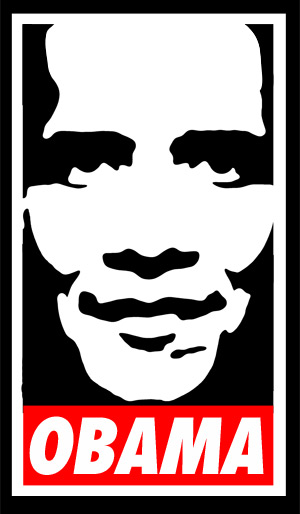
Change we Can Believe In?


Hate to be a damp squib, but...

I can't say I'm over the moon. I was more than a little spooked by the prospect that McCain could get in - well, more than that, that Palin could get in. I had visions of McCain stepping up to make his victory speech, clutching at his chest, collapsing to the ground...Doesn't bear thinking about really, and that worst-case scenario is now safely out of our minds. But in all the euphoria, I wonder how much 'change' Obama really will bring? He may mean well, he may desire to bring change (hell, Blair and Bush thought they were doing God's will!), but such high hopes and the realities are sure to be a long way apart. Concessions will be made, the real power will probably lie behind a team of backers and moneymen with their own interests to pursue. I disagreed with the way Obama voted on the bailout, and that doesn't fill me with hope for his economic policies. I'm not sure about his foreign policy either - yes, troops from Iraq, but US presence in Afghanistan is regarded as beyond criticism, and what would he do about Iran when pushed?

Incidentally, I don't know how the Green Party expected to get very far when their website was down just a few hours before the elections. Which is a real damn shame; people whose view, I think, if they stopped to think, would be a lot closer to the Greens than to Obama's, have been swayed by the rhetoric, the hype, the hope - perhapos most of all, the idea that an African-American could actually become president (which will, of course, allow people to say that all's well with the world, look what progress we have made, a black man sits in the White House, racism is over!). Not really too much change to believe on, on that evidence.

Tuesday, 28 October 2008

Cannibal Holocaust: A Review


'Cannibal Holocaust' - the very title screams excess and exploitation, and normally I'd steer a mile away from that sort of thing (I'd rather not have to watch a film that exists solely to show extreme cruelty), but the film's reputation, and the fact that I'd previously written essays about it (without ever watching it) made me think that I should probably get round to giving it a go. Ninety minutes later, I emerged from the experience, challenged, provoked, disgusted and somewhat perplexed. I'll try to pick through my thoughts below.

I won't bother summarising the plot - you can find plenty of other synopses on the internet - although I suppose it's worthwhile noting that it actually does have a plot, and quite a lot of dialogue. In fact, it sets itself up as something of a social critique (though it's unclear how far director Ruggero Deodoto actually bought into this), rather than a brainless gore-fest.

I think you have to see the film very much a product of its time (though with the rise into the mainstream of increasingly gory horror/exploitation movies like 'Hostel' and 'Saw', there has been something of a return to that typically 1970s combination of explicit violence and some sort of twisted moral thinking that hovers between the perverse and "hm, maybe they've got a point there"). So: the 70s, as every one knows, were a time of film-making excess (or boundary pushing, whatever you want to call it), and 'Cannibal Holocaust' is probably the most notorious horror/exploitation film from that period (it was made in 1979 and released in 1980).

The emotional/ psychological vein it taps into, though, was common to films with much bigger budgets, and bigger stars: gritty, unflinching looks at the cruelties men are capable of, like the films of Michael Winner, boasted actors like Burt Lancaster, Jack Palance and Charles Bronson, and were fairly popular at the box-office. We might think of example such as the opening rape scene in 'Death Wish', or, more relevant to 'Holocaust', the western 'Chato's Land,' in which Charles Bronson's near-silent, Vietcong-like Indian warrior, Chato, slowly picks off a posse, mostly consisting of caricatured rednecks.

There are no heroes in 'Chato' - Bronson's actions are pretty barbaric (there's an unforgettable image where the penultimate posse member is shot, and falls face down into a campfire, and another when the final member is driven back into the desert to die by Chato), though the white man's are even worse. This raises an issue of moral compromise which Winner seems to have ducked out of somewhat - at times he seems to be actually advocating the sort of revenge that Chato takes, seeing it as justified because the posse have raped and murdered his family, and are racist bastards. Similarly, in 'Death Wish', Bronson's vigilante actions are celebrated (when the law fails - and, by extension, in Chato, the 'laws' of 'civilised' behaviour - you have to take matters into your own hands, and act with the sort of violence and cruelty equal to that dished out to you). Perhaps this is unfair to Winner - maybe he is taking no moral stand, showing both parties as equally vile, and presenting a completely nihilistic vision. But it's deeply unclear, and, while such uncertainty accounts for the film's unprecedented power, their deeply unpleasant, 'impure' feel, it seems somehow reprehensible (if no less reprehensible than Hollywood's increasingly overt glorification of violence, if it's to save cute little kiddies and is done by your favourite action heroes).


So to 'Cannibal Holocaust'. Like ‘Chato’s Land’, its plot involves the intrusion of evil white men into the territory of natives who prove to be just as brutal in retaliating to the atrocities committed by said white men, and like ‘Chato’s Land’, it presents somewhat confused moral messages. Even more than ‘Chato’, it could be described as a deeply misanthropic film, and, if anything, its targets appear even more confused. As another review I've read has noted, it sets up its crew of film-makers pretty much as straw men (while it may be true that news-crews exaggerate, manipulate, distort, etc, I find it unlikely that they'd go as far as to massacre pretty much a whole village)and thus muddies the message. Furthermore, while the anthropologist, Prof. Monroe, becomes the jaded voice of reason later in the film, earlier, he's not exactly a pillar of virtue, shooting several members of one tribe in cold blood so as to gain the trust of another tribe. The idea that 'Holocaust' is attacking the 'Mondo' films (some of which actually did stage shocking events) is rendered unlikely by the fact that, with its attempt at verité-realism, it comes across as a Mondo film itself –at least, in the final, 'documentary' section. (Incidentally, this 'film-within-a-film'/ 'real documentary footage' effect is nicely done, at a time when such tricks weren't common, as they are now (Blair Witch and all its spin-offs), and as indicated by the fact that people at the time thought this was a real snuff film.)

In making this film, it seems, Deodato deliberately plays up and questions his own role as exploitation film-maker (though by doing so he unwittingly undermines himself as well). When, in the penultimate scene, the TV executive orders the footage to be burned, one wonders if this was not the very same attitude held by those who tried to censor Deodato's work. For a film that exists seemingly to confront (and arguably, to exploit) the depths of human depravity, cruelty and violence, the Professor's stance (wanting to suppress the footage) seems protectionist, censorial. Surely it would make more sense to expose the film-makers for who they were (as is Deodato and the script's intention)? After all, their earlier documentary 'The Road to Hell' has been shown to have been faked, to some extent, yet people will believe it be real - would it not make more sense to expose the film-makers (and by extension, the culture of exploitative reporting that they embody)?

Furthermore, Deodato's attitude to the native tribes is confused. We're supposed to sympathise, or at least, to understand, the actions they take towards the film-crew, to see them as justified; while they react with initial suspicion towards Monroe, it never looks like they're actually going to eat him, but the massacre in a hut pushes them over the edge. Yet what to make of the native 'savagery'? In one (infamous) scene, the crew come across a naked woman, impaled on a pole. Alan smirks, seems to be enjoying the spectacle, but is then told 'you're on camera' and immediately changes to a face of concern, pronouncing that this is the result of some barabric sexual ritual, from a people who hold virginity as almost sacred (earlier on, in the film's first truly shocking scene, we've seen a native murder an adulterous woman by sexually mutilating her). Obviously, this is supposed to be yet another example of the thrill-seeking filmmakers' callousness and exploitativeness, but at the same time, it's unclear what moral attitude is being taken vis-a-vis the natives' 'uncivilised' practices. True, the girl may have been killed in this way because she has been raped by the film-makers in the preceding scene (although it's unclear whether it's the same girl), and the tribe's attitude to sexual 'impurity' demands such a grisly response, but that doesn't make the actual act of execution any easier to stomach.

And of course, there are the scenes of animal cruelty. We see a muskrat have it's throat slit, and hear its screams of agony. Is this supposed to be just a fact of life - look, meat-eaters, this is the suffering animals go through to get you your meat - or just another cheap trick? Monroe shows a little distaste, but doesn't seem too concerned. The disembowelling of the turtle is shocking (you see its legs move even as its insides are being cut out), an effect enhanced by the score, but would it be appear any more palatable (excuse the pun) if it was done with care, rather than lip-smacking relish? It seems ironic that Deodato condemns his characters for filming the turtle-killing (as indicated by the ominous and queasy strings that blare up on the soundtrack), yet is at the same time filming this staged event himself, for the purposes of his own film.

At one point, a TV executive tells Monroe "Today people want sensationalism; the more you rape their senses the happier they are" (of course, she hasn't seen the actual footage at this stage of the movie). I don't think anyone could come away from 'Holocaust' feeling happy, although they might well feel that their sense have been ‘raped.’ By pushing things just that little bit further, the film does succeed to some extent in exposing and challenging our attitudes towards extreme violence. It is strange how we find something like 'Holocaust' shocking and deserving of censorship ("ban this sick filth", as the Daily Mail might put it), but have become immune to the horrors and deprivations we see daily on our news screens. Our morality is very perverted if can react with absolute horror and outrage to fictional gore but, when confronted with real-life events such as those in Darfur, can switch on the auto-pilot response of "oh, isn't it awful, but we can't do anything, that's just the way life is"? Of course, Deodato IS exploiting his violence, just as his fictional film-makers are, and I suppose one could argue that the film's value lies as much in the issues that he DIDN'T intend to raise as the ones that he did. In that sense, it goes beyond (or below) being art - its value lies, not in its quality (though I didn't find the acting too bad, there are moments where one feels that things are about to tip over into porno, or worse) - but in the issues it raises, however it raises them. If there was ever a film that deserved the title 'thought-provoking', Cannibal Holocaust is that film.

THE SOUNDTRACK:

You can download the soundtrack here: http://arquivosnet.wordpress.com/2008/09/20/soundtrack-cannibal-holocaust-1980/. Riz Ortolani's music is pretty effective, on the whole, though I’m not really sure that it works too well away from the film. Even in the film, it sounds a little dodgy – for example, the groan-worthy easy listening cue which plays over the title credits, and which steers things towards 70s porno when Monroe bathes naked in the river (the film's one concession to an idea of an unspoilt idyll, free from the trappings and repressions of modern life - "to be like them, naked and unfettered as Adam" as he puts it in the voiceover) – although it admittedly has some impact when played ironically over the village massacre, or at the climactic dismemberment of the film-crew. Meanwhile, the 'horror' theme, with its wrenching, mournful strings, is suitably disturbing, even without Deodato’s graphic images to accompany it (though the synth percussion effects are a little dated).

AND SOME LINKS:

J.G. Ballard on Mondo films: http://www.ballardian.com/jg-ballard-on-mondo-films
Wikipedia on Mondo films: http://en.wikipedia.org/wiki/Mondo_film
A review of ‘Chato’s Land’: http://www.dvdtimes.co.uk/content.php?contentid=12010
A review of ‘Cannibal Holocaust’: http://www.braineater.com/cannibalholocaust.html
Another review: http://www.1000misspenthours.com/reviews/reviewsa-d/cannibalholocaust.htm
And another: http://www.slantmagazine.com/film/film_review.asp?ID=1848
And another! http://www.lloydkaufman.com/roids/2005/11/11/cannibal-holocaust-review/
Review of the recent DVD release: http://www.eccentric-cinema.com/cult_movies/cannibal_holocaust.htm

Finally, 'The Video Nasties: Freedom and Censorship in the Media’, a 1984 book edited by Martin Barker, has a chapter on ‘Holocaust’, and discussions of other controversial exploitation/horror films from the 70s and 80s. If you want to acquaint yourself with the sort of issues surrounding these films (and it is a fascinating area of debate) without actually having to watch them, it’s a good place to start, though it might be a little hard to get hold of.

Friday, 24 October 2008

A Power Stronger Than Itself

This review of George E. Lewis' book A Power Than Stronger Itself: The AACM and American Experimental Music first appeared in Issue 2 of eartrip magazine. To access the full magazine, go to http://eartripmagazine. blogspot.com. To order the book from The University of Chicago Press, go to http://www.press.uchicago.edu/presssite/ metadata.epl?mode=synopsis&bookkey=236682.


The Association for the Advancement of Creative Musicians is an organisation of some importance: even its detractors must acknowledge the validity of that statement. Over the years, its ranks have included Muhal Richard Abrams, Anthony Braxton, Roscoe Mitchell, Joseph Jarman, Famoudou Don Moye, Lester Bowie, Amina Claudine Myers, Fred Anderson, Leroy Jenkins, John Stubblefield, Pete Cosey, Wadada Leo Smith, Henry Threadgill – and those are just some of the best-known. Yet, despite documentation and coverage in recordings, journalistic and scholarly articles, and references in academic books, ‘A Power Stronger than Itself’ is the first full-length study of its kind, written by an AACM member who also happens to be a fine academic writer, and who has meticulously researched both the specific and wider contexts of the AACM’s genesis, from the background of economic depression in 1930s Chicago to the present day situation.

‘A Power Stronger than Itself’ is much than just a historical curiosity; in fact, I’d argue that it is one of the most important books about jazz ever written, and is worthy of the attention of anyone who claims to be serious about the music. Lewis is an academic who actually says something through the complexity of his discourse, and is not a vacuous or pretentious name-dropper (his relation of Theodor Adorno and Jacques Attali to what he's talking about is very much to the point and not put in for some intellectual brownie points). I feel this important to assert because of the rather snobby dismissals I've read in various publications, which, dare I say it, come from exactly the sort of views he critiques in the book. A black musician talking about jazz in academic terms? That’s not his place – he must be doing something wrong.

This review can only claim to cover a small number of the issues addressed by Lewis; there’s simply no way that I can write about everything that I had jotted down as an area of immediate interest when reading through for the first time. So, where to begin? Let’s dive straight into controversy…

The issue of race will undoubtedly be raised, with the AACM criticised as an exclusive black-only club. In chapter 6, Lewis brings to light the case of Gordon Emanuel, a vibes player who was the organisation’s only white member (though he regarded himself as essentially black, being the adopted brother of bassist Bob Cranshaw and living in the South Side’s black ghetto). Growing pressures from black nationalists in the group eventually forced a meeting, in which Emanuel was voted out of the organisation. This will provide plenty of ammunition for those who want to argue that AACM members, in combating the detrimental effects of anti-black racism, turned the racism back on white people; indeed, at the time, Leslie Rout argued that the incident showed how, “in the final analysis, all white men are enemies [to the AACM].” Amina Myers, who has the advantage over Rout of an insider’s perspective, admits that “I was one of the ones that was against having somebody white in the organisation. Whites were always having something. They always run everything, come in and take over our stuff, but this was something black we had created, something of our own, and we should keep it black.” Such a mentality was something that Myers had in common with Malcolm X, and those he influenced. Well-meaning whites often did more harm than good; this was about black self-determination, and there was no problem with whites as such, but the process of explicit co-operation could only come about once the generally racist conditions of America had changed to a significant extent.

Myers admits that she has since changed her views – and they were undoubtedly very much of their time (though that shouldn’t diminish their validity at that moment in history). Today, she believes that “music is open, and that’s what I look at now. There’s got to be a spiritual quality, regardless of what the color is.” I tend to sympathise with the thought-currents that led to Emanuel’s expulsion, if not the expulsion itself – but they are undoubtedly problematic, and many in the organisation at the time did not share them to such an extreme extent.

One might also note that, despite the very heavy focus on racial injustice, there was often a strongly sexist element to male-female relationships in the free jazz world, with the woman expected to be the supportive home-maker who was there for her man while he went out on his musical explorations (see the relevant chapter in Val Wilmer’s ‘As Serious as Your Life’). Of course, as a blanket statement, this is entirely inaccurate – think of Sam and Beatrice Rivers’ Studio RivBea, Ornette Coleman’s marriage to poet Jayne Cortez, or the relationship between Sonny and Linda Sharrock – but there is still an element of truth to the accusations of sexism. In a valuable sub-section of chapter eleven, entitled ‘Leading the Third Wave: The New Women of the AACM’, Lewis discusses the issue of gender politics. Multi-instrumentalist and composer Maia recounts how she asked Phil Cohran: “When we as black people reach utopia, reach this point that we’re reaching for, is that when you’re going to deal with this issue that we have between men and women? Because the black revolution is more about the revolution of black men. The problems that exist between men and women existed before racism came about.” There’s a slight confusion as to whether the AACM membership was predominantly male because of residual sexism from certain quarters, or whether the situation was more complicated. Maia suggests that the problem was not so much deliberate exclusion as a (perhaps inaccurate) perception of the AACM as what Douglas Ewart calls “a man’s club.” “The revolution was about black men. Nobody meant women any harm. But if you don’t have on a fire suit, you ain’t gonna go into no fire. It may have been open to women, but if it is not inviting to women, women are not going to come.” So, it was clearly important that artists like Maia, Nicole Mitchelle and Shanta Nurullah began to form all-female groups, to highlight female creativity, and the validity of female contributions to black experimental music.

As indicated by such a discussion, nobody is claiming that the AACM is perfect, least of all Lewis; what makes it such an important organisation is that its members acknowledge areas of complexity or disagreement, and seek to work through these. Such an attitude that was there from the start, as made clear by the transcription of the very first AACM meetings, from May 1965, in chapter four, ‘Founding the Collective.’ A major virtue of the book, then, is that it is not sanitised; that it shows the contradictions and struggles of the organisation, at the same time as the way that it remained, as the title puts it, 'a power stronger than itself', representing something much bigger than the Chicago jazz scene, and providing a model for all such initiatives. This is what is overlooked by those who criticise the October Revolution in Jazz, the Jazz Composers’ Guild, or the AACM, by those who argue that the ideals of self-determination and creative autonomy shared by these bodies are laudable but inevitably fail. The AACM was not intended to be the solution to everyone’s problems, but was firmly rooted in the realities of a specific socio-economic, musical and racial situation, and was therefore in a good position to make an impact (on a local level, and perhaps further, as with the migration to New York). Thanks to Lewis, this is now clearer than ever; that should silence those who claim that he lavishing a disproportionate amount of attention to the AACM.

The issues of race and gender are clearly of importance, then: also crucial to Lewis’ investigations is the economic side of things. An academic not mentioned in the book, but relevant to the argument, is Ian Anderson, whose essay ‘Jazz outside the Marketplace’ contains an analysis of free jazz’s growing reconciliation to capitalism, through funding and grants from banks and institutions, that may prove depressing reading to those who associated the music with radical political hopes. This would seem to fit with the standard narrative, to which there may be some truth , which would place the trend identified by Anderson alongside the failure of post-’68 activism, as evidence of the decline of the left. However, pessimism, leading on to capitulation, and, ultimately conformity, are what brought about this change in the first place, and to react in the same way is not the answer.

For, what Lewis’ book offers, beyond informative and (generally) rigorous scholarship, is hope. Lewis shows how (predominantly black) self-organisation and self-promotion could provide a viable alternative to commercialisation, line-toeing and subservience to the greedy, exploitative machinations of big-time club-owners, promoters, and record company bosses. The AACM was not primarily a for-profit organisation –members contributed funds to keep things afloat at first, even if payments were not always diligently kept up, and proceeds from concerts were plunged into further musical developments and, importantly, educational and social projects. Thus, while the AACM was in the service of the art foremost, the art was intimately linked to the life. “My youngest son’s wife called me,” Jodie Christian recalls. “She said, do you know any place where they give piano lessons? I thought, the AACM, that’s what they do. If that ever dies, then the AACM dies. That’s what’s holding it together. That, to me, is the backbone of the AACM.” (P.506) One cannot understand the music without a knowledge of the socio-economic and racial conditions of Chicago (or, for that matter, America as a whole), and one gains a deeper appreciation of the AACM project if one realises its political significance, rather than simply seeing it as ‘interesting’ music. ‘Interesting’ music is what divorces the experimental tradition from a wider audience, creating an ivory-tower elite (most notably in the classical music world) which the free jazz musicians sought to combat from the outset (Val Wilmer’s ‘As Serious As Your Life’ provides further evidence of such ambitions).

Yes, perhaps some of the participants have gained (even courted) the support of the 'establishment' (George Lewis' own work at IRCAM, for instance, although that was a slightly strange episode, and one he felt somewhat uncomfortable with, I believe) - but, as Lewis argues, quite persuasively I think, the 'establishment' (the sort of 'high culture' institutions that Anderson argues have come to support free jazz) tended to (and still does tend to) look down on the music. As many, many people will tell you, it is still a struggling music – consider the state of free improvisation in the UK (the closure of one the major venues, the Red Rose; the cutting of funding for the LMC; and the post-Thatcherite bureaucratic muddle that complicates things still further). I think it’s more the case that that a few token 'progressives’ and 'radicals, get establishment support, as a means for the capitalist hierarchy to appear 'progressive' and 'liberal', at the same time as denting the subversive force of the art they have ‘embraced.’ When trumpeter Bill Dixon was featured on a BBC Radio 3 programme devoted to ‘new music’, for instance, his work was treated with a marked lack of respect, in comparison to the numerous classical composers that the programme features, week in, week out. Underlying it all, I’m afraid to say, is a residual racism that is all the more pernicious for being unconscious. If Dixon, one of the most important instrumentalists and composers of the past forty years, is characterised as “mad,” there’s not much hope for the free music project being taken seriously.

I mentioned the danger of elitism for (predominantly white, classical) experimental music, and there are those who criticise black experimental music in a similar manner, as elitist and inherently anti-popular. These charges are not hard to repudiate, and the connection between the black avant-garde and popular music should not need too much defending – Amiri Baraka had always maintained that Albert Ayler and James Brown were equally important as figures of black self-consciousness and self-expression (see his essay ‘The Changing Same’), and Lewis provides a corroborating anecdote about Henry Threadgill playing “free” in evangelical meetings (pp.75-6). Yet the other attack, often from critics with a black power agenda, like Baraka or Stanley Crouch, needs addressing – that connections with European classical music (Braxton, Cecil Taylor, and George Lewis with Cage, Stockhausen and IRCAM) are betrayals of blackness, ‘whitening’ the music and rendering it impotent, effectively obscuring and ignoring a part of one’s identity as an African-American by moving away from one’s heritage. This leads Baraka to claim that he would prefer to listen to the hegemonic comfort of Wynton Marsalis’ revivalism than to Lester Bowie or Henry Threadgill (though he believes that they too should have “regular stages” (p.444)). Lewis’ book is crucial in this respect, showing how misguided such criticisms are, and how the AACM’s avant-garde approach actually stays truer to heritage than Marsalis’ more overt engagements with black tradition. Maybe the Lincoln centre ‘jazz neo-conservatism’ is on its way out by now, though Stanley Crouch is still yelling out its propaganda at the top of his voice – still, for those taken with its proclamations, it might be helpful to consider this: who would berate contemporary rock musicians for not sounding like Hendrix, or contemporary composers for not sounding like Vivaldi?

Lewis, then, persuasively shows how much criticism of the work of black experimentalists, from both black and white critics, is based on outmoded principles and simplistic assumptions that might have people up in arms if applied to white composers - hence the famous 'anti-jazz' slur on Coltrane, and the assumption that one must be in the tradition (this mysterious, single tradition, always prefixed by the definite article) or one is nothing, and hence the straitjacketing of people to fit rules that you yourself have artificially imposed onto them. I don’t have the space to go into it here, but there are some crucial passages in which he argues that the annecdotalism of (predominantly white) 1950s and 60s jazz criticism (such as Leonard Feather’s ‘Blindfold Tests’) deliberately stirred up antagonism, and opened up a false and unnecessary chasm between traditional musicians and experimentalists, as well as creating a simplified and distorted climate, ill-suited for the reception of music (like the AACM’s) that went beyond a certain level of complexity, that went outside the bounds of certain fairly strict parameters.

In conclusion, then, Lewis has much say that is relevant and of interest, in relation to perceptions of music, and ways of avoiding the capitalist norm (communal, self organisation, art and mastery of a craft valued over 'product' and the market). Most relevant is his penetrating analysis of the still-present subtle and perhaps unconscious racial discrimination that exists when talking about this music: put the black man in his place, don't let him mix his entertaining jazz with serious music of any kind - hence the criticism of Braxton for taking an interest in Stockhausen. There are numerous thought-provoking passages which really do change one's perceptions of things might have just taken for granted – but I’ll leave individual readers to discover these for themselves.

In the end, despite compromises that may have had to be made (the move to New York, while creatively fruitful), and difficulties overcome. As attested to by the work of Anthony Braxton, Muhal Richard Abrams, Wadada Leo Smith, and Lewis himself, these artists are still as creative as ever, and, even if some have moved beyond the AACM, they retain its ethos in all their activities. The younger generation is thriving too, and is in a reciprocal relationship with the older generation of pioneers, as seen in such examples as the collaboration between Matana Roberts and Fred Anderson on her album ‘The Chicago Project’ (reviewed elsewhere in this issue).

Characterising all these diverse activities is a strongly-held belief in the power of music as a force for good – not in a vague utopian sense, but as something that can have a real and positive impact on the lives of human beings. As Nicole Mitchell puts it, “we take for granted the power of what music really is. It’s not about trying to make a few dollars at some concert. It’s not about, do we have a crowd, or do I have an image, or have I, quote-unquote, made it.” (p.512) What it is about is the substance of this book.