Thursday, 20 April 2023

Latest

My essay, 'Songs for the Future', on Askia Touré's Songhai! and the African American epic, is out now in Paideuma, Vol.48, as part of a special tribute to issue to Touré's book that also includes essays by Addison Gayle, Jim Smethurst, and Kathy Lou Schultz. Many thanks to Ben Friedlander and Betsy Rose.

The UK reprint of Songhai! will be out soon from Materials.


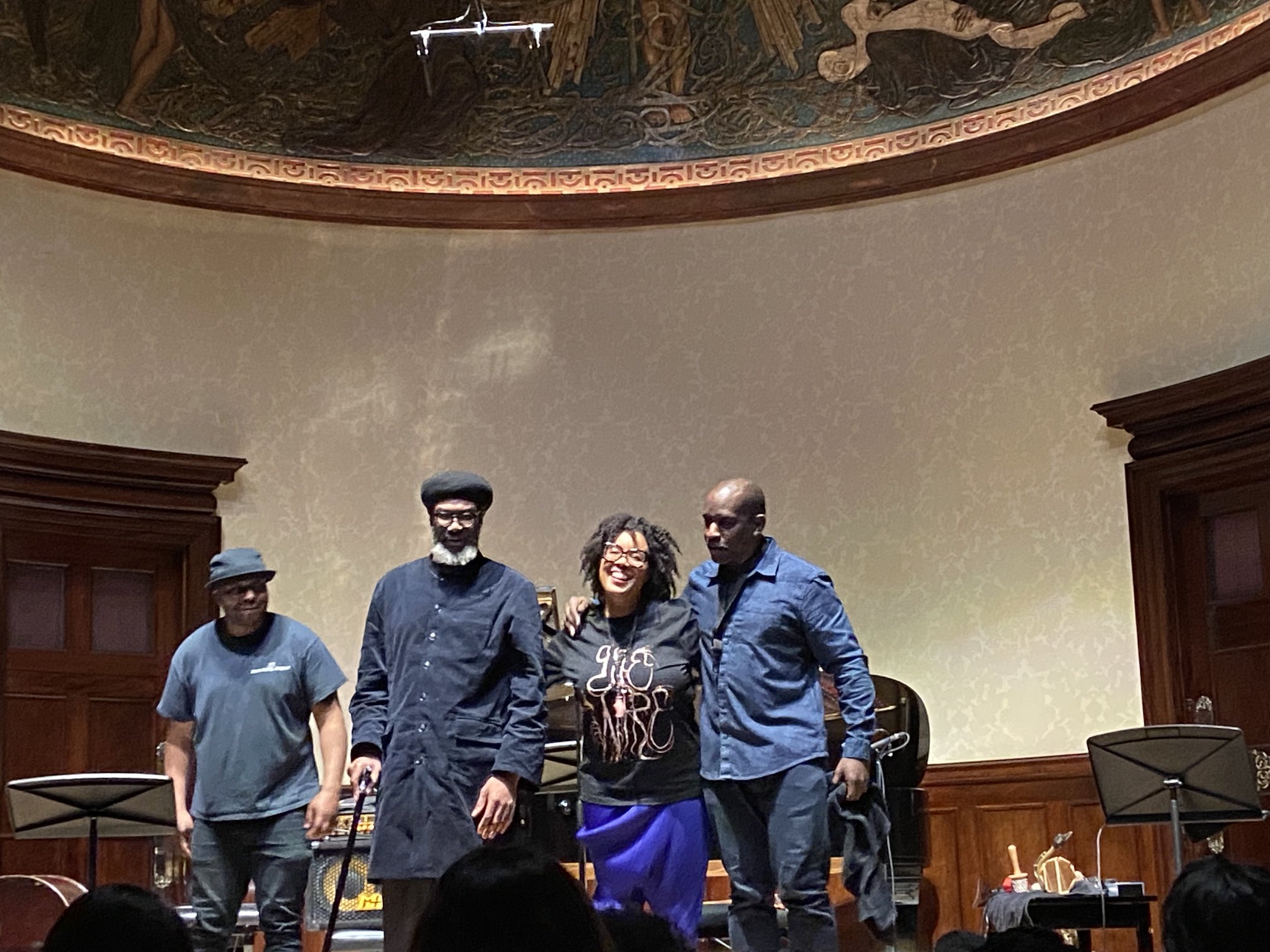
A review of the Fred Moten/Brandon López/ Gerald Cleaver show at Cafe Oto in Artforum here, with some words on Candace Hill's phenomenal reading the same afternoon along the way.

Review of Jason Moran's superb James Reece Europe tribute From the Dancehall to the Battlefield in The Wire 471.


And soon forthcoming, a long piece on the new Selected Poems of Mark Hyatt, a scholarly labour of love by Sam Ladkin and Luke Roberts, at The Poetry Foundation.

Sunday, 2 April 2023

In other news...

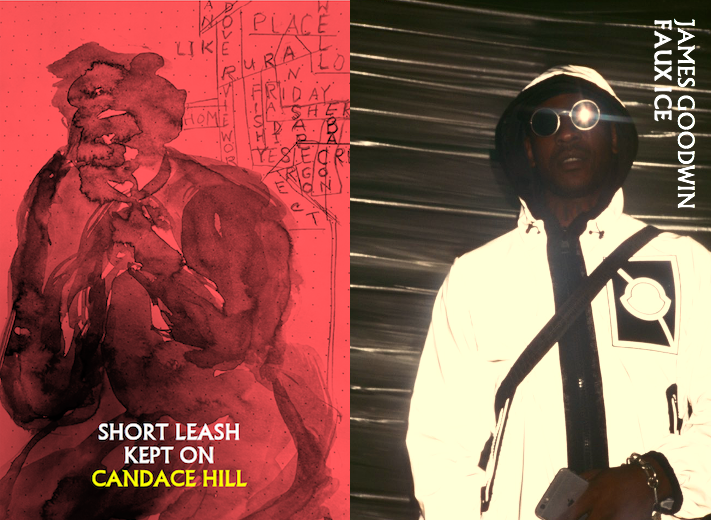
On Sunday April 8th (next weekend) we'll be launching the new Materials books by Candace Hill and James Goodwin at Cafe Oto in Dalston at a 2pm matinee reading. James will be reading from his new book Faux Ice and in conversation with Nisha Ramayya, and this will be a rare opportunity for UK audiences to hear from the astonishing Candace Hill--artist, poet, weaver, author of the 200 page epic Short Leash Kept On--who'll be reading and in conversation via video link. Come for the afternoon and stay for the Fred Moten reading at the same venue in the evening! Details and advance tickets here.
 
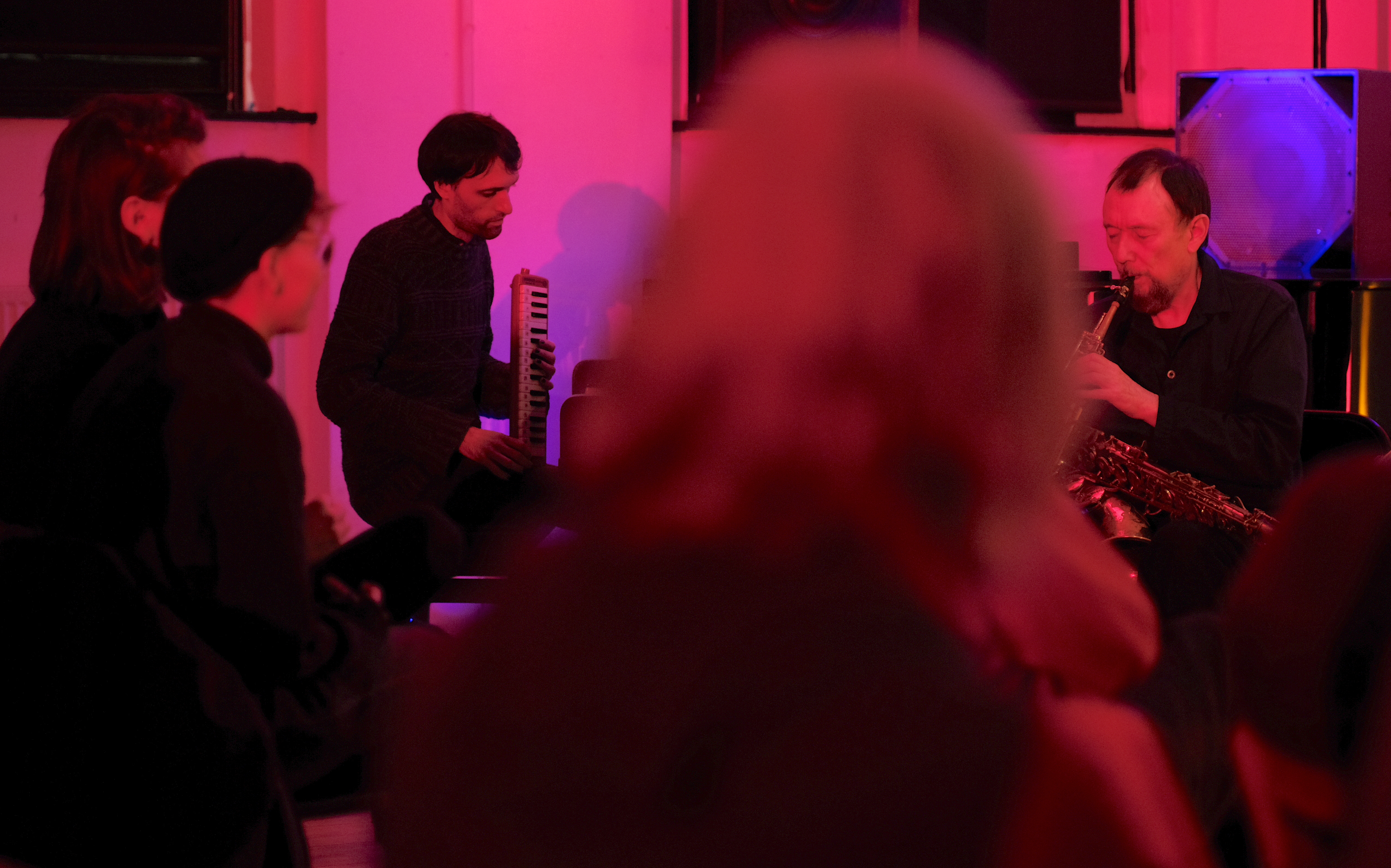
On Thursday April 13th I'll be playing with a new group, Multiple Melodicas, at waterintobeer in Brockley, South London: myself, Georgina Brett, Steve Beresford, Douglas Benford, and Martin Hackett on melodicas, along with solos sets from Eddie Prévost and N.O. Moore. Unit 2, mantle court, 209-211 mantle road, brockley, se4 2ew. Doors: 6:30pm for a 7pm start. More details and advance tickets at the eventbrite page.


Then at 7:00pm on Wednesday April 19th I'll be reading from Present Continuous for a Pamenar Press spring reading at Thingy Café in Hackney Wick. Details here.

Finally, at 7:00pm on Wednesday April 26th I'll be taking part in a performance by members of the Eddie Prévost workshop at IKLECTIK, Waterloo, as part of the here.here series, for which Eddie will also be in conversation with Emmanuelle Waeckerlé.

---

And from a previous here.here, here's footage of my conversation with Eva-Maria Houben, Emmanuelle Waeckerlé, and Artur Vidal as part of the concert Social Virtuosity with Eva-Maria Houben curated by Emmanuelle at IKLECTIK in March. The video presents the whole concert: Artur's performance of dreaming legends, Artur's and Eva-Maria's performance of loose ties, and the string ensemble piece the green that is almost a yellow, performed by Lara Agar, Angharad Davies, Isidora Edwards, Finn Froome-Lewis, Dominic Lash, and Hannah Marshall, and the post-performance conversation. The performance of the string piece in particular was astonishing, its silence full and shared, its overlapping lines a perpetual making and unmaking of space as shelter; Eva-Maria's and Artur's performance with organist Huw Morgan the previous Friday was equally exceptional: I'm hoping to work up a longer piece on that (via Straub-Huillet's Cézanne) at some point in the not to distant future...


Meanwhile, elsewhere on the internet, the Poetry Center has been digitzing some astonishing readings from the 1970s. Filmed in San Francisco State University's Creative Arts Building, Lorenzo Thomas reading 'Grandpa's Spells' (named for the Jelly Roll Morton piece) is nothing short of breathtaking. Musicked speech indeed...

But, as well as music, this work is also conversation--talking (talking to, talking about, talking with, talking back). "I want to talk about the tears and sorrows of the people", he says in his introduction. And this concept of "the people" is a global one, Thomas reading his poem in memory of Neruda and translations of work by African poets--that internationalist, multi-lingual aspect running through his work: poems by Francisco José Tenreiro, Agostinho Neto, Marcelino Dos Santos, the latter then emerging from the victorious struggles against Portugal in Angola and Mozambique. Thomas' work of the 1970s, as he honed the finely-poised ironies of his earlier work through the lens of his experience in Vietnam and his reading in writers like Christopher Caudwell, is a contribution to a left populist poetry that has been virtually ignored: far too few notices of the Collected Poems edited by Aldon Nielsen and Laura Vrana have made it into print. (I've so far been unable to place my own review.) But being able to watch this video, to hear Thomas' cadences, his sonorous rise and fall, helps to newly bring that work alive: a poetry that charges the space, crackles with fierce energy and moral compulsion.   

Thomas read with David Henderson, fronting the nine-piece band Ghetto Violence--as singer...(in this harking back to his early career with vocal group the Star Steppers, as documented in Henderson's classic early poem 'Boston Road Blues' (for the poem, scroll down to page 41 here.) In the U.S. Bicentennial Spring, Henderson and the band deliver "Hail to the Chief" ("agit-rock...dedicated to the next Presidential election". In the event, Jimmy Carter would replace Gerald Ford, who'd pardoned Richard Nixon for his Watergate crimes, in the recurring cycle of putatively 'democratic' debasement. It continues.

(The full recording of Thomas' and Henderson's reading is here.)

Also from the Poetry Centre's Digital Archives, another gem: Karen Brodine and Meridel LeSueur reading in 1981, two generations of Left feminist writing looking into the jaws of the 1980s with implacable courage. What's particularly valuable is to have this document of Brodine reading the entirety of the sequence Woman Sitting at the Machine, Thinking, written from her experience of workplace organising as a typesetter (and her reading of Engels). I'm working on a chapter on Brodine, Merle Woo and Nellie Wong for a forthcoming book on queer poetry in Boston and San Francisco which hopefully will be fully drafted in the next few months. Last year, I spent a valuable week in Brodine's archives at the James C. Hormel Center on the top floor of the San Francisco Public Library, Tim Wilson and the other librarians patiently bringing me box after box and allowing me to see, in her unpublished notebooks, drafts, teaching preparations, and talks, how, for her, poetry articulated her sense of herself as woman, as lesbian, as worker, as socialist, the clarity of the way she theorizes language, the specific uses she sees poetry as fulfilling: conceptions well beyond the cliche of poetry as a kind of transparent vehicle for messages, on the one hand, or as 'neutral' abstraction on the other. For Brodine, poetry's form is its argument: which is to say that "form" is inseparable from, dialectically related to "content", the distinction between which she skewers in her unpublished pieces on aesthetics. We all know the rhythms of our days, shaped by labour or its absence, in our different ways, some feeling the pinch more than others, and spending time with 'Woman Sitting' in particular, going over it and again, still enables a reckoning with and refiguration with the violence of that time, the violence of Brodine's and our times: this poem which is so much about time, about the work week and the ways workers work within and resist capitalist time.

knowledge this power owned, nor shared
owned and hoarded
to white men [...]
                           wrench it back
knowledge is something we have 

Here's Brodine's reading: 


And from the same reading it would be negligent not to mention Meridel Le Sueur's poems of fierce solidarity, reading the global and gendered division of labour in ways that, once again, are firmly internationalist, are about mapping the general and the particular in precise and specific ways that poetry--specifically--can be used as a tool to pry open, a compass for navigation. And Le Sueur's opening denunciation of Eliot's The Waste Land as nihilistic male modernism remains as hilarious and as provocative as it's meant to be...

Friday, 10 March 2023

Gaia: Two Orchestral Works by Wayne Shorter

Two luminous orchestral works by the late, great Wayne Shorter: first, Dramatis Personae, a Lincoln Centre Commission from 1998 with Shorter on soprano, Jim Beard on piano, Christian McBride, bass, and Herlin Riley drums alongside orchestra conducted and arranged by Robert Sadin--the bridge between the monumental, and underrated, High Life (1995) and the orchestral collaborations of the Danilo Pérez/ John Patitucci/ Brian Blade acoustic quartet to come.


A decade-and-a-half on, the massive LA Philharmonic commission Gaia (2013), described by Richard S. Ginell in Variety as a “murky, thick-set monster of a piece [...] massive, slow-moving, opaque textures, sometimes tracking Wayne’s distinctive long, snaking melodic lines on soprano; treating the sections of the orchestra as blocs”. Varying in performance from 25 to 30 minutes, this version from Gdansk in 2014 veers toward the latter, with Shorter on soprano forming part of a quartet with Leo Genovese (piano) and Terri Lynn Carrington (drums); the solo vocal part and libretto are by Esperanza Spalding, who also doubles on bass as part of the quartet. 

Shorter first began work as a teenage student at NYU, and it’s to be hoped that Shorter’s Kennedy Center collaboration with Spalding on the opera Iphigenia--his final piece after he retired from performing in 2019--might appear in the future. For now, the serene drama of these orchestral works represent the majestic, achieved late blossoming of the compositional impulse Shorter had been building throughout his entire life, from his early work on that teenage opera through to the unreleased orchestral pieces Universe, Legend and Twin Dragon he wrote for Miles Davis in the 1960s and ’80s (later realised by Wallace Roney) and the misunderstood trilogy of post-Weather Report Afro-futurist epics Atlantis (1985), Phantom Navigator (1986), and Joy Ryder (1989), along with the aforementioned High Life.

I have a longer piece on Shorter in The Wire, with thanks to Meg Woof.


(Edited down from a 30,000 word draft--with plenty more to say on Shorter’s orchestral work, his status as composer, and the framing of ‘jazz’; more of that may see the light of day elsewhere.)

///

In other news:

My interview with composer Hannah Kendall is online at Bachtrack: Kendall is Composer-in-Residence at the Royal Academy of Music this March, and a couple of concerts are forthcoming the following week. Highly recommended if you’ve not heard her music in performance before.


On March 22nd the trio GUE will be making its delayed debut at waterintobeer in Brockley, South London. Jacken Elswyth on banjo, Laurel Uziell on electronics and myself on electronics and melodica. We’ll be joined by a saxophone trio of Alex McKenzie, Nat Philipps and Nicholas Hann, plus Tom Mills on theremin. Tickets £5, doors 6:30, to be wrapped up by 9pm. Eventbrite page here.


Finally, I’m delighted to reveal the cover for the Selected Poems of Calvin C. Hernton, co-edited by myself and Lauri Scheyer, and now available for pre-order from Wesleyan. The book includes material from across his career--including the long out-of-print The Coming of Chronos to the House of Nightsong--and a foreword from Hernton’s longtime friend, publisher and champion Ishmael Reed, along with notes, chronology, and index. It will be published this August.


Saturday, 25 February 2023

News and Views

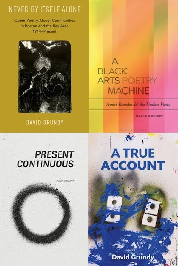
In February I was interviewed about A Black Arts Poetry Machine by João Paulo Guimarães (University of Porto) and Elina Siltanen (University of Turku) for the online Poets Talk Politics Series hosted by the University of Porto. Thanks to João and Elina for the questions and discussion, and to João for the invitation. The event was live-streamed and should be uploaded to the Youtube channel of the Instituto de Literatura Comparada Margarida Losa in the next few weeks. For now, it's available on Facebook, as embedded below (no need for an account) or at this link.


Also online is the video of the online launch for Present Continuous back in January, hosted by Malvika Jolly and with responses from Tyrone Williams, Linda Kemp, Ciarán Finlayson, and Ghazal Mosadeq, can be seen on the Pamenar Press Youtube channel here, or in the video embedded below. Many thanks to Malvika for hosting and Ghazal and Hamed for publishing, designing and typesetting the book!

Some photos from the 'Electro-Acoustic Responsiveness' gig at IKLECTIK with Eddie Prévost (percussion), John Butcher (tenor and soprano saxophones), N.O. Moore (guitar), Emmanuelle Waeckerlé (voice, objects), and Tony Hardie-Bick (electronics), courtesy of film-maker Stewart Morgan, whose film on Prévost should soon be nearing completion. 


Photo credit - Stewart Morgan Hajdukiewicz

And some photos from the Materials/Materialien reading at Halle für Kunst Lüneburg, with James Goodwin (launching the new collection Faux Ice), Lütfiye Güzel and Laurel Uziell: thanks to curators Ann-Kathrin Eickohf and Elisa R. Linn. 


James will be doing a UK launch for his book at Café Oto in Dalston on Sunday 9th April; this will also be the launch for Candace Hill's astonishing book-length poem Short Leash Kept On. James will be in conversation with Nisha Ramayya and I'll be in conversation with Candace via Zoom. (Fred Moten will be reading, in his trio with Brandon Lopez and Gerald Cleaver, later in the evening.) Tickets from the Café Oto website.


Finally, in further Materials news, Anne Boyer's Money City Sick as Fuck and Lisa Jeschke's The Athology of Poems by Drunk Women are back in print and can be purchased from the Materials website at the following links: Boyer here and Jeschke here.


Friday, 10 February 2023

“Myths and Dreams”: The Rolling Calf/Pat Thomas

(Photograph by Helen Wallace)

The Rolling Calf/ Pat Thomas
Wigmore Hall, London, 22nd January 2023

[A shorter version of this piece appears in this months issue of The Wire]

A few weeks into the new year, Elaine Mitchener continued her five-year artist-in-residency at the Wigmore Hall with a performance by her electroacoustic group the Rolling Calf Trio, joined on this occasion by Pat Thomas. In a relatively short first half, first we heard a Thomas piano solo—a characteristic study in piano resonance, making full use of the concert grand the concert hall setting (was this Thomas’ first time at the Wigmore? What are the points of access for what music is or is not allowed to be heard in such places?), thick clusters and repeating figures that never quite coalesced into riff or melody but moved off elsewhere, pealing like wave upon wave, preludial and exploratory. Next, Mitchener came and stage and, with Thomas performed a kind of deconstructed skeleton of a standard, or standards, Thomas playing plangent chords and discrete bursts of blooping electronics, Mitchener at one moment repeating a vocal sound and a physical movement that at first seemed spontaneous—head inclining to the right, hand moving up in the air alongside—and then repeating it, over and over, like a gif or a loop, problematising the notions of immediacy, performance and the like present in the position of the singer of songs of love or lost love, of feminine presentation, of the standard as vehicle for emotions and notions always greater than its lyrics suggest. I was reminded of Fumi Okiji’s paper on Cecil Taylor, Billie Holiday and gesture at the Taylor conference in New York a few years ago, riffing off Taylor’s line “as gesture jazz became Billie’s right arm bent at breast moving as light touch”, accompanied in her rendition by a video loop of Holiday’s arm in an old TV clip. The model of singer and accompanist is here at once gestured at and moved beyond, in that Mitchener, who keeps words to a murmured or half-sung minimum, functions as much as instrumentalist as singer. Even more so than the versions of standards found on Mitchener’s quartet with Alex Hawkins, the model of song form is moved away from into a more open, capacious improvisational and questing and questioning approach to the spirit of the standards more so than their harmonic or melodic content. The duo don’t perform any particular single standard as such as one, fifty-to-twenty minute ur-standard, a net picking up ghostly traces of songs that float by: the word “lovely”, a wisp of melody, a line or two half-recognised from a song. The first comparison that comes to mind—not least for the depths of Mitchener’s contralto voice, here heard with generous reverb allowing it to swell into the hall with the magnified intimacy pioneered in the recording technology of mid-century that did so much to shape ideas of what jazz singing might be—would be the ‘free standards’ of Ran Blake and Mitchener’s long-standing inspiration Jeanne Lee, in which the melodic contour, the verse-chorus-verse structure of the song are adhered to but the harmonic and rhythmic contours moved away from; or any number of deconstructions of the standard, from Taylor’s—or Sunny Murray’s—‘This Nearly Was Mine’ to the quieter, chamber deconstructions put in play by the likes of Paul Bley, Andrew Hill, or, more recently, Jason Moran.
 
Gesture and movement of another kind characterised the performance by the Rolling Calf, Mitchener’s ‘Black Power Trio’ with Neil Charles on bass and electronics and Jason Yarde on alto saxophone and an even wider range of electronics: synths, drum machines, digital manipulations and live sampling. Yarde—whose performance with Louis Moholo-Moholo’s ‘Six Blokes’ band in a three-horn line-up alongside  Byron Wallen and Steve Williamson one night, Shabaka Hutchings the other, the last time Moholo performed in the UK back in September 2019, was so vitally transforming and powerful—appeared miraculously recovered from the onstage stroke he suffered in October the previous year in France, his life saved thanks to the presence of two parademics in the audience who he insisted he go straight to the hospital, and to the treatment he was able to receive in France at a time when a government of millionaires is attempting to utterly destroy and deplete the British National Health Service in the spirit of a kind of nightmarish blend of Dickensian Victorian inequality and neoliberal ideology pushed to the max. Survival, literally, yes—that’s what this music has always been about.

The musicians entered from the back of the hall, behind and through the audience, each playing hand-held “stirring xylophones”—tuned wooden percussion instruments struck with beaters—in the quietly tempestuous manner of early Art Ensemble of Chicago records, first sparsely echoing melodic patterns, then swirling cascades in glissando’ing stir and swell; one at a time, the three came on stage, Charles and Yarde moving into loops and figures on mini-synths, drum machines and samples, Mitchener’s voice totally commanding, moving from the deliberately constricted/restricted register of the first half to declarative, soaring notes, pronouncements and announcements.


As in many of her recent performances, Mitchener has developed an approach to form in—rather than compositions or ‘heads’, but not completely ‘free’ improvisation, a set will be organised around different texts, which Mitchener will work at, sing and speak until their possibilities have been temporarily used up, moving to the next fragment. These texts, generally poems, but sometimes incorporating statements from interviews, were on this occasion organised into a collection named on the programme as ‘Myths and Dreams’, that included Césaire, Brathwaite, Una Marson, Taylor, Sun Ra, and Jay Bernard. They form points of reference, clearly demarcated sections that function something like movements in a suite, helping to organise an often quite lengthy piece in ways that are not obvious or circumscribed. These are not ‘lyrics’, in the jazz or pop model, nor are they ‘settings’, in the classical or new music model, so much as elements of musical material; while words imply narrative, context, fixity, in Mitchener’s case are treated in ways that—as in the case of Jeanne Lee, whose approach in her work with Gunter Hampel or on a record like ‘Conspiracy’ is again perhaps the closest formal analogy—might differ each time, in minute or quite dramatic ways, always with an ear to what is happening in the musical texture of that moment, how it might go on from there.
 
To me, the heart of this particular Rolling Calf performance was the rendition of a poem from young British poet Jay Bernard’s Surge, an elegy in pats in which Bernard’s archival research into the 1981 New Cross Massacre—an event which happened eight years before Bernard’s birth—is set against the unfolding tragedy of Grenfell Tower fire, which happened as the sequence was being written. Constructed as homages to the dub poetry of Linton Kwesi Johnson—particularly his own poem ‘New Crass Massahkah’—the first of two poems entitled ‘Songbook’ establishes a space and a geometry at once of the dancefloor and of wider tactical manoeuvres, the territory of mourning and militancy that first, the New Cross Massacre Action Committee and later, Justice 4 Grenfell have to trace. In Johnson’s 1981 poem, released as the final track on the 1984 album Making History, words insistently inflect the music in dialogue, in contrast and tension: jaunty but haunted, the rhythms shift from the poem’s section, describing the celebratory sociality buoyed by the rhythms of the party before the fire—“di dubbing and did rubbing”, “di dancung and di skanking”—to the rhythm of the fire itself—“di crash and di bang”, “di heat and di smoke”—to the rhythm of activism, its persistence and resistance. “but wait / yu noh remembah”, “but stap / yu noh remembah”: the poem is a call to remembrance, of the need to tell and re-tell a story ignored or mis-told in official record. Like Johnson’s poem, written in the immediate aftermath of the attack, Bernard’s later poem traces the rhythms of dance—the party before the fire—turned to violence—the fire itself and the second violence of bungled police investigation and racist media reportage—in turn turned to resistance through the work of the committee and the Black Peoples’ Day of Action. Over time, the mathematics Bernard’s ‘Songbook’ traces—“me seh ah one step fahwahd an ah two step back”—its manoeuvres of progress and defeat, of progress and defeat, of going round in circles or back to square one—becomes not just the immediate events of a particular movement, but of the seemingly infinite deferral of closure, as the quest for justice stretches into and beyond the space of a lifetime. Echoes fade away, generations build and develop; Johnson’s insistent call to remembrance fades and must be taken up and replayed, overlaid and overlayered like the laboratories of dub transformations that take up and distort the sounds of an original track. When performing, Bernard themself recites the poem without music: the music-and-speech dynamics of Johnson’s dub poetry, with its low-key delivery given power and contrast by the accompaniment of Dennis Bovell and the Dub Band, internalised into the rhythms of the poem itself, as stripped-back, ghostly echo; a memory, of a social moment, a movement, something we can barely hear. “Me seh half de revalushun deh pun de attack / Only half a salushun to de tings dem we lack.” One step forward, two steps back, half a step, half the revolution, half a solution—the process is incomplete. There’s no closure, no justice. 
 

Yet Bernard’s poem is also about togetherness and community. Playing with rhymes or assonance in words like “back”, “attack”, “tack”, Bernard’s poem , which, like Johnson’s work, refuses to be contained by standard English, is buoyed up and carried on by the pleasures of rhythm and the pleasure of sound, the excess of sound, sounds ability to contain and then explode, the poem as a kind of carrier, an unexploded charge, carrying its “secret cargo” into the present. And when Mitchener delivered the poem within the context of music once more, the poem attained a fresh power, a declarative insistence. In comparison to Bernard’s Johnson-esque understatement, Mitchener’s was loud, present, unnerving: she delivered the text half spoken, half sung, a singer’s voice, expansive and huge, used to projection, not the quiet dynamic of a poet’s voice; her delivery at once toasting and sprechstimme; combined with the abstracted patterns of Charles on bass and Yarde on electronics, drum machines and synths stuttered into loops and sampled patterns, giving way to blasts of Yarde’s alto squall, the music traced another kind of time again, one in which instrument associated with pop music are repurposed and abstracted and which, in turn, an avant-garde that has too often excluded the matter of black life, is repurposed for its energies.
 
The music moves on again—picking up on the carefully poised ironies of a Sun Ra statement—“those who will not dance will have to be shot”—traversing language of ritual and apocalypse, Mitchener now playing with the ritual of calling out the band’s names—the celebratory incantation over music that signals celebration and closure in the Art Ensemble’s rendition of ‘Odwalla’ at the end of almost every concert they gave over the years, or the ecstatic sung shout outs on Pharoah Sanders’ 1981 album Live. “We are the Rolling Calf!” she proclaims, and as she picks up a phrase from a Cecil Taylor interview—“Hearing is playing. Music does not exist on paper”—turning it into an incantation, Pat Thomas makes his way to the stage, adding further electronic bloops and trademark thick chords and clusters on piano to the stuttering loops set up by Yarde and Charles. “Music does not exist on paper”. After a minute or so, the lights go out, the musicians playing in the dark, rendered illumination, focused on hearing, on the work that listening and playing can do, beyond visuality, beyond representation, beyond the page. The trappings of concert hall, of the performer/stage division, of the above-stage frieze, with its art deco image of music-making as a ritual idealized and frozen, already expanded by the trio’s entrance through the audience, by Mitchener’s dance round the stage, blowing a whistle, by Thomas’ entry onto the platform from the front-row seats; all these melt away, focus into the material and more-than-material presence of sound itself. Mitchener has long been an expert at making time melt, bend, twist in this way, all with an awareness of history, of music’s history and the histories beyond music that music sediments. Tonight was a particular resplendent example.

Sunday, 5 February 2023

The Goldfish Bowl: 'The Romantic Englishwoman' (1975, dir. Joseph Losey)


What is it that's so unsatisfactory about this film? And what can that tell us? Before answering that question, a brief run-through of the plot. Glenda Jackson's frustrated bourgeois housewife, having gone to the spa town of Baden-Baden for unspecified reasons, maybe or maybe doesn't have a brief affair with Helmut Berger's young gigolo. In town on a botched drug deal, Berger operates through a combination of what we might term freelancing: as a car or drug smuggler but, it seems, principally as a gigolo whose opening line is that he's a "poet". (The role he plays here, as a class-ambiguous outsider who both manipulates and is manipulated by bourgeois families seething with tension, mirrors that of Visconti's then-recent Conversation Piece--or, indeed, Terence Stamp in Pasolini's Teorema, at once far more ambiguous and far more socially incisive than either film.) Meanwhile, back in British suburbia, Jackson's husband, writer Michael Caine abandons plans to work on a novel to begin a screenplay based on his jealous imaginings of his wife's Baden-Baden sojourn. When Berger telephones Caine to announce that he's an admirer of his work and turns up (literally) "for tea", the stakes are set for the triangle to play out, with the added drama in the final third of Berger's drug connections, among them the poker-faced Michael Lonsdale, turning up in a kind of lugubrious pursuit. 

No spoilers here, though the film doesn't aim at resolution so much as a kind of blank termination. The title is bitterly ironic, a phrase spoken by Berger's gigolo about the various ways he's paid for his services: with the utmost discretion by European women; with a kind of throwaway vulgarity by American women--"here, go and buy yourself some shirts"; and with a kind of guilt passion by English women, who wish to invest, not simply their money, but their whole beings into what for the others is more clearly transactional. Hence "romantic". Social roles, the film's ending seems to suggest, are fixed: the characters know this, they analyse it, generally with bitter cynicism or contempt, sometimes with frustrated outbursts of drunkenness, rage, or desire, but their knowledge does nothing to change it; attempts to move beyond these constraints in the name of 'freedom' are in themselves played out according to similarly hierarchical and fixed positions; desire cannot escape these prohibitions. The film exacerbates this sense by focusing on a limited range of characters and settings. These are bourgeois characters within bourgeois spaces: the house and garden; the hotel and its surroundings; the occasional visit to a dismal restaurant or club. Even as these characters, given the narrative events, spend much of the time engaged in international travel, the journeys through a setting that would reveal a fuller social world--a town, an airport, a port--are reduced to a truncated snapshot of empty spaces, seen at their edges. They move within a confined world and take that world with them wherever they go, in a grim and claustrophobic myopia. When they look out of the window--as in the shots of Jackson aboard a train that play over the credits--they see a mirror. 


In this deliberate limitation to a confined social setting, the film echoes Losey's earlier The Servant, The Go-Between, or Boom! In The Servant, principally the increasingly claustrophobic house; in Boom!, the luxurious island getaway, isolated from the mainland; in The Go-Between, the wide-open spaces of a lushly filmed Norfolk countryside whose empty flatness comes to stand for a kind of myopic claustrophobia characteristic of a particular class at a particular time. In The Servant, desire is manipulated as part of an endless, circular game of power relations and hierarchies, negotiated across lines of sexuality, gender and class; in Boom!, it's a Burton-Taylor tete-a-tete which is both a kind of "battle of the sexes" and an allegorical struggle with mortality; in The Go-Between, forbidden desire across class lines and the fetishised mediations of smuggled messages leads to a denouement in which the outsider protagonist represses all thought of desire as a founding trauma. Losey's films of the 1960s and 1970s--the period in which he reinvented himself from a filmmaker of social problem pictures and taut, gritty noirs, to an arthouse director--were often criticised for the essential vacuity of their gestures. Losey, it was said, took the formal innovations of Resnais-ian temporal ambiguity or self-conscious echoes of the history of art (as when Jeanne Moureau's Eve strikes a pose from Massacio's Explusion from Eden) and presented them for their own sake: they became empty signifiers, somewhere between costume dramas and the arthouse, in which a self-evident critique of a decaying social class was presented with gimmickry and trickery; or at worst, in which the formal presentation nullified the critique that was being made. (Is The Servant, for example, with its presentation of the usurpation of the power a member of one ineffectual, privileged class by another shown to be cynical and grasping, as Amy Sargeant suggests in her BFI Film Classics guide, ultimately a reactionary film?)
Such criticism was neither entirely right nor entirely wrong. During the '60s and '70s, Losey made films that were various combinations of flawed, highly skilled, and near-disastrously misjudged. In The Go-Between, things come together with a tact and taste that has far more beneath its surface than the costume drama feel implies. (It's a film, in other words, that's easy to misread as simply nostalgic, Downtown Abbey-style, particularly given the lush Michel Legrand score all all those sweeping shots of green fields--as Serge Daney punningly put it, "the depth of field which is often the depth of the fields, very green, crossed diagonally and nervously.") In Boom!, meanwhile the misjudgments are so far off that the film achieves the status of camp--quite brilliantly. (Not for nothing is it highly regarded by John Waters.) With Losey, quality--both the actual quality of cinema, or the pretentious trappings of a "cinema of quality"--was never absolute. 'Accident' was followed by the startling incoherence of Secret Ceremony and Boom! but in turn by The Go-Between. The Romantic Englishwoman and an indifferent Galileo--the literal return to Brecht--were followed by the incisive Mr. Klein, a film which actually felt to reckon with the weight of history, all framed through characteristic Losey-ian preoccupations. Tracing a through-line in Losey's work thus becomes both all too easy--given its auteurist excesses--and one that's frustrated by how unevenly it's executed. What we watch, at least from Eve onwards, is a set of variations on a theme, more or less successfully rendered. (And Losey's detailed breakdown of the making of his films in Michel Ciment's exemplary 1985 book Conversations with Losey gives a lovingly detailed sense of continuity between the more apparently diverse elements of his ouevre.The Romantic Englishwoman has all the features of Losey's Pinter collaborations (for this script, one playwright--Pinter--is replaced by another--Stoppard; Losey had of course worked with a perpetually stoned Tennessee Williams on Boom!, as per the waspish recollections in Conversations with Losey), but without the deceptively minimal clarity of analysis--particularly relating to social class--that Pinter's presence afforded those films. 

Take the classic Losey-Pinter structure of flashbacks and flashforwards--longer or shorter inserts of scenes whose relation to the main narrative is not immediately revealed, which might later resolve into being seen as "earlier" or "later" than that action, or which might reveal themselves as a particular character's subjective fantasies, and which serve to offer an ambiguity of subject position and narrative temporality that, as Losey argued, was specific to the cinema, in what are at once intensely filmic and intensely literary adaptations of often dense source texts (novels by Nicholas Mosley--who, as the son of the British Fascist leader, knew all about power relation and masculinity--and L.P. Hartley, respectively). This device has been used to particularly good effect in the late '60s/early '70s Pinter collaborations Accident and The Go-Between. Its most obvious antecedent lies in Resnais--and indeed, Losey directed an obscure sequel to Resnais's La Guerre est Finie which shared its original star, Yves Montand, ten years after the original. Its use by Losey is, however, perhaps closer in spirit to a lesser-known film which, like Losey's, shares a more ambiguous mainstream/arthouse cachet: the 1968 melodrama Petulia, directed by that other American abroad, Richard Lester (and sharing with The Go-Between the presence of Julie Christie, radically different in both films). In Resnais, the most obvious forebear for this technique, the dense intercutting of multiple temporal levels furthers a political analysis, with--for example--narrative puzzle as analogy for the way that politics is subsumed or repressed vis-a-vis the Algerian war of independence and political torture in Muriel, or the workings of the political underground in La Guerre est Finie. In Petulia, they serve as a cynical demolition of the Californian 'summer of love' and its reverberations among the liberal (or not so-liberal) wings of the bourgeoisie--along with the presence of racism and intimate partner violence--and in Losey's Pinter collaborations, as a careful analysis of the ways that gender and class replay among networks of power--the ivory tower of Oxford University in Accident, on the one hand, and the English country house in The Go-Between, on the other.


Most of these examples are films about the past: or, if about the present, about the inability to reckon with the legacies of the past that serve as the return of the repressed, particularly in a gendered violence, done by men to women, which assumes unspoken structural dimensions. In the car crash and its aftermath that opens and closes Accident, a particular moment reveals itself as made up of a mosaic of different perspectives, while Losey/Pinter through various methods also suggest that much of what's seen exists within the warped imagination of Dirk Bogarde's central character, the Oxford don whose repressed desire leads him to commit an unforgivable act. In The Go-Between, meanwhile, the traumatic repression of an incident seen only at the end of the film (the discovery of the illicit, cross-class lovers in flagrante delicto, leading to social exposure and suicide) is cinematically expressed through the insertion into a broadly chronological narrative of brief flashforwards to its conclusion which function something like involuntary memories. While these might technically be experienced as flashforwards, they ultimately take place within what is essentially a flashback structure, in which the adult Leo is finally able to recall his suppressed childhood experiences, as signalled by the famous Hartley line heard in voiceover at the start of the film: "the past is a foreign country; they do things differently there". In either case, from the perspective, both of its making in 1971 and the publication of the novel in 1953, the narrative is framed as a retrospective, deceptively nostalgic one, towards its clearly outmoded Edwardian setting (and one with an oblique nod to the colonial relations that, in Resnais' Muriel, exist on the peripheries of the narrative, yet are central to its puzzle-like meaning.) These are films in which we see country houses, Oxbridge colleges, games of cricket: the signifiers of nation and history that exerted a particular fascination for an exile like Losey, driven by McCarthyism to the old colonial heartland.


More contemporary in its setting, The Romantic Englishwoman is less clearly oriented towards the past, and its flashbacks become something more like premonitions: memories of an event that may never have happened, whose presence causes that event to affect the course of future events. These flashes--whether forward or back--centre on an incident that occurs, as in Accident, near the start of the film: the moment Jackson and Berger take a lift together in their hotel and may or may not initiate a sexual relationship. Yet, whereas in Losey's other films, devices of literary narration were incorporated or subsumed into what were, as he notes in Conversations, fundamentally cinematic temporal structures, enabling the recurring snippets of a traumatic event to oscillate through the film like shards of glass or wisps of smoke, here, the literary, constructed nature of memory is turned into a kind of clunking, meta-fictional conceit, in which in life imitates arts as the paranoiac, jealous fantasies of Caine's novelist/screenwriter--the encounter in the lift, and, ultimately, the wife's decision to abandon her husband and the entry of gangsters as the story turns into a 'thriller' (a more contemporary--and cinematic--mode of storytelling than that of The Go-Between's "costume drama")--come to life onscreen and in the narrative. 


In their initial appearance, these scenes are compelling enough. What happened in the lift in Baden-Baden? From whose perspective do we see this? What are the lines between desire--whose desire?--and action? In its opening third in particular, the incident in the lift serves as a central focus for the insinuation of various triangulations of a bourgeois marriage--a kind of infinite range of scenarios, generally operating according to the same pattern, on the various real or imaginary pairings of the heterosexual couple and a third partner: the frustrated wife and the younger gigolo; the frustrated husband and the young au pair; and so on. Yet as we see Caine type on screen and then see the fantasy come to life with Berger's arrival at the house, the film curls on in itself in a way that begins to shut off other possibilities. (Losey himself later expressed discomfort with the way the scenes of Caine writing fitted into the texture of the film.)

Like Fassbinder, Losey argued that the power dynamics so coldly dissected in his films are operations of sexuality in general, as opposed simply to those of heterosexuality: "With [the 1962 film Eve--perhaps the first of his 'arthouse' or auteur films] I wanted to make a picture - as I still and always do - about the particular destruction and anguish and waste of most sexual relations, whether heterosexual, homosexual, bisexual or whatever". (Hence what is in effect a bisexual triangle, or quartet, or, at the film's end, a kind of expanding circle, in The Servant.) In The Romantic Englishwoman, they are particularly focused on the ways that such power dynamics play out within the context of heterosexual marriage. As with much of his work, the film couldn't easily be called either a feminist or an anti-feminist film: Caine's obnoxious outburst at Jackson's friend, a visiting gossip columnist, for repeating feminist statements about female homemaking roles, represents one pole; yet, in a film such as this, as, to a different extent, with Moureau's more liberated Eve, Jackson's dreams of liberation from marriage can occur only through another man, and no real possibility of sociability outside the heterosexual contract is offered. We simultaneously watch the playing out of male jealousy--Claude Chabrol-style--though Caine's character, apart from this one outburst, never reaches heights of Chabrolian murderous rage; and of Jackson's "romantic" desire for escape--the doomed template of much melodrama. Too often, though, the film simply presents this double-bind as is, with little other perspective on what we already know. Truth becomes truism, even fatalism. Does the presence of the gangster subplot imply an equivalence between the workings of organized crime and those of bourgeois marriage and the affairs and transactional sexualities that exist alongside it--the one 'legitimate' and the other the necessary other to allow that structure its legitimacy? 


If this were an early Fassbinder film, it might. Here, however, Losey is so preoccupied with formal exactitude that a more layered sense of meaning--allegorical, narrative, ideological--evades its grasp.Yes, the film allies form to content--as in Resnais, as in Lester, as in Losey's other films. The flashback-flashforward structure insists on the claustrophobic way in which its characters play out pre-ordained social roles--again and again. It insists on this at a formal level, at every stage. 

But to what end? 

***

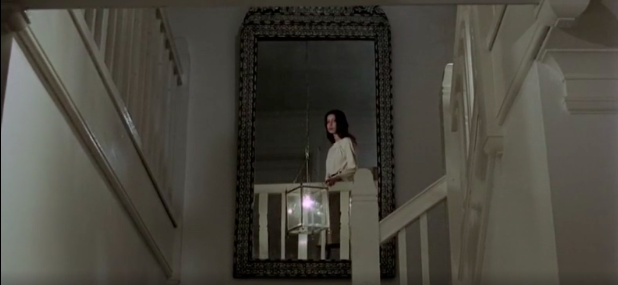
As the auteur model hardened into a kind of doctrine, within both mainstream and arthouse cinema, its worst characteristics--the delineation of directorial vision through mannered stylistic over-emphasis and the obsessive replaying of certain themes or preoccupations from film to film--ossified. Often, this gets called "self-indulgence": there can be a pleasure to that, as in the obsessive zoom lenses and luxuriant sweeps of historical decor in '70s Visconti (especially Ludwig), a critique from within of its own decadence with some parallels to that of Losey. But it can also become excessively mannered--perhaps mannerist. In The Romantic Englishwoman, the flashback-flashforward device takes its place alongside other characteristic Losey features such as the obsession with shots which use mirrors to produce a kind of mise-en-abyme or double framing, incongruously languorous, lushly romantic orchestral scores, and bitterly ironic cut-aways. By now, however, it has become an example of a technique, a device, a tic used to more or less good effect in earlier films--the mirrors of The Servant, the cutaways of Accident, the Michel Legrand score to The Go-Between--that simply replays itself, as if one could part the parts together to put something that, while in perfect working order, seems to have been produced without any real necessity. Yes, style and form enact narrative content: and on top of this, the meta-scenario of the script, in which Caine's screenplay becomes a kind of self-fulfilling prophecy, renders narrative itself a mise-en-abyme. But form and content here are too perfectly tied: the parts fit so neatly that any social commentary is reduced to a bare-bones outline. 

Writing of The Go-BetweenSerge Daney argued that 
Losey feels obliged to attract the attention in terms of social relations toward a visual mechanism which was always designed to conceal these relations.
Perhaps this is the central issue. The cold distancing that such a style produces--one watches every shot, not so much as a moving, breathing thing, but as a kind of fastidious construction, like a well-made watch--superficially offers something approaching the analytic operations of early Resnais or the alienation effects of Losey's mentor, Bertolt Brecht, but without the content of thought and critical reflection on the mediations of the aesthetic medium that effect was intended to foster. 

As Jackson and Caine arrive back at the house where a party awaits them--the end of the affair, real or imagined, that disrupts the bonds of the couple form, the reiteration of the social bonds of bourgeois life--it's evident that there's no way out. We see this from the outside, looking in on the goldfish bowl--a bowl we may well ourselves have no access to, as the screen shows us yet more images of bourgeois life and tells us they are unhappy. The viewer is placed determinedly outside the frame, where they can stand with the arch-framemaker, Losey himself. 


Yet what kind of outside is this? In the Brechtian model, the artwork prompts a self-critical reflection on what is being shown and how it's being shown aimed to combat deception, smoke-and-mirrors, and the replaying of art as the endless perpetuation of a bourgeois perspective. And this is why Brecht's work--or the work of, say, Straub-Huillet--still feels so alive, however difficult. In a film like The Romantic Englishwoman, however, we seem to stand outside the characters for no particular purpose. Brechtian engagement is replaced by a kind of deadened admiration of craft for its own sake. Perhaps this is why the film feels so "cold", so dead, such an exercise in style. 

In Conversations, Losey recalls the picture as one in which he had relatively little interest. "I don't like the characters", he remarks. 
And they're not likeable [...] Helmut's character [...] [is] the only one in the whole film who has an articulated, concrete philosophy. It's an anarchistic philosophy but at least it's there. The others are just kidding themselves one way or another. I've made that picture a thousand times, maybe not as well, but - you know, it's a remake essentially. It deals with an impossible situation in which a bourgeois life encases people and they don't get out of it and to that extent it's The Prowler, Accident, Eve
Yet, beyond Losey's own dismissal of the film as a begrudging rehash of the kind of story he'd told before, the fact that it exists perhaps tells us something else about the evolving nature of cinema as the reactionary years of the seventies settled across the Euro-American world. What does it mean that such a film was made? Who was it for? There's more thinking to be done on this question that I have the capacity for here, but suffice to say that, for all its faults--in fact, because of those faults--The Romantic Englishwoman has something to tell us about the peculiar status of a particular model of cinema--not quite arthouse and not quite not-arthouse--that had evolved out of the ruptures and eruptions of what Getino and Solanas termed 'Second Cinema' and made a kind of uneasy rapprochement with Hollywood's 'First Cinema': a cinema within which, paradoxically, or so Daney argued, Losey had been able to make more socially subversive films than in the apparently more radical work of the auteur years--The Boy with the Green Hair, The Dividing Line, and so on. Losey's own comments on his film suggest that he had by this point himself become entrapped within the same world as his characters: a circular series of representations of a circular series of relations, the bourgeois life whose lovingly detailed exposure had become the de facto image of art cinema of a certain kind (Antonioni, Visconti, Losey...) 

In Losey's final film, La Truite, released seven years down the line, Isabelle Huppert plays what is in effect an updated version of the Jeanne Moreau character in Eve, or, indeed, of the Helmut Berger character in The Romantic Englishwoman: a figure whose act of rebellion and survival within a bourgeois world are both entirely directed against it and entirely dependent on and circumscribed by it: "an anarchistic philosophy but at least it's there". Once more, though the characters spend a lot of time travelling within settings of various opulence, there's, really nowhere for them to go. As Daney writes
Losey looks at this small world, this modern fish tank, with a slightly indifferent tenderness. He continues to pretend undoing the terribly tangled web of the plot, even though it is no more important than mishmash.
In the fishtank of formalism, aesthetics is divorced from pleasure: everything is a copy, nothing changes. Or, to adopt another metaphor, the picture that the puzzle portrays will always be the same, however the pieces are jumbled. Daney's "tenderness" might be read as "sympathy"--sympathy for Moureau and Berger and Huppert's acts of revolt, sympathy for the roles in which all the characters, without exception, are trapped--a sympathy so all-encompassing, and so low-level, that it can hardly be called "humanism", which protests, not with the anguish of Sirkian restraint or the caustic exaggeration of Fassbinderian satire, but with something colder, flatter, both closer in spirit to its bourgeois subjects and immeasurably further from any kind of transformative analysis of the situation in which it finds itself. And perhaps, after all, this is where certain aspects of Euro-American cinema, of Euro-American society, still find themselves, half a century on.