Friday, 13 April 2018

“…And Not Goodbye”: Cecil Taylor (Part 1)


Cecil Taylor died last week, at the age of 89. I think a lot of people had been preparing for this moment for some time, the occasional appearances and cancelled performances representing a slow tailing-off after consistent concert activity for decades before (in recent years, especially with regular sparring partner Tony Oxley); a sense that Taylor was ill and that the fire was finally burning lower, or at least, more intermittently; the last performances characterised by a slower, more limpid lyricism – which had always been there, but more often juxtaposed with those characteristic Taylor fireworks, those extreme instances of virtuosity that rendered him the most relentless and exciting and full of ideas of almost any musician, ever…

A couple of years ago, after Taylor had performed at the funeral of Ornette Coleman, another of that generation of pioneers of the late 1950s and early 1960s, I wrote down a dream.

CT was doing what may be a final performance, in some sort of large genteel university room. There was a really large group and I was really stoked and moved to see this valedictory thing. they started off by playing the piece “Taht” from Winged Serpent, but as they went on, I noticed that CT himself, though he was initially there, was no longer sitting at the piano and had disappeared. There was a team of other pianists, deputizing, some of them also adorned with various little instruments, whistles, recorders, etc. The overall feel of it was intensely sorrowful, like something enormous and beautiful and necessary had been lost and would never be captured again.

What can you say. Taylor’s music has changed (“changed utterly”) my listening life – my life itself, perhaps – in more ways than most. At times of concentrated listening, I can think of nothing else like it, nothing else as nourishing and beautiful and complex, music that can and should and does seem to go on forever, thinking and emotion and speed and a gorgeous, overwhelming intensity of purpose, of group concentration, communication, interaction, interconnection, conjunction, contradiction – all those adjectives, those nouns, don’t go there. I wrote about Taylor’s poetry for an MA dissertation some years back, and got deep into that as well. (Often the only way his poems are accessible, given the sparse publication record, are on live performances, and I made a stab at transcribing those – probably virtually impossible for the musical performances…) Those twin things are what I want to get down here – and again, what can you say, never enough, never more than a scattering of enthusiasms, but the gift keeps on giving, the vast discography, so much still to be said. What I thought I’d do was to provide a brief index of highlights and favourites, some of them more obscure, from the music, then go on to the poetry in a second part post. Of course, providing examples in this way risks becoming simply a by-the-numbers enumeration – a list of records, when each one in reality was a small volcanic explosion, an eruption into the atmosphere which might utterly change anyone who heard it. There are no bad Taylor records, pretty much, if we judge them on any other standards than those his own music so relentlessly and consistently establishes -- each one of them manifesting utter commitment, grace, poise, ferocity, intensity, all those adjectives critics fumble for, his piano running ahead of them in flurries and runs and clusters and sudden dropped chords of astonishing, heart-stopping beauty.

Bearing in mind too, this advice from the Taylor documentary All the Notes:

It's fun, if you don't let them make you write-all-this-stuff-down-forever, when all that shit'll drive you mad. Cause that's not fun, and everything should be fun, it should be a celebration of life.

Or, as Pheeroan Ak-Laff puts it, Taylor’s enormous appetite for knowledge, enacted and embodied in performance, “made mincemeat of the mere intellectual”; made mincemeat of body-mind dualism, of the imperial trajectories of western thought. Someone writes somewhere that each of Taylor’s notes is a monolith; someone else calls each of his notes a continent; a world. Some of those worlds below.

Early Taylor: This Nearly Was Mine

Taylor’s early records are of course awkward in the sense that, while his style is beginning to properly form out of Brubeck (passed beyond, after watching Brubeck on a double-bill with Horace Silver, copping his licks, as recounted in the invaluable interview with A.B. Spellman for the book Four Lives in the Be-Bop Business), Monk (a different room in the monastery), Bud Powell (the scene changing), he’s often cramped by the rhythmic straightness of the hard-bop/bop continuum he’s forced to work within (Ornette got over this by getting rid of the chordal instruments – no comping! But Taylor was the chordal instrument…Let alone having to play “tunes”). Taylor had played with saxophonists before – Steve Lacy’s tartly cool soprano; a slightly mis-matched post-bop date, set up by others, which catches him with Coltrane perhaps before the latter was quite ready (imagine the collaboration a little further down the line!); and a bit later, CT would sometimes play in informal settings with Albert Ayler (one precious, 20-minute recording survives on the massive Holy Ghost box-set). But I think it’s really when Archie Shepp, himself a rookie out of blues / R&B and the new influence of Coltrane, comes into the picture, that things really get interesting. I know a lot of people think Shepp’s a little awkward here, but for me, especially when he’s paired with Jimmy Lyons, there’s a rough and smooth, sweet and sour combination that’s later echoed by the Jimmy Lyons / David S. Ware combo of the late 1970s CT Unit and that really gels with Taylor’s melodic and ensemble conceptions. One of my favourite performances from this era – and one I’ve noticed cropping up on a number of other tributes as well – is the near-15-minute take on Richard Rodgers’ musical chestnut “This Nearly Was Mine”, a kind of lolling, lollop-ing, languorous, passionate, utterly, utterly gorgeous stretching-out, Shepp in perfect sardonic melancholic mood, Cecil rolling through on that same melodic stream.


Into the Hot

Into the Hot is a great, great album; released, confusingly, on a split album with the John Carisi ensemble (as Amiri Baraka put it in his review, “cool progressive”), credited to Gil Evans, who appears on the front cover in an obvious cash-in on his own Out of the Cool, but who by all accounts barely even produced the record. (The tracks were reissued, more sensibly, alongside a side by Roswell Rudd, later on in the 60s.) Three pieces, Lyons and Shepp, a real compositional sense, arranged, really, classic avant-garde big-band, careful and full of emotion, just perfect pieces, lessons for how to do jazz composition without the tricksy twiddlings of the Third Stream. There are moments, especially on “Bulbs”, of absolutely heart-stopping beauty, that rich stream of emotion Taylor could tap and which could not always – could almost never – be tied to a single adjective, containing multitudes.


Conquistador

The Café Montmartre recordings in the trio with Lyons and Sunny Murray were obviously a massive breakthrough – Nefertiti, The Beautiful One Has Come, those long, long work-outs where Taylor seems to be taking “comping” to a whole new level (as Monk did) – and then the mostly unrecorded participation in the October Revolution in Jazz, The Jazz Composers’ Guild and the militant democratisation and self-organisation of New York’s free jazz musicians. As Taylor puts it in the opening chapter to A.B. Spellman’s Four Lives – which is still the best economic insight into the music, and vital for explaining Taylor’s subsequent trajectory – to the academy (briefly – his orchestral conception in the 1970s definitely developed from his regular workshopping with students at Antioch, and you hear this influence too in a recording release by Jemeel Moondoc’s Muntu from around this time), and to Europe (where the pianos were at least better, and the Mafia itself was not involved in jazz clubs, even if rip-off merchant agents and promoters abounded). As Taylor puts it there:

That's what the Jazz Composers' Guild was all about. We had hoped to get together and to try to make conditions that were more the way we felt would benefit the musicians and, like, not necessarily the gangsters that we usually have to deal with.

So this is where Bill Dixon comes in. (*see below) Conquistador, on Blue Note, Dixon as part of a band including two basses (Alan Silva and Henry Grimes), Andrew Cyrille, Lyons on alto. These are new compositions, two of them, perhaps more jazz-inflected than Unit Structures from the same period (US and Conquistador were Taylor’s first recordings for four entire yearsUS is less percussive, more intricate, chamber-textures – this partly due to the “avant-classical” sound of Ken McIntyre’s oboe – and the limpid strangeness of “Enter, Evening” has few parallels in Taylor’s work). On Conquistador, things build to a new, ecstatic energy, and might be seen as the bridge between the orchestral conception developed on Into the Hot and the later music of the Cecil Taylor Unit.

This is I think, still my favourite Taylor record. Of course, a lot of this is to do with first acquaintance – the way something sticks as the first time you encountered an artist whose work would change life, to the extent that I can’t imagine a life in listening without Cecil’s music there, nor, really, the first time I heard it as a moment of revelation – I think it may have been Conquistador on college radio, though, definitely Conquistador was early. And still, the moment when the second theme on the title track comes in, about six minutes into the track, may still be one of the most exhilarating moments of all time in music, the way the unison melody surges out over Silva's and Grimes' vertiginous doubled-basses, like wings lifting the rest of the music – light and heavy at the same time, exemplary of Taylor’s melodic gift, capacity for ensemble mobilisation, and the transformative lift his music could make: gravity and grace at the same time.

(*Dixon played an unreleased duo with Taylor in 1992 – there are, needless to say, bootlegs – and then there’s the late album in trio with Tony Oxley, a live performance from Victoriaville is one of the sparsest albums in the entire Taylor discography, and it’s telling of the respect in which Taylor must have held Dixon that it’s Dixon’s processed, echoing trumpet that dominates; usually, at this stage, Taylor’s collaborators were along for the ride, riding the wave of Taylor’s established re-juxtapositions, re-combinations, pattern-playing, but here, things are open in a strange and surprising way. Needless to say, critics were not impressed.)


“The orchestration of one man’s piano” (Taylor / JCO)

The later 1960s were a time of transition. Remember, Taylor had barely been able to perform during the earlier part of the 1960s, helping Joe Termini’s the Five Spot to become the hotbed of the hip cognoscenti, but unable to sustain a long-term booking there, reduced to washing dishes, lacking the time and the space to develop his conception (compare to any number of classical pianists providing the umpteenth version of a Mozart sonata…) This sense of frustration is well-captured in the Spellman book – released in 1966, it catches Taylor on a cusp, having signed for Blue Note (a label with some clout), but increasingly looking towards Europe. Out of the initiatives which saw things like the JCO and the October Revolution had brought musicians together, and several large-group experiments resulted. Of the free jazz greats, it was perhaps Sam Rivers (and later, Braxton and Henry Threadgill) who would really develop the big-band as a medium; but the JCO, formed by Mantler and Carla Bley out of the JCG, released a fine album of what are essentially concertos for various soloists by Mantler entitled Communcations. Mantler’s charts, as on most of the other pieces, are gnarly, punchy, serving as swelling crescendo and riff punctuation for Taylor to give full rein to his virtosity. The charts have a kind of doomy heaviness to them; this is probably one of Taylor’s noisiest and most exhilarating recordings, a true piano concerto. Mantler calls it “the orchestration of one man’s piano”, and when that piano is already an orchestra in itself, and the orchestra in question has twenty musicians – no less than FIVE bass players – and when some of them include Gato Barbieri, Lyons, Cyrille, well…


The late 60s into the early 70s: Europe / Antioch College

Around this time, given the economic situation, Taylor increasingly began to perform in Europe, on often-exhausting tours, and to develop the Unit music with Lyons, Sam Rivers and drummer Andrew Cyrille (documentation of this in a live performance from Paris in 1969, and the documentary produced for Luc Ferrari’s series on avant-garde music, Les Grands Repetitions, broadcast on French TV, which features footage of the Unit rehearsing in what appears to be an old chateau in 1967). Student Studies is one of the more intriguing items from this period, recorded in 1966 but unreleased until 1973. This sees perhaps the first recorded appearance of “the lick” (see below), and also a kind of interestingly glacial, slowed-down version of the compositions Taylor would play with the newer version of the Unit in the later 1960s. Listen to how responsive Cyrille’s drumming is here – such crisp snare! – and Lyons’ almost sardonic delivery of the melodic lines – the pauses giving the music a real tension, a patient building – this, it strikes me, may be due to the extremely reverberant acoustic they’re playing in – maybe they had to let the phrases hang out at first. In either case, the slowed-down approach (at first at least) allows us to hear the logics behind what would be played at much more furious pace later on, and the music feels, in a sense, more open – there are passages approaching atonality, Silva’s bass is loud and singing, Cyrille is totally on it, open yet precise, Lyons is Lyons – this feels like real, collaborative endeavour, within a heavily-rehearsed, composed framework. Shit, in its use of space, it's almost psychedelic...


(Student Studies)


(Les Grands Repetitions)

It was also at around this time that Taylor also began to perform solo. He taught at Antioch College from 1969 to 1973, which gave him a much-needed opportunity to hone his conception – adequate rehearsal time, access to instruments, and to a steady stream of talented students who formed parts of large rehearsal bands. Though his students were not as starry, this time arguably parallels what, some years later, what Anthony Braxton would do at Wesleyan. Sadly, much of this work is unrecorded (or at least, buried deep in the Taylor archive). From the Antioch period come recordings like the solo Indent; Japanese recordings with the Unit (Akisailka) and solo once more; Taylor also started up his own label, Unit Core, who released a split solo / Unit platter called Spring of Two Blue J-s, which I’ll discus more in the poetry post. Each one of these recordings is great, and the solo music in particular is caught at a fast pace of development which might become a little more stabilized later on. My favourite is maybe the solo from Japan, just over half-an hour in length, but pretty much a perfect encapsulation of this stage of the solo playing. Two tracks in particular carry through the years: “Asapk in Ame” (full of "the lick", which we’ll return to below), and the more melancholy side of things slipping through on “Lono”.


Piano-on-Piano, Mark 1: Friedrich Gulda

Perhaps a curiosity, but one I’m fond of: this a short duet between Friederich Gulda and Taylor, recorded at Moosham Castle, Austria, in 1976. (Taylor's solo 'Air Above Mountains' was recorded at the same location.) The rest of the album finds Gulda, better known as a classical pianist, freely improvising with Albert Mangesldorff, Barre Philips, John Surman, Stu Martin and Ursula Anders (I think Taylor may also be involved, but don’t quite recall…) Telling, of course, that the youtube comments criticise Taylor for “not being able to play Mozart” while Gulda “could play jazz”. The beneficence. While Gulda had some jazz chops, what’s interesting about this collab is the territory they take – the motoric low-end figures, based on staggered explosion and release, that Taylor was exploring a lot in his solo work, become even more jittery when echoed and amplified by Gulda – at times it sounds like Gulda is doubling Taylor, a weird kind of stereo-matching or mapping or mis-matching effect. It’s certainly sparky – in fact, the few piano-on-piano collaborations Taylor made, far from crowding each other out, tend to create a nice contrast: of course the Mary Lou Williams performance addressed below is controversial, but there’s also a late film of a collaboration with Taylor devotee Yosuke Yamashita (probably one of the best of Taylor’s imitators, and one with a broader conception than that, in the “total piano” style of someone like Don Pullen or Jaki Byard).


Piano-on-Piano, Mark 2: Ayizan

Embraced: billed as an encounter; a meeting of generations, between Taylor and Mary Lou Williams, this album is often seen as one of the lesser-items in Taylor’s discography, as a kind of failed experiment. And that language of embracing is perhaps encapsulated as much in the poems (“Choir” and “Langage” – two of Taylor’s best) that are printed in the liner notes, as in the music itself. Carnegie Hall was booked, the concert was widely-billed – Taylor apparently doing a lot of persuading for Williams to feel comfortable. Williams wanted Taylor to play written music which moved through the history of jazz, from boogie-woogie to free, but Taylor preferred to improvise in his own fashion; what emerges, with Williams backed by more straight-ahead be-bop musicians, is sometimes awkward, rhythmic fixity underneath torrents of notes. And the concert and the resulting album were controversial as an apparently confrontational merging of styles that belied its title, and Williams herself wrote to Taylor that “being angry you created monotony, corruption and noise.” (See Linda Dahl’s biography of Williams for the full account). Yet this encounter is instructive in a number of ways as more than a case of simple communicative failure. As an encounter between members of successive avant-garde traditions, a flamboyant gay man and a woman in a male-dominated field, in particular – and, musically, sometimes, as on this track, “Ayizan”, it can gel all the more beautifully for the moments of ill-fit; when Williams’ own gnarlier tendencies off-set Taylor’s, or mesh with his balladry, it feels achieved.


Petals: The Late 1970s unit

It’s in the late 1970s that the Unit reaches its peak: first, with the version from 1976, featuring tenor player David S. Ware and the similarly powerful Marc Edwards –documented on what seems to be any people’s favourite Cecil album, Dark to Themselves, and on some absolutely incredible bootlegs from the same period. Ware is in the role that Archie Shepp fulfilled on the earlier records like Into the Hot, to inject some fire alongside Lyons’ as “straight” man (read, slippery, endlessly sliding away from the proposed, to use Baraka’s phrase of John Tchicai). It’s a performance by this group from a (quite well-recorded radio broadcast) bootleg at the aptly-named Power Centre, University of Michigan, in 1978 that provides their finest hour: a piece called “Petals”, different to the piece o the same name on the solo concert Silent Tongues, and as far as I can tell, not recorded on any official releases. From the announcement, it sounds like this might have been a first performance – Taylor says “Petals, just once through” – which intriguingly suggests that the repetitions of the melody were actually written as part of the composition. It’s not a “head” repeated twice, but a vital part of how it’s structured. The melody has that that lift I mentioned earlier in relation to Conquistador: the ostinato “James Brown shit” of the piano left-hand, the horns unison singing out over the top, the emotional shift, hard to characterise, from hopeful assertion to a kind of almost sardonic resolve in the melody’s second part. Then Marc Edwards’ powerful drumming, the contrast between Lyons and Ware – someone should release the Power Centre performance for absolute sure.


One Too Many Salty Swift…

The next instance of the Unit takes shape around 1978 (if we’re going by the official discographies), and features CT and Lyons with Ramsey Ameen on violin, Raphe Malik trumpet, Lyons, Sirone and Ronald Shannon Jackson giving it a funk edge. Resulting records include One Too Many Salty Swift and Not Goodbye, from HatHut, and two more compositional records for New World Records: the self-titled Cecil Taylor Unit, and the totally astonishing Three Phasis. As Phil Freeman notes in a piece on the 1978 unit, One Too Many Salty Swift, the last in the leg of a European tour, building its energy from the disrespect of promoters who refused to let Taylor use the grand piano reserved for classical pianists (who would have used about half the resources of the instrument that Taylor regularly exhorted from it), takes its time to build, in a series of staged duos between group members, but then, when the full unit plays collectively, reaches such sustained plateaus of intensity (plateaus, not waves – this terminology I think coming from a discussion I had years ago with the pianist Alexander Hawkins, one which helped to shape the way I understood Taylor’s structures no end), that it can almost be unbearable – you feel like you might leave your body, you don’t know how the musicians themselves sustained this kind of peak, night after night, let alone the listener processing or not processing this absolute information density. Truly ex-stasis (the title of a late Taylor body), group being transporting, within the body, out of the body, within the individual, out of the individual…


Solo

Tayor solo seems to be some people’s favourite. And it’s a strain of the music that forms a parallel to the group work, something of an equal focus, particularly as time went on (and, of course, it’s cheaper for promoters to pay one musician that an entire group, let alone rehearsal time…) There are some amazing records that emerged from this, and Taylor solo is, needless to say, like no one else solo. Yet, though astonishing in itself, I always feel that the richness of texture and density found in the Unit music is what I always come back to, what I always find the most sustaining – the compositional mindset, that structural way of thinking, is clearer in the solo work. The early solo material is in some ways my favourite, before Taylor settled into achievements of style (late style?), the same licks and patterns recurring from performance to performances. Carmen with Rings, which I believe might be his first solo performance in public ever, or at least the first recorded one, is surprising in that regard – closer to atonality (this from the student studies phase, also Unit Structures, where Cecil’s music is leaner, more angular, less suffused with ripe melodicism, fascinatingly barbed and spiky) – also an album released I believe on a Greek label, Praxis. Silent Tongues is clearly great; Air Above Mountains; the shorter, more concise pieces on Fly! Fly! Fly! Fly! Fly!; an earlier solo record from Japan in 1973; For Olim, from the late 1980s; The Willisau Concert, on the turn of the millennium, on which the lower note register of the Bosendorfer grand on which he insisted later in his career are really exploited to the full. But my favourite is still Garden, a double album alternating between longer and shorter pieces. There’s a six-minute or so piece here, Pemmican, which may just be the greatest thing he ever recorded. It contains a chord that Vijay Iyer says changed his life.

One chord he plays changed my life. It’s in the middle of the head, 1 minute in (and recurs on the repeat) – an A octave in the bass, and a B, G, B in the right hand. Andrew Hill also favored such a voicing, as in the piece “Subterfuge” on Black Fire. It’s a mysterious and spectral sound, stable and yet void, an anti-chord. When I first figured out what it was, it was like peering into the abyss.

I don’t think that’s an exaggeration. This is probably the most exquisite solo piece Taylor recorded, and it’s six-minute length – typical of the “ballad sections” he’d often deploy in performances fro the 1970s on – encapsulates his compositional-improvisational thinking, in “layers” as he calls them, abyss to astral…Pemmican is food for the journey, nourishment – a Native American word, Taylor has Native American ancestry. Survival food, survival music. Structurally, the piece is fascinating – elements held in suspension, in juxtaposition, in parallel, not so much ‘progress’ and ‘development’ but the alternation of expertly-moved blocks, what Taylor might call “cells” or “units”. Vertical organisation rather than horizontal, as I’ve heard some people call it. But it’s far from a dry technical exercises -- emotionally, what it’s “mood” exactly is, or how it could be described is complex. Melancholy is the word everyone uses, and it has that, but the pleasure of it too – lament, sorrow too deep for tears, restraint – words don’t go there.

https://open.spotify.com/track/53ynKGchni1ymFsPEm0Bm8

The 1980s: Large Groups

Carrying on from the Unit of the late 1970s, the early-mid 1980s was largely a large-group phase: records like It is in the Brewing Luminous, The Orchestra of Two Continents with Borca, Rava, Stanko, Tchicai, Frank Wright, et al; much work with dancers, Rashid and Brenda Bakr (the latter’s vocals and poetic contributions really bringing out this element of Taylor’s work). This saw some of Taylor's most developed orchestral music (much of it which went unrecorded, given reports of large groups), and late on saw him with the Italian Instabile Orchestra and leading a few big bands in club residencies, sadly mostly unrecorded.

Here’s a video of the “Orchestra of Two Continents” – notably not styled as the “Unit”, suggesting maybe that the Unit is conceived of as a smallish ensemble (say, five to eight members), while Taylor’s big band / orchestral conception embodies a slightly different mode of thinking of organization (maybe more akin to Mingus’ Workshop groups). This is a smaller version of the big band that plays on Winged Serpents, and I think they're playing some of the same tunes (the first piece is the one that's called “Taht” on that album). Some really wonderful moments – especially at the end, where the applause comes in and then they all start vocalizing while Cecil does this amazing camp dance with what appears to be a shopping bag – and then Jimmy Lyons is the only person left making noise, whispering some words into the microphone, before Frank Wright whispers into his ear, I guess that Cecil's finally disappeared off stage, and he walks off – something really beautiful and sad about that moment, I guess because Lyons would die soon and there seems something apposite about him being left there, having the last word. Karen Borca's bassoon playing is something else – check out the extended solo 20 minutes or so in – how someone can get sounds like that of the instrument is hard to fathom, and the invention, as with Lyons’, seems just fucking ceaseless – John Tchicai gets in some shudderingly ferocious tenor and some great joyous vocals, there's something I love too about that unison passages where they're playing those characteristic Cecil melodies, almost classic big-band style, playing off the soloist, or the soloist playing off them, Cecil really laying in, palms and elbows all over the keyboard...


Jimmy Lyons: The Transition

In 1986, Jimmy Lyons died of lung cancer. His collaboration with Lyons had been the closest musical relationship of Taylor’s entire career, lasting over 25 years; for Taylor, Lyons was like Danny Richmond was to Charles Mingus, a corner-stone, unobtrusive, a totally individual stylist, but one equally happy to keep things crackling from a totally non-grandstanding position, neither background nor foreground, but absolutely indispensable to things, without whom the whole structure could collapse, or simply meander. In terms of his own playing, Charlie Parker entering the free-jazz age is the usual comparison, but that absolutely doesn’t do justice to things: totally alive with melodic invention, never stale, always surprising and fresh (check his solo career – the album with Lester Bowie, Other Afternoons, or the amazing groups he led with his wife, the aforementioned bassoon player extraordinaire Karen Borca), Lyons was the link between Taylor and the band, transmitting ideas, solfege, internalising the way both the melodic structures and the broader compositional frameworks of Taylor’s Unit music could incorporate discipline and wild, far-out improvisational openness. Though Taylor taught the entire band the materials, it seems that it was Lyons who really helped in transmitting those ideas – think of the way it’s always him who introduces the luxuriant melodic ‘heads’ on ‘3 Phasis’ and the 1978 ‘Cecil Taylor Unit’ recording). Without Lyons, I doubt we’d have reached the peaks of the late ’70s Unit, where performances would last for over two hours and the music would reach such a peak of information density and total commitment of energy that it seemed to erase linear time in favour of an endless, ecstatic, hyper-kinetic present: a kind of eternity in music created, not from the stasis and peace that the word 'eternity' might suggest, but from pushing things to the limit of mental and physical possibility in a process filled, packed, crammed with action.

Reportedly, Taylor couldn’t go near a piano again for several months after Lyons death. The first tour made by the Unit, the year after, was marked as a Jimmy Lyons Memorial Tour, and Taylor never found a collaborator who could quite accomplish that anchoring function (particularly in relation to the more arranged, through-composed orchestral conception present in the music from Into the Hot through to Winged Serpents) again (though William Parker and Tony Oxley were persistent and consistent late companions). In an interview from 1987, Taylor recalled:

I met Jimmy Lyons at a coffee shop on Bleecker Street (in Greenwich Village) the week that Hemingway committed suicide […] He (is irreplaceable in all respects--musical loyalty, humanity, friendship, love, responsibility to the music that I wrote, the best interpreter of the music, my right arm, my best friend.

Several years later, Taylor recorded a poem for Lyons on the trio album In Florescence:

J
in the centre of…stone death-mask
a sacrifice
twenty-six years
a life
loving
given with generosity 
(my transcription)

Critics have often noted that Taylor worked far less frequently with horn players after this – Carlos Ward appears on the first few efforts after, but Taylor predominantly worked solo, trio or with drummers. The most important indication of Taylor’s new work – again, a shift to Europe, though paralleled with lots of work in America- comes in the series of performances documented on the massive, and now out-of-print FMP box-set Cecil Taylor in Berlin – 10 CDs and a booklet documenting all sorts of collaborative encounters with the great and the good of European free improv, a clearly energizing force. It’s not as if Taylor hadn’t played with European free improvisers before, notably on the Orchestra of Two Continents tour, but these up-close encounters, particularly with drummers, generate new sparks. In fact, some of my favourite moments of the box-set are with the big-band groups– a favourite of mine is Legba Crossing (I think only released as a limited edition with the first few copies of the box-set, so obviously doubly-inaccessible…), on which he doesn’t play piano at all, but transmits voodoo poetics to the group, who I imagine crouching and spreading over the auditorium in a true ritual – Alms Tiegaarten / Spree, on which he does play piano, is also very fine. And another called Melancholy

Dance—Movement—Style

At this stage, it’s worth pausing on what Taylor’s conception had now become. Particularly with Lyons out of the picture, things tended to full on his piano style, and the performative elements of his concerts, the use of poetry (more on this in the second post) and dance. Taylor had collaborated with dance companies, Dianne McIntyre in particular (and later, Min Tanaka -- see below), and was extremely knowledgeable about the history of dance. Some clips of performances with dancers from 1983 have recently surfaced…


In performance, Taylor himself had begun incorporating what are not exactly dance “routines”, but improvised introductions, ways of owning and placing himself in the performance space – generally as part of solo performances. Taylor's dance movements sometimes resembled a kind of kinetic sculpture, as he raises an arm and a leg and stands poised (posed) on one foot, while declaiming off a sheet of hand-written paper stashed inside the body of the Bosendorfer, or holding a mallet between thumb and forefinger, ready to strike and scrape the piano strings in a manner that actualizes his frequently-cited description of the instrument as '88 tuned drums.' As he put it in an interview with Whitney Balliett:

They used to snicker at Monk when he got up and dances during his numbers, but what he was doing was simply a natural extension of his music. My motions are the same.

Movement is key here; and the dance extends to the dance at the piano. Again from the interview with Balliett:

I think of what I write as blocks or grids – these are the bases of my improvisations. I don’t improvise on the melodies I write. I improvise on their intervals. I’m in a state of trance when I play. I think of groups of sounds. I think of groups of rhythmic ideas. I think of quality of speed and quality of sound. A student asked me once where the pulse is in my music. I asked him how many different rates of breathing there are. I told him that what I’m interested in in my music is the variety of pulses that exist in a given moment. I’m very conscious of body movement when I play.

So if we think of the sounds Taylor produces as physical – his shifting on the piano stool, his peddling – the dance between stool, hands, keyboard – if we actually take seriously that oft-quoted statement from the Spellman book, “I try to imitate the leaps in space a dancer makes” – then the repeated figures in his music, and the movement they enable, begins to crystallise nicely. Watch videos of his performances, the close-ups in particular, notice how his hands turn into sharp, jabbing prongs during those infamous dissonant runs from the top-end down, the two strongest fingers of each hand doing the hard work while the others curl up for a moment of temporary respite. Here we might also recall the title of Taylor's first duo encounter with Oxley, 'Leaf Palm Hand', and note the way that, at times, Taylor looses the tight muscular control which forms the basis for his extreme virtuosic style, instead simply letting his fingers slip and slide across the keys in rippling, downward runs, or banging out fortissimo clusters with his palms. What’s missed here is attention to his footwork, and his use of pedalling is central to his style – easy to miss, but incredibly sensitive, as Derek Bailey noted with some astonishment in an interview with Ben Watson for Watson’s Bailey bio:

One of the many remarkable things about Cecil is his pedalwork. He does get a lot of different sound out of the piano. I’ve played with a lot of Cecil imitators, and the one thing that’s constant all the time – usually – is the sound of the piano. Cecil does some amazing shit, just shifting the sound, and I think it’s his pedalling. Occasionally he refuses to accept that it’s a piano, he goes down to one finger. Sometimes he’s the ultimate piano player, a nineteenth-century kind of piano player, at other times he’s pointing out everything that’s wrong with the piano. (Quoted in Watson, 357)

Over the years Taylor managed to transform himself into a full band or even an orchestra in himself: he takes care of the bass end of the music, with those punched-out figures right down at the bottom end of the Bosendorfer (what he's called his 'James Brown shit'); the rhythmic/percussive side (in everything he plays); the harmonic middle-ground; and the top-end usually occupied by the horns. When you add other players on top of that, there is the danger of an overly dense and muddy texture, but what is particularly amazing is how rarely this happens: in fact, the only occasion I can think of is the twenty-first century big band performance with the Sound Vision orchestra, which entered the sort of free-jazz territory exemplified by Alan Silva's 'The Seasons' or 'Luna Surface. As William Parker, who played in these contexts with Cecil from the early 1980s on, puts it:

When it really started, “letting go” was like a field holler. It was related to the old music. Create that steam. And that’s what the end result of the music was. We rehearsed five days, eight hours a day and then when the gig came, all the music he’d given us and the notes and the sounds and the structures, now it began to come to life in another kind of way.

By contrast, the solo work, as it developed and coalesced and crystallized over the years, has become more luminous and clear and straightforwardly beautiful than ever. A good few years ago, I wrote:

Cecil, who, early in his career, bemoaned the narrow- and simple-minded criteria of the white jazz critics of the day, has subsequently succeeded in creating such an imposing body of work that it is near impossible to digest, analyze and absorb is output in any completely systematic way. When each performance contains enough material to last about ten releases from anyone else, one’s hard put to compare and contrast things too much: you simply have to let things wash over you, focusing in on particularly striking details and familiar touching posts as anchors and absorbing everything else by osmosis.

Taylor’s style has become more and more firmly established as a unique, inseparable imprint, a form of thought that flows throughout everything he plays. One cannot imagine him ever recording as a sideman; everything has to take place on his own terms, a rare place and one that he’s earned with strenuous effort over a period of half a century – more.

“The Lick”

It’s at this period that we really start to notice – perhaps because there are often fewer horns, so the melodic focus is on Taylor’s piano, the recurring presence of a particular melodic figure that is virtually unavoidable if you listen to any recordings from the last couple of decades. “The lick”, as Hank Shteamer dubs it, had been present from at least the late 70s, if not earlier (Tony Harrington dates it back to “Student Studies”, from 1966) – and the solo performances from Imagine the sound (1981) and Fly! Fly! Fly! Fly! Fly! (the same year) focus on it pretty heavily. Again, I’d stand by what I wrote previously:

It can by now be said to constitute a kind of rhythmic thinking hard-wired into his brain: just as certain poets become such masters of their craft that they can think in verse, their thought emerging through and in metrical form rather than existing separately from it, so Taylor's specific harmonic and rhythmic tics mark a total absorption in, and control over, the formal qualities of his music. The ‘lick” has formed an ever-present, yet fluid compositional element in almost all of the pianist's improvisations during the latter third of his career.

Here’s Shteamer’s take:

it's like Taylor's pet melodic cell. he tends to always play The Lick, and its attendant variations in this sort of locked-hand pattern, i.e., his two hands play in rhythmic unison. The Lick is this bluesy little figure that's like "boo-ba-doo-ba DWEN-ga DWEEEEN-ga" or "boo-ba-da DWEN-ga DWEEN-ga." it's sort of an infinitely variable pattern (sometimes the "boo-ba-doo-ba" or the "DWEN-ga DWEEEEEN-ga" are extended), but The Lick acts like this center of gravity--in "Garden" and so many other performances, Taylor uses it to build momentum. those "DWEN-ga DWEEEEN-ga" sections are the real signature accents.

gradually he works up to what i call his Flurry playing, those stabbing torrents of notes that he plays with his index fingers perpendicular to the keyboard. this mode of playing almost invariably comes at the climax of a piece, i.e., after he's worried over The Lick for several minutes. he usually alternates those single-note Flurries with grand, pounding chords and little interludes of The Lick, usually played more rapidly and elaborately than in the intro sections.

There’s also a nice recent account of this on The Wire by Tony Herrington, where it gets dubbed (via a Diamanda Galas blindfold test) “a bad riff”:
It begins with Cecil rolling a bass figure, that bad riff, under the fingers of his left hand, feeling it out, applying sensual pressure at all the significant points, keys yielding to the touch; then with both hands he slides it up through the registers, amplifying the intensity with increasingly urgent motion, before tying it off by hitting a sequence of blue-hued notes with laser precision, but injecting them with just enough harmonic ambiguity to keep you suspended in the heightened eroticism of the moment. It’s a process that takes just three seconds to unfold, and Cecil repeats it numerous times over the next five minutes, each time mutating and expanding the original phrase with variations in attack, sonority, note choice and timing until it has been transformed into a long unbroken line that is sent flying through the upper registers. 
[…] the pianist must have played this phrase, this bad riff, hundreds of times before: it appears on most of his records from 1966’s Student Studies onwards. As with Ornette Coleman, that other historically imbued revolutionary agent of 20th century black American music, Cecil Taylor’s music was partly an art of quotation and recontextualisation, or cut and paste. His improvisations drew from a vast library of fragments – favourite phrases, motifs, licks and riffs; intervals, inversions and voicings – which he summoned forth into the here and now each time he soloed, reconfiguring and recombining them, impacting them into one another at great speed and with immense force. This is why listening to a Cecil Taylor performance can bring forth sensations of déjà vu (historical echoes) and future shock (revolutionary statements) simultaneously. In an ongoing act of vernacular surrealism, the familiar was made strange again by being rendered in utterly new conjunctions. […] But to get back to that bad riff, and to expand on Cecil’s own description of a single struck note, it is a whole continent, a world in itself.

So it’s a kind of microcosm that generates the whole – and to which the whole always returns. You can look at in on different levels, “angels of incidence” – as the ‘bass-line’, the equivalent to comping, the germinal “seed” (a concern of several of his poems, on literal and metaphoric levels), that which begins and which ends, “the point from which creation begins” as the Black Artists’ Group would have it. Sometimes its presence could feel exhausting (exhaustive?), a strange resort to the jazz lick which seemed almost a throw-back – was not the freeing-up of the New Music to do with a rejection of licks, a constant search for the new? – and sometimes it can seem fresher than others. But, for better or worse, that was what Taylor had come down to, that was what exemplified the compositional approach; and from it he could generate worlds up on worlds upon worlds.

Tony Oxley

Back to the chronology! So, after Lyons’ death, this era is associated in Taylor's discography with the mammoth box set of recordings from his 1988 Berlin residency, released on FMP; it was there that he first played with Tony Oxley, who in the following twenty or so years, has proved to be one of his most frequent collaborators, and clearly loves the sparks thrown out by Taylor's fleet-fingered pianism. Watch the video Burning Poles, basically the Feel Trio (Parker and Oxley) plus Andre Martinez, a frequent collaborator at this time (so once more the dual percussion line-up). In performance, his upper body stays quite still, his eyes remaining focused on the drumkit while his arms swing round it almost casually, producing a sweeping wash on the cymbals, or accentuating the leader's fiercely rhythmic attack with metallic interjections and clattery, herky-jerky rhythms of his own. When he does look up, catching Taylor's eye (both men momentarily playing by touch and locking each other's gaze), the pleasure he gets from being in such a context is clearly visible. There's a real twinkle in his eyes and a smile on his face; he looks as if he might burst into laughing at the sheer joy and exuberance and energy of all that sound just pouring out all around him. It’s fitting, then that Oxley was present at Taylor's last performance, though apparently playing electronicis rather than percussion). There are numerous duos and trios and group performances with Oxley over the years – here’s a live one from the 2000s.


Later Collaborations

Sometimes it could feel as if there wasn't an equal counterbalancing voice as there had been with Lyons -- a sense that other musicians, however skilled and responsive, were going along with the flow rather than adding to the pile -- but the collaboration with Derek Bailey, two performances, one of them released as Pleistozaen Mit Wasser, the second available in a short extract on youtube at the tonic, was something else. Not always successful, and the better for that, in a sense -- Cecil plays the first half hour playing the inside of the piano, complementing Derek's clanging angularity, and vice versa). But at its best, pretty astonishing.


I'm quite fond of Nailed, a pretty explosive quartet with Evan Parker on sax and Barry Guy on bass, plus Oxley. Guy and Oxley go absolutely full tilt, and Parker lays out a fair bit, but when he plays, we get some of the energy present in the earlier Unit: perhaps due to Parker’s jazz lineage, the increasing Coltrane influence that’s increasingly come through in his playing after the more of his earlier, scrabblier EFI work. Definitely one I return to.


And there are moments on Momentum Space, with Elvin Jones and Dewey Redman, one of the few other occasions with a horn player, and with two players with a heavy history –Jones, with whom Taylor also played in duo, establishing the Coltrane connection, and Redman with Ornette Coleman. The record as a whole feels a bit bitty, perhaps. When Redman enters, with passages of chunky melodic bite, his presence is really felt – at one point even quoting Lonely Woman – but he tends to sit on top of Cecil's unstoppable filigree, never quite achieving the long-form interaction or simultaneity that Lyons could initiate, interaction that felt like it could go on forever. This perhaps due to the absolute honing of what was essentially a compositional aesthetic in later years. The more open performances happened in unexpected collaborations -- with Bailey and a late collaboration with Pauline Oliveros available on an obscure DVD has some surprises as well. Precisely the edges that show, the potential for failure, give it that edge. In big-band contexts, too, there's a kind of roiling openness that approaches 'classic' free jazz much more than most of his later work -- a bootleg of a huge big-band in a club residency -- or with the Italian Instabile Orchestra. (Very different in that sense to Bill Dixon's late orchestral work, where Dixon is more compositional -- or the traditional big-band revivals of Shepp’s Attica Blues Big Band -- to name early collaborators, and people featured on Imagine the Sound. Seeing the contrast on Imagine the Sound – Shepp basically a straight hard-bop player, albeit fizzling with energy, Dixon gnomic and unpredictable, Taylor, in solo format, honing the licks and compositional aesthetic. A bootleg with vibes player Joe Locke from the 90s at Yoshi’s offers some rare and scintillating surprises – Taylor has, as far as I can tell, not played with a vibes player since the strange luminosity of the very early album in which Earl Griffiths takes Bobby Hutcherson-esque vibes duties (this is probably Taylor’s most Monk-ish album). It should still be up on that veritable treasure-trove, the Inconstant Sol blog. Many more things: an in some ways strange pairing with Anthony Braxton, apparently fraught with personal tension – this was my only experience of CT live, back in London in 2007, and the 45 minute group set, basically Braxton plus the Feel Trio, had some excellent moments. Numerous groups in America. The aforementioned trio with Oxley and Bill Dixon. CT was recording more and more in this period, and there’s a risk of exhaustion – you simply can’t keep up with all. But dive in.

Min Tanaka

Taylor’s late performances were often in collaboration with butoh performer Min Tanaka: notably, a duo at the Tokyo Prize, which Taylor won in 2013 (and out of whose prize money he was swindled, making the papers more so than his music did – a sad but unsurprising indication of the media’s prurient interest / lack of interests in the arts); then again in the performances given at the Whitney Museum as part of their Taylor exhibition in 2016, his final public outings, which were sadly unrecorded, though there are plentiful reports and reviews online. There’s also, apparently, a film by Ammiel Courtin-Wilson, who was working on a full-length Cecil documentary; predictably, no distributor as yet, mainly just a few festival circuit showings – the review I’ve read suggests an almost pure performance film, Taylor and Tanaka in his apartment, moving with grace in loving and respectful dialogue, full of humour and quixotic pathos. The Tokyo performance reminds me a little of those beautiful duo performances by the Kurtags, not so much in that it represents a life-time bond as close as theirs, but in the sense of late style, of a clarity that performing at that age can bring, all the bullshit cut through straight-away, as achieved precondition: respect without trepidation, each performer at home in their uniqueness, as Cecil puts it in a poem, “in otherness’s ourselves”. Indeed, what makes Tanaka such an ideal collaborator is perhaps because he comes from an entirely different discipline – one based on improvisation, on movement, but in visual terms, with none of the grammar of jazz or European free improvisation to negotiate, but to approach Taylor’s music on its own terms, and on his own terms. That opens up, not a gap, bridged by a shared musical grammar (or style, or idiom), but by a conjuncture of converging differences. And the weirdness of Tanaka’s performance, his facial grotesqueries, his awkward elegance, elegant, virtuosic awkwardness, match and highlight just how brilliantly strange Taylor’s own style is, emerging from a whole history of musicological and esoteric study into being nothing but itself.


Ornette Coleman’s Funeral

One more: his performance at Ornette Coleman's funeral. Just five minutes or so – though he apparently read a poem before as well – and at the time I remember thinking that it might be his final performance, it's got such a slow and measured pace, luminous, crystalline, that often-noted echo of Debussy (particularly La Cathedrale Engloutie), a comparison often deployed in earlier critical writing on Taylor, but only really coming through in this late work. That performance somehow felt valedictory for both for Taylor and for Ornette, particularly given the context. It turned out not to be the last – the Whitney performances, in trio with Tanaka and with Tony Oxley (on electronics!), and in a new Unit, from all accounts, combined that new-found late luminosity with characteristic energetics. But it is the last available, and it seems fitting to close on that.


(Coming next -- Part 2, on Taylor's poetry)


Tuesday, 27 February 2018

CONCERT NOTES: Clementi, Nono, Eastman

[A couple of brief notes here on some recent concerts -- wanted to write more about the Rose Wylie show at the Serpentine, which I saw on the last day, bursting with colour and scale and joy, seriously good, but the momentum behind what I wanted to say has gone a bit. The picture below will have to compensate: my notes from the exhibition, wandering around the space in circles, near delirium, even, certainly delight, scribbling down thoughts as they came. Also wanted to write about Feldman and Lachenmann performed as part of an excellent new lunchtime concert series on Borough High Street -- but for now, Nono and Julius Eastman will have to do.]
Nono, Fragmente-Stille...an Diotima (plus Clementi, Lely, Molitor)
Bozzini Quartet

(As part of Principal Sound (Nono / Feldman), St John’s Smith’s Square, 17th February 2018)

I went to this to see Nono’s Fragmente-Stille, his string quartet written after Hölderlin, taken by some as his ‘retreat’ from politics but to me absolutely a political piece. (And doesn’t the bourgeoisie love to point out the ‘hyopcrisies’ of artists with commitment, and the ways that commitment gets tested and figured in the changing grounds of defeat and of the texture of the work itself? As the liner notes to the Arditti’s recording put it: “some [were] disconcerted by Nono’s ‘turnabout’ from a revolutionary to an apolitical stance, others yet claiming with guileful joy that the worn and tired rebel was now crawling towards his cross”.) A totally masterful piece, I think, and masterful not in the way the term ‘mastery’ would imply the whole canonical value judgement that Nono’s work undermines from within, or elsewhere, in its whispered bow scrapes and sudden moments of taut, shivering, shimmering ensemble noise, but in terms of being a touchstone, a piece to return to, again and again, to refresh and to remind of the alternatives it proposes: as Nono put it, “other spaces, other heavens”. The first half was a rather disappointing comparison, and, if anything, I’d have preferred to just see Fragmente-Stille: excerpts from Otto Frammenti by Aldo Clementi, a contemporary of Nono’s whose strange and hard-to-place music the Bozzinis have championed on disc, John Lely -- a short piece called ‘Doubles’ -- and Claudia Molitor, a longer work, maybe 20 mintues or so, departing, though in ways I couldn’t quite catch, from a line of Rilke’s (Und laB Dir jeden Tag geschehen)So first, the Clementi, which at the time I found immensely frustrating, but am still intrigued by, if not convinced, whatever that would mean. But that question is important -- to be convinced of Clementi’s music, what would one have to be convinced of? What elsewhere? I need to hear more Clementi to make these judgments, I suppose, and am talking about its placement on the programme, particularly given my expectations around the Nono, and the way the other pieces sat rather awkwardly separated from it, not only by the interval that divided first half from second, but by something that on the evening at least seemed more profound, more significant. Simon Cummings at 5 Against 4 notes of Clementi’s piece Madrigale -- where the sonic palette of instruments is more unusual, more open, perhaps -- 
I don’t hear the piece as yet another bland illustration of the ubiquity of decay—on the contrary, Madrigale is surely more positive than that: the way the pianists persist undaunted in their rotating patterns of musical material irrespective of the work’s gradual grinding to a halt is rather poignant; would that all things could continue with such focussed determination towards their inevitable ends.
For sure: but the need to use terms like ‘poignancy’ or ‘undaunted’ or ‘positive’ and ‘focussed determination’ seems to me emblematic of the way that to talk about this music requires a humanisation of what otherwise seem purely formal exercises -- the stuff of composition classes elevated to the concert hall platform itself. But I can only really talk about the pieces performed on the night. And of these to say: Clementi’s canons, as if often remarked, are studies in decay, or delay. They are obsessive, but contained, melancholy, but with no overt emotional markers: music as something approaching the notion of ‘pure form’. But of course art can’t do that, things slip in from the outside, and the melancholy of these pieces is perhaps both that things slip in and that they can never slip in enough, and so the pieces build up a shell, a cage, a self-enclosed space which is nonetheless communicated in public. Clementi often said -- presumably thinking of composers like Nono here, for whom music and political commitment had to be connected -- that all art could do was to describe its own ending. There’s a risk here, of nostalgia for some closer connection between community and aesthetics, not to explode this wall as so many experiments in utopian living, utopian art, did, or even in the fragile realisations of Nono’s own late works -- those where he is most truly political, contentiously, perhaps -- but to lament or just to re-iterate the ending. As Clementi himself put it in 1977:
Not anymore is the musician a beacon that guides the whole of humanity, as in the beautiful Romantic era. Mankind does not seek art anymore but only comfort, practicality, pleasure and entertainment. One has to have the courage to admit that there is no more need for art”. (Quoted here)
This notion of the beauty of the Romantic era, and of the role of the musician -- in which the word musician takes on a necessarily limited sense, that of the composer -- as beacon for the whole of Humanity, rests on universalist assumptions whose partiality we can all too easily question, particularly when it ignores the vital social role played in any other number of traditions than that of Western Art Music, by music and the musician (thought of in a collective sense -- as groups of musicians, integrated into community, rather than as individual artist, providing music to be played in the bourgeois concert hall). The inverse of such a conception, the melancholy fixation on its loss, does not, however, lead to a formal or political conservatism, but to somewhere elsewhere -- though it is by no means the political commitment (in all its complexity) of Nono’s music. As Michele Zaccagnini writes in a thesis on Clementi:
Clementi [...] subtracted teleology from the Adornian equation metaphorically – thereby sealing Pandora’s box before Hope could come out. Compared with the high stakes that Adorno put on the role of the modern composer, Clementi saw his act as fundamentally useless: an utterly decadent, almost inglorious practice of fiddling with remnants of a formerly glorious art-form.
Focusing on craftsmanship and artisanship (the latter his term) rather than art of artistry -- the creation of discrete objects that yet, unlike that of many artisan products, had no function as such -- Clementi’s conception comes to seem something like the Romantic notion of “absolute music” entirely stripped of its mystic purism. Though they were friends, and Clementi late in his life wrote a musical tribute to Nono, their work took different paths in relation to the dilemmas of art and political commitment faced by Nono, Lachenmann, Henze, Wolff, Cardew, and the like, Clementi never retreated into the mysticism of Stockhausen, and his formalism is so extreme as to push to a limit more comfortable experiments would not have the boldness to accomplish. Yet listening to the Otto Frammenti, especially when set alongside Nono’s own fragments, one couldn’t help thinking that, if art describes, and can only describe, its own ending, not in its realisation but simply its cessation, or decay, perversely, it simply becomes more trapped inside itself, repeating itself in the act of ending in a manner that leads to a kind of pristine stasis, beautiful but cold.

Or perhaps that was just my mood. But the other pieces on the first half of the programme, by John Lely and Claudia Molitor, enacted a kind of watered-down version of that Clementian repetition, their cycling structures spaced-out in comfortable alternations to leave a melancholy flavour that spiced but didn’t disturb the space of concert hall, of contained listening within limited frame. They were at times pretty, spiced with enough extended techniques to render them ‘avant-garde’, but not enough to suffuse the entire piece as structure of rupture or new language, necessary language, to evade while inhabiting and in dialogue with the whole history of, in this context, western art music -- as Lachenmann, in the ‘Serynade’ I heard at the Borough New Music series the other week, a study in piano resonance, piano decay, the virtuoso tradition, the physical resonance of the piano and the history that cements, concretes -- or as Nono, here. Instead, in Molitor especially, extended techniques risk becoming mere appendage, just another tool to deploy along with the virtuoso tradition or the frankly bland ensemble sound of much string quartet writing. They are merely effects: the concept of ensemble is not troubled, the relation of parts to whole, individual to collective. These pieces didn’t have the stakes of Clementi, become pure neo-classicism and formalism without extending that to discomfort in the way Clementi’s granite fragments do: like pieces of a statue, puzzling in themselves, parts of a whole that are whole in themselves but demand the reconstruction of an impossible totality.

Thence to the second half, taken up in totality by the Nono: a sudden focus, but a focus slow and patient and fragile and at times intensely difficult. Fragmente-Stille: fragments in stasis, in silence, but many of them, so that event follows on event, not - in terms of listening - obviously in the clear demarcation in the division of movements or sections, but as whispers of material sounding out of silence - the secrecy by which the musician’s meditation on Hölderlin text fragments which are printed in the score, but which the audience cannot see, engages (if not dialectically) with the hierarchies of the tradition of western art music -- and that signifier in particular of bourgeois culture, the string quartet -- and with the silencing of the artist driven away, driven apart, reaching a core of social situations in solitude (Hölderlin), the exiling and the suppression of revolutionary hopes, on the dawn of the 80s -- all of this encapsulated in the Hölderlin fragment chosen by Nono, “yet you do not know this”. Unlike the pieces on the first half of the programme, which could feel simultaneously too rushed and too sparse, too smooth, too calculated, with almost no space for silence -- Nono’s is a piece which excludes neither silence nor physicality - of performers, of the physical bodies of the instrument, the breath of a musician in engagement with the sound-producing capacity of that instrument sometimes sounding even over the musical ‘note’ produced by the instrument itself -- openness, to the outside. Hear the breath of the bow, the instrument extended to its limit in quietness flecked with noise at the edges -- all that’s excluded from the tradition of Romanticism, of virtuosity, of the whole-made ensemble and the well-held note. For Nono, ensemble is not a disciplined block, but fragments in discord, fragments in discourse: Nono thinks about the divisions (of group / of audience / of individuals within ensemble), doesn’t soften it or convert it to regressive splintering. No note can be sounded straight -- this is a piece absolutely full of fermatas -- notes held on the brink of silence, extended almost beyond the point of audibility then juxtaposed with sudden chatter, or sounded with edged harmonics, decay and loss and event following event, no settling through “reduction” to repeated flurries of old forms. It quivers, its shudders, it whispers, it quietly screams, it sighs. It never intones pacifically or chugs. In stillness there is movement, in silence, sound; there are stakes. Noted snuffed like candles, and the ritual of ending in -- bow slow suspended on string -- and then the musicians sitting for a near-minute, meditating on Hölderlin’s texts, no sound emerging, holding the moment before applause brings back the world of bourgeois concert hall and contains anything that might explode that -- the eternal dilemma faced by Nono’s work -- all this a moment of intense drama, while yet refusing the drama of ending, in the cello notes becoming progressively more inaudible, then the silence that final held pose. In his composer’s note, Nono talks about “weak moments”: fragments, not as aphorisms, complete in themselves and united as ‘synthetic moments’, nor by what he might see as ‘synthetic movement’, but conflicting moments not subsumed to a dialectical goal. His note describes the fragments as “always open”: aphorism etymologically relates to being ‘marked off by boundaries’. Ring-fencing: of pieces in programmes, of performers on stages, music in social contexts, the dilemmas of music and political commitment -- Nono doesn’t pretend to erase these fences, but at least he sees a world outside them. Without noise, without furor, Fragmente-Stille is a whisper from somewhere else that you can hear sounding now. It can’t be packed away, leaves its traces still.

(As an afterword: Before the concert, on a freezing evening, we walked past Parliament Square and Millbank tower, Tory Party headquarters overshadowing the Tate, bland and huge; and thought of how the Millbank building was broken into and occupied by students, and the defeat of that movement; when the square was full of kettled protesters, charged by police horses, as the tuition fees bill went through the seat of Power inside the close walls of Parliament; and of Nono and defeat and commitment. And in the concert I thought about what these other pieces lacked, sounding out contained as the building now is just another London facade on a water-front where the power of government (the eternal flame of the police department, of the Tory party) sits over the water from the power of finance and the art establishment. Nono’s music hates that, its reverence is for an elsewhere, and reverence not indifference, in the cold of the church it has no comfort save the saving grace of whispers from elsewhere not even sounded, the musicians reading Hölderlin’s poems to themselves, that barrier of alienation and distance that’s embedded in the format of the bourgeois concert hall, the deconsecrated church, descralised sacrality of art, inhabited and literalised, pushed to edges of audibility. As Nono himself puts it: ”multiples fragments and silences from other spaces, other heavens, to rediscover differently the possibiltiy of not saying farewell to hope.” Would that the programming -- and the performance was, needless to say, very fine -- had given it that respect.)

Julius Eastman - Femenine
Apartment House
Cafe Oto, February 20th 2018

A week or so later, and a very different concert: Julius Eastman’s Femenine, the single work on the programme, performed by Apartment House. I saw this about a year after seeing Eastman’s utterly exhilarating four-piano pieces performed alongside a very moving performance of Rzewski’s De Profundis by the composer as part of the LCMF. I wrote about Eastman a few years ago
, having discovered him quite by chance, and since then, when he was almost virtually unknown, the dedicated work of supporters such as Mary Jane Leach has led to the publication of a book of essays, the discovery and release of new scores, new recordings, the proliferating performance of his music around the world. Of these, Femenine has particularly taken off, its hour-long sprawl offering a comparison to the longer works of the likes of Reich but almost totally opposed in spirit and conception and execution. This was performed at LCMF the other night, and I was eager to see it: I didn’t love it on hearing the rather grainy and distorted recording by the SEM Ensemble on the CD release, but the recording of that LCMF performance totally converted me. If asked to characterise its general mood, one might even venture to say that it’s the gentlest of his pieces -- not the brash scalar trumpets of ‘If You’re So Smart, Why Aren’t You Rich’, not the motoric joy of ‘Stay On It’ (which was performed at Oto the previous night), not the chugging fervour of ‘The Holy Presence of Joan of Arc’ -- but as ever with Eastman, there’s no aural wallpaper, the tension between concentration and relaxation a constant throughout, even as foot taps or head sways also throughout. This tension exists for listener at least -- this is a hard, hard piece to play, especially for the vibraphone player, who has to maintain the same, steady repeated figure all the way through the piece, even as the other players adjust tempos and swirl round, this figure both opening and ending alone, over the distorted, rhythmically slightly off-kilter mechanised sleighbell recording that plays as the almost invisible breathing, or heartbeat of the piece). At times the performance, in all its dimensions, reached passages of prettiness (particularly in the dialogues for flutes) that risked being a little cloying -- and I presume the score contains elements of improvisational openness which mean these decisions are made by the players in part, and are open to change on every performance -- but most of the time there was a quiet ecstasy, an earned and beautiful calm that functioned a shifting centre constantly metallic and jagged around all its edges.

In his re-appraisal of Femenine, written after re-listening to the performance given at the LCMF in 2016, Tim Rutherford-Johnson notes an “erotics”, against a hard-edged, machine-driven tendency in Reich, Glass, etc. I’m not so sure of this here. Perhaps the term ‘erotics’ gestures at the title’s double-edged queer refusal of gender -- the “men” put into the mis-spelled “femin/femenine” aiming to destabilise the association of gendered behaviour from the interpellative categories of biology -- and to challenge the association of minimalism itself with a kind of culturally-appropriative hard-edge (or bland wash of sound) used to sell cars, TV performances, whatever. But however we characterise the emotional or physical spaces it conjures and inhabits, the piece cannot be refused. It begins with the sleigh bells, meant to be motorised but performed now on a recording, playing for at least five minutes, or so it seemed, as the musicians (vibraphone, piano, two flutes, violin, cello and synthesizer) took their places from the audience. This meditational preparation, ritualistic and establishing the seriousness of the piece: then the aforementioned vibraphone part, then slow ensemble tones over the top, riding with this, before a kind of counter-melody gets introduced: as the piece slowly unfolds (not the right metaphor), I distinguished something like three ‘sections’, which recur and refuse any notion of ‘progression’ or ‘climax’ (even as this is frequently played with in a series of ecstatic but also hilarious ‘false climaxes’): the initial riff plus long tone harmonizing on top which then becomes main focus then countermelody gloriously surging and also piano chords bit as punctuation as false climax or one of many and also what seemed to be sections of group improvisation (or improvisations in groups, within the group as a whole) which are also sectional: filigree piano, flutes and strings duetting. Under it all, vigraphone as both melody and timekeeper, sleigh bells as both timekeeper and noise. Highlights: some fantastic octave-chordal work from piano, passages in which the piano poundsin, out, in out of sync, but also the exhilaration of ensemble suddenly coming together in rousing octave chords, all sounding the same before drifting back into beautiful unsynchronised motor that the piece makes its territory. (On the role of improv, I’m not entirely sure -- Mark Knoop’s snyth at least seemed to be mainly improvised. It added a real lower end to the bottom, though the flashes of higher end keyboard sound didn’t quite fit (was there a synth in the original?)) As I say, bits felt a bit too pretty, going into delicate scales, at times with the flutes a bit too melodic, in the sense that melody sat over rhythm, establishing a foreground / background that most of the time didn’t exist, though throughout, melody is rhythm and rhythm is melody -- some echoes of jazz, inevitably invoked because of Eastman’s work with his brother Gerry in a jazz ensemble, also present, generally in the piano part, and generally more successful. To take the title of another Eastman piece, everyone staying on it, the vibraphone part, playing the same repeated phase over and over for over an hour, the sole instrument to start and finish, quite a feat. Eastman’s pieces, in all their varied ways, establish a complex but purposeful emotional tenor full of formal interest and with a core to sustain and be returned to on repeated listenings as a kind of cleansing, a balance, a beautiful and shining example.

Thursday, 1 February 2018

SPLINTER Magazine Second Issue


Available from here.

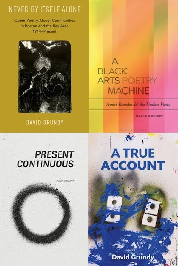
Poetry from Tom Allen, Helen Dimos, Edmund Hardy, Laura Kilbride, Will Rowe, Naomi Weber; reviews by David Grundy (of Will Rowe's Collected Poems) and Danny Hayward ("Transgression for Anti-Fascists: Verity Spott’s Click Away Close Door Say). Look out for further announcements -- SPLINTER readings, new books from MATERIALS, &c...

Saturday, 14 October 2017

New from MATERIALS: Bonney and Marriott

Two new books now available from Materials: GHOSTS by Sean Bonney and DUPPIES by D.S. Marriott.


“We were talking about prophecy, about defeat and war, about how nobody knows what those words really mean, and what they will come to mean.” 


“Grime is late shift, zero hour, it makes a beeline for bare life, but what it lays bare leaves everyone cold. Grime is the thread that links afro-pessimism to afro-futurism, but its role proceeds without ties or duplicity.

Both available from http://material-s.blogspot.co.uk/

Thursday, 24 August 2017

SPLINTER Magazine Out Now!

First issue of a new, bi-monthly magazine edited by myself and Gizem Okulu. Poems from Janani Ambikapathy, David Brazil, Christina Chalmers, James Goodwin, Rob Halpern, Rosa van Hensbergen, Justin Katko, Sara Larsen, Luke Roberts, Alli Warren, John de Witt, and a review of Tim Thornton by Joseph Persad. Available now, here!


Monday, 24 July 2017

Ryan Dobran – Story One (Self-published, 2014)


Errors, Patterns & Repetitions from Jacqueline Arias on Vimeo.

Ryan Dobran’s Story One exists only in a fugitive, self-produced edition, though there should be copies left if you ask him. (The publication accompanied a gallery collaboration with the artist Jacqueline Arias, of which Arias' portion can be seen above, as part of a show called 'Former Islands'. The show also had wall posters of Dobran's poem "Fantasy Index", published in Cordite Review.) Following on from Dobran’s previous books – Your Guilt is a Miracle (Bad Press, 2008), Ding Ding (Critical Documents, 2009), Confection ((c)_(c) Press, 2011), Shouts from OK Glamour (Barque Press, 2013), and Remote Carbon (Critical Documents, 2014) – it’s gnarly and difficult work, characterized by a particular biting tone which certainly approaches sarcasm, but it offers an explicit and immediate directness distinct from his previous work. As its title indicates, it has a quasi-narrative framing, centred on the domestic preparation for work and the work that is done in the work-place itself. Beginning “at the beginning”, the tone, ventriloquizing as it does various familiar discourses around office work and its frames, is often brutally direct. It’s very quotable – there are killer lines on most every page. But, despite the narrative and the presence of a central first-person speaker who functions as something like a ‘character’, its narrative doesn’t resolve or offer closure – it is a perpetual present characterized by incremental change which doesn’t change anything but merely repeats, an implicitly cyclical and easily-recognisable structure of routine whose exaggerations occur in the telling. Though the numbering of the title suggests that this is the first of many – a start, if not a new one, it also suggests a singularity, both unique and utterly familiar. This is it. Importantly, it’s a story in which not much actually happens. Banal events are stretched out into luxuriantly cynical description – the moment of waking, showering, slicing a fruit, parking a car – while environmental change, globalized warfare and the workings of international capital become larger frames which can’t be afforded the same narrative clarity, appearing to provide an alarming shift of scale which is nonetheless at every turn related to these minutiae, whether explicitly or implicitly.

Dobran writes (in personal communication):
It’s definitely a departure in terms of clause structure at least and I was going for a pseudo-narrative that keeps restarting. I was desperately trying to be funny, and I often think about the link between the desire to laugh and the intractable and putatively ineluctable position that one can feel beleaguered by when locked into a job whose hours one counts. I think it must be some kind of “cruel optimism” that sets the restlessness along with a middle-class upbringing whose creators conspired to make their children think that holding open possibility for what may come--and indeed what should come provided enough hard work--is itself a form of necessity. But on the other side of cruel optimism is beneficent pessimism, whose feeling of immobilization is linked to the same social reality but whose manoeuvring is without any desire at all.
That final sentence references Lauren Berlant’s Cruel Optimism (2011), a book which explores how European and American fantasies of the good life and of a work-ethic based doctrine of achievement (what Berlant calls, "conventional good-life fantasies – say, of enduring reciprocity in couples, families, political systems, institutions, markets, and at work”) are still held to even after it has become clear through periods of crisis that liberal capitalist democracy cannot provide them. Such a relation to the present continues despite being disproved, centred on various intricate modes of adjustment. For Berlant, “a relation of cruel optimism exists when something you desire is actually an obstacle to your flourishing.” The continuing process of survival – staying afloat – involved in sustaining some sort of relation to this object of desire, this fantasy of fulfilment, even when it is clearly unattainable becomes so total that “the loss of what’s not working is more unbearable than the having of it, and vice versa.” These methods of coping (what Berlant calls “norms of self-management”), then, do not remove the initial desire but sustain it.

Dobran’s ‘beneficent pessimism’ instead embraces this immobilisation and removes desire. Both relations involve a certain pose of cynicism, but this doesn’t mean they’re total – as, in Dobran’s poem, the speaker treads a gamut between a kind of numb, almost thoughtless physical functioning and outbursts of sadness in love or brutally comic competitive violence. This is itself a means of adjustment, but one whose mode of survival doesn’t aim at the sustaining of the desire it knows is blocked. The speaker doesn’t expect the kinds of sustaining relations – to work-place, domestic partnership, etc – that still motivate Berlant’s cruel optimists. Instead, lack of belief is what allows the worker in the poem to fulfil their tasks as if they believed in them. Such a lack might, in other context, be the grounds for attempting change – rebellion, rejection, nihilism or politically-transformative collective action, as it might manifest in life-style dropping-out, work-place sabotage, organizing, protest, etc. Perhaps it’s too fanciful to suggest that the book’s red and black cover might jokingly hint at the political tendencies associated with those colours – communism and anarchism – to suggest their near-total absence in the world and mind-set the poem so convincingly and rigorously inhabits. Pessimism of the intellect, pessimism of the will. Now carry on.

The poem occasionally shifts its focus to imagine cosmic scenarios of destruction which are nonetheless almost entirely filtered through limited and limiting perspectives, the modes of mediation they would seek to reach beyond in sublime transformation. At one point, Dobran writes: “I don’t think any of us / has the story we most want / to fulfil the proud suggestions / from EARTH.” The shift from singular to plural here suggests both the supposed ‘universality’ of ‘the story’ that is desired and its miserable limitation to a failed individualism. What none of us have is what each of us want, separately, even if the particular scenario desired seems like the most personal thing. The capitalized “Earth” itself comes up with all sorts of helpful suggestions which cannot be made to fit a narrative frame which would contain and fulfill them. Choose your own adventure. However, as in Berlant’s cruel optimism, even the contained and stereotypical story of effort and success, centred on work, the nuclear family, and a libidinal investment in a particular economic model, cannot be fulfilled.

The ‘adjustment’ to the working day described in the poem sometimes veers to statements of patently false enthusiasm – “the beauty of the globe is real”; “I await / the greatest day” – though it’s worth noting that such instances of beauty occur precisely at the moment of destruction, of negation, the moment when the earth explodes in nuclear holocaust and the light is registered on the “beatific space station”. On the other hand, there is cynical description of continuing routine, void of any connection to the sublime beauty of cosmic destruction within “the stupid days” of the work routine. Adjustment to work routine must negotiate between the modes of forcibly internalised enthusiasm conventionally said to lead to promotion, betterment, and the like, and a relentless cynicism which must nonetheless operate almost entirely within the frame of that which it criticises. What is outside work in the poem is only “wasted free time” and the promise of last night (associated, perhaps, with desire, fantasy, dream), which is itself dismissed – “Everything that last night meant is shit.”

Dobran’s poem, with its ventriloquism of the masculinist logics of patriotic imperialism – “nuke this motherfucking coffee”, “inhabit the dude without lifting the brow” – sees the toxic masculinity that might be found in an office space as inseparable from the logics of violent, patriotic imperialism, as bolstered by an economy churning along on a good life mentality (both ones of simultaneous suppression and release). In this sense, the speaker of the poem may find links along a collective fantasy of violence, national identity, gender identity, class identity (or aspiration), but these are ones which will not allows any real solidarity to emerge, which are defined and perpetrated on violence of various kinds against others, even colleagues. Thus, the joke about beating up someone who “comes round to take my spot / at the sink basin”; or, “I will use your face to destroy / the manager.” This is not worker solidarity, even if it is posed against some manifestation of authority (albeit a localized one). The speaker uses two other people to destroy themselves for his own advantage, perhaps in order to replace the manager. If that is the implication, destroying them is not a destruction of the structural position that the particular person in this case designated as ‘manager’ fills and represents; it redirects to personal antagonism a broader (let’s say, class) analysis. (Though it’s worth noting that such talk of the ‘structural’ might risk a kind of fatalistic purity of investigative method. For a recent work that insistently and even obsessively explores the dynamic between a cartoonish, personally-based antagonism and a structural approach – one which might be said to characterise different trends in contemporary U.K. and U.S. political poetry and theatre in various ways – see Lisa Jeschke and Lucy Beynon’s David Cameron: A Theatre of Knife Songs (Shit Valley, 2015); also Danny Hayward’s review of the same in Hix Eros 6).

In any case, the promise of “us[ing] your face to destroy / the manager” is something of an empty threat. The future-tense injunction has something of the character of an earlier and yet more ridiculous injunction in which the speaker barks out: “Give me pleasure, shower.” This injunction is a rhetorical pose which suggests power even as it knows the mechanized comfort-givers associated with the good life bestow only a limited horizon of actual comfort and power. If the animate holds no promise, the inanimate must substitute. The shower’s pleasure-giving both has the structure of an exploitative demand and acknowledges the speaker’s lack of agency which the statement of command attempts to disguise.

As I’ve suggested above, the poem’s title brings up the relation of story, routine, agency and patterning. In telling their own ‘story’, the poet here merely attests to the crushingly and fatalistically pre-determined narrative which labour forces most everyone to accept, all the way from the shower to the desk. As a fragment from Kafka’s journals which is (twice) set in devastating form in György Kurtág’s 1987 Kafka Fragments has it: “Slept, woke, slept, woke. Miserable life.” There is nothing unique about this narrative content, and neither does it reflect collective or instructive values: it is at once particular, alienated, individualised, a cell, and crushingly familiar, skewed into repetition at both ends of the scale. It is a condition presented as unchangeable and permanent and yet also permanently subject to anxiety, lack of safety, the threat of losing your place even within this crushing process, the motions you will not any longer be allowed to go through. So this story, the first and the last, will be just another template, yet also one which self-destructs, just as work routine is locked in cycles of starting and re-starting that don’t necessarily ‘progress’ – though progress that (in meagre drip-feed fashion) is the aim (the discourses of self-betterment, promotion, and the like; sell yourself more, sell yourself better, devote your whole life to the task, for everyone’s good).

More broadly, this might also relate to periodic financial crisis and recovery, boom and bust, as part of a neo-liberal economic consensus, or a purported, forced and manufactured consensus, which is imagined to have finished with narrative for good (ends of history), but in which the constant recurrence of crisis, collapsing, recovering, re-starting, collapsing, recovering, etc, constantly belies that narrative end-point. The story, from beginning to end, can never end, even as it is said to have already ended: it will always repeat, with its minor fluctuations, crises and supposed resolutions, with everyone playing the role of the characters whose actions, whatever their motivations, must always conform to the same predictable patterns.

Likewise, the notion of effort and self-bettering is no longer manifested in (certain kinds of) physical labour, given that those physical elements of work have reduced in visibility and importance, present only through the distance of time and space. Thus, the shift from blue-collar to white-collar, from assembly line to desk, the shift in ‘the west’ from industrial to tertiary industries as the result of the mass out-sourcing of industry to places abroad where labour is cheap and protective regulations less present. So that there is a kind of indifference or apathy set off by a sense of that global positioning within systems of exploitation, which must also figure with a sense of one’s own exploitation – reckoning with different levels of privilege which the discourses of American Maoism might term ‘labour aristocracy’, working through that global and specific class dynamic in which: “I continue to thrive as a result / of my steadfast commitment to / servicing the petite-bourgeois / home improvement / industry.” (Note here how the job itself, which aims at a balance with the domestic sphere necessary to complete the circle of the well-contained good life, loops back into the domestic whose raison d’etre it is to bolster.) The office workers eat their lunch: “Everyone just sits there in a vat of space / starving the poor. Keep your fucking / text focus, poet-broker.” Being in the vat, it seems like they themselves are being cooked and eaten. The injunction to keep focussed suggests that the dramatic-bathetic statement ‘starving the poor’ is not the proper domain of the enclosed text-object-poem. It is not the deal or contract with the reader, with the demands for action it might make, that has been agreed. Of course, by ventriloquizing that position, the poet goes against it, even as the poem itself consciously sticks within certain limits. Such moments of underplayed extremity manifest a humour which is sometimes as violent as that situation, and sometimes as apathetic, which perhaps amount to the same thing. As Dobran puts it: “Humor is neither / defense nor protection, but stimulant. / The possibility of action is simply too / ridiculous.”

*         *          *

As any good story should, the poem begins “at the beginning”, with reference to a “plastic cradle” which is the flesh. The worker is re-born each day, progressing from the infantilism of waking (“more drool / than ga-ga”) to the ‘maturity’ necessary to accomplish the tasks of work which, perhaps, replaces the mother. Indeed, the text as a whole is notably male in its environs, even if the cast of characters beside the speaker remains something of a backdrop, barely even delineated in terms of physical description, let alone characteristic. Here, people are their role, whether that be in the job or in usurping the speaker’s place at the sink, a moment which leads to a bleakly comic outburst of responsive violence. Only towards the end does some element of what might be the traditional subject of the “lyric” that the poem at one point seems to name itself as – a love relation.

The book’s opening is reminiscent of Creation narratives: “at the beginning, at the left / off light” has something of the Book of Genesis about it, not only in its opening phrase but in the faint echo of God’s generative command, “let there be light”. The light here, however, has been switched off at some point (implying that this is not the first ‘beginning’, but one of many involved in a daily routine). The flesh-cradle is felt as an exterior shell, one that is synthetic rather than fleshly, or at once synthetic and fleshly. You sit in your flesh almost as if you sat the desk; it contains you, as your total environment. Detail is precise, but this leads, not to an attention to the object and its production, but to the entirely unexceptional: the “firm, / but not hard, plastic bottom” of the slippers, the page-long description of cutting a grapefruit in minute detail. “There is nothing less than ordinary / details configured in surprise / arrangements.” The phrasing here is subtly unusual – we might expect “nothing more”. ‘Nothing less’ suggests some sort of achievement, or grandeur, or, indeed, surprise. Expressing it in this way only reinforces how none of these things apply: for the surprise must not be too surprising. It must be predictable, within a certain field of expectation. The speaker goes on to talk about changing the alarm sound on their phone every day, in order not to fall back asleep: “the threat of behaviour / and any remarkable achievement / of habit”. Yet these are not things that can be perfected – or, their perfection is in their acknowledged imperfectness, their highly-functioning inadequacy as coping mechanisms and ways of living and surviving.

Once the alarm has gone off and the speaker is properly awake, they are able (in the second person) to assert the following: “You affirm at 06.34 ante-meridian / that the beauty of the globe is real. / and that your place on its fine. Just / or merely, don’t care.” ‘Fine’ can, of course, be both a term of particularly esteemed quality and the base-line of survival – not especially great, but I get by. It’s the common answer to a common greeting-question – ‘How are you?’ – whose connotations are determined by the inflection of the answer – ‘fine’. Similarly, ‘just’ is not here ‘justice’, but ‘nearly’ or ‘merely’. ‘Don’t care’ could either be an injunction, the speaker speaking to themselves or to the reader, as with the second-person of ‘you affirm’: a kind of negative mantra which nonetheless possesses a kind of self-help function. Beneficent pessimism – because you don’t care, you can get on by. 

On the same page, however, the speaker “begin[s] to care, / because there is plenty of time to care”– a care itself produced by “boredom”, but one which might be different to the “care / that you thought of / that time, at the edge of it” – the deictic reference, which could mean a care thought of at the edge of boredom, or of care itself. Care is both to look after something and to give a fuck – to care for (someone) or to care about (something). It would seem that the care that arises from boredom is the former, the care at the edge perhaps the latter – but the terms are deliberately vague. In a work routine characterized both by uber-specificity and amorphous vagueness – we never find out the exact details of the job; the ritual around it is more important that what exactly is done, what the job is ostensibly ‘for’ – you don’t need to care for anybody else, in some kind of loving relation, though you might need to ‘take care over’ your work, which isn’t exactly the same thing as caring about it.

Care might be taken as a positive which mitigates a negative – you have to take care of someone because they cannot take care of themselves – though, in its noun form, it originates as something profoundly negative in feeling. The affirmation involved in waking is a negative one – “Just / or merely, don’t care” – as is even the care which emerges from boredom or beyond. Likewise, we later read: “the life of lyric is a sad / fucking ministry of vapid / negation”. Lyric poetry – as this poem both is and isn’t a ‘lyric poem’, excluding in the main as it does the subject and address of love and passion – might, in this formulation, thus be construed to affirm, in the face of evidence otherwise, that the world really is beautiful and that ‘you’ fit into it quite comfortably, bolstered and encouraged to carry on as you are but your relative comfortable position of waged precarity. This is not traditionally what lyric does. But what Dobran terms “the crust of deformation” might be both the deformation of an alternative possibility of social life accomplished by the structures of wage-labour and their affective ‘crust’ – a merely ‘vapid’ negation’ – and the deformation of what is by which it is de-formed, destroyed, transformed into something else. This crust “waits upon the magnetic / personae” – waiting upon them like a servant, or waiting for them as the speaker “await[s] / the greatest day” (a phrase I’ll come onto in the next paragraph). The personae are magnetic, perhaps in the sense that they are charismatic, or compelling, or that anything can be stuck to them – they are personae that are waiting to be deformed, blank canvasses or shape shifters, not touched by a fixed particularity. Yet the crust which will stick to them, like a mask covering a volcanic explosion, the crust of the earth, or a dirty remainder, does so within “the infinity / of the singular” – both what is utterly reduced to an endlessly reproduced and common individuality of negation and – as Tom Allen suggests in a review of the poem for Hix Eros 6 – that which negates this negation, in which the singular and the common are neither falsely reconciled nor at odds.

This passage occurs after the following sentence, which again plays between the notions of beauty and the day being just the same as any other – particularity and sameness, newness and repetition: “Ready for beauty, I await / the greatest day.” An eschatological expectation seems to raise its head – the great day which shall surely come and which shall be infinitely stretched beyond the bounds of repetition, routine, sleeping, waking, living and dying, disappointment and loss. This is in itself the good life fantasy which Berlant discusses and which, I would argue, Frank O’Hara partially satirizes in his great ‘Ode to Joy’: “We shall have everything we want and there’ll be no more dying.” That ‘we’, with its “cocktail bars” and “supper clubs”, is one determined by class exclusion. Here I argue for the opposite of Michael Clune’s reading of the ‘Ode’ in his book American Literature and the Free Market (pp.64-6). For Clune, commerce and desire here are consummate: “the desire of the collective blows through the priced objects of everyday life, infusing them with its aura.” Yet, contra to Clune’s notion of entirely fulfilled desire, Hazel Smith notes that “no more dying” could also be read as the end of sexual satisfaction (Hyperscapes in the Poetry of Frank O’Hara, p.78). At first glance, it may appear, through a carefully-judged set of antitheses focussing on love, death and life, which are forcefully combined throughout the poem’s three stanzas, that everything that happens here, happens “that love may live”. Yet the “symbol acknowledge[d]” in this new mode of living privileges “vulgar materialistic laughter / over an insatiable sexual appetite”, and the model of eternity advanced occurs as much through tedium as excitement: “not once but interminably”. Labour itself is removed: “buildings will got up into the dizzy air” as if they simply erect themselves – with the sexual pun intended – yet poverty rears its head through a gruesome image of intravenous feeding: “and the hairs dry out that summon anxious declaration of the organs / as they rise like buildings to the needs of temporary neighbors / pouring hunger through the heart to feed desire in intravenous ways”. Desire here is paradoxically ‘fed’ or sustained through a hunger connected to these “temporary neighbours” – perhaps suggesting the temporary sociality of the city, geographies of cruising, a queer space breaking out the repressive mould of the second stanza’s “heat-hating Puritan.” Yet the flipside of such a sociality, growing as it does out of the city’s contingency, is a class-based precarity potentially resulting in the very death the poem insistently and apparently denies.

The title of O’Hara’s poem is of course borrowed from a totemic ode to the new forms of social life named as humanism, or universalism, in Beethoven’s setting of Schiller’s poem. This ode excludes as much as it includes. As Theodor Adorno wrote:
It is peculiar to the bourgeois Utopia that it is not yet able to conceive an image of perfect joy without that of the person excluded from it: it can take pleasure in that image only in proportion to the unhappiness in the world. In Schiller’s ‘Ode to Joy’, the text of the Ninth Symphony, any person is included in the circle provided he is able to call ‘even a single soul his own in this wide world’: that is, the person who is happy in love. ‘But he who has none, let him steal weeping from our company.’ Inherent in the bad collective is the image of the solitary, and joy desires to see him weep. Moreover, the rhyme word in German, ‘stehle’ [steal], points rightly to the property relationship. We can understand why the ‘problem of the Ninth Symphony’ was insoluble. In the fairytale Utopia, too, the step-mother who must dance in burning shoes or is stuffed into a barrel spiked with nails is an inseparable part of the glorious wedding. The loneliness punished by Schiller, however, is no other than that produced by his revellers’ community itself. In such a company, what is to become of old maids, not to speak of the souls of the dead?
Theodor Adorno (trans. Edmund Jephcott), Beethoven, The Philosophy of Music, pp.32-3
Bearing this in mind, it’s hardly surprising that Schiller’s ode recurs today, in Beethoven’s setting, as the anthem for a political project – the European union – whose battering-down (for example) of Greece exactly captures that logic of inclusion, exclusion, sacrifice. By contrast, in O’Hara’s formulation, there is perhaps still a utopian expectation which isn’t entirely circumscribed by that which it knows it is the ideological manifestation of. The desire it expresses – which isn’t necessarily the one it can seem to express – is consciously bound up in that which inadequately releases or deflects it.

Yet the only way by which infinity (or desire) can manifest itself in Dobran’s poem is through an ouroborotic temporal relation very much connected to that which ‘the greatest day’ would seek to redeem, and without a trace of utopian aspiration, longing, or belief. “Today will be the same as today was.” Today will be – future tense – the same as today was – past tense – though ‘today’ itself is presumably present. In relation to such temporalities, we might consider a number of comparative instances from the poem, some already quoted. “Ready for beauty, I await / the greatest day”: beauty is that which will come, which is ‘awaited’, though it is unclear in what objects this abstract beauty will inhere.“You affirm at 06.34 ante-meridian / that the beauty of the globe is real”: beauty is affirmed in the present tense, as manifest in the globe itself. “We are the beautiful ones. / Everything that last night meant is shit”: beauty is again present, current, and, somewhere between the two previous examples (beauty as abstraction or beauty as the globe), has become the attribute of an unidentified collective subject. In the latter instance, the past is firmly rejected, even as the formula with which this paragraph begun, in which today will be the same as it has been, implies a folded-in encircling by the past. But if ‘last night’ promised some sort of temporal break-out, even one circumscribed by its placement in relation to the day – night as the time of (sexual?) release, or merely sleep, the escape of dream – it must be rejected. Beauty is not here connected to desire; it becomes an empty substitute for something perfected in the presence of manifest imperfection, something which stands in for referentiality, valourizing the (falsely) general over the particular, and coating it with an aesthetic sheen whose distance from the drab realities of office life lends at irony with which Dobran’s precisely plays.

This is “the auto-worship of the present”: a worship which is automatic, or a worship that takes itself as its object of devotion. Depending on how you read the hyphenated formula, this worship is done either by the celebrants who presumably include the poem’s speaker and others like him, or by the present itself which, like beauty, both attaches and refuses to attach to a specific referent. We celebrate the present and we are it, even as it denies us to ourselves. The present at the moment of speech must be the day, the poem’s emphatic temporal location, and day itself comes to seem to be the thing that both “disclose[s] / and exploit[s] the bodies / whose metabolic shifts / comprise” it.

Metabolism, a word deriving from the ancient Greek for ‘changeable’, is that process which allows organisms to grow, reproduce, excrete and in various other ways respond to their environments. In Dobran’s poem, this process of constant adaptation allows something like (the working) day to remain fixed – as in the endless small adjustments required by relations of cruel optimism, here rendered as a natural process. ‘Metabolic shift’ might also pun on shift work (itself another process of adaptation, availability, readiness); or, indeed, on John Bellamy Foster’s coinage ‘metabolic rift’ to describe Marx’s theorisation, in the third volume of Capital, of the means by which capitalist production and the growing division of town and country lead to an “irreparable rift in the interdependent processes of social metabolism, a metabolism prescribed by the natural laws of life itself.” (See Foster, http://monthlyreview.org/2013/12/01/marx-rift-universal-metabolism-nature/)) Capital must use up natural resources to sustain itself, without the balancing of intake and outtake that metabolism itself involves; likewise, it uses up the workers on whom it relies, supplementing their intake only to the extent that it pays them enough to feed and live, or with the good life fantasies that promise something else, however deferred. Cruel optimism partially realizes – ‘disclose[s]’ this – and leaves itself open to be ‘exploit[ed]’ by it, even comes to desire such exploitation. The process is one of simultaneous clarity and concealment, perfectly balanced.

How to get out of this? In his recent review of Dobran’s book for Hix Eros 6, Tom Allen writes “There is no direct moment of rupture that I can locate in Story One.” Yet he goes on to identify in the poem what – though he doesn’t use this term – we might name a mode of Realism that is not simply a report on conditions as they are – though it is nothing if not that – which, in reporting on and inhabiting those conditions and contradictions, is not a settling for less; which, in apparently offering itself as a fait accompli, at the deferred and repeated beginning all over again, forces an implicit protest, however sarcastic and aware of its own limitations. At the conclusion of his review, Allen focuses on a section from roughly the middle of the poem. Dobran’s “The shell of the commute / is not the whole answer” is spoken “to myself / and to my listeners / in the back seat”, and the reason for this (“because”) is given as the fact that “the spirit unfolds in a slimy mass of visionary potential”. Yet this present unfolding occurs only “when I slide into my icy spot / in front of the building / adjacent to my office.”

It’s hard to read the tone of this characterisation of ‘spirit’ and ‘potential’. Spirit is uncapitalized and prefaced by the definite article, which at once particularizes it and refuses to give us a theoretical framework – say, a Hegelian one – into which we can definitely place it. The ‘slimy mass’, meanwhile is like a diseased, malevolent goo or virus, the alien Blob from the 1958 Steve McQueen drive-in classic (one of whose original titles was apparently ‘the mass’). It might also ventriloquize the traditional tone of class-hatred which disdains the greasy proletariat and sub-proletariat – after all, as noted earlier, the class-specific cruel optimism of the worker who “service[s] the petite-bourgeois / home improvement / industry” sustains itself by being, however drably, positioned in a better situation than those who have to perform other forms of labour – or indeed, than those who, being unemployed, are unable to sell their labour power at all.

Certainly, that would be one way of reading Dobran’s line, yet to describe this ‘mass’ as possessing a ‘visionary potential’ – where vision is not only the ability to see what is, but to see something else beyond it – is a direct juxtaposition which leaves some room for manoeuvre. The ‘shell’ recalls the ‘crust’ of deformation on p.10 - a container which is, perhaps, breakable, and out of which an as-yet-undefined magma or mass could emerge. (‘The crust of deformation’ further suggests a pun on ‘crustal deformation’, the changing of the earth’s surface by tectonic shifts within the earth’s crust which cause earthquakes.) Of course, the amorphous shape is exactly what the individuality of the individual worker is converted into in the capitalist structuring of work – the amorphous is not the negation of the closed-off and the singular, but what reduces humans to gallerte. In that sense, ‘potential’ might simply be exploitable labour-power, and one could see such undefined homogeneity as simply created by the apparent particularity of the office routine the poem describes; yet the spirit’s slimy, visionary mass, however much the poem guards itself against an optimism that might simply be cruel, does suggest something else. Yet to say this might seem to go against the way the poem itself actually seems to work, to make the kind of familiar critical manoeuvre or demand by which one is told that something which seems to do one thing actually does something else, usually something with a vaguely-defined political potential. But it is not the poem itself that will tell us what the ‘something else’ might be. Rather, as Allen suggests, looking back on Story One from a different situation – itself not a thought it is necessarily possible to properly think – might reveal to us the unanticipated kernel within its workings that it does desire.

Monday, 15 May 2017

New from MATERIALS: Prynne & Kruk

A sequence of ten poems by J.H. Prynne.


“Oh strike the light, float the boat, for
sake of common peril they are fallen away
as gathered up in sight of lamentable in-
difference and will go down against us”. 


16 pp, card covers (blue), saddle-stapled.

Also announcing the opening of the German wing of MATERIALS, MATERIALIEN, run from Munich by Lisa Jeschke. First publication, Stecknadel, a German-language translation of Frances Kruk's Pin by Koshka Duff.


More info on both here.