Friday, 30 December 2022

Blog Posts in 2022

Present Continuous (Update Post) (November 2022)
New Pamphlet (Update Post) (November 2022)

New (Update Post) (October 2022)

Sean Bonney Special Issue (September 2022) 
Pharoah (On the passing of Pharoah Sanders) (September 2022) 
Betsy Jolas’ bTunes (September 2022) 

Wednesday, 23 November 2022

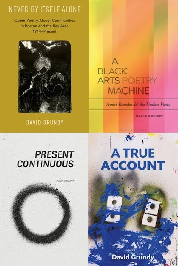
Present Continuous


The full version of Present Continuous, a book of lockdown essays/prose pieces, excerpts of which first appeared as a pamphlet with Phil Baber's The Last Books earlier this year, is now out from Ghazal Mosadeq's Pamenar Press, with grateful thanks to Ghazal and to Hamed Jaberha for his work in typesetting and design.

Copies available here.

Present Continuous was written during the first year of the coronavirus pandemic between March 2020 and April 2021 in Lewisham, London. Part I was written between March 2020 and June 2020: the movement from spring to summer, from the first announcement of a national lockdown to the Black Lives Matter protests sparked by the murder of George Floyd and Breonna Taylor in the United States and the death of Belly Mujinga in the UK. Part II was written during the autumn and winter of 2020 and 2021, during which time a “second wave”, peaking in December and January, prompted a second set of lockdown restrictions. Part III was written in Spring 2021, as restrictions eased and the issue of police violence raised its head once again with the murder of Sarah Everard and the early debates around the Police, Crime, Sentencing and Courts Bill—as of April 2022, passed into law as the Police, Crime, Sentencing and Courts Act—with its further criminalisation of protest by a government more viciously racist and repressive than any in recent memory. 

Over two years since the first declaration of lockdown, and following a seemingly endless series of virus variants and subvariants, an apparent shift from ‘pandemic’ to ‘endemic’, and a kind of exhaustion of vocabulary and will, I hope these essays provide some kind of record, not only of a particular moment in time, but of the tendencies going into and moving out of that moment, as we move forward into a future more uncertain than ever; not just where ‘we’ were in 2020 and 2021, but where ‘we’ are—or might be—now.

Wednesday, 16 November 2022

New Pamphlet


...out from Andy Spragg and Jimmy Cummins' Run Amok Press.

Three sequences, including one after Lu Xun's Wild Grass.

Launching tonight at 7pm at Biddle Bros. in Clapton, for those in London--I'll be reading alongside Jimmy, Rachel Warriner, Vicky Sparrow, and Dorothy Lehane.

Saturday, 15 October 2022

Juliet Fraser - Wave Songs

Juliet Fraser - Wave Songs
City University, Tuesday 11th October 2022 

Alvin Lucier, Wave Songs
Newando Ebizie, I birth the moon
Newton Armstrong, The Book of the Sediments

[Note: A shorter version of this piece will appear in the forthcoming issue of The Wire magazine.]

Image: Lee Lozano, from Wave Paintings.

As part of City University’s laudable free concert series, soprano Juliet Fraser presented three works for voice and electronics in a condensed but focused programme lasting around an hour. This condensation was reflected in the evening’s visual presentation. At recent concerts at City’s basement performance space, I’ve seen percussion spilling over the limits of the stage (for the Pierrot Ensemble’s performance of the late Harrison Birtwistle’s The Axe Manual alongside new music by Marc Yeats). On this occasion, however, the stage was bare apart from four speakers, a music stand, and Fraser herself. Onstage, the lights meant Fraser’s shadow was doubled, at times tripled, the darker shadow and its overlapping, progressively lighter ghosts: aura, umbra, penumbra. It was an appropriate figure for all three works’ play with liveness and pre-recording, various forms of doubling and recurrence—impersonally in Alvin Lucier’s Wave Songs, noisily, shatteringly in Nwando Ebizie’s I birth the moon, and with a kind of melancholic implacability in Newton Armstrong’s The Book of the Sediments, the latter two pieces world premieres forming part of Fraser’s cycle of commissions based on the work of Rachel Carson’s Sea Trilogy. (Previous instalments, by Laurence Crane and Lara Agar, were heard at John Lely’s and Tim Parkinson’s long-running series Music We’d Like to Hear late last year.)
 
The concert took its title from Lucier’s piece, “for female voice and pure wave oscillators” commissioned in response to Lee Lozano’s Wave Paintings in 1998 and first performed by Joan La Barbara, but so far, never officially recorded. “Wave Songs, Lucier’s programme note remarks, “consists of eleven solos for female voice with two pure wave oscillators”, with tones fading in and out at the beginning and end of each song. 
“The singer stands between the two loudspeakers from which the pure waves flow. Throughout the course of the work she sings pure tones on the vowel ‘oo’ matching the sounds of the pure waves, in order to create the most vivid beating [...] As the oscillator tones get closer and closer together as the work progresses, it becomes virtually impossible for the singer to accurately tune her pitches”. 
This play with human error and with the ‘purity’ of electronically generated sound waves is not so much an animating tension as a flicker at the work’s edges, the drama of pitch regulating that governs much western music a kind of crackling undercurrent to a work that often sounds like an encapsulation of that very principle. Introducing the concert from the stage, Fraser remarked that Lucier’s piece, involving various complex mathematical complications, can seem like an intellectual exercise. Her advice was to “feel the piece rather than listen to it”. At the same time, that very distinction between feeling and listening is perhaps one the piece is also interested in collapsing. Expanding and exploding customary practices of listening, Lucier treats sound as material, vibration, solid yet evanescent, something both literally and metaphorically felt, a world of sonic illusion in which the distances between sine waves and the vocal line create ‘beating’ effects—as Lucier puts it, “bumps of sound produced as sound waves collide”. But this vocabulary of expansion, explosion, collapse and collision doesn’t really capture the still spirit of the piece, its moving stasis, its static movement.
 
As is well-known, Lozano effectively dropped out of the New York art world in the early ’70s, her early work, “comix”, sexualised paintings and drawings that drew with fresh and raging energy from the currents that also produced the often tamer works of pop art. Subsequently moving from these works into sexualised depictions of tools—screws, pipes, wrenches—Lozano in turn embarked from 1967-1970 on the Wave Paintings, abstract canvases depicting multiplying wavelengths of light. Lozano had planned a follow-up series with each painting painted in a different state, including “stoned, drunk, horny”—the body and the changing passions of the body mixing with the ‘objective’ phenomena of light and object, tool and, questioning what abstraction is and means and how it interacts with the female body and perceptions of the female artist. As it stood, however, she instead made a series of dramatic gestures of refusal that aimed to resolve contradiction, first through Dialogue Piece--inviting “people [she] would rarely see [...] to [her] loft for a dialogue”--and then Untitled (General Strike Piece, Feb. 8, 1969) and DECIDE TO BOYCOTT WOMEN (1971), in which she cut off communication, first with the art world—instead, Lozano promised to work only towards “total personal and public revolution”—then with all women, before dropping out altogether.
 
Painted before this process of removal, Lozano’s Wave Paintings saw her painting accumulating waves on canvas, culminating in a total of ninety-six waves painted over three days, stopping only when she reached the physical limit of how many waves she could paint in a single session. As painter David Reed remarks in an Artforum interview on Lozano’s work with Katy Siegel, “the series is infinite, it’s just her physical limitations that stopped it.” For Siegel, the work “seems to combine a rigorous scientific approach with some kind of personal statement.” Reed concurs: 
“Her interest in science is a way of connecting art to larger issues and keeping it from becoming merely formal [...] Lozano’s “Wave” paintings seem to offer proof of the difficulties of that transformation of the self, and reasons for the doubts. The series is meant to be endless, but she can’t make it endless. It ends physically, not conceptually. She desires more than she can achieve, not just physically, but in other ways as well. It’s like Kafka saying, “Oh, there’s infinite hope, just not for us.””
As Reed remarks, in Lozano’s work, “you aren’t coerced into having emotions; you decide to have them.” Such work explores the nexus of perception, emotion, abstraction and the material presence of bodies. And Lucier’s own interest in the pure, potentially infinite sound of oscillators, activated by disturbances in environment, relates to his own position as a stutterer, explored most famously in I am Sitting in a room (1969), in which the imperfections in his speech contribute to and are then erased by the feedback created from repeatedly playing it back into a room. “I want audiences to open up their ears to their environments”, Lucier commented to his student Douglas Simon. In exploring “how space intrudes its personality on the sounds you produce”, Lucier continued,  “I simply want to find out what these [different] environments do to sounds, not to make them but to take what I can find, and in that way each performance will teach me something.” Ideally, this process of learning sees both Lucier and his listeners alike as embarking on a process of finding out about sound, about themselves, about the world. 
 
“Are you trying to tell the audience something beyond what they hear?” asked Douglas Simon. “Yes”, Lucier replies. 
“It’s just an extension of what you do when you’re a small child at the beach and put a shell up to your ear and hear the ocean. Then you stop. You don’t do that as you grow older. Your ear stops doing that because you’ve got to think about other things, how to make a living and how to speak to people, how to communicate verbally. I guess I’m trying to help people hold shells up to their ears and listen to the ocean again”. 
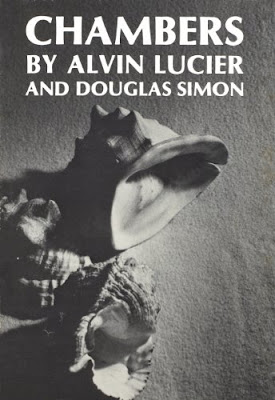


Waves were a longstanding metaphor for Lucier: the generation of music from the performer’s brain waves in Music for Solo Performer (1965), the recreation of the sounds of the sea in Chambers (1969), for resonating objects. Lucier’s sound waves, Lozano’s light waves, and the oceanic framing of the concert come together Lucier’s Wave Songs is in eleven short movements. The piece achieves the remarkable feat of generating a soundworld at once extremely quiet—it seems that every audience twitch can be heard—and one that totally fills the space of perception, huge and morphingly fixed, the soprano singing held notes over sine waves producing beats/difference tones against them. In a music that collapses the traditional divisions between melody, harmony and rhythm, the work operates on a principle of held tones and tone succession, the differences between which generate rhythm and harmony at once. The third song sees vocal leaps approaching Feldmanesque melody—specifically, the Feldman of Three Voices, like Lucier’s piece, premiered by Joan La Barbara, and likewise recorded by Fraser—as the sine waves chirrup like frozen, heavy birdsong or a muted car alarm. 

A work so rooted in physical phenomena becomes moving in both a literal and a metaphorical sense. As is so often the case with Lucier’s work, it opens up the environment, gives us a space to see ourselves or whatever we choose to see reflected and enabled there, getting to the roots of sound, what it does to us and what we make it do. In the penultimate “song”, language enters the work for the first and only time, as the soprano sings words from Lozano’s writings describing the thinking behind the Wave Paintings, the shock of the entrance of language subdued by the rendition of the text as a single-note melody. Lozano’s text describes light waves—“the waves are really a reference to the electromagnetic spectrum”, Lucier ‘translating’ this to apply to sound waves: a description of waves heard on waves of sound. Here is a blurring of metaphor and sound, of waves in multiple senses as movement in time and space.
 
“I was trying”, Lozano writes, “to combine art and science and existence. It was a science idea transferred to an art idea.” In much of Lucier’s own work, if not Lozano’s, this becomes something like a general principle. But it’s not just about “objective phenomena”, which in Lucier’s explanations of his own work is so often described in technical, relentlessly material terms: in a work like this, they form the stage for weird dramas, audio tricks, suspensions of disbelief at once contained and expansive. “I imagine the work as a mini opera”, Lucier remarked, “with the singer taking the part of the artist, singing her paintings into existence or perhaps simply humming to herself as she worked on them.” Lozano, who’d been persuaded to allow retrospective shows such as the one for which the piece was commissioned, would die the following year; given Lucier’s own recent death, the piece assumes the status of a double memorial, the speakers both tombstones and openings to a world of other possibility, in which that which is prior emerges uncannily into the present: the voices of the dead, living still.
 
In the next and final movement, the vocals are a back of throat murmur, a sound click, murmuring on the edges of perception and of being recognisable as a singing voice, or for that matter, a human voice at all—those effects so effectively explored by the likes of Ami Yoshida’s ‘howling voice’ technique—“a barely audible sound that is perceived as sound itself rather than as vocalization”—developed, coincidentally, around the same time on Spiritual Voice, recorded between 1995 and 1997, and whose work with the sinewaves of Sachiko M as Cosmos on Tears (2002) the no-input mixing board of Toshimara Nakamura on Soba to Bara 2009) has notable similarities with Lucier’s work. Hearing the work in this space, over the course of Lucier’s Wave Songs, the acoustic voice, in proximity with the pre-recorded sine waves, paradoxically starts to sound more electronic and the electronics to sound more ‘voice-like’ or human. Or is that just a perceptual trick, the experience of one listener, with their own metaphorical and perceptual projections that they, like each listener, bring to the piece? The piece, it seems to me, asks us to interrogate the very basis of sound, of how and why we listen, while, at the same time, imposing nothing but itself. 

You could just listen. 



Image: Nwando Ebizie. Image from ColoRising.

Before—and even, arguably, during—the production of the Wave Paintings, Lozano’s work was to do with the body, with all that was stigmatised as ‘unscientific’, feminine, hysterical—the altered states of being stoned, of drinking, of sex, of changing oneself by changing the environment around one and vice versa. Her move from physical works based in objects—culminating in the immense materiality of the wave paintings—leads to performance works based on renunciation—first a dialogue piece, then a dropout piece, then a boycott piece, art as a self-contained enterprise collapsing into life and its messiness. Lucier’s work might appear to do the opposite: to order, to regulate, to present. Yet there’s something here that deranges, de-arranges perception, something between contemplation and agitation, between ecstasy, ex-stasis, a being taken out of self, and a revelation of self and its limits, the limits of a body, of hearing, of being in a space. Then there’s the question, of course, of the position of male composer and female performer, of the way that the piece is or is not gendered, questions that, perhaps, go beyond what the work can hold. 

These questions of gender more directly inflect the next piece, the world premiere of Todmodern-based, British-Nigerian multimedia artist Nwando Ebizie’s I birth the moon. As her programme note suggests, Ebizie’s concern, like Lucier’s, is with embodiment and how it shapes perception, but from a perspective that, like Lozano’s, is oriented around the subjective rather than the ‘objective’ elements of sonic process: from its process of composition, constructed in collaboration with Fraser during “a day of walking in the Yorkshire moors, talking, eating and improvising”, and takes inspiration both from Rachel Carson and from “the experience of miscarriage, the hopes, the fears of birth, the absurdity of the body vs the strong will to create, the ‘I’ wanting to become we”. (We might call to mind here Ruth Anderson’s haunting 1968 tape work, The Pregnant Dream, with its swirling spoken voices concerning dreams within dreams, speaking and forgetting.) From a different angle, Ebizie raises similar questions to Lozano and Anderson alike: how does embodiment shape perception? What is time? Where are we positioned in relation to phenomena, to each other, to the world? These are questions that, as Lozano suggests, might be “science idea[s] transferred to art idea[s]”, but they are also, incessantly philosophical, social, political. Lucier’s work, like that of Newton Armstrong at the close of the concert, understands process as something like a grid, composition as the enacting of certain pre-arranged rules with margin for error and change creeping at the edges. Ebizie’s has the feel and sound of a more improvised approach, in which the clarity of successive movements and sections found in the other two pieces is replaced by a more amorphous world of live voice and electronic shifts, of clattering soundscapes that swirl into and out of ambiguous climaxes.
 
The piece begin with Fraser’s spoken voice matter-of-factly announcing the creation myth—“in the beginning”—alongside echoed, drawn-out, multiplying voices and clattering percussion, with live and recorded voices mirroring each other onstage and over the speakers. Fraser’s intonation is at times operatic, but the interaction with the electronic park constantly draws the music away from ready reference, as, in a burst of fractured rhythms on the speakers, a live soprano wail careens into an elongated electronic scream that in turn becomes a buzzing digital whirr. “What is...what is...what is?” Fraser repeats with increasing urgency, before a burst of laughter breaking down into back-of-throat gurgle, gargle, voice crack. “The constant trials and failures of creating life”: an uneasy chant over a heartbeat rhythm, dropping out—“a great tidal wave of earthly substance, torn off into space”. Ululation, shimmering echo and on the speakers, the sound of breath that becomes wind or wind that becomes breath. A long, high wordless melodic line over rising and falling voices on tape, melismatic incantation. It all suddenly stops with the sound on the tape of an inhalation, another breath, somewhere between beginning and ending, poised to speak again.


The final piece on the bill, Australian-born City University lecturer Newton Armstrong’s The Book of the Sediments. Armstrong’s work has recently received the full-disc treatment on Simon Reynell’s Another Timbre label, in works that, as he puts it in an interview with Reynell, “work on some new approaches to musical line, repetition, and layering.” “All of my recent instrumental music has included electronic sounds,” he continues, “and these are usually treated in an ‘instrumental’ way, with the loudspeakers integrated into the ensemble. And all of my work for the past twenty years has involved computer programming at some point in the process.” This manifests, for instance, in “deformed, non-strict canons [...] created by algorithms that I designed.” Armstrong defines a canon as “a line alongside itself”, and that sense of setting lines alongside one another likewise infused his new work.
 
The work opens with a down-toned drone reminiscent of Giacanto Scelsi--Anahit, perhaps--Armstrong’s ‘instrumental’ treatment of the electronic lines pointing to their acousmatic uncanniness. Are those horns? Woodwinds? Strings? Purely electronic tones? Fraser’s live voice sings in countermelody, a descending two-note motif, a study in recurrent descent and descant, waves’ rise and fall. Now a second motif, silence between each iteration of the tape part, seeming at the end of held sounds to reveal itself, not as instrumental but as a treated voice. If Lucier’s sine wave appears as the index of ‘pure’, non-human sound, Armstrong even more blurs the distinction, ghostly timbres changing into something else then back into themselves, accumulating not so much as ‘progress’ but process.
 
Armstrong’s programme note suggests that he took his cue from Carson’s description of “the slow accumulation of sediments on the deep sea floor” which eventually form the matter of the earth—a process Carson calls an “epic poem”, in Armstrong’s words, “an inscription of all that has happened in the geologic and climatic history of our planet”. Here is another way to approach the relations of material, of time and space found in the preceding works: what Armstrong calls “the interactions between the momentary and the vast, and of endless process as a form of saying”. But can this work’s methodology be called accumulation, as the sediment metaphor suggests, and as Lozano’s expanding wave paintings might also suggest, or is it instead a winding down, in the era of climate change anxiety, the echo chamber of covid, lockdown, of politically-fostered alienation, loneliness, and a sense of real and impending catastrophe? As motifs and layers build, accumulate, recede, white noise sounds—field recordings of oceanic waves?—enter on the tape. A hum, a slight chirrup, a sinewave, a wave, the literal and metaphorical intersecting in sounds and time and tide’s ambiguous embrace.
 
Wave sound to fade. Soprano sings high, Fraser’s hands held together in front in a resting gesture somewhere between benediction and protection, holding something up or holding onto something. Difference tones hum between the ears, ship-like clankings on the tape, surrounded in sound: this is at once a spectacle of control and of overwhelming, of being overwhelmed, lost at sea. Or is it that sound just a dripping tap in the bathroom sink—connected to the problems of world water supply, of declining and rising sea levels, of ice cap melt and of drought? Fraser stands silent onstage while the sines wind down and the water continues to splash, and it’s over. The Book of the Sediments is a work at once of connection and disconnection, alienation and a kind of melancholic peace. After Armstrong’s piece ended, the applause that followed sounded alien, strange, like rain gone wrong. Such music, at root, strives to alter the way we hear. This was a concert that altered the space in which it was placed; one might take us back out into the world with a different sense of how we walk through it, of where we go from here.

Friday, 14 October 2022

New

My introduction to the new Blank Forms republication of Amiri Baraka, A.B. Spellman and Larry Neal's classic Black Arts Movement music magazine The Cricket: Black Music in Evolution is out now, alongside facsimile reprints of all four issues and a preface by Spellman himself.


Also out, a piece on the new Igor Levit recording of Hans Werner Henze's Tristan at Artforum.


More to follow...for now, some recent listening...

'China Fights'


Karl Amadeus-Hartmann, an important figure for Henze, emerged from his period of "inner emigration" during the Nazi era to find himself at first championed as an un-tainted figure who might take up a position in the new, "Year Zero" Germany, and then, in the era of the Truman Doctrine and the Cold War positioning in West Germany, once more at risk of external or self-censorship for his socialist sympathies. I've been reading a thoroughly-researched and persuasive article in Twentieth-Century Music by Ulrich J. Blomann And Jürgen Thym that demonstrates how Hartmann ended up either actively suppressing many of his Nazi-era socialist/anti-fascist works or incorporating the musical material into 'neutral', non-programmatic instrumental forms. Blomann and Thym's case study is China kämpft / China Fights, originally the opening movement in the Sinfoniae Dramaticae (1941–3), based on the Chinese revolutionary song ‘Meng Jiang-nuin, and dedicated to Soviet writer Sergei Tretyakov--himself killed in the pre-war purges--and to Tan Shih-hua, the hero of Tretyakov's novel A Chinese Testament. Eventually premiered at Darmstadt in 1947, US influence meant, according to Henze, that attendees were encouraged to boycott the premiere, and on subsequent performances, Munich newspaper Das Steckenpferd denounced Hartmann and Käthe Kollwitz as the "creator[s] of a socialist approach to art" for this "free reworking of a socialist song from the Chinese civil war". Hartmann revised the piece, denying that it was based on anything but a 'neutral' folk-song. Likewise, the final movement of the symphony, ‘Vita nova’, contained declamations from Shelley’s ‘Mask of Anarchy’ in Brecht’s translation: Hartmann wrote to his publisher suggesting that publication would be inadvisable, given the Cold War political climate, and the movement has since been lost. As a self-described "leftie without a country", unwilling to move to a socialist or Soviet country and mindful of the complex position faced by the likes of Shostakovich, but also aware that his socialist and anarchist sympathies rendered him at risk of losing his job in "the West", Hartmann, the authors argue, once more found himself in a period of "inner emigration" in which the politics of his works had to remain disguised between the 'neutrality' of symphonic form. Beyond Hartmann's specific case, there's much more to say about this conjuncture, and how it plays into the discourse of serialism, the legacy of Schoenberg and Webern--with whom Hartmann studied--and the [false] binaries between Zhdanovshchina and CIA-sponsored modernism with which Hartmann, Henze and others had to battle in the post-war period...

Marion Brown in Paris


The extraordinary Vintage Music Experience channel at Youtube continues to put out a wealth of extremely rare recordings on a daily basis, most recently a radio broadcast by a Marion Brown quartet featuring Gunter Hampel, recorded shortly before May '68. I'd need to double-check, but I don't believe any of these compositions made it onto an official record...

Wayne Shorter's 'Universe'


The late Wallace Roney performing Wayne Shorter scores written for Miles Davis, full of the expansive majesty of Shorter's orchestral writing that has only been widely showcased in recent years. I've not found a way to hear Shorter's collaboration with Esperanza Spaulding on the opera Iphigenia, so if anyone reading this has any tips, do let me know...

Mal Waldron in Amsterdam


An excellent late Mal Waldron quartet with Sean Bergin on tenor driving things into 'out' territory on a few numbers--this group, as far as I know, never made it onto an official release.  

Marion Bauer's 'Lament on an African Theme'


Finally, Marion Bauer's 'Lament on an African Theme': though Bauer had a reputation in the post-war period, she's little-known today, and is not a composer I know much about. Likewise, I can't find out much about the piece, but I believe it's an orchestration of a movement from her string quartet, with the "theme" in question subjected here to a series of austere yet stirring variations. Would love to know more about the source of the melody and how it relates to the history of white American composers' use engagement with African diasporic material...

Friday, 30 September 2022

Sean Bonney Special Issue


After two years, the Sean Bonney special issue of the Journal of British and Irish Innovative Poetry, co-edited by Jeff Hilson and myself, is finally out in the world. It’s been a long road, and a lot of work along that road, but, many hundreds of emails and proofs and conversations later, we’re grateful that so many people have come together to treat Sean’s work with the seriousness it deserves. You can access the issue here.

This is a larger than usual issue of the journal: it reprints four essays by Sean—on Sun Ra/Amiri Baraka, on Louis-Auguste Blanqui/Louise Michel, and on Anna Mendelssohn, along with the complete ‘Notes on Militant Poetics’—and eleven essays on his work, almost all specially written for the issue, by Tom Allen, Christina Chalmers, Robert Hampson, Lisa Jeschke/Danny Hayward, Esther Leslie, Rob Kiely, Will Rowe, Kashif Sharma-Patel, Vicky Sparrow, Lindsay Turner, and Steve Willey, an editorial introduction by Jeff and myself, and a detailed bibliography of Sean’s work that I prepared based, in part, on prior work by Ian Heames, Justin Katko, and Harry Gilonis. Special thanks, not only to the contributors, but to Eleanor Careless, who patiently guided us through many technical issues, especially along the latter stages of the route to publication...

Jeff and I first spoke about the issue in several phone sessions during the first lockdown in summer 2020; and now we head towards the end of summer 2020 with more catastrophe looming. Here’s a bit from the introduction which, hopefully, speaks to some of this:
We’d like to begin with a brief reflection on what it meant to edit this issue when we did, between the spring of 2020 and the spring of 2022. Sean Bonney died in the autumn of 2019, during the UK general election which saw Boris Johnson elected as prime minister, and a month or so before the first strains of COVID-19 emerged. We first began to edit this issue during a national lockdown in the UK, and a condition of lockdown in many countries worldwide, at a time when social norms expectations and safety nets were even more radically dissembled, with no immediate end point in site.

During this time, reality seemed to have become a Sean Bonney poem [...] Bonney’s work is extraordinarily precise and complex in its disentangling of the relation between metaphor, history, and the actuality of conditions like riot, plague, and starvation: conditions, that as the global pandemic that emerged in 2020 revealed, are far from the mere decorative detail of a distant past, outsourced from the murderously complacent centre of ‘Great Britain’ or ‘Fortress Europe’. Here, plague is somehow at once symptom, cause, and antidote. Bonney attempts to stage the impossible: how to conceive of solidarity when enforced isolation and quarantine seem to make the conditions for collective social life impossible, reinforcing the atomisation that’s already built into each facet of life within contemporary capitalism. The poem doesn’t pretend that it’s reached a new synthesis out of this contradiction: the false balm of a simplified version of dialectics that resolves what remains unresolved in reality, whether in poetry and political theory, or as party line. But with every fibre of its being it wants to push thought past its limit to a synthesis that would move beyond the deadly cost of such contradiction, a desire felt more keenly than ever in the aftermath of Sean’s death, in the ongoing conditions of plague and its after-effects we’re in now. 
We’ve said that, in 2020, reality, its landscapes, both internal and external, seemed to become a Sean Bonney poem. But this isn’t quite the right way to put it. It’s not that reality became a Sean Bonney poem. Rather, reality was already a poem by Sean Bonney, a report on the affective truth of social life, ‘the enormous noises of the border // Kreuzberg. Exarchia. Hackney’, taking in everyone from Dante to Ericka Huggins, Blanqui, Ulrike Meinhof and George Jackson: writers who, too, drew their visions from history’s prisons, precarious housing, social immiseration, and periods of ideological crisis.


Here’s the official write-up and Table of Contents: 

The author of numerous pamphlets and full-length collections, including Our Death (2019), Letters against the Firmament (2015), Happiness (2011), The Commons (2011), Document (2008), Baudelaire in English (2007) and Blade Pitch Control Unit (2005), Sean Bonney was a crucial part of contemporary poetry communities in the UK and internationally. Formatively shaped by the influences of Maggie O’Sullivan and Anna Mendelssohn and by Bob Cobbing’s Writers Forum workshops, Bonney’s work drew from the aesthetic practices of the British Poetry Revival, and from Left-wing political and aesthetic radicalism, including the Angry Brigade, the Black Radical Tradition, Punk, the Situationists, Surrealism and Revolutionary Marxism and Anarchism. Predominantly based in London, but also in Liverpool and Nottingham and, in his final years, Berlin, Bonney’s work was in dialogue with a much wider range of international poetries past and present. With Frances Kruk, Bonney ran the small press yt communication, and he was an active publisher and organiser, committed to an aesthetic drawn from Punk and DIY traditions, as well as the legacy of the Mimeo revolution, samizdat publishing and radical pamphleteering. A critic and scholar as well as a poet, his critical work challenged the boundaries of academic writing, as he aimed at conceptualising what he called a ‘militant poetics’, in doctoral work on Amiri Baraka and in essays on Louis-Auguste Blanqui, Anna Mendelssohn and Sun Ra among others. His work in poetry, poetics and critical prose was extraordinarily wide-ranging in its field of influences, and in turn exerted a powerful influence on those poets around him. We hope that this feature will give a sense of the full richness of his career in poetry in its many different phases and dimensions, as well as taking into account Bonney’s unswerving commitment to political activism and to thinking through the relation of politics and aesthetics. 

Co-edited by David Grundy and Jeff Hilson Volume 14 • Issue 1 • 2022. 
(Published September 2022) 

----------------------------- 
Table of Contents 
----------------------------- 

Editorial ‘No Simple Explanations’ 
David Grundy and Jeff Hilson 

Sean Bonney: A Selected Bibliography 
David Grundy 

[Articles] 

‘As Simple as Music’: Kinds of Noise in Sean Bonney’s Poetry 
Tom Allen 

Speaking with the voices of the dead: Sean Bonney, Arthur Rimbaud, Amiri Baraka and revolutionary poetics 
Robert Hampson 

The State is a Murderous Life-Support Machine: A Conversation about Death 
Lisa Jeschke and Danny Hayward 

A preliminary reading of Sean Bonney’s ‘What Teargas is For’ 
Robert Kiely 

Notes Towards a Commentary on Sean Bonney’s Letters Against the Firmament 
William Rowe 

Bonney’s Militant Poetics: Revolutionary Aesthetics, Politics and Black Poetics 
Kashif Sharma-Patel 

‘This Face of Glee...This Terrifying Sound’: Sean Bonney Through the Soundhole, Where Bonney IS 
Stephen Paul Willey 

[Essays] 

Time Negatives of Variable Universe: On Sun Ra and Amiri Baraka 
Sean Bonney 

Comets & Barricades: Insurrectionary Imagination in Exile 
Sean Bonney 

Notes on Militant Poetics 
Sean Bonney 

‘Minds do exist to agitate and provoke / this is the reason I do not conform’—Anna Mendelssohn 
Sean Bonney 

The Involution of the Storm Corner: Sean Bonney’s Occult 
Christina Chalmers 

Bouleversed Baudelairizing: On Poetics and Terror 
Esther Leslie 

Sean Bonney’s Social Space 
Vicky Sparrow 

The Poetics of Despair: Listening to Sean Bonney in Charlottesville, Virginia 
Lindsay Turner

Tuesday, 27 September 2022

Pharoah

Above: Pharoah Sanders playing at Carnegie Hall in New York, 1972. Photo: K. Abe/Shinko Music/Getty Images.
 
Pharoah Sanders passed this week, the day after what would have been John Coltrane's 96th birthday.

My obituary is at Artforum.

As a supplement to that piece, some of my favourite Sanders radio and video shots below.

--Sanders' feature on 'Naima' from Live at the Village Vanguard Again--or for, that matter, on 'Peace on Earth' from Live in Japan--is one of the great solos in jazz's recorded history, reinventing the idea of what a 'ballad' could be, of what a 'solo' could be, of what music could be. But, to me, this version of Strayhorn's 'Lush Life' from the Seattle residency that yielded Live in Seattle and the recently issued live version of A Love Supreme surpasses even those. During those brief years of collaboration before Coltrane's death, he and Sanders were plumbing the depths to reach the heights, their music a lived reinvention of the social, of the painful and beautiful movement towards the creation of a more just world. It calls to us still.


--I only wish there were more recordings of Sanders' work with Dave Burrell and Sonny Sharrock from around the time they made Tauhid. Burrell's pianism, with his ability to vamp for hours, his harmonic inventiveness, his unassuming and relentless energy, was one of the key spurs in Sanders' move from the open-ended frameworks of the late Coltrane groups to something more groove-driven, to one-chord vamps, a kind of free jazz minimalism that, in its emotional impact, is as maximal as anything ever recorded. The aspirations of the music move out--it's there in the track and album titles, but it's there in the music too, its endless open horizon. On Sanders' studio albums, his bands were often supplemented with additional instruments--the unforgettable use of Julius Watkins' french horn on Karma, of Leon Thomas's vocals on Jewels of Thought, of the extra horns and additional percussion on Summun Bukmun Umyun, Thembi, and the rest. Or the ensemble sound of Izipho Zam, criminally underrated, recorded for Strata-East but not released until four years later. In terms of live recordings, move forward a few years and there's Sanders' group with Lonnie Liston Smith, Sirone on bass, and Majeed Shabazz on drums, in bootlegs from the 1968 Antibes Jazz Festival, playing material from Tauhid, which had been recorded two years prior, and The Creator Has a Master Plan, which had yet to be released. Some film footage from the same performances gives some further visual cues into the band's interplay.


--From the Nice festival two years later, with Cecil McBee replacing Sirone and Jimmy Hopps replacing Shabazz and Lawrence Killian on percussion, a quintet version of the Lonnie Liston Smith arrangement of 'Let Us Go Into the House of the Lord' that appeared on Summun Bukmun Umyun, turning the traditional spiritual made famous by the Edwin Hawkins singers into an epic suite of changing moods and colours. Listen to the way Smith's solo, via simple scalar repetition, transforms as he keeps the sustain pedal depressed and the chords become denser and less consonant, moving into the thick intensity of Sanders' multiphonic re-entry, a passage of fearsome power with Sanders' saxophone accompanied by screams and hollers and Smith's piano chords transformed into part of a thicket of percussion, before things settle into McBee's bass solo. I've always found McBee's arco playing here and on the studio album completely astonishing, some of the most moving music I know.


--From the same year, Sanders and Archie Shepp in a dual-horn line-up with Alice Coltrane at a Carnegie Hall benefit concert, channelling the inside/outside feel of Coltrane's Ptah, the El Daoud, where the Shepp role was taken by Joe Henderson. The dual-horn line-up here is not just a reminder of John Coltrane's last band but, as that band itself was, of the "duelling tenors" sound popularized in the fifties, with the sounds of competition, cutting contests, jam sessions, rendered instead contributions to a conversation of collective rapture.


--As Sanders' moved 'inside' during the seventies and eighties, his quartet with John Hicks on piano, Curtis Lundy on bass, and Idris Muhammad on drums perfected a certain vein of post-Coltrane, post-bop playing. Analogies might be drawn to what David Murray was doing around the same time: endless streams of invention over changes, 'outside' passages deployed at moments of climax, a resolute swing, a fulsome romanticism. This long, long performance of 'Doktor Pitt' from--I believe, 1986, at the Fabrik club in Hamburg--exemplifies their particular energy.


--With McCoy Tyner at the Lugano Jazz Festival in 1985 playing 'For Tomorrow': wistful yet full of hope. 


--In duo with John Hicks in Frankfurt in 1986, playing material from the quartet album Africa. I've always loved the version of Hicks' 'After the Morning' here. The word that springs to mind so often with Sanders' later career is serenity: this piece exemplifies that.


-- Ask the Ages was one of Sanders' great late-career albums. Sonny Sharrock had been one of his earliest compadres, and the music they made in this reunion, and attendant tour, was a kind of retrospective of all the styles they could play: swinging post-bop, the blue, free playing, ventures into rock. Live, the energy gets dialled up even more--this was, after all, a Sonny Sharrock who'd been playing with Peter Brötzmann in Last Exit for the past few years. But the music is wider, deeper, broader than that of Last Exit: the panorama of Black populist modernism and modernist populism that Sanders had mastered so well.


When Charlie Parker died, Ted Joans went around Greenwich Village writing "Bird Lives" on walls.

As a friend wrote to me on finding out the news of Sanders' passing: "Pharoah Sanders is immortal".