Showing posts with label Emmanuelle Waeckerle. Show all posts

Wednesday, 3 June 2026

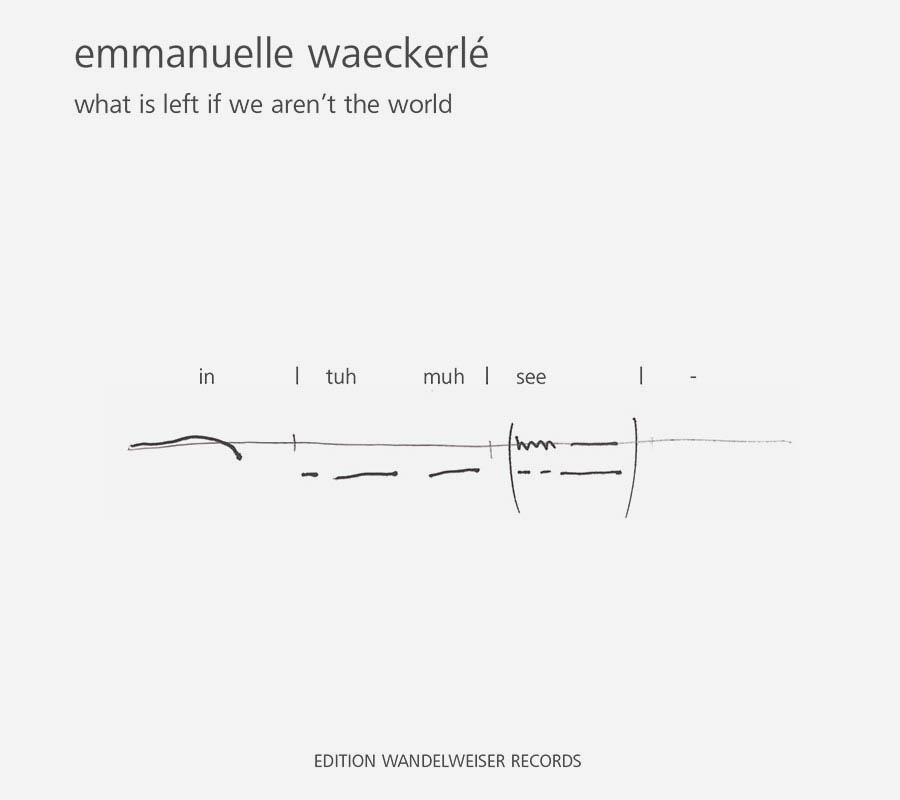
what is left if we aren't the world

Reproducing here liner notes to a new CD released by Edition Wandelweiser Records containing realisations of Emmanuelle Waeckerlé’s score what is left if we aren’t the world: recordings from 2022—an early home recording, the premiere performance in Amsterdam—with one of the 2023 Klangraum performances, from earlier in the week, and a later performance in Thessaloniki, all with different ensembles.

Emmanuelle and I met around Eddie Prévost’s weekly workshops a few years ago and we discussed this score soon after it had been written. The following summer, I witnessed and took part in the closing realisation of this piece at the Wandelweiser gathering, Klangraum, in Düsseldorf, the weather humid, changeable and breaking outside. (I wrote a brief report on the festival for The Wire, but its impact on me goes beyond critical summary.) The format of the gathering involves pieces being performed—one might say ‘workshopped’—every day for an entire week. It takes quite something for a piece, however open the score, to sutain that amount of attention, but what is left if we aren’t the world more than does this.

Over the past few years, I’ve found the piece a way to think and feel about what it feels like now—it makes a cameo in a book of poems I’ve been working on for the past few years called On Musical Objectsand I was honoured to write the liner notes to this CD release (for which Ryan Dohoney also provides a typically astute take). As upcoming performances in the context, not of music, but of performance art, activism, and discursive practices, suggest, what is left continues to evolve, and I’m looking forward to seeing and hearing about future iterations.

Until we are done, until we feel or sound indistinguishable from what is there…

what is left if we aren’t the world?

Emmanuelle Waeckerlé’s piece is a placeholder, a holding place, holding space. A way to respond to the alarming and sudden cessation of social life during the pandemic—whether that was experienced as ending, as interlude, or as a kind of new beginning. The piece has its origin in a recording of Emmanuelle’s voice and the wind on a stormy night in lockdown: the voice alone, but not alone, the wind its own kind of breath, one that doesn’t need a body to breathe through, to keep going or to preserve. what is Left, the ensemble piece that emerged from this, is a way of collectivizing that aloneness. From I to We, always asking who “we” are; who is allowed to be “we”.

A year after the premiere in Amsterdam, the piece was performed five times at the Jazz-Schmiede, Düsseldorf, as part of the long-running Wandelweiser gathering, Klangraum. Lines were blurred between rehearsal, performance, and composition. Whatever their role in a particular piece, everyone is a listener, with listening a shared activity orienting us to each other and towards the world. The piece was workshopped: not as a precursor to something finished, but as part of an ongoing process, in which the discussions that surrounded the piece—how to perform it, what it means—are just as much a part of the piece as its score or a performance of that score.

what is left if begins with “pandemonium”, an explosion of sound which can be alternately joyous, explosive, or wracked, gradually fading out into a silence in which musicians and environment merge. Composed during Covid, it indexes that desolate time, but also the ways in which chaos continues to form the underlying, unstable ground of our equally uncertain present. This kind of collective catharsis is a space for grief as well as rage, and for the networked, swarm intelligence of collective sound-making occurring within the framework of a social relation of mutual attention and care. To go beyond ourselves whilst also digging deep into those parts of ourselves that we’ve forced ourselves to suppress, in order to go on: those huge griefs that, during the pandemic, we lived with and then had to force ourselves to forget; the ongoing griefs of the catastrophes we’re living through now, five years on.

I’m struck by the instruction in the score: “pandemonium [...], but not an apocalypse”. Because the idea that everything has ended is perhaps too easy, even as the possibility of planetary extinction becomes more and more palpable. How do we cope with an end that is not an end? How do we go on? The score opens at the moment when one doesn’t quite believe what’s happened, and continues into the moment where we try to hold onto the beliefs that sustained us up to this point, and to integrate—or to refuse to integrate—the new knowledge that trauma brings. “finding ourselves inside of something. Finding something inside of ourselves. Keeping moving.

Within these sounds we hear the reflection of the horrors of where we are, all the things that block us truly being together—the anxieties, the cruelties, the hierarchies, the pettiness, the violence, the mistrust, the fear. But we also hear the possibility of what it would mean to be together, truly, glimpsed, briefly: a fraction of a second, a sliver of a sound.

Both the self and the tutti fall apart. And this is where we have to start. For after we figure out what’s left, the question is, as Emmanuelle says, “what to do?”

July 2025

Sunday, 2 April 2023

In other news...

On Sunday April 8th (next weekend) we'll be launching the new Materials books by Candace Hill and James Goodwin at Cafe Oto in Dalston at a 2pm matinee reading. James will be reading from his new book Faux Ice and in conversation with Nisha Ramayya, and this will be a rare opportunity for UK audiences to hear from the astonishing Candace Hill--artist, poet, weaver, author of the 200 page epic Short Leash Kept On--who'll be reading and in conversation via video link. Come for the afternoon and stay for the Fred Moten reading at the same venue in the evening! Details and advance tickets here.
 
On Thursday April 13th I'll be playing with a new group, Multiple Melodicas, at waterintobeer in Brockley, South London: myself, Georgina Brett, Steve Beresford, Douglas Benford, and Martin Hackett on melodicas, along with solos sets from Eddie Prévost and N.O. Moore. Unit 2, mantle court, 209-211 mantle road, brockley, se4 2ew. Doors: 6:30pm for a 7pm start. More details and advance tickets at the eventbrite page.


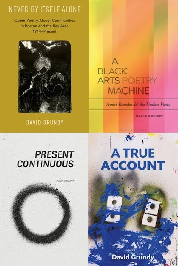
Then at 7:00pm on Wednesday April 19th I'll be reading from Present Continuous for a Pamenar Press spring reading at Thingy Café in Hackney Wick. Details here.

Finally, at 7:00pm on Wednesday April 26th I'll be taking part in a performance by members of the Eddie Prévost workshop at IKLECTIK, Waterloo, as part of the here.here series, for which Eddie will also be in conversation with Emmanuelle Waeckerlé.

---

And from a previous here.here, here's footage of my conversation with Eva-Maria Houben, Emmanuelle Waeckerlé, and Artur Vidal as part of the concert Social Virtuosity with Eva-Maria Houben curated by Emmanuelle at IKLECTIK in March. The video presents the whole concert: Artur's performance of dreaming legends, Artur's and Eva-Maria's performance of loose ties, and the string ensemble piece the green that is almost a yellow, performed by Lara Agar, Angharad Davies, Isidora Edwards, Finn Froome-Lewis, Dominic Lash, and Hannah Marshall, and the post-performance conversation. The performance of the string piece in particular was astonishing, its silence full and shared, its overlapping lines a perpetual making and unmaking of space as shelter; Eva-Maria's and Artur's performance with organist Huw Morgan the previous Friday was equally exceptional: I'm hoping to work up a longer piece on that (via Straub-Huillet's Cézanne) at some point in the not to distant future...


Meanwhile, elsewhere on the internet, the Poetry Center has been digitzing some astonishing readings from the 1970s. Filmed in San Francisco State University's Creative Arts Building, Lorenzo Thomas reading 'Grandpa's Spells' (named for the Jelly Roll Morton piece) is nothing short of breathtaking. Musicked speech indeed...

But, as well as music, this work is also conversation--talking (talking to, talking about, talking with, talking back). "I want to talk about the tears and sorrows of the people", he says in his introduction. And this concept of "the people" is a global one, Thomas reading his poem in memory of Neruda and translations of work by African poets--that internationalist, multi-lingual aspect running through his work: poems by Francisco José Tenreiro, Agostinho Neto, Marcelino Dos Santos, the latter then emerging from the victorious struggles against Portugal in Angola and Mozambique. Thomas' work of the 1970s, as he honed the finely-poised ironies of his earlier work through the lens of his experience in Vietnam and his reading in writers like Christopher Caudwell, is a contribution to a left populist poetry that has been virtually ignored: far too few notices of the Collected Poems edited by Aldon Nielsen and Laura Vrana have made it into print. (I've so far been unable to place my own review.) But being able to watch this video, to hear Thomas' cadences, his sonorous rise and fall, helps to newly bring that work alive: a poetry that charges the space, crackles with fierce energy and moral compulsion.   

Thomas read with David Henderson, fronting the nine-piece band Ghetto Violence--as singer...(in this harking back to his early career with vocal group the Star Steppers, as documented in Henderson's classic early poem 'Boston Road Blues' (for the poem, scroll down to page 41 here.) In the U.S. Bicentennial Spring, Henderson and the band deliver "Hail to the Chief" ("agit-rock...dedicated to the next Presidential election". In the event, Jimmy Carter would replace Gerald Ford, who'd pardoned Richard Nixon for his Watergate crimes, in the recurring cycle of putatively 'democratic' debasement. It continues.

(The full recording of Thomas' and Henderson's reading is here.)

Also from the Poetry Centre's Digital Archives, another gem: Karen Brodine and Meridel LeSueur reading in 1981, two generations of Left feminist writing looking into the jaws of the 1980s with implacable courage. What's particularly valuable is to have this document of Brodine reading the entirety of the sequence Woman Sitting at the Machine, Thinking, written from her experience of workplace organising as a typesetter (and her reading of Engels). I'm working on a chapter on Brodine, Merle Woo and Nellie Wong for a forthcoming book on queer poetry in Boston and San Francisco which hopefully will be fully drafted in the next few months. Last year, I spent a valuable week in Brodine's archives at the James C. Hormel Center on the top floor of the San Francisco Public Library, Tim Wilson and the other librarians patiently bringing me box after box and allowing me to see, in her unpublished notebooks, drafts, teaching preparations, and talks, how, for her, poetry articulated her sense of herself as woman, as lesbian, as worker, as socialist, the clarity of the way she theorizes language, the specific uses she sees poetry as fulfilling: conceptions well beyond the cliche of poetry as a kind of transparent vehicle for messages, on the one hand, or as 'neutral' abstraction on the other. For Brodine, poetry's form is its argument: which is to say that "form" is inseparable from, dialectically related to "content", the distinction between which she skewers in her unpublished pieces on aesthetics. We all know the rhythms of our days, shaped by labour or its absence, in our different ways, some feeling the pinch more than others, and spending time with 'Woman Sitting' in particular, going over it and again, still enables a reckoning with and refiguration with the violence of that time, the violence of Brodine's and our times: this poem which is so much about time, about the work week and the ways workers work within and resist capitalist time.

knowledge this power owned, nor shared
owned and hoarded
to white men [...]
                           wrench it back
knowledge is something we have 

Here's Brodine's reading: 


And from the same reading it would be negligent not to mention Meridel Le Sueur's poems of fierce solidarity, reading the global and gendered division of labour in ways that, once again, are firmly internationalist, are about mapping the general and the particular in precise and specific ways that poetry--specifically--can be used as a tool to pry open, a compass for navigation. And Le Sueur's opening denunciation of Eliot's The Waste Land as nihilistic male modernism remains as hilarious and as provocative as it's meant to be...

Thursday, 26 January 2023

IKLECTIK Gigs


I'll be playing at IKLECTIK, Old Paradise Yard, 20 Carlisle Ln, London SE1 7LG, with members of Eddie Prévost's London Improvisation Workshop (Emmanuelle Waeckerlé, Tony Hardie-Bick and N.O. Moore), Eddie Prévost, and John Butcher, on 14th February. Details here: https://iklectikartlab.com/electro-acoustic-responsiveness-improvised-trajectories/ 

And a couple of weeks later, on Sunday 26 February 2023, I'll be at IKLECTICK again for here.here | Social Virtuosity with Eva-Maria Houben, as part of the here.here series curated by Emmanuelle Waeckerlé and Harry Whalley. Three new works by Eva-Maria Houben, written for Artur Vidal and Dominic Lash, will be performed, and there'll be a discussion with Eva-Maria led by myself and Emmanuelle. More details here: https://iklectikartlab.com/here-here-social-virtuosity-with-eva-maria-houben/ (Artur and Huw Morgan will also be performing more work by Eva-Maria on Friday 24th Feb at 7pm, St James Garlickhythe, Garlick Hill, London EC4V 2AF, UK. See: https://www.eventbrite.com/e/all-good-things-come-in-threes-music-by-eva-maria-houben-tickets-518929260387

The performance of Eva-Maria's Together on the Way last year was truly one of the most astonishing things I've seen (I wrote about it on this blog): these works really live and breathe in live performance, and if you can, I'd encourage you to try to make one or other or both of these performances.