Charles Mingus recorded this version of Martin Niemöller’s anti-fascist warning in 1965.
And today, sixty years later in Minneapolis when people intervene to help their neighbours, to come to the aid of those in their community, to attempt to ensure due legal process, they are pushed to the ground by the agents of Immigrations and Customs Enforcement and shot ten times, shot four times, shot in the body on the ground, shot in the head, when pulling away in a car. Alex Pretti. Renée Good. A nurse, a poet. The observer is the new target. To be a witness a fatal act.
The Associated Press detailed that Pretti had embraced a person who had just been shoved by an agent. An agent then shoved Pretti, and the two fell back, still embracing.
They shoot down good and they shoot people embracing.
Sharing footage of death has been a necessary way of contending with the lies the administration tells in public. Evidence, reproduction, to show that this happened, even as the state doctors the photos and footage it itself releases. The image, when our eyes can’t be trusted, and the word: the lies told about the image. “I didn’t say that”. “He didn’t say that”. The image and the word. The reproduction of the image becomes a weapon, and, as a weapon, its consequences are fatal: loops of death. The line between witnessing and horrified voyeurism that for the past years of live-streamed genocide has become a part of the texture of observation. What does this do to solidarity and how we conceive of it.
Beyond these ethical questions, questions of representation, questions that matter for our conscience and our consciousness as artists, yet in ways that we find sometimes impossible to track, what matters is what you do. In Minneapolis, protests, marches, a general strike. The resistance of communities to the violence perpetrated on them, in their name.
Mingus’ recitation plays over footage from a demonstration shot for Thomas Reichman’s 1968 film Mingus. His biographer, Gene Santoro, writes:
Mingus figured you had to stand for something. The powers that be would come for you anyway. He was busted a few times with other marchers and spent time in the Tombs, New York’s downtown holding tank.
Mingus also shows Mingus facing eviction from his loft at 5, Great Jones Street, where he’d hoped to set up a music school, in 1966, and from which he was evicted after a crooked landlord set him up for a fall. The film’s last scene shows the press and cops crowding round as his instruments, his scores, his life are taken out of the building, and he’s taken to the police station after they find needles and a rifle in his belongings. He was released: no shots were fired; he planned music for a ballet called ‘My Arrest’.
Charles Mingus, a well-known jazz musician, was arrested with two other persons late last night in a demonstration by a group of 200 hippies outside the Charles Street police station in Greenwich Village. Mr. Mingus, who was accused of scuffling with a civilian and two policemen who attempted to intervene, was charged with three counts of felonious assault. The demonstration began with a march by the hippies from Washington Square Park to the Charles Street station. It was touched off by rumors that an itinerant musician had been arrested earlier. These were later said to be unfounded. At the station the hippies sat down and began singing. The police moved the group half a block to the corner of Greenwich Avenue, where, they said, Mr. Mingus engaged in a scuffle with a motorist who had objected to hippies sitting on his car.
Mingus recorded ‘Don’t Let it Happen Here’ in March 1965, introduced by Ralph Ellison for a TV performance, and again in December, in the version released on Music Written For Monterey 1965. Not Heard... Played In Its Entirety At UCLA Vols. 1 & 2. That same year, sixty years ago, the assassinations of James Meredith, Malcolm X. Mingus fires his rifle into the ceiling and notes that it’s the same kind of gun that killed JFK. The right wing and liberal state alike claim a monopoly on violence, at home and abroad, and the vigilante forces that operate outside it, but with its tacit approval. In March 1965, FBI informant Gary Thomas Rowe murdered the Civil Rights volunteer Viola Liuzzo, shooting at her car as she ferried from the march on Selma. It was rumoured he’d assembled bombs for the bombing of the 16th Street Baptist Church bombing in Birmingham, Alabama. Liuzzo grew up in one-room shacks with running water: her activism was the result of experience, of solidarity, the opposite of the KKK’s violence, as today, citizens turn up for their neighbours while others cheer on the forces of hatred. Gary Thomas Rowe received immunity.
The state assassinates people in private, and its agents murder people in public, on the highways and on the streets, whether they are activists or not. Fred Hampton. Sandra Bland. The state becomes and remains fascist because it assassinates and decimates the opposition. But this process of becoming is not some sudden leap of the cliff, though it can feel that way. The state becomes and remains fascist because the potentials for fascism are already there. In his book Late Fascism, Alberto Toscano looks at the analyses of police violence against populations of colour in the writing of Angela Davis and George Jackson to argue that fascism is a differentially-distributed experience. For some, the experience of the state is that it is already fascist. And then it spreads. The tree rotten from the inside will eventually collapse and take down everyone who’s placed their trust in it.
In Reichman’s film, Mingus delivers a sardonic monologue, tinged with furious irony and ironic fury.
I pledge allegiance to your flag—not that I want to, but for the hell of it, I pledge allegiance. I pledge allegiance to the flag of the United States of America, the white flag, with no stripes, no stars. It is a prestige badge worn by a profitable minority.
“If they take you in the morning, they will be coming for us that night”, James Baldwin wrote to Angela Davis a few years later.
The movement of the people in the streets can be clamped down on, it can be diverted, dispersed, thousands dead, arrested. The empire hovers over the regime, at home and abroad. The empires, plural, their vassals, their dregs. In Venezuela, in Iran. Invasion, kidnapping or ‘deals’ in exchange for extraction, of oil, of wealth: gangster capitalism, the continuation of decades of imperialism by all and any means, already dividing up the land piled up with rubble and with the dead. Fifty per cent of profits from new mineral and oil projects in Ukraine will go to the US; under the aegis of the US-led “board of peace”, the UAE plans a collaborative open-air prison marketed as a ‘safe zone’ in Gaza; the British government denies its complicity in the genocide in Sudan. But the movement doesn’t stop.
Mingus’ delivery in the TV performance is halting, as he fumbles the number of people genocided—death exceeding the weight of statistics—and over the collective noun to use—the politics of solidarity—speaking out against “those who killed…the other people with me.” And in that very awkwardness lies its clarity, its power. “And I say the only way we can avoid this is to look and speak out now. And don’t…let…it happen here”. From an opening lament spread between the brass instruments in the band as he recites Niemöller’s text, Mingus strikes up a propulsive piano figure and the band blares into collective improvisation. On the march, on the move. Fluency in fracture and the stammered statement of fact. The movement doesn’t stop. And though they may breathe in breaths strained, asphyxiated, observed, occupied, a breath that comes in gasps, a breath in combat, the people—continue to breathe.
Angelika Niescier with Tomeka Reid and Eliza Salem, October 30, 2025, JazzFest Berlin. Photo (c) Berliner Festspiele / Camille Blake
(The third of three subscriber posts on Subtackon this year’s Jazz Fest Berlin. The first two are longer essays on particular sets by Wadada Leo Smith and Vijay Iyer and by Pat Thomas, the third a more general overview of the festival.)
Angelika Niescier—Marta Sánchez—Tim Berne—David Murray—Elder Ones—London Jazz Composers Orchestra—Amalie Dahl—Fire! Orchestra—Mary Halvorson—Marc Ribot—Mopcut and MC Dälek—Sakinda Abdou—The Handover—Moabit Imaginarium—James Brandon Lewis—Cadences—Where we’re going.
Something like a festival, shapeed as it is by the organisational demands of a one-off occasion, by acts that it’s felt will draw an audience, by the circuit of prizes and names, and names, offers a cross-section of whatever is felt to be happening at a particular moment on time. It’s partly through festivals, which tend to be recorded and documented far more and far more officially than regular gigs, that we construct our history. (The archive of Jazzfest Berlin / the Berlin Jazztage is a particularly rich resource, as the documentation made available at last year’s festival revealed.) But what really happens is what happens on the ground, day to day: that which continues, in New York or Chicago or London or Berlin and beyond. What’s beyond the headline, what continues after the applause has ended. What we heard in Leo Smith or Pat Thomas, in the massed voices of larger and smaller groups around them, also sounds out round the margins of the big events, events that, in the current environment, are themselves no doubt in the margins, under threat of some kind. The sound must come from every angle.
As a subscriber post on Substack, this piece on a track from Adegoke Steve Colson’s and Iqua Colson’s album Triumph!, along with thoughts on survival, the outcast and, once more, the work of John Wieners.
Often, the poems that give consolation to others don’t always give consolation to the poet themselves, or the time of release is different. The renewal they offer wavers in its power. It saves some and not others, and sometimes it seems like it can save no one or do precisely nothing, but what matters is that it’s still there, if nothing else as testimony and record, as the poems of the martyrs in Gaza, as the poems of the shining martyrs Wieners saw in the queer poets of Boston, as in all the poems being written now, all the poems that have been written and that will be written, triumph of the outcasts, coming!
I come home to find out that Louis Moholo-Moholo died, this Friday 13th, listen to recordings of what I guess was his last band, with Alex Hawkins on piano, John Edwards on bass, the twin saxophones of Jason Yarde and Shabaka Hutchings, on a European tour in 2019.* Free jazz, yes, and music never more free, but freedom, entirely within melody, with the way melody is treated, as, for the first six minutes they do nothing but play the melody, over and over; however many variations are spread around it, how many patches of atonal fights and flurries, at any one point during that time, one person will be playing the melody. And this music above all the music that survives of the twentieth century, perhaps, because of the extremity of its conditions in which it emerged, because of the unshakeable faith and unceasing struggle of the movement with which it was already, whether at home or in exile, in solidarity, this has music has something about it of the quality I can't help name as anything other than truth: where hope is not just an alibi--the fear of facile hope as betrayal--but a present and necessary reality, a utopia and a reality all at once.
Moholo-Moholo's is music that knows life because it knows death, and isn't afraid to face up to that, but that finds a way, in itself, in the spirit it is, not in a spirit external to the music, but within the music, and from that, the music can move out into the world, into the (freedom) movement that made it and the movement it maintains. It was like that when I saw Abdullah Ibrahim last year, however old he was and however slowly he played. Each touch of each note weighted with grace. (And in the video we see Alex Hawkins lead the already 80 year old Moholo offstage, up from the drumkit, by the hand, as Ibrahim, too, was guided by the hand, to and from the stage.) So often, as we see in the music of those in their last years, the late performances of Cecil Taylor, say, or, Hal Singer, or whoever you care to name, music strains beyond the limits of a body that would slow down beyond its speed, spirit pushes at the limits where it would usually part from the body. For isn't that what sound and music is, or what we make of it, as it takes on a life of its own and survives its makers? And so often the most moving music played by Ibrahim, Moholo, the Blues Notes--Feza, Dyani, McGregor et al--was a record of loss: most movingly of all, the Blue Notes' records for Mongezi Feza, then later for Johnny Dyani, where the studio becomes a place for a gathering, a wake, a way to put to rest and release the spirit of the individual, collectivized, collectively held in the memory of song.
So, too, this music from 2019 is lament and celebration at once: it is never not both, the one that cannot exist without the other, their constant dialectic, their co-existence, that struggle of being alive. On Pule Phuto's piece 'Zanele', a Xhosa name meaning "they are enough", they are sufficient, the band hold their instruments and sing Zanele, Zanele, over the piano's gently rocking chords and the crisp crackle and splash of Moholo's snare and cymbals, his whole playing contained, wound-up tight and sharp, propelling the music's hugeness of heart and soaring song precisely through its containment. Music that always exists in and emerges into the condition of singing, the act of singing: to repeat the melody over and over, whether in instrument or to open our mouth and sing it, means we're still alive, we're still alive, we're still alive, and they are enough; and when the band emerge into 'You ain't gonna know me cos you think you know me' and play the melody over and over like a hymn, a benediction, all those words for which the usual designation of 'ballad' is entirely insufficient, for the second time watching the video I burst into tears. What is the point of anything without hope.
(*This is the 'Five Blokes' band that recorded Uplift the People(Ogun, 2018), but to really witness the band's joyous, flowing dynamic, you have to see the videos. Another full-length concert from a few days before the Bimhuis performance above took place at Church of Sound, with Shabaka Hutchings replaced by Byron Wallen and Steve Williamson is here: Part 1, Part 2)
An essay I began a few years ago on N.H. Pritchard, II, is out now in African American Review, with thanks to Aileen Keenan and Nathan L. Grant. Here’s the abstract:
In 1967, Wilmer Lucas wrote that N. H. Pritchard’s poems “decompose the reader by sight and sound.” This essay follows Lucas’s prompt in several ways. It examines Pritchard’s early poetry in the context of the New York art scene and the Umbra Poets Workshop, outlining his development of the concept of “transrealism” and the subsequent visual reorganization of his work, before focusing on the sonic dimensions of his poetry, and suggesting that his approach ultimately led him toward silence. The conclusion emphasizes Pritchard’s legacy in the work of new generations of experimental musicians and poets and its continuing relevance today.
And, since I drafted the essay, Pritchard’s previously-unpublished “exploded haiku” The Mundus, versions of which I discuss in a section of the essay, has come out as a book from Primary Information, edited by Paul Stephens. Here’s my blurb.
Rumours of N.H. Pritchard’s long-lost poem, The Mundus began to surface a few years ago, summoning us to imagine the mystic, Black radical work to transform society. Pritchard’s was always a music of language, a chanting on the page, a sonic visualisation that troubles the edges of both poetry and music alike. He broke apart form at every level—word, letter, sentence, phrase—sounding out mutable mutating beauties and metamorphosing phonic propositions that resound into our present. It is a remarkable work by the standards of any time.
Meanwhile, over on the Jacket 2 website, Charles Bernstein has helpfully posted a funding letter Pritchard wrote in 1967, summarising the project, which expands, corrects and (hopefully) extends some of my guesses in the essay.
~~
Elsewhere...
A sequence published in the winter issue of Almost Island, with thanks to Mantra Mukim.
Reviews of the Donaueschinger Musiktage in the latest issues of The Wire (you can find also find a long versions in an earlier post on this blog) and the new Beam Splitter/Phil Minton album, along with a contribution to the magazine’s year-end reflections and charts.
And stay tuned for reprints of out-of-print titles from Materials, which should be here in the next couple of weeks (hopefully before the year is out)...
~~
And finally…
A few days ago, astonishing new footage of Albert Ayler was uploaded by Jay Korber to his Youtube channel: one ten-minute piece from Munich and one full set from Berlin, both filmed on a 1966 European tour featuring the three-front line of the Ayler brothers and violinist Michael Samson. What’s perhaps most striking about these, given Ayler’s reputation, is the amount of time spent playing melodies. There are relatively few sections of the ‘free’ improvisations for which Ayler was infamous: instead, medley, melody, the ‘folk’ element of the music are more pronounced, not in the somewhat constrained pop forms into which Ayler’s music attempted to fit on New Grass, but as a continuous stream of cadential, decorated, ornamented, amplified, reiterated, singing declaration.
As Peter Niklaus Wilson notes in the recently-translated biography Spirits Rejoice: Albert Ayler and his Message, the Ayler band had been touring Europe as part of a package tour organised by impresario George Wein, what bassist Bill Folwell called the “B tour” to the star turns of Sonny Rollins, Stan Getz, Max Roach and Dave Brubeck. It was on this tour that what was for a time thought to be the only footage of Ayler was recorded at the London School of Economics for the BBC’s Jazz 625, tapes subsequently destroyed in a cull of old recordings (so does Britain value art). Samson recalls ecstatic response to the group’s music on some of the gigs from the tour, comparing their reception in the Netherlands and France to the Beatles, though this doesn’t seem to have applied to the West German gigs: the audience in the footage, respectable and be-suited, appear indifferent, if not hostile. Yet the music Ayler was making had been designed precisely to reach out, to create a collective experience whose call the audience seem on this occasion to have been unable to hear.
Wilson labels the period 1965 to 1968 as the transition from ‘free jazz’ to ‘universal music’, with melodic material less a “catapult theme” for improvisation than something which “take[s] on an unprecedented weight in the playing process - firstly, through their length (for they are now often relatively extended, multi-joint structures), secondly, through the chorus-like recurrence of thematic passages between the solos, thirdly, through the clear shortening of the improvisations”. Wilson sees this as “a populist quality Ayler consciously worked towards”—what Ayler described to Nat Hentoff in 1966 as “trying to get more form in the free form […] something […] that people can hum. […] I want to play songs like I used to sing when I was really small. Folk melodies that all the people would understand.”
Wilson also quotes Samson, who suggests that those melodies drew from Ayler’s past in the Baptist church, where communal participation through singing had a pride of place. Ayler’s extended songs were an attempt to create participation, ‘spiritual unity’ , to bridge a real or perceived gap with the audience in a collective experience (in the next stage in his music, he’d go further, adding words and singing himself, alongside musical-romantic partner Mary Maria Parks).
This was not an about-face, a betrayal of the abstract freedoms of Ghosts and Ayler’s earlier music—an accusation Ayler would face in response to the more overtly R&B-oriented New Grass—and nor does it invalidate or represent a progressive maturation from that earlier music. Rather, Ayler’s ‘free’ playing represents one dialectical outgrowth of the syncretic traditions of song his melodies reference: marching band music, church songs, the nursery rhymes or folk songs he’d heard as a child. The multiple overlapping lines of counterpoint or call and response concentrated to occur all at once, at the same time, in multiphonics and atonality, not so much tonality’s absence as its saturation, its density, all the keys at once. Likewise, the restatement of those formative elements, with the Ayler brothers playing counterpoint lines while Samson vigorously bows along in rough-toned obbligato, manifests an element that was latent in the free improvisations, just as those improvisations manifest an element that was latent in the kinds of melodies on which Ayler drew. As Wilson notes, Ayler is not improvising less than in the more abstract earlier phase, where those improvisations were clearly separated from brief opening melodies. Rather, his various decorative figures offer a nearly-continuous micro-improvised commentary on the melodic figures that, in more conventional jazz frames, would be understood as the ‘heads’ preceding the main business—the virtuosic improvised solo.
Noise is an extension of melody; melody contains within itself the sound of noise.
In his contemporaneous reception by the French press, Ayler was often positioned as either a kind of racialized musical primitive or a dadaist in the anarchic vein of European avant-gardists: either atavist revenant or European modernist, the actual, dialectic quality of his music was often not fully grasped. (Greg Pierrot gave a good paper on this at the International Surrealism conference in Paris last month.) This was, though, the changing same, the radical tradition: continuity and rupture, old-time religion and present-day revolution (spiritual, musical, or otherwise), the tiger’s leap into the past. So, while I refer to ‘folk’ qualities of this music—a term Ayler himself used—‘folk’ here, I think, stands as much for vernacular traditions outside or to the side of the developing pop vocabularies of the culture industry, enmeshed as those were with Cold War economic developments. It does so, not in the sense of the revivalism of the US folk movement, or indeed the European folk songs on which Ayler drew, for instance, for the melody of ‘Ghosts’, based as it is on the Swedish ‘Torparvisan (Little Farmer’s Song)’ (Gunde Johansson’s version is here), as a kind of musical romantic anti-capitalism. Rather, it’s shaped by the experience of modernity, as opposed to evoking a static, idealised image of a real or imagined past. It stands at once for particularity, for the personal memories of the songs first heard and sung that Ayler evokes in the Hentoff interview, that maternal transmission (recall W.E.B. Du Bois and his great-grandmother’s lullaby, his infant’s initiation into the sorrow songs), and for the collective dimension that—as Du Bois’ account of the sorrow songs reveals—those songs open onto. Like ‘jazz’ itself, it is syncretic, drawing in all the ear can hear: folk music not as backwater, tradition to the side, but as part of a relation to modernity, to the problems of the world, away from those labels that would limit, ‘folk’ as much as ‘jazz’. As Wilson writes: “From baroque to country music to the European avant-garde: in the abundance of these allusions Ayler’s music [of this period] really transcends every jazz idiom, no matter how broadly conceived, and makes one understand why Ayler shied away from the jazz label at the time, preferring to speak of the vision of a ‘universal music’”.
‘Ghosts’, said Don Cherry, “should become mankind’s National Anthem!” Nation within a nation, nation without a nation, internationale, outernationale. Spirits rejoice.
Abdullah Ibrahim Trio, Haus der Kulturen der Welt, Berlin, September 7th 2024
As HKW Director Bonnaventure Soh Bejeng Ndikung remarks from the stage, “when Abdullah Ibrahim is in town, he deserves a packed house”, and the audience duly flows into the Miriam Makeba Auditorium well past the advertised start time. Beginning fifteen minutes late, the concert lasts perhaps another ninety without a break, although it feels much shorter. Now 90 years old, Ibrahim largely follows the format of his recent trio album 3, recorded last year at London’s Barbican. Ibrahim, flautist Cleave Guyton and bassist Noah Jackson—the latter members of his group Ekeda—rarely play together as a trio. Rather, the pianist alternates extended solos with duo features, from up-tempo, traditionally-swinging jazz—Guyton playing Monk on piccolo, Jackson playing ‘Giant Steps’ on double-bass—to slower pieces characterised by Bachian counterpoint and timbral combinations reminiscent of the exquisite 1963 duos recorded by Eric Dolphy and Richard Davis. But Ibrahim is the real focus, his playing manifesting what we might call late style: pared down, all ornamentation cleared away.
For decades, Ibrahim’s solo performances have involved long medleys in which fragments of his familiar songbook are linked like flowers in a garland. In the past, these were often driven by propulsive groove. As he gets older and older, the medleys get slower and slower, music stripped back to the bare bones—a blues scale, a Monkian dissonance, a rich, impressionistic chord. As Ibrahim once remarked of Good News From Africa, his superlative 1973 duet with bassist Johnny Dyani, “[when] you play bebop, you fill out a space. When you play our music, you don’t play notes, you just play space!” Without a rhythm section, Ibrahim’s rubato playing unfolds introspectively, in flexible, slow time. Chords, melodies, transitions come together as in a waking dream, in which each phrase has simultaneous fragility and depth. It’s as if the weight of history accumulated in the pianist’s fingers at once lends them the collective power to strike the keys, and weighs them down, so that each note played must be wrested from the accumulated ghosts of time, ageing and history. To play is to “invest in loss”, Ibrahim remarks in a recent interview. One must “strike the note [...] with the utmost sincerity”, because “you don’t expect to get anything in return”.
We might, I think, view all of Ibrahim’s late performances as essentially variations on the same structure. In a 1984 interview with Graham Lock, Ibrahim linked the role of repetition in his music to the Islamic Tariqa, or state of trance. “At home we have chants – you say: ‘There is no God but He’; say that for five, ten hours, you’ll get stoned! [...] That’s where the music comes from and its purpose is to put you in that stage[.]” Previously, this could be heard in the repeated, loop-like structures which guided and grounded Ibrahim’s music. But his current mode, a set of repeated ruminations on the same pieces, might too be linked to that state of Tariqa, to the way a prayer follows a set pattern in order to address questions that remain new precisely through repetition, drawing again on that water from an ancient well. Tonight, the beautiful and sombre ‘Blue Bolero’ that emerges as the evening’s theme or leitmotif, a kind of anti-fanfare, as it did overt twenty years ago on African Magic, another trio album recorded at HKW back in 2001, as well as on the more recent Dreamtime. The piece is played three or four times, orientating the music, giving it direction.
Towards the end of the performance, Ibrahim plays the melody to ‘Ubu Suku (Evening)’, a piece first heard on Duke Ellington Presents the Dollar Brand Trioback in 1963, but receiving perhaps its finest rendition in a breath-catching duet version with Archie Shepp the following decade. I’d had the melody in my head all day: one of Ibrahim’s most beautiful pieces, its melodic figures rise and fall, surging into an impassioned sigh met with a lilting, halting left-hand reply. Guyton and Jackson’s arrangement for clarinet and cello gives the piece a chamber-music quality, but it’s the special weight of Ibrahim’s brief solo rendition that sticks in the mind. As the applause rings out, Ibrahim returns once again to ‘Blue Bolero’, then abruptly stands up from keyboard. His wife, Marina Umari, comes on stage to support him as he links arms with the other musicians and the audience rise for a standing ovation. Putting a hand to the side of his head, he sings, unamplified, as he’s done at the end of all his recent concerts, alternating a South African refrain with English words bespeaking the Middle Passage. (On 3, the piece is sub-titled ‘The Sound of Centuries Old Maritime Cargo’.) “When I came back, there was no one there to welcome me home”, he sings, barely audible. With everyone in the room standing, it’s as if we were at church, the music carrying the weight of those apartheid years in which Ibrahim became a kind of national composer, Mandela calling him “our Mozart”, but also of those longer and ongoing imperial histories with which those years are entwined.
I hear a voice from the audience quietly harmonizing behind me, and imagine if the whole hall had raised their voice in anthem. But that would not have been appropriate, for this is about quietness, about ‘solotude’: being alone, but with witnesses. Ibrahim keeps singing as he’s guided off stage, and as he disappears into the shadows and the applause gets louder, I swear I can still hear him singing, and I wonder where his mind has travelled. For this music is not just about one person, but about those legacies which have formed and informed his music, and this song is neither a statement of facile resolution nor fatalistic acceptance, but of a kind of hope that comes out of facing the abyss, plucking a note out of it, a word, a song. I swear I can still hear him singing.
Two luminous orchestral works by the late, great Wayne Shorter: first, Dramatis Personae, a Lincoln Centre Commission from 1998 with Shorter on soprano, Jim Beard on piano, Christian McBride, bass, and Herlin Riley drums alongside orchestra conducted and arranged by Robert Sadin--the bridge between the monumental, and underrated, High Life(1995)and the orchestral collaborations of the Danilo Pérez/ John Patitucci/ Brian Blade acoustic quartet to come.
A decade-and-a-half on, the massive LA Philharmonic commission Gaia (2013), described by Richard S. Ginell in Variety as a “murky, thick-set monster of a piece [...] massive, slow-moving, opaque textures, sometimes tracking Wayne’s distinctive long, snaking melodic lines on soprano; treating the sections of the orchestra as blocs”. Varying in performance from 25 to 30 minutes, this version from Gdansk in 2014 veers toward the latter, with Shorter on soprano forming part of a quartet with Leo Genovese (piano) and Terri Lynn Carrington (drums); the solo vocal part and libretto are by Esperanza Spalding, who also doubles on bass as part of the quartet.
Shorter first began work as a teenage student at NYU, and it’s to be hoped that Shorter’s Kennedy Center collaboration with Spalding on the opera Iphigenia--his final piece after he retired from performing in 2019--might appear in the future. For now, the serene drama of these orchestral works represent the majestic, achieved late blossoming of the compositional impulse Shorter had been building throughout his entire life, from his early work on that teenage opera through to the unreleased orchestral pieces Universe, Legend and Twin Dragon he wrote for Miles Davis in the 1960s and ’80s (later realised by Wallace Roney) and the misunderstood trilogy of post-Weather Report Afro-futurist epics Atlantis (1985), Phantom Navigator (1986), and Joy Ryder (1989), along with the aforementioned High Life.
I have a longer piece on Shorter in The Wire, with thanks to Meg Woof.
(Edited down from a 30,000 word draft--with plenty more to say on Shorter’s orchestral work, his status as composer, and the framing of ‘jazz’; more of that may see the light of day elsewhere.)
///
In other news:
My interview with composer Hannah Kendall is online at Bachtrack: Kendall is Composer-in-Residence at the Royal Academy of Music this March, and a couple of concerts are forthcoming the following week. Highly recommended if you’ve not heard her music in performance before.
On March 22nd the trio GUE will be making its delayed debut at waterintobeer in Brockley, South London. Jacken Elswyth on banjo, Laurel Uziell on electronics and myself on electronics and melodica. We’ll be joined by a saxophone trio of Alex McKenzie, Nat Philipps and Nicholas Hann, plus Tom Mills on theremin. Tickets £5, doors 6:30, to be wrapped up by 9pm. Eventbrite page here.
Finally, I’m delighted to reveal the cover for the Selected Poems of Calvin C. Hernton, co-edited by myself and Lauri Scheyer, and now available for pre-order from Wesleyan. The book includes material from across his career--including the long out-of-print The Coming of Chronos to the House of Nightsong--and a foreword from Hernton’s longtime friend, publisher and champion Ishmael Reed, along with notes, chronology, and index. It will be published this August.
As a supplement to that piece, some of my favourite Sanders radio and video shots below.
--Sanders' feature on 'Naima' from Live at the Village Vanguard Again--or for, that matter, on 'Peace on Earth' from Live in Japan--is one of the great solos in jazz's recorded history, reinventing the idea of what a 'ballad' could be, of what a 'solo' could be, of what music could be. But, to me, this version of Strayhorn's 'Lush Life' from the Seattle residency that yielded Live in Seattle and the recently issued live version of A Love Supreme surpasses even those. During those brief years of collaboration before Coltrane's death, he and Sanders were plumbing the depths to reach the heights, their music a lived reinvention of the social, of the painful and beautiful movement towards the creation of a more just world. It calls to us still.
--I only wish there were more recordings of Sanders' work with Dave Burrell and Sonny Sharrock from around the time they made Tauhid. Burrell's pianism, with his ability to vamp for hours, his harmonic inventiveness, his unassuming and relentless energy, was one of the key spurs in Sanders' move from the open-ended frameworks of the late Coltrane groups to something more groove-driven, to one-chord vamps, a kind of free jazz minimalism that, in its emotional impact, is as maximal as anything ever recorded. The aspirations of the music move out--it's there in the track and album titles, but it's there in the music too, its endless open horizon. On Sanders' studio albums, his bands were often supplemented with additional instruments--the unforgettable use of Julius Watkins' french horn on Karma, of Leon Thomas's vocals on Jewels of Thought, of the extra horns and additional percussion on Summun Bukmun Umyun, Thembi, and the rest. Or the ensemble sound of Izipho Zam, criminally underrated, recorded for Strata-East but not released until four years later. In terms of live recordings, move forward a few years and there's Sanders' group with Lonnie Liston Smith, Sirone on bass, and Majeed Shabazz on drums, in bootlegs from the 1968 Antibes Jazz Festival, playing material from Tauhid, which had been recorded two years prior, and The Creator Has a Master Plan, which had yet to be released. Some film footage from the same performances gives some further visual cues into the band's interplay.
--From the Nice festival two years later, with Cecil McBee replacing Sirone and Jimmy Hopps replacing Shabazz and Lawrence Killian on percussion, a quintet version of the Lonnie Liston Smith arrangement of 'Let Us Go Into the House of the Lord' that appeared on Summun Bukmun Umyun, turning the traditional spiritual made famous by the Edwin Hawkins singers into an epic suite of changing moods and colours. Listen to the way Smith's solo, via simple scalar repetition, transforms as he keeps the sustain pedal depressed and the chords become denser and less consonant, moving into the thick intensity of Sanders' multiphonic re-entry, a passage of fearsome power with Sanders' saxophone accompanied by screams and hollers and Smith's piano chords transformed into part of a thicket of percussion, before things settle into McBee's bass solo. I've always found McBee's arco playing here and on the studio album completely astonishing, some of the most moving music I know.
--From the same year, Sanders and Archie Shepp in a dual-horn line-up with Alice Coltrane at a Carnegie Hall benefit concert, channelling the inside/outside feel of Coltrane's Ptah, the El Daoud, where the Shepp role was taken by Joe Henderson. The dual-horn line-up here is not just a reminder of John Coltrane's last band but, as that band itself was, of the "duelling tenors" sound popularized in the fifties, with the sounds of competition, cutting contests, jam sessions, rendered instead contributions to a conversation of collective rapture.
--As Sanders' moved 'inside' during the seventies and eighties, his quartet with John Hicks on piano, Curtis Lundy on bass, and Idris Muhammad on drums perfected a certain vein of post-Coltrane, post-bop playing. Analogies might be drawn to what David Murray was doing around the same time: endless streams of invention over changes, 'outside' passages deployed at moments of climax, a resolute swing, a fulsome romanticism. This long, long performance of 'Doktor Pitt' from--I believe, 1986, at the Fabrik club in Hamburg--exemplifies their particular energy.
--With McCoy Tyner at the Lugano Jazz Festival in 1985 playing 'For Tomorrow': wistful yet full of hope.
--In duo with John Hicks in Frankfurt in 1986, playing material from the quartet album Africa. I've always loved the version of Hicks' 'After the Morning' here. The word that springs to mind so often with Sanders' later career is serenity: this piece exemplifies that.
-- Ask the Ages was one of Sanders' great late-career albums. Sonny Sharrock had been one of his earliest compadres, and the music they made in this reunion, and attendant tour, was a kind of retrospective of all the styles they could play: swinging post-bop, the blue, free playing, ventures into rock. Live, the energy gets dialled up even more--this was, after all, a Sonny Sharrock who'd been playing with Peter Brötzmann in Last Exit for the past few years. But the music is wider, deeper, broader than that of Last Exit: the panorama of Black populist modernism and modernist populism that Sanders had mastered so well.
When Charlie Parker died, Ted Joans went around Greenwich Village writing "Bird Lives" on walls.
As a friend wrote to me on finding out the news of Sanders' passing: "Pharoah Sanders is immortal".
Pink Siifu and Tha NEGRO Alive Experience
Southbank Centre, August 6th 2022
Part of the ongoing show In the Black Fantastic currently on display at the Hayward Gallery, just round the corner of the Southbank’s concrete maze, the setting for this summer gig was an unusual one: the foyer of the Queen Elizabeth Hall had been transformed into a gig space, with a stage set up in a corner and people wandering round the edges into the zone where the music was happening. This perhaps affected the vibe of the show—people wander around, find it hard to focus, the open-plan setting risking relegating the stage itself to a kind of background item. But perhaps that’s also the point—the music as part of a social environment, albeit one bracketed by ticket prices and cultural expectations. Trying to channel the vibe of a party inside an art space makes for an odd feel: but increasingly, as hip-hop and R&B artists enter the artworld, these are the social dynamics that the music has to reckon with. “Make some noise if you’re working class”, Goya Gumbani shouts out at one point in his set. About ten people respond.
Opening act muva of Earth led a solid, jazz-tinged band in songs about nature, positivity, and self-acceptance, accompanying herself on a couple of numbers on rippling, Alice Coltrane-esque harp, alongside the band’s trumpet, acoustic bass, cello, keys, and a drum machine. The music knows its vibe and stays there: a kind of hinterland between jazz, particularly the gentler end of the Afrocentric music of the sixties and seventies, (neo-)soul and R&B: a soundscape shaped by the sounds of the past as connotating a certain mood, a feeling successfully transmitted. That channelling of the sounds of the past as vibe—encountered as much through samples as through—in Goya Gumbani’s set. Another jazz-tinged band—bass, guitar, keys, and again, a drum machine—launched in with one of the familiar Ahmad Jamal samples prevalent in ’90s hip-hop. In their use by the likes of Pete Rock, those samples suggested a kind of critical nostalgia—the music of a prior generation, now often associated with middle-class attainment, repurposed to soundtrack contemporary urban realities. I wonder what their replaying now signifies, and how the relation between these different layers and levels of musical history relates to the broader project of the Black Fantastic exhibition. What attitude toward history might be taken here? Perhaps, though, these questions are too much for any one show to handle. London-based but Brooklyn-raised, Gumbani’s delivery tends towards a gentle upward inflection at the ends of line, as if every line were at once question and statement; the music gently strolls along at a jazzy mid-tempo. Gumbani is an engaging stage presence: the vibes are invariably good, even if the set lasts perhaps a little too long.
The pairing of the opening acts with Pink Siifu is in some ways a strange one. Presumably, they were chosen because all reference jazz within a context also shaped or inflected by hip-hop. But Siifu, it seems, has an entirely different sense of what jazz is. He can do mellow—and on other projects proves well capable of delivering the sort of woozy, jazz-sampling, gently mumbled post-Cloud Rap soundscape recently popularized by the likes of Earl Sweatshirt, Mavi, Mike, and producers like The Alchemist. But for this project, based on his incandescent 2020 album NEGRO, jazz, when it appears, is associated with a strain of politically-inflected Black experimentalism about as far from mellow as can be imagined. On the album—a sprawling of twenty tracks, doubled in number in a subsequent Deluxe edition—Siifu’s vocals—often distorted and buried in the mix—move through churning guitars, bursts of free jazz, everything from Amiri Baraka’s ‘Nation Time’ to the Black Panther Coloring Book, in response to the wave of police violence and the rebellion against it in the United States during the spring and summer of that year. NEGRO often challenges the distinction between music as energy, pleasure, and excitement, and music as reaction to trauma: notably on ‘ameriKKKA, try no pork’, where news reports on racist police killings build up into a chattering, feedbacked backdrop. Its opening words recounting a killing streamed live on Facebook, the track sparks reflection on the spectacular mediation of anti-black violence, the scopic fantasies delineated in David Marriott’s Haunted Life. Live, the news fragments form the introduction to an energetic number in which Pink Siifu encourages the audience to rock out, uneasily blurring the boundary between aesthetic pleasure and spectacle of blackness and class with which the history of hip-hop, and its representation in white-controlled media, has played such a pivotal role.
‘Tha NEGRO Alive Experience’ include a number of musicians who collaborated with Siifu on the album itself; this group previously toured Europe last year, but the music hasn’t grown old in that time. Chris Williams plays trumpet—often heavily processed—channelling the hard edge of seventies Miles Davis, where the trumpet seemed to swallow itself and be reborn as a kind of hybrid guitar/hornet/cornet. Many numbers are drenched in Grant Jefferson’s guitar feedback and Parker McAllister’s booming electric bass, while drummer Mekala Session. Siifu himself, wearing a vest and giant skiing goggles, moves round the stage, an electric presence even when he’s letting the band have their say. He functions as catalyst, bandleader, and lead singer, but he’s also part of a group: the energy is collective and shared. That energy draws much of its sound and fury from hardcore punk: ‘Run Pig Run’, played early on in the set, is a good example. Siifu encourages people to mosh at the end, and they do. But the music consistently refuses both genre and a stable pattern of mood or tempo. Following a high energy number, the band switch into a ballad on gentle guitar strums, but cut it off before people can settle in. A number from Siifu’s newest album, Gumbo—its title aptly suggesting his musical aesthetic—gets reconfigured from smooth and mellow to gnarly and edgy.
On both NEGRO and Gumbo, Siifu takes the feel of the contemporary, online playlist, whether curated or algorithmic—constant switches, a logic that’s sometimes rendered more subliminal than apparent—and takes it somewhere else. The music constantly chafes at the constraints of the well-crafted pop: the songs are too long or too short for smooth narrative trajectories, more like shards of avant-garde poetry than crafted short stories. Likewise, it has an ecstatically coruscating sense of the relation between genres, and of the signifiers—particularly racialised—that genres contain. In interviews, Siifu has invoked—among others—George Clinton, Sun Ra, Dungeon Family, and Bad Brains, to the latter of whom the guitar-based punk energy of this show is clearly akin.
This kind of thinking is not new. In the late sixties, Amiri Baraka’s essay ‘The Changing Same’ suggests a kind of united front of Black Music, from free jazz to R&B, putting this into practice on his album It’s Nation Time-African Visionary Music a few years later. Siifu’s invocation of Baraka’s ‘nation time’—here a kind of mellow, spaced-out reflection that sounds as if Siifu is either flying or floating from the heights or from subterranean depths—suggests an ongoing reckoning with musical strategy deeply imbricated in the ongoing history of anti-racist struggle in—and beyond—America.
Hip-hop is over four decades old. Siifu channels its original, hybridising spirit—not as a recognisable genre as such, but an assemblage of elements from seemingly incompatible sources, channelled through the verbal and moral authority of people who use their voice as instrument or the instrument as a voice, whether speaking, rapping, singing or screaming--all of which Siifu can and does do. Listening to and moving with Siifu’s relatively short set—perhaps thirty minutes in length—I also think of Miles Davis, whose music of the ’70s the seventies and its kinship with the hip-hop generation was so memorably chronicled in the writing of the late Greg Tate. At times, in spirit as much as in sound, the music also channels the various New York-based Downtown scene fusions of the early eighties, with its interface of jazz, punk and no wave, or the equivalent scene of British experimentalism, from The Pop Group to God, in which vocals are treated as a kind of structural or instrumental element, breaking down definitions of what we mean by ‘song’. Pink Siifu’s music is clearly what might be labelled ‘experimentalism’, even as the term ‘experiment’ is a misnomer: it draws on numerous predecessors, follows an exciting and still-relevant lineage. Is it an art music or a popular music, and is that an either/or question? The gig took place in a gallery. The music is available for free online: the record or cassette will set you back double figures. Whatever all this tells us about the future of hip-hop, its intersection with class, with social space, and with the available frames for art, Pink Siifu’s music is a real force, and this gig gave a good snapshot of its energies.
Image above: Grachan Moncur at New York's Vision Festival
Trombonist and composer Grachan Moncur, III, has passed away, the latest loss from the New Thing generation who came of age in the sixties, whose music opens up a world, worlds yet to be attained, makes them open and transparent, brilliant and glittering. Moncur’s work exemplifies the compositional—or, to put it more specifically, the structural: it’s ‘free’, in that it dispenses with, or at least treats as optional the logic of chord changes, but it’s not ‘energy music’; it’s focused on writing, on a composition as an atmosphere to be inhabited, rather than mere structure for blowing, but it’s infinitely more flexible than the stiffness of self-conscious ‘Third Stream’ experiments with the compositional. Brooding and filled with space, constructed on suspended drones or simple vamps, Moncur’s pieces are far from the stereotype of free jazz as energy, ecstasy, and volume. This is a music constructed around space, around absence, in which the careful, and often calculatedly askew placement of notes replaced a logic of momentum and virtuosity of bop, the functional drive of soul jazz, or the decorative restraint of Third Stream and cool jazz. Like the playing of Alan Shorter, of Andrew Hill, or of Mal Waldron—their interrupted vamps and riffs, their calculated mistakes and inscrutable equations—like the spaces between Thelonious Monk’s notes or the dissonant bur of his striking adjacent keys on the piano, Moncur’s music above all contains a core that refuses to reveal itself, an absent centre or central absence, a form of inner or hidden knowledge that initiates an inoculates and protects, that enables survival. Listening to Moncur, the ‘inside-outside’ binary has to be reconfigured: this is music that at one moves ‘out’, in terms of harmonic possibility and liberation from fixed changes—while by no means rejecting them per se—and moves ‘inward’, in the sense of a contemplative inwardness. Moncur, as William Parker would later say, looks for the centre of each note, looks for the silence around it, too: plays only what’s necessary, no filigree, no decoration. Destination...Out! proclaimed the title to a Jackie McLean album for which Moncur’s contributions were pivotal. But outness—McLean’s destination, Sun Ra’s outer space, Dolphy’s Out to Lunch—had its corollary in Moncur’s work in inner space—Inner Cry Blues, as the title to a later album had it.
Moncur came from the same thriving music scene in Newark, New Jersey, that produced the Shorter brothers, organist Larry Young, trumpeter Woody Shaw. He grew up in a musical family, of Caribbean heritage: his father, Grachan Moncur, II, played bass with swing ensemble The Savoy Sultans at Harlem’s Savoy Ballroom; his mother’s best friend was Sarah Vaughan. Low sounds drew his ear: he began on cello, then switched to trombone. He began playing as a teenager, studied at a private musical school, and moved onto Juilliard before having to drop out due to high tuition fees, subsequently touring as Ray Charles’ music director for three years. Energetic hard bop groups were in vogue thanks to Art Blakey: fellow Newarker Wayne Shorter would join Blakey’s Jazz Messengers and push Blakey further out as he took his first steps towards participating in the reinvention of the music. Moving, like Blakey, Larry Young and other fellow Newarkers, to New York, Moncur’s first post-Ray Charles gig saw him part of a Blakey-like sextet, the Jazztet, co-led by Art Farmer and Benny Golson, Moncur contributing compositions including his trademark ‘Sonny’s Back’, a celebration of Sonny Rollins’ return to playing after his infamous retirement. Within the Jazztet, their music a balance between the sound and fury of Blakey and the more measured, distanced sounds of cool jazz, Moncur can be heard finding his voice: the trombone precise and limber, in the manner of J.J. Johnson, but with a pensive openness to it even at higher tempi.
The Jazztet had offered efficient, pleasing post-bop—a kind of synthesis of existing trends which offered structure and balance. The real breakthrough, however, came when he joined forces with altoist Jackie McLean with whom he’d played as a teenager sitting in with touring groups in Newark. McLean, of an earlier generation, was coming out of bebop into freer-influenced playing and Moncur was there with him. In 1963, they recorded three albums together: One Step Beyond and Destination...Out appeared under McLean’s name, Evolution under Moncur’s own. To this day there is nothing quite like these albums. As well as its more profitable line in soul jazz and boogaloo stylings, Blue Note Records had become the home for what would be known as ‘free-bop’ or ‘inside-outside’ playing: Eric Dolphy’s Out to Lunch, Andrew Hill’s Black Fire and Point of Departure, the first records of the teenage Tony Williams, the mid-sixties work of Larry Young. This music took an emotional quality found both in cool jazz and hard bop—the melancholic, even mordant sounds of a McLean or a Mal Waldron, in which melodrama and emotional insularity are each other’s mirror reflections, the astringent manoeuvres of a Sonny Rollins—added the spaciousness of Thelonious Monk, and went somewhere else again. But it wasn’t so much a synthesis of trends as an opened fissure in a world of certainty, genre, categorisation—a world suggested even by the coordinates of names and references I’ve just outlined. It’s a music that lends itself to adjectives: brooding, melancholic, mysterious, even minimalist. Such work didn’t oppose bop, didn’t oppose cool jazz, though it went beyond the limitations into which both sets of stylings had arguably by this period moved; likewise, it supplemented and contrasted the more ecstatic stylings of the post-Ayler continuum as a necessary undercurrent, sidestepping down an alternative path, though deriving from the same source.
At the turn of the decade, Ornette Coleman had removed the piano, opening up the harmonic possibilities beyond the changes; McLean and Moncur replaced piano with vibraphone, its combination of shimmering sustain and percussive attack, in the hands of Bobby Hutcherson, offering another set of possibilities: a cushioning and probing at once rhythmic as harmonic or melodic, and a timbre at once crisper and more ambiguously floating than that of the piano. One Step Beyond—for which I named a student radio show a decade or so ago—has two compositions apiece by McLean and Moncur. McLean’s ‘Saturday and Sunday’ and ‘Blue Rondo’ suggest one vibe—exploratory, cool, open—Moncur’s ‘Frankenstein’ and ‘Ghost Town’ another: the clipped medium temp of ‘Frankenstein’, a kind of swinging march or lope towards the unknown, ‘Ghost Town’ radically slowed, inward, lugubrious, sinister. A simple descending scale, blown in Moncur’s attack-free legato over Hutcherson’s vibratoed vibraphone descends to a bass burr or leaps up an octave in a kind of contained panic. Eddie Khan’s bass carries the rhythmic weight, Tony Williams’ drums are barely there: before the tempo shift for McLean’s oddly jaunty solo, he offers little more than single cymbal strokes, a playing conspicuous by the absences its leaves as the presence it fills.
On Destination....Out, recorded at the year’s end, all but one of the tracks—Mclean’s dedication to Kahlil Gibran, ‘Kahlil the Prophet’—are by Moncur: ‘Love and Hate’ opens the album, followed by ‘Esoteric’, and closing off with ‘Riff Raff’, a piece he’d play onstage in the production of James Baldwin’s Blues for Mister Charlie. ‘Love and Hate’ remains to this listener perhaps the group’s greatest ever recording, a lengthy melody played with exquisite slowness over a simple chordal figure in vibraphone, the spacious setting allowing the contrast in styles between the two horns to reveal itself to the full. Moncur plays the melody first, from the core of its inward focus, before McLean’s alto produces a sour blaze of light: inside-outside, shadow-light, chiaroscuro. ‘Esoteric’ is more self-consciously maze-like, something from The Twilight Zone, ‘Riff Raff’ jaunty, defiant, swinging, its march-style dynamics suggesting the lope of ‘Frankenstein’ or Andrew Hill’s ‘Les Noirs Marchant’. The following year, the piece would make its way to the stage as part of Moncur’s contribution to James Baldwin’s Blues for Mister Charlie, on which more presently.
Evolution was Moncur’s first record under his own name, adding Lee Morgan to the basic quintet format. It’s an album of two halves: misterioso tone pictures, in the first half, a move somewhat closer to post-bop in the second. The opener, ‘Air Raid’ is not exactly programmatic, despite its title: the vibraphone trills with which it opens suggesting a generalized figure of suspension, waiting, pause, over which Moncur blows inscrutable truths in light-dark, dialectical relation to the B-section’s double-time swing. ‘Evolution’—its title suggesting Mingus’ tone poem ‘Pithecanthropus Erectus’, on which McLean had participated the previous decade—opens with droning, gently dissonant held notes punctuated by more suppressed martial rolls on the snare; the sound of the three horns getting inside the sound, interrogating what ensemble sounds like. McLean comes in over the top, somewhere between preaching and questioning; by the time Moncur’s solo comes round a few minutes later, it’s unclear if what’s offered is consolation, desolation, or some other affect entirely. The other pole comes on the closing track, the joyously sideways march of ‘Monk in Wonderland’: through the looking glass, down the rabbit hole, bop surrealism as cohesion, moving ahead, together.
The feel of Moncur’s music at this time is suggested by the titles to his piece—‘The Intellect’, Gnostic’, ‘Nomadic’, ‘Esoteric’: an intellectual otherness, a pursuit of knowledge by other means, in other directions, Some Other Stuff. This is a music that moves between places without fixed abode, the mind wandering, errant and introspective, moving in to go out. Monk had opened up the spaces in the music with his sparsely placed notes and pungent dissonances; players like Moncur followed further down that route; tempos were often slow, notes placed into the space like stones in a rock garden, in expansively condensed dramas of scale and shade whose contours were, deliberately, closed to the fetishized world of performance and display. This music refused to let out all its secrets; this was the ‘cool’ that had given the name to ‘cool jazz’ but unlike the stereotyped image of tragic glamour associated with the likes of white musicians such as Chet Baker, this was about a kind of strength rather than a performed weakness, a quiet resolve and inward satisfaction; the inwardness, as Moncur suggests in the liner notes to Some Other Stuff, necessary to survive in the city, on the move; but also a space of discovery, of an alternative—perhaps even utopian—to society as it was and is currently constituted. In this time of struggle, musical and political ,people would need all their inner resources as well as their external ones in order to survive. But, despite its introspection, it was also a music about communication. Moncur perhaps worked best with a more exuberant musicians to play off: the telepathic interplay and contrast between Moncur and the sweet-sharp alto of Jackie McLean; or, later, his contrast to Roswell Rudd in Archie Shepp’s band. Moncur’s music of this period was so effective because the musicians he played with were equally interested in opening up the idea of how a jazz group worked, of the lines between ‘frontline’ and ‘rhythm section’, of how you built space, constructed narrative, moved from straight line to ellipsis.
In April 1964, Moncur III took an acting job in the Broadway production of James Baldwin’s provocative and today neglected play Blues for Mister Charlie. The acting gig in the three-hour production meant that he could use the time between his appearances to go backstage and rehearse the pieces he’d written for an upcoming studio session for Blue Note, the results of which would be released the following year as the album Some Other Stuff. Moncur also played an important role in the play, serving as understudy for minor parts, and playing a townsperson who delivered a solo performance on trombone. An interview feature in Down Beat early the following year fills in the details:
“When I got the call to audition,” he said, “my emotions were mixed—a jazz musician, being confronted with a situation on the Broadway stage. I assumed that I’d have to play something ‘stiff’ for the audition, but to my amazement, they wanted to hear my own music. I played for [director] Burgess Meredith, and he was quite receptive. First I played Frankenstein and laid back a little...He liked it but asked to hear more. When I played Riff Raff, I really opened up, and he was gassed...I had expected a stiff, professional job—nothing more. As it turned out, my judgment couldn’t have been more in error [...] The show really involved me and became my most serious obligation” [...]
Underlying almost all Moncur’s reflections one notices an almost compulsive need to come to grips with the everyday world. For this the tragic insight of Baldwin's play served as fertile ground. The challenge to create music about a deranged social action became more than a mere mechanical exercise; it had a therapeutic effect.
“Blues for Mr. Charlie was a demanding job because I was playing alone,” Moncur said. “If I goofed, there was no rhythm section to pick me up. I had to blend with the mood and pitch of the actors—every nuance—every inflection.
When the theatre was empty, I would go there and practice. I’d try to project my tone to every point in the house—inch by inch. The acoustics were my only support, and I had to know every phase of the reverberation... The mood of the stage was always changing, and if I wasn’t absolutely flexible, the whole performance could be ruined. If you don’t think that’s a responsibility, try it.”
[‘Flexible Grachan Moncur’, Down Beat, Jan 28, 1965: 15]
This aloneness suggests something of Moncur’s music: music as reflective supplement to the social action dramatized on the stage in the next-door theatre, honed and sharpened within the sound-proof space of the rehearsal room, constructing spaces for and around itself. The play itself opens with the sound of mourning from the church, Baldwin writing, in his words, to the accompaniment of “my black ancestors, who evolved the sorrow songs, the blues and jazz, and created an entirely new idiom in an overwhelmingly hostile place”. Songs from Moncur’s former employer Ray Charles and Rufus Thomas played from a jukebox, along with Folkways recordings of work songs; Moncur played onstage as a kind of choric figure, his music swelling underneath the memories of the central, martyred Richard, and his love for the music he plays. The music speaks for what cannot be spoken, the trauma of memory and the possibility of future action. Black music here is memory and defiance; communal repository, the “mighty witness” that enabled Baldwin to find a new language befitting he demands of his first play.
No recordings exist of the 1964 staging, though a playbill notes that he played the pieces ‘Riff Raff’ and the otherwise unrecorded ‘Carissima’. We can, however, hear the record date for which he rehearsed. Though often neglected in comparison to the McLean collaborations, Some Other Stuff may turn out to be Moncur’s greatest work. As Moncur later told Adam Shatz:
“That whole record was inspired by the hard times I was having in New York. I’d just fallen out with the first young lady I’d met in New York, and I’d moved out of my apartment in the Diplomat Hotel opposite Town Hall, which was the biggest mistake I ever made since I had a room there with a private bath and telephone for only $27 a week [...] I was a nomad after losing my room, and I was a gnostic because I had to survive in the streets by my own wits.’”
The Down Beat profile commented on Moncur’s combination of “free acoustical structure”, with “specific harmonic design” as “an intimate extension into a new language”, and Some Other Stuff marked another step beyond even the music of the previous year. Blues for Mister Charlie marked a new departure for Baldwin—a turn to the public environment of the stage, influenced by his personal grief and fury at the murders of Medgar Evers and Emmett Till and by changing political currents. So, too, Moncur would soon participate in a wave of New Music that drew on but extended the music of bebop, often in avowed connection to political militancy. As well as that intellectual otherness I’ve named above, the names of Moncur’s pieces—‘Frankenstein’, ‘Riff Raf,’ ‘Space Spy, ‘New Africa’—suggest the confluence of a working-class identity and a conscious ‘weirdness’ or ‘outness’, or sense of dread, that Amiri Baraka noted as a key propensity in be-bop, and that also characterises the work of fellow Newark Alan Shorter, of Sun Ra, Earl Freeman, and many others. The pieces recorded on Some Other Stuff—‘Nomadic’, named for Moncur’s shifting housing situation, and ‘Gnostic’, the secret knowledge required to survive on the street—suggest at once a personal, introspective language and a common, classed experience. The ensemble might seem more conventional than that on the McLean records, with Hutcherson replaced by Herbie Hancock, but the album in fact radically extends their sense of space, in large part due to the astonishing flexibility of Tony Williams—then in his avant-garde phase, thanks to early work in Boston with Sam Rivers—and the openness of Hancock and Wayne Shorter, whose proclivity for free playing has gone too little remarked in surveys of his career. ‘Gnostic’, as Don Heckman’s liners note, “eliminated a pulsating meter”, Moncur’s questioning melodic fragments answered by doomy unison figures with Shorter’s tenor doubled by Hancock’s left hand as his right maintains a constant tolling, in a kind of desolate version of call and response. It’s an astonishing piece: a music that could go anywhere, in which contemplation also means expansion, a world in a grain of sand. ‘Thandiwa’ gestures toward new-found Afrocentricity, taking its name from Bantu language: Moncur’s jaunty, walking-marching pieces are given a sharp, joyful twist, ironized yet at peace. The solos invariably play with that melodic earworm; Shorter’s sharp keens and caresses, Moncur’s melodic musings, Hancock’s swirling triplets and single line, notes opening out like strings of pearls, Cecil McBee elegant and to the point. Opening the second side, ‘The Twins’ plays off a single chord: like Shorter’s later ‘Schizophrenia’, it plays with mirroring, doubleness, dialectic perhaps. Along with ‘Nomadic’—which predates Miles Davis’ ‘Nefertiti’ in serving as a feature for Williams’ drums—the focus here is on rhythm: not the propulsive, Afro-Cuban inflections of a Blakey or a Roach, but a kind of thinned-out, clipped maintenance of a constant tension. Hancock’s chords on ‘The Twins’ suggest the harmonic vocabulary of his own neglected Inventions and Dimensions; McBee, who at periods plays repeated notes in a high register, extends his bass like a high- or a live-wire. Rather than resolution, the point is a constant opening: to inhabit the space of the in-between, up and down, side to side, to sustain a dissonance and see where it goes, remain in the looping ambit of a rhythm; single lines, single notes, a sparse dialogue, an enigmatic conversation of elliptical exchange and give and take.
Moncur was not overtly political as some of his peers, but had at least some involvement in the emergent Black Arts Movement activities of fellow Newarker Amiri Baraka. In March 1965, he led a group at New York’s The Village Gate, as part of a benefit concert for the newly-founded Black Arts Repertory Theatre/School (BART/S): also on the bill were Sun Ra, Betty Carter, the groups of John Coltrane, Albert Ayler, Archie Shepp, and Charles Tolliver. One track per group was included on the original Impulse! Records release entitled The New Wave in Jazz, Moncur’s entitled ‘Blue Free’; a second, much-longer piece, ‘The Intellect’, was first released on the Impulse double LP The New Breed: The Dedication Series Vol. VIII: Cecil Taylor/Charles Tolliver/Grachan Moncur/Archie Shepp (1978). To my knowledge, no other recordings of this group exist: the combined tracks, recorded in impeccable sound, represent almost a lost album. In some ways, we might see it as representing the ultimate stage of the ‘introverted’ tendency in Moncur’s playing represented, say, by the piece ‘Gnostic’ on Some Other Stuff: a hidden knowledge found deep inside the self through a press of isolation and contemplation, a defensive retreat into the self that is also a social affirmation of what it takes to survive in tight spaces and what expansive resources can be found there. Moncur’s music is the still centre of the swirl of sound around it: Ra’s Arkestra, entering its most experimental phase; Coltrane and the New Thing saxophonists; the life-force of Betty Carter’s post-bop vocal extensions. ‘The Intellect’ lasts over twenty minutes, and throughout is extremely slow, grave, engraved: a pause, an interlude, a call to arms, to peace, or to the abyss. With Cecil McBee spending much of the piece ruminative arco lines, Joe Chambers’ drums are often barely there, a perpetual flutter on cymbals with brushes like a kind of tremulous breathing. Bobby Hutcherson’s vibes offer a crisp counter-commentary, acidic and icy or shimmeringly lyrical, lights emerging from the haze; and Moncur solos with a sense of space rarely heard until the “silences big as a table” of the AACM, each note—often the same note repeated—considered from every angle, every possibility, before being sounded out again; like Coltrane’s polyvalent ‘sheets of sound’ but with the additional notes shorn away.The combination of a kind of static or stasis, of inscrutable gloom or wisdom, of brooding introspection—not the romantic openness or blueness of the traditional ballad, but something deeper, darker, existentially freighted and inscrutable, as if conveying or searching for some hidden meaning lost as soon as it’s uttered--as when the audience begin applauding too early, at least a minute before Moncur’s restatement of the main theme takes things out with the beautiful, solemn, terrible pace of a glacier; the soloist playing as if speaking alone, yet always in conversational tandem with the other musicians—it refuses to be anything other than it is.
“These musicians change what is given and hopefully understood. What the normal feeling of adventure is [...] show you the music is changing before yr very ears,” wrote Amiri Baraka in the liner notes. Steve Young, music co-ordinator at BARTS, was more dramatic. For Young, the music conjured up:
“the lands of Dada-Surreal a la Harlem, South Philly and dark Georgia nights after sundown, night-time Mau Mau attacks, shadowy figures out of flying saucers and music of the spheres [...] This music, even though it speaks of horrible and frightening things, speaks at the same time so perfectly about the heart and to the heart. This music, at the same time it contains pain and anger and hope, contains a vision of a better world yet beyond the present and is some of the most beautiful ever to come out of men’s soul or out of that form of expression called Jazz.”
Following the Village Gate Benefit, Baraka remembered Moncur as one of the musicians, alongside Coltrane, Ayler, Ra, and McLean, who participated in the outdoor music programme the Black Arts Repertory Theatre/School ran in Harlem that summer, in which the musicians would “play in playgrounds, housing projects, parks, vacant lots, along with four other trucks we sent out Summer of 65, carrying Poetry, Drama, Graphic Arts, Dance into the Harlem Community”. Moncur himself was not politically outspoken, but his next major collaborator was amongst the most politically outspoken of all the New Thing musicians: Archie Shepp. From around 1966 onwards, Moncur formed Archie Shepp’s phenomenal two-trombone band alongside Roswell Rudd: Rudd extroverted, satirical, Moncur a brooding heart at the centre of the storm. The albums from this period, with studio ensembles of various sizes, are unparalleled—Mama Too Tight, The Way Ahead—but it’s the live album from a European tour with a disgruntled Miles Davis, later released as One for the Trane: Life [sic] at The Donauschingen Music Festival where the music really takes off. (Radio broadcast recordings also exist of a gig in Rotterdam the same month, October, 1967, and a December gig in France, released as Freedom on a 1991 bootleg).
While Shepp’s early work with Bill Dixon and the New York Contemporary Five emphasized sparse, Ornette Coleman-style heads and improvisations, exacerbated by the absence of chordal instrument, and his work with Bobby Hutcherson on New Thing at Newport and On This Night imparted a kind of sardonic cool to his flurries, his new music, likely under the influence of Roswell Rudd, now turned towards timbres more reminiscent of pre-swing jazz than of bop. The band’s key feature was its unusual two-trombone timbre—Rudd’s raucous upper-register blares contrasting with Moncur’s propensity for dark-toned, melancholic and menacing shades—and for its suite-like form, as Sousa marches, blues and standards emerged and disappeared from extended improvisations in long pieces that flowed without a break. Shepp later recalled the kinds of reception the band encountered.
"We performed [...] one time in Paris at a big hall called the Salle Pleyel, where we followed Miles Davis. Now, Miles had gotten a standing ovation. This was in 1967, [soon] before the student rebellion in Paris. And so we came on, and we were shocking to look at: Roswell was wearing a baseball cap; I was wearing a dashiki. And there was this explosion of sound, cacophonous, and we only played one song, one long piece for about an hour and a half. [...]
When we finished, contrary to Miles, there was an outcry of boos – oh, it was terrible. But up in the balcony — where all the young people were seated, in the cheap seats — everyone was cheering. So there was a standoff for about ten minutes between the boos and the cheers. And finally I was asked to do an encore; it was amazing. And the following year they had that student rebellion, so I guess it was an indication of things to come."
Moncur in rehearsal with Archie Shepp, 1966. Photograph by Guy Kopelowicz.
In the summer of 1969, Moncur accompanied Shepp to the more conducive environment of the Pan African Festival in Algiers. Anticipating the trip, Moncur had written a piece entitled ‘New Africa’, which Shepp had recorded for an expanded group that February. Though the recordings would not be issued for another five years—eventually appearing on the unjustly-neglected Kwanza—they’re among Shepp’s finest, Moncur’s enormous spaces turned to the expanded future so many saw unfolding on the African continent, calling across to those other cities of Algiers from the inner cry of New York’s inner city with clarion certainty and turbulent purpose. In Algiers, Moncur played with Touareg musicians, on the streets and on a boxing ring converted into a stage: though he can often barely be heard on the lo-fi recordings of Live at the PanAfrican Festival, the experience was crucial to all involved. Interviewed by Algerian newspaper El Moudjahid, Shepp affirms jazz as a weapon in the popular struggle. For Moncur, though, music is just music. “Music and politics are two very different things. Music is spiritual, politics is, if you like, material. There may be some rapport between them, but they are two distinct things”. (My translation) Afrocentricity and a wide-open experimentation both the atmosphere of Algiers and of post-May ’68 Paris nonetheless suffuses the recordings the members of Shepp’s group would make for BYG Records on departing Algiers. Recording everyone and everything, while hardly paying anyone, the BYG sessions are an invaluable document, despite the business practices of the label’s owners. Moncur appears amidst the dense ensemble textures of Alan Silva’s Luna Surface and Dave Burrell’s Echo, two of the loudest free jazz recordings ever made; by contrast, his featured role on Burrell’s La Vie de Boheme, an instrumental adaptation of Puccini’s opera, sees his trombone replaces operatic voices with a kind of measured, mournful cool, and contains perhaps the sweetest playing of his career.
The two albums recorded under his own name are fresh takes on the introspective spaces from earlier in the decade. For the first of the sessions, Moncur’s New Africa, three members of the Algiers quintet—Moncur, Silva and Burrell—are joined by Andrew Cyrille and Roscoe Mitchell, with Shepp appearing on the final track. The pieces tend to operate on vamps, repeating figures, slowly pulsing ostinatos, over which Moncur teases out and develop simple, leisurely melodies, their cast suggesting something of the various ‘folk’ musics he might have heard in Paris or Algiers. His second BYG album, Aco Dei De Madrugada (One Morning I Waked Up Very Early), would indeed, feature Brazilian singer/pianist Fernando Martins and drummer Nelson Serra De Castro, the record divided between Moncur originals and arrangements of Brazilian traditional songs. Mitchell, meanwhile, functions in a kind of update of the Jackie McLean role: his alto thinner and, if anything, even more sour than that of McLean, his playing relatively restrained compared to the stream of notes he would unleash with the Art Ensemble of Chicago, he offers tonal contrast to Moncur, the lyricism of his playing delivered with a timbral sharpness that gives it a piquant clarity. The title track, here recast as a suite, again bursts with the sense of possibility, of wide-open space; hard, concise and lapidary, ‘Space Spy’, by contrast, conveys an impression of relentlessness, seriousness, a brooding and oppressive atmosphere in which repetition is the spur of tension and uncertainty rather than familiarity and comfort, as Burrell stabs out a two-note motif, like rumbling morse code, while Moncur explores gnomic, fragmentary dissonances. ‘Exploration’, as its title implies, is the ‘freest’ track on the record; another menacing low-end melody gives way to a period of collective soloing that finds Moncur and Mitchell initially, elusively, suggesting clock-tower chimes. The horns and Burrell then proceed to riff off each other, picking up, varying, developing and discarding each others’ melodic figures in a sometimes sprightly, sometimes deliberately lugubrious fashion. Another unison melody opens ‘When’, this time more simple, song-like and hopeful, the sort of material that could easily be turned into a collective chant. The temperature boils up when Shepp joins on tenor: the extension of pauses to create tension and uncertainty; the sudden re-entrances in a blurring, blarting blast; the use of particular forms of tonguing, slurring, notes trailing away after that initial fortissimo impact; the combination of languor and passion, romanticism and fury, sometimes within the same phrase; the timbral reminiscences of Ben Webster or Jonny Hodges tied to the multiphonic innovations of John Gilmore and John Coltrane, sliding between smoothness and acidic sharpness. Moncur follows, blowing some delicious, voice-like high notes that seem to pre-echo Mitchell’s bleats, trills, and smooth melodicism, and Shepp ends the piece with fluttering harmonics that seem to momentarily transform his tenor into a flute.
As well as playing in Shepp’s live group, around this time, Moncur and Burrell joined with drummer Beaver Harris and saxophonist Roland Alexander to form a group entitled the 360 Degree Music Experience. Though they wouldn’t record for several more years, footage of an early live appearance with poet-vocalist Bazzi Bartholomew Grey has recently surfaced online the humour in Moncur’s music illustrated by his exchanging duck calls with Grey on ‘Blues for Donald Duck’. Here was the ‘inside-outside’ sound of the time: repetitive vamps, extended solos, a steadiness and optimism more extroverted than the earlier, ‘gnostic’ recordings.
Moncur’s playing still had that burnished tone, that sense of space, but to different means. The results can be heard to the full in what was perhaps the summit of his achievement, the album Echoes of a Prayer, one of a series made by the Jazz Composer’s Orchestra and released on the JCO label in 1975. Opening with a trombone prelude, Moncur’s album-length suite is organised on that repeat: ‘Reverend King’s Wings’, ‘Medgar’s Menace’, ‘Garvey’s Ghost [Space Station]’, ‘Angela’s Angel’, and ‘Right On’, separated by a drum transitions, featuring Congolese drummer Titos Sompa alongside Harris. The cycle plays twice, ending with an ‘Amen Cadence’ and a bitter coda, featuring Bley on piano, pointedly entitled ‘Excuse Me, Mr Justice’. The circling structure offers an analogy both for the lack of progress made—the deaths of martyrs—King, Medgar Evers—the attempted silencing of figures of resistance—Garvey and Angela Davis—and for the recurrence of collective resolve—‘Right On’, while also suggesting a rejuvenative notion of the cyclical, the figure of ‘sankofa’, of ancestral return and inspiration as a means of moving forward.
The operative mood of much of Moncur’s earlier music was brooding, minimalist, melancholic: but what stands out above all is the joy of the music, as often wide-open and celebratory as ominous and questing, with storm-clouds averted for a blazing sun. This is often connected to the consciously diasporic heritage of the music and to the insistence on a group sound, with soloists embodying certain aspects or moods within an overall texture: much of it is riff driven, and the drums that boil up in the transitions are a central part of the music. The album packs a wider variety of moods, textures, feelings into its running time than some manage in an entire career. Moncur’s solo over rising, choraled brass chords and fluttering cymbals on ‘Garvey’s Ghost’ is like the sun rising: checking the time, it’s hard to believe that only eight minutes have passed. The up-tempo drive of ‘Angela’s Angel’ is another highlights: in the first version, Moncur follows Pat Patrick’s flute with serene confidence, in the second, Hannibal Marvin Peterson blows to the heavens. The album has never been reissued and remains almost never discussed. One day someone will analyse together the JCOA recordings made in the 70s—Bley’s Escalator Over the Hill, Don Cherry’s Relativity Suite, Roswell Rudd’s Numatik Swing Band, Leroy Jenkins’ For Players Only—as a necessary chapter in the history of jazz, ‘free’ or otherwise. For now, seek out the music while you can.
Through the seventies, Moncur continued to work with the 360 Degree Music experience, to work with Shepp on live tours, and to participate in New York’s Loft Scene, where Dave Burrell recalls him bringing the likes of vocalist Eddie Jefferson over from Newark. In general, though, he recorded far less. His obscurity was in part to do with health issues, included dentistry, as well as artistic control of the music. As his widow, Tracy, remarked to WBGO:
“After he made the albums for Blue Note, he wanted to own his own music. He wanted to not only get royalties as a performer but also as a composer. He was told that he was never going to work again. Basically, he still worked, but he was one of the first to get out there and actively try to own — and did end up owning — his own music.”
Shadows, released under Moncur’s name in 1977, features strong performance from vocalist Andy Bey on a set of standards and ballads, and is not what one might expect given Moncur’s previous work. The determined strangeness of the album lies, not, as on Evolution or Some Other Stuff, in the spacious inscrutability of playing or compositions, in its balance of the straightahead—swing, chord changes, ballads—with the textural oddness of Bey’s vocals, treated at times as a kind of instrumental third horn alongside Moncur’s trombone and Marion Brown’s alto. Dave Burrell’s typically expert composition ‘Teardrops for Jimmy’ is meltingly traditionally, beautiful, Bey entering half way through and channelling a higher-pitched, more emotionally extroverted, Johnny Hartmann, Moncur offering sweeping, lilting cadences in glorious tandem.
I’m less familiar with the later work than the earlier, though there are fine turns on albums like Butch Morris’ debut, In Touch...But Out of Reach, from 1978, merging with Morris’ dark-toned cornet on lengthy explorations, and, in particular, on Frank Lowe’s Decision in Paradise (1983), its crisp bop edge contrasting Moncur’s burnished tone with Don Cherry’s bright trumpet and Lowe’s rough-edged tenor—the tone and placement of notes within a ‘freebop’ context suggesting an airier version of the work to come of the David S. Ware quartet—and with an early feature for the late Geri Allen. On the heads, alternately jaunty, sardonic, lushly intellectual, long phrases spool out with a post Ornette-Coleman feel; Allen offers smoothness, doubling, a variety of voicings; Lowe breaks things up in truncated riffs and melodic fragments; Cherry pitches and sails; Moncur discloses his hidden knowledge with inspiring steadiness. He knows! Throughout his late recordings, Moncur’s playing maintained its qualities, adding layers of emotional expansiveness that brought it closer in line with ‘inside’ playing: up-tempo joy, balladic serenity. More important than technical terms is the feeling or quality of the tone: it’s there, you know it. In 1995, Moncur’s trombone graced William Parker’s In Order to Survive. My favourite cut is the ballad, ‘Anast In Crisis Mouth Full Of Fresh Cut Flowers’, in Parker’s words, “written about a poet named Anast whose words cannot get out to the world, so the words turn to flowers. Anast cries out but no one hears her because her words are now flowers”. This paradox of communication and non-communication, the offerings the musicians make. “From the infinite number of sounds available”, writes Parker, “[Moncur] chooses the right notes, and places each note in the middle of its tone centre. His sound is full of hope and is laced in the tradition of change.” 'Laced' is a lovely metaphor: flowers, lace, delicacy, the blooming richness of his sound in tandem with the other horns, Lewis Barnes’ trumpet and Rob Browne’s alto, words that become flowers, in and beyond crisis, resplendent.
In his final years, Moncur recorded a couple more albums as a leader, returning to his classic earlier compositions in new arrangements with Mark Masters on Exploration (2004) and on Inner Cry Blues (2007). Sporadic as they were, his relatively few appearances were always welcomed; his sound now opened up to a more straightforwardly swinging joyousness that leavened the intensity of his early work, within a relaxed, post-bop idiom. His real legacy, though, remains that work of the sixties and seventies, a time when anything was possible: the inner explorations of Some Other Stuff, of Evolution and Destination...Out, the wide-open spaces of New Africa and, above all, the cleansing collective propulsion and catharsis of Echoes of a Prayer. Moncur’s music emerged at a time whose implications are still little understood. His work and life open up a gnostic possibility, dismantling illusion, going the way of the hidden, pursuing knowledge by other means, opening onto new vistas, “a vision of a better world yet beyond the present”.


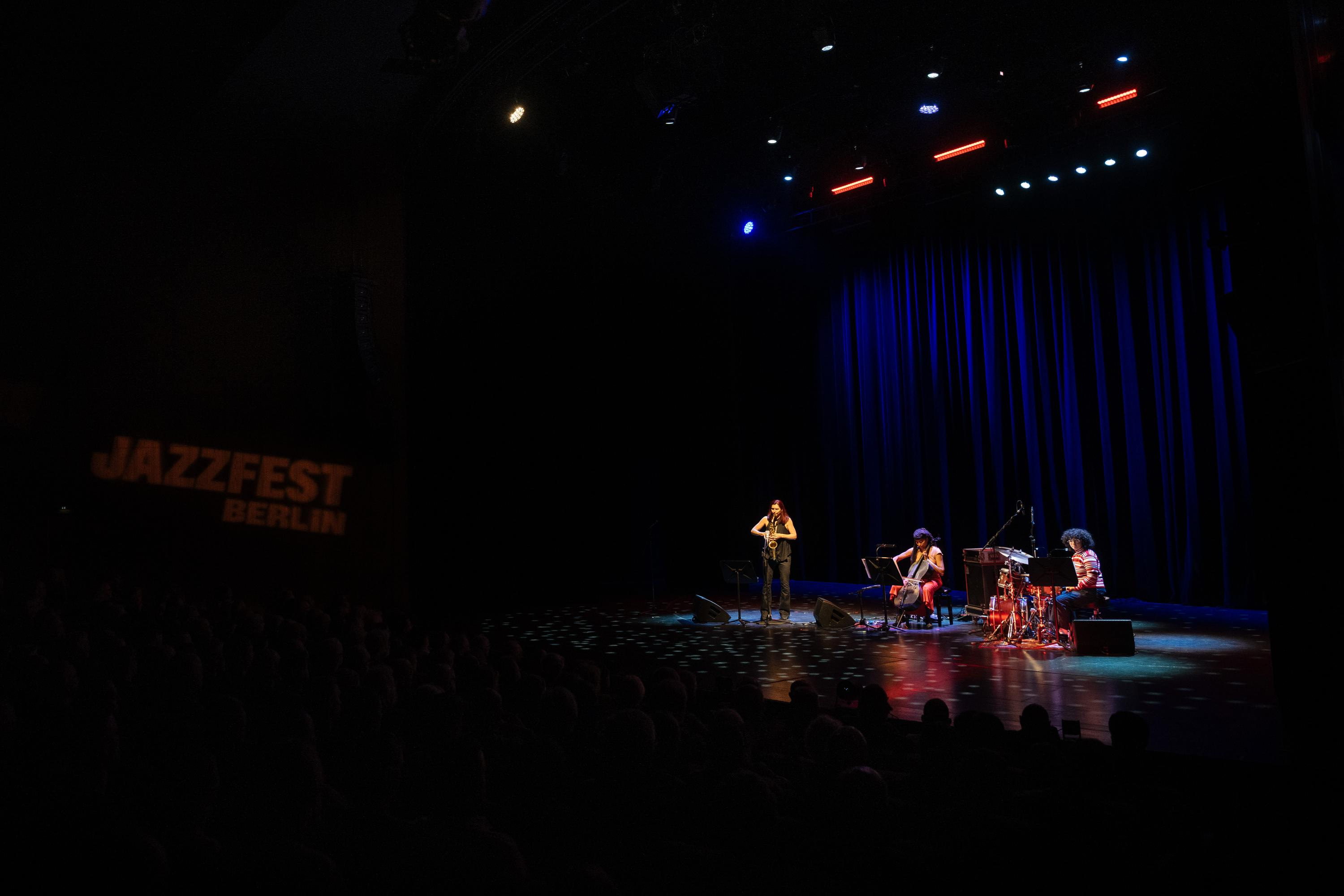


%20.jpeg)