Showing posts with label Steve Noble. Show all posts

Saturday, 10 September 2022

Up-to-date (From Attica to AMM)

(Some pieces of writing recently published in other venues.)

Attica is in front of me”, an essay on musical responses to the Attica uprising by Archie Shepp, Frederic Rzewski and Charles Mingus, appears online in a special issue of the Blank Forms journal, edited by Ciarán Finlayson, commemorating the uprising fifty years on.

A piece on the Eddie Prévost residency at Café Oto in July is at Point of Departure. There were four concerts in Bright Nowhere, celebrating Prévost’s eightieth birthday: the piece has write-ups of all four--a multi-saxophone concert, the ‘Sounds of Assembly’ group, a Workshop concert, and the last ever gig by AMM. 

And at Artforum, a shorter write-up of the AMM gig from the same residency.


An edit from a much longer interview I did with Eva-Maria Houben last month is up at VAN magazine. (The full interview will be out in the fullness of time--watch this space: I also wrote about the recent performance of Houben’s ‘Together on the Way’ at the Southbank Centre a few months back.) 


Other odds and ends:

A review of Decoy and Joe McPhee’s gig at Café Oto came out back in the July issue of The Wire, of which there’s an image below; there’s also a review of the Explore Ensemble concert of music by Poppe, Dunn, Dillon and Miller in the October issue, of which I’ve just posted a longer version on this blog


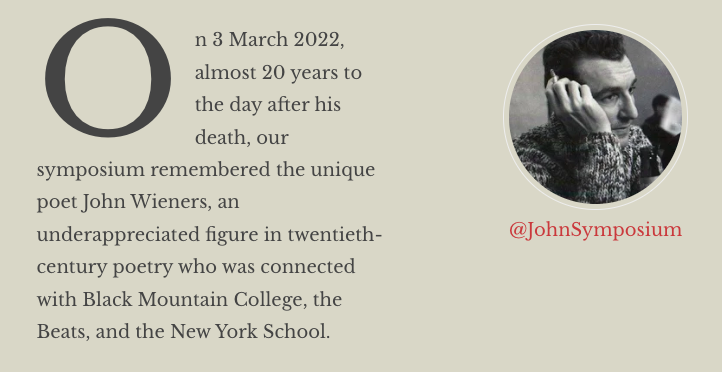
And even further back, in March, organiser Mark O. Chamberlain kindly read out my short paper at the online John Wieners symposium hosted by Durham University: video of that and the other papers can now be viewed online here.


In the near future, among other things, a piece on Igor Levit’s new disc based around Hans Werner Henze’s Tristan, a journal special issue, a poetry pamphlet from Andy Spragg’s and Jimmy Cummins’ RunAmok, new titles from Materials/Materailien, and the Blank Forms reprint of Baraka, Neal and Spellman’s The Cricket, to which I contributed a short introduction. Lauri Scheyer and I are also putting the finishing touches to Calvin Hernton’s Selected Poems with Wesleyan University Press, a project that’s been in the works for a few years and which we’re very excited to see moving to completion...

More on all that in due course!

Tuesday, 17 May 2022

Recents (Vivier/McPhee/Nodosus/Duras)


For Artforum, I wrote up the three-day Claude Vivier festival that took place the Southbank Centre in early May. Great in particular to hear pieces like 'Lonely Child' and 'Zipangu' live--all too rare an occurrence, though there seems to be a bit of momentum around Vivier's work of late. Vivier's was a career cut short just as it seemed to be entering a new phase--but such riches there, particularly in the last two or three years of his life. Despite the traces of Stockhausen in the earlier works--their theatricality, their derivation of works from melodic cells or formulae--and the affinities with Spectralism in those towards the end, there really is little else like this in music, in its singularity of focus, the strange ambiguity of its soundworld: waves of un-identifiable feeling, swathes of colour, beams of light. For context, Bob Gilmore's biography is very highly recommended. Hoping to write in more depth on Vivier for another project, in any case...


Photo by John Sharpe.

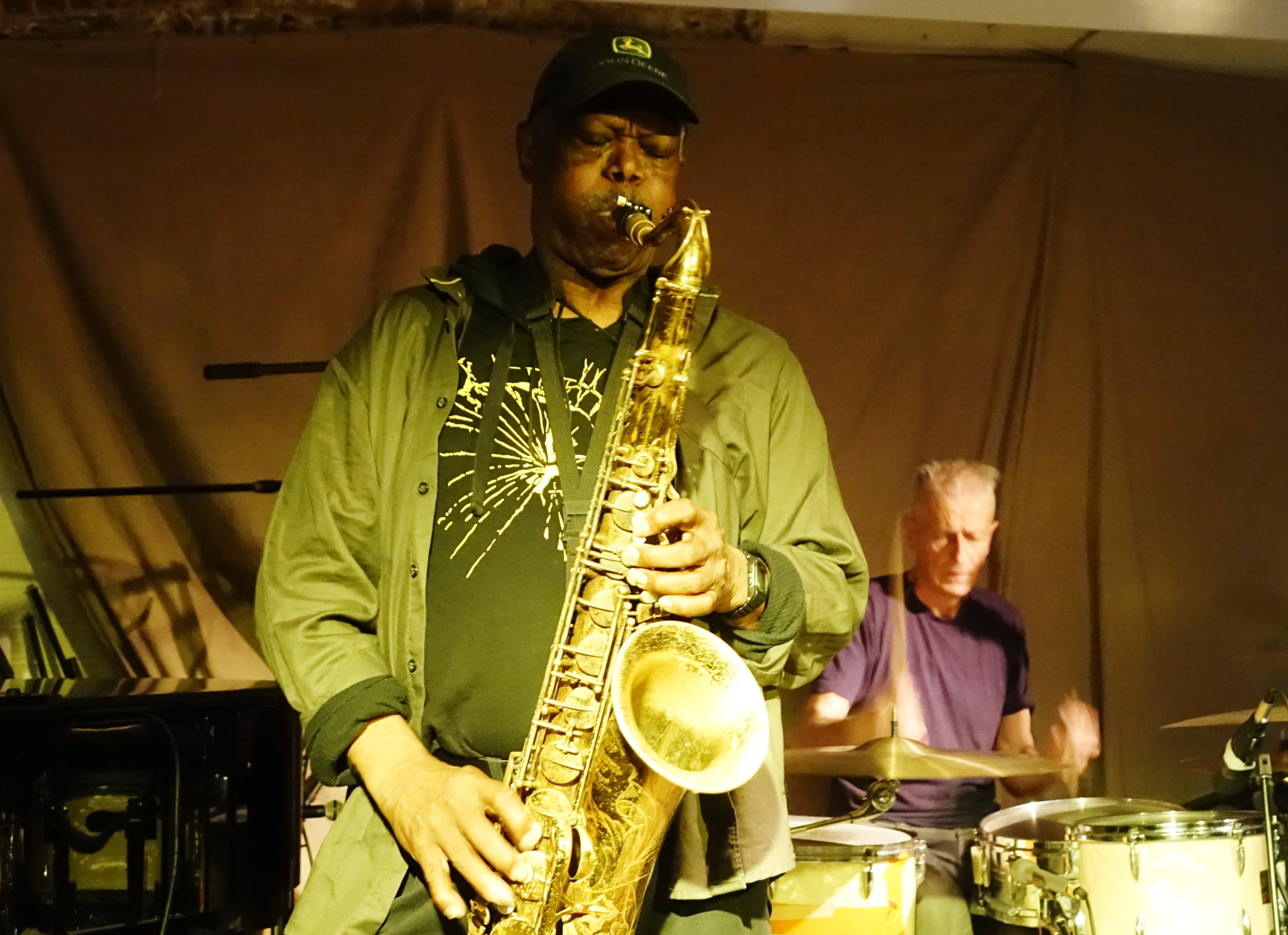
A few days before that, Decoy with Joe McPhee at Cafe Oto were sublime, continuing their periodic reinvention of the organ trio as if they'd never left off. Alex Hawkins on a vintage Hammond B-3 hired for the occasion, John Edwards on deep-diving bass, Steve Noble on absolutely thunderous drums, McPhee--who I last saw at the venue pre-pandemic, in a series of varied duets including a mesmerisingly surprising one with Áine O'Dwyer on harp and vocals--this time on tenor only, no trumpet (with occasional recitations of poems), taking his time, playing in bursts or sections rather than blasting in one uninterrupted flow, an immensely subtle player, though the energy he conjures up might make that easy to overlooks. This is a real live band, thriving off the crowd's energy and creating energy all of their own, they played for two nights, four sprawling sets, from floor-rumbling quakes to glassy high pitches and McPhee's too-little remarked lyricism (there's little else as gorgeous as that short early seventies piece 'Cosmic Love', recovered for posterity several decades after it was made). Somehow, despite the broader revival of interest in those of his generation--preferably dead and thus saintly--McPhee has to an extent escaped this sort of mainstream attention. Perhaps his career outside the circuits of academia has something to do with it; or the fact that McPhee isn't writing works for classical forces and the concert hall, those worlds that still, despite gradual signs of change, are arbiters and gatekeepers of musical value and prestige within the world of the avant-garde. Perhaps, too, class could be invoked, McPhee working in a factory for years alongside his musical career. Either way, it's almost impossible to believe that he's in his early eighties, and Decoy is surely one of the most sympathetic contexts he's had over the past ten years. Above all else, there was a real sense of joy and fun to the music: life affirmed, over and over. A capsule review of that will be out in the next Wire.


And within the same week, Dom Lash and N.O. Moore at the indefatigable Hundred Years Gallery. Scheduled as a trio, they ended up performing a duo in the absence of the scheduled John Butcher, the unforeseen combination of double bass and guitar a fairly unusual combination (though Joe Morris and Damon Smith provided an interesting contrast over the speakers in the break). In fact, that accident served as a kind of focussing device, in two sets fascinating for their textural detail and the concentration the detail afforded: Moore's playing admirably finding ways out of the inevitable Bailey-Rowe alternatives facing the non-idiomatic guitar player, a modest array of pedals swallowing up the sound like hiccups or stuttering gulps, scratching and plucking, cut-off gasps, or else exploding and expanding the sound with the occasional flying-fingered virtuoso run; Lash's scrapes and thwacks activating the bass's woody surface, all the nervy robustness of the instrument at play, tensile and tense. Gnarly is the word I'd use, in the all the best senses of that word. (Some representative video clips provided by a fellow audience member here.)


Mention should also be made of the album launch the previous month by another Lash-featuring group, Nodosus,  this one taking in South London at Iklectik, round the corner from Waterloo station, a warmish evening, farm animals poking their heads behind the fence next-door. I've brought along a gigantic volume of the collected poems of Larry Eigner that I brought back from New York, the conglomeration of minute fragments in unwieldy, oversized form. Maybe that combination of the small and the large says something about the music that takes place, maybe that's just coincidence. "All matter / standing / build up / wave to wave" reads an Eigner poem dated May 10, 1970. And the pairing that takes place here--whether opposition, interrelation, transformation--of solidity and flux, materialism and what troubles its edges, is as good a way into this music as any.

Nodosus is a brass and strings kind of ensemble: John Butcher's on tenor, Angharad Davies on violin, Matt Davis on trumpet and electronics, Dimitra Lazaridou-Chatzigoga on zither.  The sound they make together is, as might be expected, quiet(ish) and droning in its tendencies, but it's often fuller or more jagged of texture than might at first meet the ear. This is, above all, real ensemble music by a group of players really excellent at listening in groups, overlapping and building a collective texture that's not homogenous but finely abraded, interlinked, solid yet with a tendency to dissolve at any point. Lash, focused more on the bow than in the duo with Moore, was perhaps more assertive than might have been expected from his playing in Wandelweiser contexts or the quieter idioms of "non-idiomatic" playing: moving forward or holding back, leaning into the music's deep end or playing high harmonics as a kind of ethereal commonplace, commonplace ether, everyday magic. Activating the resonating surface of a zither with e-bows and objects, Lazaridou-Chatzigoga's sense of touch never ceases to amaze, succession of vibrating or smoothly oscillating held pitches ensuring the music has a drone-like energy to it all the way through, but capable of switching texture at any moment. What's fascinating about watching Lazaridou-Chatzigoga perform is the way you can see the sound shaped before your eyes: the pressure of object on string, of finger on object, the way that placement alters sound, live-sculpting, structures built and dismantled, textures thickened and lightened, tightened and loosened, a playing unassumingly yet at times overwhelmingly focused in its presence. Angahard Davies, too, is the most subtle of players, her approach to the violin so often a radical reinvention of all the cliches associated with the instrument--quiet, brittle, circling, not smooth and flowing and dripping with molasses-like pathos; and so good as a group or solo player alike--again, that interrogation of the surface of the instrument, of touch, a perpetual reinvention of what it means to play ensemble; while Butcher and Davis  bring in a sense of breath, of extension and pausing, holding notes in upper registers and multiphonics, latching onto phrases that cycled, held, subsided. I remember Davis' playing, in the deconstructionist vein of Dixon--Doerner--Uhler--Kerbaj, from one of the first free improvisation gigs I went to, at the old Red Rose in Finsbury Park; possibly the Freedom of the City festival; Bechir Saade might also have been playing. It's not a playing self-consciously minimal in its approach, nor does Davis appear to have any interest in asserting himself as a single voice or element outside the ensemble texture; and while the tone of the instrument might lend itself to a certain melodic heft, leaning more towards the melancholic lineage of Dixon and its jazz trumpet associations than the noise elements of the trumpet-with-electronics approach, its place in the group is one of texture as much of melody (or conversely, of melody, as much of texture). Finally, it's perhaps easy to take John Butcher for granted, but every time he plays there's a new surprise to go alongside the vocabulary he's long made his own. A particular phrase he played at one point was one of those moments in an improvised performance perfect in their transitoriness, jewel-like, gleaming--and unassumingly as much a part of the music as any other. 

"All matter / standing / build up / wave to wave". Yes, the Eigner poem fits perfectly, arbitrarily precise: the sound of these five musicians together combining over two sets in solid rippling waves.  A few years ago there might have been some debate about whether this was 'eai', which school of Berlin or London silences it might have bene placed in. In 2022, it was free to be what it was, in all of that inscrutable and beautiful mystery. The CD can be found on Daniel Thompson's Empty Birdcage records here.

Finally...somehow I've only just discovered the existence of Marguerite Duras' children's story Ah, Ernesto!, via Duras' last film, Les Enfants, an expanded feature which later spawned her novel Summer Rain--one of the first of her books I read in a copy discarded by the local library or charity shop. (The original was adapted into a short by Straub-Huillet.) There's a reprint from 2014, apparently illustrated as if it were a cookbook, which I suppose fits Duras's austerity but not the wildness that austerity enshrines. From  the looks of it, the original printing has some more (in)appropriately wild psychedelic images, including a giant Einstein. If anyone knows of somewhere I can get hold of a more affordable (French-language) copy than the £87 currently listed on AbeBooks, do leave a comment here.


(To be read, perhaps, alongside Lorna Finlayson's piece "I was a Child Liberationist" at the LRB...)

Thursday, 21 October 2021

Dominic Lash Ensembles at Café Oto


Photo by Roger Huddle.
 
John Butcher (tenor and soprano saxophones), Pat Thomas (piano), Dominic Lash (bass), Steve Noble (drums / percussion); Consorts (various musicians—full list below). Café Oto, Dalston, 21.10.2021.

Last year, bassist Dominic Lash began a record label, Spoonhunt, releasing music by three of his own ensembles: on Limulus, a quartet featuring, among others, saxophonist Ricardo Tejero, another quartet on Discernment, John Russell’s final recording alongside John Butcher and Mark Sanders, and a large ensemble called Consorts, heard on a record called Distinctions. Much of this music in turn arose from Lash’s 40th Birthday gig at Café Oto, and so it was fitting that, with the easing of pandemic restrictions, it was at Oto that the releases could be officially launched. The venue isn’t open at full capacity until next Monday, but there was still a good turn-out for what was by no means a flashy or hip gig or something with a visiting act as a draw: an indication of the health of the UK free improv scene, pandemic or no pandemic, and of the respect in which Lash and his music are held.

Given Russell’s passing, and the unavailability of Discernment’s original drummer, Mark Sanders, the quartet that played the evening’s first set had quite a different sound to that heard on the record, with Pat Thomas—originally supposed to be on the original date—replacing Russell and Steve Noble standing in for Sanders. This could have gone anywhere: Thomas sticking to piano, rather than electronics, always promises a certain amount of contained thunder, Noble a perhaps more buoyantly rhythmic approach, but the band might equally well have trod into the more abstract/rhythmically unmoored territory of quote un quote non-idiomatic playing. (By this I mean, a certain idiom that also gets called ‘European free improvisation’, whether that’s meant to imply geography, artistic tendency, style, or genre; usually, some sort of combination of all of those). Expectations of the latter arose in large part thanks to the presence of Butcher, whose earlier work with Russell and Phil Durrant (who was heard in the evening’s second half on electronics) gives his work some affinity with the beginnings of the more minimal school of improvisation that ends up with New London or Berlin silences, while the painstakingly precise multiphonics of his solo saxophone work (latterly, often amplified with electronics or in resonant spaces), suggests a kind of bridge between minimal tendencies and the more reactive scrabble of EFI. This kind of generic hair-splitting, of course, doesn’t go anywhere near to suggest the studious fluidity of Butcher’s playing, or the expansive range of Lash, Thomas, and Noble across numerous contexts. As I say, this could have gone anywhere.

As it turns out, the set—maybe 40-minutes or so in length, though I didn’t check the time—was surprisingly like free jazz. (Surprising, that is, given the tendency of the sectors of EFI with which Butcher would normally be associated to distinguish themselves from ‘energy music’ tendencies.) The quartet didn’t suggest free jazz so much in terms of dividing the music up into ‘themes’ and ‘solos’ or even pulse, but more in certain harmonic gestures and levels of energy/volume, generally initiated by Thomas and picked up on by Butcher, working some way outside his usual vocabulary. This is not, perhaps, Butcher’s preferred territory, but it didn’t show: particular on soprano, which he alternated with tenor, with I think two turns on each instrument apiece, he touched on scalar, declarative iterations that bordered on late Coltrane at its Live-in-Japan woolliest, repeated melodies echoed—not in the rote-repetition that screams “I’m listening and reacting”, but in genuinely surprising and fitting echoes—from musician to musician to musician. Butcher began in jazz when he was starting out in the early ’80s, playing in groups with pianist Chris Burn while studying physics at Surrey University and continuing to play in Burn’s big band while beginning a Ph.D on ‘charmed quarks’ in London. As Burn remarks in an interview with Simon Reynell: “I always joke that what started off as a 22 musician big band playing jazz compositions ended as a free improvisation duo.” (By 1992, the band sounded like this.) And jazz, free or otherwise, has largely left both Burns’ and Butcher’s vocabulary since then, though an unexpected and surprisingly effective duo with Matthew Shipp—convened at the invitation of Trevor Brent in 2010, also at Oto, and followed by an equally unexpected trio with synth player Thomas Lehn—saw a rapprochement of a sort. (A 2016 interview in which Shipp and Butcher sketch out the respective traditions from and out of which they emerge makes for interesting reading: it can be accessed here.) Likewise, one of the highlights of the performance by the Lash-convened quartet was seeing Butcher adjust to a climate that—largely through Thomas’ playing—had more of an idiomatic connection to free jazz than might be expected in this setting. Particularly in a solo context, Butcher plays virtually every note with an extended technique—multiphonics, false fingering, overblowing etc—veering away from any conventionally pitched vocabulary. That certainly figured here, so ingrained is it in his style: notably, on soprano, eerie, ultra-high altissimo, whistle-pitch sounds, or whispered wind ghosts floating through the body of the instrument after the mouthpiece had been removed. Yet these were juxtaposed or combined with melodic and rhythmic shards strongly suggestive of jazz, fragments of stories that Butcher seemed surprised he knew, but which he was able to re-tell, to spin towards and away from, with authoritative relish. What might have been par for the course in the work of more free jazz-oriented group thus attained the genuine “sound of surprise” here because of its variance from the norm of Butcher’s particular idiomatic tendencies, and in any case, I don’t think Butcher, inveterate Cubist that he is, could leave those phrases entirely intact.

Pat Thomas’ approach to the piano is historically rooted yet utterly distinctive. Spaciously hammered, thick, thick two-handed near-cluster; sparingly used and stringently lush ninth chords; repeated figures that are not quite riffs, not quite melodic fragments, more like rhythmic stutters that sound like a succession of mini-hammers. Deliberately so, there’s something beautifully paradoxical about his approach: gracefully ungainly, liquid granite, utterly poised in consciously distorted fashion. It’s immutable, authoritative, declarative, but entirely adaptable; the hyper-arpeggiated, glissandi-thick, rolled and clustered figures he gets in the upper register are nothing like that of Cecil Taylor, with which such playing inevitably gets compared—partly because of Thomas’ very different sense of space, his tendency to play in measured bursts rather than continuous streams (the unbroken sections of playing tend to focus on repetition rather than constant development); likewise, I don’t think any other pianist has quite the control of the lower register that Thomas has; and his use of the pedal is inevitably much subtler than the morasses of sound he conjures up with it might at first suggest. One chord he played maybe half-way through the set saw him release the pedal before the natural stage of decay where others would have simply let the note ring out; like Butcher, Thomas reminded us, in a kind of hyper-materialist, self-conscious meta-gesture, of the sources of sound production, drawing on the power of the gesture—the reverent haze or dramatic cloud the sustain pedal allows—while also drawing attention to its provisional quality (but with none of the studied fussiness that description suggests). Meanwhile, Steve Noble’s scraped or struck, perhaps bowed, small gongs and cymbals, along with other ways of playing the drum kit as pitched more than rhythmic instrument (his kit was out of my eyeline so I could only guess as to the origin of the sounds) kept things texturally open and spacious. And Lash, of course, has it all down—bowed harmonics, free arco hinting at but never settling into walking patterns, careening caterwauls and ship-wreck groans, the perfectly-placed pluck pinging into the space like a falling droplet that sends ripples from the centre to the edges of a body of water, be that puddle or pond.

During the course of the set, there were ‘episodes’, the conclusion of one and the beginning of the next generally signalled by Butcher switching instrument, but they felt more like movements in a suite than the variable incidents of a typical free improv set, moved between as they were with total, fluid assurance. The first such transition, about five minutes in, saw the music suddenly stop—one of those serendipitous pullings of the emergency-brake that generally sees the musicians wryly laugh and the audience begin to applaud, as if willing the music to end there. Here, the silence was sustained, and things immediately moved in a different direction: a focussed adjustment characteristic of the set to follow. Thomas was often the driving force behind the quality of each particular ‘movement’, though his playing was anything but grandstanding: repeated chords suggested, even as they slid away from, a harmonic direction or area. Yet it was above all a collective music, a conversation between equal musical personalities. Take away any one of the parts and the quality would radically have changed. It’s rare to see a purely improvised set of such cohesion, no hesitancies or verbiage or over-staying of welcome, each transition natural and surprising and fitting, everyone in sync, knowing when to sit out and when to step back in, no one treading on each other’s toes but no one hiding around the corner waiting for things to get going either. I trust the set was recorded, and I hope it might see release in some form or other.


Consorts, kind of chamber ensemble-cum-big band which, as far as I know, has only previously performed on the 40th Birthday gig which forms the basis for the group’s Spoonhunt release. Here’s the full line-up, taken from that release’s info sheet.
Douglas Benford - harmonium and percussion
Steve Beresford - electronics
Marjolaine Charbin - piano
Chris Cundy - bass clarinet
Seth Cooke - steel sink and metal detector
Angharad Davies - viola
Phil Durrant - modular synth
Matthew Grigg - guitar/amplifier
Bruno Guastalla - cello
Martin Hackett - Korg MS10
Tim Hill - baritone saxophone
Tina Hitchens - flute
Sarah Hughes - zither
Mark Langford - bass clarinet
Dominic Lash - double bass
Yvonna Magda - violin
Hannah Marshall - cello
Helen Papaioannou - baritone saxophone
Yoni Silver - bass clarinet
Alex Ward - clarinet/amplifier
I don’t think this was entirely reproduced on the night—Lash was playing electric guitar rather than bass; I didn’t see Alex Ward, Bruno Guastalla, Sarah Hughes, or Helen Papaioannou; Seth Cooke didn’t appear to be playing a steel sink and I’m not sure if the objects he was crouched over next to a small amplifier were metal detectors or not—but I think it’s largely representative. And whatever the individual components, the ensemble is in a sense also the piece they play, even if that piece is only loosely structured, certainly not formally scored or even conducted. With this line-up they could conceivably function in any way Lash decided, from the more conventional Improvisers Orchestra format, with its conductions and exercises, to full-on Alan Silva Celestrial Communications-style skronk. Full disclosure—Dom asked me to write the liner notes for the group’s album last year, but was more interested in what I might have to say about the music without knowing the methods that produced it than provided with the nuts-and-bolts of its structure. And I think that concern with what the music sounds like, rather than how it’s structured, is the point: an exploration of large-group texture that deliberately avoids the aforementioned large-group improv tendencies to density and information over-load while also gesturing towards—and departing from—the more minimal tendencies with which Lash’s has been involved in the Set Ensemble and other Wandelweiser-related endeavours.

As I understand it, the Consorts piece is essentially a set of sustained tones building to a crescendo, and those are the only guidelines: no score, no conduction, no other signals. (And in the rehearsal/soundcheck last night, apparently no mention of sustained tones was made.) So in part Consorts can be understood as a sort of exercise in orchestration, a textural experiment. As an exercise in orchestration, there’s a kind of giddy delight in textural variety—I’ll take not one but three bass clarinets, combine a string section with various electronics, ‘small’ or otherwise, round out the bottom end with a baritone, throw in two guitars. The group Lash had chosen is not ‘star-studded’—though who wouldn’t want a violin section with Angharad Davies in the corner! —which is, in fact, all the more index of their dedication in a music that is, after all, at its best, never about egoic fulfilment: players who quietly work away, in London or Cheltenham or Oxford or Bristol, at their craft: Martin Hackett’s inimitable Korg MS10, the tripled bass clarinets of and Mark Langford, Yoni Silver and Chris Cundy; Hannah Marshall’s richly adaptive cello; Steve Beresford in small electronics mode. From my seat, the only musicians in view were Marjolaine Charbin on piano, Mark Langford, the nearest of the bass clarinet players, and Hannah Marshall on cello (with Lash’s guitar popping in and out of view behind her). Consequently, I only realised, for example, that there was a flute in the mix about 30 minutes in, and had no idea Angharad Davies had been in the mix until Lash called out her name at the end. All this meant that I had to concentrate on it as a group sound rather than focusing on the individual sources of any particular sounds. Which is to say that being able to see the individual members of the ensemble perform both does and doesn’t make a difference. The ability to identify by eye, and thus by ear, the individual contribution of a particular instrument/individual helps one pick out one texture in the weave, one dot of paint in the pointillist whole, or any other such metaphor you might choose, but it doesn’t really reveal much more than how the parts are put together—which, as Lash’s reticence about explaining the piece’s structure implies, isn’t really the point of the exercise. Hearing snippets of sound and realising half an hour in that there was a flute in the ensemble, for example, is rendered all the more serendipitous, and the overall texture all the richer.

On Distinctions, the peak crescendo section has something of the quality of the more avant strands of doom metal; the 2021 iteration, while not quite as glass-rattling, certainly reaches for an effect you might call overwhelming, for its sheer, sustained volume, and the thick intensity of its accumulated textural thicket. The groups imperceptibly reaches a massive cataclysm of sound—driven, I think, by Phil Durrant’s very loud electronics, or perhaps it was Seth Cooke’s amp and whatever objects he had plugged into it; or maybe Matthew Grigg was also doing some small-scale Hendrix things with a guitar and amplifier; or Charbin was deploying e-bows, piano strings, and sustain pedals to give similar clouds. Either way, the sound was, thick and immutable, catharsis or textural exploration, followed by a shorter de-crescendo out (though it apparently lasted around ten minutes). Live, as opposed to on record, you can really feel the music fill the space; in providing contrast to the ‘climax’ and a mirror to the opening, the de-crescendo emphasizes the piece’s architectural, or is that architectonic, qualities. It reminded me a bit of taking part in a Michael Pisaro large group piece—also at Oto—back in 2015, in which everyone played ppp so that the overall volume was the strange effect of a very large group playing at a kind of medium volume: like an orchestra with a mute on it. Harry Gilonis also suggested the piece might be set alongside new music exemplars of the crescendoing sustained/repeated tone like James Tenney’s ‘On Having Never Written a Note for Percussion’ or Stockahusen’s Inori, to which I’d add some of Giacinto Scelsi’s orchestral pieces. (Lash himself mentions Phill Niblock, whose music he’s performed and on whom he’s written academically.) The Tenney is an exercise in solo texture and focus, with its own influence on a strand of improvised music—think Mark Wastell’s tam tam or Eddie Prévost’s bowed cymbal—as well as the general ‘swell piece’ structure found in larger groups. It would be interesting, meanwhile, to think what an improvised ‘swell piece’ like Consort’s does that those composed pieces don’t, and vice versa. If Scelsi and Stockhausen’s experiments in the form associated it with a specifically ritualistic quality (in Stockhausen’s case, unexpectedly Messiaen-type sonorities, allusions to the 'Dies Irae' melody, etc), there was almost nothing ‘ritualistic’ about Consorts. Let’s call it a more materialist approach to sustained tones that aims to be a study in texture and group contributions to an overall sound rather than a trance-inducing exercise. (Of course, the whole crescendo thing might also be seen to originate in the serious musical joke that is Ravel’s ‘Bolero’.)

These are all open-ended hints rather than a final say on the matter. Suffice to say I enjoyed both halves of the evening very much: unusual in the level of contrast between the sets and the level of focus throughout. But of course, given the calibre of the players, entirely to be expected. Roll on the next series of Spoonhunts!

Friday, 16 August 2013

BRÖTZMANN / ADASIEWICZ / EDWARDS / NOBLE -- CAFE OTO 12.08.2013


The relative engagement of Brötzmann performances tends to vary on the particular set of instrumental collaborators he’s playing with, & this quartet was certainly an unusual take on things. (By ‘engagement’, I don’t mean Brötzmann’s own - he does his thing, and consistently - more the contextual framing of that thing, its relative predictability or consistent hitting of the area known in sports parlance as the ‘zone’.) The vibes setup inevitably set ‘Out to Lunch’ connections in orbit (particularly as I’d be running through Dolphy tunes in my head on the cycle ride over), but Adasiewicz is a very different, much busier vibes player than Hutcherson, just as Brötzmann is a very different player to Dolphy, far less angular, with an approach far less obviously accommodating to a pairing with vibes. Whereas Hutcherson on OTL will strike a note with a clang, followed by an unexpected, jagged, slightly extended pause, in tandem with the crisply off-kilter rhythm section of Richard Davis and Tony Williams, Adasiewicz favours (or did in this setting) strategies such as the repeating of a particular phrase with ever increasing dramatic emphasis, and virtuoso jazz runs up and down the vibes, notes a-flying in all sorts of directions. This latter, especially when combined with a predilection for setting up a pedall’d cushion around his sound, tends to fill up the space rather than leaving it, as Hutcherson does: none of that understated approach from OTL in which tension is amped up through contrast and a patient spacing and varying of approach; or, indeed, that of Archie Shepp’s ‘New Thing at Newport’, cocktail jazz put through the wringer and turned into sensuous, barfing disquiet, quiet love and rage, controlled yet unexpected eruption, elongation and foreshortening. Live, Adasiewicz is nothing if not demonstrative, to almost comic effect. One particular physical move sees him shift on his feet to strike some notes, then lift one foot off the ground and move to the sound, as if the physical after-effect of the power of striking that note is about to topple him to the floor like an out-of-control child, one who’s temporarily lost control of their limbs. In another, he lifts the keys up on their string and furiously rattles them about as additional un-tuned percussion to Noble’s drumming. Periodically, he wipes his dripping face and beard down with a towel like a tennis player between points.

So, the presence of vibes and of their particular deployment took some getting used to, particularly given that I was in the far left corner of the room, where the combined force of Noble’s extremely loud drumming, Adasiewicz’s also loud vibes and physically demonstrative performance, and the hyper-amplified sound of John Edward’s double-bass, at times threatened to drown out Brötzmann himself. This was especially evident in the passages of most extreme intensity, where the group became a churning morass of sound, an effect rather like listening to one of the bootleg or semi-legit recordings of 1960s free jazz, in which drumkits, cymbals in particular, create a near white-noise wash, bleeding into the near-undifferentiated cloud of volume and density formed by the rest of the group; from that cloud will emerge the most piercing and burred blasts and blarts of reed-bitten saxophone squall, blasts sounded because they are the only thing that will rise above the storm they also encourage and propel. Such a description might suggest typical Brötzmann fare, the ecstatic group effect that draws in free jazz fans again and again, but, in truth, his own playing tended as much towards the melancholy ‘ballad’ approach he’s favoured over the last couple of decades, a vibrato-heavy pathos-shading which one might best describe as an improvised impersonation or filtration of a tradition of tough-tender jazz saxophonists, from Ayler to Shepp to Coleman Hawkins. Often, he would enter with phrases that slowed the music down, that saw a sudden drop or transition in energy levels, sticking fairly closely to that phrase-area as the other musicians began to dip and rise, to boil away underneath, never letting the music actually enter straight jazz ballad territory, now a few blurts from the upper register, a deliberate shift, and then into ‘full blast’ territory.

The two sets performed were continuous and quite lengthy pieces, the first in particular lasting as much as an hour; after spending some time at one of those noise-peaks, Brötzmann would take a breather and come back in with another horn, during which time Adasiewicz would do his vibes thing, including one very sympathique, more lyrical linking up with the ecstatically-focused Edwards at some point during the second set. Noble seemed permanently restless in his refusal to let the music dip substantially, often hitting a pronounced thwack as if to rudely interrupt or prevent the opening up of too much space, to insist that the music stay on the high road, the speed-freakery of the autobahn. As with his recent performance with Anthony Pateras at the LCMF, it was an extremely solid and seasoned display, the reflexes of an improviser who’s played long enough and at a high enough level to be able to think automatically, without going through the motions. Yet somehow it felt like the sort of improv performance a rock drummer might get behind, over-emphatic in its effects and affect: sustained and fairly steady or ‘straight’ rhythms would be set up which forced the music into particular areas, such as the mallets passage at the start of the second set, and the consistent loudness felt like a particular mode of attaining intensity that is not necessarily always the best or must effective way of building a dynamic group sound - it’s almost a short-cut, one might say. Indeed, Noble’s playing, as much as the presence of Adasiewicz’s vibes, probably accounts for the rather more unusually and heavily jazz-flavoured passages that surprisingly proliferated: at times, Edwards would even play walking bass. There were moments when I found this a little uncertain, wasn’t sure how to engage with it, felt that it somehow made Brötzmann’s playing sound somewhat limited (as if throwing out some free-bop choruses might have better fitted the setting, though no-one would have wanted that). But there were also points at which I really liked the effect, the contrast between Brötzmann’s playing, which stuck to his usual two general areas (loud/full-blast and wounded balladry), and that backdrop, into which he would also fit his phrases rhythmically. A case in point, the final section, a kind of mutant blues swagger, Brötzmann on tenor, which moved out of the melancholy / despair tinges of the first half into something more assertively, if ambiguously joyous, even, though somehow devastating in its effect - or perhaps that was simply the cumulative effect of something like two hours of music. The Oto crowd, which had fairly packed out the space, filtered out quickly, off into the night, space to digest, exhaustion, the slow come-down.