Showing posts with label poetry news. Show all posts

Tuesday, 12 May 2026

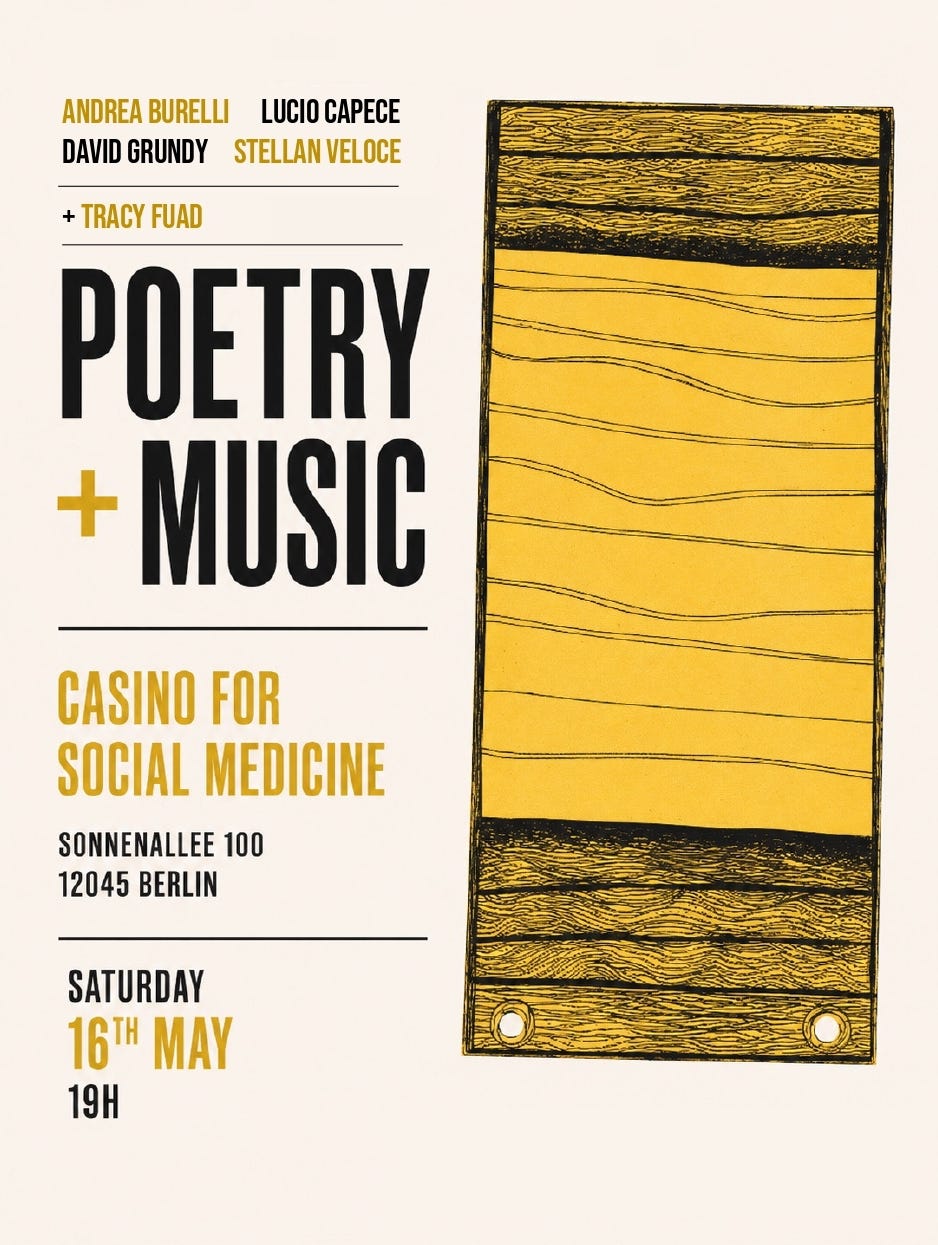
Poetry + Music this Saturday


A relatively spontaneous announcement of a relatively spontaneous gig: this for a new quartet combining poetry and music, with myself (poetry), Andrea Burelli (voice, poetry, perhaps violin), Lucio Capece (bass clarinet), and Stellan Veloce (cello). It will happen at the Casino for Social Medicine at Sonnenallee 100, Berlin, on this coming Saturday, 16th May, at 19h.

As a trio, Stellan, Lucio and I worked together twice last year, and that was beautiful. (Their duo at a performance a few months before the first of those occasions, after which I approached them to work together, was even more beautiful). As a quartet with Andrea, we’ve done one rehearsal so far, and I think it’s entering a whole new dimension, which I’m very excited about.
Also reading will be Tracy Fuad. And I’m excited about that, too.

Do come if you can.

More performances to be confirmed in due course!

Wednesday, 19 November 2025

November Updates

In the past few weeks, I’ve been working quite intensively on a long essay on Cecil Taylor’s poetry for what looks to be an expansive collection on Taylor’s work edited by Peter Valente. Having long thought a book like this should happen, I’m delighted it finally is! Taylor’s work has meant a lot to me for what seems like forever—certainly, since writing, or trying to write an MA thesis on his poetry back in 2011: a somewhat wobbly first step, or what Taylor himself would call an ‘Excursion on a Wobbly Rail.’

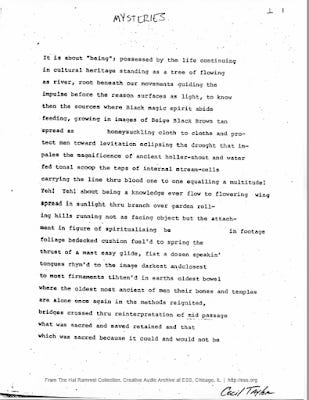
This latest iteration is part of what I think of as a suite of writing on Taylor’s work, particularly his poetry: a memorial post in 2018, a piece for Chicago Review in 2019, and an essay on Taylor and vodou for Point of Departure in 2020. It updates all that with some new reseearch—the conference on Taylor’s work at CUNY in 2019, Phil Freeman’s recent biography of Taylor, In the Brewing Luminous, a valuable chronological synthesis of existing materials and new interviews, and—not least—seeing a copy of Taylor’s unpublished poetry manuscript, Mysteries, of which the first page is above.

Besides that essay, I’m planning for other writing on Taylor, its final form yet to be determined, to find its place in two current manuscripts on music, Survival Music and Ensembles. Taylor’s work continues to mean a huge amount to me. An all-consuming music, an all-consuming vision. Here’s a bit of the work in progress:

In the film Imagine the Sound, Taylor speaks of making “the commitment to poetry”. But what did poetry mean for Cecil Taylor? Poetry was, I argue in this essay, where he theorized his artistic conception. It was poetry he credited with saving his life, and in turn, it became part of the way he understood the nature of life, his own life, and that of life in general; of how to live one’s life, of how to approach art with charm, with ferocious grace, and with the unstinting courage of conviction.

Lots to catch up on in the meanwhile....In the not too distant future, I’m hoping to post here some writing on Wadada Leo Smith and a report on the Berlin Jazz Festival. Some other things are in the works as well. For now, news and some capsule reviews, notices of new work...

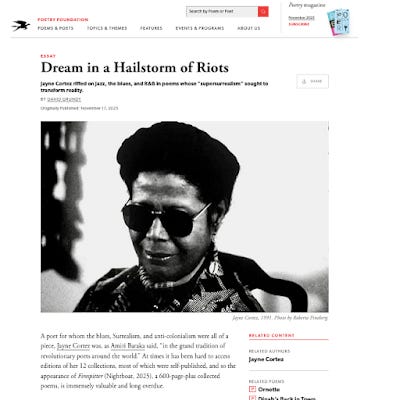
—‘Dream in a Hailstorm of Riots’, a long piece on the new collected poems of Jayne Cortez, is up at the Poetry Foundation.

From the mid 1960s through the early aughts, Cortez wrote about the political crises of her times: Attica, Allende, Palestine, Rwanda. But like fellow African-American Surrealists Ted Joans and Bob Kaufman, she was as interested in transforming reality as in documenting it. She bursts generalities and stereotypes in startling catalogues of surreal images that build around repeated phrases like the riffs of an improvising soloist. In her work, observations of everyday life and political events turn into dream visions, apocalyptic landscapes, meditations, and exhortations that crackle with energy, rage, and love. Above all, she is perhaps the poet of what her generation referred to as “The Music,” the various traditions of jazz, the blues, and R&B that soundtracked the freedom dreams of the Black liberation struggle. Cortez wrote poems in tribute to musicians and led her own band, the Firespitters, for decades. Hers is a voice—both on and off the page—that speaks with authority, curiosity, and an unshakeable faith in the power of poetry to change consciousness and change lives.

—Honoured to receive this attentive review by Eric Keenaghan of Never By Itself Alone at Resources for American Literary Study. Eric’s own work on queer coalitions, and with the writing of Muriel Rukeyser is, are necessary projects of historical reclamation and reminders of traditions of principle, resistance, and the complex negotiations of struggle for committed writers in times of crisis—needless to say, perhaps more relevant than ever.

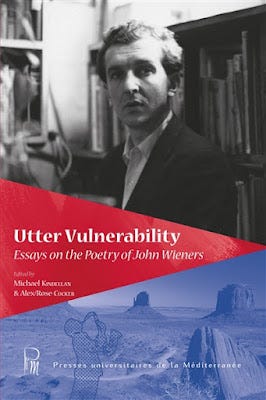
—An essay on John Wieners from almost ten years(!) ago, now in print in Utter Vulnerability: Essays on the Poetry of John Wieners, edited by Michael Kindellan and Alex/Rose Cocker, published by Presses Universitaires de la Méditerranée. This was the first thing I wrote after handing in my Ph.D thesis and it feels like a signficant part of the work I did since then flowed out of this way of thinking. It’s about love and poetry and fire and Wieners’s relationship to his first love, Dana Durkee.

This chapter addresses what John Wieners claimed was the most important romantic attachment of his life—that with his partner of six years, Dana Durkee—and the eventual ending of that relationship. As I’ll show, this loss can be said, in part, to have prompted Wieners’ fully-fledged entry into the world of poetry, prompting the composition of his breakthrough volume The Hotel Wentley Poems (1958), and it seeps into the minute fabric of his language itself, whether through conscious acts of address, revision and removal, or sublimated elements of textual echo which at once memorialise and disavow the object of loss. By introducing this element of biographical resonance, I do not wish to reduce Wieners’ poetry to a pained lyric exceptionalism, the poet as an exemplary figure of suffering removed from the social conditions that produce that suffering. Rather, such information serves as a means of heightening the way loss and despair intersect with socially produced domination, and the problems of community and desire in the face of persecution and its constant threat. As Denise Levertov astutely noted in 1965, in Wieners’ work, “Confessional” subjects such as mental breakdowns and the pain and loneliness of queer love are “not autobiographically written about, they are conditions out of which it happens that songs arise”.

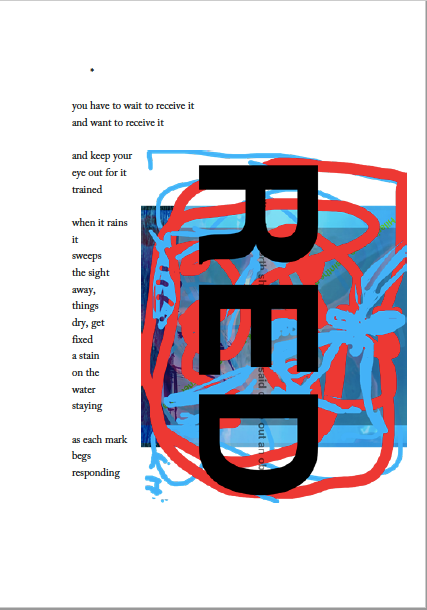
—And last but not least, I’m very pleased that CJ Martin and Julia Drescher’s Further Other Book Works have taken on Abstractive, the book of poems and visual art works I wrote with the great Candace Hill Montgomery last year (with some final tweaks this past month). More details will be forthcoming. For now, as a sneak preview, here’s a page of the manuscript….

Thursday, 2 November 2023

A True Account


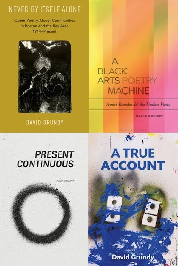
A True Account, a book of poems, recently came out from The 87 Press, with cover art by the great Candace Hill-Montgomery. Here's the write-up:
A True Account collects works written between 2013 and 2020, published by a variety of small presses in the UK and the US. Here are variously refracted the student movement, austerity, general election, referendum, the crisis of 2020 or 2019 or any year you care to name; the Massacre of the Innocents, the housing question, the October Revolution in November; Sappho, Mingus, Storm Ophelia; Rukeyser, Rilke, Rodefer; the aesthetics of resistance, the insistence of history: luxury and voluptuousness, peace and pleasure, beauty and order, the questions that still remain unanswered and the problems that remain unsolved. “Wanting poetry to save my life, to shame my life, as LONG as the WORLD is WIDE, and as WIDE as the WORLD is LONG.”

“Lyrically gorgeous and real poetry. This book is a bright spot in a bleak time.” - Peter Gizzi 
You can get the book here, and I'll be launching the book in person in London at Cafe Oto on December 8th.


--Also out, a cassette release of me reading my 2014 long poem The Problem, The Questions, The Poem on Ben Hall's cassette label Ornette Coleman Fiend Club--available here


--Jazz poetry primer in The Wire.


--On Christian Wolff in Artforum. This piece came out just days before the disgraceful firing of AF's editor David Velasco over the publication of the 'Open Letter from the Art Community to Cultural Organizations' against the ongoing mass murder in Gaza, and the subsequent resignation of Zack Hatfield and Chloe Wyma, whose editorial guidance over the pieces I've published in Artforum over the past few years has been exemplary. An open letter of October 27th, criticizing the actions of AF's owners, Penske Media Corporation, can be found and signed here.

***

Meanwhile, in person, for those of you in or around Berlin, I'll be giving two talks in December, both at the Freie Universität: on Monday, December 4th I'll be giving a lecture on Amiri Baraka and the Advanced Workers (details here), and then the following Tuesday, 12th December, I'll be giving a seminar on my current project on free jazz, Survival Music (Room 319, John F Kennedy Institut for American Studies, Lansstraße 7-9, 14195 Berlin, 2pm-4pm). And this month, at the kind invitation of Dimitra Ioannou, I'll be giving a talk at the A Glimpse of Festival, critical institute for Arts and Politics, Politechniou 8, 104 33 Athens, Greece, on the weekend of November 25th/26th.

Wednesday, 6 September 2023

News of News of News of News

Some recent writing:


--On Krzysztof Penderecki for Bachtrack.


--On Don Cherry and Peter Brötzmann's work with children for the Don Cherry special in The Wire's September issue. (The issue also has reviews of a live performance by Edith Steyer's John Carter project, of the latest instalment in Wild Up's Julius Eastman project, and of Angel Bat Dawid's Requiem for Jazz and the latest in the Red Hot series, themed around Sun Ra's 'Nuclear War'; more reviews, of the A L'Arme Festival and of Klangraum Dusseldorf, in the October issue).


--Liner notes for The Art of Noticing, one of the CD releases recorded at Eddie Prevost's Bright Nowhere concerts last year.


--The Calvin Hernton Selected Poems is now in the world from Wesleyan UP, with the first review in from Publishers Weekly here.

Details of in-person and on-line launches to follow...

--Finally, I've updated my Soundcloud page for the first time in around a decade with some recordings from the past few years: https://soundcloud.com/david-grundy


Friday, 10 March 2023

Gaia: Two Orchestral Works by Wayne Shorter

Two luminous orchestral works by the late, great Wayne Shorter: first, Dramatis Personae, a Lincoln Centre Commission from 1998 with Shorter on soprano, Jim Beard on piano, Christian McBride, bass, and Herlin Riley drums alongside orchestra conducted and arranged by Robert Sadin--the bridge between the monumental, and underrated, High Life (1995) and the orchestral collaborations of the Danilo Pérez/ John Patitucci/ Brian Blade acoustic quartet to come.


A decade-and-a-half on, the massive LA Philharmonic commission Gaia (2013), described by Richard S. Ginell in Variety as a “murky, thick-set monster of a piece [...] massive, slow-moving, opaque textures, sometimes tracking Wayne’s distinctive long, snaking melodic lines on soprano; treating the sections of the orchestra as blocs”. Varying in performance from 25 to 30 minutes, this version from Gdansk in 2014 veers toward the latter, with Shorter on soprano forming part of a quartet with Leo Genovese (piano) and Terri Lynn Carrington (drums); the solo vocal part and libretto are by Esperanza Spalding, who also doubles on bass as part of the quartet. 

Shorter first began work as a teenage student at NYU, and it’s to be hoped that Shorter’s Kennedy Center collaboration with Spalding on the opera Iphigenia--his final piece after he retired from performing in 2019--might appear in the future. For now, the serene drama of these orchestral works represent the majestic, achieved late blossoming of the compositional impulse Shorter had been building throughout his entire life, from his early work on that teenage opera through to the unreleased orchestral pieces Universe, Legend and Twin Dragon he wrote for Miles Davis in the 1960s and ’80s (later realised by Wallace Roney) and the misunderstood trilogy of post-Weather Report Afro-futurist epics Atlantis (1985), Phantom Navigator (1986), and Joy Ryder (1989), along with the aforementioned High Life.

I have a longer piece on Shorter in The Wire, with thanks to Meg Woof.


(Edited down from a 30,000 word draft--with plenty more to say on Shorter’s orchestral work, his status as composer, and the framing of ‘jazz’; more of that may see the light of day elsewhere.)

///

In other news:

My interview with composer Hannah Kendall is online at Bachtrack: Kendall is Composer-in-Residence at the Royal Academy of Music this March, and a couple of concerts are forthcoming the following week. Highly recommended if you’ve not heard her music in performance before.


On March 22nd the trio GUE will be making its delayed debut at waterintobeer in Brockley, South London. Jacken Elswyth on banjo, Laurel Uziell on electronics and myself on electronics and melodica. We’ll be joined by a saxophone trio of Alex McKenzie, Nat Philipps and Nicholas Hann, plus Tom Mills on theremin. Tickets £5, doors 6:30, to be wrapped up by 9pm. Eventbrite page here.


Finally, I’m delighted to reveal the cover for the Selected Poems of Calvin C. Hernton, co-edited by myself and Lauri Scheyer, and now available for pre-order from Wesleyan. The book includes material from across his career--including the long out-of-print The Coming of Chronos to the House of Nightsong--and a foreword from Hernton’s longtime friend, publisher and champion Ishmael Reed, along with notes, chronology, and index. It will be published this August.


Saturday, 25 February 2023

News and Views

In February I was interviewed about A Black Arts Poetry Machine by João Paulo Guimarães (University of Porto) and Elina Siltanen (University of Turku) for the online Poets Talk Politics Series hosted by the University of Porto. Thanks to João and Elina for the questions and discussion, and to João for the invitation. The event was live-streamed and should be uploaded to the Youtube channel of the Instituto de Literatura Comparada Margarida Losa in the next few weeks. For now, it's available on Facebook, as embedded below (no need for an account) or at this link.


Also online is the video of the online launch for Present Continuous back in January, hosted by Malvika Jolly and with responses from Tyrone Williams, Linda Kemp, Ciarán Finlayson, and Ghazal Mosadeq, can be seen on the Pamenar Press Youtube channel here, or in the video embedded below. Many thanks to Malvika for hosting and Ghazal and Hamed for publishing, designing and typesetting the book!

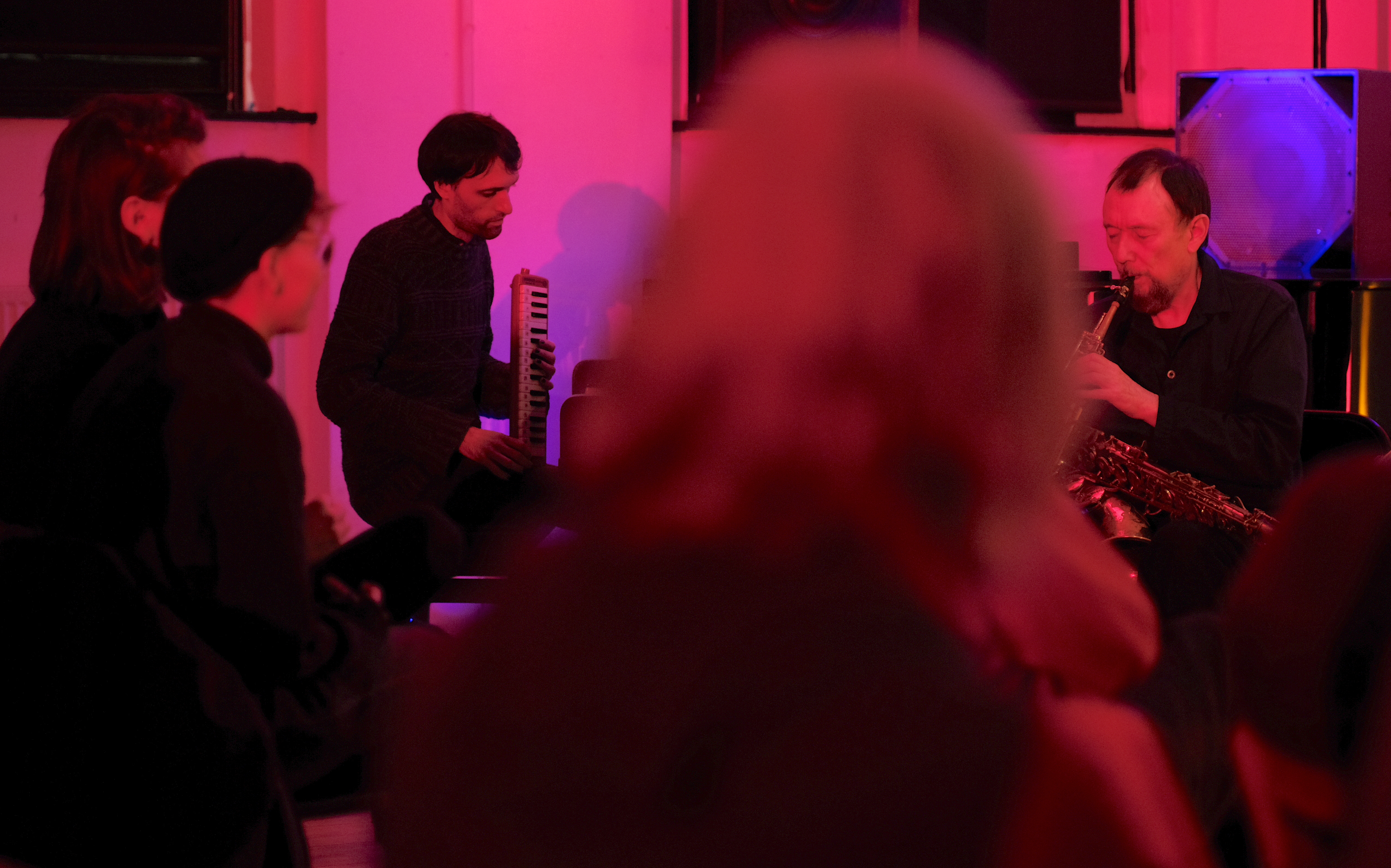
Some photos from the 'Electro-Acoustic Responsiveness' gig at IKLECTIK with Eddie Prévost (percussion), John Butcher (tenor and soprano saxophones), N.O. Moore (guitar), Emmanuelle Waeckerlé (voice, objects), and Tony Hardie-Bick (electronics), courtesy of film-maker Stewart Morgan, whose film on Prévost should soon be nearing completion. 


Photo credit - Stewart Morgan Hajdukiewicz

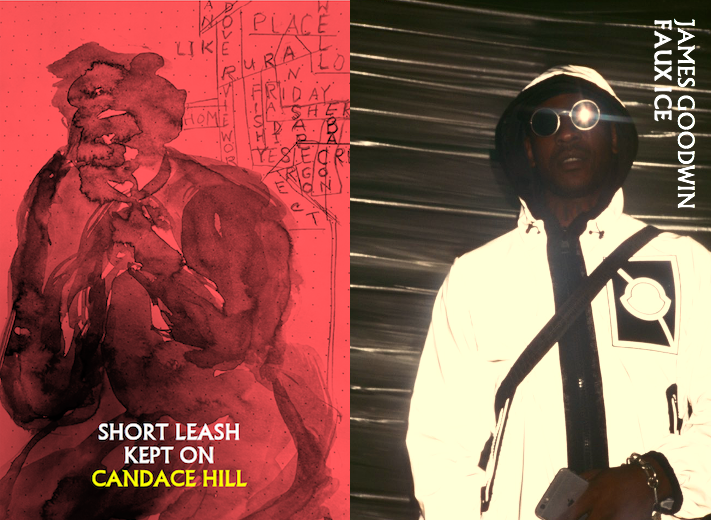
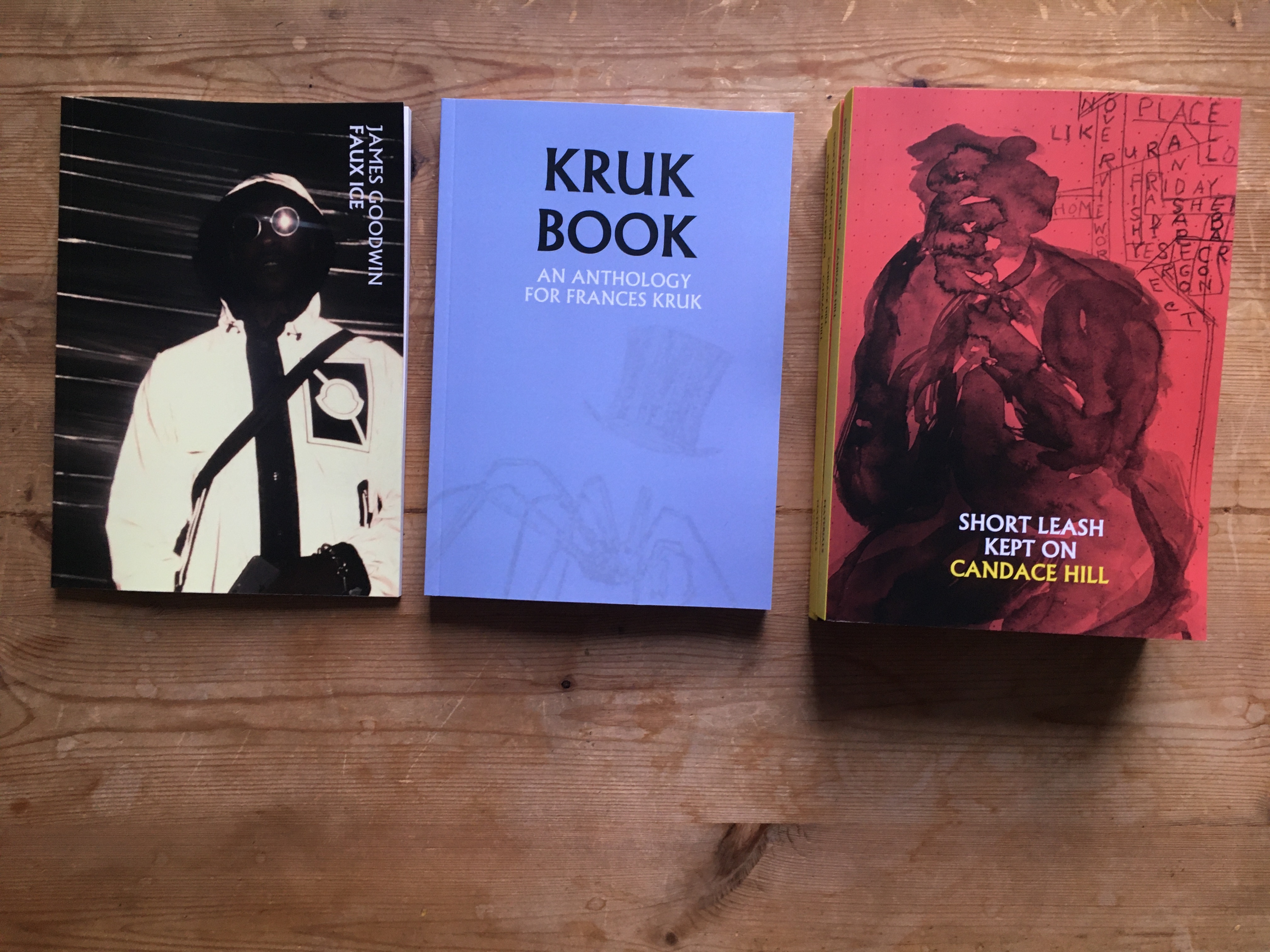
And some photos from the Materials/Materialien reading at Halle für Kunst Lüneburg, with James Goodwin (launching the new collection Faux Ice), Lütfiye Güzel and Laurel Uziell: thanks to curators Ann-Kathrin Eickohf and Elisa R. Linn. 


James will be doing a UK launch for his book at Café Oto in Dalston on Sunday 9th April; this will also be the launch for Candace Hill's astonishing book-length poem Short Leash Kept On. James will be in conversation with Nisha Ramayya and I'll be in conversation with Candace via Zoom. (Fred Moten will be reading, in his trio with Brandon Lopez and Gerald Cleaver, later in the evening.) Tickets from the Café Oto website.


Finally, in further Materials news, Anne Boyer's Money City Sick as Fuck and Lisa Jeschke's The Athology of Poems by Drunk Women are back in print and can be purchased from the Materials website at the following links: Boyer here and Jeschke here.


Monday, 16 January 2023

New from Materials

Announcing three new titles from Materials: Faux Ice by James Goodwin, Short Leash Kept On by Candace Hill, and Kruk Book: An Anthology of Frances Kruk. All three can be purchased from the Materials website: http://material-s.blogspot.com/

A long-awaited reprint of Askia Touré’s Songhai is also available for pre-order and will be printed in early 2023.


Wednesday, 4 January 2023

Updates for January


Pamenar Press will be hosting an online launch for Present Continuous on 15th January, with responses from Linda Kemp, Ciarán Finlayson, Tyrone Williams, and Ghazal Mosadeq. In-person launch hopefully to follow in the coming months... The link for the event is here: https://www.eventbrite.co.uk/e/launch-of-present-continuous-by-david-grundy-tickets-501266961977?aff=erelpanelorg

Also this month, Lisa Jeschke and I will be hosting a reading/discussion with Materials/Materialien at Halle für Kunst Lüneburg, Germany, on Sunday 28th, with readings by Laurel Uziell, James Goodwin (launching his new Materials book, Faux Ice), and Lütfiye Güzel, followed by a discussion about the first ten years of the press with Lisa and myself. A book table will also remain in place for the duration of the Halle's group exhibition, focused on the various stages of production of an artwork. Thanks to Elisa R. Linn and Ann-Kathrin Eickhoff for the invite.

News of four new books from Materials shortly to follow....

Wednesday, 23 November 2022

Present Continuous


The full version of Present Continuous, a book of lockdown essays/prose pieces, excerpts of which first appeared as a pamphlet with Phil Baber's The Last Books earlier this year, is now out from Ghazal Mosadeq's Pamenar Press, with grateful thanks to Ghazal and to Hamed Jaberha for his work in typesetting and design.

Copies available here.

Present Continuous was written during the first year of the coronavirus pandemic between March 2020 and April 2021 in Lewisham, London. Part I was written between March 2020 and June 2020: the movement from spring to summer, from the first announcement of a national lockdown to the Black Lives Matter protests sparked by the murder of George Floyd and Breonna Taylor in the United States and the death of Belly Mujinga in the UK. Part II was written during the autumn and winter of 2020 and 2021, during which time a “second wave”, peaking in December and January, prompted a second set of lockdown restrictions. Part III was written in Spring 2021, as restrictions eased and the issue of police violence raised its head once again with the murder of Sarah Everard and the early debates around the Police, Crime, Sentencing and Courts Bill—as of April 2022, passed into law as the Police, Crime, Sentencing and Courts Act—with its further criminalisation of protest by a government more viciously racist and repressive than any in recent memory. 

Over two years since the first declaration of lockdown, and following a seemingly endless series of virus variants and subvariants, an apparent shift from ‘pandemic’ to ‘endemic’, and a kind of exhaustion of vocabulary and will, I hope these essays provide some kind of record, not only of a particular moment in time, but of the tendencies going into and moving out of that moment, as we move forward into a future more uncertain than ever; not just where ‘we’ were in 2020 and 2021, but where ‘we’ are—or might be—now.

Friday, 30 September 2022

Sean Bonney Special Issue


After two years, the Sean Bonney special issue of the Journal of British and Irish Innovative Poetry, co-edited by Jeff Hilson and myself, is finally out in the world. It’s been a long road, and a lot of work along that road, but, many hundreds of emails and proofs and conversations later, we’re grateful that so many people have come together to treat Sean’s work with the seriousness it deserves. You can access the issue here.

This is a larger than usual issue of the journal: it reprints four essays by Sean—on Sun Ra/Amiri Baraka, on Louis-Auguste Blanqui/Louise Michel, and on Anna Mendelssohn, along with the complete ‘Notes on Militant Poetics’—and eleven essays on his work, almost all specially written for the issue, by Tom Allen, Christina Chalmers, Robert Hampson, Lisa Jeschke/Danny Hayward, Esther Leslie, Rob Kiely, Will Rowe, Kashif Sharma-Patel, Vicky Sparrow, Lindsay Turner, and Steve Willey, an editorial introduction by Jeff and myself, and a detailed bibliography of Sean’s work that I prepared based, in part, on prior work by Ian Heames, Justin Katko, and Harry Gilonis. Special thanks, not only to the contributors, but to Eleanor Careless, who patiently guided us through many technical issues, especially along the latter stages of the route to publication...

Jeff and I first spoke about the issue in several phone sessions during the first lockdown in summer 2020; and now we head towards the end of summer 2020 with more catastrophe looming. Here’s a bit from the introduction which, hopefully, speaks to some of this:
We’d like to begin with a brief reflection on what it meant to edit this issue when we did, between the spring of 2020 and the spring of 2022. Sean Bonney died in the autumn of 2019, during the UK general election which saw Boris Johnson elected as prime minister, and a month or so before the first strains of COVID-19 emerged. We first began to edit this issue during a national lockdown in the UK, and a condition of lockdown in many countries worldwide, at a time when social norms expectations and safety nets were even more radically dissembled, with no immediate end point in site.

During this time, reality seemed to have become a Sean Bonney poem [...] Bonney’s work is extraordinarily precise and complex in its disentangling of the relation between metaphor, history, and the actuality of conditions like riot, plague, and starvation: conditions, that as the global pandemic that emerged in 2020 revealed, are far from the mere decorative detail of a distant past, outsourced from the murderously complacent centre of ‘Great Britain’ or ‘Fortress Europe’. Here, plague is somehow at once symptom, cause, and antidote. Bonney attempts to stage the impossible: how to conceive of solidarity when enforced isolation and quarantine seem to make the conditions for collective social life impossible, reinforcing the atomisation that’s already built into each facet of life within contemporary capitalism. The poem doesn’t pretend that it’s reached a new synthesis out of this contradiction: the false balm of a simplified version of dialectics that resolves what remains unresolved in reality, whether in poetry and political theory, or as party line. But with every fibre of its being it wants to push thought past its limit to a synthesis that would move beyond the deadly cost of such contradiction, a desire felt more keenly than ever in the aftermath of Sean’s death, in the ongoing conditions of plague and its after-effects we’re in now. 
We’ve said that, in 2020, reality, its landscapes, both internal and external, seemed to become a Sean Bonney poem. But this isn’t quite the right way to put it. It’s not that reality became a Sean Bonney poem. Rather, reality was already a poem by Sean Bonney, a report on the affective truth of social life, ‘the enormous noises of the border // Kreuzberg. Exarchia. Hackney’, taking in everyone from Dante to Ericka Huggins, Blanqui, Ulrike Meinhof and George Jackson: writers who, too, drew their visions from history’s prisons, precarious housing, social immiseration, and periods of ideological crisis.


Here’s the official write-up and Table of Contents: 

The author of numerous pamphlets and full-length collections, including Our Death (2019), Letters against the Firmament (2015), Happiness (2011), The Commons (2011), Document (2008), Baudelaire in English (2007) and Blade Pitch Control Unit (2005), Sean Bonney was a crucial part of contemporary poetry communities in the UK and internationally. Formatively shaped by the influences of Maggie O’Sullivan and Anna Mendelssohn and by Bob Cobbing’s Writers Forum workshops, Bonney’s work drew from the aesthetic practices of the British Poetry Revival, and from Left-wing political and aesthetic radicalism, including the Angry Brigade, the Black Radical Tradition, Punk, the Situationists, Surrealism and Revolutionary Marxism and Anarchism. Predominantly based in London, but also in Liverpool and Nottingham and, in his final years, Berlin, Bonney’s work was in dialogue with a much wider range of international poetries past and present. With Frances Kruk, Bonney ran the small press yt communication, and he was an active publisher and organiser, committed to an aesthetic drawn from Punk and DIY traditions, as well as the legacy of the Mimeo revolution, samizdat publishing and radical pamphleteering. A critic and scholar as well as a poet, his critical work challenged the boundaries of academic writing, as he aimed at conceptualising what he called a ‘militant poetics’, in doctoral work on Amiri Baraka and in essays on Louis-Auguste Blanqui, Anna Mendelssohn and Sun Ra among others. His work in poetry, poetics and critical prose was extraordinarily wide-ranging in its field of influences, and in turn exerted a powerful influence on those poets around him. We hope that this feature will give a sense of the full richness of his career in poetry in its many different phases and dimensions, as well as taking into account Bonney’s unswerving commitment to political activism and to thinking through the relation of politics and aesthetics. 

Co-edited by David Grundy and Jeff Hilson Volume 14 • Issue 1 • 2022. 
(Published September 2022) 

----------------------------- 
Table of Contents 
----------------------------- 

Editorial ‘No Simple Explanations’ 
David Grundy and Jeff Hilson 

Sean Bonney: A Selected Bibliography 
David Grundy 

[Articles] 

‘As Simple as Music’: Kinds of Noise in Sean Bonney’s Poetry 
Tom Allen 

Speaking with the voices of the dead: Sean Bonney, Arthur Rimbaud, Amiri Baraka and revolutionary poetics 
Robert Hampson 

The State is a Murderous Life-Support Machine: A Conversation about Death 
Lisa Jeschke and Danny Hayward 

A preliminary reading of Sean Bonney’s ‘What Teargas is For’ 
Robert Kiely 

Notes Towards a Commentary on Sean Bonney’s Letters Against the Firmament 
William Rowe 

Bonney’s Militant Poetics: Revolutionary Aesthetics, Politics and Black Poetics 
Kashif Sharma-Patel 

‘This Face of Glee...This Terrifying Sound’: Sean Bonney Through the Soundhole, Where Bonney IS 
Stephen Paul Willey 

[Essays] 

Time Negatives of Variable Universe: On Sun Ra and Amiri Baraka 
Sean Bonney 

Comets & Barricades: Insurrectionary Imagination in Exile 
Sean Bonney 

Notes on Militant Poetics 
Sean Bonney 

‘Minds do exist to agitate and provoke / this is the reason I do not conform’—Anna Mendelssohn 
Sean Bonney 

The Involution of the Storm Corner: Sean Bonney’s Occult 
Christina Chalmers 

Bouleversed Baudelairizing: On Poetics and Terror 
Esther Leslie 

Sean Bonney’s Social Space 
Vicky Sparrow 

The Poetics of Despair: Listening to Sean Bonney in Charlottesville, Virginia 
Lindsay Turner

Sunday, 17 July 2022

"Give what you can and take what you can’t"


Poets’ Hardship Fund Family Fun Day / Benefit Reading, 56a infoshop, July 16th 2022

Since January last year, the Poets’ Hardship Fund, run by Tom Crompton, Dom Hale, and Alex Marsh, has been a lifeline for poets and for poetry. In practical terms, it’s a lifeline for poets because it provides them a little extra money that can mean the difference between paying rent and not paying rent, buying food and not buying food. And it’s a lifeline for poetry in that allowing poets to exist and subsist, at least a month at a time, lessening the physical and mental fatigue that crush out words, that dense, barely breathable space from which poetry has to constantly fight its way out: impossible geometries, a Piranesi prison labyrinth or an Escher staircase turning in on itself. More than this, though, the PHF has been an example, springing from the mutual aid initiatives that emerged in response to the government’s criminal mismanagement of the pandemic—the response is as much a symptom as the plague itself, as someone said at yesterday’s event. In focusing this specifically on poetry—with the proviso that the problem is a far wider one, and the capacity to link up to other such endeavours—it’s created a real and—to use that word again—practical ground in which that often-bandied word, ‘community’, might actually mean something.
 
For the last decade or so, my own experience of a particularly poetry community, scene, or whatever term you want to use, has been one of friendship, of a disparate and shared project of writing, but it’s also been one of fractures, disputes, controversies, oversights, often channelled through the academic or fringe academic frameworks—conferences, symposia, papers, special collections, email listservs—which still, to an extent, remain important sources and channels of activity, but in which internalised hierarchies and standards have too often seen an identification, conscious or not, with the institution that ill-prepared us to challenge those processes by which the institution, leaned on by the State, purges and prunes itself of any extraneous elements—us!—judged surplus to requirements. And this has, arguably, caused focus to be directed in the wrong places, perhaps, vision to become obscured. But by no means do I want to suggest that it has been the prime characteristic of these scenes. A spirit of huge generosity—which is by no means distinct from being opinionated, rebarbative, fully of passionately held positions—animates the small presses, magazines, readings and reading series that are the real centre of this marginalised work, and it’s from this spirit that the PHF emerges as a corrective or alternative, not just to the generalized spite of the kinds of life we’re told we should be living—or hardly living—blared out from a newspaper, billboard, or government message near you, but to the hierarchical blindness that can all too easily be internalised by those given a modicum of power—professorships, management and middle-management, what Lisa Jeschke and Lucy Beynon once called being a “mini-boss”.
 
The PHF and its attendant magazine, Ludd Gang, along with the small press Gong Farm—both sets of publications printed, photocopied, and stapled at home—don’t so much provide an idealised community, but simply a practical one, and one practical in more ways that the endless debates about poetic strategy, whether poems might be slogans, which party poets should join, etc. The bottom line is that everyone is able to survive. Perhaps these questions didn’t have to be asked, or to be asked in the same fashion, a few years ago, though one can hardly say any of these experiences are new. As someone whose experience of higher education was shaped by the 2010 lifting of the fees cap, the protests against which happened a year after I finished my BA, and whose postgraduate education was in turn marked by the sinking horizon of job prospects beyond fixed-term, temporary, precarious positions, mine is a common experience in which I’ve been luckier than many. In their founding statement, the PHF write: “The Poets’ Hardship Fund UK provides a channel for getting some money to poets who require it, without the kind of means-testing processes attached to similar kinds of efforts.” The story keeps writing itself: austerity, the pandemic, and now the expanding effects that have emerged from and on the back of these and into a future of rising energy prices, rising prices in general. Euphemism dominates, as the terms shift, in a language of metaphor, the poetry of capital—“the financial crash”, as if the economy were a speeding car, “austerity”, with its moralistic tinge, “cost of living”, with its language of pure economics, a set of numbers removed from the lives it names but ignores, “hostile environment”, as if this racist, anti-migrant hostility were a product of the space itself, rather than a specific and targeted policy driven by the actions of a set of people, the ideology of a class. As for us, we weren’t even using the term “cost of living” back in 2020: the language was at once more apocalyptic and more practical—“social murder”, “mutual aid”—certainly not euphemistic.

As I say, this is both new and not new. Back in the day, there would be occasional benefit readings for individual poets. Yesterday, the PHF organised what was in essence a benefit reading for an entire community, launching their new anthology, Ill Pips—the title a pun on the
Personal Independence Payment (PIP) that replaces the old Disability Living Allowance benefit—and seeking to raise money to keep the fund going. When the PHF started a year and a half ago, donations flowed in relatively comfortably: since then, however, as the “new normal” reverted to the “old normal”, and the government support temporarily introduced during the pandemic was removed, more have started claiming and few have continued to donate. The PHF benefit took place, largely, in lieu of donations from those actually endowed with the capacity for comfortably survive—which is to say, the of salaried academics with permanent jobs has trailed off at just the point that the ‘cost of living’ bites. Instead, this was mutual aid: the community supporting itself, poets buying each other’s books from the table, giving donations—which, in a sense, is what already happens at a poetry reading with a booktable and in the self-sustaining world of the small press and the little magazine, but which here takes on a larger and more urgent form. What was billed as a “family fun day” took place at 56a infoshop, a small, volunteer-run anarchist bookshop founded as a squat in 1991, located a few street corners behind the labyrinthine ‘developments’ and destroyed market of Elephant and Castle. Inside, magazine holders and books from floor to ceiling, a collection of VHS tapes, posters and information, a small dog wandering in and out of the heat. Outside, the sun beating down in the middle of a heatwave apparently unprecedented in the UK, a self-assembled, malfunctioning barbeque—eventually replaced with disposable—a crate of beer, a table overspilling with books, in a concrete corner by the entrance to some flats. As much as a benefit or a reading, this was a social occasion, a summer party. To me, these occasions are still marked by that sense of realigning when events started to happen again late last year, persisting beyond the lifting of restrictions—the collective processing of a trauma, an interruption, a fragile holding together in which the joins still show. Perhaps this will wear off as more events continue to happen, perhaps it will always be there, something else to add to our losses. I don’t mean to make this sound like a huge gothic edifice, poet-wraiths congregating like a group of the undead Halloween costumed as so many Thomas Chattertons: it was a summer party, and it was fun.
 
Six of the eight advertised readers read: short sets, attentively heard. Perhaps inevitably, many of the poems were about those conditions that produced the necessity for a fund like this: the precarity of those within the university, the process of applying for work and state benefits. Nicky Melville’s poetry of the past decade or so has often charted processes like these through found texts—a project from a few years ago was based on tippex erasures of bank leaflets. The poems he read today used university brochures in which the words ‘university’, ‘student’, and so on, were altered to refers to ‘butchers’, ‘butchery’, descriptions of courses changed to descriptions of preparing meat. The poems operate on a knowing based on humour: the identification of a shared experience of alienation turned into a collective laughter that takes the deadening repetition of bureaucratese on its own terms and twists it against itself. Perhaps the most effective poem he read, though, was the short, single sentence with which he began: “Life is cheap. Living is dear”. The language of truisms by which economic valuation serves as the basis of life opens up just a fraction to enable some other term of, or beyond value, life beyond measure. Fred Carter’s poems manifested a kind of nervy, earnest argumentative lyric energy. The poems repeatedly speak from an individual experience to a collective wish, their insistent use of “we” and “us” seeking to create a community while also speaking from it. Laurel Uziell read from a new sequence about the experience of defeat, and a personal experience of police violence, first as a kind of crushing helplessness, the second, at a demo where the police where chased away. Laurel’s work, too has an argumentative quality, but one based more than Fred’s in a dialectical irony, a caustic-sincere holding up for inspection of socialized positions and perspectives that unfolds as a movement in and against the breaks and flows of poetic language. The poetry is consistently reflecting not so much on itself, as on the contradictions of activism, social life, the interpellations and mis-interpellations of identities individual and collective alike. Poetry is the vehicle to do this not because it offers direct, unmediated experience, but because it draws attention to meditation and seeks to work dialectically within it.
 
If Fred’s work largely addressed conditions in the academy and Laurel’s those of activism, Tim Wolff’s poems spoke more directly of life at the receiving end of the State’s slow violence, as expressed in the benefits system. As a volunteer from the shop—whose name I unfortunately didn’t catch—remarked in an impromptu speech that followed Wolff’s reading, the dole queue as a physical entity has now been replaced by an automated system, a website, an app. You’re not standing in a line; you’re on your computer, on your phone, on someone else’s computer or phone, as the site crashes or the phone-line stays on hold for hours at a time, replaying an automated message like a kind of anti-lullaby. The capacity for collective resistance enabled by presence within physical space—when you see someone on the line being mistreated and step in; when you collectively grumble and gossip about the conditions you’re put through—is replaced by forced separation, individualised anxiety, total atomisation. Digital bureaucracy and data gathering are the fronts, at once new and old, of a process of slow social murder. In Wolff’s work, the frustrations and despair generated by such systems translate into physical positions, each line a miniature drama of movement and statis—a line about ‘spinning on the sofa’ comes to mind—as the body exists in relation to. The poems didn’t offer the narrative by which such experiences are often described: instead, they at once resisted and sought for narrative, a through-line, a way out. But this was a language, too, of defiance and anger, of barbed satire. Verbal inventiveness—metaphor, simile, modes of often grotesque comparison—throw back the blankness of bureaucratese and name the conditions for what they are. If socialist realism could be reclaimed, it might describe something like this.
 
Sometimes, it can seem that every good thing is the product of something bad. “Wrong life cannot be lived rightly” becomes the new Victorian parlour stitch. The sun which this BBQ party temperatures the result of climate change, as the ironically-named ‘leadership’ context, in which a parade of Tory gorgons line up to compete for callous, murderous intent in the right-wing gameshow that is the British media, sees candidates threaten to abandon the net zero pledge: even greenwashing won’t do. One of the things, it seems to me, that the poetry emerging from our current conjuncture tends to do is to twist figures, metaphors, circumstances in on themselves, at once trying to cut through and further tie itself in knots. The poems—and the figure of the poet within them—act like the contortionists that, faced with the brutality of the state apparatus and its privatized allies, we’re forced to be everyday. The space of the poem is that of a labyrinth, a maze, a black hole, entropy and energy the constant balancing points by which the poem steers around and away from their central voids. That might suggest that the poems are always on the back foot. That would be true. At the moment, what other foot could we be on?
 
But poetry does not, cannot just offer reactive affective mimesis. A report on reality is written in the hopes of transforming it. Dialectic might be one word for the kind of work such poetry does. Another might be transmutation. Sean Bonney’s work was always exemplary for this: when, in the second set of readings, Sophie Carapetian read out one of Sean’s poems after Katerina Gogou, rendering—at least in this reading—loneliness a means of coming together. ‘and loneliness is power is sharpened and bloodstained is swirling is swirling’. This process of conversion—loneliness as power, atomised suffering turned into a virtual collective of the excluded, including ghosts, the dead, those minimum-waged or unwaged, done daily violence to—happens in the poem first, but we have to believe that it can happen outside the poem for the poem to mean anything. Or is it the other way round? It’s again a question of scale. Sophie’s other text, a sprawling essay, began with a conceit about eyes becoming fists, turned into an analysis of mark making and the line as systems of domination—in the case of official language, official speech, the shibboleths which enables people to speak— or-in the case of much contemporary art—of participation in such processes. It ended as a demand for an intergalactic communism and a reclamation of the idea of propaganda as a necessary force. After all, why not make the most extreme demand? Why not reclaim discarded, discredited words? What is there to lose?
 
One of Laurel’s poems contained a sardonic line about ‘form’ and ‘content’—the question debated endlessly in poetic histories and seminars rejected and taken up in new terms. In their speech, the 56a volunteer suggested a way this could be understood as a more general model, drawing links here between what makes a poem live and what makes solidarity real. Poets are not concerned with whether or not what they write is a poem: instead, it becomes a poem in the encounter between poet and text, between text and reader, an exchange, a sharing. Poiesis: “the activity in which a person brings into being something that did not exist before”. Likewise, solidarity is an action, a cutting across barriers: those suicided in prison, those on hunger strike, across the states of Britain and Fortress Europe and beyond, are not thought experiments, but real people for whom real action must be taken. The speech expressed frustration with the idea of creating ‘space’, of creating ‘community’. Sure, we need to do those things. But what about flipping the terms, and instead seeking to create ‘density’—a thickness, a concatenation of actions, of people, of poems? Such density must of necessity reach beyond poetry, poems and poets. As the PHF founding statement has it: “The problems we’re seeking to address extending far beyond any discernible ‘poetry community’—we see this fund as, at least, ‘a start’. The premise is simple: give when you can and take when you can’t.” In a variation on ‘from each according to his ability...’ giving and taking balance each other out: equilibrium is dynamic, against the entropic process by which the means and the will to live are steadily drained out, “like the use medieval use of leeches as a cure for leukaemia”, as someone remarked. Again, this doesn’t just happen in poems themselves—as condensed concentrations and containers of social energy—but in the social life around them, into and out of which the poem releases that energy.
 
Over the course of the afternoon, in the concrete courtyard outside the 56a infoshop, an audience of around fifty people, coming and going, arriving and leaving, made up of poets, but not just of poets, raised £700 to keep the fund going. £700 might not sound like all that much money, but it will be a lifeline for many. The Official Poets whose names you might see in prize lists and newspapers offer a specialism in ideologically vague poeticising—poiesis redefined as “activity in which a person fails to brings into being anything that did not exist before”. These poets won’t donate, won’t care, won’t be aware. The world that flares into existence at events like the benefit outside the infoshop is not their world. This is a world created by poets for themselves and for those who tread into its orbit; not a clique, not an elite, not a coterie, but a collective in its truest, and thus in its most fragile and most provisional sense. Reading last, Luke Roberts said something along the lines of—to paraphrase: “I’ve been doing this for a while, and over this time, many people have told me what poetry is or isn’t or should be. But if there’s any definition of poetry, what it can be and what it can do, perhaps about it’s this.” This gathering, this spirit, a mutual aid organised around words, a community that’s come together around poetry, poems, and poets, but that, in doing so, seeks to extend itself beyond the fractures that keep people apart, to overlap, to survive.

Later that evening, I went to see Eddie Prévost perform the second in a series of eightieth birthday concerts he’s giving every Saturday this month. Prévost grew up in a bomb-blasted Bermondsey. In the film Eddie Prévost’s Blood, he remembers going to a school with his single parent mother who said “you won’t get in here because you don’t have a dad with a top hat”. Prévost had never heard of John Cage when he began making music with AMM in the mid-sixties: instead, he was looking for sounds he hadn’t heard before, channelling his social experience, his sense of a world within and beyond that experience. In the years since, he’s devoted his life to an art form—that of freely improvised music—that, like experimental or avant-garde poetry or whatever it is we call whatever we’re doing, receives almost no funding, no recognition, and whose social value is dismissed out of hand. But as Prévost said from the stage, the practice of free improvisation is not about knowing per se, but about knowing by doing, knowing through practice. The senses are theoreticians, we know what’s to be done, though that knowledge isn’t easy, though it’s imperfect or awkward or broken or fractured. There’s a beauty in process, in the operations of the dialectical, though there’s a danger, too, in valorising process over endpoint. If all we have is process and all they have is an endgame—including control over the means of production of death, that ultimate endgame—then we’re fucked. Well OK, we’re fucked. The process is constant. We keep having to begin again, to build it up from a diminishing set of resources. Well OK. We keep going. It’s a start.