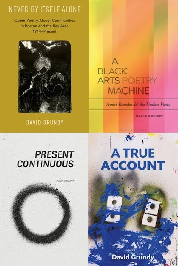
No New Year’s list of projects like last year for 2026, but in the New Year, I’ll be endeavouring to write up my notes for reviews that didn’t manage to find a home elsewhere, potentially to include all or some of the following...
—Jessie Cox’s Sounds of Black Switzerland
—Jack Spicer’s Collected Letters and some new Spicerian titles from Wry Press
—Records by the Urs Graf Concert / Gabriel Bristow and Steve Noble
—ake’s debut on Sub Jam
—Bassoonist Karen Borca’s Good News Blues
—Poetry by Ariel Yelen
—N.H. Pritchard’s The Mundus
—Archival releases from Horace Tapscott
In the meantime, as the sub-zero temperatures descend and the new year begins with the latest bout of criminal invasion, the latest oil-grab and imperialist intervention, the latest blatant violation of international law, some astonishing footage of the Blue Notes at Ronnie Scott’s Old Place on the Ogun Records youtube channel. Ian Hutchinson’s original film The Real McGregor, shot in 1967 and restored by Paul D.J. Moody in 2025, is prefaced with some brief excerpts of newly-shot contemporary interviews—including Hazel Miller, Evan Parker and the late Louis Moholo-Moholo—filmed as a part of an in-progress documentary on the Blue Notes. The (colour) footage itself follows. Chris McGregor on piano, Dudu Pukwana, alto, Mongezi Feza, pocket trumpet, Ronnie Beer, tenor, Johnny Dyanu, bass, and Moholo on drums, playing in the small original venue of Ronnie Scott’s Jazz Club, maintained by John Jack after Ronnie Scott’s itself moved on to a bigger premises, music every night of the week.
The only previously-available footage of the group I’d seen catches them in an earlier iteration, shortly after initially moving to Europe. Though the footage only offers truncated glimpses of a full performance, they’re still more recognisably within the bop-oriented mode with which they’d began than the free music to which they soon gravitated within the experimental laboratory of the London music scene. In terms of records, the music featured here is most reminiscent of the 1968 album Very Urgent, released under McGregor’s name, perhaps the group’s closest engagement with free jazz, and in itself marking a transitional stage to the emergence of the Brotherhood of Breath big band, documented in a chapter of Bill Shoemaker’s excellent Jazz in the Seventies.
For these exiles, uprooted from their homeland by apartheid, The Old Place became a kind of home, a lab, as well as a stage. Shoemaker notes that “without a piano in his flat, McGregor spent all-nighter after all-nighter composing in the damp, cold basement venue, often falling asleep at the piano”. Informed by material difficulty, in which the group often struggled for gigs and to make ends meet, the music has as its backround too loss, sorrow, and turmoil: The Blue Notes’ original tenor player Nik Moyake, returned to South Africa soon after the group’s original departure, dying of a brain tumour in 1965, while Moholo and Dyani would be stranded for months in Argentina, where they’d gone on tour with Steve Lacy, after the 1966 anti-commnist military coup (watched with approval by the USA). But this is not music of existential negativity, formalist exploration, or anarchic destruction, tendencies perhaps more pronounced in the European versions of free music in which it participated, so much as the persistent and insistent declaration of liberation, as a process always in motion. Key to the Blue Notes was the influence of kwela, a Zulu word meaning “get up”. In 1967, Pukwana, Beer and McGregor appeared on Gwigwi Mwrebi’s album Kwela. McGregor hung out with Albert Ayler for several days, talking and playing. Dancing, and other forms of ascension, rising. Free music was not a movement away from dance but into other ways of moving and using the body.
In this footage, we see the Blue Notes a few years into their exile from apartheid, playing as if their lives depended on it, or with a new lease of life, the formal opening up of the music to create that unique and beautiful synthesis of free playing and endless melodic capacity, song as collective repository. Within the basement club’s cramped conditions, it’s all the camera can do to keep the musicians in the frame: an intimacy and an expansion, as if the collective and individual force this group represented couldn’t be contained by the media in which it was captured. Recordings after all, as we know from Baraka’s comment on Albert Ayler, are but rumours of the original, in-person blaze of sound. Rumours, ruins. But here they are through the restored lo-fi haze, dispelling time’s mists and basement cold in blazing heat: Mongezi Feza’s foot lurching out as if kicking a football or stabilizing himself during his solos, as if otherwise his playing might cause him to levitate: Moholo stopping playing for a moment, looking exhausted but not spent, preparing himself to re-enter a music which it sometimes seems can never stop; a Dyani bass solo which cuts away to images of painting, a laughing baby, the life that surrounds the music that compresses it into the space of a bandstand and the time of a gig; the furious, raucuous, joyous collective soloing by Feza, Pukwana, Ronnie Beer. (Perhaps the least-remembered of The Blue Notes today, Beer later left music to build boats in Ibiza but was a key part of the South African jazz scenes from which they emerged: this film offers a fine opportunity to see him at work). McGregor’s piano, meanwhile, launches speedy runs that blur into the sustain pedal then come out again into staccatoed clarity, moving in surges or waves, and the music as a whole is constant movement, towards the end of apartheid, yes, but also that constant search that moves beyond any end point. Restored from another era, the music sounds out of a past but also with the promise of a future not yet arrived. The music’s quality, Evan Parker notes in his interview, is “certainty”. As the year turns, reading the news, going out on the street, facing the upending of orders or their continuance in more brazen form, the spread once more of something that moves towards a fascist consensus, all gives rise to of doubt, despair, a series of shocks. That certainty is something vital. It’s how The Blue Notes survived—and—maybe—it’s how we might get out of this.
***

Available to subscribers on Substack, an essay on the varied career of the neglected saxophonist Robin Kenyatta. This might be the first substantial piece on him in decades—at least, according to my initial attempts at researching Kenyatta: a player who’s been on the edge of my listening consciousness for a while now, since hearing his solos on records by Bill Dixon and Andrew Hill, but whose full career had so far eluded me. There’s still much that’s unclear, but for now, consider this something like a listening guide. Here’s a sample.
Something of the dual character of Kenyatta’s work is suggested by the fact that he was spotted by Bill Dixon—one of the most committed of the avant-gardists—while playing with Pucho and his Latin Soul Brothers. Replacing Giuseppi Logan in Dixon’s groups, Kenyatta takes a searing solo four minutes into ‘Metamorphosis 1962-1966’ from Dixon’s 1967 Intents and Purposes: a ballad feature full of yearning, somewhere between fulfilled desire and its anxious absence that always reminded me of Charlie Mariano on Mingus’s The Black Saint and the Sinner Lady—or for that matter, Mingus’s more usual alto player, John Handy, a mentor of Kenyatta’s. The same year, Kenyatta appeared—alongside a rare recorded appearance from Logan—on Roswell Rudd’s Everwhere, returning the favour the following year with Rudd’s appearance on his own debut, Until. The wide-open, folk-tinged quality that Rudd brought to Shepp’s group and his own projects suits Kenyatta perfectly: there’s a declarative, melodically-focused joy to everything he plays. Technically extremely proficient, he plays flute, alto and soprano saxophones with equal felicity, and in the late ’60s had a phase of playing exclusively on tenor. Until opens, unusually, with a ballad—the title track, written by pianist Barry Miles (not to be confused with the British writer of the same name, Miles featured Kenyatta on the Third Stream-ish album Presents his New Syncretic Compositions in 1966). As previously evidenced on his appearance on Intents and Purposes, ballads were Kenyatta’s strength. One senses he knew this. Interviewed by Robert Palmer in 1974, he noted that he attempted to convey meaning and feeling through tone rather than prolixity of notes: why play ten notes where one will do?