A subscriber post on Substack on a solo guitar (and saxophone) set by Dirar Kalash, with diversions on Paul Klee, Christa Wolf, mathematics, awkwardness, blues, and cheerfulness as ways to utopia.
Before he plays, Kalash speaks about the idea that politics,
revolution, resistance is not ideology, or not just ideology, but
something that is forced from one when one can no longer breathe, as
Fanon says of anti-colonial revolt. Air through the lungs, rising up.
The piece at once literalizes all that and turns it into representation:
the deaths of racialized people in custody, in jail or on the street;
DK speaks the words “I can’t breathe” into the saxophone before squalls
of notes translate it or transcend or move through it, breath becomes
sound becomes something else—not, he says, as a process of abstraction,
or of abstraction as the removal of context, content, but abstraction as
politics; or abstraction as the constant oscillation of the literal and
the metaphorical, the capacity for translation in sound and speech of
what it’s possible at a given moment to say amidst all the choking air.
Sound becomes something else, and that something else is not easy, it’s not nice,
it’s messy or unpleasant, it’s what we’d rather gloss over, its sticky
entanglements. Breath and the breathing apparatus, a trail of saliva
from the saxophone, a trial, the phlegmy mucus matter of the lungs one
coughs up, a habitual gargling or strangling vocabulary of vocalities, a
matter of course. “Base materialism”
and so on. Is how the spirit chokes to get out, is labour, bodily
production, without which any notion of spirit and its entanglement with
matter is just an empty mystical shell.
ake’s
biography describes her as “a surrogate weeper, currently working and
living in Beijing, conducting site and context specific sound
experiments, events, behaviors and installations, also writing poetry,
being a musician, organizer and waiter”. Among other activities, ake
“accidentally initiated the nomadic space A2 space”, and appears as part
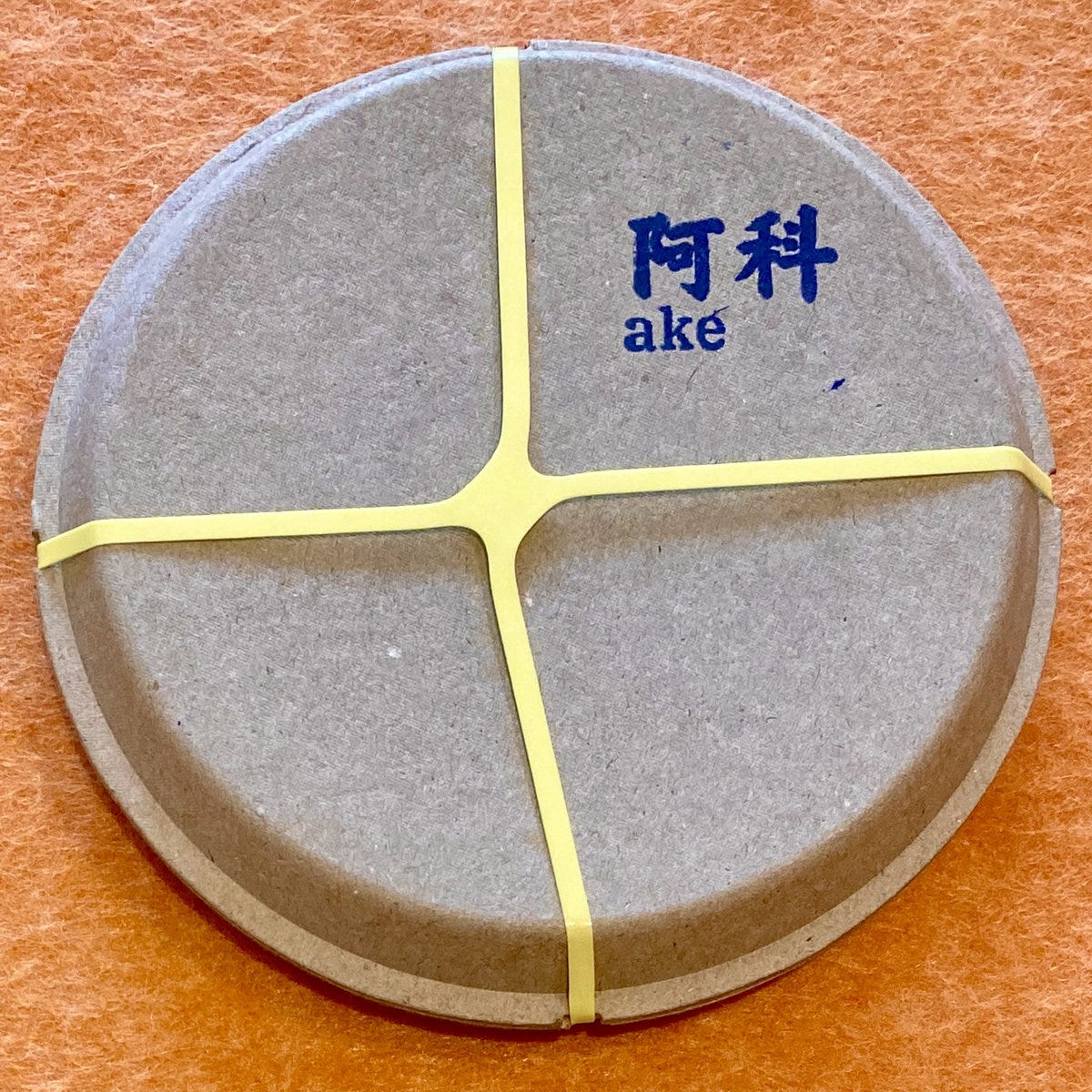
of collaborative projects on Zhu Wenbo’s Beijing-based cassette label Zoomin’ Night, as well as Yan Jun’s sub jam cassette box Silence is Shit, but ake (阿科), released in January 2025 as Sub jam 020, is her first solo album.
Working with the material to hand, ake’s work gives a new, subversive meaning to the well-worn term “site-specific”.The
eight tracks fit together awkwardly, like a kind of broken jigsaw. They
refuse to build up to a unity, but remain fragments, though, as
fragments, they are in themselves whole: broken wholes, wholly broken. A
majority of the tracks are field recordings, though this is no
pastoral. If it has a ‘field’, it is the field of the (urban) social:
social action and social inaction as experienced in the corners of
everyday life, the boredoms and discontents and acts of quiet rebellion
by which one might negotiate one’s way through the world and its
systems, what is given to us, what is taken away from us. These are
recordings of environments, or recordings that make environments, that
intervene in them, that frame and re-frame them, that question or that
spark questions. Workers destroying a wall in a Shenzen hotel are heard
from a bed, the hammer blows a kind of impromptu drum set, accompanied
by scattered fragments of conversation [...] How do we listen to this album? A field recording is supposed to
put emphasis on the environment, but these recordings often feel
‘inwards’ as much ‘outward’. It sometimes feels as if the listening is
being done as much by the performer as the listener, eavesdropping,
confused.
(The second of three subscriber posts on Substack on this year’s Jazz Fest Berlin. The first two are longer essays on particular sets by Wadada Leo Smith and Vijay Iyer and by Pat Thomas, the third a more general overview of the festival.)
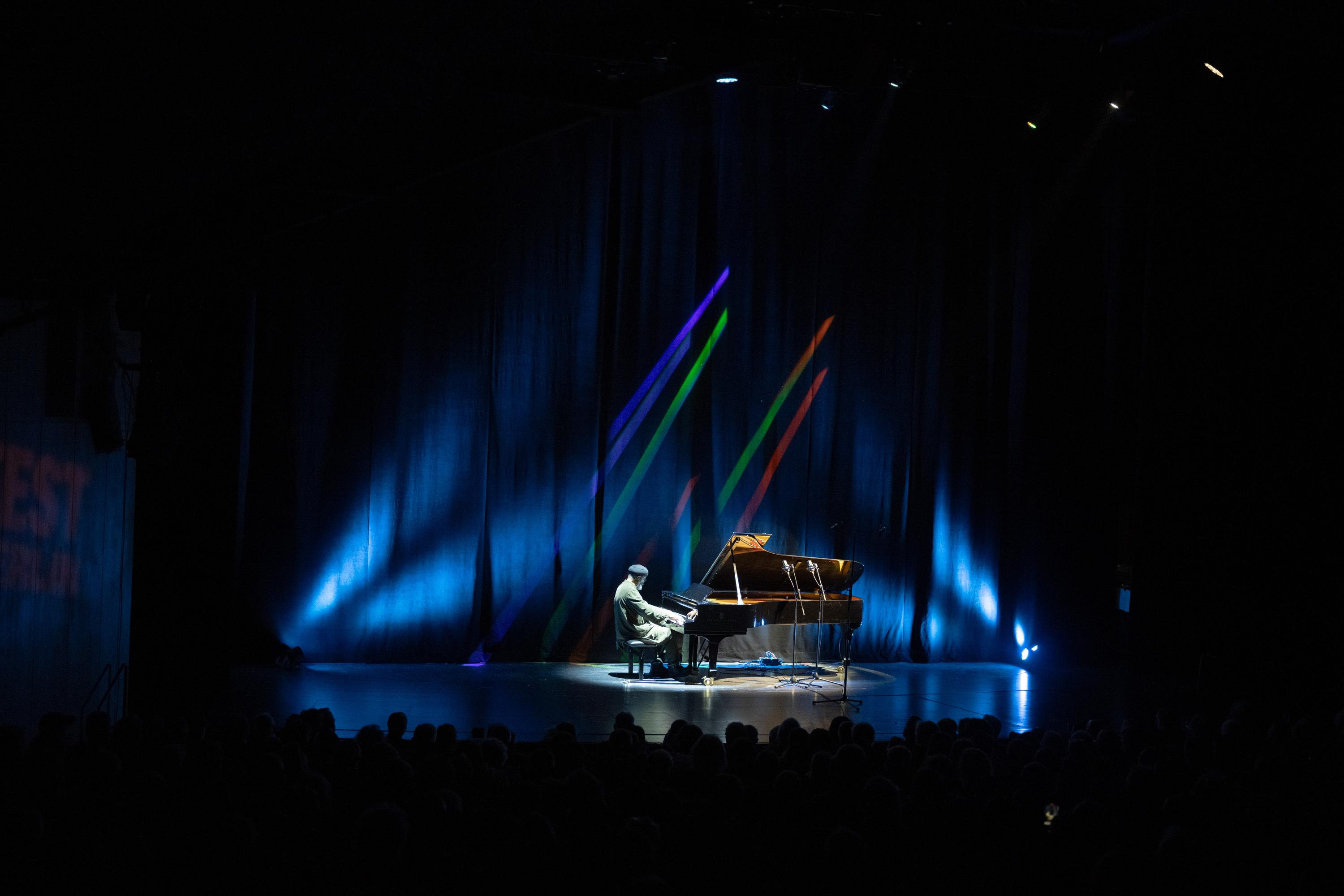
Thomas manifests absolute presence on stage: gregarious off it, on stage he is all business, sitting down and playing without the need of announcements or framing beyond the music itself. In an improvised solo set in the vein of the recent records The Solar Model of Ibn-Shatir and The Bliss of Blissback to Nurin 1994, Thomas played what were essentially a series of short pieces: not quite miniatures, but relatively brief, each a study in a particular technique or texture. (One might call them études, perhaps.) Two were studies in rhythm and the harmonics that ring off a scraped or plucked piano strong, particular down the lower end of the instrument; the others focused on thick, splashy clusters and hand-over-hand runs dispensing with tonality as old news.
Trumpeter Paul Shearsmith passed away a few days ago in Stuttgart, aged 78. One of those many presences on the UK free improvisation scene known to—and as—one of the faithful—his German Wikipedia page is extensive, his English Wikipedia page non-existent. So is cultural memory.
Shearsmith grew up in Tadcaster, Yorkshire, where his father was the local blacksmith. Influenced, in his words, by the BBC Sound Effects library, on leaving the Leeds School of Architecture and moving to London, he attended jazz gigs by Stan Tracey. Here, as he tells it, he would stage a weekly heckle. On the basis of this, he was invited by drummer John Stevens to attend his workshops, playing a battered pocket trumpet he’d bought second hand with Stevens and the Spontaneous Music Ensemble and with the London Musicians Collective at the Little Theatre Club in the West End and at the ICA back in the 1970s.
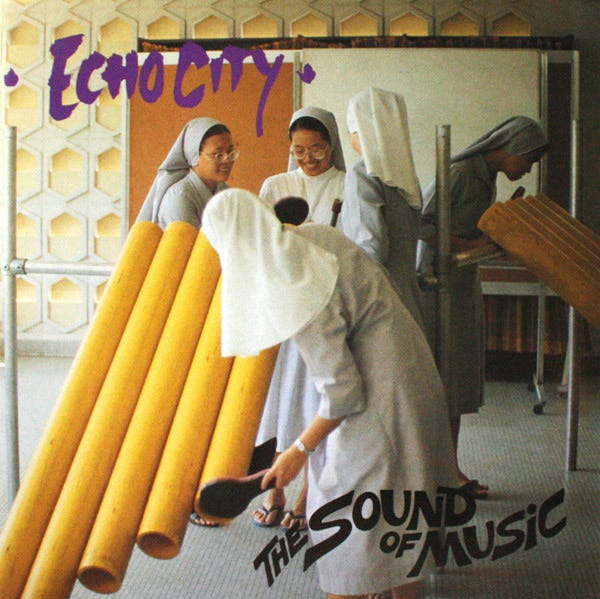
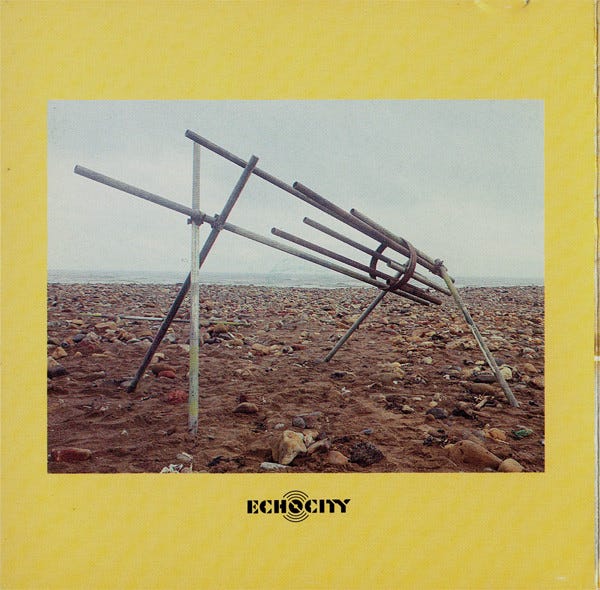
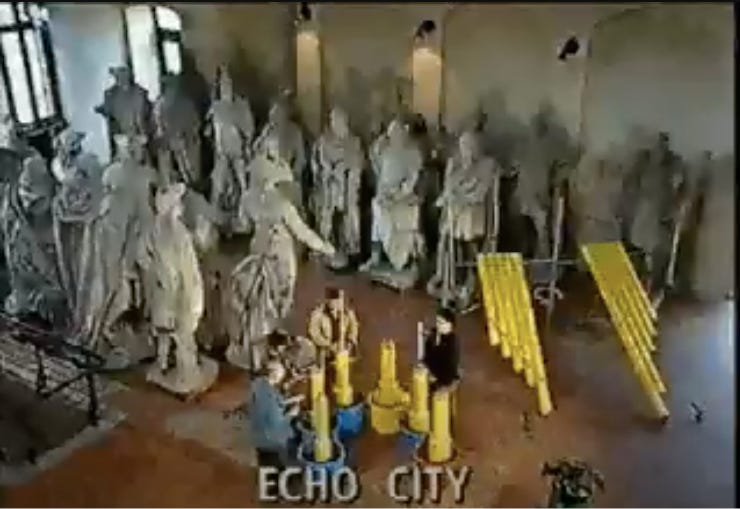
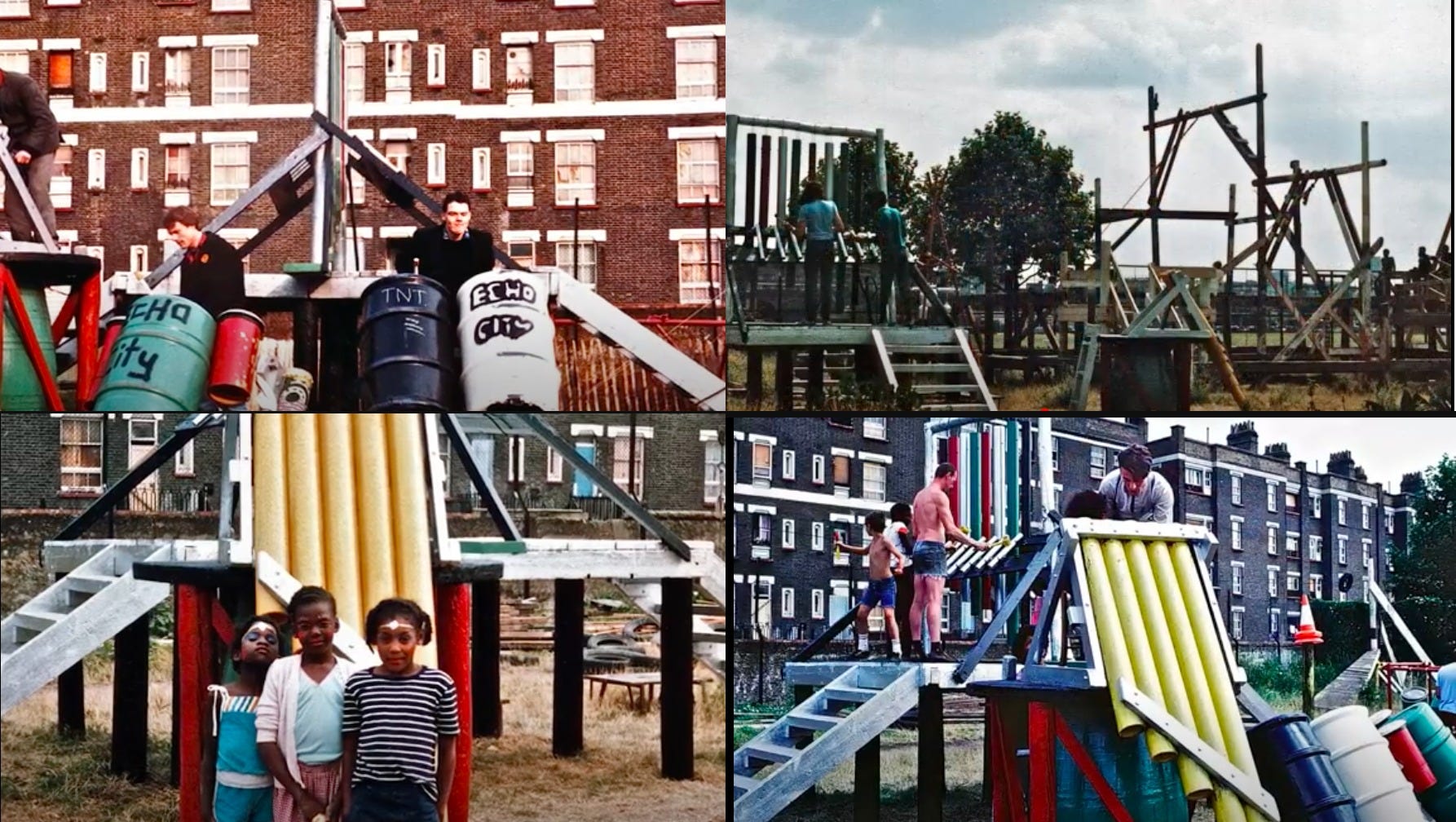
In the early ’80s, he travelled to Indonesia, where he came back with a ‘trompet’, a children’s instrument made from film canisters, a plastic tube, and a reed made from a balloon. Adapting this with a garden hose pipe as the ‘baliphone’, he met instrument-builder David Sawyer and through him joined the collaborative group Echo City with Guy Evans, Giles Leaman, Julia Farrington, Rob Mills, and Giles Perring. Starting in 1983 with a playground in Weaver’s Field in the East End, dubbed by the NME an ‘urban gamelan’, the group built what they called ‘sonic playgrounds,’ inventing tuned percussion instruments, made from old piping and other industrial and storage implements, including ‘batphones’, ‘fibrephones’ and ‘barrel drums’, and running workshops across the UK, Europe, East Asia and North America, including a collaboration with members of the Sun Ra Arkestra on the beach in the Isle of Jura, off the coast of Scotland. In Echo City’s work, music becomes sculpture, part of a public place and a participatory aesthetic. This is not about gigs or records, though they are a part of it, but about a more ongoing and more genuinely collective process. As Shearsmith put it: “I believe music belongs to everybody and can be made by anyone. Don’t let technique get in the way”.
Album art from Echo City’s second album, The Sound of Music (Some Bizarre, 1992)
These kind of public projects have always been a key part of UK improv, and, whether in Echo City or elsewhere, it was the spirit of collective playing that informed Shearsmith’s work, from his early work with Stevens to Maggie Nicols’s The Gathering, playing in the groups the Funking Poets and APE with the likes of saxophonist Big Mike Walter and poet Grassy Noel (for the latter, Shearsmith added fire extinguishers to his instrumental arsenal), or in the duo The Fujii with Japanese singer-guitarist, Koichi ‘Fuji’ Fujishima, who he met while the latter was busing in York, and latterly, with Ben Watson’s freewheeling AMM all stars.
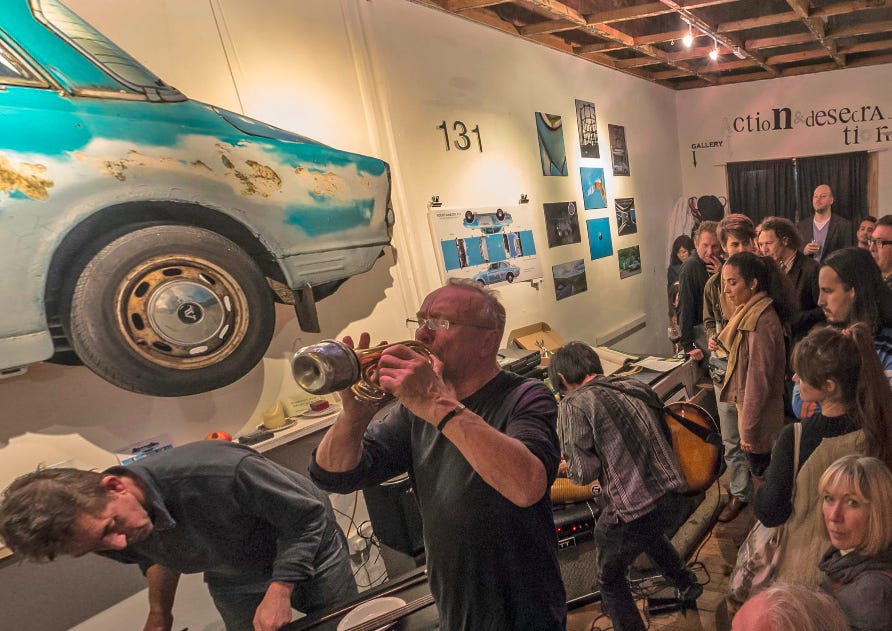
Over the years, Shearsmith worked in an architecture firm, practiced photography, turned his car into a work of sculpture, played trombone, tubing, “tuned gas main”, and the baliphone in addition to his trusty pocket trumpet. Back in the day, I played in private a few times with Paul and the other members of KMAT, his trio with guitarist Keisuke Matsui and bassist Graham Makeachan, indefatigable host at the Hundred Years Gallery in Hoxton, where Shearsmith was a regular. It was soon after the election that saw Boris Johnson elected mayor of London: Shearsmith, he reported, had been playing in Ken Livingstone’s “battle bus”, blasting out socialist classics like ‘The Red Flag’. Around that time I remember anti-austerity protests, the student movement, the carnivalesque energies around the Hundred Years and its constellations, a warehouse near King’s Cross with a variant on Henry Threadgill’s Hubkaphone made out of old storage canisters for reels of film, a parade with bells through the streets of Hoxton organized by Mary Lemley in memory of Gabriel Hardisty-Miller, running into Grassy Noel going the other way up the street on a protest where, suddenly, everyone was going joyfully in every direction at once, and the street briefly reconfigured itself, as on protests it does, lines of poems, lines of music that refused to line up or be counted, out of time. And Paul Shearsmith’s pocket trumpet, piquant and strong in the wake of Don Cherry, blowing out little blasts of light.
Free improvisation in the UK and elsewhere developed as a social music and in this often unheralded way it continues, in venues like Hundred Years, the late lamented Iklectik, or the slightly more publicly-visible scene around Cafe Oto. It’s a music that's often politically connected to the traditions of left wing politics that have for decades been under steady attack from both the Right and the Labour party in its Blairite or Starmerite configurations: as well as the Livingstone Battle Bus, Shearsmith recorded an Iraq war protest song, and the Hundred Years Gallery has recently been raising money for the people of Gaza. Heard by small audiences, the music is not ‘popular’ by record industry terms—or the kinds of ‘focus groups’ by which Starmerite lurches to the right are justified—but it is more fundamentally than that a people’s music, one that, because it does not make money and is barely tied to market demands, aims at exploring only itself and its world, that draws, in spirit and sometimes in letter, on the traditions of protest in folk musics of various kinds, in free jazz, in experimental theatre or film and in the various experimental incarnations grouped under the headings of prog-rock or (post-)punk (Guy Evans of Van der Graaf Generator and Susie Honeyman of the Mekons both played in Echo City). The music stages a counter-history and a different way of being to all the various lies and erasures of memory surrounding it.
That was the world Paul Shearsmith believed in. That was the music that Paul Shearsmith made.
[Extended cut of a review forthcoming in The Wire.]
A bastion of New Music for over one hundred years, the Donaueschinger Musiktage continues to make its way into the twenty-first century as that century reaches its quarter-way point. Along the way, many questions; and perhaps, some answers. Taking place before I arrived was an early concert by double-bassist Florentin Ginot in works by Rebecca Saunders and Clara Iannotta, though I caught him on Saturday night in an outdoor performance in the ‘enchanted forest’ setting of the Schlosspark, the trees framing another glade of speakers which projected creaking, woody electronics which merged environmental and virtual sound in pieces by Carola Bauckholt and Lucia Kliger. At one point, the sound of a passing train appeared to come from the speakers before we saw its lights speeding past the glade; at another, I could have sworn I heard owl hooting through the trees, only to look up and see Ginot rubbing on a string.
I also missed Enno Poppe’s hour-long piece for ten drumkits, Streik, while somewhere between the bus stop and the freeway, but the festival’s association with radio station Südwestrundfunk (SWR) ensures that virtually all the music is broadcast, enabling a listen-through on return. Much of the work’s play with spatialisation—as well as the visual spectacle of ten drummers—is lost encountering the music this way, but, on this purely audio evidence, it effectively negotiates between stuttering announcements and raucous clatter, and retaining interest for its hour-long running time is no mean feat. (Though Poppe’s claim in the programme notes that an ensemble of this size “needs a composer” arguably overlooks the work of percussion ensembles not controlled by composers—albeit ones not necessarily operating in the frame of New Music. Take Max Roach’s M’Boom for a start. Quiet as it’s kept, the Black avant-garde was there well over half-a-century ago.)
Between the big orchestral concerts held on the Friday and Sunday in the Baarsporthalle, a gymnasium temporarily converted to concert hall, were works for smaller forces, though one would be hard put to describe them as “chamber music” in anything but name. In a smaller gymnasium next door, earplugs were handed out for a Friday night concert of the late Phill Niblock’s final compositions—perhaps a first for the festival. Neil Leonard’s programme note beautifully describes Niblock’s woodwind pieces as “something akin to an Ellington chord [...] sustained beyond the limits of a single player’s breath”. That was heard here in BLK + LND, a duo for Leonard, on bass clarinet, and double-bassist John Eckhardt, along with the ever-present drones of along with the ever-present drones of Niblockian electronics. As the audience sprawled on the floor, Leonard moved his way through them in an exploration of spatial effects, while Eckhardt and the speakers formed fixed points around which to anchor the sound. In Biliana, a solo work for Biliana Voutchkova, voice and violin united to take on a timbre that seemed to draw on folk musics. Niblock’s music is a kind of return to basic principles—the combination of unison tones, the drone, the open string—in ways that both abstract them and render them palpably material, vibrating in a kind of small-scale sublime. He will be missed.
The next morning, amidst the more high-tech surroundings of the Donauhalle, Mark Andre’s hour-longselig ist...followed traces of mourning. The work was written in memory of a friend’s child, and includes samples from Berlin’s Charité Hospital and the Tränenpalast, or ‘palace of tears’, at Friedrichstraße, where families from either side of the Wall would say tearful farewells. In concept and instrumentation, there were resonances with Nono’s …Sofferte onde serene, but whereas that work’s tape part is often rough-edged and palpably physical in its transformation of Maurizio Pollini’s piano playing, the electronics here functioned more like a sort of additional, infinitely-detailed sustain pedal to Pierre-Laurent Aimard’s piano. In the afternoon, the ensemble lovemusic offered chamber works by Kari Watson, Hannah Kendall, David Bird, and Laura Bowler that were, as Bird put it, in various ways “pop-facing”. Amidst taped interludes featuring an old-fashioned radio as a prop, electronics functioned here to explore what the programme notes (via Bachelard) termed “the dialectics of inside and outside” in various ways. Perhaps most effective, though, was the use, in a work from Kendall’s tuxedo series, of an older technology, that of multiple music boxes, containing snippets of hymns, spirituals and works from the classic repertoire, history over-layered in a kind of haze. (It was through the premiere of Kendall’s large-scale work shouting forever into the receiver at Donaueschingen a couple of years ago that I first came across her work, in which a rigorous historical consciousness is profoundly allied to aesthetic experimentation in ways that feel especially vital.) Meanwhile, across the road in a small cinema, a beautifully understated film by Sebastiano d’Ayala Valva depicted the rehearsals for Occam Ocean Cinquanta, the orchestral work by Éliane Radigue and co-composer Carol Robinson premiered at last year’s festival, further suggesting ways in which traditional ideas of the ensemble—whether those concern instrumentation, the role of improvisation, or the development of pieces along ‘narrative’ lines—continue to be interrogated in search of new ways of conceptualizing music itself.
Radigue’s was the big opening piece at last year’s festival. Opening the Friday night orchestra concert this time was a very different work, Simon Steen-Anderson’s Grosso, featuring the group Yarn/Wire and a gigantic Leslie speaker. As its title implies, the piece is a kind of concerto grosso, retaining the format of the concertino group within the broader mass of the orchestra, but without necessarily treating that group soloistically. Over its forty-something minutes, the piece worked through repertoire of lightly ironized gestures—among them, vibraphone descents that might have accompanied a flashback dissolve or a sci-fi cartoon, and passages for multiple harmonicas—in various configurations. Audience response was certainly positive, and there was a lot of intricate texture, but there was something about its surface I found off-putting: a playfulness that felt oddly joyless, a music in perpetual quotation marks or parentheses. Pascale Criton’s Altersimilarly questioned the frames in which we hear music, but in ways that felt more closely related to the question of a more deeply shared experience. As soloist, the magisterial Juliet Fraser was set amidst a sea of orchestral microtones, at first singing fractured syllables and consonants on the borders of language, and then an English-language text she’d herself written about pandemic isolation, ending with a plea for collective listening. A surprising and effective shift to intimacy, this conclusion functioned to gently break the third wall—or at least, to gently crack it—not as a magic trick or a stock alienation effect, but in ways that sparked welcome reflection.
The concert closed with George Lewis’ The Reincarnation of Blind Tom, a concerto for composed orchestra and two improvising soloists: Roscoe Mitchell, on soprano, and the latest iteration of Lewis’ machine improviser Voyager, now an AI programme for piano, working off the composed music from the orchestral principals. Furious scrabbles from the piano or smeared, acidic soprano saxophone alternated with tuned gongs, brass plunger mutes, downward slides and smears. As ever with Lewis’s work, the piece has a broader conceptual underpinning. Blind Tom Wiggins, the pianist prodigy whose near-superhuman musical memory and pianist virtuosity saw him play the White House aged ten while still enslaved--and to whom Pat Thomas has also recently paid tribute--here offers a figure for reflecting on music’s role in mediating ideas of human agency and human freedom, with the AI pianist offers at once a ghost (or reincarnation) and a presence from the future, capable of the hyper-human virtuosity Wiggins was said to possess.
The work, Lewis commented in a Q&A, is not so much about idea of “machine consciousness” or of “what it means to be a machine” as it is about “the phenomenology of freedom”. Blind Tom could play just about anything, but, as an enslaved person, his musical ‘freedom’ occurred within conditions of profound unfreedom. In such cases, music, as the supposed index of what it means to be human, to be a subject, have a soul, in turn posed a problem for the system in which enslavement relied on denying human agency, the capacity to feel or desire, to the enslaved. And today, the algorithm is guided and framed by racialized bias, the AI considered, in Lewis’ words, “something to take power with”, the tool of the Elon Musks of this world. So often framed as a kind of neutral or scientific mode of technological advancement, AI is shaped—as are all modes of technological advancement—by existing biases, often racialized and gendered, and by existing structural imbalances. Today, for instance, as AI opens new artistic horizons and triggers existential dread about job security, AI-databases decide which Palestinians to kill. And back in the 1980s, as Georgina Born details, there was controversy about the role of the US military in computer technology developed at IRCAM, where Lewis first developed Voyager. It’s vital to be aware of these contexts, and Lewis’ piece was salutary in drawing attention to these vexed questions of freedom. Improvisation, of course, played a key role in debates about the musical capacity of racialized subjects. If improvisation can be dismissed as somehow 'not real music', entire modes of music-making outside a certain idea of the western tradition can be discounted. Voyager doesn’t know the difference between composition and improvisation, Lewis suggested, and perhaps we don’t either, but the uneasy dalliance between the two continues to be a kind of unspoken problem within new music. In restoring the tradition of improvisation to the concerto format from outside the confines of the cadenza, the work performs a valuable service, as improvisation is finally, slowly, accorded a seat at the new music table, the improvising soloist expanding the palette of the orchestra and vice versa.
Yet if things are changing, they are changing slowly. There was marked discomfort among some sections of the audience during the improvised performance that followed by the trio of Roscoe Mitchell, on bass and sopranino saxophones and little instruments, turntablist Ignaz Schick and percussionist Michele Rabbia. By my reckoning, at least a quarter had walked by the end, and there was a snigger or two to my left as Mitchell switched from saxophones to his table of little instruments and Schnick pulled electronic swoops from his turntables. To many of us, these were not unfamiliar musical gestures, but to sectors of those in attendance, it seems, they are perhaps (still!) seen as illegitimate, and it’s precisely the ambiguity they raise that indicates their radicality. This might seem bizarre, given that Mitchell has performed at the festival before, for instance, his 1977 duo with Richard Teitelbaum as part of the now-defunct ‘SWF-Jazz Session’ slot following Lewis’s own duo with Anthony Braxton the year before. But old habits die hard. Facing a hostile reaction from the audience at Willisau in 1976, Mitchell repeated the opening phrases of ‘Nonaah’ dozens of times, until the audience came on side. That was nearly fifty year ago, but perhaps there’s still a need for that kind of gesture. That’s to say: there is (still!) great value, within a new music context, in work that still retains the capacity to discomfort, and thus to interrogate basic assumptions about what is acceptable, or not, within this supposedly experimental frame. The sparseness and space, the awkwardness heard in the music: the way overlapping lines apparently fail to connect, the moments it falls away into the edge of nothing, are precisely the places where such music does its work. When the trio reaches a pause or near-pause, they are not playing composed silences, but improvised silences. I don’t just mean that these are improvised because they take place within the frame of musical improvisation, but that the quality of the silences themselves, and their framing, feels radically open, unstable. This music dares to be awkward, unscripted, to show—and not, as in the case of some of the pieces, to choreograph, stage and compose—the joins, the parts where things don’t fit, where a musical language might be negotiated through live, improvised, real-time encounter, an ongoing dialectic rather than the presentation of (however beautiful) a completed thought. The place to begin is in the cracks, at the edge.
This is not necessarily a generic designation, but a matter of context. On the Sunday, Michael Finnissy’s choral work Was frag ich nach der Welt may, in a sense, have been one of the most ‘traditional’ pieces on the programme, in that it worked exclusively with a form that has existed for centuries—the a capella choir—in a setting of 15th century poetry by Andreas Gryphius that interpolated elements of a mass by Heinrich Schütz. (The piece’s title is also shared with a Bach cantata.) Likewise, its sonic vocabulary harked back more to the sounds of what might by now be heard as the ‘traditional’ avant-garde, concerned with line, with gesture, with rhetoric and musical argument, more so than with texture or timbre. Yet it was precisely through this historical untimeliness that it reached contemporaneity. Finnissy explained in the Q&A his interest in the way the texts balanced formal strictures (poetic Alexandrines)--a distancing or objectivizing of experience-- with the reality of war trauma. In Gryphius’s Europe, tormented by the 30 Years War that destroyed two thirds of the population, including half of Gryphius’ family, that destruction was up close. Today, we watch wars on a screen—Gaza, Ukraine—and those mediations take on a new light. The point is not to evoke the ‘timeless suffering’ of war, so vague it becomes liberal generality, but to think the way art frames and re-frames these experiences: what changes in them, what stays the same. The work comes to us doubly out of time: as an echo, or what Finnissy calls an “annotated discussion”, both of pre-modernism and of 20th century modernism. Its contemporaneity is to be out of time, even as its setting of German war poetry of the 1600s layers onto our experience (distanced, mediated, prohibited) of Gaza. Sounded in unison at the beginning and end of the work, the title phrase—“what do I ask about the world?” (or, “what do I care for the world?”)—remains a vitally open question.
On the same bill, Claudia Jane Scroccaro’s impressive On the Edge gently interrogated the concert format, the work opening as the audience filed in, with the choir distributed around the walls of the hall, speakers playing both live and pre-recorded vocals and filtering the ambient sounds of the concert hall, so that the line between the pre-recorded and the live was blurred. Though the work derived in part from her work at a women’s shelter in Paris, where women could often not speak directly of their trauma but approached it through songs, such as lullabies, Scroccaro in a Q&A the next day noted her reluctance to aestheticize and appropriate these women’s experiences, turning such questions into part of the fabric of the piece itself. Setting poems by Mina Loy revolving around the figure of the outsider, the work asks how to speak, and who speaks, for whom. Taking the stage, the soloists repeat words from Loy—“Come to me, there is something I have to tell you but cannot say”—each syllable a downward-sloping melisma in looping tendrils, as if caught in its own, perpetually preludial loop, the condition of narration, explication, revelation. Music here contains both trauma and balm, speaking by not speaking, revealing or refusing to reveal through an opacity at once lulling and barbed. As material from the lullabies emerges, swelling and rumbling on the verge of perpetual climax, electronics swirl up like tinnitus, a ringing in the ears, after-echo of an explosion we can’t hear: rather, we can only witness the after-echoes, the traces of its origin. The soloists walk off the darkened stage, singing, joined by the choir, in an undoubtedly effective madrigal of leave taking, the sound moving to the back of the head, the back of the room, in a kind of spatialized fade-out. It hangs there, the resonant conclusion of an unfinished thought, this music that is always coming after, always leaving, never quite managing to depart.
The final concert was similarly devoted to expanding the idea of the orchestra. In the second half, Chaya Czernowin’s unforeseen dusk: bones into wings added six amplified singers who, she notes in a pre-concert Q&A, function not so much as soloists as, in her words, “survivors from a storm”, cast adrift amidst quiet, amplified sounds and constant, see-sawing pitch slides: episodes and structures that strive, by the work’s end, to “take flight”. Meanwhile, it’s not often, perhaps, that those words ‘exuberant’ or ‘entertaining’ can be genuinely applied to new music, but the two works in the first half buck the trend. In both, it’s hard to say whether electronics replicate orchestra or whether orchestra replicates electronics; better to call it a case of mutual transformation. Francisco Alvarado’s piece REW.PLAY.FFWD took its inspiration from a by-now dated piece of technology—though one of late enjoying a revival—the cassette tape. Orchestral whooshes and whoops, accelerandos and ritardandos imitated the tape’s rewind and fast-forward function as a kind of rollercoaster or perpetual motion machine, interspersed with hushed interludes sparked by bowed electric guitar harmonics. Sara Glojnarić’s DING, DONG, DARLING! did similar work with digital sounds, somewhere between Tyondai Braxton and footwork, glitter and jitter. Hi-hats, played live or pre-recorded, stuttered alongside proliferating electronic basslines, contemplative string chords interrupted by brass stabs that refuse to separate the zone of contemplation and action. A spoken voice intoned the title phrase with camp relish at two points, the evocation of what the piece identifies as a queer utopia. Both works had an infectious energy and were received with whoops and cheers, Glojanrić’s taking the Orchester Preis. One of the trends in the New Music of the past half-century has been to deal with the problems of history through the veil of mourning, the pathos of distance, and another to ignore those problems through a formalistic or decorative concern with colour and timbre. Alvarado and Glojnarić’s works, like that of Lewis on the first night, suggested a third approach: fully aware of those questions of history, of the exclusions and oversights of music new and old, but refusing to give up on notions of play, of joy. Critical play, critical joy, joyful criticism, joyful participation in the endless work that still has to be done.
Two luminous orchestral works by the late, great Wayne Shorter: first, Dramatis Personae, a Lincoln Centre Commission from 1998 with Shorter on soprano, Jim Beard on piano, Christian McBride, bass, and Herlin Riley drums alongside orchestra conducted and arranged by Robert Sadin--the bridge between the monumental, and underrated, High Life(1995)and the orchestral collaborations of the Danilo Pérez/ John Patitucci/ Brian Blade acoustic quartet to come.
A decade-and-a-half on, the massive LA Philharmonic commission Gaia (2013), described by Richard S. Ginell in Variety as a “murky, thick-set monster of a piece [...] massive, slow-moving, opaque textures, sometimes tracking Wayne’s distinctive long, snaking melodic lines on soprano; treating the sections of the orchestra as blocs”. Varying in performance from 25 to 30 minutes, this version from Gdansk in 2014 veers toward the latter, with Shorter on soprano forming part of a quartet with Leo Genovese (piano) and Terri Lynn Carrington (drums); the solo vocal part and libretto are by Esperanza Spalding, who also doubles on bass as part of the quartet.
Shorter first began work as a teenage student at NYU, and it’s to be hoped that Shorter’s Kennedy Center collaboration with Spalding on the opera Iphigenia--his final piece after he retired from performing in 2019--might appear in the future. For now, the serene drama of these orchestral works represent the majestic, achieved late blossoming of the compositional impulse Shorter had been building throughout his entire life, from his early work on that teenage opera through to the unreleased orchestral pieces Universe, Legend and Twin Dragon he wrote for Miles Davis in the 1960s and ’80s (later realised by Wallace Roney) and the misunderstood trilogy of post-Weather Report Afro-futurist epics Atlantis (1985), Phantom Navigator (1986), and Joy Ryder (1989), along with the aforementioned High Life.
I have a longer piece on Shorter in The Wire, with thanks to Meg Woof.
(Edited down from a 30,000 word draft--with plenty more to say on Shorter’s orchestral work, his status as composer, and the framing of ‘jazz’; more of that may see the light of day elsewhere.)
///
In other news:
My interview with composer Hannah Kendall is online at Bachtrack: Kendall is Composer-in-Residence at the Royal Academy of Music this March, and a couple of concerts are forthcoming the following week. Highly recommended if you’ve not heard her music in performance before.
On March 22nd the trio GUE will be making its delayed debut at waterintobeer in Brockley, South London. Jacken Elswyth on banjo, Laurel Uziell on electronics and myself on electronics and melodica. We’ll be joined by a saxophone trio of Alex McKenzie, Nat Philipps and Nicholas Hann, plus Tom Mills on theremin. Tickets £5, doors 6:30, to be wrapped up by 9pm. Eventbrite page here.
Finally, I’m delighted to reveal the cover for the Selected Poems of Calvin C. Hernton, co-edited by myself and Lauri Scheyer, and now available for pre-order from Wesleyan. The book includes material from across his career--including the long out-of-print The Coming of Chronos to the House of Nightsong--and a foreword from Hernton’s longtime friend, publisher and champion Ishmael Reed, along with notes, chronology, and index. It will be published this August.
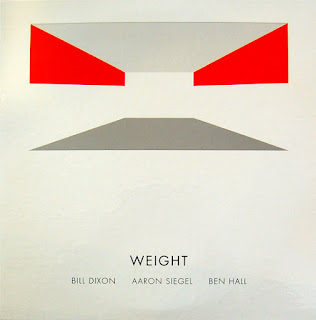
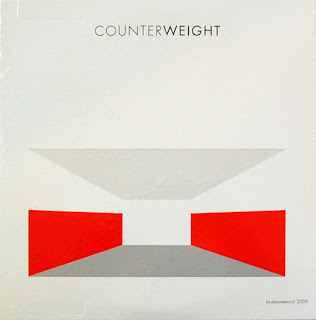
(Bill Dixon/ Aaron Siegel / Ben Hall --Weight/Counterweight (Brokenresearch, 2009))
Last night I dreamed that I had to organize a concert for the late Bill Dixon: but, on the day of the supposed performance, without access to a venue, publicity, or any other means of communication, time was running out. Dixon had sent a message that I was supposed to let Wynton Marsalis and Lincoln Centre know about the gig, via the cryptic means of a packet of kielbasa (I think); I was worried that I'd have to host the whole performance in my living room, and my failure to publicize the concert was in being denounced as elitist in various music magazines even as my laptop refused to function in order to spread the word. Meanwhile, Fascists were attacking buses which had been covered with flowerpots for completely ineffective protection, the wrecked vehicles lurching round the corner, their windows covered in tarpaulin, as enormous grey factories were being built by the side of the road, the fate of these vehicles apparently subject to the unstable whims of Conservative government housing policy. I'd found my way to a building that might have served as a venue, but as a university turned out to be a hospital--with the map outside showing a church--and staircases led to dead ends, elevators to sheer drops, and corridors back to the rooms in which they'd started, the typical low-level anxiety of the dream-maze seemed unlikely to reach any kind of resolution.
The night before, I'd fallen asleep watching a projection of the video below: a Dixon quartet performance, with Alan Silva, Mario Pavone, and Laurence Cook, from 1981. That experience--Dixon's choked flurries, whispers and screams and the deep, double double-bass line-up making their way through the mists of sleep--was made all the stranger by the presence of the announcer who, superimposed in his swivel chair at the bottom of the screen, speaks over several minutes of the performance, or again, live-translating over Dixon's interview (I don't speak Italian). Layers on top of layers, wheels within wheels, weights and counterweights failing to balance; it's all there, as much as it'd be a mistake to mistake whatever the manifest for the latent content within what any dreams does in rearranging the building blocks of the conscious mind. Whatever the case of this particular dream, in the first weeks of the year, I've had late Dixon on as a kind of tolling and turning: that sombre declivity or trough that is the arbitrary turning of one year into the next. Time, then, to get some of it down it writing, to purge my subconscious and to move into the year.
Bill Dixon's is a music which has to be heard, focused and concentrated on, or any sense of its momentum, development, and propulsive stasis is lost. His recorded history as a leader can be divided into several broad areas: the orchestral music of Intents and Purposes, his major recorded statement; the solo and small-to-medium size group work of the 1970s and 1980s documented on the solo box-set Odyssey and on his recordings for the Italian Black Saint/Soul Note label with the likes of Alan Silva, Tony Oxley, Laurence Cook; and a return to orchestral music in the 21st century, most notably 17 Musicians in a Search of a Sound-Darfur (2007), the mesmerising Tapestries for Small Orchestra (2008), with its five-trumpet line-up (about which I wrote a somewhat underdeveloped note of enthusiasm on its release), and his final album, recorded live by the Tapestries ensemble weeks before his death, and aptly-titled Envoi (2010). Dixon's 'late style'--as we might expect from late style in general--digs deeper than ever, marked, not only by the luminosity of music made at the end and the edge (reconciliation, harmonious resolution, etc), but, as Edward Said famously puts it, by "intransigence, difficulty, and unresolved contradiction".
Indeed, if one were searching for an example of a late style that could be said to have refused incorporation and recuperation, Dixon's would be as good as any. On the music of his final decade, Dixon's music, which had always been profoundly introspective, became a subtle criss-crossing of textures and shades for which the analogies with painting--reflecting his own visual arts practices--are particularly apt: a chiaroscuro type of sound, taking place in a barely-lit interior or an indeterminate nocturnal outside, or the massed forces of blocks of sound made up of intricate and intimate detail that only reveals itself on a second or third listening. The music is invariably slow, even glacial, though there are bursts of energy that develop slowly, like magma or miasma (to mix natural metaphors). Let's mix some more. It's vaporous, rocky, aquatic. It's earthy and it's evanescent. It's almost always spacious, giving the quality of silence even when there's no actual silence. As Taylor Ho Bynum recounts in the 30-minute documentary included with Tapestries for Small Orchestra, Dixon once announced to the participants in a rehearsal: "Listen to the space in the room. If you can't do something more beautiful than that, shut the fuck up.” That belligerent, almost aggressive pursuit of beauty is what characterises all his music, which refuses a programme and insists on abstraction. But, as Dixon tells the players on Tapestries, while "people think of abstract art as mumbo-jumbo", in fact, "anything abstract, anything that is abstracted from something is the essence of that something. It is taking those things that shape and define it, stripping away the filigree. So that's what you're doing--you're going to the centre". And so too in Dixon's music abstraction is only the core or essence of something once everything else has been stripped away: not absence, emptiness, or vapidity, but a centre, a point of focus, a burning flame.
You can stand in one spot and blow a mountain down. You can dance around everything and not move a butterfly. It's the concentration of the energy: singular, and when it's compressed within the confines of the group. And that's when the excitement happens that enables you to create that aura, so when you want to play something delicate, it seems even more fragile.
(Dixon, in 'Going to the Center')
The power of Dixon's late works lies as much in his compositions and their realisation by improvising players as in his own playing. Never one to foreground himself as a virtuosic 'soloist'--though he worked perhaps more extensively than any other trumpeter in developing a solo music, as Odyssey attests--Dixon's approach was collaborative, a contribution to the collective texture of the music, and, in his final recordings, it became starker and more stripped down than at any point. Dixon had been working with electronic modifications to his trumpet--principally, reverb and delay effects--for decades, as can be heard on tracks from Odysseydating back to as early as 1972, but it was around the turn of the millenium that he began to incorporate these as a key part of his (late) style, on recordings like Berlin Abbozzi (2000)and the trio recording Cecil Taylor / Bill Dixon / Tony Oxley (2002) These effects were not always well understood by free jazz critics or audiences who, as Charles Wilson suggests in a review of the latter disc, might be "as conservative in their tastes and expectations as the audience for, say, the current Rolling Stones tour. Those who complain that Cecil Taylor isn't playing "fast and loud" on this disc are no different than those at a Stones concert who would complain that they didn't play 'Satisfaction'. [They] prefer to approach Free Jazz and Free Improvisation as genres with sharply defined boundaries”. (Eric Lewis' (French-language) discussion of Dixon's contentious press conference at the Victoriaville festival in advance of the performance further unpacks the (often racialized) critical assumptions behind such judgements.) For his part, Dixon stated that year that the electronics helped to bring out hidden resonances and added dimensions of the higher harmonics he favoured, "mak[ing] what is almost audible to the ear, audible". They also worked with a style that had changed as his body aged--he increasingly concentrated, for instance, on his distinctive, pedal register low notes, rather than the higher ones found alongside them in his earlier playing. In the liner notes to Tapestries, Stephen Haynes notes:
It is worth noting that all of this new work is framed within/arises from the context/effect of age/longevity on physicality coupled with stored experience, sustained study and daily experimentation. Just as one hears a timbral shift in the late work of singers (the past ten years of Abby Lincoln’s work) or wind players (compare/contrast Ben Webster as ‘rabbit’ with twenties Ellington to his ballad work with Art Tatum at the Patio Lounge in 1956: air as tone/note) that simultaneously evidences un-invited/welcome limitation while opening a doorway to new musical pathways, Dixon’s currently decreased employment of upper register multiphonics reflects organic change and the artist’s use of what is available to create new work.
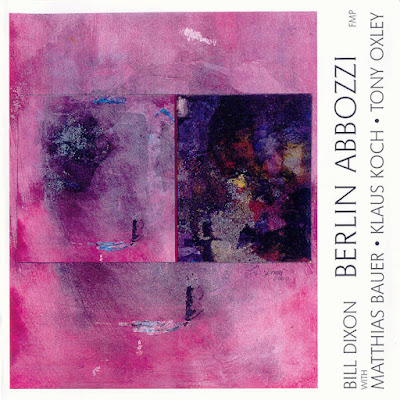
On Berlin Abbozzi, we hear Dixon alternate between electronically-treated work--the basis for much of the lengthy centrepiece, 'Open quiet/the orange bell'--and untreated work for muted trumpet. It’s hard to know which sounds more fragile (a favourite Dixon word): on the final track, ‘Acrolithes’, both the electronically-reinforced delay work, with its emphasis on extended silence and on texture (popping, blasting, gusting, whispering) over melody or even ‘note’ as such, and the more traditionally lyrical muted timbre of the acoustic trumpet, heard ruminating aloud about a third of the way through, seem to bring out different aspects of Dixon’s playing within each other, not so much as mutually reinforcing balance (weight/counterweight) as constantly morphing dialectic. And so, even as Dixon's playing, in his final recordings, moved further and further away from the (acoustic) note/melody approach to that of (electronic) tone/sound/noise, you can hear the ghosts of the former in the latter.
Showers of breaths, whispers, grunts, sudden blarts and blasts of noise, at once vocalic and machine-like, an aeolian series of gusts, eddies, and other airborne movements and a focused study in extension, decay and the perception of time. As Dixon remarked in a 2002 interview: "There is a feeling tone that has propulsion and the ambience of an enclosure that permits being inside the enclosure or riding the crest of it. It is hard to explain. One has to listen and try to get inside of the sound." The use of the term abbozzi provides one way in, referring as it does to the underpainting whose monochromatic base provides definition for the colour values in layers painted over it. Dixon again:
I like to do multiple layers. If it is done right, I can play three lines simultaneously. There is no trick to it. If I place the delay properly and long enough, I can play something against that, and something against that. That is my interest at this particular point. Reverberation takes the dryness out of the tone. I use three mikes: one for delay, one for reverberation, and a clear mike.
With Dixon's use of reverb and delay, every sound has its double, nothing dies away straight away: the sounds seem to fight off the effects of time and the weight of mortality and, if only temporarily, to win out a kind of floating, suspended space--part purgatory, part paradise--in which a process of reckoning and acceptance can be staged. In his concentration on extended techniques, his compression of the most minute gestures of lip and breath and valve, Dixon--as is commonplace to remark--made the trumpet sound nothing like a trumpet. But of course, this was really more trumpet like than ever, part of the dialectic of instrument and instrumentalist that has characterised Black music in America from the start. Over the ears, Dixon's approach reinvented the idea of the trumpet--the playing of younger musicians like Axel Dörner, Birgit Ulher, and Nate Woolley, or of his Tapestries collaborators Rob Mazurek, Taylor Ho Bynum, Graham Haynes, and his student Stephen Haynes, is perhaps unimaginable without him.
Weight/Counterweight, recorded in 2008 with two young percussionists--composer Aaron Siegel and Ben Hall, a student of Milford Graves and Jumma Santos--was released in a limited vinyl edition with no liner notes and only the barest of information, and thus received less attention than others in his final batch of recordings. But, of all these, it provides the most extended opportunity to hear Dixon as player from his late work. Working in a freely improvised context--though Dixon eschewed the division between composition and improvisation, insisting that he wanted even completely improvised recordings to sound as if they might have been composed (and vice versa)--Siegel and Hall are heard as much on tuned percussion (gongs, dowels, bowed cymbals, vibraphone, glockenspiel) as on drums, giving the music a floating, meditative quality punctuated by bursts of slowed-down drama, like a quiet, suppressed explosion. Meanwhile, Dixon as the only 'lead' instrument--though any distinction between 'lead' and 'support', 'leader' or 'rhythm section', 'soloist' or 'ensemble', figure or ground, is soon eradicated--can be heard without the dense textural weave of bassoons, saxophones, contrabass clarinets, cellos, and trumpets into which he inserts himself on the orchestral recordings: unadorned, vitally present.
In producing the album without liner notes--in contrast, for instance, to the extended essays by Stephen Haynes and Bynum on Tapestries, and its release alongside Robert O'Haire's 30-minute documentary filmed at the recording sessions--Dixon more than ever seeks to focus attention on the sound alone. Given this, the words above feel so much preamble to an event that they can never hope to capture. It's hard to give the music a chronological summary, given its meditative refusal of narrative, programme, or anything but the quiet intensity of its moment of unfolding. Perhaps it's architectural--the title to the first piece, named for Le Corbusier's studio, suggests so; or perhaps it's painterly--as per the title to the third, 'Contrapposto'. Or perhaps, as Dixon has himself admitted, the titles are a kind of poetic extension that comes after the fact rather than the determining shape of the piece.
There is no special way to view or see or hear. Make up stories if it makes you more comfortable. Find the music programmatic, but know it wasn't done that way. The music and the dance are what they are. There are no stories, no symbols. One day we won't even have titles--or our titles will be poems in their own right.
(Dixon, quoted in the liner notes to Intents and Purposes)
For me, the album concentrates the most into the twelve minutes of the second track, 'Hirado'. The piece leads off from a typical Dixon melody--three notes, spaced out and cracking round the edges--extended and delivered with such gravity and ferocious single-mindedness of tone that the minimal becomes maximal, a world contained in the progression from tone to tone, semitone to semitone. Feldman's work with the simplest of melodies in pieces like 'For Philip Guston' comes to mind--though their approaches are very different--here amplified by Siegel and Hall's use of resonant, chiming vibraphone like something directly out of late Feldman (and specifically, the Guston piece). Unlike Feldman, however, the concern isn't so much with interlocking series of melodic lines--an interlocking carpet-weave of patterns--but with a more constantly morphing texture. Gently, the three players seem to chase each other, become their own ghosts, echoing and spiralling out and giving the effect of additional players; or the trio concentrate down to seem like one spectral voice; and at any point, they seem conscious that they might as well shut up if they have nothing more beautiful to say than the silence around them. On a series of deep notes that push deeper and deeper, foghorn through the fog, dungchen from the mountaintop, the music transitions into flurries of activity, rolling glockenspiel and rolling drums that have picked up a clattery thing or two from Dixon's long-term collaborator, Tony Oxley. A succession of deep notes and breaths take things suddenly out: the sudden recession of the wind, the stilling of eddies on the waters, a cloud moving out of sight.
'Contrapposto' is whispers from the edge of consciousness, rumours from the sky; fanfares from the abyss, ram's horn blasts from beneath the earth. The title, referring, as so often in Dixon's work, to the tradition of Italian visual art he loved so deeply, implies dynamism and relaxation, mathematical proportion: yet this isn't about a flattened field of idealized beauty. Recall that contrapposto, counterpoise, provides a means of artistic balance through temporary dis-balance--the figure with weight on one foot, the other slightly bent. (Or, weight / counterweight, as per the record's overall title.) In this pose, the figure temporarily rests from movement, or prepares to take another step, caught between coming and going, frozen into the stasis of the artwork: movement in stasis, stasis in movement. Music, time-based and immaterial rather than plastic and fixed, refuses this balance--or, couldn't achieve it even if it wanted. And, if we've learned anything from the revolutions in sound ushered in by the New Thing musicians of the 1960s--Dixon not least amongst them--it's that the Greco-European Renaissance conception of harmony is, at worst inadequate, and at times complicit with, the racialized orders that form what, in his often-overlooked The Mask of Art, Clyde Taylor called "the aesthetic contract": what Sean Bonney calls "a hierarchy built on scalar realities that justifies social conditions on earth, where everybody is in their place, and nobody is able to question the beauty and perfection of these relationships."
What kind of a conception of beauty, or balance, inheres in Dixon's late work? Writing of the insistence on talking about Beethoven's late work in terms of death and ageing, "mak[ing] reference to biography and fate", Adorno wrote: "It is as if, confronted by the dignity of human death, the theory of art were to divest itself of its rights and abdicate in favor of reality". According to this account, 'reality breaks through' into art and gives it especial clarity that's supposed to be clear-eyed but ends up becoming, if anything, more mythologized than the artistic screen through which, like the rending of the temple vein after the crucifixion, it's supposed to break. By contrast, as Said summarises Adorno: "Lateness is a kind of self-imposed exile from what is generally acceptable, coming after it, and surviving beyond it". "Episodic, fragmentary, riven with absences and silences", "lateness is the idea of surviving beyond what is acceptable and normal. In addition, lateness includes the idea that one cannot really go beyond lateness at all, cannot transcend or lift oneself out of lateness, but can only deepen the lateness. There is no transcendence or unity". While "death is imposed only on created beings, not on works of art", the artist--aware of their impending death--places their artwork in ironic or allegorical relation to their death. As Adorno puts it, late works "do not surrender themselves to mere delectation". Dixon's use of electronics, and his years of study in developing a personal vocabulary of extended techniques, amplifies and abstracts the sounds of human breathing and vocalised noise--cries, whispers, sighs, reverberant moans--via the mechanical prosthesis of the trumpet and the ever-present extension and falling away of the delay effect, not as a facile analogy with death and cessation, but nonetheless, as Said puts it, as part of "the predicament of ending without illusory hope or manufactured resignation".
'The Red and the Black'--does it title refer to Stendhal's novel, with its motif of the titular card game, rouge et noir, and its combination of game-playing, chance, and the individual's negotiation of forms of order?--opens like a funeral march, rolling toms and a vibraphone melody--abstracted--with Dixon blowing spaced-out, single notes. To my ears at least, so much of Dixon's work--and again, it should be stressed, is purely the personal whimsy of one listener--seems to build on Miles Davis' solo on 'Saeta' from Sketches of Spain as the basis for an entire aesthetic--taking that depth, that maximalism of the minimal, that's only hinted at in Davis' performance, and building it into an entire world. And so, here, Dixon alone (with just the fainted bowed cymbal like the sound of the room around him), around six minutes in, like Davis as the solo voice of mourning on 'Saeta'; but whereas Davis, playing a part in Gil Evans' Spanish-oriented drama, declaims to the backdrop of a public procession, a noisy street band, Dixon whispers to himself, to whoever will still themselves enough to hear: what remains after the parade passed by, the stillness at the core of its activity, the abstraction to the centre. Over pitched percussion trills Dixon speaks out two final notes: melody reduced to its essence, "taking those things that shape and define it, stripping away the filigree"; a series of notes rising and falling, the placement of sounds in time and their cessation, moving, pausing, and then gone.