Showing posts with label Jayne Cortez. Show all posts

Wednesday, 19 August 2026

The Changing Same (Part 2) (Preview)

As ever with this kind of writing, there’s a whole range of other work I drew on during the research, which this writing is in concert with. More on the critical field available to subscribers at Substack by following this link.

Wednesday, 19 November 2025

November Updates

In the past few weeks, I’ve been working quite intensively on a long essay on Cecil Taylor’s poetry for what looks to be an expansive collection on Taylor’s work edited by Peter Valente. Having long thought a book like this should happen, I’m delighted it finally is! Taylor’s work has meant a lot to me for what seems like forever—certainly, since writing, or trying to write an MA thesis on his poetry back in 2011: a somewhat wobbly first step, or what Taylor himself would call an ‘Excursion on a Wobbly Rail.’

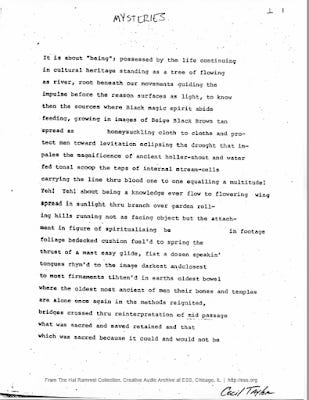
This latest iteration is part of what I think of as a suite of writing on Taylor’s work, particularly his poetry: a memorial post in 2018, a piece for Chicago Review in 2019, and an essay on Taylor and vodou for Point of Departure in 2020. It updates all that with some new reseearch—the conference on Taylor’s work at CUNY in 2019, Phil Freeman’s recent biography of Taylor, In the Brewing Luminous, a valuable chronological synthesis of existing materials and new interviews, and—not least—seeing a copy of Taylor’s unpublished poetry manuscript, Mysteries, of which the first page is above.

Besides that essay, I’m planning for other writing on Taylor, its final form yet to be determined, to find its place in two current manuscripts on music, Survival Music and Ensembles. Taylor’s work continues to mean a huge amount to me. An all-consuming music, an all-consuming vision. Here’s a bit of the work in progress:

In the film Imagine the Sound, Taylor speaks of making “the commitment to poetry”. But what did poetry mean for Cecil Taylor? Poetry was, I argue in this essay, where he theorized his artistic conception. It was poetry he credited with saving his life, and in turn, it became part of the way he understood the nature of life, his own life, and that of life in general; of how to live one’s life, of how to approach art with charm, with ferocious grace, and with the unstinting courage of conviction.

Lots to catch up on in the meanwhile....In the not too distant future, I’m hoping to post here some writing on Wadada Leo Smith and a report on the Berlin Jazz Festival. Some other things are in the works as well. For now, news and some capsule reviews, notices of new work...

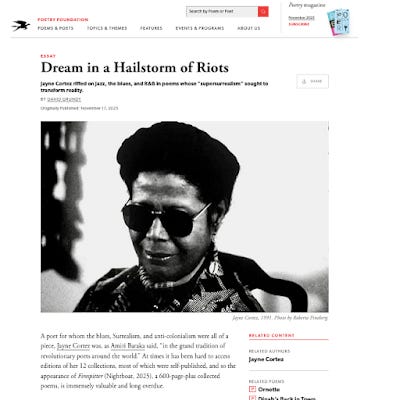
—‘Dream in a Hailstorm of Riots’, a long piece on the new collected poems of Jayne Cortez, is up at the Poetry Foundation.

From the mid 1960s through the early aughts, Cortez wrote about the political crises of her times: Attica, Allende, Palestine, Rwanda. But like fellow African-American Surrealists Ted Joans and Bob Kaufman, she was as interested in transforming reality as in documenting it. She bursts generalities and stereotypes in startling catalogues of surreal images that build around repeated phrases like the riffs of an improvising soloist. In her work, observations of everyday life and political events turn into dream visions, apocalyptic landscapes, meditations, and exhortations that crackle with energy, rage, and love. Above all, she is perhaps the poet of what her generation referred to as “The Music,” the various traditions of jazz, the blues, and R&B that soundtracked the freedom dreams of the Black liberation struggle. Cortez wrote poems in tribute to musicians and led her own band, the Firespitters, for decades. Hers is a voice—both on and off the page—that speaks with authority, curiosity, and an unshakeable faith in the power of poetry to change consciousness and change lives.

—Honoured to receive this attentive review by Eric Keenaghan of Never By Itself Alone at Resources for American Literary Study. Eric’s own work on queer coalitions, and with the writing of Muriel Rukeyser is, are necessary projects of historical reclamation and reminders of traditions of principle, resistance, and the complex negotiations of struggle for committed writers in times of crisis—needless to say, perhaps more relevant than ever.

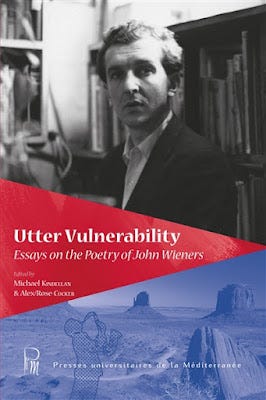
—An essay on John Wieners from almost ten years(!) ago, now in print in Utter Vulnerability: Essays on the Poetry of John Wieners, edited by Michael Kindellan and Alex/Rose Cocker, published by Presses Universitaires de la Méditerranée. This was the first thing I wrote after handing in my Ph.D thesis and it feels like a signficant part of the work I did since then flowed out of this way of thinking. It’s about love and poetry and fire and Wieners’s relationship to his first love, Dana Durkee.

This chapter addresses what John Wieners claimed was the most important romantic attachment of his life—that with his partner of six years, Dana Durkee—and the eventual ending of that relationship. As I’ll show, this loss can be said, in part, to have prompted Wieners’ fully-fledged entry into the world of poetry, prompting the composition of his breakthrough volume The Hotel Wentley Poems (1958), and it seeps into the minute fabric of his language itself, whether through conscious acts of address, revision and removal, or sublimated elements of textual echo which at once memorialise and disavow the object of loss. By introducing this element of biographical resonance, I do not wish to reduce Wieners’ poetry to a pained lyric exceptionalism, the poet as an exemplary figure of suffering removed from the social conditions that produce that suffering. Rather, such information serves as a means of heightening the way loss and despair intersect with socially produced domination, and the problems of community and desire in the face of persecution and its constant threat. As Denise Levertov astutely noted in 1965, in Wieners’ work, “Confessional” subjects such as mental breakdowns and the pain and loneliness of queer love are “not autobiographically written about, they are conditions out of which it happens that songs arise”.

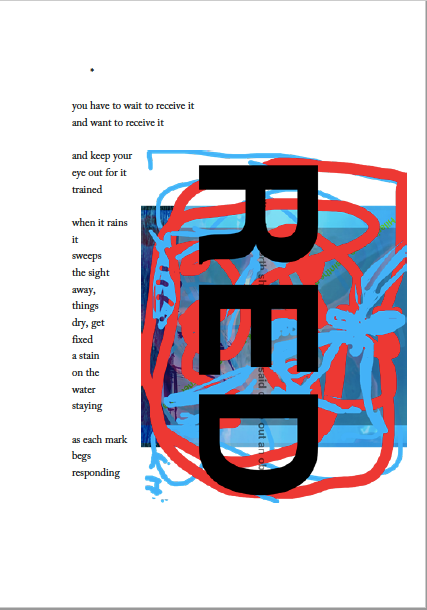
—And last but not least, I’m very pleased that CJ Martin and Julia Drescher’s Further Other Book Works have taken on Abstractive, the book of poems and visual art works I wrote with the great Candace Hill Montgomery last year (with some final tweaks this past month). More details will be forthcoming. For now, as a sneak preview, here’s a page of the manuscript….

Wednesday, 12 March 2025

Recent Poems Read

--Asha Puthli on ‘What Reason Could I Give’.


--Christa Wolf on dividing skies.

--Jayne Cortez telling us that ‘There it is’.


~~

It’s been a while since I’ve done this, so just some reports on some of the latest books to have made their way from the letterbox onto my table, where the shelves have run out of space and the piles continue to pile up. First up, a package in the mail from Michael Klausman and Patrick Tiller’s Colorado-based wry press, continuing their acts of unexpected and pleasing acts of careful recovery and shepherding into print. 
The Cobra King is a small, posthumous book of poems by Oswell Blakeston, whose pseudonym contracts the two names of Osbert Sitwell, or reads, alternatively, as “o swell”. A former drinking buddy of Dylan Thomas (“mouse” to Thomas’s “rat”, so the preface tells us), Blakeston was very much part of the British modernist scene from the 1920s on, though he remains under the radar: among other things he made what is reportedly the first abstract film, watched by Buñuel, wrote prolifically for the important film magazine Close-Up, and was a key part of the circle around Bryher; as well as his involvement in film, he was a painter, a writer of cookbooks, travel books (one of which saw him banned from Salazar’s Portugal), mystery novels and poems. Ian Young’s introduction—which recalls meeting Blakeston in a London pub while editing his gay poetry anthology The Male Muse in the early seventies, and recalls among other things Blakeston’s outré anecdotes of the German dancer, performer and actor Valeska Gert—suggests that there were as many as one hundred books and chapbooks over the years. The Cobra King comes from typescript in the Harry Ransom archives in Austin: described by Blakeston as his “beefcake poems”, they’re short and pithy with a wicked streak, memories of queer love or lust, come-ons, put-downs, alternately melancholic and joyful. The pick of the bunch a free-verse couplet half-way down a poem: “Make love until / we have no faces”.
If the Blakestone book is petite, pocket size, Paolo Lionni’s Headlines is widescreen, the page stretching out to extend the long lines of Lionni’s mixed prose texts and poems, largely emerging from London’s countercultural milieux, and lovingly assembled by Klausman from various underground magazines and from the 1962 manuscript which gives the book its title, found in the papers of yet another neglected poet, Philip Lamantia. More links with the film underground around the likes of Piero Heliczer, including a prose text originally written as the script for an unrealized surrealist film set on an Italian train. As the title suggest, newspapers form an important source, in found text re- or de-contextualized or satirically paraphrased, along with more gnomic addresses to poets like Corso and Ginsberg. As the biographical note suggests, these were mainly the product of Lionni’s itinerant twenties, bursting with energy, and culminating in a kind of ecstatic manifesto, ‘To The Queen’ first published on the front page of the International Times in 1966 after a copy—collectively signed by, among others, Rosemary Tonks, Michael X, Harry Fainlight and Brian Patten—was sent to Buckingham Palace. In such work, as with Blakestone, poetry is perhaps one of many modes, not just of art, but of living: the scattered fragments of a life lived on the move, the very incompleteness and sometimes disjointed energies of the work are a part of its spirit, which tugs at the corners of the pages as if yearning to jump onto the street or road or boat once more.


Not an archival project, but recent poems: Ken Bluford’s Skip Tracing is the first full-length collection, following the collaboration with Tom Weatherly, Climate/Stream. Bluford was part of the scene around Middle Earth Books in Philadelphia, including Bockris-Wylie, hung out at the Poetry Project and Slug’s Saloon, and is, the bio note informs us, the brother of Guion Bluford, the first African-American astronaut in outer space. The 145 pages of poems here were largely first published as facebook posts, antidotes to the ever-shortening streams and screeds of today’s social media platforms and their intersections with the mendacities of US national (and international politics). Bluford instead offers wry, ironic or tender, measured reflection on a variety of subjects: here, for instance, the noirish Robert Mitchum western Blood on the Moon might make an appearance alongside Al Green or Charlie Patton. Bluford’s (non-exclusive) preference is for four-line stanzas, often capped off with an incisive couplet that introduces a new resolution or note of ambiguity, plentiful enjambment constantly moving the twists and turns of poetic thought against the interrupter or continuation of the line-break. The bio notes the way the poems combine the responsive nature of improvisation with the careful workings of form, elements that true students of improvisation knows are in no way incompatible—the paramount example, perhaps, Coltrane’s warp-speed working-through of patterns in ‘Giant Steps’, a track Bluford recalls from a street a few blocks away from where he lived and workshopped and woodshedded, as the “revolving drums” of a concrete mixer merge with a drumset, a Coltrane mural whose blues suggests waves of water or sound, across the stanza, a poem about keeping the memory alive as the mural fades--as one of the tasks of poetry is to keep a cultural memory that fades into nothing even in the very guise of being re-branded, re-marketed and sold on any number of online platforms. Poetry knows a history in the crevices, in the metaphorical association, the quick flash, that the poem taps into with a patient speed: not so much, perhaps, the famous breakneck up-tempo of the famous recording in which Coltrane suddenly calls double, triple, quadruple, quantum time, but one of the slower, earlier takes heard on the Heavyweight Champion boxset. (Not that ‘slower’ means slow.)


(The group’s conversation on the first alternate take, transcribed by Vijay Iyer and Steve Coleman. Coltrane opines “I don’t think I’m gonna improv this—I ain’t goin be sayin nothin, tryin just, makin the changes, I ain’t goin’ be tellin’ no story...Like, tellin them black stories.” “Shoot. Really, you make the changes, that’ll tell em a story.” “You think the changes are the story!” “Right, that’ll change all the stories”. “I don’t want to tell no lies!” “Changes themselves is some kind of story”. The melody, the chords, what rides both to twist away from it.)

One of the sharpest of the political poems, ‘Self-Defense Poem’, avoids the mode of elegy that many of the better-known poems emerging from Black Lives Matter and the Floyd Rebellion have adopted, instead deploying a mordant and incisive irony against the white-right-ring militias and their hysterical fears of antifa and black life, and the rewriting of cops as potential victims of assault who must shoot first, ask questions at the inquest. Imagining that they’ve shot a cop in pre-emptive ‘self-defense’, the poem concludes: “And if I was photographed having a drink or two // With fellas from Antifa with time to kill / Who’s to say this poem isn’t aimed at you”. The tone of world-weary—yet not resigned—wisdom, chastened compassion, or a quick and cutting take-down of the lies that justify continuing anti-black violence, calls to mind the later work, say, of Lorenzo Thomas, in Dancing on Main Street: sometimes in the pacing and tonality too I hear echoes of Bluford’s friend—and Thomas’s literary executor—Aldon Nielsen, who’s thanked in the acknowledgments, and who is himself on a streak of fine poetry books of late—the Selected Poems edited by JP Marcoux from Blazevox a couple of years back, and most recently, the recent book-length interview-cum-autobiography Memewars with E. Ethelbert Miller. Either way, Bluford’s is a very fine first full-length—at the age of 75!—and deserves the expanded set of readers I hope this publication will land it.


Following the trail, also from Blazevox and in the mail, is Edric Mesmer’s Tides that Dont Perturb. As librarian at the University at Buffalo—he was an excellent host when I did archive research there in 2022—Mesmer has excellent knowledge of Buffalo’s literary and artistic lore, and a fine line in bibliographic research with the Among the Neighbors pamphlet series. Buffalo provides some of the referential landscape of these poems, including my favourite in the book, a tribute to Cornelius Cardew, who worked on the manuscript for Treatise while on a fellowship in the town in the sixties—the original version of the score published by Gallery Upstairs Press, who put out the chapbook Pressed Wafer by another temporary Buffalo resident, John Wieners, the same year. On that archive visit, my train out of town towards Massachusetts was delayed for over an hour, I think because of snow: at the station I met a couple who told me stories of the campus in the sixties, the architectural history of the town, a wealth of connections and cross-connections and a generous encounter that stayed with me, but I could never remember the names—until Edric identified them as Max Wickert and Katka Hammond just this past week. (A poem is dedicated to them in the book.) It’s connections like that, coincidences or dots joined up, that the poems specialize in, but that’s not their motivating method, more a part of their texture. The poems have something of the crossword puzzle to them, the pleasure of teasing out their careful and multiple allusions, often framed through classical mythology, but they also have the pleasurable spark of language that doesn’t need to be deciphered to be richly enjoyable, as the sound and play propel forward across Dickinsonian dashes—“trying to capture the cadence of thoughts, and ruptures”, as Edric puts it, in a time when thinking has become fragmentary and disjointed, to make the connections or leave them hanging there. During one of several memorial panels for Tyrone Williams at the Louisville Conference on Literature and Culture this past February, JP Marcoux talked about Tyrone’s use of the em-dash in relation to Fred Moten’s notion of the break, to the picket lines of a sanitation strike, as a pause or a connector which might reach across from life to death and back, an image I just can’t get out of my head: in Edric’s poems, I’m thinking of the em-dash as a bridge, a rope one perhaps, over the yawning abysses or tides that open up under us as we teeter forward into this bad new year. Like stumbling by chance into a talk on St Francis, staring at an aquarium, counting the syllables, moving ahead into the light.


Finally: from the other side of the Atlantic, Tom Crompton and Dom Hale, two thirds of the Poets Hardship Fund, have put together a beautiful petite chapbook from Tom and Alex Marsh’s Gong Farm called Mud Ramps. It’s a prose text of less than a dozen pages—eight to be precise, in fourteen paragraphs—and calling it a prose poem risks putting it too safely in a generic box, but it is in prose and it is fundamentally and committedly about poetry. Perhaps it’s more like an essay, but then, really, it’s a poem, or an essay, or both, in prose, but really, in language. It’s a petite book, with a lovely cover image by Amy Todman, printed at the Leeds Footprint Workers Co-Op, and that size, the modesty of scale speaks to its humility of ambition. It’s not small because it’s seeking to be a collector’s item but because that smallness of scale is where we can widen our view, slip it into our pocket or a letterbox, a carrier pigeon coming in off January winds to bring us a message for the turning of the year. The pamphlet has a polemical edge too—the text feels like a manifesto for our time—but the polemic has a generous edge, and it builds itself, not by defining an in- or out-group in the classic mode of the manifesto. This isn’t about building a movement or a group, but a manual for anyone to use. Like a poem it’s sometimes obscure in the best ways, and it’s in the obscurity that the clarity, really, is to be found: you feel it wandering on the edge, shaded by the landscapes of the north of England or elsewhere, their vocabulary—kerb, cairn, calyx moorsense, borage, scrim—echoing the work of Barry MacSweeney and Maggie O’Sullivan it’s informed by. (O’Sullivan, along with Stephen Rodefer, provides one of the epigraphs, opening up a world in just four words: “Poetry finds my life”.) A few years ago, in an interview broadcast, of all places, on Instagram, the late Jean-Luc Godard said that the Americans invaded Iraq in order to capture the birthplace of writing. I remembered it as him saying they wanted to invade Iraq in order to destroy language from its source. Either way, he’s being proved right as the swirl of banalized language in this era of Global English swallows itself up under the sign of Trump and Musk—what the opening page of Mud Ramps has this down pat in identifying as “the virtual extraction void”, “bot-language” the “devouring machines”. AI is no longer an early millennium sci-fi flop by Stephen Spielberg but the consuming future of warfare, our lives, as Europe rearms and the US inclines itself more and more to domestic neo-fascism. Once you start reading it’s tempting to quote every other line: the best thing, though is to read it yourself. Paraphrase dilutes the mellifluous fluency of its phrasing. But here’s a run-through, some tunes from amidst the overall flow of the song: plotting counter-landscapes, “inventing scales to measure”: the image of the tuning fork in the traffic, “remaking languages is always the first and last principle”, “it’s not freedom but discloses it”, the dissonance of collective life, Dorothy Wordsworth “hallucinating drills and airstrikes” and calling Tom Raworth on the phone to reflect on the making or destruction of landscape. And: the momentary and stupid beauty of the poem that becomes history, down crumbling lanes of the heart, “the ancient and futural horizons of poetry that emulsify all living writing with the brilliant dead”, and the penultimate sentence, what is at the text’s core—“so that who we are is really unimportant in the language”—as what a poet offers is an air that remains beyond the life or name that gave it breath. And so this text, its collective resonance, reverberation, something for the road, for the year ahead. I’m very grateful to have this and I recommend it highly!
 
~~

So ends the round-up. More to come on various things, including Theodore Harris and Amiri Baraka’s Our Flesh of Flames, out in expanded full colour reissue. Still wanting, too, to write on Elaine Mitchener’s stupendous record Solo Throat from last year, to finish off other manuscripts, other projects, tidying, collecting, sifting. More, in time, to be revealed, whatever the rest of March and beyond chooses to bring.

Wednesday, 6 November 2024

Festivals and Funerals / After the end of the world


It can be both too easy and to difficult to pick out what is world historical amidst a barrage of doom, defeat, and pessimism, the constant absorption of shock as a new norm. It now seems that the pandemic rolled out in the middle of what we can now understand as the Trump era: first as tragedy, then as tragic farce, the two elections of Donald Trump as president of the United States. Last night, as the US presidential election took place, I had a fever dream that I lived in the DDR, experienced, my dream notes say, as “a benevolent but spirit sapping simulacrum”, everything soundtracked to ‘Holiday for Strings’, which I think I heard the Sun Ra Arkestra play this weekend. 

In the waking world, yesterday, alongside the election result in the US, in Germany, a terror plot to establish a Nazi state. In Gaza, in Lebanon, the mass slaughter without end. In a talk on the Society of Black Composers, before the results of the election had come through, Harald Kisiedu opened by discussing the recent rise of the AfD in Germany, while noting that, in 1967, a survey suggested that seventy per cent of white Americans thought Civil Rights reforms were taking place at too quick a place. Sixty years on, from Trump to Björn Höcke, ‘remigration’ is the trope of the day. As Kisiedu suggested, the creolizing influence of Black music within German culture fostered during Weimer was one of the first targets of the newly legitimized Nazi regime, part of the creeping force of ‘degenerate art’. Today culture perhaps plays a less obvious role as target of fascist discourse. What musical culture do contemporary German fascists have? Schlager for days. Disco hymns to tolerance with their lyrics re-written to fascist ends, sung on holiday islands. That’s the fascist festival. Celebration of sadism. Celebration as sadism. At his rallies, Trump picks and choose any number of songs as if distinctions of genre or sound or tone have no real meaning, dances alone, as if dance itself were not a communal form but the disconnected moves of a man exercising a form of arbitrary, illogical power. “Let’s not do any more questions. Let’s just listen to music. Let’s make it into a music. [sic] Who the hell wants to hear questions, right?”

An email I received the other week asks whether, in such times, music is “spur for revolutionary consciousness” or instead for “self-preservation”? What kinds of community does it create? The music that claims--or perhaps, no longer even claims--to be the most revolutionary plays to the smallest audiences, and the music for mass audiences turns even the images of mass politics, mass resistance, into spectacle, colludes with dictatorial regimes, covers over, keeps up the charade of democracy (Julius Nyerere: “The United States is also a one-party state but, with typical American extravagance, they have two of them.”) Here music is both powerless and, in a time of culture wars and the apparently serious use of the term ‘cultural Marxism’, (left-wing) culture is at once endowed with a seriousness and an impact it has not seemed to have for years and turned into a kind of hollow charade, a parade of within the increasingly totalized culture industry.  Thinking of Trump’s victory in the election, and the parade of stars, from Beyoncé to Cardi B, who came out in support of Kamala Harris, Harmony Holiday writes
I believe that, in a final assessment, when it’s all underground or sea, black music will be one of the only redeeming elements of this empire, the poetics of inevitability black music insists upon, so much [...] It is black music that governs the US, that gives it a legible pulse and makes it a real place and not a full time amusement park for disaster capitalism, but when that music grows too shallow and ‘popular’ to face its own heartbreak, and change, [it] starts pretending to be hard and declaring itself a winner of a race everyone is losing and limping through [...] You thought this was a party and not a funeral.

Festivals and funerals, the two terms on which Jayne Cortez’s poetry collection of that name turns, thinking of the funerals of leaders, of activists, of musicians she’d attended and witnessed and absorbed in the years of assassinations at the end of the 1960s and the beginning of the 1970s: Fred Hampton, George Jackson, Martin Luther King, Malcolm X, John Coltrane. How to turn the funeral into the means for organizing, the spur to continue, rather than the dead end of grief, as Jackson put it shortly before his death in Blood on My Eye

People’s war is improvisation and more improvisation [...] Improvising on reality is the key principle underlying the building of a united left and raising the consciousness of the people. Even funerals can be used as an issue, since there will be so many of them. . . . [They] should be gala affairs, of home-brewed wine and revolutionary music to do the dance of death by. 

Today no one even speaks of people’s war, or of a united left for that matter, though improvisation is still an issue. But the question remains: how to prevent the funeral parade of American death and its global export from being presented as a festival, a celebration, ringing hollow as the last vestiges of this latest failure to prevent a Trump presidency are cleared away, the memes and tropes, Brat Girl Summer and the rest, and then how to prevent the reaction from sinking into a simple despair or a simple numbness, a seeming inevitably, each time a shock is felt its impact less keen. And to reckon with the fact that, for all the lies and manipulations, Trump’s election to power is token not simply because of election-mongering, voter fraud, the entire atmosphere of intimidation and violence, the billion-dollar power of right-wing tech bros, the Elon Musks of this world, the official and the unofficial media alike, not simply because of the crushing force of the oligarchy and the latter-day robber barons and their running dogs, but because people, voters, actively and sadistically desire these people to be in power, because people hate women, because people hate migrants, because of the sadism of that desire, whether on the part of the rich who vote in their own class interest, the feeling of strength in what is in fact classed and raced and gendered strength, or the illusory feeling of strength from those who vote against their own interests, the feeling of strength in what is in fact a condition of weakness, even at the cost of their unfreedom. How to fight that? How to go beyond it? If we are now living in what is, essentially, a fascist world, what do we do? These are both new and old questions.

When a US flag was flown during an Archie Shepp performance at the Donaueschingen Festival in the late ’60s--thus implicitly positioning Shepp as avatar of jazz as US imperial export, of Willis Conover or Nicholas Nabokov, of the Congress on Cultural Freedom, rather than that of his own politics, deeply opposed to US imperialism and domestic racism--Peter Brötzmann tore it down. And, as John Szwed recounts, during a concert in Central Park Ra’s Arkestra gave in Central Park: “At one point [...] the Arkestra hit a screaming space chord, and the large American flag stretched across the back wall of the band shell fell down. With that, Sonny abruptly ended the concert.”

As Ra famously put it, “it’s after the end of the world...don’t you know that yet?” After the end is where to begin. The end of history. The end of the idea of the end, that we have somehow transcended or gone beyond both the fascisms of the past and the freedom dreams of the past, those forbidden black and red dream of communism and socialism and abolition. The radical tradition, the continuity that preserves memory even in its transformation.  

A few days after the Brexit vote and a few months before the first Trump victory in June 2016, Sean Bonney wrote:

Nothing stops. Nothing speaks. [...] Now, a couple of days after the referendum, it looks like [the civil] war has started. It won’t be declared. Every declaration, every sentence spoken by every public figure has been a lie. [...] We’re deep inside the apocalypse now. 

What’s needed,

a collective effort to get us through to the other side. No sleep. No dreams. Just a grim determination to defeat those fascists who would murder us, to cast them intact into the hell of worms.

After the end of the world, within its ending. After the end, in the beginning.