Showing posts with label Hip-Hop. Show all posts

Saturday, 15 August 2026

The Changing Same (Part 1) (Preview)

Preview of a two-part Substack post on jazz and hip hop poetics.


The next two posts here will explore some background to two book chapters I worked on in the past few years, both just published in edited collections. In the next post, I’ll write more about “A Question of Form: Jazz in Joans, Kaufman, and Cortez”, a chapter in The Cambridge History of African American Poetry, a monumental volume edited by Keith Leonard. This first post, though, focuses on “Nation Time(s): Jazz and Hip-Hop’s Changing Same”, published in Hip Hop and American Culture, also from Cambridge University Press, and edited by academic and Wire magazine columnist Rob Turner. The book chapters themselves will also be available to subscribers behind the paywall.

It is—or should be—uncontroversial to say that the criminalized treatment of contemporary hip hop artists is hardly different in content to that of the blues and jazz artists of the past—in itself a continuity, though hardly of a desired or desirable kind. Nonetheless, the question of whether hip hop, half-a-century since its inception, fulfils or negates various traditions, radical or otherwise, can be the subject of some controversy. At stake in hip hop’s use of jazz as lyrical and sonic trope is the status of cultural heritage, perceived relations to history and community and the question of what this music, what any music, does, the question of what it can or could or should do.

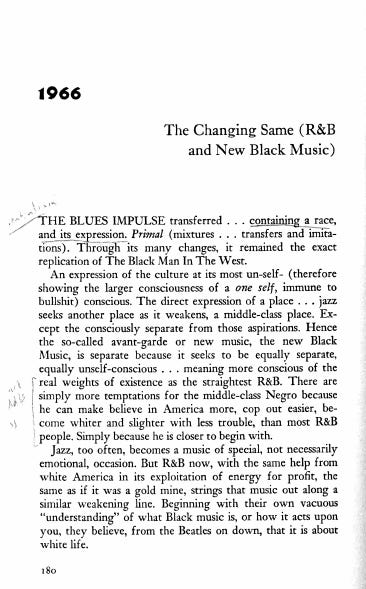
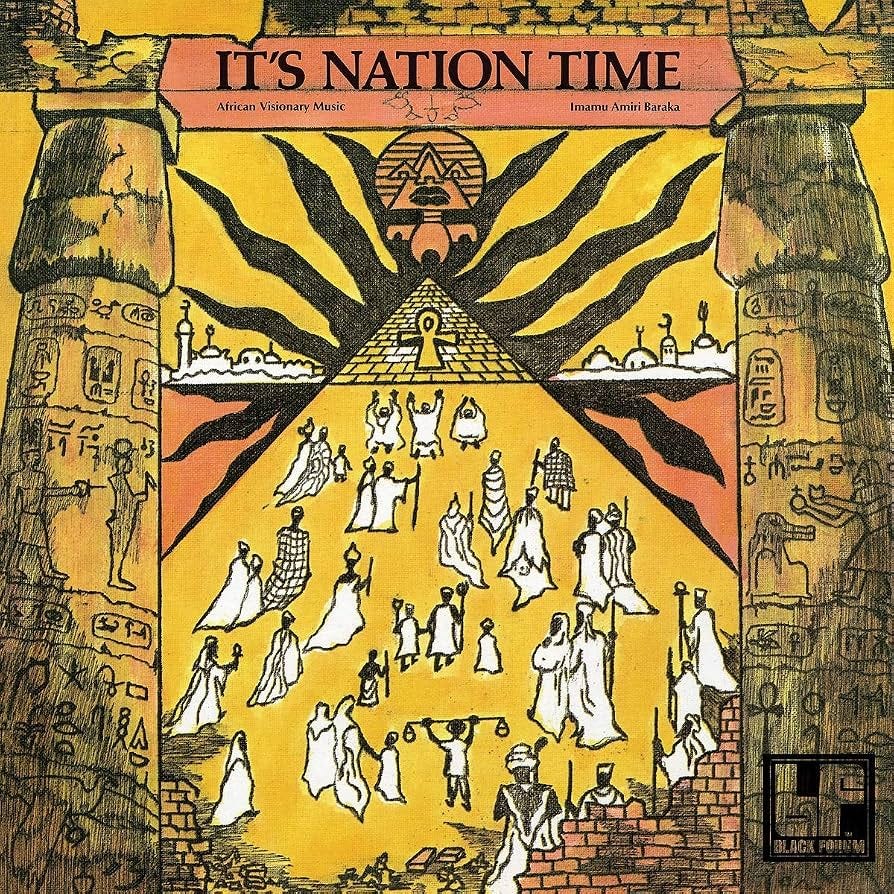
The chapter focuses on the relation of jazz to hip hop via Amiri Baraka’s notion of the “changing same”, and proceeds through some close readings of lyrics and jazz samples from “Golden Age” hip hop. Baraka’s 1966 essay caps off Black Music, that still-foundation survey-statement on the jazz of the decade’s first half, and the New Thing, the New Black Music, free jazz in particular. As Baraka started to conceptualise how the Black Arts might expand, political coalition-making had its artistic equivalent. Popular art, so a simplified version of the argument might go, had a social appeal that the New Music lacked; the New Music had a political content or focus that popular music lacked. Each could infuse the other: a coalition aimed at challenging the economic, aesthetic and political structures within which Black music and Black musicians were presented and exploited. Baraka himself put this into practice not only in his criticism but in his own artistic work, recording his own poetic-musical collaborations across doo wop—Black and Beautiful, Soul and Madness (1968)—free jazz—A Black Mass (1968), with the Sun Ra Arkestra, and ‘Black Art’ (1965), with Sunny Murray et al—and the combination of four separate groups, each within a different genre, on It’s Nation Time (1972).

Such work is, in turn, fairly regularly cited, along with that of Gil Scott-Heron, The Last Poets, and the Watts Prophets, as a key precursor to hip hop. So the story goes, a form of poetry-with-music that grew out of, and often had as its subject, the heritage of blues and jazz, evolved into what would ultimately become a multi-million dollar industry, shaping the global sound of popular music.

But there is, of course, some ambivalence here. In his later writing on music collected in books such as Digging, Amiri Baraka himself espoused the position, fairly standard among those of the Black Arts generation, that hip hop was of value when more politically outspoken, when continuing the specifically political frameworks associated with Black Art. The artists of value were Public Enemy or The Roots, with the latter of whom Baraka recorded that astonishing version of ‘Something in the Way of Things (In Town)’. Not party music, but Party music (“and when you asked what truths their party taught…”) As with the coalitional impulse of R&B, free jazz, blues, and oral poetics espoused in ‘The Changing Same’, it was the more niche forms of art—as jazz had become, as the New Music had generally remained—in which aesthetic and political values were enshrined, while popular music was too easily susceptible to capitalist capture, to the self-perpeutation of stereotype, and to a-political hedonism or nihilism. When not guided, it went off track—which was precisely when it became popular.

Baraka turned to Marxism-Leninism a few years after recording It’s Nation Time, and the Leninist strain to this argument is aesthetically prefigured in its Nationalist iteration in ‘The Changing Same’ era. The Advanced Workers, the Vanguard, emerging from within the masses, have to direct the masses away from the distractions of disco or gangsta rap and towards consciousness, towards revolution. At the same time, they must work within those forms to shape them, and the aesthetics of those forms rub off. Pleasure and its precise direction becomes hard to happen, libidinally wayward. Perhaps nowhere is this better illustrated than it Baraka’s attempt to make a disco record, the 45” recorded with the Advanced Workers and the Anti-Imperialist Singers in the later ’70s, in which he literally gives a speech in the middle of the record, while, over danceable beats, singers chant that their listeners should not be dancing at all, but “marching in the street”. It’s a dialectical move, and in itself, a clever twist on the way that Martha and the Vandella’s ‘Dancing in the Street’ was repurposed as an anthem of urban protest in the previous decade. But can the dialetic be guided this way? Is this how art works?

The rest of the essay is available to subscribers via Substack here.

Wednesday, 5 August 2026

Stolen Moments, Broken Epics (Preview)

Preview of a subscriber post on Substack on Nellie Wong and Harmony Holiday.

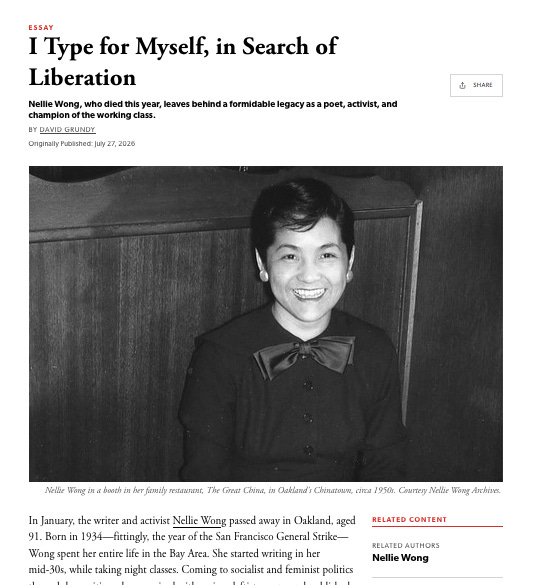
In the past month, two articles of mine on two quite different poets appeared in The Poetry Foundation and the newly founded Hythe Review. This post goes into a bit more detail on the background to those pieces and serves as an additional tribute to the late Nellie Wong, who passed away earlier this year.

It’ll be followed in the next while by material relating relating to two further recent publications, on jazz poetics and on the relation between jazz and hip hop. More on those in due course.

Nellie Wong: Typing Back

Based in San Francisco for many years, Nellie Wong features in a chapter of my 2024 book on Boston and Bay Area queer poetry, Never By Itself Alone, focused on her comradeship with fellow poets and activists Merle Woo and Karen Brodine. Wong wrote of labour, of class struggle, of family history. Her first book appeared in the late 1970s, when Kelsey Street Press published Dreams in Harrison Railroad Park; her final book will appear posthumously in this new century, now moving beyond its first quarter.

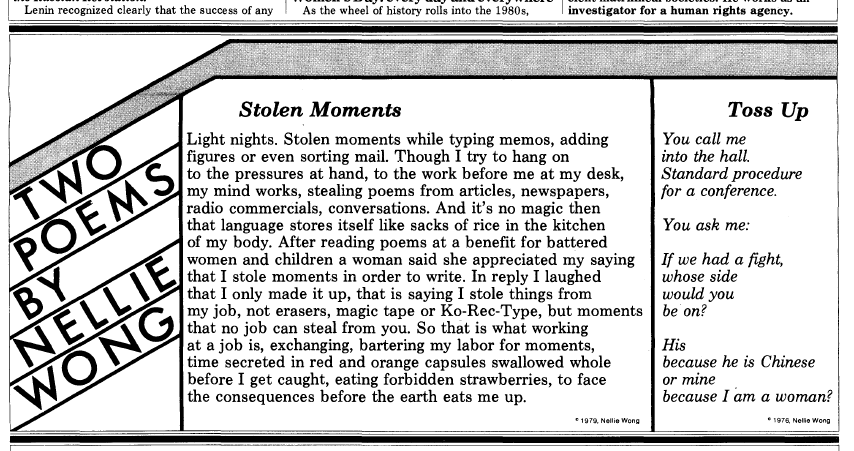
Employed as a secretary, typing others’ words, Wong used her own poetry and prose to write back, to write over the words of bosses. To write, Wong reminds is, is also to be involved in labour—physical labour, or labour that removes traditional, hierarchical distinctions between intellectual and manual labour, that attempts to deny the workings of the mind within the workings of the body and of the body within the mind. Poetry, activism, and education were a way out of those frames and into herself, into the fullness of her own life, but using precisely the means of that gendered labour—the typewriter, reproducing the words of others as a way of reproducing oneself for a wage, become now a weapon, a way into words and language and struggle.

To type back, Wong discovered, is to fight back, to discover and invent, to transmit. There is a friction here, and it is this friction that poetry operates like a lever. To type back is not the current invisibilising process of automation, of Large Language Models which anticipate and erase waged labour without any alternative recompense. Rather than the erasure of bodies, such writing attests to their presence within the system, insisting on their agency, their potential for sabotage, and their own inherent worth.

An early draft of Nellie Wong’s ‘Stolen Moments’, published in the Freedom Socialist newspaper in Spring 1980. A revised version forms the title poem to Wong’s 1997 pamphlet.

Last year I was privileged to attend an online discussion with the socialist feminist organisation Radical Women. Wong was involved with both RW and the affiliated Freedom Socialist Party until her passing, and was there herself on the Zoom call. I was deeply honoured by her presence, and struck by her modesty. Here’s the conclusion to the Poetry Foundation piece:

An individual writer’s work makes a contribution toward something whose contours will exceed those of their own life. “You will not survive the work that still needs to be done,” Wong wrote back in 1981. “You will be gone when the questions of the future arise like wildflowers on the plains of this earth.” To write is to live, but also to accept death. Wong’s late poems reconcile themselves to transience in the belief that human struggle might build a better world. As she wrote in “Under Our Own Wings” in 1979:

If you begin I begin
If you sing I sing . . .
In death our bodies regress to the innocence of bones.
In love we work to live in America under our own wings.


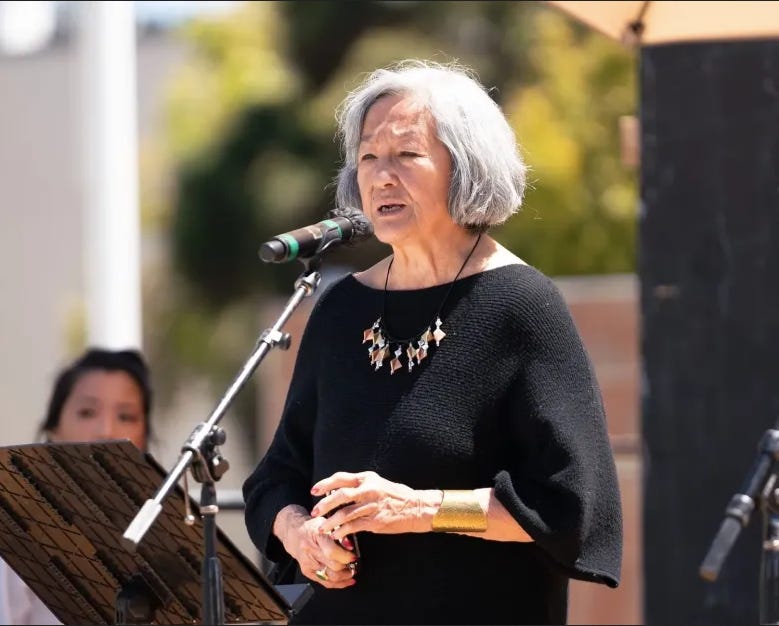
Nellie Wong reading at the Generations of Power festival in 2022. Photograph © Mark Shigenaga, via The Oaklandside.

Beyond the introductory work of that article, readers should head straight to the source. There are multiple rare recordings of Wong available at the invaluable Archive.org, among them:

—a 1978 reading with Susan Griffin (including the unpublished dialogue ‘The Interrogation of Ms. Security-Runs-A-Risk’);

—speaking on Asian American writing for KPFA radio the following month;

—Allie Light’s 1981 film Mitsuye and Nellie: American Poets, featuring Wong and Mistuye Yamada, who is at the time of writing an astonishing 103 years old;

—reading her comrade Karen Brodine’s poems in Washington for Radical Women in 1991, as well as delivering a lecture on ‘Racism, Sexism, and War’;

—interviewed on the KMVT15 Community Media TV channel, in a programme entitled ‘A Banquet of Poems’;

—and speaking on family and creativity with her siblings Flo and William at the Headlands Center for the Arts in 1996.

Wong’s illuminating 2017 reading and conversation with Genny Lim at the San Francisco Poetry Center can also be accessed via the Poetry Center website. In July 20025, she read with the Laborfest Writers Group at Bird and Beckett Books: the full reading can be viewed on Youtube, as can the memorial reading held in January 2026. A lovingly-maintained website can also be found here. And the organisations with which Wong was involved—a part of her life just as important to her as her writing, and inseparable from it—can be found at their respective websites: Radical Women here and the Freedom Socialist Party here.

In these traces, in her work, in her impact on many lives, Nellie Wong lives on.


Harmony Holiday’s broken epic

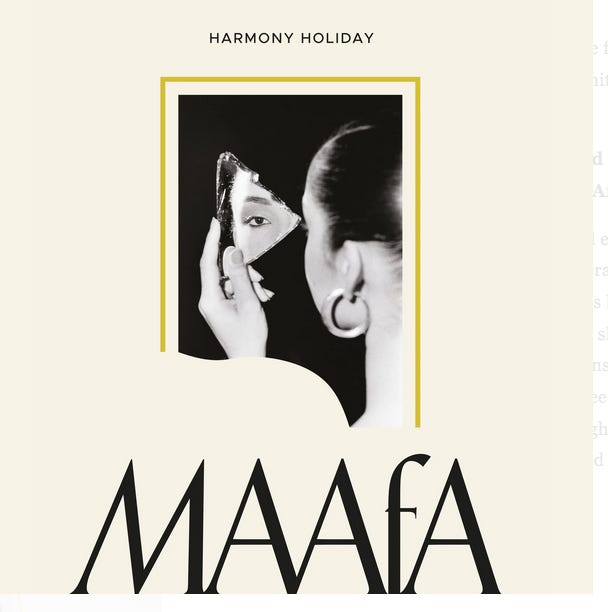
Also just published, a review of the expanded UK edition of Harmony Holiday’s epic poem Maafa, on The 87 Press’s new open-access journal The Hythe Review. For those who don’t know, Holiday’s Substack, Black Music and Black Muses has been running for several years and documents her ongoing writing on music. But music suffuses almost everything Holiday writes: her essays, her ongoing biography of Abbey Lincoln, her collections of poetry.

Maafa’s soundtrack would be Prince; it would be Pharoah Sanders; it would be the music of Holiday’s father, Jimmy Holiday, of Billie Holiday, to name some of Holiday’s touchstones, those named within its pages and the pages of her other books. 

The rest of the post can be read by subscribers on Substack here.

Wednesday, 10 August 2022

Hip-Hop, Genre and History: Pink Siifu Live

Pink Siifu and Tha NEGRO Alive Experience
Southbank Centre, August 6th 2022


Part of the ongoing show In the Black Fantastic currently on display at the Hayward Gallery, just round the corner of the Southbank’s concrete maze, the setting for this summer gig was an unusual one: the foyer of the Queen Elizabeth Hall had been transformed into a gig space, with a stage set up in a corner and people wandering round the edges into the zone where the music was happening. This perhaps affected the vibe of the show—people wander around, find it hard to focus, the open-plan setting risking relegating the stage itself to a kind of background item. But perhaps that’s also the point—the music as part of a social environment, albeit one bracketed by ticket prices and cultural expectations. Trying to channel the vibe of a party inside an art space makes for an odd feel: but increasingly, as hip-hop and R&B artists enter the artworld, these are the social dynamics that the music has to reckon with. “Make some noise if you’re working class”, Goya Gumbani shouts out at one point in his set. About ten people respond.

Opening act muva of Earth led a solid, jazz-tinged band in songs about nature, positivity, and self-acceptance, accompanying herself on a couple of numbers on rippling, Alice Coltrane-esque harp, alongside the band’s trumpet, acoustic bass, cello, keys, and a drum machine. The music knows its vibe and stays there: a kind of hinterland between jazz, particularly the gentler end of the Afrocentric music of the sixties and seventies, (neo-)soul and R&B: a soundscape shaped by the sounds of the past as connotating a certain mood, a feeling successfully transmitted. That channelling of the sounds of the past as vibe—encountered as much through samples as through—in Goya Gumbani’s set. Another jazz-tinged band—bass, guitar, keys, and again, a drum machine—launched in with one of the familiar Ahmad Jamal samples prevalent in ’90s hip-hop. In their use by the likes of Pete Rock, those samples suggested a kind of critical nostalgia—the music of a prior generation, now often associated with middle-class attainment, repurposed to soundtrack contemporary urban realities. I wonder what their replaying now signifies, and how the relation between these different layers and levels of musical history relates to the broader project of the Black Fantastic exhibition. What attitude toward history might be taken here? Perhaps, though, these questions are too much for any one show to handle. London-based but Brooklyn-raised, Gumbani’s delivery tends towards a gentle upward inflection at the ends of line, as if every line were at once question and statement; the music gently strolls along at a jazzy mid-tempo. Gumbani is an engaging stage presence: the vibes are invariably good, even if the set lasts perhaps a little too long.


The pairing of the opening acts with Pink Siifu is in some ways a strange one. Presumably, they were chosen because all reference jazz within a context also shaped or inflected by hip-hop. But Siifu, it seems, has an entirely different sense of what jazz is. He can do mellow—and on other projects proves well capable of delivering the sort of woozy, jazz-sampling, gently mumbled post-Cloud Rap soundscape recently popularized by the likes of Earl Sweatshirt, Mavi, Mike, and producers like The Alchemist. But for this project, based on his incandescent 2020 album NEGRO, jazz, when it appears, is associated with a strain of politically-inflected Black experimentalism about as far from mellow as can be imagined. On the album—a sprawling of twenty tracks, doubled in number in a subsequent Deluxe edition—Siifu’s vocals—often distorted and buried in the mix—move through churning guitars, bursts of free jazz, everything from Amiri Baraka’s ‘Nation Time’ to the Black Panther Coloring Book, in response to the wave of police violence and the rebellion against it in the United States during the spring and summer of that year. NEGRO often challenges the distinction between music as energy, pleasure, and excitement, and music as reaction to trauma: notably on ‘ameriKKKA, try no pork’, where news reports on racist police killings build up into a chattering, feedbacked backdrop. Its opening words recounting a killing streamed live on Facebook, the track sparks reflection on the spectacular mediation of anti-black violence, the scopic fantasies delineated in David Marriott’s Haunted Life. Live, the news fragments form the introduction to an energetic number in which Pink Siifu encourages the audience to rock out, uneasily blurring the boundary between aesthetic pleasure and spectacle of blackness and class with which the history of hip-hop, and its representation in white-controlled media, has played such a pivotal role.


‘Tha NEGRO Alive Experience’ include a number of musicians who collaborated with Siifu on the album itself; this group previously toured Europe last year, but the music hasn’t grown old in that time. Chris Williams plays trumpet—often heavily processed—channelling the hard edge of seventies Miles Davis, where the trumpet seemed to swallow itself and be reborn as a kind of hybrid guitar/hornet/cornet. Many numbers are drenched in Grant Jefferson’s guitar feedback and Parker McAllister’s booming electric bass, while drummer Mekala Session. Siifu himself, wearing a vest and giant skiing goggles, moves round the stage, an electric presence even when he’s letting the band have their say. He functions as catalyst, bandleader, and lead singer, but he’s also part of a group: the energy is collective and shared. That energy draws much of its sound and fury from hardcore punk: ‘Run Pig Run’, played early on in the set, is a good example. Siifu encourages people to mosh at the end, and they do. But the music consistently refuses both genre and a stable pattern of mood or tempo. Following a high energy number, the band switch into a ballad on gentle guitar strums, but cut it off before people can settle in. A number from Siifu’s newest album, Gumbo—its title aptly suggesting his musical aesthetic—gets reconfigured from smooth and mellow to gnarly and edgy.

On both NEGRO and Gumbo, Siifu takes the feel of the contemporary, online playlist, whether curated or algorithmic—constant switches, a logic that’s sometimes rendered more subliminal than apparent—and takes it somewhere else. The music constantly chafes at the constraints of the well-crafted pop: the songs are too long or too short for smooth narrative trajectories, more like shards of avant-garde poetry than crafted short stories. Likewise, it has an ecstatically coruscating sense of the relation between genres, and of the signifiers—particularly racialised—that genres contain. In interviews, Siifu has invoked—among others—George Clinton, Sun Ra, Dungeon Family, and Bad Brains, to the latter of whom the guitar-based punk energy of this show is clearly akin.

This kind of thinking is not new. In the late sixties, Amiri Baraka’s essay ‘The Changing Same’ suggests a kind of united front of Black Music, from free jazz to R&B, putting this into practice on his album It’s Nation Time-African Visionary Music a few years later. Siifu’s invocation of Baraka’s ‘nation time’—here a kind of mellow, spaced-out reflection that sounds as if Siifu is either flying or floating from the heights or from subterranean depths—suggests an ongoing reckoning with musical strategy deeply imbricated in the ongoing history of anti-racist struggle in—and beyond—America.

Hip-hop is over four decades old. Siifu channels its original, hybridising spirit—not as a recognisable genre as such, but an assemblage of elements from seemingly incompatible sources, channelled through the verbal and moral authority of people who use their voice as instrument or the instrument as a voice, whether speaking, rapping, singing or screaming--all of which Siifu can and does do. Listening to and moving with Siifu’s relatively short set—perhaps thirty minutes in length—I also think of Miles Davis, whose music of the ’70s the seventies and its kinship with the hip-hop generation was so memorably chronicled in the writing of the late Greg Tate. At times, in spirit as much as in sound, the music also channels the various New York-based Downtown scene fusions of the early eighties, with its interface of jazz, punk and no wave, or the equivalent scene of British experimentalism, from The Pop Group to God, in which vocals are treated as a kind of structural or instrumental element, breaking down definitions of what we mean by ‘song’. Pink Siifu’s music is clearly what might be labelled ‘experimentalism’, even as the term ‘experiment’ is a misnomer: it draws on numerous predecessors, follows an exciting and still-relevant lineage. Is it an art music or a popular music, and is that an either/or question? The gig took place in a gallery. The music is available for free online: the record or cassette will set you back double figures. Whatever all this tells us about the future of hip-hop, its intersection with class, with social space, and with the available frames for art, Pink Siifu’s music is a real force, and this gig gave a good snapshot of its energies.

Wednesday, 20 November 2013

LONG.LIVE.A$AP.


This is music with a pose aware of its own status as pose, but one posed for an audience different to that working-class or lumpen-proletarian audience one which hip-hop might, in the past and even in some cases in the present, at least pretend to speak for and to. This is music for hipsters, the Pitchfork crowd, posing as music for the people, but which everyone knows is music for hipsters; to be listened to by trendy white kids ‘slumming’ it through their headphones, but with the requisite amount of ‘artiness’ to prevent them from feeling that they’re actually accessing a true lumpen-proletarian vision. Thus, the mix of lyrics with pretensions to the hard-edge macho-misogynistic boasting of a gangsta lienage with ‘cloud rap’ quasi-melancholy, the woozily doomy ambience of post DJ-Screw aesthetics. A$AP Rocky doesn’t rap much, compared to, say, MF Doom’s hyper-virtuosity: the words merge into the background, the track standing on its production rather than by its words (a trend perhaps initiated by the Lil B/ Clams Casino collaborations). Indeed, this is what characterizes the increasing blurring of the lines between style and content, where the emptiness of the gangsta boasts is indeed treated as empty, as almost a secondary texture to the production, dextrousness of flow more than content. Lil B is the extreme example of this, perhaps, veering wildly between the most banal of self-help positivity mantras and aggressive rape-threats to the more interesting parodies of the ideas of persona whereby Whitman’s “I contain multitudes” becomes ‘I’m Bill Clinton’, ‘I’m God’, ‘I’m Gay’, etc, all reduced to the same incompetently slurred and slow, seemingly semi-improvised quasi-rapping.

Still, I think the first song ‘Long.Live.A$AP’, which shares the name of the album, is doing something more interesting, structurally, something which both underlines and goes against the suggestions of its title, with its suggestions of royalty, the urgent non-spaced full-stop between the words breaking up the length or eternity it claims to claim, the urgency of the ASAP acronym turned into ‘get money’, as if that eternity could be accomplished by the money that accumulates the exploitations of an obscured history as its never-ending transcendental legacy for getting everything you want right now, forever. What, for example, to make of the poignancy of its high-pitched sung chorus, asserting that, “Of course, I’m living forever I’ll / Forever, I’ll live long”, with its odd rhythmic landing on the first word (‘I’ll’) of the next sentence, here included as the concluding cadence of the previous line; the grammatical weirdness whereby a verb is elided in order to allow that rhythmic extension of the “I’ll”, so that Rocky claims he’ll “forever”, in which ‘forever’ becomes a verb one could perform, even as the future-projection in the claim to be able to live forever is insistently reduced to a present tense “I’m living forever,” ending with an insistent “I’ll LIVE” that nonetheless never connects up with the “I’ll / forever” which precedes it and which it should complete, so that the futurity of living forever can never be said directly. Not only because of this grammatical weirdness, but because of the odd ethereality of the voice itself – which one might even depict as having the vague associations a kind of soul-ascended-from-the-body spectrality, particularly after Rocky, his “soul […] feel[ing] empty” challenges “the reaper [to] come get me” at the end of the first verse – or the fact that Rocky, despite his claims to invincibility and immortality, to being “on the road to riches” and “tot[ing] that 9,” equally depicts himself as running scared, somewhere between Malcolm X (perhaps via Krs-One), holding his gun in readiness at the window, and a middle-class weakling (“Strangers make me nervous, who’s that peekin’ in my window with a pistol to the curtains?”).

This is all, it seems to me, a making-fragile of the usual gangsta boasting (a boast, to live forever through one’s music or one’s poetry, that of course has existed well before hip-hop) as it appears in the verses, whose juxtaposition with this dreamy chorus is highlighted with almost clunky transitional tenacity in the production, highlighting the status of that chorus as both dream interlude before the reality of life sets back in and as that aspired to by the rest of the song, but only ever briefly reached. The notion of eternal life is here abstracted from the very material subject matter of the rapping – money, women and drugs – so that the material ‘keeping it real’ boasts of hip-hop (which have been, to varying degrees, of course a dramatic facade, a wish fulfilment fantasy, in large or in part) are given a kind of metaphysical tinge (which is, one might argue, entirely apposite given the sacralization of money and/or its gains that hip-hop capitalism has fully, though perhaps parodically and from a complex class position, embraced). As such, this is perhaps the opposite of that process Theodor Adorno believed to be traced in the music of Gustav Mahler, in which “the underworld of music is mobilized against the disappearing world of the starry heavens in order for the latter to be moved and to be a corporeal presence among humankind”; here, corporeal presences and ambitions (which might lead, indeed, to becoming a corpse, through drug addiction, gun crime, and the like, as the lyrics acknowledge) re-ascend into a set of starry heavens which are no longer believed, mystified in the here and now. The stars have already been moved down to earth, and have taken up residence, as hip-hop celebrity replacing the class solidarity that the genre had, and still does, at least in part promise, as the vague intimations of metaphysical belief that circle around Christianity and Islam in hip-hop’s mythic universe.

We might compare here Kanye West’s figure of Yeezus; West still with enough belief invested in some vaguely-theorized ‘Most High’ to take precautionary measures to defend himself against accusations of blasphemy, yet elevating material ambitions, getting, enjoying and maintaining the trappings of wealth as an almost divine goal in itself. But whereas Kanye’s Yeezus is relentlessly harsh, even in its self-pity, the ugliness of the Nina Simone sampling on ‘Blood on the Leaves’ only the most egregious example of this, A$AP’s far less skilful and interesting play with persona – as much a factor of the (multi-personed) production as of the actual rap – nonetheless haunts in its manipulative poignancy in a manner that might also indicate where hip-hop might think it’s come in 2013; or where the afore-mentioned Pitchfork-esque white hipster audience that seems to me to increasingly be shaping this kind of work, thinks it’s come. The wistful whimsicality of the ‘live forever’ chorus is not equivalent to that gesture by which, for Adorno, Mahler’s ironic undercutting of the utopian urge is precisely where he is at his most utopian; instead, it denies that very possibility, and would even seem happy with that state of denial, fetishizing that sense of melancholia and loss in order to amp up its boasts, while dressing them all up in a gauze of a simply aestheticized beauty.

Of course, that sentimentality – think UGK’s “One day you’re here, baby, the next day you’re gone,” as turned into epic vocalized sorrow on the elongated, stretched-out DJ Screw remix – is a hip-hop staple that allows the tough-guy to think himself a feeling man at heart (or, at the least, the production, the use of a jazz or a soul sample, might allow that). A$AP’s female / child-like alter-ego (note the child’s voice that comes in in the final reprise of that chorus), his dreaming high voice – whether or not it is his, treated, or a guest appearance – is thus both separated from and fused with his more ‘gangsta’ image, having it both ways, removing the dreams of ‘living forever’ which might be a call for a collective justice and redemption rather than merely the individual desire for invincibility they would more easily, obviously or even accurately seem to be, while also suggesting that they are central to the verses they surround or interrupt.

Or again, the trope of a boast which undermines itself is hardly a new one – and it’s also present on Kanye’s ‘I am a God’, however much this kind of 1950’s movie-psychologising response is anticipated and satirized within the form of the song itself, a relentless refusal of a particular kind of confessionalism, even as much of the album also falls into an ugly and self-regarding self-pity. On ‘God’, the production, rather than suggesting an ethereal other register as it does in ‘Long.Live.A$AP’, only serves to heighten the relentless crudity of the lyrics, the way they constantly put their foot in their mouth and celebrate the fact of doing just that. So that (to repeat myself), the melodrama Kanye makes of the song’s relentless self-inflation (the repeated sampled screams and the stutters in the music, placed just so as to unsettle the flow at the ‘wrong’ moment) is not so much a cutting-down, a staged vulnerability, but part of the whole performative mask which anticipates an imagined defeat or fear or hubris as, maybe, just another boast. (As well as being part of the whole persecution complex that goes with that exaggerated vanity). But to say that there’s, oh, I don’t know, some ‘real despair’ behind it all is exactly the move that the music anticipates and disallows by occasionally staging moments of apparent self-doubt (which are anyway often ‘resolved’: the singing of “ain’t no way I’m giving up. I am a God” after the final four screams).

Yet, by contrast, I can’t help feeling that there is something more to Rocky’s eeriness than either this anticipatory denial of a separate ‘true inner core’ – jarringly enacted by the high-pitched male screams which ‘punctuate’, or, more accurately, interrupt the lyrics – or a kind of evasively sentimental quasi-metaphysical gesture, hinting at the true material core, the potential collective demand behind the relentless individualized drive of its gangsta-materialisation of the spiritual and spiritualisation of the gangsta-material. This, if only for the way it’s insistently been embedded in my head now all day and all night, despite itself, despite its own anticipations or manipulations of this for indie-cred.

But perhaps I am simply wrong.

Saturday, 12 March 2011

Common - Nag Champa


I've been listening to this track a lot over the past few weeks and thought I might as well pop down a few thoughts; not anything structured, just a brief (or not so brief) glance through some lines which seem to me particularly to stand out, and attendant reflections which may be sparked off by them. Having only come to ‘Nag Champa’ recently, I can't help but view the song through several lenses – that of Miguel Atwood-Ferguson's orchestral version on the Suite for Ma Dukes album, that of the original track sampled by Dilla for the song ('Morning Order', from an obscure 1980 duo album by Hugh Hopper and keyboard player Alan Gowen), and that of the mix (available on youtube) which pairs Common's original vocals with Atwood-Ferguson's orchestral arrangement.

Given that Hopper and Dilla both died in recent years, the track takes on a poignancy it wouldn't have previously had – a poignancy, a nostalgic, sentimental quality which suffuses the Atwood-Ferguson album and gives it its emotional weight (for instance, listen to the way that the eight-minute version of 'Stakes is High' becomes near-epic, stretched out in length and intensity not just by the way that it takes a full three minutes for the song proper to begin, but by the weight of Dilla’s memory, by the crowd who have come to the concert to pay him homage, by the self-consciously ‘classic’ status of it all – treading the right side of that fine line between simple rehash/ retread and true tribute, true memorial). The downside of this is the sense that Dilla's death has made it impossible to criticise his work – ‘the good die young’, etc – and he's become a virtual saint within the hip-hop community, as if invoking his name is a placeholder for talking about 'quality' hip-hop, music that doesn't go along with the 'guns/ hoes/ bling' or cheesy naffness of mainstream rap. Of course, his own attitudes with relation to women, or at least, certain attitudes that appear to be expressed in lyrics (though I'm aware that over-identification of the voice in the song with the voice of the singer in all aspects of their life, outside the music, is something which can land us in hot water; and which is a problem with much hip-hop misunderstanding, perhaps) were not exactly exemplary. And in this song we get Common’s own casual homophobic toss-off: “You couldn't hang if you was a poster/
Posin like a bitch for exposure/ It's rumours of gay MC's, just don't come around me wit it / You still rockin hickies, don't let me find out he did it.” One might think here of Amiri Baraka’s almost obsessive use of the word 'faggot' (just look through any sample of his mid 60s-mid 70s work), compared to which Common’s “gay MCs” seems fairly tame – and yet the seemingly milder slur 'gay' in fact hurts more, because, unlike ‘faggot’, the word is not in itself an insult, merely a description; it only becomes a slur through intention. Baraka seemed to pour a whole lifetime of rage and despair and fire into the word ‘faggot’, not only on behalf of himself but on account of the racial and political injustice of sixties America, and on account of his own disillusion with the quietism and 'drop-out' attitude of the bohemian artists with whom he had previously associated – a lifetime that did not, of course justify him using the word, and did not disguise the fact that his homophobia was genuine (along with anti-semitic, anti-italian, anti-irish and anti-female tirades) – but a lifetime that seems trivialised by Common's casual, off-hand dismissal of what might more normally be called “wack MCs” as “gay MCs” (particularly given the fact that ‘Nag Champa’ comes a few decades after ‘Black Art’ et al, and might be expected to know better). It appears that C has since modified his views, most notably in the song 'Between You, Me and Liberation', in which he describes his shock at a close friend's coming out; but even so, there's still some way to go – one might, for example, reasonably take offence at the way he likens his friend's revelation to the revelation that his girlfriend has been raped by father and to the loss of a relative to cancer. Still, I suppose, it’s a start.

OK, so far, so unsavoury: but over to Dilla again, his voice on the song’s chorus like a ghost, fuzzed up and hazed over with echo, not 'amplified' by electronic treatments but made strange, other, honeyed-haunting. Yet there are also moments where the untreated, original recording of the voice itself sounds through – fragile, not ‘weak’ exactly, but not 'strong' either (in the sense that Dilla is not normally a 'singer'); it has a delicate quality to it, accentuating and counter-pointing the underlying, under-running sample, emphasising its melodic qualities as Common emphasises its rhythmic qualities during the verses.

And that brings us to the rap itself, Common really entering the 'flow' (yes, that word) of things, entering into things proper after an initial psyching up: "Yeah baby boy...in the place...to be". The place/space established by setting up a particular mood, vibe; nag champa as a device for mood alteration – ashram incense, fragrance, Dylan and the Dead using it as part of their concert rituals (a complete sensual experience - sound, sight, smell, touch (vibration)) – also, "When I was working on Like Water for Chocolate, I would go to Detroit like two to three times a month. When we would go to Jay Dee's basement we would always burn nag champa incense, that's where I got that title from"; so "the place to be" is the place where the music was made (the physical place that Common was in when he recorded the words of that intro), but also the place where you the audience will listen, using this as make-out music or chill-out music or just simply as music). Into the rap: dividing up three words to emphasise the final "-ting" at the end (like a modified version of the 'ping' sounded at the end of a line when writing on an old-fashioned typewriter) – "Excite-ting, enlight-ning, invite-ting" - an invocation, invitation in, a slight brag, a self-description, a calling card, but also a kind of manifesto: music and lyrics that will seek both earthly excitement and spiritual enlightenment (teaching), and will embrace an audience to whose concerns they speak, with which they chime. "I'm writin' shit that I feel, [I'm not a faker, I'm not just doing for the cash, this is not just a pose] Raps are Black Steel In the Hour of commotion, the motion of Com": here a nod to Public Enemy, and perhaps the song's best wordplay, free associated from the PE reference, as '[Black Steel in the Hour of] Chaos' becomes its synonym 'Commotion', and the motion of that word moves forward into Common's own name (alias), so that this becomes *his* (finest) hour ("in the hour of the motion of Com"), *his* movement, *his* flow; moving with the times, moving in them, even against them (against the commercialisation or 'corruption' of hip-hop); moving with others (co-motion) - and now moving to the next line, rhythm in the music dictating rhythm in the speech and also shifts (movements) in the meaning of the words, hip-hop's alliance of beats and speech leading to free associations/connections that reach beyond themselves, beyond initial intention or mere propositional statement, despite the fact that, on first listen, raps can sound very straight-up, accessible on first hearing (‘what you hear is what you get’). There's something more subtle at work here, however – allegiance to rhythm and rhyme almost working against allegiance to 'sense': "Raps are Black Steel In the Hour of commotion, the motion of Com/ Is like that of a ocean, devotion cuz I'm / The Earth, Wind, and Fire of hip hop" - from Public Enemy (musical forebears, inspirations) to the speaker himself (Com) to movement/(e)motion in metaphorical comparison to oceans and elements - which brings us back to musical forebears, beyond rap this time to Earth Wind and Fire, connections sliding smoothly and suggesting something exciting about a mind's movement, a mind's play. The rest of the verse is more straightforward - a nice routine on the ‘common’ "time is money" catchphrase ("time is money/ The mind is funny, how it's spent on getting it") - and then we're into the chorus (already discussed) for the first time, the words of which are, I now notice, again about *movement*.

New verse: “this never-ending battle to please” – the difficulties of expectation, now Common’s moved “from bashful to asshole to international”; play on ‘hot’ and ‘cold’ – “Niggas, magazine writers, MCs/ Who request hot shit, I freeze/ And tell em where I was rose, we always said cold” [the need for a scoop, the pressures of being a ‘spokesman’ or merely the pressure to give a juicy tit-bit of gossip deflected back to talking about the ‘hood’, the origin, ‘where I come from’, grew up, a suggestion of allergy (rose cold/rose fever)]; a few lines on, another nod to influences, predecessors, forebears (“You not gon' respect self, at least respect the heritage”), with the attendant responsibilities of being a major artist –(“Affect the lives, the spread of wealth and the merit is/ I realize what I portray day to day, I gotta carry this”) – a well-placed line break “I gotta carry this/ And beats” [as well as the somewhat grandiose notion of being a spokesman, the realisation that rapping skilfully – not simply speaking polemics over beats, but allowing word and music to reciprocally mould each other – something physical, mental, at this moment, now – “And beats, rhymes and life is where the marriage is”]; now onto religion – “Picked up a fallen angel on the path that I MC / Familiar voice, come to find out the angel was me” (this is, for Marc L. Hill, “a Common who is deeply spiritual but no longer looking to the sky for help”; and the couplet reminds me of Saul Williams’s ‘Wine’, which, coincidentally, I wrote about around this time last year: “So never question who I am, God knows/ And I know God personally/ In fact he lets me call him me / In fact he lets me call him me.”)

What else? Next verse: “My refrigerator poetry's magnetic like ultra” – poetry as down-to-earth, domestic, about life and its niceties, as well as all the grandiose boasts and metaphors and claims; poetry (rap) as moveable, alterable, not fixed but as spoken utterance, existent in the moment of speaking rather than on the page; words as physical things, a kit of objects which can be moved around, re-arranged. (It would be interesting, in fact, to know Common’s writing process, given the way the lyrics’ flow is very much determined by the particular beat they ride.) “Got my eyes on the tiger, eyes on the prize” – wonder about the shift from ‘of’ to ‘on’ – he’s watching the tiger, rather than watching with the tiger’s eyes, as per Rocky III… - “Eyes on the thighs of Mary J. Blige” – hmm, well, the succession of long assonant “I’s” match the “-ting” triad from earlier in the song in terms of delivery, at least. “My verse depth is that of a baby's first step / Or the old lady who died and the nurse wept” – voice as coming from a spectrum of experience, infancy to age, joy to sorrow, the poet as speaking from a collective standpoint, speaking from beyond themselves. Parallels between the spoken and written, words once more as physical objects– “I flow like cursive writing” – water (remember “the motion of Com / Is like that of a ocean”), ink, liquid. And finally, the repeated “We be that, we be that / Afrodisiac, disiac” – does this reveal the whole song as a sexual boast? …as another instance of African-American male pride, those boasts, from the 60s and onward, of sexual potency, which at once played on and fell victim to the old racist notion of the black male rapist/stud – that Black Arts notion of the strong, virile Blackman against the weak white ‘faggot’? But we note that the subtitle to the entire song is, in fact, “Afrodisiac for the world” – we move out to a global scope (‘Common’ ground (noting, on the way, that Common’s alias at once suggests his ‘realness’, the material poverty of his origins, and implies his uncommonness, the fact that he stands out from the crowd)), and we think on the way that hip-hop’s use of sampling increasingly traverses borders, cultures, musical and geographical, in a manner akin to, say, Ghedalia Tazartes – think, for example, of Mos Def’s ‘The Ecstatic,’ or Nas and Damian Marley’s recent collaboration – the way that it elides, glides, jars, brings together, smashes and mashes and mixes up – Madlib’s production on ‘Madvillainy’ (from Sun Ra to Steve Reich’s ‘Come Out’ (itself an early example of ‘sampling’/looping) to 40s educational programme and superhero parody) – Public Enemy and The Bomb Squad – the kaleidoscope of samples on the Beastie Boy’s ‘Paul’s Boutique’...No wonder the record companies started cracking down on hip-hop’s poly-vocal/-phonic/-morphous appropriation, its free treatment of authorship, its opening up and out (“invitin you and yours to my openness”…

Links:

Full Lyrics to ‘Nag Champa’
Marc L. Hill - Common, 'Like Water for Chocolate' (review)
Eric S. - Homophobia and Indie Rap
'Suite for Ma Dukes' EP

Thursday, 11 February 2010

Saul Williams - Amethyst Rock Star (2001)


I’ve been listening to a lot of hip-hop lately – which has been tying in with some of my thoughts surrounding the role of the oral and aural in poetry – and Saul Williams has been one of those who has most interested me. His use of contemporary rock elements, particularly on his more recent albums, isn’t always to my taste, but, lyrically, he’s someone I can very much admire as a true poet –as someone who bends and twists language like it was a physical thing, to make it mean to turn the head and spin the mind. Below are some extended notes on his first album, ‘Amethyst Rock Star’.

As might be apparent from the title of this, his debut record, Williams is not your easily categorisable artist. While what he does has some affinities with ‘conscious hip-hop’ in the vein of Common or Mos Def, its musical setting is often quite different, and, lyrically, it tends more towards the ‘spoken-word poetry’ with which he made his name than to the tropes of rap, which are included as part of a word-play centred commentary (“While you rhyme about being hardcore, be heartcore”), as objects of reflection rather than as carriers of the message. Such a refusal of category conventions arguably originates from hip-hop’s own use of sampling to provide a wide range of generic backdrops to the vocals – including not just music but snippets of film dialogue and ‘slice-of-life’-style conversational interplay as part of a line-blurring performance act – but, given hip-hop’s emergence as a much more marketable, solidified, and less fluid thing than it was in the past, Williams’ category-dodging is fraught with both entwined musical and racial tensions that complicate the critical position taken on his work. On ‘Amethyst Rock Star’, Williams is working with (a) politically-conscious aural poetry (b) such poetry as it shades into ‘hip-hop’ (c) rock music inflections. Thus he announces himself not as a ‘rapper’ (though from comments he’s made in interviews, it seems that producer Rick Rubin was trying to get him to make a ‘hip-hop’ record), not as a ‘hip-hop artist’, but as a rock star – and not as just another rock star either – rather, as one restoring to the word what it has lost in terms of its stellar potential, its light-filled metaphoric power (Williams as a poet is much into outer space (as Sun Ra): the use of space as a fantastic realm which, rather than just providing escapism, liberates into a new understanding of the world away from hackneyed modes of perception, racial social cultural models leading to a slow dying which extends to the way life is lived as much as it does to the preponderance of death). At the same time, the notion of the ‘amethyst rock’ succeeds in bringing things back down to earth – to the first line of poetry that Williams ever wrote (see the Introduction to ‘The Dead Emcee Scrolls) – “I stand on the corner of the block slinging amethyst rocks” – which is at once the (generalized) nonchalance of the man ‘just hanging out’, watching, observing, waiting, and (given the story surrounding the creation of this poem) the very personal experience of the poet discovering himself in a moment of inspiration that seems hardly explicable by means of ‘rationality’, but as part of the same kind of logic as dreams, as the surreal. This process of transportation is prompted by a physical object – the piece of amethyst Williams carried around with him in his pocket – valued at once for its material qualities and for the spiritual awakening that somehow surrounds it, becomes associated with it. I’m sure that what also appeals to Williams is the notion of the rock star as an individual set apart from the crowd, though very much an embodiment of a collective will – as a voice channeling and having an impact on the thoughts and feelings of (sometimes) a whole generation, as vehicle for the people (and the spirits) to speak through.

As this star like a precious stone, Williams also plays off the ‘bling’ culture of contemporary hip-hop, suggesting a spiritual power rather than the mere glitter of baubles – an insistence on the divinity of the human (a la William Blake) which extends into what many might see as an excessive egotism (in itself another familiar hip-hop trait – bigging oneself up at the expense of others, the bragging song – though Williams isn’t about cursing out his rivals as the mere trading of insults; rather, he castigates those in power or those pretending to a ‘gangster’ cool, to ‘keeping it real’). This reaches its apogee on the final track where the poet shouts out the words: “So never question who I am, God knows/ And I know God personally/ In fact he lets me call him me / In fact he lets me call him me” – which he follows up with a hint at the matriarchal, eastern-oriented God of his book, ‘Said the Shotgun to the Head’ (as opposed to the phallic, male, western model, its apogee found in the shotgun pointed to the head, the suicide of civilisation): “And I know God personally/ In fact she lets me call her me/ In fact she lets her call her me.” It’s a suitably overblown climax (and really quite exhilarating – though more so when he digs into his chanted rhythmix than when he bellows out the sung chorus), bringing things full-circle from the record’s Wu-Tang-style opening: “Nigga you better drink half a gallon of Shaolin before they play on the strings of my violin.” That opening is typical of Williams in its word-play twists, as a colourful boast moves into the more complex notions suggested by “my life is orchestrated” – at once a kind of tight-wired organisation (against the forces of oppression), and something weighted against by the deadening organisations of routines and category-placements – as well as a claim to equal legitimacy with the bastions of white culture (“london symphony, concentrated”), and a move out beyond America (to be taken up on the Greek and Egyptian references later in the song).

And overblown boasts or aspirations to the divine within are not the records’ only lyrical themes, with the debts owed to others figure just as strongly. The most noticeable example of this is the massive shout-out list mid-way through ‘Coded Language’, where the chanted names take on the quality of a ritualistic utterance, an incantation, magic syllables – it’s as if Williams thinks he can actually channel the spirits of these predecessors the louder and more forcefully he yells out their names, and, listening to it, you might almost come to believe that yourself. As throughout the record, this wouldn’t have the same impact translated onto paper – it lives and breathes as sound, language as larynx, as breath and lung, as tongue and teeth. The best approximation I can think of this effect, beyond listening to the album itself, is provided by the computer’s sadly inadequate caps lock-key: “in the name of: ROBESON, GOD'S SON, HURSTON, AHKENATON, HATHSHEPUT, BLACKFOOT, HELEN, LENNON, KHALO, KALI, THE THREE MARIAS, TARA, LILITHE, LOURDE, WHITMAN, BALDWIN, GINSBERG, KAUFMAN, LUMUMBA, GHANDI, GIBRAN, SHABAZZ, SIDDHARTHA, MEDUSA, GUEVARA, GUARDSIEFF, RAND, WRIGHT, BANNEKER, TUBMAN, HAMER, HOLIDAY, DAVIS, COLTRANE, MORRISON, JOPLIN, DUBOIS, CLARKE, SHAKESPEARE, RACHMNINOV, ELLINGTON, CARTER, GAYE, HATHOWAY, HENDRIX, KUTL, DICKERSON, RIPPERTON, MARY, ISIS, THERESA, PLATH, RUMI, FELLINI, MICHAUX, NOSTRADAMUS, NEFERTITI, LA ROCK, SHIVA, GANESHA, YEMAJA, OSHUN, OBATALA, OGUN, KENNEDY, KING, FOUR LITTLE GIRLS, HIROSHIMA, NAGASAKI, KELLER, BIKO, PERONE, MARLEY, COSBY, SHAKUR, THOSE STILL AFLAMED, AND THE COUNTLESS UNNAMED.” Of course, this isn’t quite as simple as it seems – it’s not just another list of African-Americans of note, for it incorporates Hiroshima and Nagaski, and blends said African-Americans with white poets, South American revolutionaries, English playwrights, Russian pianist-composers, and Indian Gods. “In the name of” – that opening phrase, which takes on something of the quality of an intake of breath before the great exhalation of words, echoes the ‘exorcism’ conducted at the end of ‘Penny for a Thought’; Williams takes on the language and tonal gravitas/fever pitch of religion and translates it into his own idiosyncratic cry for a new way of seeing. This new path incorporates diverse and esoteric religions, political figures, and reconfigured attitudes to sexuality, class and race – “we enlist / every so-called race, gender, and sexual preference”; reconfigured relations between humans and, ultimately between humans and the world – “Climb waterfalls and trees, commune with nature, snakes and bees.” The aim is not to draw up a simple “list of demands” that can be ticked off some bureaucrat’s checklist as if that erased the stains of past guilt and continuing injustice – the aim is (and Williams seems to mean this literally), to “uplift the consciousness of the entire fucking world.” And this is not merely a utopian dream content to remain simply as a dream, the goal stated so as, in effect, to maintain its difference; it is a battle-cry designed to be implemented, for such uplifting is a responsibility: “Every per-son as beings of sound to acknowledge their responsibility to uplift the consciousness of the entire fucking World.” These are aims that other hip-hop artists – even the most conscious and ‘right-on’ of the lot – don’t even come close to approaching, and it’s these aims which make Williams’ poetry so refreshing, so invigorating, so necessary.

On the more subdued moments – for they do exist as well! – there is just as much to admire. ‘Robeson’ has its ostensible subject and atmosphere the surrealism of a dream in which the human and animal disconcertingly entwine through the distortions of a marriage ceremony, overseen (and burdened) by the ghosts of oppressed ancestors and those (like Robeson) who spoke out against that oppression; but ends up as Williams’ earnest plea for his daughter to forgive him for his neglect – though no coincidence here that her name is Saturn, thus connecting the responsibilities and emotional niceties of the domestic with the longings and the upward reaches of the cosmic, the necessary entwining of ‘real life’ and imagination (because the two are one): “How could I ever neglect to hug you? You are a planet hugged by a rainbow”. Williams is acutely aware of the dangers of having one’s head filled with dreams of the cosmos and of total liberation – political, social, cultural, sexual, spiritual – which might lead one to neglect relationships with the very human beings for whose benefit and in whose name this revolution is supposed to exist. It’s characteristic that he chooses to address this through a fusion of the two modes – the elevated poetry and the simplicity of his care for his daughter (“God’s will be done. I love you.”) I’m not sure that we’ve heard such penetrating honesty since Michael Franti’s ‘Music and Politics’ (“If ever I would stop thinking about music and politics, I would tell you that sometimes it’s easier to desire and pursue the attention and admiration of 100 strangers than it is to accept the love and loyalty of those closest to me….If ever I would stop thinking about music and politics, I would tell you that the personal revolution is far more difficult, and is the first step in any revolution”).

In terms of the music, this is a rap record with a rock band – rock would manifest itself even more explicitly in Williams’ following releases: ‘Saul Williams’, where he ditched the band for backgrounds which he mostly produced himself (though, rather than sounding home-made in any lo-fi way, they tend to come across as rather standardised, Rage Against the Machine-style rap-rock – repeated hooks blared loud with the focus moved away from the words and the pell-mell or reflective delivery they generate, which is where the subtlety and interest is really at), and ‘The Rise and Liberation of Niggy Tardust’, where he covers U2 (nice to hear a contemporary American rapper talking about injustices outside the usual remits – in this case, Northern Ireland) & whose title responds to shape-shifter white rockstar David Bowie. Mind you, ‘Amethyst Rock Star’ doesn’t really feature a typical ‘rock band’ as such – primarily because it includes cello and viola alongside the bass, drums and guitar. In fact, the cello appears to be electric and is often used to double or complement the guitar, to play guitar-type riffs – which can be rather effective, as on the storming 11-minute concluding track, ‘Wine’, or the urgent propulsion with which it begins ‘La La La’. What we don’t have here is the sampling culture of hip-hop; but then again, one might argue that, in Williams’ case, the sampling is in the words, which, seemingly carried along on the weight of their own propulsion, bring in whole cultures and frames of references that you could all too easily miss if you switched off for a few seconds. And, as I’ve said before, Williams isn’t exactly a hip-hop artist, in a strict sense, anyway – and neither he is ‘just’ a slam poet – he is not ‘just’ anything. And thus, on his debut ‘hip-hop’ record, he operates over a drum n’ bass hook (the title cut of DJ Krust’s ‘Coded Language’, reprised on this album), his voice switching to lilts of half-sung Rasta (“seven mountains higher than the valley of death”), his words full of metres and rhymes that spill over the standard couplets of rap, his interests (as I’ve been stressing, and as he’s admitted in interviews) very much embracing rock (this embracement of a piece with his strategy to dare and to defy – to reclaim rock, a whitened version of black music, and in doing so to connect with the neglected the work of the Black Rock Coalition as well as with all those blues forebears). And finally, given his criticism of the trend towards “realness” in much modern rap – “keeping it real” as promoting an ersatz sense of how things are, when the necessity is to change them – it’s entirely appropriate that his reconfiguration of the racial stereotyping of the black man and woman is also part of his quasi-mystical philosophy: “The role of darkness is not to be seen as, or equated with, Ignorance, but with the unknown, and the mysteries of the unseen.” From where we are to where we could be and back again with that changed perspective: Williams is nothing if not ambitious, and ‘Amethyst Rock Star’ remains a clarion-call whose vibrations continue to ripple the air nearly a decade after its release.