Showing posts with label music. Show all posts

Thursday, 3 September 2026

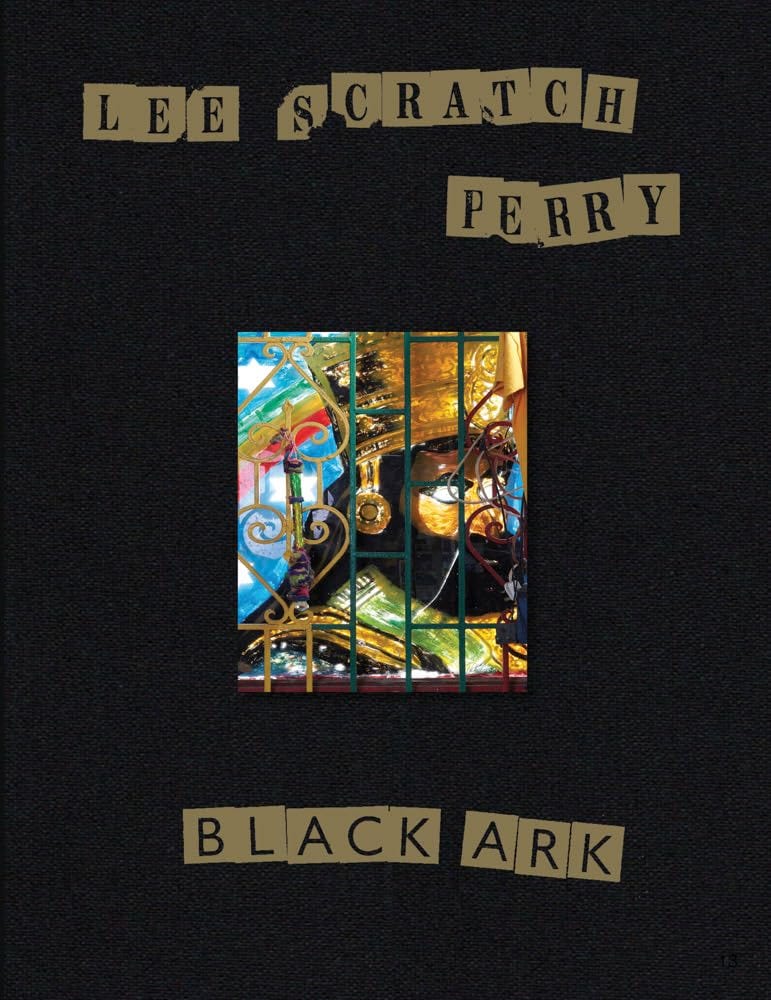
Lee $cratch Perry Black Ark (Preview)

Just out in Issue no.264 of Aperture magazine is my capsule review of the photobook Lee Scratch Perry Black Ark (Edition Patrick Frey, 2026), a visual inventory of what remains of the producer’s legendary Kingston studio. To read the review, see the print and digital versions of Aperture. I've posted an altered and extended cut for subscribers on Substack, of which here is a preview.

Rarely has a single space been so productive in such a short span of time as Lee “Scratch” Perry’s Black Ark. Here, in a studio compound located in the front garden of his family home at 5 Cardiff Crescent, Washington Gardens, Kingston, Perry produced hundreds, if not thousands of records, released and unreleased. Perry’s ear for eccentric sound effects and mysterious production techniques on basic electronic equipment opened up hitherto unknown dimensions in what musicians would play around him, swathed in clouds of ganja smoke, as Perry mixed, exhorted, encouraged, blessed proceedings with Bible verses or obscure rituals of his own devising. Singers like Susan Cadogan and Max Romeo called to lovers or called down Babylon or chanted down the devil, while Perry, the self-proclaimed “Ghost Captain” or “Mad Scientist”, alternated between resonant solemnity, prophetic fervor, and madcap humour, sometimes at the same time, providing sound effects of crying babies and mooing cows, sampling British sitcoms by holding the microphone up to the TV, turning reverb and echo into new constructive principals remaking ideas of rhythm and space.

As Kodwo Eshun writes of Perry’s work in More Brilliant than the Sun: “As soon as you have echo, listening has to completely change. Your ear has to chase the sound. Instead of the beat being this one event in time, it becomes this series of retreating echoes, like a tail of sound. The beat becomes a tail which is always disappearing round the corner and your ear has to start chasing it.” The music wrongfoots. Where one might expect to find a cymbal splash, instead a gaping void. Yet it all seems contained within a cavernous single entity, that, like the Black Ark itself, expands into mysterious rooms, corridors, voids: beneath it all, the thickness of a bass so resonant it came to seem a holy principle, the church on which Jah might build his rock.

New sign, new mind, echoplex [...]
With that echoplex, Ethiopia
With that echoplex, Africa [...]
With my echoplex, anything can happen
Who knows what coming next? 

In the ritual space of the Black Ark, the line between visionary experimentation, eccentricity and mental instability became increasingly blurred. In 1978, when a truce had been briefly brokered between the rival gangs supporting the political parties, the conservative JLP and the democratic socialist PNP, Perry had become involved with the Nyabinghi Theocracy, a Rastafarian offshoot ocused on theological discussion who conducted intensive drumming sessions that could last hours or days at a time, and with whom Perry planned a never-completed album. Millenarian imagination abounded. Through music, not only peace in Jamaica, but world peace might be achieved. Perry emblazoned the entrance to the Ark with the words “THEOCRACY MUSICAL GOVERNMENT”. By the following year, however, the truce had broken down. Consumed by paranoia, and amidst the backdrop of Jamaica’s political turmoil, Perry had evicted almost all visitors from the compound. As David Katz recounts in his comprehensive biography, People Funny Boy: The Genius of Lee “Scratch” Perry, he now refused to allow in anyone with dreadlocks, and insisted to the Black Star Liner record label that he would work only with white musicians.

Perry was increasingly uninterested in treating the Ark as a musical space. Instead, he seemed intent on turning it into a kind of private art installation. Musical instruments and audio equipment—pianos, keyboards, guitars, basses, speakers, mixers—became objects used in private rituals of his own devising, organised around the natural elements—earth, air, fire, water. Electronic equipment filled up with sand or rocks, instruments were painted and repainted according to internal mystical symbolism, and, in bursts of graphomania or “hypergraphia”, covering every inch of the Ark with graffitied text and symbols deriving, in part, from Nyabinghi symbolism (in which, for instance, X stood for the Devil and D for Death). Visiting Perry in 1979, photographer Dave Hendley recalled that Perry “had written on absolutely everything”, from the objects within the space to the space itself. When singer Susan Cadogan asked him why, he replied: “Well, if you don’t write, you wrong!”
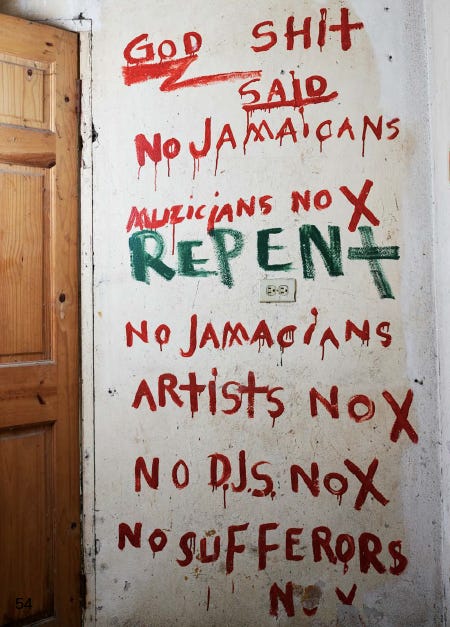
Graffitied wall from Lee Scratch Perry’s Black Ark. 
Photograph from Lee $cratch Perry Black Ark © Edition Patrick Frey.

“I am a madman”, Perry declared in a later song of the same title. “I am a cultist / I am a badman [...] The heart is a drum / my mind is the bass”. As scholar Michael Veal writes in the foreword to the new photobook Lee $cratch Perry Black Ark, a documentation of the space as it stood in 2021, “it became increasingly unclear whether Perry viewed the Black Ark as a recording studio, a religious shrine, a nature reserve, the command module of a space capsule or, at the most extreme moments, a mental health ward”. “The studio must be like a living thing, a life itself”, Perry remarked. In what Veal calls “his increasingly eccentric attempts to force the hi-tech sound technology around him into a more organic relationship with nature”, Perry let the equipment decay, dug holes in the floor so that the drumkit would be suspended over the element of water. He miked up a palm tree to record “the living African heartbeat”, buried tapes in the soil for protection. Enacting a constant fusion of modern technology—electricity, fire, light—and soil, earth, roots, for Perry, metaphor and reality constantly crossed over.

In spring 1982, one of the elements with which Perry was obsessed—fire—took ever, when the studio control room burnt down. Over the years, Perry repeatedly claimed that set the fire himself as a kind of “sacrifice” or exorcism of the bad energy that had accumulated in the space. Did Perry burn it down himself as a “sacrifice”, frustrated at the gangsters who’d infiltrated his circle and attempted to extort him? Or was it, as family members claimed, the result of an electrical fire while attempting to revamp the space? One interpretation has the Black Ark fire as catastrophe, the logical endpoint of a period of destructive decline; alternatively—an interpretation Perry himself sometimes leaned towards—the fire was a cleansing force from whose ashes Perry arose, phoenix-like, to reinvent his art from within its ruins. Whatever the truth, it would form a key part of the myth Perry would build around himself and others would build around him in the remaining four decades of his career. As in the fire in the Dante Hotel which, in 1979 burned poet Bob Kaufman’s possessions and manuscripts—charred pages of which editor Raymond Foye rescued from the flames—the barrier between symbolism, metaphor, literary imagination and life itself seems to have been definitively removed.

Friday, 23 January 2026

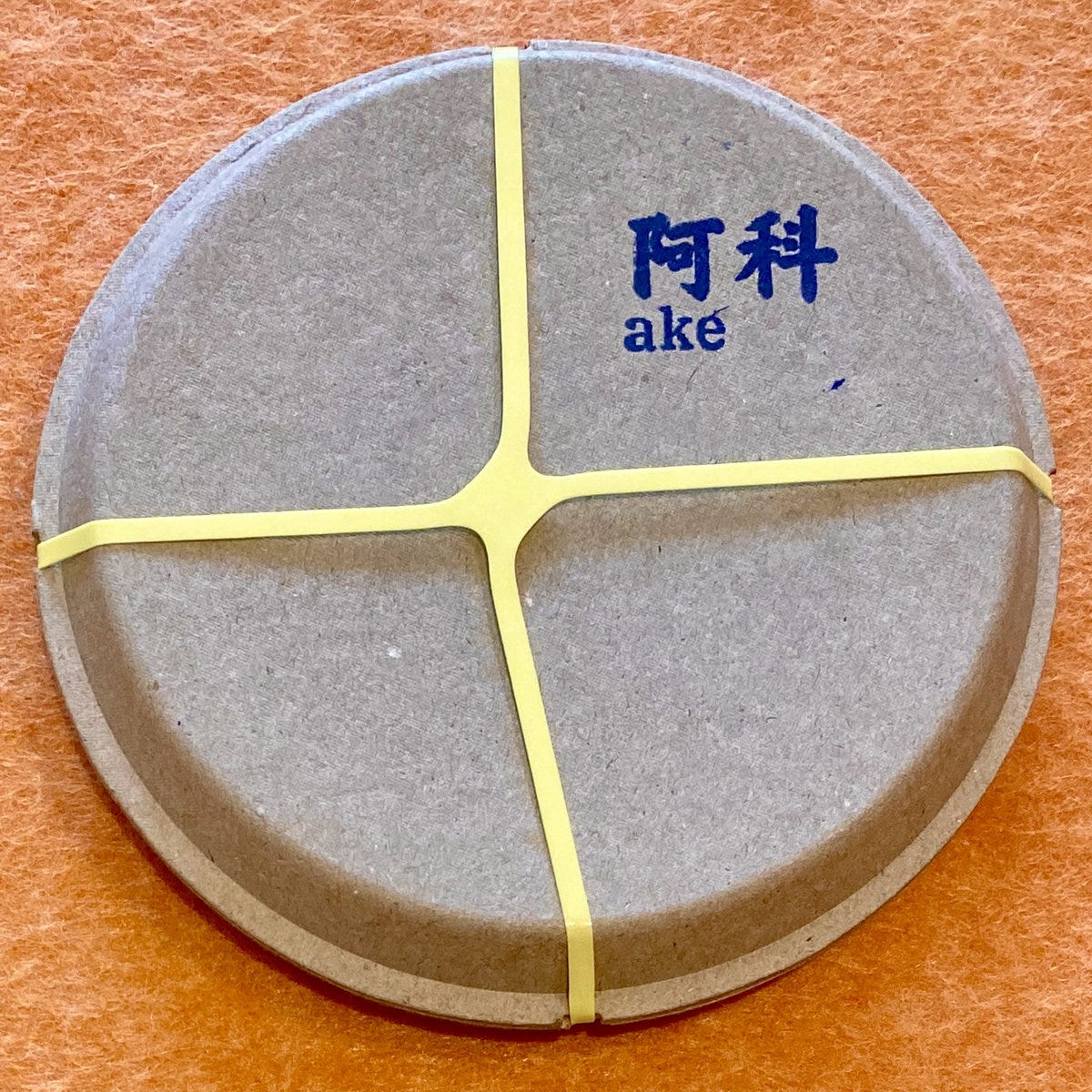
“do something”: The work of sound artist ake (Preview)


A subscriber post on Substack about Chinese sound artist ake.

ake’s biography describes her as “a surrogate weeper, currently working and living in Beijing, conducting site and context specific sound experiments, events, behaviors and installations, also writing poetry, being a musician, organizer and waiter”. Among other activities, ake “accidentally initiated the nomadic space A2 space”, and appears as part of collaborative projects on Zhu Wenbo’s Beijing-based cassette label Zoomin’ Night, as well as Yan Jun’s sub jam cassette box Silence is Shit, but ake (阿科), released in January 2025 as Sub jam 020, is her first solo album.

Working with the material to hand, ake’s work gives a new, subversive meaning to the well-worn term “site-specific”. The eight tracks fit together awkwardly, like a kind of broken jigsaw. They refuse to build up to a unity, but remain fragments, though, as fragments, they are in themselves whole: broken wholes, wholly broken. A majority of the tracks are field recordings, though this is no pastoral. If it has a ‘field’, it is the field of the (urban) social: social action and social inaction as experienced in the corners of everyday life, the boredoms and discontents and acts of quiet rebellion by which one might negotiate one’s way through the world and its systems, what is given to us, what is taken away from us. These are recordings of environments, or recordings that make environments, that intervene in them, that frame and re-frame them, that question or that spark questions. Workers destroying a wall in a Shenzen hotel are heard from a bed, the hammer blows a kind of impromptu drum set, accompanied by scattered fragments of conversation [...] How do we listen to this album? A field recording is supposed to put emphasis on the environment, but these recordings often feel ‘inwards’ as much ‘outward’. It sometimes feels as if the listening is being done as much by the performer as the listener, eavesdropping, confused.


Friday, 3 January 2025

New Year


Back at the start of 2022, I posted some kind of new year’s resolutions list on this blog. Technically, it was more an expanded to-do list, which I suppose is the ambiguity of the form itself--an internalized work-discipline where ‘character-building’, personal fulfilment, achievement of goals, etc, etc, all merge together: pseudo-movement, changing and continuing, like Mike Kelley’s Banana Man, surrounded by a crowd of people who declare themselves all to be moving but who seem to be standing still, lying in a crater in the earth flapping arms and legs and pretending to be an angel, dressed as a stagnant pond that recirculates but doesn’t move. So too, the resolution form, stuck between a series of goals, achievements, work tasks, and something more numinous that doesn’t just turn life into a series of targets and believes in some actual possibility of change. 

But who thinks about lists for so long? So here, a few years later, another list, a placeholder for myself as much as anything: an accumulating pile of projects, some of them already initiated back in 2022, others more recent, all of them overlapping so that nothing is ever truly finished--a way of not ending, somewhere between useful motivation and pathology.

Working collectively, collaboratively, is one way to see writing as part of something that reaches beyond itself, beyond selves, as something with a future. And working together this past year, in person and virtually, with Candace Hill on a poetry-and-art book called Abstractive has been a joy--the manuscript now done and in search of a publisher. It’s been a pleasure, too, to open up an ‘infinitive conversation’ document with Nhã Thuyên, in lieu of conversations in person and on foot round the city, and a real honour in the summer to publish Don’t Hide the Madness, a chapbook excerpt of the longer manuscript Taste of Water, in Kaitlin Rees’s expert and fastidious translation. Dont Hide the Madness and a of Askia Touré’s Songhai! were last year’s Materials titles: in the works next year are Howard Slater’s translation of Abdellatif Laâbi, some other new titles to be announced, and newly typeset-reprint of D.S. Marriott’s Duppies, and fresh runs of temporarily out-of-print titles by Anne Boyer, Lisa Jeschke, James Goodwin, and Tongo Eisen-Martin.

Since 2020 editing work with Tonya Foster and Jean-Philippe Marcoux on the two-volume anthology The Umbra Galaxy has been a constant presence. Four years on, the books are moving ever closer to the finish line, and after years of online meetings, it was a thrill to discuss it in person and in public with Tonya and Jean-Philippe at the Furious Flower conference in September, the next iteration at the Louisville conference on literature and culture this coming February. 

Outside collective work, there a number of manuscripts in some sort of progress: there’s the makings of a critical manuscript on contemporary poetry, maybe called Working Notes, still to be hashed out; a book on free jazz, Survival Music, continues to be researched and slowly written, as does another planned book on music, Ensembles, accumulating and expanding before (hopefully) to condense a little; there’s an in-progress poetry manuscript, On Musical Objects (a bit of it here), and along the way I may have accidentally ended up writing a book of daily/political essays, though that’s perhaps best left to brew a little. And outside writing--and back to collective working--continued music-making in duo with Tansy Spinks (so far, largely in a studio on a hill overlooking West Norwood, occasionally in other places like Cafe Oto), and in trio with GUE, as well as in another duo with Unk in a bunker near, if not quite beneath, a heath; ‘expanded improvisation’ workshops with Mattin, and a related project on freedom and improvisation.

But enough of lists! All these enumerations of projects tends toward the logic of the CV, the accumulation of writing or writing about writing experienced on substack or social media or whatever other data-harvesting curated venue tend towards the personal brand competing for attention, rather than as part of the collective (fractured, fragmented, sometimes cohesive) struggle within language that one would hope writing would strive towards. As European right-wing social democracy continues to destroy itself, the ‘centrist’ media narrative continues to cling to ‘liberal hope’, the Macrons and von der Leyens and Ampels and Harrises of this world seen as a bulwark against the rise of fascist and neo-fascist parties. But, as a friend put it to me the other day, this imagined centre is, in fact, the centre of the right-wing, as the political climate lurches (is pushed) towards the anti-migrant, anti-woke manufacturing of culture wars with quite material effects, the fusion of nationalist rhetoric and international capital, the accelerated race to hell. For over a year now genocide has gone on unchecked in Gaza, murder on murder on murder, and still the weapons flow, the US has elected a president who promises some unforeseen fusion of old and new right in alliance with tech billionaires, who in turn contribute funding and support to the fascism that rears its head in France, in Germany, in right-wing riots in the UK, the rhetoric of the border on the one hand, the flow of capital, the flow of weapons on the other. Increasingly, we’re going to be writing our way into fascism, however directly it affects us, some insulated, some on the front lines. Our writing, our music, our art, our action, is going to have to rise to this. Our ‘our’.

Today, for once, the sun is shining, though snow is forecast; a squirrel is running around outside gathering or burying its food; plants, still half-way between life and death, lean out towards the window and towards the light.