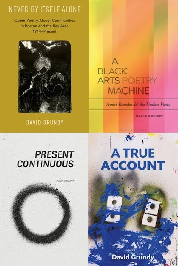
Showing posts with label Frances Kruk. Show all posts

Monday, 15 May 2017

New from MATERIALS: Prynne & Kruk

A sequence of ten poems by J.H. Prynne.


“Oh strike the light, float the boat, for
sake of common peril they are fallen away
as gathered up in sight of lamentable in-
difference and will go down against us”. 


16 pp, card covers (blue), saddle-stapled.

Also announcing the opening of the German wing of MATERIALS, MATERIALIEN, run from Munich by Lisa Jeschke. First publication, Stecknadel, a German-language translation of Frances Kruk's Pin by Koshka Duff.


More info on both here.

Wednesday, 21 August 2013

Kruk / Scozzaro / Chalmers


The poets Frances Kruk, Connie Scozzaro and Christina Chalmers have poems in the recent trans-atlantic virtual poetry mag The Claudius App (V). Having seen all three read the work printed here, relatively recently –different readings, in different cities, of these different texts – differently prickly and differently energizing in all sorts of different ways – it’s nice to see them in the same place, though I have a feeling they’ll be overlooked in the wake of lengthier E-mail Theory Spectaculars or the work of ‘bigger’ names. Would only, also, that the App were printable, not entirely enmeshed in its on-screen graphix scene…But anyway, here’s some sort of canned capsule synopsis stuff.

[1] Kruk’s work, sections of an untitled poem, is crabbed and cramped and dense with implication and suggestion and a biting humour, a humour that is never safe, whose bite renders it not really humour at all, exactly; it’s not ‘light’, or mocking in contempt; it might bite your leg off, like the “dog” “you” are, but never as a polemicized aggression; it’s more sly, harder to read than that, tho’ not out of any moral evasion – its ethical commitment doesn’t waver. Who is the target of address, who is being put down by whom? Who are You? “You’re a dog. / And the mangy kind [...] / busy dreaming you’re no dog / gob you slave into the plague.” The jammed-impacted lines crab out on a carefully wrought, sharp assonance, a dog becoming a mouth and a ragged carrier of disease; this dog that could be the dog you say your enemy is, capitalist pig, god of war, or the dog that these masters make you, the “slave” who is part of a plague-ridden and -carrying mass of workers made animal, a “killed” “fool” damp with spittle, reduced to a drooling “nil” who dreams of a “no place” and whose self is eaten by inculcated linguistic values, the words for ‘you’ you don’t control - “those words you / Thought were yours but now they eat you / now they eat you now they / Bring you and they x you” - eaten as and by pie charts, as “data-packed / False triangles,” bleeding jam blood, “Jam / at the gates. / Red in black at every entrance”, “super-nerved- & data-wired,” one of those ghosts of the dead whose rest (as per Walter Benjamin and as per voodoo) can or has never be settled in justice, can never be safe, recycled into cycles of consumption and quasi-cannibalism of labour murder and exploitation, the administration and organisation of death: “dotted lines every time / & no not even the dead are safe.”

[2] OK: Scozzaro’s humour comes from a different frame of reference, to Kruk’s, or take on that frame, a consideration of the impact of labour on daily living and on sex and on gender relations: it undermines or complicates or ironizes or makes bathetic a statement that somehow nonetheless remains sincere – goes for the same kind of register or affect as the Shaggs song its title, ‘What is Parents’, half-references, but without turning that into a knowing naïvete or scorn for the real stuff that gets expressed badly, or ‘well’, within the formal frameworks the Shaggs inhabit. Perhaps the comparison doesn’t go much further than that; it doesn’t; but e.g. what I mean is that the poem can say that the Incredible String Band “play their instruments / well” as a joke or a near-joke, and really mean it at the same time; ‘well’ here isn’t just a put-down indicating some practiced corporate ‘success’, just as “we fuck really well because I love you so much” needn’t be a sneer. The voice that speaks these poems, not quite a single or singular self, is one that works with/in the daily frustrations that make the “heart” an object in a game, a domino – “the heart is a domino, stacked in a line of many,” queuing in a line for a handout, for money or food, ‘stacked’ like some object on a supermarket shelf, as part of a collective of equally rent individuals living within the real drudge of a despairing bathos in which “your rented flat” and “this table” become substitutes for the “paradise” of the settled bourgeois home You Should Have; the heart, itself a metaphor for some feeling felt as bodily and mental but not acceptable or accepted, not happy as a normal or comfortable happiness, happy within structures of normative or ground-down feeling: “What is / working when you have no end for it […] most people ask me why aren’t you happy / like they’re happy, their spirits bent in the shape of a / smile.”

[3] Chalmers’ ‘Hell, Realism’, full-on political-personal mash/mesh. In form the run-on, or off, to the end of the prose-enclosed line, internal rhyme, a block of text unpunctuated, would seem almost the opposite to Kruk’s shorn bursts, though often there’s a similar sonic patterning. “this is not pre-political is not post-political” - wants to shout out against that which would close it down, “that which co-opts collective resistance, “collaps[ing] into the bourgeois public sphere.” Here the language of, say, Marxist political activism or a more academy-enclosed, tho’ still political ‘theory’ bursts out into, again, daily lives lived under and within and through labour, communication breakdown: “there is no expectation in love / and conversation.” Labouring or laboured bodies become actors, like the actors in Blanqui’s ‘Eternite par les Astres’, that vision of the cosmos as a theatre in which is enacted the eternal return of a nineteenth-(say now twentieth- or twenty-first century) bourgeois hell, in Chalmers’ version as actors who can’t even remember their lines, who are not “saying the right lines at all”; imprisoned bodies as prisons themselves, “phoning myself on skype”, protest-energy depleted, (w)rung out, “for my hands are tied to / our exhaustion”, where “grief” becomes mere “decadence”, where life does or can not live. This is the realism of hell, its communications networks as “uncomprehending telephone line[s]” and “listrooms” and skype, economics as a game played by incompetents, world budgets treated like Las Vegas sprees, “gambling machines which return no money,” the whole thing captured for a fleeting posterity on a live feed, “video ingestion”; the deferral of hope disguising itself as hope itself, as a kind of freezing to apathy, “refrigeration by hopefulness”; “cry[ing]” out not to be that, to be more than that, debris of a Blanquis-esque cosmic drama or “cosmic metaphor”, theological remnants of a fetishized and arcane-religious secular system, its numbers, its diagrams, “swaddling / the use value of militancy”, causing to fall into “the sink-holes of the depoliticised.” But “you” are, still, “the breakings of restraint.”

Sunday, 10 February 2013

DOWN YOU GO; OR, NÉGATION de BRUIT (Frances Kruk)


These poems, cryptic fragments on white page, peopled by 'small people', 'dwarves', 'mutants', 'tiny dogs', somewhere between fairytale and B-movie-scene-schemata ("back in the mines, the dwarves"). Like the poems, compression as a kind of violence, balled-in on themselves, clenched fist-tight. A kind of gesture towards heroism, defiance ("I revolt / project"; "Swarms! we will bang into the sun / blinded") that just as often is met by statement of flat-out despair ("history's deaths mean nothing, you / nothing"), and a gesture anyway that implies a kind of bumbling slapstick (as if one could "bang into the sun," clumsy mutliple Icarus), body attacked from within, by epileptic-type fit (“my chest judder”), or from without, by the torture-style glare of artificial light (“spasm in this pit sucked / blind by white lights”), or in anger lashing out against inanimate object as damage ("the fist against deaf walls”). What the spasm’d-in pit is is unclear; locations remain cryptic, as holes, recesses, enclosed spaces that could be those of the body as much of outer physical space. Note the tight control of sound: "spasm in this pit sucked" mashes itself on the tongue to become "spit fucked" or somesuch, "blind white lights", shortened and then elongated i's in alternation. It sounds quite violent when pointed out or up like this, tho’ the effect of reading it on the page is that the violence has become small, a tiny, hideous croak (particularly given all the references to scale, a kind of opposite to the vast & booming spatial projection of the Olsonians); little feral fragments, cut-off dog-yelps; “little zombie spines yapping silly”; &c. When I saw Kruk read it at the Damn the Caesars jamboree in Cambridge last year, the sense was of a kind of twisted or twisting inward choking, not bitter or sardonic but in some sense almost private, its edge not quite comic but not quite full-blown horror. Real disquiet – you wouldn’t laugh, as you would, those guffaws, however sardonic, at barbed or self-mutilating ‘humour’ in, say, a Keston Sutherland poem. Or, say, Peter Manson. Maybe that’s to do w/the gendered dynamics of poetry readings. But I think it’s also a real quality of these poems, and shouldn’t be seen as anything like retreat. There's a desire for control over the poems’ destruction & battering ("floods water sense water talks water / When I Name It"), yet the statements are frequently assertions of failure, of inability to affect or to control change: "we inserted a history and now it won't stop"; "I ordered a hurricane and I am still on this island" - as if the invocation of natural catastrophe posed solution, petulant solution, outlash like the fist pumelling the 'deaf' walls (itself a curious perversion of purpose, as if the point of punching an object was to make it hear). Or the poem’s other major outburst: "the orchids are fake, stupid fake island and forest." 'Nature' here is no more than model, ornament, imitation, simulacrum - "again the fake garden, motionless plastic curves" - in an artifice where only the body can be felt to shudder or tremor into desire for something more, yet whose very shuddering or tremoring or desiring constricts into blockage & physical attack. And the body itself may at times be artifice: "my chest Metal", a plastinated pulse; the poem's "fake islands" not only being physical locations in which the body is placed, but as equivalent to the (bodily) "inner islands" mentioned elsewhere. As in, 'no man is...' - in which case this fake inner island is what you are not, but are told that you are (like the radio become "inhuman" (see below). That the humanity yr body asserts as even just mere howling or mute registration of pain in some sense mitigates against this, but is also circumscribed by it; that this is a discourse itself that can be turned into parody, into movie monsters, stupid little dogs and people under attack and in distress, rendered ridiculous and "pathetic".

The fist pummeling the walls, the deaf walls: why would a wall, by definition not a hearing object, need to be described as 'deaf'? As substitute for human interaction, beating the wall because no human will hear, that enclosure: deafness as loss of communication, meaning-capacity. Throughout these poems, they recur again & again: hearing, deafness, blindness - blocked voices, choked, inability to express pain or the trauma of history except in fantasy ("This time we are Great in our Smart / Bomb Time Machine Device"), reduced to a "dead noise, revolt noise" that remains trapped in sand, an unheard negation that gives the poem its subtitle (“Negation of noise / unheard”). This noise is radio, or it is howling (see poems I, V, XIII). The voice in these poems sometimes desires to be that noise, or to describe it, cut-off before it can announce, can name itself in declarative or confident identity (one poem ends with the cut-off line "-but I'm "); the outbursts or sneering assertions of failure are perhaps some other voice that invades it, or they are perhaps that voice's turning against itself and others on realisation of its own failure - "we go to fuck the mutants / we go to mutant them"; "the most pathetic poem is small people on fire." That burning humans could be a poem is strange enough - inverting the idea that a poem could be language made particularly beautiful or efficacious, instead figuring it as a kind of uncontrolled attack on the body, as a violence - that this is a degraded poem, the qualifier 'the most' indicating, perhaps, that all poems are in some way pathetic.

The assertion that "there is no depth", ending the sequence as a whole; that one cannot get beneath the surface of these poems, that they cannot be decoded through deciphering allusion, that the grid of referentiality is too vague to be pinned down exactly. Yet that they work with a small packed-in image-complex, cluster round body, garden, blindness (“Blinded,” “sucked blind,” “I have no / eyes”), deafness, light, noise, any gesture outwards, swarming towards the sun, warring against the mutants, liable to miserable failure or to turning against the wrong enemy (for are the dwarves, the small people, the tiny howling dogs, not the perverted mirroring of ourselves, the oppressed made stupidly small?). Shut up, "down you go," back into the mines, yr box, the trashcan of history. Yet in attacking the mutants, like a mercenary who turns hero in some movie, that violence ends up as solidarity: "I am with the mutant / firing limbs" -- that even the tiny howling dogs or the burning small people or the dwarves in the mine might not be cast down forever, that the "revolt noise" might not go unheard. This is the kind of reading that the poem in once sense seems to resist in its verbal clamp(put)downs, the uncontrolled danger its bodies face from themselves or from others, yet the very fact of the compression, the white space, the quality of fragment, suggests something else beyond the stutter, that which is cut short, the noise within the gnomic, bitter quietness, "mouths bitter in sand" or "thirsty, howling" become "swarms!" of "revolt noise." "It is stupid to wait."

Furthermore, while the "Negation of noise / unheard" might be placed in opposition to the "revolt noise" of the preceding line - negation as silencing - it might also be the negation of unheard noise. The noise, in other words, that bleeds through its negation; (heard) noise itself as the negation of unheard noise, of muting and silencing; noise as a negation of a negation, an oppositional force in the face of an official discourse which relegates all else other than itself to 'meaninglessness'. Speculatively - "the resistance which otherness offers to identity"; noise as non-identity. That which is reduced to silence, its mute sand-mouth, is that which is underground, that which the assertion that “there is no depth” would try to cover over, but which contradicts any such assertion - the "subterranean gallery" which is the scene of the fist-wall encounter, "bound underground on hooks," "the mine shaft / dumb", "back in the mines the dwarves, the presences." This underground is hell; it is the hell in which labour is trapped, peopled by the Morlocks of HG Wells' 'The Time Machine'. (The Time Machine could even be obliquely referenced here, as in the “Smart / Bomb Time Machine device,” where it seems to have been crossed with a weapon of war and perhaps, even, & more obliquely still, a Smart Phone [TM], although perhaps it would be best to say that it’s not so much a ‘reference’ as part of the cultural unconscious that the poem inhabits, that B-Movie legacy of sci-fi & monster movie that doesn’t feature so much as direct stereotype, archetype or what have you, but as a kind of under-texture that feeds into the poem indirectly: somewhat similar, one might say, to the way that the poetry of Ian Heames em- or de-ploys a computer game / sci-fi register.)

What sounds in this underground is that which is heard only as noise, as howling, as the sound of the poem's opening swarm who rush blinded into the sun, unused to the light. One recalls Dante's swarm of lamenting damned, whose resounding sounds of lamentation are likened to "grains of sand swirling when a whirlwind blows" (viz.: "in sand you hear dead / noise"). In Pulse Demons', named for a Merzbow album (more noise!), Eugene Thacker connects this Dantean swarm to the horde of demons whom Jesus drives into the herd of pigs ('my name is Legion, for we are many') interpreting both as symbols of the rebellious, virus-like horde, of how it appears to those in power, as the force of disorder, of multiplicity, of that which will not be contained in the one, the singular, the class that takes its interests to stand for those of all, that lie of universality. Michel Serres, from ‘Genesis’: “these demons are nothing but the calls of the world, or the moans of the others who are crying for help. Would you be frightened by this wailing?” Perhaps I'm extrapolating, politicizing this demonic or damned (in any case, monstrous, seemingly unformed) swarm to an extent that Thacker doesn’t, quite – tho’ of course the notion of the swarm has its political theorizations in Negri, Foucault, etc: quite a trend recently, in fact, even as it risks romanticization, abstraction from specific issues, a kind of free-flowing ‘poetics’ substituting for concrete political theory, much in the same way that Serres' own work seems ultimately limited by its ‘liberated’, post-Deleuze/Guattari stylistics.

But to continue, w/that caveat in mind. Authorities attempt to silence the noise-swarm of the masses, and when it comes through, it does not speak in their language. The radio is a model for this kind of communication: EVP, voice phenomena, white-noise voices, static, interference – the message that scrambles, distorts, and replaces the original, ‘clean’ communication, that is contained within it, yet that goes against it, that seems to come, and perhaps does come, from outside it, as attack. On the one hand, this implies that all voices are equivalent, that by turning the dial, you can silence one voice, push them back into the noise of radio noise, come to the next clean channel, the lush strings that drown out the loud scream. It's a matter of choice, in other words. Yet there are those moments when the radio interference becomes uncontrollable, resists the desire to remain on the safe channel. Voices in other languages, other dialects, bursts and blarts of discord break through. The voices of the excluded, of the repressed dead trying to speak to us (W. Benjamin at the back of all this). Transmissions from the City of Dis: the heretics, those who have spoken against the existing order. “Radio, when it's not human.” This inhumanity in fact as humanity speaking through the medium, rendered as ghost-voice, as noise, "waves of brutal as Cochlea." Cochlea: the auditory portion of the inner ear (innerness, again) – the “waves of brutal” thus as sound waves (tho’ obviously resonant with the water that flows thru the poems). We are instructed to "listen" to this crowded sound, this "high pressure Crush": and then presented with a space, as if what could be heard could be rendered only as a blank, the white page as either silence or noise, unrendered, only subsequently glossed as "radio." LeRoi Jones, from a poem collected in 'The Dead Lecturer': "And silence / which proves / but / a referent / to my disorder." For Jones, those "who speak of singing" have never heard song; their zen silence is inhuman, their "legends" are ossified monuments, are death. Silence itself becomes noise, or the possibility of noise, defined by its opposite & sometimes assuming the maleficent effect that opposite is supposed to possess. (Viz. Zizek's characterisation of non-violence as itself violent: silence as a violent silencing.) Serres puns on 'murmur' as 'mur-mur', that noise which penetrates even through a wall. Walls may close off torture or injustice to sight, but the noise leaks through that wall, under the door. And while the wall itself is deaf, the fist tries to punch through: perhaps the sound of its banging can be heard. But Serres, in his allusive build-up of puns & metaphoric constructs (in which, broadly speaking, the wall stands in for ‘rationality’ as force of containment) conveniently forgets the existence of sound-proof rooms, anechoic chambers, mines, bunkers secreted away underground, muffled by earth, by sand, or surrounded by water, marooned on islands. Kruk: "dead / noise, revolt noise." Dead air is the silence of the radio announcer who can't fill the time with noise, the void. But what fills that air here is, perhaps, the voices of the dead who have been silenced yet who can still be heard to shout out. The noise is dead, it is out to sea, on "a boat", Rimbaud's drunken boat, "water," the "hurricane," the flood, the water that floods sense ("floods water sense") - noise the amorphous, the liquid, never object, never solid - one might drown in it -- it "crush[es]...Madness & Truth." Yet this water is invoked, like the calling down of the hurricane, or the assertion that "water talks water / When I Name it." To name, through noise, to give voice to dead noise as the voice of the dead, as the noise of revolt, the project of revolt: "I revolt / project." Throwing yr voice at the walls, in the hope that they will break through them. Joshua fought the battle of Jericho. It is again the water that threatens "Nervous walls / with their cheap metal flickers" - water or "something" more amorphously "surging." Such might, of course, equally be read as an assault on the body of the individual, rather than the assault of the swarming, noisy mass on that which delimits and encloses them (the force of revolt read, as it is by Rimbaud, as natural catastrophe, hurricane, earthquake, flood: not as the containment of the political aspect of revolution through natural metaphor, but as the expansion of the political even into 'nature'; just as, here, there is no 'nature' but that of the body and its projections and enmeshings). And the strength of Kruk's poem is that it is, it could be both, that it is not some simple call to arms as I have perhaps been trying to read it, through seizing on these notions of noise, wall, water - and maybe that's just because of what I'm reading at the moment, reading in. Not that the poem is just open to that reading in, it is precise, as I said, in its image-complexes. But these complexes are used in turned-in and twisting ways, full of defeat and failure that is yet also the promise or negative image of the defeat and failure of said defeat. Does that do this justice? Not really. I haven't even got to the notion that these are 'after' Danielle Collobert - as translations, as modes of text generation, I'm not sure which. Which opens up a whole 'nother kettle of worms, can of fish. And I haven’t even talked about the recurrent “crkl.” But let's leave it there for now.

NB: Kruk's book originally published thru Punch Press, sold out. Reprinted in the mighty 'Crisis Inquiry', available thru Damn the Caesars or, in tha UK, from Mountain Press.

Sunday, 18 March 2012

Spring Decoys: Cambridge, 17.03.12


A decoy is usually a person, device or event meant as a distraction, to conceal what an individual or a group might be looking for.

'Spring Decoys' was a festival, I guess you'd say, that happened in Cambridge over four nights the previous week: this year's version of the Miscellanous (theatre?) Festivals which Jeremy Hardingham has been curating in the Judith E Wilson Drama Studio for the past few years and which have seen some extraordinary collisions and collections of poets and performers and musicians, extending often from seven in the evening till three in the morning – energies of productive chaos and some sort of social sense derangement, energies which you can take within you as tinderbox or as constellated spark which can't ever be fully translated outside that place's seal (even when you're inside that very place, that drama studio, again, for some other event), but which yet you do take, you do carry, in readiness for expected or unexpected re-prompting, re-flaring. The come-down is what's worse, and the chronicling or cataloguing of what did occur schematically is a part of that, but how else to make a sense of it beyond that it was, merely, a good one-night last stand?

So, yes, the Decoys were, then, drawing on this spirit of Miscellaneous Festivals past, the difference this time I suppose being that 'performance' and 'poetry' each had their slots on different nights (Wednesday's event in particular, involving Ollie Evans and Ian Burrows and Lisa Jeschke and Lucy Beynon and Irum Fazal and Jeremy Hardingham, deserves a write-up which I haven't given it). Though the poetry event was far from a simple 'poetry reading', Justin Katko (that night's curator) maintaining, throughout the evening, an improvised noise jam (some keyboards / some max msps / some recorders and some kazoos / some record players / some melodicas / some korg monotrons) which played thru the intervals and even under and into some of the readings (most notably under Jonathan Redhorse's rhythmic and droll prose delivery and, at that stage of quiet spaced-out drifting concentration that inevitably sets in at the end of such a long and varied evening, under Samantha Walton's reading, accompanied with artless tenderness by Jow Lindsay on Jandekian plugged-in piano). At various stages, too, Jeremy Hardingham enacted extended or momentary solo performances which seemed both to work alongside and against those readings whose sonic and physical space they shared. Indeed, the evening was visually dominated by a construction he'd rigged up along the centre of the room (the audience placed around the walls' square) -- a row of large envelopes bundled into bag-shapes, filled with pieces of paper confetti (stage-snow, I guess), and dangled from the ceiling on ropes and electric cables, large pieces of squared paper taped underneath, to the black box's floor. Occasionally, he would perform a sudden act of what one might either term vandalistic outburst or creative opening up (evacuation?), unravelling, revealing what lay inside the initial formulaic blankness of the envelope scrunches, ripping and dropping fire exit signs, hammering white-painted wood constructions, crawling and contorting and eating paper snow and white dust.

But that I've written on his performances at this length doesn't mean that they dominated proceedings: there were 18 readers in total, one turning up on the night and asking to do something – which he did – the others mixed between Cambridge locals (who got five minutes each) and invited poets from out of town (who got fifteen): Marianne Morris, Sean Bonney, Ed Luker, Joe Luna, Jow Lindsay (tonight, as 'Sofia Stres'), Jonathan Redhorse, Frances Kruk, Danny Hayward, Samantha Walton and Jefferson Toal the visitors; Ryan Dobran, Neil Pattison, Tomas Weber, Caitlin Doherty, Connie Scozzaro, Luke Roberts, [Blank] the 'Cambridge poets'. As line-up this doesn't look 'established', though poets such as Bonney, I guess, count as 'big names' within the ridiculous but hopeful smallness of this 'underground’/ as it is: yet, yes, it looks like a young scene, and a varied scene, no 'Brighton' school or 'Cambridge' school, no Prynne vs Sutherland vs London debates, but an invigorated and ironized and heartfelt, often rebarbative, but in the end in some provisional way really collective, 'scene' (not even that word, which is too fixed, perhaps, though I don't mean to imply that 'anything goes'). Now this seems something like the line Chris Goode lays down in his introduction to the 'Better than Language' anthology, with the additional overlap (outside a book) of performance -- the poets' noise ensemble, the presence of theatre makers (themselves often poets or deeply invested in poetry) such as J. Hardingham, O. Evans, L. Jeschke, L. Beynon, whether performing or in the audience. In all of this the ramshackle (conversational adjunct, private whispers and jokes, interval spilling (wine as well), the passed bottle of whiskey, bar zero, the endless negotiations with the english faculty's electronic locking system) existing alongside the purposiveness and intensity of thought and critique of the poetry itself, which was, in the end, why we were there.

To go through the readings one by one, oddly, perhaps. Marianne Morris' set, its early placing and non-combative (tho' not lazily or easily won) gentleness, its quiet emotional and moral resolve, as she read fragments, literally at times, small scraps of ripped paper with the words written there; this method of reading, presenting work in progress and in working method, offering it up outside the category of the 'finished', is a risky move and one whose results could vary -- but having seen Morris read twice now, on two succeeding Saturdays (previously at the 'Women Poets Against DSK' event organized to follow the traumatic protest against the shameful platform given to D. Strauss-Kahn at the Cambridge Union), it is a method which in those moments has perhaps said, despite my initial reservations, or done, or made us or I feel, more than the overt aggressive hammering rack/ratch-ets which too are necessary and kin to it, and into whose anger too it spills: and this was a quieter reading, certainly, than the first: and the poem dedicated to Mary Stillman, tho' I can't quote its substance back as I'd like to, was really, yes, beautiful in its non-naïve directness and wish. Ryan Dobran's poem with its wit, hanging out in an alley with Michael McClure. And the release of laughter in that, the first now enabled in the audience. Neil Pattison, one of the highlights of the evening, I thought, reading his new and very different work, which is bright colours and Delicate Steve and Skeletor (these poems were addressed to Skeletor) and his reading, shunning the microphone, pacing and looking up at those for whom the poem was shared, and looking up to show that this did mean something in poetry and in life, and it did. And Sean Bonney, all prose, the letters he's been writing for the past six months or so asking themselves about poetry's efficacy, and the prose poem as form, or discovering what formal hybrid between, in any case making in that an argument which we do need to hear and hear even if at moments there might be the flare-ups or disagreements that any such strength or force of conviction-polemic might engender.

The first interval.

Ed Luker, reading much the same set, I think, as that delivered at the Foule Readings last term, last year: again in that internet jargon'd, ironized register which maybe is a 'Brighton' thing in some way - Joe Luna's reading later doing it too, tho' differently; Tomas Weber, the wax wiped off in time, his hours of labour invested the previous week in the making of the four-page poem he read on the night, proceeding as it did oddly on that mixture of allusion and joke (the twenty different nationalities that made their appearances, the fleeting characters disappearing in the space of a line or a word, the strange role and negotiation played by semi-private methods of text generation, the Santorum song/ the ‘Kill Blinton’ laughter points). I've tried to write about his work in a report on a previous reading and didn't really get anywhere; and so here; somehow it still resists me in that way, even tho' it doesn't feel resistant in a closed or harsh way – it is not 'friendly', such an awful word, or easy, but somehow still open to what is brought to (bear on) it.

The second interval.

One of Jow Lidnsay's hilarious extended screeds, governmental names checked and over-balanced in multiplying satirical venom, those moments when he could be heard over the raucous racket(eering) noise which he'd requested from the 'house band' (so many miles here from Jack Kerouac and Steve Allen, it's not real). Joe Luna
’s poetry thru internet and irony defeating its own sudden lunges at utopic total universalism, seen as the only ground for ethical hope, head-spinningly, then spun back to the mirror or the filter, the window or the screen thru which passing data and role-play, tv shows jammed up on prynne, the unwitty circus, the plastic or pixellated selves thrown back at us thru which negotiating our real self, if that can be ever whole or non-complicitly separated (not yet), is the burden, placed, here, on and in and thru language.

The third interval.

Caitlin Doherty's first pamphlet has just appeared in a beautifully semi-wonky hand-made edition of 100 from Foule Press, and moves with incredibly dextrous assurance for a first publication thru registers from a page of sound poetry (read tonight) to choric dialogue which translated quite brilliantly into a collective performed realization at a Foule Reading last year: tonight was quieter, solo, newer work, I think, continuing the obsession with satellites that's translating into some really interesting riffs on technology – this is work that is really going places and should be kept on with for sure. Connie Scozzaro, reading just two poems, a shortness and a sharpness and a roughness; Jonathan Redhorse, about whom I know very little, tho' there are some engaging and really interesting pieces of his fiction that are internet searchable, with a sharp and smooth delivery I've already in part discussed or mentioned;

The fourth interval. No: these become blurred, I think the programme was departed from a little as things went on (probably eleven o clock at least by now). In any case, Frances Kruk, another prose work, the audience's flicking from Kruk to Hardingham's performing (as, again, I've mentioned) – I'd have liked to hear it better, because now I'm finding that I can't summon up incisive comment as I'd have liked (such slippings are inevitable, I guess; and in any case I wasn't sure I was going to write this up - to do so seems a little expected or boring, perhaps, now?); then, the fourth interval. Audience sliding around now, divisions between interval noise and reading less clear-cut: so, suddenly, Danny Hayward was reading, a long work, and as one would expect a politically incisive scalpel on the particular issues he'd chosen thus to excavate, excoriate; and Luke Roberts, for the second time that day, after the first reading in a long time, from the (excellent) 'False Flags' and a new work written in December -- that longer reading given at the Runneymede Literary Festival in London, this second five minutes only, a single poem only, again from 'False Flags', with its background preamble, Bobby Fischer and Kasparov, the poem if I remember correctly, and on looking thru the book, being 'The Sonar Deal';

The fith(?) interval (?!):

One other reader; then to end it Jefferson Toal, whose work is really prized in these parts by those few who know it, and which should, on the evidence presented of it tonight, be prized outside, and known by more than a few. The noise back up and the tidying up and finishing the alcohol and eventually at after 2AM everyone going outside, that entire dark dream.