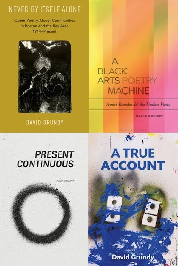
My new book, Never By Itself Alone: Queer Poetry, Queer Communities in Boston and the Bay Area, 1944-Present, is out now from Oxford University Press. Here's the blurb:
Providing an unprecedented exploration of key moments in queer literary history, Never By Itself Alone changes our sense of both the American literary and political landscapes from the late 1940s through the 21st century. Grundy presents the first comprehensive history of post-war queer writing in Boston and San Francisco, intertwining analysis of lesbian, gay, and queer writing, and insisting on the link between activism and literature.
The book centers a host of underrepresented writers, especially writers of color and those with gender non-conforming identities, and challenges the Stonewall exceptionalism of queer historiography. Starting with Robert Duncan's 1944 essay, 'The Homosexual in Society', one of the first significant public defenses of homosexuality in the US, Grundy takes the reader through pioneering works by queer voices of the era, including Adrian Stanford's Black and Queer, the first published book by an out, Black gay poet in the US; the Boston collective Fag Rag and their radical reconsideration of family, private property and the State; the Combahee River Collective, whose Black Feminist analysis drew together race, class, and sexuality; the anthology This Bridge Called My Back, in which women of color spoke truth to power, together; and New Narrative writing, which audaciously mixed Marxism, porn and gossip while uniting against the New Right. Linking these works to the context which produced them, Grundy uncovers the communities formed around activism and small press publishing during this era and elevates neglected voices to narrate a history that before now has never been told in its entirety.
Drawing on extensive archival research, Never By Itself Alone is a rigorous and unmatched work of both literary criticism and queer scholarship which underscores the vital importance of radical accounts of race, class, and gender in any queer studies worthy of the name.
The short version: the book is in eleven chapters and three parts. The first part covers the period from towards the close of the Second World War to the paradigm shift popularly represented by the Stonewall Rebellion, with four chapters, on Robert Duncan and the formative essay 'The Homosexual in Society', Jack Spicer, The 'Occult School' of Boston, with one chapter on Ed Marshall and Stephen Jonas, and another on John Wieners and Gerrit Lansing. The second turns to Gay Liberation-era Boston between 1969 and 1983: there's a further chapter on Wieners, alongside Charley Shively and the Fag Rag collective, followed by a quartet of writers published by the Boston-based Good Gay Poets press: Adrian Stanford, Stephania Byrd, Prince-Eusi Ndugu, and Maurice Kenny; and finally the Combahee River Collective, with particular focus on the work of Audre Lorde and Kate Rushin, along with the still-vital anthology This Bridge Called My Back. The final part focuses on the Bay Area, taking things from 1969 to the present: there are chapters apiece on Judy Grahn and Pat Parker, a chapter on the socialist feminist writing of Karen Brodine, Merle Woo, and Nellie Wong; and a concluding chapter on New Narrative, with a focus on the work of Kevin Killian, Dodie Bellamy, Bruce Boone and Bob Glück. A coda takes things up to the present day via Rob Halpern, Pamela Sneed, and Eileen Myles, among others.
The long version: this is a book about community--poetry communities, activist communities, and the community of the living and the dead that makes up both. And of course no book occurs in a vacuum: so all the more grateful thanks to everyone at the press, especially Hannah Doyle and Alex Rouch, to the peer reviewers, proofreaders, and typesetters, and to everyone who so generously gave of their time, energy and knowledge--poets, scholars, enthusiasts, librarians, archivists, friends--over the course of the research that went into it. (Special mention here should go to Jack Herndon for his generosity in granting the use of the beautiful artwork on the cover, an illustration by the great Fran Herndon for Jack Spicer's The Heads of the Town up to the Aether.)
The title comes from Jack Spicer, writing to Robin Blaser in the Second Letter from Admonitions. Spicer's describing his own poetic process, and his formation of the idea of the serial poem as opposed to the 'one-night stand' of the single, stand-alone poem--the latter still the model for so much contemporary poetry-- but, in doing so, he's also describing the relation of poems to other poems, people to other people, people to poems, the serial chain of community, of love and struggle and competition and compensation and bitterness and generosity and enmity and empathy that makes up the history this book explores--one that is, in part, the history of the local, of coterie, of specific campaigns in specific places, of poets gathering in apartments and communes and university departments, holding Magic Evenings and Consciousness Raising groups and rallies and readings--but one that is also, through this very activity, the history of the global, a way of rethinking the world itself. The book, written through the pandemic and into whatever world we're in now, in lockdown and local libraries and university archives, can perhaps do no more than skim the surface of this thriving underground, this Occult School, this surviving line, broken and unbroken, threatened yet thriving, an alternate tradition of art and anarchism and alchemy, of insurrection and instruction, of the quest, through poetry, for new modes of knowledge, new ways of living, new revelations of expression and thought. The traces are found in archives or through word of mouth, boxes of papers on a café table in the dead of night, pamphlets scanned and photocopied and hastily copied pamphlets in the corner of a library in the day, snow falling or sun shining outside. In gathering them up, I hope that, though writing within various English Departments, I've managed to avoid the trap that Spicer, in that letter, so sternly warns against: "the English Department (and from the English Department of the spirit - that great quagmire that lurks at the bottom of all of us)". This is an academic book, but the knowledge that these poets manifest and pursue, in all the diversity of their lives and their poems and their approaches to life and to poetry, can by no means be circumscribed within the English Department, even if it's high time that the English Department stood up and took notice of these children of the working class, and not just took notice, but learned from them, and the transformations they fought for and accomplished: all the dreams fulfilled or unfulfilled in the richness and the waste, the destruction and the defiance, the love and the loss, the excitement and the struggle and the flaming joy of the lives these poets lived, and that live on through their poems. For neither a poem nor a poet is ever by itself alone.
---
The book can be ordered from OUP here: at the moment, it's a hardback, and thus pricy, but do request a copy for your library! Meanwhile, you can see a video of an online launch of the book for The History Project, Boston, in which I'm in conversation with Julie Enszer and Michael Bronski, below. More in-person launches to follow soon, I hope.
--And a sneak preview of what's on page 99 of the book at the Page 99 Project blog: https://page99test.blogspot.com/2024/07/david-grundys-never-by-itself-alone.html