Showing posts with label Alice Coltrane. Show all posts

Tuesday, 28 July 2026

Funeral Music

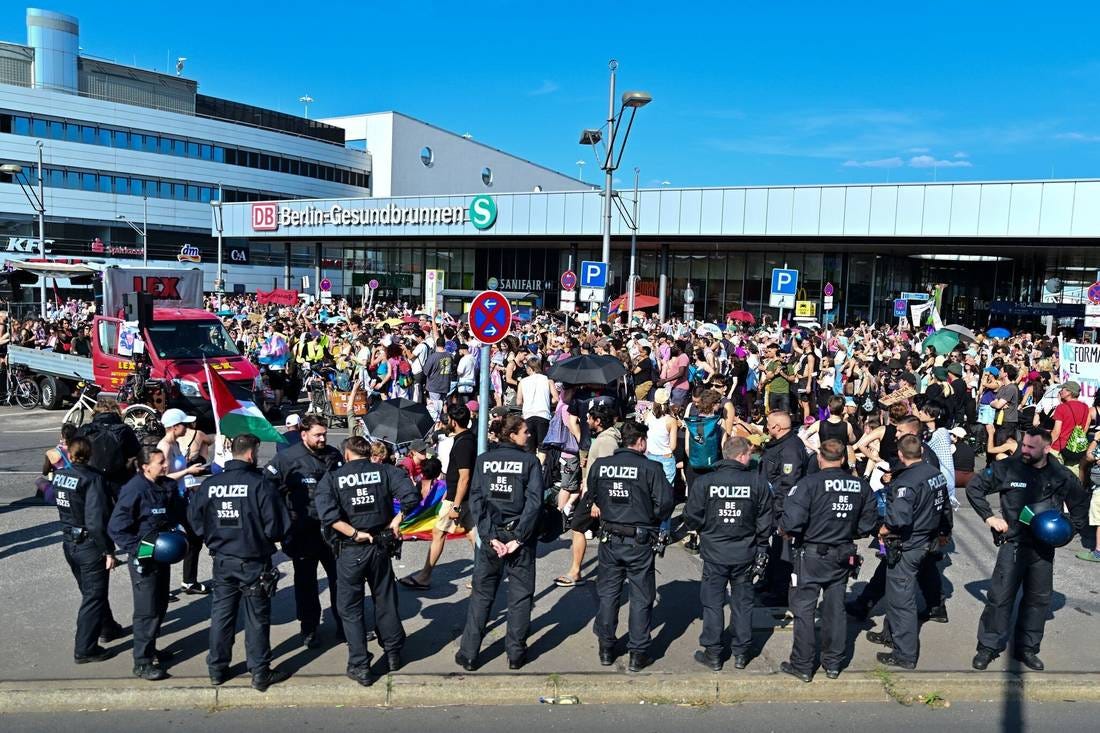
I was at a party on Saturday night when someone came in and said that a van had driven into the Berlin Christopher Street Day parade, killed one person, injuring more. I’ve never been to CSD; go, instead, to the Internationalist Queer Pride demo that, since 2021, has been organised in contradistinction to the corporatisation and pinkwashing of the main CSD demo, whose organisers had called the police to remove pro-Palestinian marchers. Since 2023, this has meant outspoken support for the victims of the genocide in Gaza, and all the attendant policing that involves. So to me Berlin Pride also means cops pepper-spraying and pain-gripping people on the street. Well, it’s in the tradition. In the sun, the heatwave having finally come back after the week’s rain and thunderstorms, finally setting off after several hours, marching past the newly-converted Rheinmetall weapons factory, formerly a builder of car parts, the first time arms manufacture has taken place in Berlin since the Second World War; Rheinmetall, sender of weapons to Israel, to Turkey, to Saudi Arabia, for use in Syria, in Gaza, in Yemen, part of the government’s shift towards increased weapons production since Olaf Scholz’s 2022 Zeitenwende speech and its 100 billion euro fund for war, the willed and ever-expanding horizon of war. The march monitored, not for our own safety, but for the safety of the city’s “white” citizens, by vanloads of armed cops with their machine guns pointing down to the ground; the same cops who let another van drive through or past the protective barriers in the Tiergarten to plough into a path of queers that evening. Not protecting us from the world, but protecting the world from us.


After the parade, in the evening, people start heading off to the parties. The killing happened around ten p.m. and I didn’t find out till around midnight. People had been arguing in the kitchen about the World Cup. Guatemalan funeral music by the San Lucas Band was playing, out of tune, slow. Then Ornette Coleman. The music soared. I felt the world drop out. I don’t quite know how to describe that simultaneity—of hearing that music, which I love and which to me is the sound of possibility and joy and collective potentiality, of what Coleman means by harmolodics, infinitely transposable in whatever register, whatever instrument, whatever key—you could call it queer if you wanted to do that—of hearing that music at the same time as that news. I don’t know what it means, I’m not writing to turn this into a metaphor or an allegory or to makes sense of it, I’m writing it because I have to, I’m writing it to register the loss. Mourning is about revision and return, repeating that initial moment of knowledge, replaying it. It’s a loop, yet it develops; it moves forward, yet it stays in the same place. I’m writing this two days later but I’m still in that kitchen, the world is still dropping out, Ornette is still playing, the San Lucas Band are still playing, and I’m still in that kitchen. I don’t know who they were, the person who was killed, I don’t know their name, and I mourn their absence, that gap. The driver of the van attacked people with a knife or a machete after ramming the van into people on the path and fled. And I don’t know who they were either. And I’m still in that kitchen and already I’m thinking, if it’s an Islamist attack, queers will be used as convenient propaganda—never more convenient than when dead—against whoever it is the state wants to kill, deport. Whoever it was who drove that van could equally well have been one of the white supremacist AfD supporters at the counter-protest staged earlier that day. And if it’s not an Islamist attack, we’re just dispensable: they’ll gloat, those other AfD supporters, CDU supporters, and all their unaffiliated supporters, privately, in their homes, or publicly, online: they’ll cheer the death; they’ll smirk at our loss.

So say what. Stay alert. Some platitude of the sort. Mourn, but don’t let them use us, use you.


I wrote those last lines the same night. The next day, the news comes out in more detail. Wanted posters on digital screens. Perpetrator, Islam, terror attack, plastered everywhere, all over the newspapers, all over the city, and the victim still not even named. The year before, the Chancellor had described raising a queer flag over the Bundestag as akin to treating it as a “circus tent”. Today, the national flag is lowered to half-mast in a gesture that passes as “solidarity”. But I don’t really know what’s worse. This half-mast show, as if there were some sort of unity between the national flag and a flag that should negate the idea of the nation, of this nation, entire. Already the videos coming out, this instrumentalised commentary that is the opposite of mourning, that is like spitting in the faces of the dead. Already the voices of the AfD and its cheerleaders in the right or the so-called “centre” raising themselves. A white blonde Woman on Welt says “Political Islam kills” and talks about Hamas and “irregular migration”, as if that had anything other than precisely fuck all to do with any of this. “Deport all dangerous individuals”, says someone else. (The attacker was born in Germany.)


So mourning is once again becoming a weapon against those it’s supposed to protect. But you still have to mourn. Where does that feeling go. Who becomes a part of the “we” imposed like an unwanted national flag, vampirically, over the bodies of the dead. The flag doesn’t absorb the blood that flows from the body, it doesn’t stanch the wound. Rather, it is the very thing that sucks the blood out: blood spread into its colours, blood the basis of its being.

It’s not my nation and it’s not my flag. But these are, I feel, my dead, not the dead of those nation and flag who opportunistically claim them; not directly, but still, my dead, and I mean that internationally— these dead, not dead to be recuperated by nations and borders but dead who belong beyond those borders; my dead, in whatever way one might take that to mean, without taking any ownership. The person who was murdered was visiting from Poland with her daughter; the killer was German. No nation owns that death.

These dead my dead, because, yes, whatever it was Donne said about diminishment and involvement and nothing in itself entire, yes, that, perhaps, but more specifically: this person is dead because they were queer or they were seen as queer or they were in a queer space, a space that was, for that moment, queered, and because those have been or are my spaces, too. And because of that, because when I heard the news the world dropped out, because this next day and the day after I still can’t get it out of my head—because of all this, I still have to mourn.

I tried to do that by writing a poem. This is hardly a poem. On the afternoon of the next day I pace around inside and it starts to rain and I stay inside and eventually I cycle over to the vigil by the Brandenburger Tor. It starts to rain again, then it stops, then it starts again. This is hardly a poem. Soon after I arrive they finish clearing away the barriers by the gate. A tourist takes a series of selfies in the vacated space, oblivious, smiling away. On the ground on the raised bit of pavement there are rainbow and trans flags, placards, candles. By now, early evening, some hours after the vigil began, swelling to ten thousand people, the crowd is small, but still present. People stand here, they linger, they don’t just pass by, the group becoming in its silence rather than its noise a crowd. “And when he had opened the seventh seal, there was silence in heaven about the space of half an hour” and the opening of the seal signalled the end of whatever world and you know all the noise that will follow. Here, it’s quiet, respectful. I realise I haven’t brought any flowers with me to lay so I leave nothing but my temporary presence. People look dazed. Some quietly crying. Older gays and younger queers, mainly but not exclusively white. Some Zionists holding up a sign saying “this is what happens when you globalise the intifada” are eventually persuaded to leave. Then I notice after a while that the rainbow flag carried by the woman sitting quietly near the centre has a Star of David in the middle. Next to me are some people with a keffiyeh and a keychain with Palestinian flags. Who do you think I felt safer standing next to.

And it’s not, not really, my safety that’s the issue. Or not the me, not the we, the state might take me to be.


I don’t think I’ll ever be able to think of Tiergarten now without thinking about the attack. About its political uses by the predictable barrage of right-wingers calling for “re-migration” and denouncing Islamist terror as proxy for their racist nationalism. About the Zionist flags I saw at the vigil. About the feeling of the ground opening up, the world dropping out, and at the party, when I heard the news, I didn’t know what to say or what to do so said my goodbyes without comment and I left, quietly, as if ashamed.

The driver of the van attacked people with a knife or a machete after ramming the van into people on the path and fled. Later, when he ran at them with the same weapon in an allotment in Spandau, the cops shot him. As if this was some sort of satisfactory conclusion. But likely, it’s only the beginning. They will talk about “protecting” us and there will more cops on the parade to police us and to police real or imagined threats, and white blonde women and straight men on Welt will say things like “political Islam kills” and talk about Hamas and “irregular migration”, and the head of the Alternativ für Deutschland will condemn the killing knowing full well that many of their supporters are delighted by it on all counts, the cops killing the Muslims killing the queers, two birds with one stone.

And many men died of the waters, because they were made bitter.”


Recorded by ethnomusicologists, the music of the San Lucas Band was nominated for a Grammy Award and the musicians were displaced and probably killed in the Guatemalan Civil War, with its genocide of indigenous populations and activists. The Kaqchchikel musicians, survivors of the Mayan populations decimated by the conquistadors and their massacres and the diseases they brought, tried to bend the western instruments they’d been left and the funeral march melodies and dirges they were playing into the microtonal inflections their own traditions encompassed. It’s as if you can hear the music break under the strain, and yet it stays together.

The evening of the Monday after, the sirens seem to have not stopped sounding. Cops on my road. As if their music were any less sickening or inappropriate than whatever threat it is they are supposed to protect whatever “we” it is they think they are protecting us against.

I refuse it, I refute it, I am not that we.

The vigil was silent but after it I needed to hear something, and so, over these past days, I listened to ‘Atomic Peace’ and ‘Altruvista’ and ‘I Want to See You’ by Alice Coltrane, recorded after John Coltrane’s death, and to ‘Vigil’ by John Coltrane, recorded in watchfulness before his own, and I listened to John Corigliono’s AIDS Sympony, its first movement, titled Of Rage and Remembrance, and I listened again to the San Lucas Band, and they all finish playing. For now, Coltrane’s Meditations is the only purgation that will do, for each sound that comes out on the record sounds like it’s about to break in two. There is no mourning here that is not screaming. No screaming that is not mourning. Multiphonic. Flame. Flowers by a monument in the rain. Flowers by a grave.

And then again silence.

Not to let such a death be used, and not to let it be in vain.


25th-28th July 2026

For the victim of the attack on Saturday

and for all those it will be used against

Sunday, 24 March 2013

john coltrane: 'lush life' in seattle, 1965


this from a cd which collects the remaining recordings from coltrane’s residency at the penthouse in seattle in 1965 – an expanded group comprising pharaoh sanders, donald rafael garrett (on bass and clarinet), jimmy garrison, elvin jones. the quality is pretty dreadful compared to the officially-released impulse 2-cd set (the untitled half-hour track taken from a radio broadcast is the cleanest, similar in vein to ‘evolution’ from the impulse set). nonetheless, worth making it thru the murk to find this cover of billy strayhorn’s ‘lush life’. i’ve been playing it for days, it makes me feel ill or something tho’, voices transported thru some ancient analogue form of recording technology, ghosts in the machine sounding out some terrible warning barely disguised as languid balladry, an interlude before the up-tempo and familiar ‘my favorite things’ routine (which itself sounds under some terrible strain here, coltrane’s soprano piping away obsessively over phrases that drown out under the general murk of the rest of the band’s pounding). this is partially a quality of the recording, but it’s there in the rest of the seattle tapes as well (as per this blog post from a little over a year ago). partially this is to do with the tension between the move towards free jazz that coltrane, sanders and garrett are taking, and the continued use of standard material – i mean, it’s perhaps somewhat surprising to find coltrane playing the strayhorn at this stage (tho’ the impulse set also includes ‘body and soul’), and there are moments here, as there are (to a far greater extent) on 'body and soul', where pharoah sanders enacts a queasy near-disintegration of the standard quite different to anything else in his or coltrane’s work (despite an online reviewer’s rather dismissive comment that he simply was “not really in this mould,” that it was “not his bag then”). & while coltrane and tyner stick to the chord changes, coltrane's playing nonetheless has an urgency to it far from the smooth and uncluttered phrasal shapings of his 1962 'ballads' record and collaboration with the smooth baritone of singer johnny hartmann. while the hartmann version stays solely and comfortably within the mode of wistful, resigned melancholy that characterizes strayhorn's tune, its chronicle of lonely day-drinkers (“sad and sullen faces / with distingué traces”, “twelve-o-clock-tails,” etc), here we have an attempt – or at least, this is how i hear it – to seek reassurance within that melancholy as a kind of pleasurable resignation, even transformed into a triumphant emotive assertion (as in nathaniel mackey's notion of 'blutopia'), rather than the desolation and desperation that the interpretation increasingly gestures towards – hence coltrane’s clinging close to the melody in a fairly lengthy opening exposition. yet sound and fury are always on the verge of kicking in, as witnessed by some upper register intrusions around two minutes in, and by increasing phrasal clutter and expansion before the entrance of pharaoh sanders (just as, in this period, coltrane's own ballad 'naima' comes to seem less and less a serene ballad, more and more poised between the quiet bliss of its first half and the element of uncertainty that creeps into the second, that element of the tune emphasized and exacerbated in lengthy solos that are increasingly dramatic in their stasis - check, for example, the 1965 version at antibes, or the version with sanders at the village vanguard the following year). so sanders follows coltrane with strange tonguings (signalling elvin jones’ drums to really start kicking in, almost drowning everyone else out on the muffled murk of the bootleg recording), a queasy sliding or turning away, a kind of dribbling and wavering quality to the tone, far from 'free jazz macho', an uncertainty, hesitancy, odd phrasal gaps, not quite going far enough away from the tune to constitute an explosion of something radically other (as in archie shepp's solo preface to a version of 'in a sentimental mood' live in san francisco), but rather opening up some space in another dimension inside or outside the tune (between the lines, off the edge of the page) which it never quite enters, falling between the changes-melody approach and something much more askew, all the more disturbing for that uncertain balancing act. (and all the more emphasized by the fact that the other musicians are rhythmically and harmonically still within the changes framework - that quality, tension-and-release, soloist straining from rhythm section yet playing with them at the same time - given a particular and still almost shocking quality in these seattle recordings, in a way that's hard to pin down technically (sanders' own debut recording on ESP disk has the same tension, but it's in no way similarly productive, just as cecil taylor's early recordings are hamstrung rather than productively ennervated by this opposition)). i really think this is something which hasn't quite been matched since (david s. ware's takes on standards, for example are ecstatic, reverent, even sentimental, their ‘free jazz’ techniques nowhere near as chilling as elements of coltrane’s seattle ballads): it certainly hasn’t been matched in sanders' own late-career interpretations of standards, which move back to a smoothed-out, less-complex version of coltrane's own earlier takes on that repertoire. nowhere here the volability of coltrane’s 'sheets-of-sound' approach, a kind of unstoppable glossolalia, hyper-complexity as the realisation of the form at its limit, teasing out every single implication of the tune's harmonic sequence to the point of exhaustion or even self-parody, hyper-articulacy as a kind of babbling on the edge of terror to which the only response is the scream, literally vocalised or sounded thru saxophone multiphonics, reed-shriek. sanders’ later ballads don’t really contain the smoothness of coltrane’s more measured approach on 'ballads' either; rather, they manifest a kind of robust steadiness, straightforwardly tender (i’m thinking here of recordings like ‘crescent with love’, or the take on, of all things, ‘a nightingale sang in berkeley square’). tenderness on the seattle recordings, by contrast, is wracked by doubt and violence, desperately yearned for, returned to, but never with any sense of resolution – that which one breaks thru to, in that "air from another planet" of sanders' solos (as in the final movement of schoenberg's 2nd string quartet, poised on the breakthrough to atonality) isn't fulfilled utopia, isn't heaven, is unimaginable, could be utter horror, catastrophe. and even tenderness itself enshrines exactly such horror in the societal conditions in which one must place coltrane’s 1965 recordings (tho' their address to these conditions is in no way propogandistic-direct, doesn’t necessarily offer alternatives or answers) – by which i mean that tenderness cannot be a total other to violence, is implicated within it even as it must be vitally felt as its other, its counterforce (thus, coltrane’s following up of the unexpected and utterly chilling multiphonic in his recapitulation of the melody at the end of ‘body and soul’ with an exceptionally tender melodic extrapolation that at once mitigates against and emphasizes the sheer strangeness and foreigness of that multiphonic). well this version of ‘lush life’ doesn’t go quite so far as i might seem to be suggesting, within the compression of its 10 minute running span (on the recording of ‘body and soul’, it’s partially tyner’s lengthy solo that sets the ground for the most ‘out-there’ sections of the piece, ratcheting up the tempo, granite thud and thump and right-hand sprinkle, wavering arco, spirals of repetition like a sudden lock, trapped in a cycle you can’t get out of) – and yet at times sanders’ solo comes to seem a hideous parody as it tries to push the tune into something it isn’t and remains stuck on those changes, a gurgling and gargling strained thinness of tone transforming the tune and its changes from melancholy to an emphasized statement of – what? and then coltrane’s re-statement of the melody, ending in low-register barfs and morphing back into the contours of strayhorn’s tune, stuck in codas that can’t end, that contain but can neither entirely release nor entirely dissipate the disturbed energy that has built up on the relentless propulsion of jones’ drums and sanders’ questing spirals. and right at the end, almost all we can hear is the hollow thud of jones’ drums, tyner’s piano tinny uncertain ending, cut-off by the recording before it’s even finished. what the hell would this have sounded like as you sat in the club with your strayhornian cocktails. what the hell does it sound like now. melancholy as real despair, latent violence, hardly some heroic artist-struggle but objective social record. that’s how we have to hear coltrane, that’s why even fans like the amazon reviewer i quoted earlier just don’t get that, for example, sanders’ utterly un-canny or really terrifying solos on ‘body and soul’ and ‘lush life’ don’t just evince a failure to fit into a particular mould, that he can’t play ballad changes properly or something; rather, they temporarily split that ballad form right open and reveal the abyss at its heart.

(a belated part 2)


that last sentence was one of those rhetorical flourishes on which it seemed right to end the other night, but i've been thinking about this over the past day or so and realized that one element i could and really should have talked about to a greater extent was the tune 'lush itself' itself, and its relation to strayhorn's race and homosexuality. it seems fairly established that the line "i used to visit all those gay places" is not a reference to sexuality, both because the sexual connotations of that term were not widely established at that stage, and because strayhorn, as a 16 year-old from homewood, pittsburgh, wd likely not have been aware of them. but i wonder if we cd argue that the tune's melancholia, its lyrics' description of a milieu which is materially luxurious but emotionally unsatisfactory (visits to paris, moves into a cosmopolitan world of jazz and cocktails, and so on, don't make up for the pain of lost love), is also a melancholia with unspoken, perhaps even unintended wider resonances - if not in the original, or hartmann's smooth, gentleman's rendition, then certainly in coltrane's exacerbated expansion of something that was in some sense there at the heart of the original tune (that 'abyss' i somewhat clumsily mention at the end of the original post). by these i mean, firstly, racial overtones: fine clothes, drinks, a more tolerant / cosmopolitan european cultural setting with its own african-american expatriate community, don't disguise the glaring fact of continuing racism which means that wealth for a black man or woman is not the same as it is for a white man or woman - not to mention the real melancholia of continuing murders and race riots and ghettos and incarceration as tactic (these things which have not gone away, even if frank ocean's portrayal of disaffected ‘super rich kids’, on the album 'channel orange', is of a very different kind to strayhorn's projection of an older man's world-weariness from the position of a non-rich kid; and even if black wealth is increasingly celebrated as excess, joie-de-vivre, the jewell'd paraphernalia and weaponry of hip-hop, its money obsession). second, the melancholia of strayhorn's own sexuality, the particular and difficult problems of that sexuality within the black community, the sense of seeking 'sophistication', elegance, etc, as opposed to a more macho modern of proletarian manliness that the black arts movement would frequently valorize to the extent of caricature.

and it’s in relation to this that fred moten’s ‘in the break’ proves helpful: moten puns on strayhorn’s surname and the similarly ‘straying’ or wavering pitch of his vocals on his 1964 version of ‘lush life’, to suggest that str’s work manifests “a disruptively essential fugitivity”, “a propensity to wander or migrate or stray that is always animated by desire,” this propensity characteristic not only of his own practice but of the artists of the harlem renaissance whose sexuality and frustration at american racism lead them to europe – james baldwin, beauford delaney – this perhaps also present in strayhorn’s line in ‘lush life’ about a curative “week in paris.” relevant here might be strayhorn’s early ambition to be a classical composer (a realm he could not enter due to his race) – again, this realm of ‘sophistication’, that which, in a double-bind of condemnation, one is not allowed (by the white establishment) to enter into, not supposed to possess, because of one’s race and class background (‘culture’ as doubly foreign, both european in influence and ‘alien’ to yr supposed class and race position) – and the desire for which is also later taken (by the militant black resistance to the white establishment) as a betrayal of black working-class culture, in often sexualised terms. (see here amiri baraka’s conflation of aspects of the european or white avant-garde with this betrayal – his ambivalence towards cecil taylor explicitly figured thru a suspicion of the ‘euro-american’ lineage which he sees as taking taylor away from the more ‘authentically black’ style of, say, an archie shepp (even as taylor himself, in interviews, frequently claims just that very blackness, disowns the very same euro-americans – cage, stockhausen, david tudor – that baraka lumps him in with) – yet implicitly predicated on a suspicion of taylor’s homosexuality conflated with 'whiteness', 'europe', or 'classical influences' (again, see moten’s more expanded take on all this in his reading of baraka’s ‘the burton greene affair’)).

if this fugitivity is both racially and sexually determined, it would be be too simplistic to draw this back into the argument about coltrane and sanders’ exacerbation of 'lush life's melancholy: the melancholy of the original tune can’t really be said to emerge out of a self-tortured closeting (strayhorn was nothing if not open about his sexuality, tho' his relatively low public profile compared to ellington seems to have been the price he paid for such freedom). i mean, check his enunciation of the word "places" on the afore-mentioned 1964 version of the tune on which he sings and plays piano - this isn't the wounded heterosexual masculinity of chet baker, more a clipped kind of queerness that identifies itself as queer precisely by being less heart-on-its-sleeve than someone like baker. this itself is perhaps out of a reaction to the stigmatizing of homosexuality as particularly 'feminine', out of which camp dismissal emerges as the deliberate parodic disavowal of deeply felt hurt or pain, especially in love – and so strayhorn’s own version of ‘lush life’s’ melancholy is less emotionally volatile or searing than coltrane’s or sanders’ can be, as if fear of any indulgence in a specifically homosexual or 'feminine' melancholy comes to be precisely that which characterises the homosexuality of strayhorn’s rendition, while the heterosexual musician is free to take the role of emotional depth-plumber. (think also of the fact that miles davis' trumpet playing, actively taking the 'female role' as it 'speaks' for the silent jeanne moureau in scenes from louis malle's 'l'ascenseur pour l'echafaud' (or taking the role of porgy in 'porgy and bess', or the female mourner in 'saeta' from 'sketches of spain'), doesn't seem afraid of emotional vulnerability, even as davis' own personality veers strangely(?) between the debonair, fine-dresser ('the man in the green shirt') and the hyped-up boxer, hard drinker, ladies' man.)

which is all to say (again) that it would be too simplistic to interpret coltrane and sanders as consciously bringing out the racial and sexual melancholy that lies behind the surface love-melancholy of 'lush life': i’ve no idea of their attitude towards homosexuality, and in any case tackling a strayhorn tune isn’t exactly a statement of intent in that regard, ‘lush life’ itself having become such a standard (coltrane apparently adding it to the session with johnny hartmann after hearing nat king cole’s rendition on a car radio). nonetheless, their take on the tune (which as far as i can tell is pretty much unique in terms of its emotional register among the many interpretations that have stacked up over the years) might be taken without too much of a stretch to suggestively, if not uncomplicatedly, correlate with those resonances.

similarly, their playing here, not necessarily through programmatic intent, but through its affective qualities, pretty much blows away the argument that being particularly open about emotions, especially painful ones, is a particularly feminine thing, that strong/silent men might remain more tight-lipped – tho’ perhaps one might characterise the emotional register of coltrane’s work as hard to mistake as stereotypically ‘feminine’ in a way that davis’ might have been. (even as davis and coltrane get lumped together as both equally examples of masculinity by herman gray, for instance, who argues in a piece for callaloo that “davis and coltrane, like their contemporaries, enacted a black masculine that not only challenged whiteness but exiled it to the (cultural) margins of blackness - i.e, in their hands blackness was a powerful symbol of the masculine.”) that said, at the point coltrane and sanders recorded ‘lush life’ in seattle, davis’ own work had moved more towards a fast and loud style in which the softness and perceived technical shortcomings of previous recordings were replaced by hard, fast tempi. well, that’s itself a caricature, take ‘filles de kilimanjaro’ or ‘in a silent way’, take even simon reynolds’ argument that the emphasis on groove, extended timings and so on across davis’ late 60s-mid-70s output, its gesture towards something approaching the ambient, is itself some kind of feminine, anti-phallic, ‘oceanic’ deleuzian flow: “i reckon miles was half in love with, half in read of, the ‘female’ will-to-chaos, the mutagenic, metamorphic life force[…]that’s why miles’s misogynist nickname for oceanic flux with ‘bitches brew’.” in any case, to suggest that emotional forthrightness, length, technical complexity and so on are specifically male or macho would of course be a stupidly reductionist position to take. one might, for example, note the change from the rhythmic emphasis of mccoy tyner and elvin jones to the more floating, freer rhythms of alice coltrane and rashied ali as a different kind of complexity and elongation, one predicated less on the tension that characterises the seattle recordings and more on a trance-like flow in which detail is of less importance than overall, continuing effect (the deleuzian / gregory batesonian ‘plateau’) – and one might then adopt reynolds’ position and characterise this (albeit in scare-quotes) as ‘feminine’, noting alice coltrane’s role, her harp-like arpeggios. but then one might also note that her work on, say, ‘live in japan’, has a kind of droning grounding to it predicated on a strong left-hand (she cites her husband as encouraging her to use the whole register of the piano, to move away from a more limited be-bop concentration on particular areas of the keyboard), is hardly just harp-like delicacy and float. and rashied ali, jimmy garrison, sanders, coltrane, are equally, collaboratively responsible for this freeing-up. while gendered readings of the music might prove valuable, then, (witness david ake’s essay on ornette coleman and the ‘re-masculation’ of jazz), i’m not primarily interested here in reading coltrane's music that way – even if i have proffered the (homo)sexual melancholy of strayhorn’s composition as some sort of backdrop to the expanded melancholy of coltrane and sanders’ rendition. and even if i have suggested that the more emotionally forthright performance or transformation of this melancholy comes to seem a heterosexual privilege, as much as jazz itself came to seem a particularly macho or heterosexual form (despite its original, new orleans brothel associations with homosexuality – viz. jelly roll morton’s gay mentor tony jackson). but this is meant less in terms of a particular performance of black masculinity (sexualized or not) as in terms of a socialized understanding of coltrane’s 1965 ‘lush life’ in which melancholy, as in the blues but formally beyond it, comes to seem a force, not of resignation or quietism, but of some kind of registration of the objective difficulties and traumas of revolt, racial, sexual and political.

Tuesday, 20 December 2011

John Coltrane: Selflessness / Live in Seattle


Coltrane in 1965 is what I keep coming back to. Now that all this stuff is on the you tube (see above), I've been listening to it again, taking advantage of the potential to skip back and forward in a track, to listen and re-listen to particular second-long clips without having to juggle the fast-forward function on cassette or cd player – just with mouse clicks, to listen to a ten-minute or a ten-second section three times in a row...and all that jazz. McCoy Tyner's playing was so *thick* at this time, his chordal voicings approaching clusters in their density, and his rhythmic monotony a crucial part of the dialectic between stasis and continuance/momentum that gives his playing its peculiar quality. (This is similar, I suppose, to the trance states induced by particular kinds of tribal drumming, but you're not going to go into a trance here: the rhythm is too insistent and also too broken-up (thanks to elvin jones, “gretsch freak”) – it doesn't have that swirling endlessness that makes alice coltrane's playing on, say, ‘live in japan’, ultimately boring (much as I love her harp-like-swirl and the use of the entire range of the keyboard, from lowest thud to highest tinkle - and tho' of course the boring and monotony as such are in some sense a crucial part of both pianist’s playing styles, in a way i'm not sure i've yet quite grasped or come to terms with. (Tho’ this might provide a clue:

The venerable Curt Sachs may have put his finger on what is at issue here in Rhythm and Tempo (1953), when he discovered that "rhythm" itself, to misquote Freud, is a primeval word with antithetical senses. On the one hand, rhuthmos (Greek) denoted river or flow. On the other rhythmus (Latin) denoted blockage or dam. Sachs's point is not that Greeks and Romans had different cultural coordinates (to a large extent they did) but that coiled within rhythm itself was a certain undecidability - perhaps the very same undecidability that Derrida traced in the connotative oscillations of "tympan."

John Mowitt, 'Percussion: Drumming, Beating, Striking' (Duke University Press, 2002), p.24))))

So there's this thing called 'selflessness' that coltrane recorded in ’65 - it's from those studio sessions that were included on 'the major works of john coltrane', a 2cd box set impulse released in the 90s sometime, and which i remember listening to after borrowing it from my local library (who for some reason owned this (now probably out-of-print) thing alongside art blakey and stan getz and MJQ and courtney pine (they subsequently sold off all this stuff, no idea where it went: perhaps some old-people's home now possesses 'ascension', 'om', 'selflessness' and 'kulu se mama' on two shining discs and plays it as dinner music)). that was the first time i heard 'ascension', and 'selflessness' is a side-note compared to that…but ‘side-note’ is the wrong turn of phrase entirely, this is *vital* shit. i hate it when, say, allmusicguide does one of their fucking capsule reviews where they go, 'o, this is fine, but not the best place to start if this is your first time with player x', relegating most everything to some deferred future where you're an ‘expert’ and can therefore ‘take it.’ to that I’d say, *launch yourself in*, yeah? - of course you won't fucking understand it, I still don't, coltrane himself didn't, this is at the limits, it's hard to understand when you're up in that air... - but, ok, I heard 'expression' and 'ascension' early on, and i loved the passionate melodics of the opening heads (‘ogunde’ is based on a folk song, after all), and i didn't really *understand* pharoah sanders at all, and in fact i actively disliked him, but these things take time, go on with it, get on.

('selflessness' and 'live in seattle', which are the things i'm going to write about here, both feature donald rafael garrett on bass and clarinet, which is ostensibly the reason i'm considering them both together. garrett's not someone who was much heard from, or about, but val wilmer's 'as serious as your life' posits him as one of those crucial mentor figures during the mid-60s (giuseppi logan as another), whose contributions to the music and to the scene were certainly not proportional to their scant and inadequate documentation on record. (http://www.bardoworks.it/rafael.html has some further info.)


Donald Rafael Garrett in concert in Pisa, San Zeno abbey, 1983

// now let's get on, 'selflessness' opening with one of those melodies coltrane was writing around this time, ostensibly as serene or joyous up-cry, but which turn into a kind of desperate keening -as if one wished *too much* for that transcendent, solving/dissolving joy, for that synthesis, for the one final note that would provide the answer to the thousand fractured, cycling notes played through before: coltrane himself blowing the melody strong, sanders dipping and diving around him, with some wonderful watery, rattley flutter-tonguing.

& rafael garrett's arco bass insists on being taken as a third lead melody voice, blending with the horns, rather than partaking in the strummed and thrummed deep-end accompaniment that jimmy garrison, the coltrane quartet regular, would have provided. – to illustrate this, let’s take the first ten minutes or so of 'evolution', from the 'live in seattle' recording, where Coltrane, Sanders, and Garrett (this time on bass clarinet) soar in imitative, roaring and meshing blasts and honks, while Garrison provides a solid rhythmic underpinning which seems to be going on its own separate box or booth, tethering down the 'out of this world' massed vocalised ecstasies of breath and air and metal, and essentially playing the flamenco-inflected bass solo which he then proceeds to deliver once the horns have stopped playing (this solo being a regular occurrence on Coltrane's live recordings). the absence of a drummer highlights just how 'free' the horns were capable of be(com)ing, of moving outside established licks in a flowing and melting and melding way: formally, one could describe this as ‘rhapsodic’ (in the sense that the term 'rhapsody’ comes from the Greek 'rhapsōidos', which itself comes from the combination of 'rhaptein', to sew, stitch together, and 'aidein,' to sing). & jazz itself is, perhaps, ultimately a rhapsodic form, based on fragments, breaks, discontinuities, allusions and quotations – at the same time that, as in hip-hop, *‘flow’* is central: propulsion, momentum, ‘looking ahead’. nonetheless, garrison’s desire to provide an established 'jazz' element does contrast with what the horns are doing (tho' to start off with his picked harmonics sound suitably 'exotic'); their flow reaches an extent to which it becomes *overwhelming*, dispensing with clock-checking time, with finishing a tune in ten minutes so that people can go and buy drinks, so that time itself becomes a felt, controllable thing, slowed down and speeded up at the musicians’ will – for the ultimate example of that, you’d have to look at those mammoth extended pieces by the Cecil Taylor Unit, where time itself stretches so much it almost seems to break, to fracture, to become meaningless.

well, now we’re here, hell, let’s just *listen* to the *whole* of 'evolution' – garrett's thin-reed wail on clarinet, notes bent, metallic melted to malleable shape-shift, transitioning into sanders' shronking and then that unbearably beautiful way he ends his solos with a kind of desperate lyricism, keening up-slide to notes. again, that *thin-ness,* not the full-bodied-ness we think of when we think of free jazz – say, Brotzmann or Coltrane himself – not that *filling out* of the sound-space: yeah, Sanders can do that, does do that, but what I'm talking about here is his use of *fragility*, a sense of self un-stable and breaking under the pressure and force of riots and revolutions and that late 60s belief in cosmic transformation; yeah, fucking *eschatology*, if you like, material transformation – sound is material, isn't it, it could speak another reality into being and not simply be contained within the glass-cash-register chinking register of the night-club / the record-label / the hit-parade / the culture industry. Uh, yeah, if Sanders' multiphonic explosions of simultaneous multiple notes, overtones, difference tones intend to vibrate the space into the fullest potential possible, the most filled wholeness - "every kinda chord you can hear under the fucking sun” - his solos at this time end with, say, two successive notes, the stalled beginnings of a melody, as his saxophone moves into being a voice, trying to sing a song to itself but now having to flutter-tongue burble and cry in woundedness – and it's the *transition* here that gets me, in this say, thirty seconds of music which expands out beyond itself as a non-melodic ear-worm which encapsulates for me what Coltrane could have and was constantly trying and failing to do - that failure as *built into the condition of the music*, the condition of music itself, the condition of the world itself that would not change as was wished – a desire that cannot express itself in logic, barely even in illogic, gesturing towards the "possible world," yeah, a "community of risk," someone in some other context said that.

that transition i mean is when sanders' solo is ending and suddenly, without warning on the audio version at least, coltrane, i think it is, comes out to the microphone and starts shouting, comes in roaring, 'OOOMMM' 'OORRRRHM' / 'OOOOOM' – 'OM', the primal word, the primal vocalised sound that sets the universe into being ("and god *said*, let there be light" - light and sound as one simultaneous flash, an explosion into being as the origin of the universe, some collective pre-evolutionary memory of the big bang) (see simon weil's fine article 'circling om') - that roaring is *almost* a parody of some horror-movie ‘black-magic’ voodoo roar, but it transcends that, it's not transcendent, it's a bellow of roaring animal pain outside language, outside the formal language of music, outside song - is not speech, is not song – is both – those moments when coltrane would take the horn out of his mouth; as miles davis had advised, but not to stop playing, instead to give vent to that roar of exhilaration mixed anguish…

more transitions (‘transition’ the title of a record from this year, coltrane’s music itself in transition, in creative mentor-exchange with the new thing saxophonists – sanders, shepp, carlos ward, ayler, john Gilmore – for whom he was a talismanic figure, the leader and legitimiser of the movement – tho’ he was equally influenced by their own side-slant attack; the ‘classic quartet’ splintering apart, that tension, between tyner’s static rhythmix and the way his playing cannot *help* but ratchet up in intensity and depth and drive when placed in the same physical space as coltrane’s boiling over; jones perhaps the prime force driving coltrane out into polyrhythmic ambiguity (that means, simultaneity), (*energy music*), himself frustrated (exhilarated?) by the wall of sound above and beyond him (reportedly throwing his drum-sticks at the wall at the end of ‘ascension’); garrison the one hold-over, once the transition to that final quintet was accomplished – and yet, it’s precisely that tension, that push-pull, that gives this music its power, and its *objective social content* – this the year of the watts riots – rip it up, split it up, all felt as personal upheaval, split and shatter into collectivity, that transition into new forms is *of course* painful, as any transition is, who knows where and what horror or beauty it could turn into, treading on thin ice, on air, tight rope tightened or loosening.)
http://www.blogger.com/img/blank.gif
so, transition, when coltrane stops shouting and the horns go triple over garrison's jazz moves, when they're wailing da-naaaaaaahhhhh-nuh, da-naaaaaaaaaaah-nuh (I can't fucking 'transcribe this', as onomatopoeia or notation or whatever - it is un-fixable in that sense, less we develop the technology to contain it - and if we did that, then we'd be in some society where our understanding of what went beyond our current grain made life liveable, where wounded cry was not just some impoliteness to be ignored, ill-advised feeling-show)); when Tyner comes in under and it's like some floor locks into place beneath the horns, and then he solos, the relief of that, there's only so much reality or surreality or irreality you can endure... 7:08 into Tyner's solo, Garrison pluck-repeating single note, the music freezing into repeated locked-record-groove stasis, like stammer-stuckness, like Coltrane repeating the head to 'confirmation' twenty times in a row, seeing it from its different angles, its different permutations, trying to reach every possible harmonic implication, to see the whole thing from all fucking angles - but different to that, I suppose, in that repetition is used in Tyner as a particular dramatic effect, whether gravity pillar-thick chord or as harp-like arpeggiated swirl with thick deep-end muscle - a space he moved into at this time, 1965, which never before or since was quite the same, had a lightness to it that this gravity-insistence - well, it's that, but at the same time it suggests that moment when everything's gonna split open - it never quite does - well, the horns come back in and thick cluster bash, is pentecost tongues to "set fire and death on whitey's ass" (if you believe amiri baraka...ok, this is not hate music – or maybe it *is* - “what we need is hatred. from it our ideas are born” (genet) – maybe it is, and maybe the critics were right (the london evening standard’s jack massarik, & his infamous off-mic “torrents of hate” jibe when some coltrane was played on one of bbc radio 3’s afternoon jazz snoozefests) – but if they were right, they were right in a strictly narrow sense that made them see that hatred as mere perversity, misanthropy, nihilism;

any hatred that there is in the music would have to be inextricably linked to love, love and hate mingled, hate motivated by love - by which i mean that there has to be a sense of what *has to be done* (perhaps *hateful* things) if change is going to be more than just a willed-for moment of religious transcendence, reliant on the intervention of an on-high god we ceaselessly invoke with or without the hope that he will finally choose *now* to intervene - it is still an in invocation then, but an invocation to action, however direct or indirect, to change systems of oppression and exploitation, bigotry and misery. of course, coltrane has an odd relation to direct action, we see this in that awkward interview where frank kofsky tries desperately to make him into a post-malcolm marxist but only succeeds in getting him to talk about the need for universal peace...archie shepp, the disciple, no doubt encouraged him to raise the political ante, there were young black men in the clubs at which he played shouting 'black power! black power!', and maybe coltrane would have become more politicised if he'd lived until the 60s - but this is the same as the 'what would malcolm have done if he'd lived' argument that those on the left still engage in from time to time. (counter-facts, counter-histories are all very well, but they never happened, did they?)

oh, ok, back to 'selflessness' again, and finally: things move on out. i'm so used to thinking of sanders' playing as undergoing a trajectory, from wild yawping, coruscating, disturbing beauties with coltrane (and those couple of blue note dates, ‘symphony for improvisers’ and ‘where is brooklyn’ w/don cherry), and then, once coltrane dies and he becomes a leader in his own right, a more controlled use of the free playing as occasional effect, climax, or 'interlude', between burbling, mellow, melodic rambles over ethnicky grooves and repeating chords...but here sanders' playing is not just the squall or blast of sound i'd remembered it as; rather, he develops rather jauntily carnivalesque rhythms (in a very distant pre-echo of Sonny Rollins, circa 'Don't Stop the Carnival'), tho' this is done, it shd be noted, thru unusual and forceful tonguings or fingerings (or however it is he gets those effects).

dig too, on these recordings (on this and 'live in seattle'), how the two main horns, sanders and coltrane, sometimes seem to swap over, coltrane adopting sanders-esque howls, sanders sliding his own melodicisms alongside coltrane's prophet-like, authoritative pronouncements. i'm not using 'prophet' here as some un-thought-through metaphor: prophets (i'm thinking in the biblical sense here) use poeticised, metaphorical, fanciful language (i mean, 'revelations' is sci-fi before the category of sci-fi, right?) to call down the abuses and corruptions and degradations of current society; to predict the calamities that will befall the society if it does not change it ways (or have those ways *changed for it*); and to posit an alternative future in which that society is healed and mended and transformed. is coltrane not doing all three of those here, as far as the limits of his instrument and his epoch and his imagination will let him?

of this kind of *total engagement* there is still need.

Friday, 2 October 2009

One Step Beyond Special Edition: Rashied Ali Tribute (September 2009)


Photograph of Rashied Ali by Francis Wolff

I put this show together a few days ago (hence the 'September' reference, even though we're in October now I've finally got round to posting it). The track with James Blood Ulmer is particularly interesting, though I was only able to play part of it in order to keep things down to two hours. Try and track down the whole record if you can: MP3s can be downloaded from Rashied Ali's official website.

ONE STEP BEYOND SPECIAL EDITION – RASHIED ALI TRIBUTE (September 2009)

* To listen to the show, click on the blog-post title, which should take you over to the relevant site. (Free registration is required for streaming and downloading.)*

Drummer Rashied Ali died last month. Most famous for playing with John Coltrane’s late groups, and for performing on the only duo album Coltrane ever recorded, ‘Interstellar Space’, he went on to appear on many fine free jazz recordings of the late 60s and to play a key role in the ‘Loft Jazz’ scene in New York during the 70s, establishing his own performance space, Ali’s Alley, and his own recording label, Survival Records. Playing until just a few weeks before his unexpected death of a heart attack, he always remained a superb duo player, as witnessed by recordings and performances with Frank Lowe, Leroy Jenkins, Sonny Fortune and Henry Grimes. In addition, he continued to perform the music of John Coltrane with the group Prima Materia, and was part of the explosive trio By Any Means, alongside William Parker and Charles Gayle. Whilst seeking to honour his legacy, this programme is also intended as a reminder that, while the music of Ali and so many great musicians like him still remains endlessly rewarding, it will not do simply to look back with nostalgia and fond regret at the music of those who have passed on; for Ali embodied a spirit of discovery, of experimentation and of deep commitment, which is first and foremost a living spirit, a conception of music as a life force and as a part of lived life, of music as organic and flowing and never-ending.

song is a bolt of light –
being messenger of that light
is no task for those not in touch-
ing distance of all that weight-
less weight, their pasts as now,
worn so lightly, the cloak thrown
not away, but draped to conduct
energy, past prisms of tradition into
light, radiant unsmiling, grave
laughter that will rise again,
ascend always
out of the earth.

PLAYLIST

FIRST HOUR

Rashied Ali - Solo Drums Improvisation, Moers Festival, 1979 (excerpt)
ALBUM – Unreleased Live Recording

John Coltrane – Venus
John Coltrane (tenor sax, bells) Rashied Ali (drums)
ALBUM – Interstellar Space (Impulse Records, 1974 (recorded 1967))

John Coltrane – Expression
John Coltrane (tenor sax) Alice Coltrane (piano) Jimmy Garrison (bass) Rashied Ali (drums, percussion)
ALBUM – Expression (Impulse Records, 1967)

Alice Coltrane – Via Sivanandagar
Alice Coltrane (piano) Ron Carter (bass) Rashied Ali (drums)
ALBUM – Huntingdon Ashram Monastery (Impulse Records, 1969)

Marion Brown Quartet – Why Not?
Marion Brown (alto sax) Stanley Cowell (piano) Sirone (bass) Rashied Ali (drums)
ALBUM – Why Not? (ESP Disk, 1966)

SECOND HOUR

Frank Lowe/Rashied Ali – Duo Exchange, Part One
Frank Lowe (tenor sax) Rashied Ali (drums)
ALBUM – Duo Exchange (Survival Records, 1972)

Leroy Jenkins/Rashied Ali – Swift are the Winds of Life
Leroy Jenkins (violin) Rashied Ali (drums)
ALBUM – Swift are the Winds of Life (Survival Records, 1973)

Rashied Ali Quintet – Address (Adrees) (excerpt)
Earl Cross (trumpet) Bob Ralston (tenor sax) James ‘Blood’ Ulmer (guitar) John Dani (bass) Rashied Ali (drums)
ALBUM - Rashied Ali Quintet (Survival Records, 1973)

Touchin’ On Trane, Part A (excerpt)
Charles Gayle (sax) William Parker (bass) Rashied Ali (drums)
ABLUM – Touchin’ on Trane (FMP, 1991)

This Must Always Have Happened (excerpt)
Henry Grimes (voice, violin, bass) Rashied Ali (drums)
ALBUM – Going to the Ritual (Porter Records, 2008)

Tuesday, 14 July 2009

One Step Beyond: Complete List of Shows (Part One)


Over the last three years I presented the show 'One Step Beyond' on CUR1350, the Cambridge University student radio station. When I was starting out I tended to mix tracks by different artists, with no particularly rhyme or reason other than that I felt they were worth playing, but I soon started to use the 2-hour slot for a more in-depth focus on particular artists or genres or movements, mixing biography, music, analysis and (as time went on) polemic. The presentation is a little duff at times, though it gets smoother later on - which means that the rants get longer! In any case, there's quite a bit of rare stuff on here, mainly jazz and free jazz.

During the show's second year, I was joined by fellow student Noa Corcoran-Tadd, who also had his own solo shows, including a very interesting soundscape project called 'Seventy Loud Years', mixing music and spoken word (political speeches, film clips, etc) in an alternative history of the twentieth century. It was a nice surprise to find genuinely experimental stuff on student radio, which too often seems to be a training ground for the mediocrity of local radio, with all its Alan Partridge-esque trite awfulness, or the equally trite environs of BBC airtime fillers. It's a far cry from 'the finest emerging minds of the new generation', blah blah - a space for radicalism and experimentation and so on - it seems that's not the way things run anymore. It's also a far cry from the college radio scene in the U.S., where covering jazz and experimental musics has been part of the schedules for years, where playing something other than the latest chart pap/pop is regarded with respect rather than with bemusement or contempt. In any case, I stuck with it, and if the quality of the spoken word segments varies, the music stays good.

Individual shows are posted in two parts, as 128kbps MP3s: they're all posted on multiply (http://fatgut.multiply.com), which seems to be the best web-host for this sort of thing (i.e. it has the largest capacity and is the easiest to navigate), though it does require (free) registration before you can listen to and download the tracks. The chronological list of shows begins below (to be continued in subsequent posts). For me, the best 2007 shows were the Alice Coltrane and Andrew Hill tributes, the John Coltrane and Archie Shepp shows, the Jazz/Classical Music survey, and the brief history of Electronic Music.

FIRST YEAR: 2007

(1) BROADCAST DATE: 1st December 2006
SHOW TITLE: Pilot Show
SHOW DESCRIPTION: A one-hour try-out broadcast; my first time on air.
ARTISTS PLAYED: Charles Mingus, John Coltrane, Pharoah Sanders, Alice Coltrane, Gil Evans Orchestra, Mahavishnu Orchestra, Miles Davis, John Zorn, Sun Ra, Peter Brotzman
DOWNLOAD LINK: None: see explanation in description of next show

(2) BROADCAST DATE: 17th January 2007
SHOW TITLE: Alice Coltrane Tribute
SHOW DESCRIPTION: I think this is the first proper show I did (after a rather shaky pilot which I'm not going to post - despite the fact that it has a decent selection of tracks, the presentation is pretty awful!). Alice Coltrane had just died, so I decided to do a tribute programme, which included tracks from the albums 'Universal Consciousness', 'Journey in Satchidanda', 'Ptah the El Daoud', 'Lord of Lords', 'World Galaxy', & 'Cosmic Music'. The first MP3 is only half-an-hour, rather than an hour long, because I forgot to flick an on-air switch and so the programme introduction (and one track) was lost!
ARTISTS PLAYED: John Coltrane, Alice Coltrane
DOWNLOAD LINK: http://fatgut.multiply.com/music/item/73/One_Step_Beyond_1712007_-_Alice_Coltrane

(3) BROADCAST DATE: 31st January 2007
SHOW TITLE: Michael Brecker Tribute
SHOW DESCRIPTION: For the second show, I again paid tribute to a recently deceased musician: this time, someone else very much connected with John Coltrane (in terms of stylistic influence, if not direct contact) - saxophonist Michael Brecker. A hugely prolific recording artist, both as sideman and leader, I tried to encompass some of the range of his career: from Mel Lewis to Joni Mitchell and Funkadelic to Pat Metheny. Again, the first hour was cut short somewhat by me forgetting to press the 'on air' switch!
ARTISTS PLAYED: Brecker Brothers, Mel Lewis, Funkadelic, Joni Mitchell, Pat Metheny, Steps, Jaco Pastorius, Sarah Jane Cion, Michael Brecker
DOWNLOAD LINK: http://fatgut.multiply.com/music/item/76/One_Step_Beyond_31-1-2007_-_Michael_Brecker

(4) BROADCAST DATE: 7th February 2007
SHOW TITLE: Misc
SHOW DESCRIPTION: Things from the easier side of jazz/soul.
ARTISTS PLAYED: Miles Davis, Gang Starr, A Tribe Called Quest, Herbie Hancock, Eddie Palmieri, Marvin Gaye, Stevie Wonder, Sam and Dave, Dudu Pukwana, Hugh Masekela, Gary Bartz, Jimmy Smith, Quincy Jones, Freddie Hubbard, Amon Tobin, Roy Ayers, Bobby Hutcherson, Medeski Martin and Wood.
DOWNLOAD LINK: http://fatgut.multiply.com/music/item/79/One_Step_Beyond_7022007

(5) BROADCAST DATE: 14th February 2007
SHOW TITLE: Misc
SHOW DESCRIPTION: This show saw a focus on extended, high-energy tracks, with some rare and beautiful interludes. The music played included the frenetic free jazz of the Cecil Taylor group, in a rare recording with tenor saxophonist Albert Ayler; the big band splash of the Gil Evans orchestra; a rarely-played track from Wayne Shorter's experimental album 'Motto Grosso Feio'; a straightahead workout by Freddie Hubbard; a moody slab of Ellingtonia from Charles Mingus; a dark and exciting piece from the David S. Ware Quartet; and, to conclude, more free jazz, this time from Ayler's work as leader rather than sideman.
ARTISTS PLAYED: Cecil Taylor, Wayne Shorter, Bennie Maupin, Alice Coltrane, Gil Evans, Freddie Hubbard, Charles Mingus, David S. Ware, Albert Ayler
DOWNLOAD LINK: http://fatgut.multiply.com/music/item/82/One_Step_Beyond_14022007

(6) BROADCAST DATE: 21st February 2007
SHOW TITLE: Misc
SHOW DESCRIPTION: A focus on music from the 60s and 70s in this show, leaning towards the avant-garde side of things but with plenty of room for the blues (in a rare Jimi Hendrix recording and a track from vocalist Leon Thomas) and some elegant-stripped down jazz, as Mal Waldron and Steve Lacy play Billy Strayhorn. Elsewhere, the Beatles’ only ever instrumental track, a bitesize chunk of Miles Davis’ Bitches’ Brew Sessions, some mighty thunder from Larry Young’s White House-levitating Love Cry Want, and, to end it all, a sizeable chunk of Keith Jarrett’s legendary ‘Koln Concert.’ (Incidentally, you'll have to wait about 3 minutes for the 1st track - I was late into the studio!)
ARTISTS PLAYED: Music Inc., Mal Waldron/Steve Lacy, Sun Ra, Miles Davis, Ronald Shannon Jackson and the Decoding Society, Brotherhood of Breath, Art Ensemble of Chicago (with Fontella Bass), The Beatles, Herbie Mann, Leon Thomas, Jimi Hendrix, Larry Young, Keith Jarrett
DOWNLOAD LINK: http://fatgut.multiply.com/music/item/85/One_Step_Beyond_21022007

(7) BROADCAST DATE: 28th February 2007
SHOW TITLE: Misc (incl. Leroy Jenkins Tribute)
SHOW DESCRIPTION: Leroy Jenkins died of lung cancer the weekend before this programme went out, and the show opens with a brief tribute. Elsewhere, a mixture of different things, including a couple of tracks from David Murray, as well as different versions of the standard ‘My Foolish Heart’, from the Bill Evans trio and from John McLaughlin on solo guitar (in a performance that shows his debt to jazz guitarists like Tal Farlow, a side of him you don’t see too much of). Also, Wayne Shorter’s brilliant quartet, live at the Barbican Hall, and something from the world’s best-known jazz bag-pipe player!
ARTISTS PLAYED: The Revolutionary Ensemble, David Murray, Herbie Hancock, Bill Evans, John McLaughlin, Frank Zappa, Aphex Twin, Rufus Harley, Jaco Pastorius, Wayne Shorter Quartet
DOWNLOAD LINK: http://fatgut.multiply.com/music/item/88/One_Step_Beyond_28023007

(8) BROADCAST DATE: 7th March 2007
SHOW TITLE: Misc
SHOW DESCRIPTION: From what I can remember, this one had tracks from: the Mingus’ Big Band’s Latin take on Mingus’ compositions, ‘Que Viva Mingus!’, Danilo Perez’ album ‘Motherland’, a musical portrait of his native Panama, some solo violin and viola tracks from Leroy Jenkins, ‘Anthem of the Trinity’ from Terry Riley’s overdubbed solo keyboard album ‘Shri Camel’, part of Gavin Bryars’ ‘Jesus’ Blood Never Failed Me Yet’, a live 1980s track from Art Pepper, something from a Jean-Luc Ponty plays Zappa album, and a live Seamus Blake track. Shame I can’t find the MP3 of the show.
ARTISTS PLAYED: Mingus Big Band, Danilo Perez, Leroy Jenkins, Terry Riley, Gavin Bryars, Herbie Hancock, Art Pepper, Jean-Luc Ponty, Eric Dolphy, Seamus Blake, Keith Tippett
DOWNLOAD LINK: None: this one seems to have got lost in the archives.

(9) BROADCAST DATE: 25th April 2007
SHOW TITLE: Andrew Hill Tribute
SHOW DESCRIPTION: This show was a 2 hour tribute to pianist Andrew Hill, who had died just 5 days before. Music played is from the albums 'Point of Departure', 'Black Fire', 'Andrew!!', 'Compulsion!!!', 'Lift Every Voice', 'But Not Farewell' and 'A Beautiful Day.'
ARTISTS PLAYED: Andrew Hill
DOWNLOAD LINK: http://fatgut.multiply.com/music/item/117/One_Step_Beyond_25-4-2007_-_Andrew_Hill

(10) BROADCAST DATE: 2nd May 2007
SHOW TITLE: Sonny Sharrock
SHOW DESCRIPTION: Two hours of guitarist Sonny Sharrock, prompting one person to call up the studio (in the midst of the Sharrock-feature 'Satan', from Byard Lancaster's 'It's Not Up to Us') and ask "what is this weird music?" I don't think he was amused. The programme covers Sharrock's career, from Herbie Mann to Don Cherry, Linda Sharrock, Last Exit and 'Ask the Ages.' "I go out on stage, and my intention is to make the first four rows bleed from their ears." Indeed.
ARTISTS PLAYED: Marzette Watts, Byard Lancaster, Pharaoh Sanders, Herbie Mann, Don Cherry, Linda Sharrock, Last Exit, Sonny Sharrock
DOWNLOAD LINK: http://fatgut.multiply.com/music/item/120/One_Step_Beyond_02-05--2007_-_Sonny_Sharrock

(11) BROADCAST DATE: 9th May 2007
SHOW TITLE: Freedom of the City 2007
SHOW DESCRIPTION: One day at the 2007 Freedom of the City Festival, held at the Red Rose in Finsbury Park, London. Performances by the trio of Alan Wilkinson, Joe Williamson and Eddie Prevost (more in a free jazz mode); Unit (a Vietnamese-English rock group dipping their toe into free improv); and another trio - Matt Davis, Matt Milton and Bechir Saade (quiet, minimal electro-acoustic improvisation - 'the new London silence'). To fill out the programme, additional (studio) recordings by Milton and Saade.
ARTISTS PLAYED: Alan Wilkinson, Joe Williamson, Eddie Prevost, Unit, Matt Davis, Matt Milton, Bechir Saade
DOWNLOAD LINK: http://fatgut.multiply.com/music/item/123/One_Step_Beyond_09-05-2007_-_Freedom_of_the_City_2007

(12) BROADCAST DATE: 16th May 2007
SHOW TITLE: John Coltrane (1965)
SHOW DESCRIPTION: A focus on what, for me, is perhaps the most crucial year in the musical life of John Coltrane - 1965. The year Malcolm X was killed, this was also the year when Coltrane really started to move over towards the free jazz that his conservative former fans so decried; the year that saw the break-up of the 'Classic Quartet' of Coltrane, McCoy Tyner, Jimmy Garison and Elvin Jones, giving the music a tension that ensured, paradoxically, that these were some of the richest performances they ever gave; the year that saw Coltrane collaborating with avant-garde musicians such as Pharoah Sanders, Rashied Ali and Donald Rafael Garrett; and, most notably, the year that he recorded his most controversial album, the free-jazz big-band masterpiece 'Ascension'. The first hour of the programme sees one take of 'Ascension' played in full, followed by excerpts from other 1965 recordings in the second hour ('Om' and 'Live in Seattle'), and lengthy discussions of the motivations behind, and the implications of, Coltrane's music at this time.
ARTISTS PLAYED: John Coltrane
DOWNLOAD LINK: http://fatgut.multiply.com/music/item/126/One_Step_Beyond_16-05-2007_-_John_Coltrane_1965

(13) BROADCAST DATE: 23rd May 2007
SHOW TITLE: Albert Ayler
SHOW DESCRIPTION: Classic Ayler material including 'Spiritual Unity' (what a record) and 'Live at Greenwich Village' (listen to Don and Albert launch off after half-solemn flamenco-tinged strains of melody) with a few traces of the less-classic later work ('New Grass'), and a stonking blues track from 'Music is the Healing Force of the Universe', featuring Bobby Few on piano and Canned Heat guitarist Henry Vestine.
ARTISTS PLAYED: Albert Ayler
DOWNLOAD LINK: http://fatgut.multiply.com/music/item/129/One_Step_Beyond_23-05-2007_-_Albert_Ayler

(14) BROADCAST DATE: June 2007
SHOW TITLE: McCoy Tyner
SHOW DESCRIPTION: Two complete albums by the influential pianist most famous for playing in John Coltrane's 'Classic Quartet', made after Coltrane's death. The first is 'The Real McCoy', from 1967, released on Blue Note Records, the 2nd 'Sahara', from 1972, on Milestone Records. Also heard is a brief extract from 'Extensions' (1970, also Blue Note).
ARTISTS PLAYED: McCoy Tyner
DOWNLOAD LINK: None: somehow this show got lost in the archives.

(15) BROADCAST DATE: 7th October 2007.
SHOW TITLE: New Releases/ Tributes
SHOW DESCRIPTION: Music from recent jazz releases & re-issues, including 'River: The Joni Letters' by Herbie Hancock, 'Night of the Purple Moon' by Sun Ra, and 'The Hilversum Session' by Albert Ayler. The 2nd hour of the programme features tributes to alto saxophonist Mike Osborne and free improvising trombonist Paul Rutherford.
ARTISTS PLAYED: Albert Ayler, Herbie Hancock, Sun Ra, Trio of Doom, Ric Collbeck (feat. Mike Osborne), Iskra 1903 (feat. Paul Rutherford)
DOWNLOAD LINK: http://fatgut.multiply.com/music/item/1/One_Step_Beyond_1_-_7th_October_2007.

With Noa Corcoran-Tadd

(16) BROADCAST DATE: 14th October 2007
SHOW TITLE: Misc
SHOW DESCRIPTION: An eclectic selection of tracks, with some loose underlying themes guiding the listener through, as they journey from Japanese nu-jazz to 1970s space-fusion to the Kronos Quartet's encounter with world music to new releases from Evan Parker and Terence Blanchard.
ARTISTS PLAYED: Soil and ‘Pimp’ sessions, Quasimode, Sleepwalker, DJ Spooky, Julian Priester Pepo Mtoto, Don Cherry, Collin Wallcott, Kronos Quartet, Dewey Redman, Evan Parker/Matthew Shipp, Terence Blanchard
DOWNLOAD LINK:
http://fatgut.multiply.com/music/item/4/One_Step_Beyond_2_-_14102007.

(17) BROADCAST DATE: 21st October 2007
SHOW TITLE: Archie Shepp
SHOW DESCRIPTION: A look through the career of fiery free jazz saxophonist Archie Shepp, whose music has always been poised between tradition and innovation, the old and the modern, the challenging and the accessible, and draws on a diverse range of influences and idioms, from African music to free jazz, funk, soul, and the blues.
ARTISTS PLAYED: Cecil Taylor, New York Contemporary Five, John Coltrane, Archie Shepp
DOWNLOAD LINK: http://fatgut.multiply.com/music/item/7/One_Step_Beyond_3_-_21st_October_2007.

(18) BROADCAST DATE: 28th October 2007
SHOW TITLE: ‘Jazz’ Guitar
SHOW DESCRIPTION: Another eclectic selection of tracks, this time centred around the idea of jazz guitar, while acknowledging the fact that it is pretty hard to define what 'jazz guitar' actually is! From the jazz-rock fusion side of things to the more blues-based approach of James Blood Ulmer to the 'post-modern' approach of Bill Frissell, what all these artists share is a sense of adventure and innovation, and a refusal to be boxed in by generic conventions.
ARTISTS PLAYED: Jimi Hendrix/Larry Young, Tony Williams’ Lifetime, Mahavishnu Orchestra, Carlos Santana/John McLaughlin, Jaco Pastorius, Music Revelation Ensemble, James Blood Ulmer, Jeff Beck/ Jan Hammer Group, John Zorn & Naked City, Cuong Vu
DOWNLOAD LINK: http://fatgut.multiply.com/music/item/10/One_Step_Beyond_4_-_28th_October_2007.

(19) BROADCAST DATE: 4th November 2007
SHOW TITLE: Jazz/Classical Music (Part 1)
SHOW DESCRIPTION: The first of two programmes looking at attempts, from musicians and composers working in both genres, to fuse jazz and classical music. Today's show features works by classical composers who incorporated jazz elements into their music: Milhaud, Gerswhin, Antheil, Stravinsky, and Leonard Bernstein. And we finish with pieces by jazz composers: Duke Ellington, and the 'Third Stream' compositions of John Lewis and Charles Mingus.
ARTISTS PLAYED: Jacques Loussier Trio, Darius Milhaud, George Gershwin, George Antheil, Igor Stravinsky, Leonard Bernstein, Duke Ellington, John Lewis/MJQ, Charles Mingus
DOWNLOAD LINK: http://fatgut.multiply.com/music/item/13/One_Step_Beyond_5_-_4th_November_2007.

(20) BROADCAST DATE: 11th November 2007
SHOW TITLE: Jazz/Classical Music (Part 2)
SHOW DESCRIPTION: Following last week's look at classical composers' attempts to incorporate jazz elements into their works, and similar experiments from the jazz side with the 1950s 'Third Stream' movement, this show will focus on encounters between the two genres in a more avant-garde context in the second half of the 20th century. Artists include AMM, Anthony Braxton and Ornette Coleman.
ARTISTS PLAYED: Ornette Coleman, Cecil Taylor, Bill Dixon, Krzystof Penderecki, Alfred Schnittke, Jimmy Giuffre, AMM, Anthony Braxton
DOWNLOAD LINK: http://fatgut.multiply.com/music/item/19/One_Step_Beyond_6_-_11th_November_2007

(21) BROADCAST DATE: 18th November 2007
SHOW TITLE: Electronic Music: From Stockhausen to Squarepusher
SHOW DESCRIPTION: A look at electronic music, from the early experiments of avant-garde classical composers, to 1960s, 70s, and 80s rock, pop, and ambient, and finally the 'I.D.M' of Aphex Twin and Squarepusher. Lots of fascinating oddities and some pretty compelling stuff along the way.
ARTISTS PLAYED: Clara Rockmore, Olivier Messiaen, Pierre Schaffer, Edgard Varese, Karlheinz Stockhausen, John Cage, Louis and Bebe Barron, Raymond Scott, The Beatles, Frank Zappa, Kraftwerk, Steve Reich, Brian Eno, Aphex Twin, Squarepusher
DOWNLOAD LINK: http://fatgut.multiply.com/music/item/22/One_Step_Beyond_7_-_18th_November_2007.

The following two shows were presented solo by Noa Corcoran-Tadd

(22) BROADCAST DATE: 25th November 2007
SHOW TITLE: Fragmentation: Jazz in the ‘90s
SHOW DESCRIPTION: A consideration of the musical area in between the emerging canons of the 70s and 80s and the releases of today. Rather than attempting to establish a new canon, this week's programme considers the multiplicity of ways in which 'jazz' ideas have been approached.
ARTISTS PLAYED: Steve Coleman, Clusone 3, Masada, Uri Caine, Cassandra Wilson, Carla Bley, Squarepusher, Wayne Shorter/Herbie Hancock, St Germain, Ornette Coleman, Django Bates, Dave Douglas
DOWNLOAD LINK: http://fatgut.multiply.com/music/item/25/One_Step_Beyond_8_-_25th_November_2007

(23) BROADCAST DATE: 2nd December 2007
SHOW TITLE: Solo
SHOW DESCRIPTION: Two hours devoted to soloists of differing persuasions – from the concentrated live improvisations of Evan Parker and Keith Jarrett to the complex compositions of Luciano Berio and Charles Dodge. Plus some leavening from bassists Pastorius and Weber and others.
ARTISTS PLAYED: Anthony Braxton, Jaco Pastorius, Charles Ives, Evan Parker, Cecil Taylor, Pat Metheny, Keith Jarrett, Bill Evans, Luciano Berio, Karlheinz Stockhausen, Charles Dodge, Eberhard Weber, Steve Reich
DOWNLOAD LINK: http://fatgut.multiply.com/music/item/30/One_Step_Beyond_9_-_2nd_December_2007

Monday, 21 May 2007

John & Alice Coltrane's Visions of Infinity


JOHN & ALICE COLTRANE - INFINITY
Impulse, 1972 (original recordings – 1965, 1966)

Original performances by:
John Coltrane (soprano & tenor sax/ bass clarinet, bells, percussion – 4)
Pharoah Sanders (tenor sax, flute, piccolo, tambourine, percussion – 4)
McCoy Tyner (piano – 2,3)
Jimmy Garrison (bass – 2,3)
Elvin Jones (drums – 2,3)
Rashied Ali (drums – 1,4)
Ray Appleton (percussion – 1,4)

Overdubbed with arrangements featuring:
Alice Coltrane (piano – 1,4, harp – 1,2,3, organ – 1,4, vibraphone – 1,3, tamboura – 2, timpani-4)
Charlie Haden (bass – 1,3,4)
Joan Chapman (tamboura – 2)
Oran Coltrane (bells - 2)

And String Orchestra:
James Getzoff, Gerald Vinci, Gordon Marron, Michael White (violin)
Rollice Dale, Myra Kestenbaum, (viola)
Jesse Ehrlich, Edgar Lustgarten (cello)
Murray Adler (concertmaster)

1) Peace On Earth (9.03)
2) Living Space (10.40)
3) Joy (8.01)
4) Leo (10.08)

All Compositions by John Coltrane. All arrangements by Alice Coltrane.

Original tracks on 1,3 and 4 were recorded at Coast Recorders, San Francisco, California, 1965 & 1966. Original tracks on 2 recorded at Van Gelder Recording, Englewood Cliffs, New Jersey, 1965. Overdubs recorded at The Village Recorder, Los Angeles, California 1972. Produced by Ed Michel; supervised and inspired by Alice Coltrane.

(Discographical information obtained from the official Alice Coltrane website at http://www.alicecoltrane.org/discography2.html)

REVIEW

Alice Coltrane’s controversial ‘re-imagining’ of her husband’s late works is a strange item, seen as tantamount to sacrilege by some fans and critics who resented the fact that she’d dared to take his original performances and superimpose them over lush orchestral backgrounds (incidentally, arranged in collaboration with Ornette Coleman), re-dub the original rhythm section parts, and record new solos on piano, organ, harp and timpani. Tracks 2 & 3 were originally recorded by the 'classic Quartet' (John Coltrane, McCoy Tyner, Jimmy Garrison, Elvin Jones) in 1965, while tracks 1 & 4 were recorded by Coltrane's later ensemble (Pharoah Sanders, Alice Coltrane, Garrison, Rashied Ali, and extra percussionist Ray Appleton). On the 1965 tracks, Alice retains the original rhythm section parts, adding string and tamboura parts only, but on the 1966 tracks, Garrison's bass parts are replaced with new recordings by Charlie Harden, and she herself records new solos.

In the end, I’d say that, as a project, it’s a lot more Alice than John, despite his presence on all of the tracks. If nothing else, it gives an intriguing approximation of what a ‘John Coltrane with strings’ album would have sounded like – and perhaps that would have been his next step in an attempt to create the ‘cosmic music’ that he was after. After all, he repeatedly told Alice of his admiration for Stravinsky, though his experiments seemed to be leading him more into realms of pure rhythm and sound, based on African influences, while Alice demonstrates a more oriental, Indian influence in the exotic harmonies that pour out from luscious string choirs, overlaid with sweeping droplets of sound from her harp. You could say the album is an uneasy fusion of the two influences, but, considering the ambition of what was being attempted, it could have a been a lot worse, and it’s interesting to hear the different feel that Alice gives to the original tracks – grander and more ‘epic’ (if not in length), and even less connected to the world of jazz.

‘Peace on Earth’, the opening track (issued, like ‘Leo’, in its original form, on the rare album ‘Jupiter Variation’), has a more serene feel to it than the original, and the ‘Live in Japan’ versions – whereas, in John’s hands, it became a plea for peace, a prayer at once peaceful yet also movingly mournful, as if he realised that the ideal would never be realised in his lifetime, if at all, with Alice, it becomes a representation of that perfect peace, the paradise rather than the quest for paradise – it’s got a quality of immense stillness, contemplation, quietness, reinforced by the fact that Alice replaces her own original piano solo with a harp solo that exists in a sort of state of suspended animation, moving yet not moving through time; by that, I mean, it concentrates on repeated phrases rather than on developing, or moving, from one phrase to another. The theme of ‘Living Space’ attains an immense, film-score grandeur as Coltrane’s saxophone is accompanied by soaring strings, and, though the solos have more of a conventional jazz feel to them (due to the fact the original rhythm parts, played by the ‘Classic Quartet’, are retained), the fact that a tamboura drones along in the background ensures that the exotic edge is never far away, and the climax, where his repeated figures are undercut by booming timpani, achieves some kind of nirvana that comes from a place that seems very different from that the Quartet were exploring in 1965…

The third piece, ‘Joy’ is perhaps less successful than the other three – the throbbing grandeur/hallucinatory weirdness of the orchestral arrangement sits a bit uneasily with the jazzy thrust of Coltrane’s saxophone and the Classic Quartet rhythm section (particularly Jones’ drumming), but Jimmy Garrison’s central bass solo is effective enough, with its employment of strumming, and impression of deep sobriety and seriousness. Overall, though, there’s so much detail in the background that it detracts from the emotional and technical power of Coltrane’s playing, something that’s less the case on the other tracks. The album close with ‘Leo’, a theme that was immensely powerful in its original incarnation as ‘The Father & the Son & the Holy Ghost’ on ‘Meditations’, and became a concert staple of Coltrane’s last band. Here, the orchestra makes it incredibly dramatic, with the addition of tambourine and timpani giving it a nervous, edgy wildness that’s both exhilarating and frightening in a way that his best late-period music always was. The timpani interlude (played by Alice herself) is a touch of genius – a respite of sorts from the manic energy of John’s bass clarinet soloing, it’s a queasy, unearthly and vaguely sinister, leading into solos by Alice on first piano, then organ, before the theme returns.

While I wouldn’t take this over the originals, I would argue that, in its own right it’s one of Alice’s more successful albums, the tight arrangements saving it from drifting into the meandering meditativeness of some of her work. And it does have a sort of unearthly brilliance about it – maybe that’s just due to its beguiling strangeness, its uniqueness, but, whatever it is, it’s a trip...

[I believe that this album is out of print: you can download it at http://treehouseforearthschildren.blogspot.com/2007/04/john-coltrane-infinity-1972.html]