Showing posts with label Harmony Holiday. Show all posts

Wednesday, 5 August 2026

Stolen Moments, Broken Epics (Preview)

Preview of a subscriber post on Substack on Nellie Wong and Harmony Holiday.

In the past month, two articles of mine on two quite different poets appeared in The Poetry Foundation and the newly founded Hythe Review. This post goes into a bit more detail on the background to those pieces and serves as an additional tribute to the late Nellie Wong, who passed away earlier this year.

It’ll be followed in the next while by material relating relating to two further recent publications, on jazz poetics and on the relation between jazz and hip hop. More on those in due course.

Nellie Wong: Typing Back
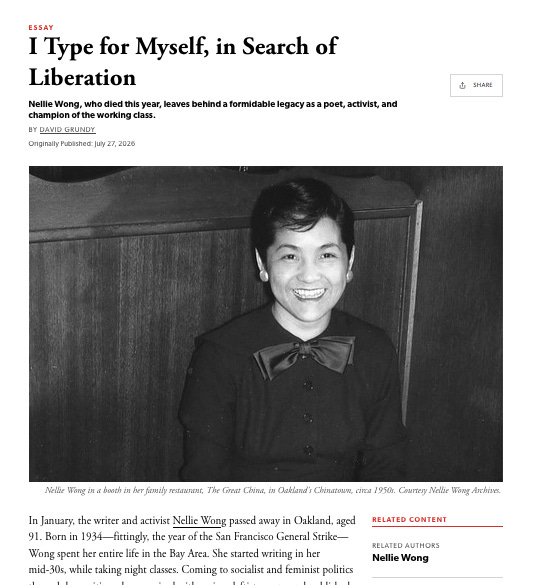
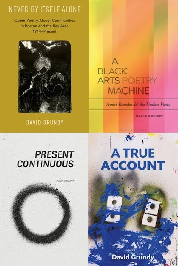
Based in San Francisco for many years, Nellie Wong features in a chapter of my 2024 book on Boston and Bay Area queer poetry, Never By Itself Alone, focused on her comradeship with fellow poets and activists Merle Woo and Karen Brodine. Wong wrote of labour, of class struggle, of family history. Her first book appeared in the late 1970s, when Kelsey Street Press published Dreams in Harrison Railroad Park; her final book will appear posthumously in this new century, now moving beyond its first quarter.

Employed as a secretary, typing others’ words, Wong used her own poetry and prose to write back, to write over the words of bosses. To write, Wong reminds is, is also to be involved in labour—physical labour, or labour that removes traditional, hierarchical distinctions between intellectual and manual labour, that attempts to deny the workings of the mind within the workings of the body and of the body within the mind. Poetry, activism, and education were a way out of those frames and into herself, into the fullness of her own life, but using precisely the means of that gendered labour—the typewriter, reproducing the words of others as a way of reproducing oneself for a wage, become now a weapon, a way into words and language and struggle.

To type back, Wong discovered, is to fight back, to discover and invent, to transmit. There is a friction here, and it is this friction that poetry operates like a lever. To type back is not the current invisibilising process of automation, of Large Language Models which anticipate and erase waged labour without any alternative recompense. Rather than the erasure of bodies, such writing attests to their presence within the system, insisting on their agency, their potential for sabotage, and their own inherent worth.
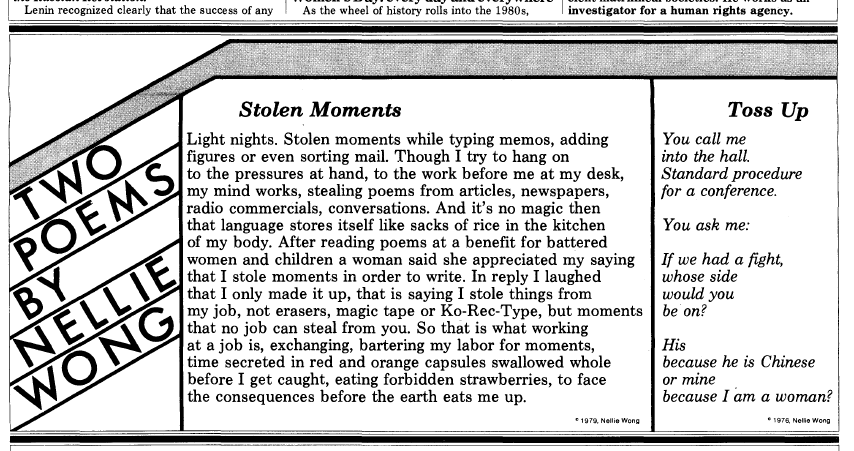
An early draft of Nellie Wong’s ‘Stolen Moments’, published in the Freedom Socialist newspaper in Spring 1980. A revised version forms the title poem to Wong’s 1997 pamphlet.

Last year I was privileged to attend an online discussion with the socialist feminist organisation Radical Women. Wong was involved with both RW and the affiliated Freedom Socialist Party until her passing, and was there herself on the Zoom call. I was deeply honoured by her presence, and struck by her modesty. Here’s the conclusion to the Poetry Foundation piece:

An individual writer’s work makes a contribution toward something whose contours will exceed those of their own life. “You will not survive the work that still needs to be done,” Wong wrote back in 1981. “You will be gone when the questions of the future arise like wildflowers on the plains of this earth.” To write is to live, but also to accept death. Wong’s late poems reconcile themselves to transience in the belief that human struggle might build a better world. As she wrote in “Under Our Own Wings” in 1979:

If you begin I begin
If you sing I sing . . .
In death our bodies regress to the innocence of bones.
In love we work to live in America under our own wings.
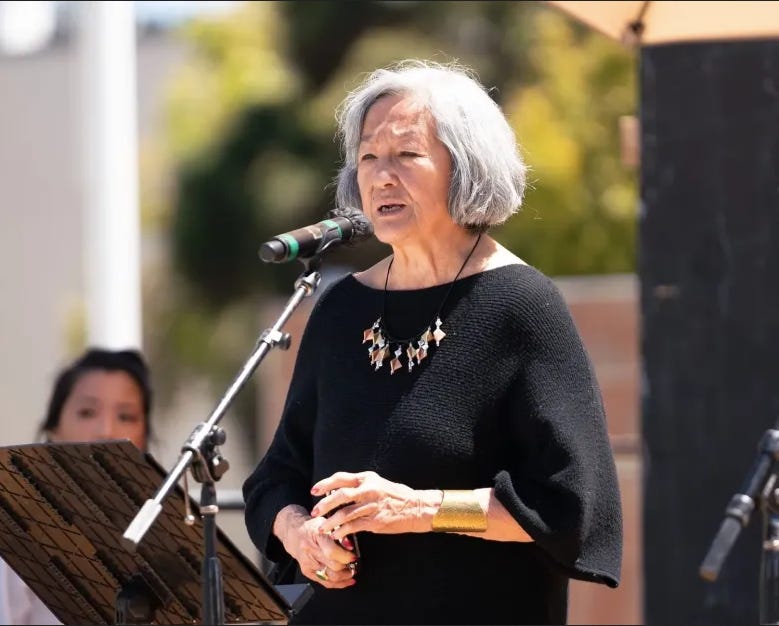

Nellie Wong reading at the Generations of Power festival in 2022. Photograph © Mark Shigenaga, via The Oaklandside.

Beyond the introductory work of that article, readers should head straight to the source. There are multiple rare recordings of Wong available at the invaluable Archive.org, among them:

—a 1978 reading with Susan Griffin (including the unpublished dialogue ‘The Interrogation of Ms. Security-Runs-A-Risk’);

—speaking on Asian American writing for KPFA radio the following month;

—Allie Light’s 1981 film Mitsuye and Nellie: American Poets, featuring Wong and Mistuye Yamada, who is at the time of writing an astonishing 103 years old;

—reading her comrade Karen Brodine’s poems in Washington for Radical Women in 1991, as well as delivering a lecture on ‘Racism, Sexism, and War’;

—interviewed on the KMVT15 Community Media TV channel, in a programme entitled ‘A Banquet of Poems’;

—and speaking on family and creativity with her siblings Flo and William at the Headlands Center for the Arts in 1996.

Wong’s illuminating 2017 reading and conversation with Genny Lim at the San Francisco Poetry Center can also be accessed via the Poetry Center website. In July 20025, she read with the Laborfest Writers Group at Bird and Beckett Books: the full reading can be viewed on Youtube, as can the memorial reading held in January 2026. A lovingly-maintained website can also be found here. And the organisations with which Wong was involved—a part of her life just as important to her as her writing, and inseparable from it—can be found at their respective websites: Radical Women here and the Freedom Socialist Party here.

In these traces, in her work, in her impact on many lives, Nellie Wong lives on.


Harmony Holiday’s broken epic
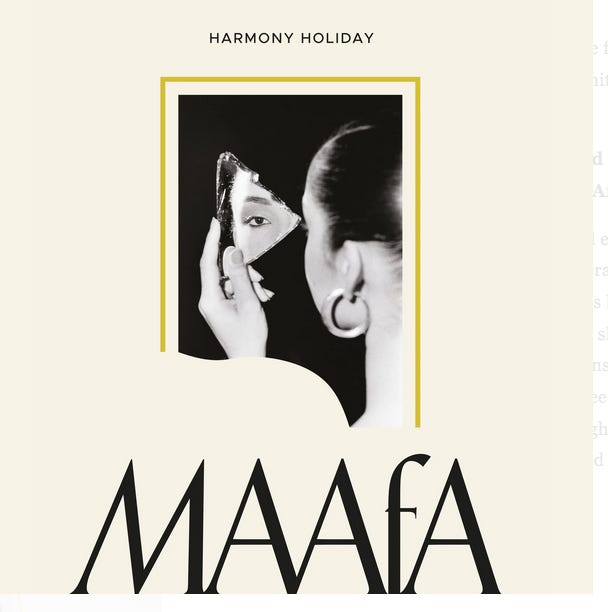
Also just published, a review of the expanded UK edition of Harmony Holiday’s epic poem Maafa, on The 87 Press’s new open-access journal The Hythe Review. For those who don’t know, Holiday’s Substack, Black Music and Black Muses has been running for several years and documents her ongoing writing on music. But music suffuses almost everything Holiday writes: her essays, her ongoing biography of Abbey Lincoln, her collections of poetry.

Maafa’s soundtrack would be Prince; it would be Pharoah Sanders; it would be the music of Holiday’s father, Jimmy Holiday, of Billie Holiday, to name some of Holiday’s touchstones, those named within its pages and the pages of her other books. 

The rest of the post can be read by subscribers on Substack here.

Wednesday, 6 November 2024

Festivals and Funerals / After the end of the world


It can be both too easy and to difficult to pick out what is world historical amidst a barrage of doom, defeat, and pessimism, the constant absorption of shock as a new norm. It now seems that the pandemic rolled out in the middle of what we can now understand as the Trump era: first as tragedy, then as tragic farce, the two elections of Donald Trump as president of the United States. Last night, as the US presidential election took place, I had a fever dream that I lived in the DDR, experienced, my dream notes say, as “a benevolent but spirit sapping simulacrum”, everything soundtracked to ‘Holiday for Strings’, which I think I heard the Sun Ra Arkestra play this weekend. 

In the waking world, yesterday, alongside the election result in the US, in Germany, a terror plot to establish a Nazi state. In Gaza, in Lebanon, the mass slaughter without end. In a talk on the Society of Black Composers, before the results of the election had come through, Harald Kisiedu opened by discussing the recent rise of the AfD in Germany, while noting that, in 1967, a survey suggested that seventy per cent of white Americans thought Civil Rights reforms were taking place at too quick a place. Sixty years on, from Trump to Björn Höcke, ‘remigration’ is the trope of the day. As Kisiedu suggested, the creolizing influence of Black music within German culture fostered during Weimer was one of the first targets of the newly legitimized Nazi regime, part of the creeping force of ‘degenerate art’. Today culture perhaps plays a less obvious role as target of fascist discourse. What musical culture do contemporary German fascists have? Schlager for days. Disco hymns to tolerance with their lyrics re-written to fascist ends, sung on holiday islands. That’s the fascist festival. Celebration of sadism. Celebration as sadism. At his rallies, Trump picks and choose any number of songs as if distinctions of genre or sound or tone have no real meaning, dances alone, as if dance itself were not a communal form but the disconnected moves of a man exercising a form of arbitrary, illogical power. “Let’s not do any more questions. Let’s just listen to music. Let’s make it into a music. [sic] Who the hell wants to hear questions, right?”

An email I received the other week asks whether, in such times, music is “spur for revolutionary consciousness” or instead for “self-preservation”? What kinds of community does it create? The music that claims--or perhaps, no longer even claims--to be the most revolutionary plays to the smallest audiences, and the music for mass audiences turns even the images of mass politics, mass resistance, into spectacle, colludes with dictatorial regimes, covers over, keeps up the charade of democracy (Julius Nyerere: “The United States is also a one-party state but, with typical American extravagance, they have two of them.”) Here music is both powerless and, in a time of culture wars and the apparently serious use of the term ‘cultural Marxism’, (left-wing) culture is at once endowed with a seriousness and an impact it has not seemed to have for years and turned into a kind of hollow charade, a parade of within the increasingly totalized culture industry.  Thinking of Trump’s victory in the election, and the parade of stars, from Beyoncé to Cardi B, who came out in support of Kamala Harris, Harmony Holiday writes
I believe that, in a final assessment, when it’s all underground or sea, black music will be one of the only redeeming elements of this empire, the poetics of inevitability black music insists upon, so much [...] It is black music that governs the US, that gives it a legible pulse and makes it a real place and not a full time amusement park for disaster capitalism, but when that music grows too shallow and ‘popular’ to face its own heartbreak, and change, [it] starts pretending to be hard and declaring itself a winner of a race everyone is losing and limping through [...] You thought this was a party and not a funeral.

Festivals and funerals, the two terms on which Jayne Cortez’s poetry collection of that name turns, thinking of the funerals of leaders, of activists, of musicians she’d attended and witnessed and absorbed in the years of assassinations at the end of the 1960s and the beginning of the 1970s: Fred Hampton, George Jackson, Martin Luther King, Malcolm X, John Coltrane. How to turn the funeral into the means for organizing, the spur to continue, rather than the dead end of grief, as Jackson put it shortly before his death in Blood on My Eye

People’s war is improvisation and more improvisation [...] Improvising on reality is the key principle underlying the building of a united left and raising the consciousness of the people. Even funerals can be used as an issue, since there will be so many of them. . . . [They] should be gala affairs, of home-brewed wine and revolutionary music to do the dance of death by. 

Today no one even speaks of people’s war, or of a united left for that matter, though improvisation is still an issue. But the question remains: how to prevent the funeral parade of American death and its global export from being presented as a festival, a celebration, ringing hollow as the last vestiges of this latest failure to prevent a Trump presidency are cleared away, the memes and tropes, Brat Girl Summer and the rest, and then how to prevent the reaction from sinking into a simple despair or a simple numbness, a seeming inevitably, each time a shock is felt its impact less keen. And to reckon with the fact that, for all the lies and manipulations, Trump’s election to power is token not simply because of election-mongering, voter fraud, the entire atmosphere of intimidation and violence, the billion-dollar power of right-wing tech bros, the Elon Musks of this world, the official and the unofficial media alike, not simply because of the crushing force of the oligarchy and the latter-day robber barons and their running dogs, but because people, voters, actively and sadistically desire these people to be in power, because people hate women, because people hate migrants, because of the sadism of that desire, whether on the part of the rich who vote in their own class interest, the feeling of strength in what is in fact classed and raced and gendered strength, or the illusory feeling of strength from those who vote against their own interests, the feeling of strength in what is in fact a condition of weakness, even at the cost of their unfreedom. How to fight that? How to go beyond it? If we are now living in what is, essentially, a fascist world, what do we do? These are both new and old questions.

When a US flag was flown during an Archie Shepp performance at the Donaueschingen Festival in the late ’60s--thus implicitly positioning Shepp as avatar of jazz as US imperial export, of Willis Conover or Nicholas Nabokov, of the Congress on Cultural Freedom, rather than that of his own politics, deeply opposed to US imperialism and domestic racism--Peter Brötzmann tore it down. And, as John Szwed recounts, during a concert in Central Park Ra’s Arkestra gave in Central Park: “At one point [...] the Arkestra hit a screaming space chord, and the large American flag stretched across the back wall of the band shell fell down. With that, Sonny abruptly ended the concert.”

As Ra famously put it, “it’s after the end of the world...don’t you know that yet?” After the end is where to begin. The end of history. The end of the idea of the end, that we have somehow transcended or gone beyond both the fascisms of the past and the freedom dreams of the past, those forbidden black and red dream of communism and socialism and abolition. The radical tradition, the continuity that preserves memory even in its transformation.  

A few days after the Brexit vote and a few months before the first Trump victory in June 2016, Sean Bonney wrote:

Nothing stops. Nothing speaks. [...] Now, a couple of days after the referendum, it looks like [the civil] war has started. It won’t be declared. Every declaration, every sentence spoken by every public figure has been a lie. [...] We’re deep inside the apocalypse now. 

What’s needed,

a collective effort to get us through to the other side. No sleep. No dreams. Just a grim determination to defeat those fascists who would murder us, to cast them intact into the hell of worms.

After the end of the world, within its ending. After the end, in the beginning.