
Following an essay on the MusikFest Berlin performance of Ligeti’s opera Le Grand Macabre, a report-essay on the world premiere of Yvonne Loriod’s oratorio Le Saint Face, touching on: Jean-Claude Touche, killed on the day of the Liberation of Paris, St Thérèse of Lisieux, Simone Weil, Olivier Messiaen, Gwen John. A preview below: the full piece is available to paying subscribers on the ambient evil of the Substack platform.
Since the start of the year I’ve been working on and off on a book—which may or may not be completed—focused around Olivier Messiaen’s opera Saint François d’Assise, so I’ve spent some time of late immersed in Messiaen’s world. This summer I saw the production directed by Romeo Castellucci at the Salzburg Festival. The people sitting next to me had seen both previous Salzburg productions, in 1992 and 1998. I was still a child then. Sometime it’s easy to forget that Messiaen began working on the opera fifty years ago. By this I don’t mean that it sounds contemporary or of the moment, but the opposite: precisely because it sounds out-of-time, because it so completely inhabits its vision of devotion and eternity, it comes to us still like an object from somewhere else entirely.
Stretched out with intermissions to last nigh-on six hours, the evening of the solar eclipse, the Castellucci production was a spectacle both austere and excessive—as austerity is in itself a kind of inverted excess. Peering out at the sun through borrowed glasses by the ruins of old castle walls, then coming down the hill for onstage baptismal rain, a tame wolf, a flock of sheep, a cascade of dead or dying animatronic birds, ondes martenots blasting out from alcoves to my right, percussion to my left. The experience will live for me for a long time.
During reading in and around the Messiaen cosmos, a significant part of the research has involved discovering the role of pianist Yvonne Loriod, Messiaen’s second wife and constant champion. Loriod’s own role as the foremost interpreter of her husband’s music is not in doubt. But her own past as a composer, coming of light of late, thanks in large part to the archival efforts of scholars Peter Asimov and Christopher Brent Murray, who are currently writing a book on her work. There’s a history to what gets heard and what doesn’t get heard, and it’s important to acknowledge that this groundwork—frequently that which enables the music to be heard at all—is vital to such stories.
Loriod’s pieces date from her late teens and early twenties, after which she put aside her compositions to work as Messiaen’s foremost interpreter. Without her scrupulous virtuosity, these pieces might never have been written. With it, they enabled Messiaen to create a whole new language, as tied to the performer who enabled them as they were to the instrument and to his own musical vocabulary. It should also be noted that Loriod was an important early interpreter of Pierre Boulez, with whom she premiered Structures, along with work from the canon. A 13-CD boxset of Loriod recordings from Vega tells an important part of this story, including music not only from Messiaen but from Mozart, Liszt, Chopin, Schumann, Albéniz, de Falla, Berg, Schoenberg, Webern, along with her contemporaries Henze, Boulez, Barraqué.
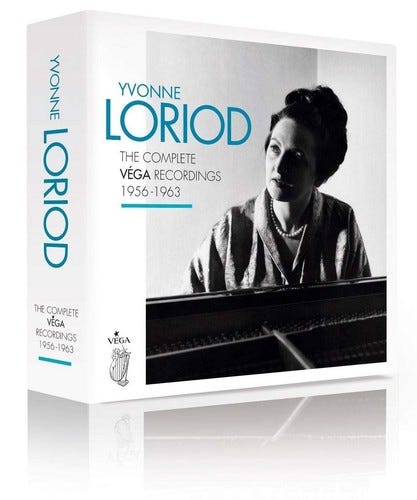
Given the demands, in particular, of being the central performer in much of Messiaen’s work, Loriod’s own compositions were quietly shelved. Gender surely plays a role here, as well: giving up one’s own talents for those of a spouse; being discouraged, if not by individuals, by a kind of social milieu in which female musicians—despite notable exceptions such as Betsy Jolas—tended to assume the role of performers rather than composers. For the moment, this remains speculation: Asimov and Murray’s scholarship may well cast a further light on this. What’s clear is that Loriod’s youthful compositions stayed in a box in the home she shared with Messiaen, unremarked. George Benjamin, pupil of Messiaen and friend to both he and Loriod, had no idea she had ever composed. After Loriod passed in 2010, those scores ended up in at the Bibliothèque nationale de France: now, some eighty years later, they are finally coming to life.
I first heard a recent recording of a 1951 work for two prepared pianos earlier this summer: a performance by Florent Boffard and Roger Muraro broadcast on Radio France and forthcoming on CD alongside Messiaen’s Visions de l’Amen. For this piece, Loriod wrote a set of densely poetic notes that perhaps owe something to Messiaen in their fusion of esoteric spirituality and rhythmic complexity, but whose elaborations have a poetics all of their own. The sound-world of this music is, moreover, harsher, its edges more pronounced than that of Messiaen—closer to those of his students—of whom Loriod, too, was one: the enfants terribles who would take from the hints of some of his works of this period what would become integral serialism before they, too, moved in other directions. (Loriod, after all, was one of the pianists in the premiere of Boulez’s Structures for two pianos.) But these are a kind of flailing for comparisons: Loriod’s work doesn’t really sound like Messiaen, nor like Boulez, nor like much of what surrounded it.
So it was some anticipation that I attended a performance of Loriod’s oratorio La Saint Face, receiving its premiere at the Musikfest Berlin this September. I wasn’t quite sure what to expect. Neither, it seems, were the programmers. An announcement reached attendees a matter of weeks before that the planned line-up had been altered. While producing a workable score from Loriod’s manuscript—which, though decorated with embellished letters and swirling drawings of wings, lacks bar-lines—it had been discovered that the work in fact lasted twice as long as supposed, a full ninety minutes. Far from a work to fill one half of a concert programme, it was essentially long enough to take up a whole concert by itself. Out went the Mendelssohn with which it had originally been paired, to leave a short programme of contemporaneous French organ works and a brief orchestral commission for the first half. Due to the rescheduling, I missed the performance of Henze’s choral music—the Italophile sensuality of the choral work Musen Siziliens—taking place in the Philharmonie’s adjacent Kamermusiksaal. But it didn’t matter. The increased length of the Loriod work only contributed to what really felt like an event [...]
In one sense, the piece is all flow. The vocalist sings in what Loriod termed an “an infinitely pure, delicate raga”, the reference here apparently to the temporal extension of classical Indian music, more than any melodic or harmonic similarity. The score’s absence of barlines might be read in this light. That absence also realizes certain conceptual—not to mention practical—challenges. The missing barlines; the fact that only at the last minute was it realized that the work was to be performed at half the speed previously conceived; the doodles of holy wings, little iconic fantasias present in the score: all these might cause one to question: was this a work intended for performance, or a kind of intense inward fantasia, something like a diary entry? In the absence of any further information, it’s impossible to tell. But what can be said with certainty is that Le Saint Face certainly one of the stranger pieces I’ve heard.
In her report on the premiere, scholar Caroline Potter writes: “If I tell you that it was sprawling, I mean that it was outrageously all over the place; if I tell you it was indulgent, it was the furthest realm of indulgence you can possibly contemplate.” The score, Potter continues, “is supremely impractical [...] Perhaps no one told Loriod that writing a 90-minute work with different instrumentation for every number, seven flutes, two ondes Martenot and the rest was a crazy idea; perhaps someone did and she ignored them. Perhaps no one apart from her saw it at all.” The piece becomes “a magnificent folly”. Wikipedia has for folly: “a building constructed primarily for decoration, but suggesting through its appearance some other purpose, or of such extravagant appearance that it transcends the range of usual garden buildings.” And there is perhaps something of this kind of decorative extravagance to a piece whose construction might well be called—if precariously—architectural.



No comments:
Post a Comment