Juliet Fraser - Wave Songs
City University, Tuesday 11th October 2022
Alvin Lucier, Wave Songs
Newando Ebizie, I birth the moon
Newton Armstrong, The Book of the Sediments
[Note: A shorter version of this piece will appear in the forthcoming issue of The Wire magazine.]

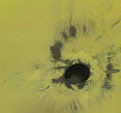
Image: Lee Lozano, from Wave Paintings.
As part of City University’s laudable free concert series, soprano Juliet Fraser presented three works for voice and electronics in a condensed but focused programme lasting around an hour. This condensation was reflected in the evening’s visual presentation. At recent concerts at City’s basement performance space, I’ve seen percussion spilling over the limits of the stage (for the Pierrot Ensemble’s performance of the late Harrison Birtwistle’s The Axe Manual alongside new music by Marc Yeats). On this occasion, however, the stage was bare apart from four speakers, a music stand, and Fraser herself. Onstage, the lights meant Fraser’s shadow was doubled, at times tripled, the darker shadow and its overlapping, progressively lighter ghosts: aura, umbra, penumbra. It was an appropriate figure for all three works’ play with liveness and pre-recording, various forms of doubling and recurrence—impersonally in Alvin Lucier’s Wave Songs, noisily, shatteringly in Nwando Ebizie’s I birth the moon, and with a kind of melancholic implacability in Newton Armstrong’s The Book of the Sediments, the latter two pieces world premieres forming part of Fraser’s cycle of commissions based on the work of Rachel Carson’s Sea Trilogy. (Previous instalments, by Laurence Crane and Lara Agar, were heard at John Lely’s and Tim Parkinson’s long-running series Music We’d Like to Hear late last year.)
The concert took its title from Lucier’s piece, “for female voice and pure wave oscillators” commissioned in response to Lee Lozano’s Wave Paintings in 1998 and first performed by Joan La Barbara, but so far, never officially recorded. “Wave Songs”, Lucier’s programme note remarks, “consists of eleven solos for female voice with two pure wave oscillators”, with tones fading in and out at the beginning and end of each song.
“The singer stands between the two loudspeakers from which the pure waves flow. Throughout the course of the work she sings pure tones on the vowel ‘oo’ matching the sounds of the pure waves, in order to create the most vivid beating [...] As the oscillator tones get closer and closer together as the work progresses, it becomes virtually impossible for the singer to accurately tune her pitches”.
This play with human error and with the ‘purity’ of electronically generated sound waves is not so much an animating tension as a flicker at the work’s edges, the drama of pitch regulating that governs much western music a kind of crackling undercurrent to a work that often sounds like an encapsulation of that very principle. Introducing the concert from the stage, Fraser remarked that Lucier’s piece, involving various complex mathematical complications, can seem like an intellectual exercise. Her advice was to “feel the piece rather than listen to it”. At the same time, that very distinction between feeling and listening is perhaps one the piece is also interested in collapsing. Expanding and exploding customary practices of listening, Lucier treats sound as material, vibration, solid yet evanescent, something both literally and metaphorically felt, a world of sonic illusion in which the distances between sine waves and the vocal line create ‘beating’ effects—as Lucier puts it, “bumps of sound produced as sound waves collide”. But this vocabulary of expansion, explosion, collapse and collision doesn’t really capture the still spirit of the piece, its moving stasis, its static movement.
As is well-known, Lozano effectively dropped out of the New York art world in the early ’70s, her early work, “comix”, sexualised paintings and drawings that drew with fresh and raging energy from the currents that also produced the often tamer works of pop art. Subsequently moving from these works into sexualised depictions of tools—screws, pipes, wrenches—Lozano in turn embarked from 1967-1970 on the Wave Paintings, abstract canvases depicting multiplying wavelengths of light. Lozano had planned a follow-up series with each painting painted in a different state, including “stoned, drunk, horny”—the body and the changing passions of the body mixing with the ‘objective’ phenomena of light and object, tool and, questioning what abstraction is and means and how it interacts with the female body and perceptions of the female artist. As it stood, however, she instead made a series of dramatic gestures of refusal that aimed to resolve contradiction, first through Dialogue Piece--inviting “people [she] would rarely see [...] to [her] loft for a dialogue”--and then Untitled (General Strike Piece, Feb. 8, 1969) and DECIDE TO BOYCOTT WOMEN (1971), in which she cut off communication, first with the art world—instead, Lozano promised to work only towards “total personal and public revolution”—then with all women, before dropping out altogether.
Painted before this process of removal, Lozano’s Wave Paintings saw her painting accumulating waves on canvas, culminating in a total of ninety-six waves painted over three days, stopping only when she reached the physical limit of how many waves she could paint in a single session. As painter David Reed remarks in an Artforum interview on Lozano’s work with Katy Siegel, “the series is infinite, it’s just her physical limitations that stopped it.” For Siegel, the work “seems to combine a rigorous scientific approach with some kind of personal statement.” Reed concurs:
“Her interest in science is a way of connecting art to larger issues and keeping it from becoming merely formal [...] Lozano’s “Wave” paintings seem to offer proof of the difficulties of that transformation of the self, and reasons for the doubts. The series is meant to be endless, but she can’t make it endless. It ends physically, not conceptually. She desires more than she can achieve, not just physically, but in other ways as well. It’s like Kafka saying, “Oh, there’s infinite hope, just not for us.””
As Reed remarks, in Lozano’s work, “you aren’t coerced into having emotions; you decide to have them.” Such work explores the nexus of perception, emotion, abstraction and the material presence of bodies. And Lucier’s own interest in the pure, potentially infinite sound of oscillators, activated by disturbances in environment, relates to his own position as a stutterer, explored most famously in I am Sitting in a room (1969), in which the imperfections in his speech contribute to and are then erased by the feedback created from repeatedly playing it back into a room. “I want audiences to open up their ears to their environments”, Lucier commented to his student Douglas Simon. In exploring “how space intrudes its personality on the sounds you produce”, Lucier continued, “I simply want to find out what these [different] environments do to sounds, not to make them but to take what I can find, and in that way each performance will teach me something.” Ideally, this process of learning sees both Lucier and his listeners alike as embarking on a process of finding out about sound, about themselves, about the world.
“Are you trying to tell the audience something beyond what they hear?” asked Douglas Simon. “Yes”, Lucier replies.
“It’s just an extension of what you do when you’re a small child at the beach and put a shell up to your ear and hear the ocean. Then you stop. You don’t do that as you grow older. Your ear stops doing that because you’ve got to think about other things, how to make a living and how to speak to people, how to communicate verbally. I guess I’m trying to help people hold shells up to their ears and listen to the ocean again”.

Waves were a longstanding metaphor for Lucier: the generation of music from the performer’s brain waves in Music for Solo Performer (1965), the recreation of the sounds of the sea in Chambers (1969), for resonating objects. Lucier’s sound waves, Lozano’s light waves, and the oceanic framing of the concert come together
Lucier’s Wave Songs is in eleven short movements. The piece achieves the remarkable feat of generating a soundworld at once extremely quiet—it seems that every audience twitch can be heard—and one that totally fills the space of perception, huge and morphingly fixed, the soprano singing held notes over sine waves producing beats/difference tones against them. In a music that collapses the traditional divisions between melody, harmony and rhythm, the work operates on a principle of held tones and tone succession, the differences between which generate rhythm and harmony at once. The third song sees vocal leaps approaching Feldmanesque melody—specifically, the Feldman of Three Voices, like Lucier’s piece, premiered by Joan La Barbara, and likewise recorded by Fraser—as the sine waves chirrup like frozen, heavy birdsong or a muted car alarm.
A work so rooted in physical phenomena becomes moving in both a literal and a metaphorical sense. As is so often the case with Lucier’s work, it opens up the environment, gives us a space to see ourselves or whatever we choose to see reflected and enabled there, getting to the roots of sound, what it does to us and what we make it do.
In the penultimate “song”, language enters the work for the first and only time, as the soprano sings words from Lozano’s writings describing the thinking behind the Wave Paintings, the shock of the entrance of language subdued by the rendition of the text as a single-note melody. Lozano’s text describes light waves—“the waves are really a reference to the electromagnetic spectrum”, Lucier ‘translating’ this to apply to sound waves: a description of waves heard on waves of sound. Here is a blurring of metaphor and sound, of waves in multiple senses as movement in time and space.
“I was trying”, Lozano writes, “to combine art and science and existence. It was a science idea transferred to an art idea.” In much of Lucier’s own work, if not Lozano’s, this becomes something like a general principle. But it’s not just about “objective phenomena”, which in Lucier’s explanations of his own work is so often described in technical, relentlessly material terms: in a work like this, they form the stage for weird dramas, audio tricks, suspensions of disbelief at once contained and expansive. “I imagine the work as a mini opera”, Lucier remarked, “with the singer taking the part of the artist, singing her paintings into existence or perhaps simply humming to herself as she worked on them.” Lozano, who’d been persuaded to allow retrospective shows such as the one for which the piece was commissioned, would die the following year; given Lucier’s own recent death, the piece assumes the status of a double memorial, the speakers both tombstones and openings to a world of other possibility, in which that which is prior emerges uncannily into the present: the voices of the dead, living still.
In the next and final movement, the vocals are a back of throat murmur, a sound click, murmuring on the edges of perception and of being recognisable as a singing voice, or for that matter, a human voice at all—those effects so effectively explored by the likes of Ami Yoshida’s ‘howling voice’ technique—“a barely audible sound that is perceived as sound itself rather than as vocalization”—developed, coincidentally, around the same time on Spiritual Voice, recorded between 1995 and 1997, and whose work with the sinewaves of Sachiko M as Cosmos on Tears (2002) the no-input mixing board of Toshimara Nakamura on Soba to Bara 2009) has notable similarities with Lucier’s work. Hearing the work in this space, over the course of Lucier’s Wave Songs, the acoustic voice, in proximity with the pre-recorded sine waves, paradoxically starts to sound more electronic and the electronics to sound more ‘voice-like’ or human. Or is that just a perceptual trick, the experience of one listener, with their own metaphorical and perceptual projections that they, like each listener, bring to the piece? The piece, it seems to me, asks us to interrogate the very basis of sound, of how and why we listen, while, at the same time, imposing nothing but itself.
You could just listen.

Image: Nwando Ebizie. Image from ColoRising.
Before—and even, arguably, during—the production of the Wave Paintings, Lozano’s work was to do with the body, with all that was stigmatised as ‘unscientific’, feminine, hysterical—the altered states of being stoned, of drinking, of sex, of changing oneself by changing the environment around one and vice versa. Her move from physical works based in objects—culminating in the immense materiality of the wave paintings—leads to performance works based on renunciation—first a dialogue piece, then a dropout piece, then a boycott piece, art as a self-contained enterprise collapsing into life and its messiness. Lucier’s work might appear to do the opposite: to order, to regulate, to present. Yet there’s something here that deranges, de-arranges perception, something between contemplation and agitation, between ecstasy, ex-stasis, a being taken out of self, and a revelation of self and its limits, the limits of a body, of hearing, of being in a space. Then there’s the question, of course, of the position of male composer and female performer, of the way that the piece is or is not gendered, questions that, perhaps, go beyond what the work can hold.
These questions of gender more directly inflect the next piece, the world premiere of Todmodern-based, British-Nigerian multimedia artist Nwando Ebizie’s I birth the moon. As her programme note suggests, Ebizie’s concern, like Lucier’s, is with embodiment and how it shapes perception, but from a perspective that, like Lozano’s, is oriented around the subjective rather than the ‘objective’ elements of sonic process: from its process of composition, constructed in collaboration with Fraser during “a day of walking in the Yorkshire moors, talking, eating and improvising”, and takes inspiration both from Rachel Carson and from “the experience of miscarriage, the hopes, the fears of birth, the absurdity of the body vs the strong will to create, the ‘I’ wanting to become we”. (We might call to mind here Ruth Anderson’s haunting 1968 tape work, The Pregnant Dream, with its swirling spoken voices concerning dreams within dreams, speaking and forgetting.) From a different angle, Ebizie raises similar questions to Lozano and Anderson alike: how does embodiment shape perception? What is time? Where are we positioned in relation to phenomena, to each other, to the world? These are questions that, as Lozano suggests, might be “science idea[s] transferred to art idea[s]”, but they are also, incessantly philosophical, social, political. Lucier’s work, like that of Newton Armstrong at the close of the concert, understands process as something like a grid, composition as the enacting of certain pre-arranged rules with margin for error and change creeping at the edges. Ebizie’s has the feel and sound of a more improvised approach, in which the clarity of successive movements and sections found in the other two pieces is replaced by a more amorphous world of live voice and electronic shifts, of clattering soundscapes that swirl into and out of ambiguous climaxes.
The piece begin with Fraser’s spoken voice matter-of-factly announcing the creation myth—“in the beginning”—alongside echoed, drawn-out, multiplying voices and clattering percussion, with live and recorded voices mirroring each other onstage and over the speakers. Fraser’s intonation is at times operatic, but the interaction with the electronic park constantly draws the music away from ready reference, as, in a burst of fractured rhythms on the speakers, a live soprano wail careens into an elongated electronic scream that in turn becomes a buzzing digital whirr. “What is...what is...what is?” Fraser repeats with increasing urgency, before a burst of laughter breaking down into back-of-throat gurgle, gargle, voice crack. “The constant trials and failures of creating life”: an uneasy chant over a heartbeat rhythm, dropping out—“a great tidal wave of earthly substance, torn off into space”. Ululation, shimmering echo and on the speakers, the sound of breath that becomes wind or wind that becomes breath. A long, high wordless melodic line over rising and falling voices on tape, melismatic incantation. It all suddenly stops with the sound on the tape of an inhalation, another breath, somewhere between beginning and ending, poised to speak again.

The final piece on the bill, Australian-born City University lecturer Newton Armstrong’s The Book of the Sediments. Armstrong’s work has recently received the full-disc treatment on Simon Reynell’s Another Timbre label, in works that, as he puts it in an interview with Reynell, “work on some new approaches to musical line, repetition, and layering.” “All of my recent instrumental music has included electronic sounds,” he continues, “and these are usually treated in an ‘instrumental’ way, with the loudspeakers integrated into the ensemble. And all of my work for the past twenty years has involved computer programming at some point in the process.” This manifests, for instance, in “deformed, non-strict canons [...] created by algorithms that I designed.” Armstrong defines a canon as “a line alongside itself”, and that sense of setting lines alongside one another likewise infused his new work.
The work opens with a down-toned drone reminiscent of Giacanto Scelsi--Anahit, perhaps--Armstrong’s ‘instrumental’ treatment of the electronic lines pointing to their acousmatic uncanniness. Are those horns? Woodwinds? Strings? Purely electronic tones? Fraser’s live voice sings in countermelody, a descending two-note motif, a study in recurrent descent and descant, waves’ rise and fall. Now a second motif, silence between each iteration of the tape part, seeming at the end of held sounds to reveal itself, not as instrumental but as a treated voice. If Lucier’s sine wave appears as the index of ‘pure’, non-human sound, Armstrong even more blurs the distinction, ghostly timbres changing into something else then back into themselves, accumulating not so much as ‘progress’ but process.
Armstrong’s programme note suggests that he took his cue from Carson’s description of “the slow accumulation of sediments on the deep sea floor” which eventually form the matter of the earth—a process Carson calls an “epic poem”, in Armstrong’s words, “an inscription of all that has happened in the geologic and climatic history of our planet”. Here is another way to approach the relations of material, of time and space found in the preceding works: what Armstrong calls “the interactions between the momentary and the vast, and of endless process as a form of saying”. But can this work’s methodology be called accumulation, as the sediment metaphor suggests, and as Lozano’s expanding wave paintings might also suggest, or is it instead a winding down, in the era of climate change anxiety, the echo chamber of covid, lockdown, of politically-fostered alienation, loneliness, and a sense of real and impending catastrophe? As motifs and layers build, accumulate, recede, white noise sounds—field recordings of oceanic waves?—enter on the tape. A hum, a slight chirrup, a sinewave, a wave, the literal and metaphorical intersecting in sounds and time and tide’s ambiguous embrace.
Wave sound to fade. Soprano sings high, Fraser’s hands held together in front in a resting gesture somewhere between benediction and protection, holding something up or holding onto something. Difference tones hum between the ears, ship-like clankings on the tape, surrounded in sound: this is at once a spectacle of control and of overwhelming, of being overwhelmed, lost at sea. Or is it that sound just a dripping tap in the bathroom sink—connected to the problems of world water supply, of declining and rising sea levels, of ice cap melt and of drought? Fraser stands silent onstage while the sines wind down and the water continues to splash, and it’s over. The Book of the Sediments is a work at once of connection and disconnection, alienation and a kind of melancholic peace. After Armstrong’s piece ended, the applause that followed sounded alien, strange, like rain gone wrong. Such music, at root, strives to alter the way we hear. This was a concert that altered the space in which it was placed; one might take us back out into the world with a different sense of how we walk through it, of where we go from here.