Thursday, 2 April 2009

HENRY GRIMES – SIGNS ALONG THE ROAD: POEMS

[The following review originally appeared in Issue 3 of 'eartrip' magazine.]

Publisher: buddy’s knife jazzedition
Publishing Date: 2007
Number of Pages: 129

Contents: signs along the road being put there; the march; easternal mysticism, virtue, and calm; sed; the arch stairwells; the walk in the dark that was heard at night; ortherama the king; of europe; untitled; untitled; the rivers run into the sea; amazed heart, all ponderous eye; the infant of attention; the luckbill; death; ghost and spirit; the place; the world our society, society our world; the chime around above time; lilith; the feeling of ahaz; that was the quip lib; as oceans – head; coasts; at any; a pre-revolutionary cabin; moments; egregious grows the light of dawn; adama and pourquory; hieroglyphics; to adopt a child; grenth; prose lefthand; in the day; the river end; peace; monk music; friend; apologia pro vita sua; water wax; back to down along spring street; in case the place should change; the ground; gage’s pick-ups; two; metabites; against the shadow of the moon; a chart of heart a chart of mind; the last chord
Additional Information: Available from http://buddysknife.de/


The facts are well known. Henry Grimes, established as absolutely one of the leading figures in the new music of the 1960s, through his work with Cecil Taylor, Albert Ayler, Don Cherry and Pharoah Sanders, disappeared in 1968. Presumed dead ever since, he was discovered in 2003, subsequently remaining in demand around the world, playing with many different groups and in many different contexts, creating anew the wonderment of the 1960s’ fervent ferment, with that same energy and ear for the serene howl of uncouth beauty. In the thirty-year gap, he did not touch a bass once. But neither did he suffer from the ills that forced so many jazz musicians off their paths of brilliant creation – drink and drugs. And thus his mind still roamed, seeking other avenues down which to travel, apart from the music which it sustained and which sustained it. It was to words that he turned, and though Marc Ribot claims in his introduction to this book that Grimes is “a man who almost never speaks,” through writing he was able to exercise his mind, to make that transference from thought to art. Filling thousands of pages with his thoughts, with diary entries and with poetry, he had no audience but himself (how different to the glass-clinking, cash-register-ringing, conversation-ringing atmospheres of the jazz-clubs in which he had played!).

Yet writing with this freedom imposed more discipline, not less – one should not expect anything otherwise, given the beautiful freedom of the bass playing. What emerges out of this selection from Grimes’ notebooks is that he was truly was using poetry to think, deeply and seriously. As he treated music as a philosophical and spiritual activity, so he understood that poetry can be fundamental to an understanding of where and what one really is. It could be argued that this absolute concentration of faculties emerged from necessity, but it was also self-imposed: no one told Grimes to write, it was his own compulsion to do so. In the thirty silent years during which he remained virtually alone, poetry was a way of reaching deep into his own innermost recesses, but also of engaging with the world from which he had cut himself off – whether this be through the use of history and mythology (‘a pre-revolutionary cabin’, ‘ortherama the king’), religion (‘easternal mysticism, virtue, and calm’) or consideration of the surrounding urban environment (‘the arch stairwells’).

Paradoxically, it may have only been by cutting himself off in this way that he could manage to so deeply engage, with the world and with himself – although it is worth noting that quite a few of these poems were written after Grimes’ re-emergence. Nevertheless, it was arguably that extreme cut-off which presented the conditions in which this poetry could be brought into existence (though one must be careful not to romanticise solitude, ‘dropping-out’, as one might be tempted to in the cases of Sonny Simmons, Charles Gayle, or Guiseppi Logan (himself perhaps on the verge of a return)).

Part of the poetry’s beauty is its individuality. Not for the sake of wackiness or trying to seem/appear anything. Compare these lines to your standard jazz poetry: “Distance was spatial/ and the time drew/fathomless,/ in quire to condescend/in the mystic measures/overlapping” (‘the walk in the dark that was heard at night’). This is difficult stuff –not just because of the use of obscure words like ‘quire’, ‘mien’ or ‘zygocity,’ but because of the whole construction and content of the poems’ almost every line. Grimes’ phrasing is genuinely knotty; he is genuinely attempting to say things that cannot be said any other way. Prose paraphrase will really not do. Recently I’ve been thinking about how it would be possible to develop a new vocabulary, or set of vocabularies, to deal with the intense demands that music like Grimes’ makes on the traditional resources of music criticism/journalism. I think that ‘Signs along the Road’ is the closest that anyone has so far come to doing this, the trade off being that it is so much a poetic conception that I’m not sure it would, or could desirably, be fitted into the confines of criticism.

In any case, music is far from Grimes’ only theme. “Events are the polarizing of urban waves in spiritual displacement”: this is a poetry that addresses that great theme of Frank O’ Hara –the contradictions of living in the modern urban world, and specifically, in the modern American city. Admittedly, Grimes’ methods and results are very different to O’ Hara’s, his city poetry being interior and private-public. By this I mean that the initially inward meditations reach outward to encompass the public (most often in its facade as architecture and constructed living space – hotels, roads, churches, parks) rather than starting out and moving in. This is a more complex process than I allow, in fact, for an observed image tends to be the initial trigger (‘signs along the road’, ‘the arch stairwells’), and the inward/outward relation often exists, as far as that is possible, in a simultaneous relation. Yet still I think there is a difference to O’ Hara’s predominantly social and public-private sphere – by which I mean that even though one is alone, one always writes about one’s friends, about lunches and parties and boat trips and sexual couplings, that even one’s deepest fears are considered in terms of others, and probably could not exist without them (“when anyone reads this but you it begins/to be lost” cements the very personal address of ‘A Letter to Bunny’). Grimes’ scope is both wider and narrower: ‘the world our society, society our world’ – this ‘world’ feels much more abstract than that of O’ Hara, which is constructed almost entirely out of those that people it.

Considering one’s environment so deeply inevitably leads one to question how one is placed within it. The poem just cited does this, to be sure, but perhaps the most direct engagement is in ‘the place’, found on pages 52 and 53. By its final lines (“and i was right: i knew/ just where i was”), one knows without a doubt that the piece’s journey is genuine. It begins: “The place was always – a thing/ to wonder, and/ always it seemed like/ it had propensity/ to outright.” This seems relatively straightforward, compared to some of Grimes’ other contortions of syntax, but read those lines again. “The place was always – a thing/to wonder:” the dash placed between the first four and last two words of the first line, importantly adding an extra dimension of meaning. Not just “the place was always [some]thing/ to wonder [marvel at]”, but “the place was always [in existence],” as well as “a thing/to wonder.” Why would this be? Because ‘place’ is not just the realisation of where one is at any one particular moment (‘I am standing on Fifth Avenue/ I am standing on 52nd street’), but of where one is placed as a human being within the world at large – beyond that, within the cosmos. “Going to the ritual,/ grown in time and beyond the gate…to the indoor place” (‘eastern mysticism, virtue, and calm’) – this awareness of the very largest context within which one is placed is the very truest way of understanding the very smallest context – one’s self, one’s body and soul. This mystic background forms an unspoken, but to my mind crucial part of ‘the place’s argument.

That should not imply any sort of shallow mysticism – rather, much of the poem is concerned with observations of thing seen, with sense-data – “a place, a hotel room…architectural archetype sameness…roadside slides”. But these things are always more than single, solid concepts, leading instead to trains of thought and association; in this highly charged context words assume more than themselves, have the ghosts of other words behind them – so that the beautifully assonant “roadside slides” conjures the phrase “roadside dives”, and makes one ponder the use of metaphors of movement (‘slides’, ‘dives’) to talk of places, buildings which do not move – and this ties back to the road (‘roadside’), to the way that cars slide or dive (in rain) along its surface, or that people slide from their cars out to these ‘low dives’, dive out (while never escaping) the cold comfort, the “couching ambiguity/ of modern life”. And then those roads connect to those “signs along the road” which make the subject matter of the titular first poem. Grimes is not necessarily thinking about these connections explicitly – they are not necessarily ‘there’ in the surface linearity of the poem’s observations, but, because of his depth as a thinker and artist, they enter his words anyhow, as if oozing from the fibres of his being.

In the poem discussed above, Grimes notes that “the place has…propensity to outright.” One can clearly not take ‘outright’ as meaning any bald, factual, common-sensical statement. The sense of Grimes’ poetry, so much a product of his senses (sensual attune-ment to, at-one-ment with the world), is far from common, if ‘common’ means ‘repeated into triviality’. Yet the humanity it translates to words could, potentially, be common to us all – it’s just that there are only some people who are willing to confront themselves and their environment with as much as honesty as to be able to access it.

Based on all this, one should be able to class Grimes, along with Cecil Taylor, as the jazz musician-poet par excellence – or, like Taylor, as more than this: as a poet whose conception is undoubtedly musically informed, displaying the same resources, reflexes, turns and emotions as his music-making, but whose writing stands alone, independent of the music. Grimes captures this best himself, in one of the few poems explicitly about music, ‘monk music’: “Music functions in a pattern./Patterns.” That line-broken, end-(full)-stopped ambiguity is something to be savoured, as it teases out this meaning: that music is both patterned and patterning, the patterns created by the musicians in some mysterious way turning round to pattern them. In that sense, Grimes goes some way towards allowing us a glimpse into just what people mean when they talk about the ‘magic’ of free improvisation – the sense of being both in and out of control, of controlling the music’s flow while also not knowing what is going to happen next. Grimes is also saying that music cannot be limited to just one pattern (the full-stop and line-break act as a pause, a hesitation before a correction – “Music functions in a pattern – no, wait, that’s not quite right, it functions in patterns.”) If we apply these insights to the poetry, I think we gain something useful: Grimes’ poems use patterns, but not so much the traditional patterns of strict metre and regulated stanzaic shapes, coming nearest to such a tradition only insofar as the ‘open field’ of Charles Olson hovers somewhere in the structure of ‘signs along the road being put there’ (Olson’s conception obviously a reaction against those older patterns, anyhow). Instead, these patterns tend, perhaps, to emerge more from a way of thinking and speaking unique to Grimes (just as reading J.H. Prynne’s prose helps one understand some of the characteristic twists of phrasing that contribute so much to the strangeness of his poems).

Perhaps they emerge from the patterns of jazz also– the sense of placement and timing in ‘monk music’ does become a lot more comprehensible if one thinks of Thelonious Monk’s playing. This is a poetry with an intensely oral/aural effect (as indicated by the fact that Grimes now recites his words as well as playing bass and violin), but the intricacy of its many effects is very textual – not in terms of numerous allusions requiring hoards of footnotes to decipher (though the range of reference is very wide), but the way in which many of the twists of meaning simply cannot be understood by hearing the poem read aloud – line breaks, punctuation, differing implied emphases which occur simultaneously. It is perhaps for this reason that ‘signs along the road’ seems to read itself aloud inside one’s head as one reads. It’s a phenomenon that I don’t recall ever happening to me with any other kind of poetry – the voice that plays itself out in my head is not that of Henry Grimes, nor is it mine, and perhaps it is not even fully a voice, but it does exist in some capacity. This sounds fanciful, but one could describe it as the voice of the poem itself, speaking independently of writer and reader but emerging only from the encounter between them. I hope, and I don’t think, that such philosophical considerations are something I am imposing on the poetry; rather, they arise from the conditions which it creates – it makes one think in this way. It forces one’s experience to become enriched, with the gentlest and most studious of touches.

It’s a shame that the book doesn’t seem to have received much coverage, either from the jazz critics (who might not be quite sure what to make of it), nor from the literary critics (for whom this is off their usual radar – ‘what does a free jazz bassist from America have to tell us about poetry?’). There are ways of writing about it intelligently, though, as Marc Ribot’s introduction shows. Thankfully, he doesn’t try to grasp for too many literary parallels – but he does mention Celan, which I think is appropriate, given the stress that both place on individual words and phrases, the way they force language to say things that one almost feels it doesn’t want to – the way that their poetry is wrenched into being from the very depths of their self. Such poetry is incredibly honest, and incredibly generous; it is what is meant by being aware, awake, and alive.

Friday, 27 March 2009

Wednesday, 18 February 2009

Flower/Corsano Duo in Cambridge


Live at the Portland Arms, Cambridge
17th February 2009

According to Nietzsche, we are "fools for rhythm." Is that such a bad thing? The Flower-Corsano Duo are all about that relentless rhythmic surge, that urge to pound and strike a drum-kit until it gives off a million sharded beams of hard light, a near-mystical beam with an aura enhanced by twanging plucked scales. It’s a beam that emerges with such clarity only out of a sheer single-mindedness, as opposed to diffuse hippy mysticism, messing around with weirdness. These guys know what they are doing, and do it – they go straight for the peaks, even if, on this occasion, it took a while to get going (this was by no means the best Flower-Corsano performance I’ve heard).

I hate to say it, but it’s hard not to avoid terminology like ‘consciousness altering’. This music offers an alternative of some sort, to the packaged and the satisfied. In its desire to always maintain that state of yearning on which its power to move the body and mind is based, this music refuses a satisfaction and a comfort with ‘how things are’ – the desire to prolong that sheer enhanced experience is inherently a desire that acts against the diurnal jackboot tread, or what poet Sean Bonney calls “that shameful but essentially boring public murder.” And yet I'd hesitate to make this too political – not only because I know nothing of Chris Corsano and Mike Flower’s political views, but because what they create too is a commodity, aimed at a particular crowd. They provide a vaguely 'spiritual' experience for an ‘experimental’ scene which doesn't believe in the spiritual but wants to get those same kicks in a ‘justified’ left-field setting.

That’s the too-cynical reduction; swing to the other extreme, and they offer a hope of some sort, or a burning desire; or, hell, I like it anyway, even if its ‘spirituality’ is actually just constant rise to climax (masturbatory or coupling, take your pick), even if all it is is repetition to orgasm and serene aftermath of that jerking trance.

And fuck the sexual analogies, it must be said that Corsano is an excellent drummer. Some drummers play something for a while, then stop and move on because it's too much effort, but he can stay in the zone, in the pocket, stopping only when the music dictates a new tack; his arms moving at pummelling speed, his dexterity is that of a boxer as he consistently rains down blows on his kit, plays very loud and very fast. It's not polyrhythmic complexity so much as single-minded determination and drive, building to the inexorable bodily mysticism that the duo pull off so well: a hard-hitting prayer, a religious punch to the gut.

The structure is not so much about note choice but about the creation of a continuous sound stream which retains its interest through a control of dynamics which is actually quite subtle. Ebb and flow, ebb and flow. Both Corsano and Flower vary the loudness in a manner that could be quite instructive for certain bands ‘on the scene’. Flower’s ‘Japan Banjo’ is laid horizontal on an ironing board, of all things; his somewhat decrepit face hidden by straggly hair, his jeaned legs kicking it to ecstasy shudder, his quivering body and bobbing head in electric shock at the electricity of his performance and of his own electric instrument.

The sincerity embodied in that drugged-up trance (where music is, as far as I can tell, the only drug, at that particular point in time) – that sincerity is a belief in sound or 'vibrations' as Albert Ayler would have it. And that doesn't seem like a hippy catchword when one senses the drum-pound tremble the floor slightly, undulation/ underlation, over and over, constant motion. It's waves, ebbs and flows; it's mostly that inexorable rhythm lull, some ex-hippy's eastern-tinged vision in a temple where they all take pot; though it emerges from and back into drone sunrises, a sitar-sounding drone which must have been playing throughout the performance but which one only notices when Corsano calls it a day and Flower switches off his amp. “Go take a crap” advises the bald wunderkind as he lays aside his drum-sticks, and that’s not bad advice; for all that talk of ‘spirituality’, for all that element to the experience Flower/Corsano offer, you’re yet shuddered into an instructive awareness of your own body that might make you value that dump you take as more than an unclean thing evaded in a quest for clean perfection. This is a messy mysticism, the dirtied but still utterly valuable legacy of some kind of psychedelic hippiedom that never really existed in the 60s when that sort of thing was most conceivable; but it exists now, beats into broken dreams its brilliancy.

Friday, 23 January 2009

Sunn O))): The Grimmrobe Demos


First track, ‘Black Wedding’ opens with a fade into just noise – just noise in that it is impossible to tell what (if any) instrument is being used, perhaps leading one to bring in the useful umbrella term ‘electronics’ – but this almost immediately turns out to be just the afterglow of feedback, and thus it can be classified as ‘instrumental’, to some extent, though one might perhaps say that guitar feedback is an ‘electronic device’ as addendum to, or extension of, an instrument. At any rate, this blurring is, I think, typical of Sunn’s desire to go beyond the guitar through the (electric) guitar’s guitarness – that volume, that amped feedback which we so associate with the guitar now, is taken to its (logical?) extreme, where it just becomes noise beyond any instrument (so that, at some shows, they use just Moogs).

‘Grimmrobe’ is an album which seems as though it never ends, as if it’s music that actually continues playing beyond the arbitrary division of how much sonic material one can fit on one compact disc. Not only this problem of turning Sunn’s work into ‘album’/commodities, which always risk losing something of the totality of their experience, but, moving down a level, the division into separate tracks seems somewhat arbitrary. (The second track, ‘Defying Earth’s Gravity’ begins in almost exactly the same way as ‘Black Wedding’, with five seconds of noise/sound before a guitar chord comes in to tell you this is indeed a guitar). Such tactics would change in later releases like ‘Black One’, where the bell-punctuated quietude that opens ‘Báthory Erzsébet’ is very much a ‘prelude’ to the rest of the track, just as the tracks of ‘Domkirke’ very much have the feel of moving towards a climax. Such a move to climax obviously differs from ‘Grimmrobe’, where there is a feel of constantly sustained climax, or climax beyond climax, so that this sustaining becomes ridiculous and then feeds back to make the whole notion of the sustained rock-music climax (itself derived from, say, the closing cadenza-flurries of a Coltrane piece from the 60s) seem simply inadequate – as if Sunn have released the hidden noisy energies of Deep Purple, who really want to be Sunn. This is some sort of structural underpinning, but of such a stretched kind that it seems inadequate to talk of ‘song structure’ (of ‘song’ at all, even when vocalists are present, as they are not on ‘Grimmbrobe’). By contrast Boris, Sunn’s closest sonic kin, work very much in building up to and away from peaks and troughs – take the Merzbow collaboration ‘Sun Baked Snow Cave’, where acoustic guitar (!) melodicism morphs into noise-clouds.

Despite all this, the second track on ‘Grimmrobe’, ‘Defying Earth’s Gravity’ has that crushing inevitability about it which most of Sunn’s music (at least, in its ‘signature sound’ guise), also has. Because the power-metal chords are sustained for so long, you know what will be happening in the next few minutes at least (and can count on a similar chord coming up as the riff drags itself along, a wounded giant’s sub-bass groans) – but, again, this is taken so far so far that the inevitably becomes strain rather than comfort (or, maybe, at the same time, a kind of comfort as well?). You can’t say, as you can when listening to, say, a Baroque violin or lute sonata, ‘I know the sort of formulation that is coming up now’, although Sunn’s sounds are actually even more obvious than Baroque formulations.

Maybe the reason for this is that the music numbs you so that you hear what is not actually there – that is the music in it. Mathis Svalina, reporting on a gig at the Knitting Factory: “But the up-to-11-ness of the noise is only part of the experience. Each monolithic riff chased itself into fleetingly exuberant harmonics. The sounds were inside the noise.” The drone becomes like your heartbeat, or your blood as a drone or pulse – which connects to John Cage, entering the soundproof room and discovering that true silence doesn’t really exist – that there is still sound even in this locked environment, the sound of your blood, normally drowned out in the everyday world conditions where you can hear everything else going on around you, environmentally. Devoid of such sonic context, in this soundless environment, your body provides its own environmental sounds.

A similar effect can be perceived with Sunn, though they go about it by very different methods – extreme noise rather than extreme quiet. Their drone becomes bodily, becomes part of your body, or you go bodiless and become part of it (getting swallowed up into something outside/inside of yourself – it’s all hinged on contradiction; or, it transcends the false dichotomies of music/noise/sound/ person/other, raises a possibility of that transcending. And what is important is the noise/sound that would seem ‘peripheral’ to that drone, to the particular chord that is being played – specifically, on some tracks, there are phaser effects (‘Black Wedding’ here, or ‘bassAliens’ on ‘White 2’) – but if you have music at that volume and in that ritual atmosphere of their concert performance, with the dry ice and lighting, you start to hear things not there. Would it, then, be going too far to say that you yourself become the producer of the music, not just the passive consumer of it? In itself, this could be construed as an anti-capitalist notion – or maybe as simply beyond capitalism, ignoring it all together.

From the liner notes and album art, there are hints that this alternative worldview goes back to an older, pagan, pre-Christian mode of perception, which in many ways is a more brutal and nihilistic one. Sunn’s attitude to these aspects is unclear – and these sort of images, this sort of text, was always something that worried people so much about Black Metal. Dangers (as well as liberating possibilities) always arise from such ambivalence. And the refusal of any one emotional realm, like the refusal of any one particular ideology, simultaneously avoids and perpetuates such dangers. Greg Anderson: “There’s not one idea we’re trying to focus on, but we are more about the aesthetic and the atmosphere than say any particular religion or idea. If anything, we just want a ritual around sound and tone, rather than any particular ideology.” For myself, I’d say that the loudness of the drone pulverizes the listener, but not to conformity – this is not the same as the US army’s use of noise as torture, though it intriguingly crosses over with it; rather, it is the opposite. ‘Black Wedding’ even feels joyful, despite the track title and the album title. But that’s no simple joy – rather, it’s a joy of despair, nihilism turned up so high that it becomes the only thing to be joyed in. Revelling in the darkness – “the blissful loathing of you is now all that remains” (from the text accompanying ‘Black One’). A kind of comfort in utmost bleakness.

Thursday, 22 January 2009

GAZA'S CABIN/ CABIN'S GAZA:
Improvisation, Bristol (17/1/09) *


Gaza was 'happening', in the lies of the world's media. Israel did use phosphorous, tanks and universities or mosques were in no way immune. It was for the people's own good, it was action against Hamas rather than the Palestinian people, hence the desire to blow up their dwellings, cut off their supplies, leave children with the dead corpses of their relatives. How could an art react, and what would be the use of an art that reacted to this outrage. By not seeing it as an abberation but a part of the whole, the continuing fabric and texture of our woven existence, tapestry of death and suffering, injustice. By making music that is intimately connected with this, by making sound that is nothing less than the sound of living, and thus the sound of dying. And death I think is no paranthesis. Death is the sentence, the shadow falls on white-washed walls from which the blood has lately been cleaned.

Two musicians in a cabin, musty and pouring dirt from its cracks. Outside the streets, the cars, the shops close their doors with the clinking sound of a cash register. A rumble exists in the city, under everything, under one's feet. The sounds emerge in the space of the cabin, fifteen minutes for this piece, synthesizer, 'objects' and saxophone. The music taps into something very deep. Dive down to the bottom of the pool, then find you can't swim and swim anyway. I don't want to sound like this is coming out of some 'pseudness', 'pretending' to discover 'truths' just as a means of sounding clever, it is not that and it is precisely because it is so hard to express in words that it has to be done in music, or that it has been done in music.

It arises of course from the surface level of that absolute electronic melancholia, drones and quasi-drones, held notes and lightly-spaced pops and clicks over heavy machine-heart. Fragments of texts, those names 'Israel' and 'Gaza', even when not spoken, as the hovering talismans that strike dread in the heart maybe more so in this context than in the whitewashed 'sanity'/sanitisation of BBC news-speak. "22 days 1203 Palestinians killed by Israel including 368 children .... Add Your Comment BBC NEWS | Israel Declares Ceasefire in Gaza. Recent News and Articles on the Keywords: cease -fire + palestinian + gaza Related to ... BBC News, UK."

I think it arises from the randomness as much as anything - the way a certain word on the radio catches in context a whole new meaning/set of meanings, the chill of recognition creating a new level of conviction, of listener/performer being convinced that what is being done is right. Of course there is still guilt, and that is maybe what this music wrestles with most, the guilt that permeates its pores, that it too is an infected discourse, but perhaps it could be infected with love and real sorrow, genuine sorrow - not "oh isn't it awful why can't they just get along" but the lament that contains within itself the conditions of the possibility of a world without the need for that lament. The 'ground-work', if you will. The music realising itself not as the solution, if a solution was posed it would dissolve in that other sense of the word, the solution that permeates everything, as watery spread.

Industrial low-edged harshsounds on synthesizer. It's not to say that this is 'mimetic' of Israeli tanks or electric drills or the piping system nightmare of Terry Gilliam's 'Brazil', or the industrial nightmare visions of 'Eraserhead' or 'Tetsuo the Iron Man.' It contains the sounds before, the sounds present, the sounds after, the sounds surrounding. Is its own text and context at once.

There is something very sombre and chilling about the voice. I listened to a poem reading today** which almost disappeared into itself by the end, and this has that same absolute fall-back to almost nothing. The resourt to song even, the singing of the utterly deserted when there is no more to do but give voice though one knows it will do no good, and in that it does good. The space beyond tears, shell-shocked but conscious. Numbed but fighting through it to sound emotion.

NOTES

* Improvisation at 'The Cabin', Bristol, by 'Bristol Improvisers Zariba' - on this occasion, Mark Anthony Whiteford and Richard Soup. Listen to the piece at: http://www.mediafire.com/?bjwemnjmzmj
** J.H. Prynne reading John Wieners' 'Cocaine' at 'Archive of the Now' (http://people.brunel.ac.uk/~enstaab2/)

Saturday, 17 January 2009

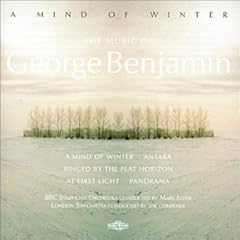
Minded to Landscape, To Sound: George Bejamin's 'A Mind of Winter'


George Benjamin, Ringed by the Flat Horizon/A Mind of Winter/At First Light/Panorama/Antara BBC Symphony Orchestra, London Sinfonietta, Mark Elder, George Benjamin, etc. Nimbus Records, 2006.

Benjamins' ear for colour was clearly a legacy of his mentor Messiaen, and it is this which distinguishes the 20-minute 'Ringed by the Flat Horizon'. Thundering percussion and low brass (in itself something of a modernist staple) alternates with almost concerto-like passages for a more cello, writing that is more concerned with linear melodicism than with the sound groupings of the orchestral clamour (however delicately and painstakingly the details of these are sketched out - for Bejamin's work is anything but messy, unsurprising given the extreme care he takes in composing, spending years on fairly short pieces). The ten-minute setting of Wallace Stevens' 'A Mind of Winter' works with a more stripped-down sound palette, the melismatic and stretched/held notes of the soprano soloist bending Wallace Stevens' words into even extra resonance. By the time of that superb final line - "nothing that is not there and the nothing that is" - it seems not so much that the work is concluding or stopping, but that it is emptying itself out into silence - an emotional, as well formal necessity. The emotional scope and intensity packed into such a short space of time is nothing short of remarkable. 'At First Light', in three movements, juxtaposes the sort of orchestral drama and dynamic one might expect from 'Ringed by the Flat Horizon' - often dark and almost neurotically powerful - with some unexpected melodic strains that could have come straight out of Messiaen (or from somewhere between Messiaen and Debussy). A case in point is the utterly surprising end of the final movement, the final thirty seconds occupied with a woodwind melody that almost dances, a conclusion of surprising and wonderfully affirmative (yet understated) optimism which remains true to the spirit of the rest of the piece even if it seems a radical departure from it. Following is the more playful miniature 'Panorama', an offshoot of the piece it proceeds on the disc, 'Antara', showcasing the synthesized pan pipe sounds which remain Benjamin's only use of electronics. Using much more silence than is normal for Benjamin, the slightly jarring overlaps between notes could be said to be a drawback, resulting from the limitations of the technology of the time (nowadays, computers could create a much smoother effect), but arguably this limitation becomes a vital part of the piece's aesthetic, creating a tension between the desire for extremely long, held notes, or the smoothness seemingly demanded by the opening melody (which sounds almsot folky), and this near-glitchy, discontinuous electronic insistence. It's like a particularly violent enjambment in a poem, cutting across what seems to be the obvious sense and/or sonic pattern, though the piece sounds far less of emotional extrimities than some of the others might. 'Antara' itself manages the breathy pan-synths within the orchestral setting (often by means of merging them with the similarly-toned flute). High held notes over dark rumblings, sonic lava erupting inexorably through tympani roar, crescendos and subsidences maintaining a constant tension. The piece, these works taken together, are a human body engaged and strained to the fullest, a landscape whose smears are clarity, the brutal jewel of snow.

Sunday, 21 December 2008

Prime Cut (1972)


Starring: Lee Marvin, Gene Hackman, Sissy Spacek
Music: Lalo Schifrin
Director: Michael Ritchie
Screenplay: Robert Dillon
Director of Photography: Gene Polito


I popped this one in the VHS player not exactly sure what I was going to get. Probably helped that I was hazy as to the plot outline before I watched it – I was expecting some sort of vaguely Point Blank-style hired-killer thriller – because ‘Prime Cut’ certainly skewed some expectations. This is truly a bizarre movie, and I feel a bit bad spoiling its strangeness by spelling it out below. If you want my advice, watch the film before you read my thoughts. It’s best taken unprepared.

The basic facts, then. We have Lee Marvin as Nick Devlin, a hired gun for the Irish mob. We know they’re Irish because of their names: Shaughnessy, O’ Brien, Devlin. In fact, reading the credits is almost as much fun as watching the film itself – listed are such wonderful-named characters as ‘Weenie’, ‘Mary Ann’, ‘Clarabelle’, ‘Ox-Eye’, ‘Farmer Bob’ and ‘Big Jim’. Mary Ann, as it turns out, is actually the main villain, played as repellent (but oddly charming) by Gene Hackman. Hackman is slightly underused, but is on true grinning, slimy, malevolent form (like Popeye Doyle, but on the wrong side of the law, and nastier). The film’s plot is sketchy enough: Marvin’s Chicago bosses want back their money, which former employee Hackman is swindling off them. Off trots Marvin/Devlin, with a couple of other city gangsters, and the city-boys-in-the-country scenario dutifully unravels itself into a series of well-staged action climaxes (with a white slavery sub-plot thrown in for good measure). The first of the big set-pieces, enlivened by some judiciously used hand-held shots, as well as some panoramic sun-baked vistas, begins at a county fair and soon turns into a fast-paced foot-chase, quickly followed by a menacing stalking-by-combine-harvester (with some nice point-of-view shots of the fleeing victims from between the churning blades). Things continue to build, and, before we know it, the climax has been reached: we start off with a shootout in a field of sunflowers (bizarrely enough), involving much hiding behind high vegetation that’s somewhat reminiscent of scenes from westerns like the Burt Lancaster vehicle ‘Apache’ or Sollimas’ ‘The Big Gundown’; the action then proceeds, via a particular destructive truck, to a large barn (the same place in which we’ve witnessed Hackman and Marvin’s first confrontation, and been introduced to the white slavery racket), where we see plenty more gunfire, and more dodging behind things (hay-bales, this time). A truly odd coda follows (and more on that later). But what to make of it all?

Well, few of its characters are well-drawn– it’s a film of few words, concentrating primarily on the sheer oddity of its premises, and on the action of its set-pieces, for effect. There are many unusual and intriguing touches – the climactic battle takes place while a thunder-storm brews overhead, the ominous thunder rumblings sitting nicely alongside gunshots. Full advantage is taken of the unusual location, with set-pieces in corn and sunflower fields. And some of the other things that fill the film make those elements seem pretty tame!

The 70s being the 70s, there are some political undertones, though these are by no means as obvious or heavy-handed as in some other movies of the time: they seem to arise as a side effect of the film’s general weirdness more than being fore-grounded as major thematic strands. Some sort of American dream is being undercut, though it’s a dream already so bizarre that it’s hard to believe anyone would have bought into it in the first place – the sort of thing Norman Rockwell might have thought up if there had been some handy ’shrooms nearby. Basically, this undercut dream boils down to Hackman’s comments to Marvin about being a ‘true American’, during the portion of the fair scene before the chase begins: we see what this involves as he paternally congratulates young kids, raising them into an atmosphere of acquisitive capitalism (giving one kid first prize for the steer he’s bought along, he hands him a wad of cash and proceeds to take the animal away from him. “But he’s a pet!” “Fatten some more up for me,” Hackman shoots back. The kid cottons on. “Want a goat?”) And of course, as the film progresses, we see what else this American dream involves. Meat-eatin’, gun-totin’, salivatin’ – Hackman and his cohorts (the local law enforcement officers included, or so we might judge from a shot in the fairground chase scene) are pretty much the opposite of Marvin’s debonair gangster (“you eat guts” he says with contempt as he encounters Hackman’s character for the first time in the film. “Sure I do,” comes the reply. “I like ‘em!)

While such subversion was common to most genres at this period, it was something which always been particular prevalent in the western, that form where the founding myths of American cultural dominance where both created, celebrated, and ruthlessly questioned. As Bill Harding argues in his fine book, ‘The Films of Michael Winner’ (track down a copy – currently a mere £0.01 on amazon.co.uk!): “The Western used to be the staple provider of action; now the urban thriller has taken over, and Clint Eastwood, Gene Hackman and Charles Bronson personify the excitement lacking in contemporary life.” This might not be strictly true – there were still a fair number of westerns being made in the 70s, with such big stars as Bronson, Eastwood, Marlon Brando, Jack Nicholson, and the like –(and it wasn’t really until the failure of ‘Heaven’s Gate’ that the death-blow really came). So, at this point in time, westerns were still being made – and good ones at that, mixing their doses of post-Wild Bunch gore and brutality with slightly more complex moral treatments (or, in the case of Michael Winner’s ‘Chato’s Land’, exceedingly problematic ones), as well as much Vietnam-era parallels. In 1972 alone, the year of ‘Prime Cut’, we got ‘The Culpepper Cattle Company,’ a much underrated piece which is probably the best cattle-drive movie ever made, Robert Redford’s mountain-man flick ‘Jeremiah Jonson’, Robert Aldrich’s exploration of atrocities perpetrated both by settlers and native Americans, ‘Ulzana’s Raid’, and the afore-mentioned ‘Chato’s Land’. But, even if I seem to have mentioned Harding’s statement only to knock it down, it does reinforce the point I’m about to make: that ‘Prime Cut’ is, in some ways, a western in gangster dress. The inexorable build-up to a climax of righteous gunfire, the American-Dream-subversion, the idea of outsiders wreaking havoc in a corrupt and hostile community – yup, ‘Prime Cut’ is basically a western.


And it shares some westerns’ idea of violence as being, more often than not, a good thing – or the best solution at the time. Marvin is shown as completely justified in the final action he takes – as with Peckinpah, we relish the climactic confrontation, because the villains are so unbelievably depraved. Think ‘Straw Dogs’ (another western in modern dress), where you’re willing on Dustin Hoffman to dispatch those Cornish yokel nasties in unpleasant ways, just as you’re willing on Marvin to blow away the Aryan/dungaree-wearing/white trash yokels of ‘Prime Cut’. At least it’s not as salacious in its violence as Peckinpah – in fact, the violence is relatively restrained, in terms of actual blood and guts, perhaps more so than it feels, given the film’s lurid (in a deadpan sort of way) atmosphere. (On a side note, one could trace a kind of ‘anti-pastoral’ strain in films from this time – Straw Dogs, Open Season (starring Peter Fonda) and of course Deliverance).

So, redemptive violence: that’s morally dubious reservation number one. Did I mention the exploitation element? The whole white slavery plot element, while not as salaciously handled as might have been, does result in a fair number of nude shots with their fair show of objectification. Sissy Spacek, in her movie debut, is pretty much there to be ogled (by viewer as well as white slavers) – let’s say she plays wide-eyed wonder and infantile trust, with boobs. As with much of the movie, though, this is pushed to the limit – the film tests its own audacity in what could either be a piece of anti-misogynistic self-criticism, a shrug of the shoulders in the face of good taste, or a mixture of the above. Key moments: a pair of scenes set, first of all, in a hotel restaurant, played for laughs as Marvin grins at the old couple disapprovingly eyeing Spacek’s see-through dress, and then back in the upstairs suite, where the naïve orphan reveals how she used to snuggle up to her best pal in a ‘touching’ (literally!) lesbian relationship. It’s so close to male-wish fantasy that it must be taking the piss – musn’t it? (“Say my name.” “Poppy.” “Say it again”. Lee Marvin looks like he wants to burst out laughing, although of course he keeps his cool – impeccably. I don’t think Roger Moore would have been able to).

Indeed, the film does seem to be attempting to make some kind of anti-objectification statement. The title, ‘Prime Cut’ establishes the money/meat link – women as meat, drugged up (just like we shoot up the cows). The aggressive acquisitiveness I mentioned earlier finds a metaphorical parallel in the Hackman crowds desire to consume – cows for meat, women for sexual pleasure. Hackman’s oaf brother is always chewing on something, even attempting to stab Marvin with a (phallic?) sausage as he goes through his death throes. And the drugged-up girls are displayed in enclosures which are later used for pigs. Appropriate enough, then, that Hackman ends up being half-eaten by a pig…

As you might have gathered, animals and meat are the main thematic link in the film, if that’s important. The movie opens with a documentary-style scene following the process of death in a cattle slaughterhouse (though, one might note, without quite the graphic touch one might expect, given the rest of the film – one might contrast it’s tone with the scene in Barbet Schroeder’s ‘Maitresse’ (a very different sort of film) from a few years later, where Gerard Deapardieu’s protagonist witnesses the bloody death of a horse). The ‘Prime Cut’ sequence is more about putting the viewer off, catching, like the film as a whole, a key somewhere between black humour (most overtly stressed later on, with the character of the old woman and her milk tasting at the fair) and face-wrinkling grotesquerie. The whole scene is dogged by this tone, with Lalo Schifrin’s easy-listening strings adding an ironic air as we see the meat being minced up into burgers and strung out into strings of sausages. It could almost be vegetarian propaganda, but little visual hints make it just that little bit weirder and more interesting – as when we catch a blink-and-you’ll-miss-it glimpse of a pair of naked buttocks in with the doomed cattle, or the shoe that comes out along hunks of meat on a conveyer-belt. So we know what’s in those sausages, as the oaf brother, Weenie, packages them up and sends them off. This idea is at once so absurd that it’s absolutely hilarious, and just about believable enough to be quite shocking. (I guess this blackly comic tone shouldn’t be unexpected, given that the director is Michael Ritchie, whose satirical film ‘The Candidate’, starring Robert Redford, mixed that straight-faced, observational, Altmanesque in-the-middle-of-the-action 70s realism with satirical touches.)

What else can be said about this movie? Well, I identified animals and meat as a crucial element; the most important line of dialogue comes at the end of the final shootout, and it’s between Marvin and Hackman. The latter’s been shot from his rooftop perch and has plummeted down into a pigsty, where the animal occupant has proceeded to chew up his legs. Managing to drag himself out, the dying villain begs a mercy killing, and the ensuing dialogue goes as follows:

Hackman: “Kill me, Nick. Finish me off, Nick. DO IT! You would for a beast.”
Marvin: “You’re a man.”
Hackman: “There’s no difference.”
Marvin: “You’re wrong. There is.”

It’s a neat punch-line, Marvin’s laconic delivery contributing, as elsewhere in the film, to the aura of tough guy cool which made his ‘Point Blank’ performance such a hit (the natty clothes help too. Check out those white loafers!) In fact, it’s almost the sort of morbid joke James Bond might have made after polishing off a villain. But at the same time, it is pretty much a straight didactic moment – as much as anything in the film can be said to be at all didactic. One review I’ve read even calls it a ‘humanistic’ moral – not the sort of thing you expect in the nihilistic climate of 70s film-making. Yes, our heroes may be gangsters, who are probably fairly unsavoury characters in themselves, but they stop short at white slavery, where women are treated as animals (sold in pig-pens, no less). You can shoot a man, but at least give him the dignity of a graceful stunt fall death. And be nice to those innocent-looking girl-children. Men are not animals, and that’s where all the problems arise. The villains see women as so much bestial flesh, and turn men into sausages: if they just had a little more respect for the human body, things would be a lot smoother.

It is, I guess, a ‘moral’ that befits the film’s sheer strangeness. And I hardly think it’s meant to be taken in entirely as po-faced a manner as my extrapolation above. After all, Prime Cut’s ‘messages’ tend to be a little more mixed than all that. On the one hand, the film trades off the ruthless, ‘Point Blank’ Marvin persona, but on the other, it softens that by his feelings towards Spacek and the orphans (mostly just paternal, it seems). At the end of the film, he is entirely the benevolent protector: accompanied by those of his men who’ve survived, he takes Spacek to the orphanage where the girls are groomed for the white slavery racket, and frees them. The last shot shows said liberated orphans running off into the fields, gambolling like lambs (and bringing to mind Spacek’s line, earlier in the film, about being let out into nature in the summer). Over it all runs a jolly Lalo Schifrin cue with prominent whistling (spaghetti western Morricone with the sting taken out, you might say). My first impulse is to see it as conformist drivel, but it’s pretty hard to feel that way if you think about it all.

To explain why, one final detour is needed. Film-wise, in the 70s, cynicism and nihilism tended to be the order of the day – more often than not, you had to let your main characters die in the final reel. Take ‘Easy Rider’ (OK, it was made in ’69, but you get the picture): Peter Fonda and Dennis Hopper couldn’t just ride off into the sunset. Why? Well, I think there was still some sense that the anti-heroes needed to be ‘punished’. Yes, this was the New Hollywood, with renegade young film-makers given free rein to do whatever the hell they wanted (I’ve read ‘Easy Riders, Raging Bulls’), but I have a feeling that the subversion was still being kept in check – just a little. It was all very well for Eastwood to happily count out the loot at the end of ‘For a Few Dollars More’, and American audiences lapped that up as much as anyone else, but those who controlled the picture-making industry in the US of A seem to have figured that, while they could exploit this new market for anti-heroism, they had to add in a touch, however slight, of moral finger-wagging, which somehow ‘justified’ it all. ‘FAFDM’, after all, was made by those degenerate (and Catholic) Europeans…So ‘Easy Rider’ opens with a similar illicit deal (money for dope, rather than dead bodies) but ends with the bikers getting their ‘just deserts’. Of course, the film-makers themselves weren’t intending this sort of cautionary tale element – it was more part of the film’s myth-making project (would Shane have seemed so iconic if he hadn’t been dying when he rode off on that horse?), in which drug-dealing bikers were the new cowboy heroes, sharing in their western predecessors’ freewheeling spirit and disregard for the rules of oh-so-barbarous ‘civilisation.’ Fonda and Hopper’s death at the hands of rednecks (like Nicholson’s earlier in the movie), is their comment on the often destructive clash between 50s and 60s values, between generations, between different philosophies and ways of living, as well as on the failure of the American dream (new or old) – “we blew it.” But at the same time it could be use to dull the subversive impact of the film as a whole, bookending it with a cautionary note. Don’t try this at home, kids – you’ll only get blown off the road with a shotgun, even if the Byrds are singing you a dinky little ballad (“all he wanted was to be free – and that’s the way it turned out to be”.)


How does that relate to ‘Prime Cut’? Well, the movie’s ending is a parody of the idealised, Norman Rockwell dungarees and cattle-ranchin’, country-livin’ world that the film has turned on its head throughout, as well as being a piss-take of the whole idea of the happy ending – but, like the man/beast dialogue discussed above, it’s also meant to be taken at least half-seriously. And in that way it’s more unnerving than any of those nihilistic, ‘Easy Rider’-style endings where the (anti)hero bites the dust. Both subverting and conforming to the anti-clichés of the 70s American thriller, it’s illustrative of a time when you often just didn’t know what the hell you were supposed to think about what you were saying – and in many ways, that’s the beauty of it. I’m not meaning to suggest that it’s a completely morally relative film, but its moral uncertainty certainly is a key part of its overall beguiling strangeness. It’s true to say that they just don’t make ’em like this anymore – and it’s hard to believe that they ever did.