Wednesday, 18 February 2009

Flower/Corsano Duo in Cambridge


Live at the Portland Arms, Cambridge
17th February 2009

According to Nietzsche, we are "fools for rhythm." Is that such a bad thing? The Flower-Corsano Duo are all about that relentless rhythmic surge, that urge to pound and strike a drum-kit until it gives off a million sharded beams of hard light, a near-mystical beam with an aura enhanced by twanging plucked scales. It’s a beam that emerges with such clarity only out of a sheer single-mindedness, as opposed to diffuse hippy mysticism, messing around with weirdness. These guys know what they are doing, and do it – they go straight for the peaks, even if, on this occasion, it took a while to get going (this was by no means the best Flower-Corsano performance I’ve heard).

I hate to say it, but it’s hard not to avoid terminology like ‘consciousness altering’. This music offers an alternative of some sort, to the packaged and the satisfied. In its desire to always maintain that state of yearning on which its power to move the body and mind is based, this music refuses a satisfaction and a comfort with ‘how things are’ – the desire to prolong that sheer enhanced experience is inherently a desire that acts against the diurnal jackboot tread, or what poet Sean Bonney calls “that shameful but essentially boring public murder.” And yet I'd hesitate to make this too political – not only because I know nothing of Chris Corsano and Mike Flower’s political views, but because what they create too is a commodity, aimed at a particular crowd. They provide a vaguely 'spiritual' experience for an ‘experimental’ scene which doesn't believe in the spiritual but wants to get those same kicks in a ‘justified’ left-field setting.

That’s the too-cynical reduction; swing to the other extreme, and they offer a hope of some sort, or a burning desire; or, hell, I like it anyway, even if its ‘spirituality’ is actually just constant rise to climax (masturbatory or coupling, take your pick), even if all it is is repetition to orgasm and serene aftermath of that jerking trance.

And fuck the sexual analogies, it must be said that Corsano is an excellent drummer. Some drummers play something for a while, then stop and move on because it's too much effort, but he can stay in the zone, in the pocket, stopping only when the music dictates a new tack; his arms moving at pummelling speed, his dexterity is that of a boxer as he consistently rains down blows on his kit, plays very loud and very fast. It's not polyrhythmic complexity so much as single-minded determination and drive, building to the inexorable bodily mysticism that the duo pull off so well: a hard-hitting prayer, a religious punch to the gut.

The structure is not so much about note choice but about the creation of a continuous sound stream which retains its interest through a control of dynamics which is actually quite subtle. Ebb and flow, ebb and flow. Both Corsano and Flower vary the loudness in a manner that could be quite instructive for certain bands ‘on the scene’. Flower’s ‘Japan Banjo’ is laid horizontal on an ironing board, of all things; his somewhat decrepit face hidden by straggly hair, his jeaned legs kicking it to ecstasy shudder, his quivering body and bobbing head in electric shock at the electricity of his performance and of his own electric instrument.

The sincerity embodied in that drugged-up trance (where music is, as far as I can tell, the only drug, at that particular point in time) – that sincerity is a belief in sound or 'vibrations' as Albert Ayler would have it. And that doesn't seem like a hippy catchword when one senses the drum-pound tremble the floor slightly, undulation/ underlation, over and over, constant motion. It's waves, ebbs and flows; it's mostly that inexorable rhythm lull, some ex-hippy's eastern-tinged vision in a temple where they all take pot; though it emerges from and back into drone sunrises, a sitar-sounding drone which must have been playing throughout the performance but which one only notices when Corsano calls it a day and Flower switches off his amp. “Go take a crap” advises the bald wunderkind as he lays aside his drum-sticks, and that’s not bad advice; for all that talk of ‘spirituality’, for all that element to the experience Flower/Corsano offer, you’re yet shuddered into an instructive awareness of your own body that might make you value that dump you take as more than an unclean thing evaded in a quest for clean perfection. This is a messy mysticism, the dirtied but still utterly valuable legacy of some kind of psychedelic hippiedom that never really existed in the 60s when that sort of thing was most conceivable; but it exists now, beats into broken dreams its brilliancy.

Friday, 23 January 2009

Sunn O))): The Grimmrobe Demos


First track, ‘Black Wedding’ opens with a fade into just noise – just noise in that it is impossible to tell what (if any) instrument is being used, perhaps leading one to bring in the useful umbrella term ‘electronics’ – but this almost immediately turns out to be just the afterglow of feedback, and thus it can be classified as ‘instrumental’, to some extent, though one might perhaps say that guitar feedback is an ‘electronic device’ as addendum to, or extension of, an instrument. At any rate, this blurring is, I think, typical of Sunn’s desire to go beyond the guitar through the (electric) guitar’s guitarness – that volume, that amped feedback which we so associate with the guitar now, is taken to its (logical?) extreme, where it just becomes noise beyond any instrument (so that, at some shows, they use just Moogs).

‘Grimmrobe’ is an album which seems as though it never ends, as if it’s music that actually continues playing beyond the arbitrary division of how much sonic material one can fit on one compact disc. Not only this problem of turning Sunn’s work into ‘album’/commodities, which always risk losing something of the totality of their experience, but, moving down a level, the division into separate tracks seems somewhat arbitrary. (The second track, ‘Defying Earth’s Gravity’ begins in almost exactly the same way as ‘Black Wedding’, with five seconds of noise/sound before a guitar chord comes in to tell you this is indeed a guitar). Such tactics would change in later releases like ‘Black One’, where the bell-punctuated quietude that opens ‘Báthory Erzsébet’ is very much a ‘prelude’ to the rest of the track, just as the tracks of ‘Domkirke’ very much have the feel of moving towards a climax. Such a move to climax obviously differs from ‘Grimmrobe’, where there is a feel of constantly sustained climax, or climax beyond climax, so that this sustaining becomes ridiculous and then feeds back to make the whole notion of the sustained rock-music climax (itself derived from, say, the closing cadenza-flurries of a Coltrane piece from the 60s) seem simply inadequate – as if Sunn have released the hidden noisy energies of Deep Purple, who really want to be Sunn. This is some sort of structural underpinning, but of such a stretched kind that it seems inadequate to talk of ‘song structure’ (of ‘song’ at all, even when vocalists are present, as they are not on ‘Grimmbrobe’). By contrast Boris, Sunn’s closest sonic kin, work very much in building up to and away from peaks and troughs – take the Merzbow collaboration ‘Sun Baked Snow Cave’, where acoustic guitar (!) melodicism morphs into noise-clouds.

Despite all this, the second track on ‘Grimmrobe’, ‘Defying Earth’s Gravity’ has that crushing inevitability about it which most of Sunn’s music (at least, in its ‘signature sound’ guise), also has. Because the power-metal chords are sustained for so long, you know what will be happening in the next few minutes at least (and can count on a similar chord coming up as the riff drags itself along, a wounded giant’s sub-bass groans) – but, again, this is taken so far so far that the inevitably becomes strain rather than comfort (or, maybe, at the same time, a kind of comfort as well?). You can’t say, as you can when listening to, say, a Baroque violin or lute sonata, ‘I know the sort of formulation that is coming up now’, although Sunn’s sounds are actually even more obvious than Baroque formulations.

Maybe the reason for this is that the music numbs you so that you hear what is not actually there – that is the music in it. Mathis Svalina, reporting on a gig at the Knitting Factory: “But the up-to-11-ness of the noise is only part of the experience. Each monolithic riff chased itself into fleetingly exuberant harmonics. The sounds were inside the noise.” The drone becomes like your heartbeat, or your blood as a drone or pulse – which connects to John Cage, entering the soundproof room and discovering that true silence doesn’t really exist – that there is still sound even in this locked environment, the sound of your blood, normally drowned out in the everyday world conditions where you can hear everything else going on around you, environmentally. Devoid of such sonic context, in this soundless environment, your body provides its own environmental sounds.

A similar effect can be perceived with Sunn, though they go about it by very different methods – extreme noise rather than extreme quiet. Their drone becomes bodily, becomes part of your body, or you go bodiless and become part of it (getting swallowed up into something outside/inside of yourself – it’s all hinged on contradiction; or, it transcends the false dichotomies of music/noise/sound/ person/other, raises a possibility of that transcending. And what is important is the noise/sound that would seem ‘peripheral’ to that drone, to the particular chord that is being played – specifically, on some tracks, there are phaser effects (‘Black Wedding’ here, or ‘bassAliens’ on ‘White 2’) – but if you have music at that volume and in that ritual atmosphere of their concert performance, with the dry ice and lighting, you start to hear things not there. Would it, then, be going too far to say that you yourself become the producer of the music, not just the passive consumer of it? In itself, this could be construed as an anti-capitalist notion – or maybe as simply beyond capitalism, ignoring it all together.

From the liner notes and album art, there are hints that this alternative worldview goes back to an older, pagan, pre-Christian mode of perception, which in many ways is a more brutal and nihilistic one. Sunn’s attitude to these aspects is unclear – and these sort of images, this sort of text, was always something that worried people so much about Black Metal. Dangers (as well as liberating possibilities) always arise from such ambivalence. And the refusal of any one emotional realm, like the refusal of any one particular ideology, simultaneously avoids and perpetuates such dangers. Greg Anderson: “There’s not one idea we’re trying to focus on, but we are more about the aesthetic and the atmosphere than say any particular religion or idea. If anything, we just want a ritual around sound and tone, rather than any particular ideology.” For myself, I’d say that the loudness of the drone pulverizes the listener, but not to conformity – this is not the same as the US army’s use of noise as torture, though it intriguingly crosses over with it; rather, it is the opposite. ‘Black Wedding’ even feels joyful, despite the track title and the album title. But that’s no simple joy – rather, it’s a joy of despair, nihilism turned up so high that it becomes the only thing to be joyed in. Revelling in the darkness – “the blissful loathing of you is now all that remains” (from the text accompanying ‘Black One’). A kind of comfort in utmost bleakness.

Thursday, 22 January 2009

GAZA'S CABIN/ CABIN'S GAZA:
Improvisation, Bristol (17/1/09) *


Gaza was 'happening', in the lies of the world's media. Israel did use phosphorous, tanks and universities or mosques were in no way immune. It was for the people's own good, it was action against Hamas rather than the Palestinian people, hence the desire to blow up their dwellings, cut off their supplies, leave children with the dead corpses of their relatives. How could an art react, and what would be the use of an art that reacted to this outrage. By not seeing it as an abberation but a part of the whole, the continuing fabric and texture of our woven existence, tapestry of death and suffering, injustice. By making music that is intimately connected with this, by making sound that is nothing less than the sound of living, and thus the sound of dying. And death I think is no paranthesis. Death is the sentence, the shadow falls on white-washed walls from which the blood has lately been cleaned.

Two musicians in a cabin, musty and pouring dirt from its cracks. Outside the streets, the cars, the shops close their doors with the clinking sound of a cash register. A rumble exists in the city, under everything, under one's feet. The sounds emerge in the space of the cabin, fifteen minutes for this piece, synthesizer, 'objects' and saxophone. The music taps into something very deep. Dive down to the bottom of the pool, then find you can't swim and swim anyway. I don't want to sound like this is coming out of some 'pseudness', 'pretending' to discover 'truths' just as a means of sounding clever, it is not that and it is precisely because it is so hard to express in words that it has to be done in music, or that it has been done in music.

It arises of course from the surface level of that absolute electronic melancholia, drones and quasi-drones, held notes and lightly-spaced pops and clicks over heavy machine-heart. Fragments of texts, those names 'Israel' and 'Gaza', even when not spoken, as the hovering talismans that strike dread in the heart maybe more so in this context than in the whitewashed 'sanity'/sanitisation of BBC news-speak. "22 days 1203 Palestinians killed by Israel including 368 children .... Add Your Comment BBC NEWS | Israel Declares Ceasefire in Gaza. Recent News and Articles on the Keywords: cease -fire + palestinian + gaza Related to ... BBC News, UK."

I think it arises from the randomness as much as anything - the way a certain word on the radio catches in context a whole new meaning/set of meanings, the chill of recognition creating a new level of conviction, of listener/performer being convinced that what is being done is right. Of course there is still guilt, and that is maybe what this music wrestles with most, the guilt that permeates its pores, that it too is an infected discourse, but perhaps it could be infected with love and real sorrow, genuine sorrow - not "oh isn't it awful why can't they just get along" but the lament that contains within itself the conditions of the possibility of a world without the need for that lament. The 'ground-work', if you will. The music realising itself not as the solution, if a solution was posed it would dissolve in that other sense of the word, the solution that permeates everything, as watery spread.

Industrial low-edged harshsounds on synthesizer. It's not to say that this is 'mimetic' of Israeli tanks or electric drills or the piping system nightmare of Terry Gilliam's 'Brazil', or the industrial nightmare visions of 'Eraserhead' or 'Tetsuo the Iron Man.' It contains the sounds before, the sounds present, the sounds after, the sounds surrounding. Is its own text and context at once.

There is something very sombre and chilling about the voice. I listened to a poem reading today** which almost disappeared into itself by the end, and this has that same absolute fall-back to almost nothing. The resourt to song even, the singing of the utterly deserted when there is no more to do but give voice though one knows it will do no good, and in that it does good. The space beyond tears, shell-shocked but conscious. Numbed but fighting through it to sound emotion.

NOTES

* Improvisation at 'The Cabin', Bristol, by 'Bristol Improvisers Zariba' - on this occasion, Mark Anthony Whiteford and Richard Soup. Listen to the piece at: http://www.mediafire.com/?bjwemnjmzmj
** J.H. Prynne reading John Wieners' 'Cocaine' at 'Archive of the Now' (http://people.brunel.ac.uk/~enstaab2/)

Saturday, 17 January 2009

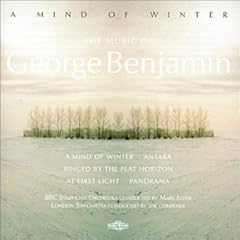
Minded to Landscape, To Sound: George Bejamin's 'A Mind of Winter'


George Benjamin, Ringed by the Flat Horizon/A Mind of Winter/At First Light/Panorama/Antara BBC Symphony Orchestra, London Sinfonietta, Mark Elder, George Benjamin, etc. Nimbus Records, 2006.

Benjamins' ear for colour was clearly a legacy of his mentor Messiaen, and it is this which distinguishes the 20-minute 'Ringed by the Flat Horizon'. Thundering percussion and low brass (in itself something of a modernist staple) alternates with almost concerto-like passages for a more cello, writing that is more concerned with linear melodicism than with the sound groupings of the orchestral clamour (however delicately and painstakingly the details of these are sketched out - for Bejamin's work is anything but messy, unsurprising given the extreme care he takes in composing, spending years on fairly short pieces). The ten-minute setting of Wallace Stevens' 'A Mind of Winter' works with a more stripped-down sound palette, the melismatic and stretched/held notes of the soprano soloist bending Wallace Stevens' words into even extra resonance. By the time of that superb final line - "nothing that is not there and the nothing that is" - it seems not so much that the work is concluding or stopping, but that it is emptying itself out into silence - an emotional, as well formal necessity. The emotional scope and intensity packed into such a short space of time is nothing short of remarkable. 'At First Light', in three movements, juxtaposes the sort of orchestral drama and dynamic one might expect from 'Ringed by the Flat Horizon' - often dark and almost neurotically powerful - with some unexpected melodic strains that could have come straight out of Messiaen (or from somewhere between Messiaen and Debussy). A case in point is the utterly surprising end of the final movement, the final thirty seconds occupied with a woodwind melody that almost dances, a conclusion of surprising and wonderfully affirmative (yet understated) optimism which remains true to the spirit of the rest of the piece even if it seems a radical departure from it. Following is the more playful miniature 'Panorama', an offshoot of the piece it proceeds on the disc, 'Antara', showcasing the synthesized pan pipe sounds which remain Benjamin's only use of electronics. Using much more silence than is normal for Benjamin, the slightly jarring overlaps between notes could be said to be a drawback, resulting from the limitations of the technology of the time (nowadays, computers could create a much smoother effect), but arguably this limitation becomes a vital part of the piece's aesthetic, creating a tension between the desire for extremely long, held notes, or the smoothness seemingly demanded by the opening melody (which sounds almsot folky), and this near-glitchy, discontinuous electronic insistence. It's like a particularly violent enjambment in a poem, cutting across what seems to be the obvious sense and/or sonic pattern, though the piece sounds far less of emotional extrimities than some of the others might. 'Antara' itself manages the breathy pan-synths within the orchestral setting (often by means of merging them with the similarly-toned flute). High held notes over dark rumblings, sonic lava erupting inexorably through tympani roar, crescendos and subsidences maintaining a constant tension. The piece, these works taken together, are a human body engaged and strained to the fullest, a landscape whose smears are clarity, the brutal jewel of snow.

Sunday, 21 December 2008

Prime Cut (1972)


Starring: Lee Marvin, Gene Hackman, Sissy Spacek
Music: Lalo Schifrin
Director: Michael Ritchie
Screenplay: Robert Dillon
Director of Photography: Gene Polito


I popped this one in the VHS player not exactly sure what I was going to get. Probably helped that I was hazy as to the plot outline before I watched it – I was expecting some sort of vaguely Point Blank-style hired-killer thriller – because ‘Prime Cut’ certainly skewed some expectations. This is truly a bizarre movie, and I feel a bit bad spoiling its strangeness by spelling it out below. If you want my advice, watch the film before you read my thoughts. It’s best taken unprepared.

The basic facts, then. We have Lee Marvin as Nick Devlin, a hired gun for the Irish mob. We know they’re Irish because of their names: Shaughnessy, O’ Brien, Devlin. In fact, reading the credits is almost as much fun as watching the film itself – listed are such wonderful-named characters as ‘Weenie’, ‘Mary Ann’, ‘Clarabelle’, ‘Ox-Eye’, ‘Farmer Bob’ and ‘Big Jim’. Mary Ann, as it turns out, is actually the main villain, played as repellent (but oddly charming) by Gene Hackman. Hackman is slightly underused, but is on true grinning, slimy, malevolent form (like Popeye Doyle, but on the wrong side of the law, and nastier). The film’s plot is sketchy enough: Marvin’s Chicago bosses want back their money, which former employee Hackman is swindling off them. Off trots Marvin/Devlin, with a couple of other city gangsters, and the city-boys-in-the-country scenario dutifully unravels itself into a series of well-staged action climaxes (with a white slavery sub-plot thrown in for good measure). The first of the big set-pieces, enlivened by some judiciously used hand-held shots, as well as some panoramic sun-baked vistas, begins at a county fair and soon turns into a fast-paced foot-chase, quickly followed by a menacing stalking-by-combine-harvester (with some nice point-of-view shots of the fleeing victims from between the churning blades). Things continue to build, and, before we know it, the climax has been reached: we start off with a shootout in a field of sunflowers (bizarrely enough), involving much hiding behind high vegetation that’s somewhat reminiscent of scenes from westerns like the Burt Lancaster vehicle ‘Apache’ or Sollimas’ ‘The Big Gundown’; the action then proceeds, via a particular destructive truck, to a large barn (the same place in which we’ve witnessed Hackman and Marvin’s first confrontation, and been introduced to the white slavery racket), where we see plenty more gunfire, and more dodging behind things (hay-bales, this time). A truly odd coda follows (and more on that later). But what to make of it all?

Well, few of its characters are well-drawn– it’s a film of few words, concentrating primarily on the sheer oddity of its premises, and on the action of its set-pieces, for effect. There are many unusual and intriguing touches – the climactic battle takes place while a thunder-storm brews overhead, the ominous thunder rumblings sitting nicely alongside gunshots. Full advantage is taken of the unusual location, with set-pieces in corn and sunflower fields. And some of the other things that fill the film make those elements seem pretty tame!

The 70s being the 70s, there are some political undertones, though these are by no means as obvious or heavy-handed as in some other movies of the time: they seem to arise as a side effect of the film’s general weirdness more than being fore-grounded as major thematic strands. Some sort of American dream is being undercut, though it’s a dream already so bizarre that it’s hard to believe anyone would have bought into it in the first place – the sort of thing Norman Rockwell might have thought up if there had been some handy ’shrooms nearby. Basically, this undercut dream boils down to Hackman’s comments to Marvin about being a ‘true American’, during the portion of the fair scene before the chase begins: we see what this involves as he paternally congratulates young kids, raising them into an atmosphere of acquisitive capitalism (giving one kid first prize for the steer he’s bought along, he hands him a wad of cash and proceeds to take the animal away from him. “But he’s a pet!” “Fatten some more up for me,” Hackman shoots back. The kid cottons on. “Want a goat?”) And of course, as the film progresses, we see what else this American dream involves. Meat-eatin’, gun-totin’, salivatin’ – Hackman and his cohorts (the local law enforcement officers included, or so we might judge from a shot in the fairground chase scene) are pretty much the opposite of Marvin’s debonair gangster (“you eat guts” he says with contempt as he encounters Hackman’s character for the first time in the film. “Sure I do,” comes the reply. “I like ‘em!)

While such subversion was common to most genres at this period, it was something which always been particular prevalent in the western, that form where the founding myths of American cultural dominance where both created, celebrated, and ruthlessly questioned. As Bill Harding argues in his fine book, ‘The Films of Michael Winner’ (track down a copy – currently a mere £0.01 on amazon.co.uk!): “The Western used to be the staple provider of action; now the urban thriller has taken over, and Clint Eastwood, Gene Hackman and Charles Bronson personify the excitement lacking in contemporary life.” This might not be strictly true – there were still a fair number of westerns being made in the 70s, with such big stars as Bronson, Eastwood, Marlon Brando, Jack Nicholson, and the like –(and it wasn’t really until the failure of ‘Heaven’s Gate’ that the death-blow really came). So, at this point in time, westerns were still being made – and good ones at that, mixing their doses of post-Wild Bunch gore and brutality with slightly more complex moral treatments (or, in the case of Michael Winner’s ‘Chato’s Land’, exceedingly problematic ones), as well as much Vietnam-era parallels. In 1972 alone, the year of ‘Prime Cut’, we got ‘The Culpepper Cattle Company,’ a much underrated piece which is probably the best cattle-drive movie ever made, Robert Redford’s mountain-man flick ‘Jeremiah Jonson’, Robert Aldrich’s exploration of atrocities perpetrated both by settlers and native Americans, ‘Ulzana’s Raid’, and the afore-mentioned ‘Chato’s Land’. But, even if I seem to have mentioned Harding’s statement only to knock it down, it does reinforce the point I’m about to make: that ‘Prime Cut’ is, in some ways, a western in gangster dress. The inexorable build-up to a climax of righteous gunfire, the American-Dream-subversion, the idea of outsiders wreaking havoc in a corrupt and hostile community – yup, ‘Prime Cut’ is basically a western.


And it shares some westerns’ idea of violence as being, more often than not, a good thing – or the best solution at the time. Marvin is shown as completely justified in the final action he takes – as with Peckinpah, we relish the climactic confrontation, because the villains are so unbelievably depraved. Think ‘Straw Dogs’ (another western in modern dress), where you’re willing on Dustin Hoffman to dispatch those Cornish yokel nasties in unpleasant ways, just as you’re willing on Marvin to blow away the Aryan/dungaree-wearing/white trash yokels of ‘Prime Cut’. At least it’s not as salacious in its violence as Peckinpah – in fact, the violence is relatively restrained, in terms of actual blood and guts, perhaps more so than it feels, given the film’s lurid (in a deadpan sort of way) atmosphere. (On a side note, one could trace a kind of ‘anti-pastoral’ strain in films from this time – Straw Dogs, Open Season (starring Peter Fonda) and of course Deliverance).

So, redemptive violence: that’s morally dubious reservation number one. Did I mention the exploitation element? The whole white slavery plot element, while not as salaciously handled as might have been, does result in a fair number of nude shots with their fair show of objectification. Sissy Spacek, in her movie debut, is pretty much there to be ogled (by viewer as well as white slavers) – let’s say she plays wide-eyed wonder and infantile trust, with boobs. As with much of the movie, though, this is pushed to the limit – the film tests its own audacity in what could either be a piece of anti-misogynistic self-criticism, a shrug of the shoulders in the face of good taste, or a mixture of the above. Key moments: a pair of scenes set, first of all, in a hotel restaurant, played for laughs as Marvin grins at the old couple disapprovingly eyeing Spacek’s see-through dress, and then back in the upstairs suite, where the naïve orphan reveals how she used to snuggle up to her best pal in a ‘touching’ (literally!) lesbian relationship. It’s so close to male-wish fantasy that it must be taking the piss – musn’t it? (“Say my name.” “Poppy.” “Say it again”. Lee Marvin looks like he wants to burst out laughing, although of course he keeps his cool – impeccably. I don’t think Roger Moore would have been able to).

Indeed, the film does seem to be attempting to make some kind of anti-objectification statement. The title, ‘Prime Cut’ establishes the money/meat link – women as meat, drugged up (just like we shoot up the cows). The aggressive acquisitiveness I mentioned earlier finds a metaphorical parallel in the Hackman crowds desire to consume – cows for meat, women for sexual pleasure. Hackman’s oaf brother is always chewing on something, even attempting to stab Marvin with a (phallic?) sausage as he goes through his death throes. And the drugged-up girls are displayed in enclosures which are later used for pigs. Appropriate enough, then, that Hackman ends up being half-eaten by a pig…

As you might have gathered, animals and meat are the main thematic link in the film, if that’s important. The movie opens with a documentary-style scene following the process of death in a cattle slaughterhouse (though, one might note, without quite the graphic touch one might expect, given the rest of the film – one might contrast it’s tone with the scene in Barbet Schroeder’s ‘Maitresse’ (a very different sort of film) from a few years later, where Gerard Deapardieu’s protagonist witnesses the bloody death of a horse). The ‘Prime Cut’ sequence is more about putting the viewer off, catching, like the film as a whole, a key somewhere between black humour (most overtly stressed later on, with the character of the old woman and her milk tasting at the fair) and face-wrinkling grotesquerie. The whole scene is dogged by this tone, with Lalo Schifrin’s easy-listening strings adding an ironic air as we see the meat being minced up into burgers and strung out into strings of sausages. It could almost be vegetarian propaganda, but little visual hints make it just that little bit weirder and more interesting – as when we catch a blink-and-you’ll-miss-it glimpse of a pair of naked buttocks in with the doomed cattle, or the shoe that comes out along hunks of meat on a conveyer-belt. So we know what’s in those sausages, as the oaf brother, Weenie, packages them up and sends them off. This idea is at once so absurd that it’s absolutely hilarious, and just about believable enough to be quite shocking. (I guess this blackly comic tone shouldn’t be unexpected, given that the director is Michael Ritchie, whose satirical film ‘The Candidate’, starring Robert Redford, mixed that straight-faced, observational, Altmanesque in-the-middle-of-the-action 70s realism with satirical touches.)

What else can be said about this movie? Well, I identified animals and meat as a crucial element; the most important line of dialogue comes at the end of the final shootout, and it’s between Marvin and Hackman. The latter’s been shot from his rooftop perch and has plummeted down into a pigsty, where the animal occupant has proceeded to chew up his legs. Managing to drag himself out, the dying villain begs a mercy killing, and the ensuing dialogue goes as follows:

Hackman: “Kill me, Nick. Finish me off, Nick. DO IT! You would for a beast.”
Marvin: “You’re a man.”
Hackman: “There’s no difference.”
Marvin: “You’re wrong. There is.”

It’s a neat punch-line, Marvin’s laconic delivery contributing, as elsewhere in the film, to the aura of tough guy cool which made his ‘Point Blank’ performance such a hit (the natty clothes help too. Check out those white loafers!) In fact, it’s almost the sort of morbid joke James Bond might have made after polishing off a villain. But at the same time, it is pretty much a straight didactic moment – as much as anything in the film can be said to be at all didactic. One review I’ve read even calls it a ‘humanistic’ moral – not the sort of thing you expect in the nihilistic climate of 70s film-making. Yes, our heroes may be gangsters, who are probably fairly unsavoury characters in themselves, but they stop short at white slavery, where women are treated as animals (sold in pig-pens, no less). You can shoot a man, but at least give him the dignity of a graceful stunt fall death. And be nice to those innocent-looking girl-children. Men are not animals, and that’s where all the problems arise. The villains see women as so much bestial flesh, and turn men into sausages: if they just had a little more respect for the human body, things would be a lot smoother.

It is, I guess, a ‘moral’ that befits the film’s sheer strangeness. And I hardly think it’s meant to be taken in entirely as po-faced a manner as my extrapolation above. After all, Prime Cut’s ‘messages’ tend to be a little more mixed than all that. On the one hand, the film trades off the ruthless, ‘Point Blank’ Marvin persona, but on the other, it softens that by his feelings towards Spacek and the orphans (mostly just paternal, it seems). At the end of the film, he is entirely the benevolent protector: accompanied by those of his men who’ve survived, he takes Spacek to the orphanage where the girls are groomed for the white slavery racket, and frees them. The last shot shows said liberated orphans running off into the fields, gambolling like lambs (and bringing to mind Spacek’s line, earlier in the film, about being let out into nature in the summer). Over it all runs a jolly Lalo Schifrin cue with prominent whistling (spaghetti western Morricone with the sting taken out, you might say). My first impulse is to see it as conformist drivel, but it’s pretty hard to feel that way if you think about it all.

To explain why, one final detour is needed. Film-wise, in the 70s, cynicism and nihilism tended to be the order of the day – more often than not, you had to let your main characters die in the final reel. Take ‘Easy Rider’ (OK, it was made in ’69, but you get the picture): Peter Fonda and Dennis Hopper couldn’t just ride off into the sunset. Why? Well, I think there was still some sense that the anti-heroes needed to be ‘punished’. Yes, this was the New Hollywood, with renegade young film-makers given free rein to do whatever the hell they wanted (I’ve read ‘Easy Riders, Raging Bulls’), but I have a feeling that the subversion was still being kept in check – just a little. It was all very well for Eastwood to happily count out the loot at the end of ‘For a Few Dollars More’, and American audiences lapped that up as much as anyone else, but those who controlled the picture-making industry in the US of A seem to have figured that, while they could exploit this new market for anti-heroism, they had to add in a touch, however slight, of moral finger-wagging, which somehow ‘justified’ it all. ‘FAFDM’, after all, was made by those degenerate (and Catholic) Europeans…So ‘Easy Rider’ opens with a similar illicit deal (money for dope, rather than dead bodies) but ends with the bikers getting their ‘just deserts’. Of course, the film-makers themselves weren’t intending this sort of cautionary tale element – it was more part of the film’s myth-making project (would Shane have seemed so iconic if he hadn’t been dying when he rode off on that horse?), in which drug-dealing bikers were the new cowboy heroes, sharing in their western predecessors’ freewheeling spirit and disregard for the rules of oh-so-barbarous ‘civilisation.’ Fonda and Hopper’s death at the hands of rednecks (like Nicholson’s earlier in the movie), is their comment on the often destructive clash between 50s and 60s values, between generations, between different philosophies and ways of living, as well as on the failure of the American dream (new or old) – “we blew it.” But at the same time it could be use to dull the subversive impact of the film as a whole, bookending it with a cautionary note. Don’t try this at home, kids – you’ll only get blown off the road with a shotgun, even if the Byrds are singing you a dinky little ballad (“all he wanted was to be free – and that’s the way it turned out to be”.)


How does that relate to ‘Prime Cut’? Well, the movie’s ending is a parody of the idealised, Norman Rockwell dungarees and cattle-ranchin’, country-livin’ world that the film has turned on its head throughout, as well as being a piss-take of the whole idea of the happy ending – but, like the man/beast dialogue discussed above, it’s also meant to be taken at least half-seriously. And in that way it’s more unnerving than any of those nihilistic, ‘Easy Rider’-style endings where the (anti)hero bites the dust. Both subverting and conforming to the anti-clichés of the 70s American thriller, it’s illustrative of a time when you often just didn’t know what the hell you were supposed to think about what you were saying – and in many ways, that’s the beauty of it. I’m not meaning to suggest that it’s a completely morally relative film, but its moral uncertainty certainly is a key part of its overall beguiling strangeness. It’s true to say that they just don’t make ’em like this anymore – and it’s hard to believe that they ever did.

Thursday, 27 November 2008

Unfolding King Lear: A Model Performance


Jeremy Hardingham, Judith E. Wilson Drama Studio ('the black box'), Faculty of English, Cambridge. 14th November 2008.

Rarely can I say that I have felt such impact from a piece of theatre. Hardingham rips out lines and phrases from Shakespeare’s play, adds in his own, puns desperately and viciously and fixatedly on like-sounding words, seemingly an act of mutilation comparable to the eye-gouged Gloucester’s agony. It all takes place in the ‘black box’ of the Judith E. Wilson drama studio, buried away beneath the Cambridge English Faculty. This Friday, afternoon the audience is small; just two rows of chairs, brought forward right to the front of the ‘stage’. The floor is covered in tarpaulin (black, of course), while a table is laden with miscellaneous props (though ‘props’ is the wrong word to use – Hardingham made them feel just as much actors in the drama as himself), and an audio system is used to produce various sound effects and fragments of music. Black-suited musician Jonathan Styles sits on a high stool, his face hidden by his copy of the script, his sung/ guttural-soft whisper emerging eerily and unexpectedly at various points. A diagram hidden away in the wall depicts the structure of the vocal cords. Hardingham himself moves with difficulty in the cluttered space, ceding an element of control as he appears to blunder round, tripping and stumbling – his use of the props is improvised, and there is a real element of danger. When he hammers a nail into his sleeve, or clambers on a chair while attached by a rope to the ceiling high above, things could easily go wrong. There is too much writing about ‘brave’ performances, but if that adjective can have any meaning in terms of a piece of theatre, it is here.

Another over-used word, but I truly felt shattered, just as Hardingham seemed to simultaneously shatter and coalesce into figures/ personas/ disembodied/ screaming ghosts articulating pain as abstract - yet intensely felt and physical. Physicality rather than any ‘transcendent’ aestheticization, the aesthetic as truly relevant to the body and its horror and desperation for glimpses of hope (hearing the sea - or thinking that one does so). All this added to by Styles' voice and clarinet as the disembodied absence of Hardingham’s enactments.

The piece begins mute, Hardingham’s mouth black-taped over, the persona of the sad-clown-king acknowledging the applause he has created for himself through the audio system, bowing to the silent and still audience. It ends mute as well, all the spoken enactment the impossibility of communication communicating itself, Beckett’s paradox. And that is true communication, no shit being shovelled and your being forced to swallow, not that travestied communion. Visual sonics, sonic visuals: his costume’s layers were gradually divested as the performance went on, though he always carried around his neck a wooden board on which he occasionally chalked a tally of the Acts, and against which a pair of scissors on a string clanked with what came to seem like the knolling of a funeral bell.

The awful series of catastrophes that end the play retained the original Shakespearian language almost complete; horror upon horror. But it was already past that stage of ‘what fresh hell is this?’, stretched out on the rack for longer than can be born. Longing for release, knowing that it will come and that longing will seem petty, selfish, unengaged. Disengage.

It was a harrowing enough experience to be an audience member, but what it must have taken from the performer, what he gave to it is truly inspiring. Ingesting salt and what appeared to be putty, smearing and clambering, spitting out shards of Shakespeare, shards of a broken bottle once more shattering, bleeding underfoot but carrying on. It may be hard to look at 'Lear' the same way again.